



Seed Bank Market Size, Companies, Share, Crop Production Volume, Yield Analysis, Export & Import Trends, Pricing Metrics, Competitive Positioning, and Demand Forecast
Seed Bank Market (By Crop Type: Traditional Crops (Cereals/Grains), Endangered & Rare Crops Others; By Storage Type: Mid-Term Storage, Long-Term Storage (Cryopreservation); By Technology: Conventional Breeding Seeds, Biotech / Genetically Modified (GM); By End-User: Commercial Farms & Agriculture, Research & Academic Institutes; By Application: Field Crops (Corn, Wheat, Soybean), Horticultural (Fruits / Vegetables)) - Global Industry Analysis, Size, Trends, Leading Companies, Regional Outlook, and Forecast 2026 to 2035
Source: https://www.precedenceresearch.com/seed-bank-market
 Get a Sample
 Table Of Content


What is the Seed Bank Market Size in 2026?
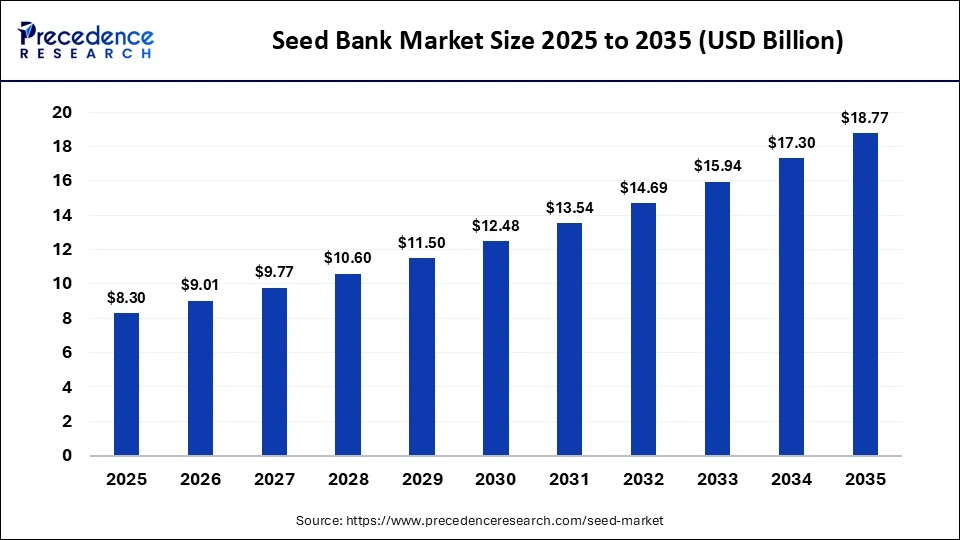
The global seed bank market size was calculated at USD 8.30 billion in 2025 and is predicted to increase from USD 9.01 billion in 2026 to approximately USD 18.77 billion by 2035, expanding at a CAGR of 8.50% from 2026 to 2035.In 2026, the market is driven by an urgent global focus on climate resilience, biodiversity conservation, and the "de-risking" of food supply chains through long-term genetic storage.
Key Takeaways
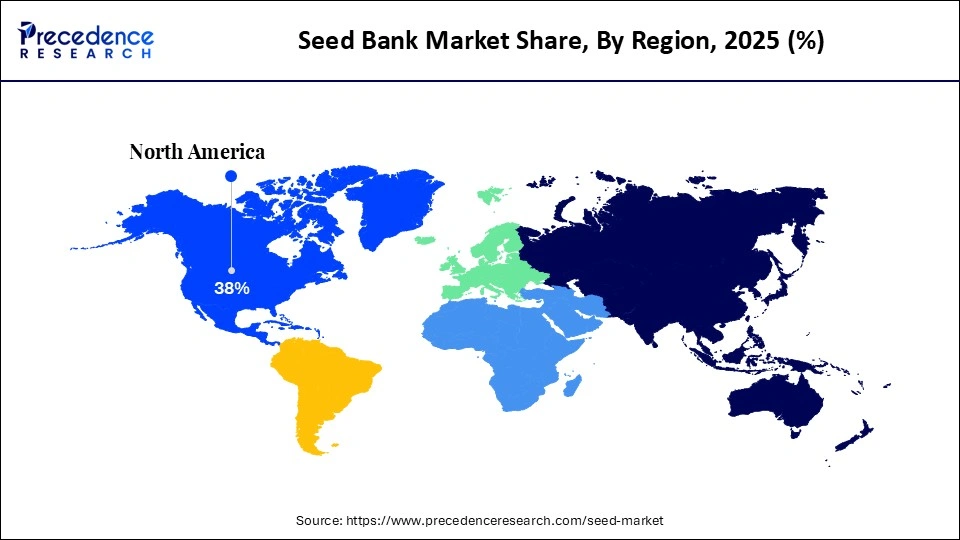
- By region, North America dominated the market with the largest share in 2025 with 38%.
- Asia Pacific is seen to grow at the fastest rate during the forecast period.
- By crop type, the traditional crops segment dominated the seed bank market by 58% market share in 2025.
- By crop type, the endangered & rare crops segment is growing rapidly in the forecast period, as the conservation of biodiversity is gaining strategic importance.
- By storage type, the mid-term storage segment led the market dominance by market share of 45% in 2025.
- By storage type, the long-term storage segment is rapidly growing with a CAGR of 9.2% during the forecast period of 2026 to 2035.
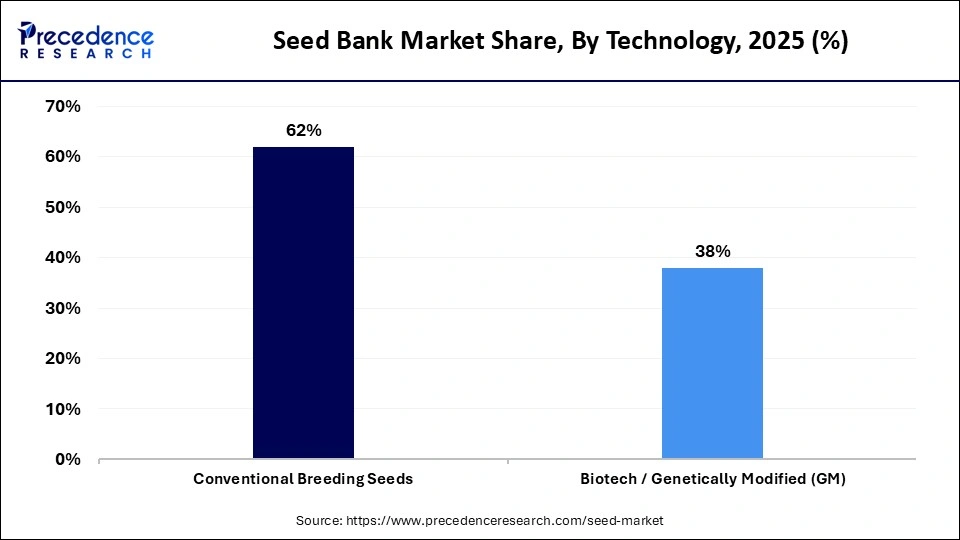
- By technology, the conventional breeding seeds segment led the market dominance with a market share of 62% in 2025.
- By technology, the biotechnology and genetic modification segment is rapidly growing in the market of seed banks.
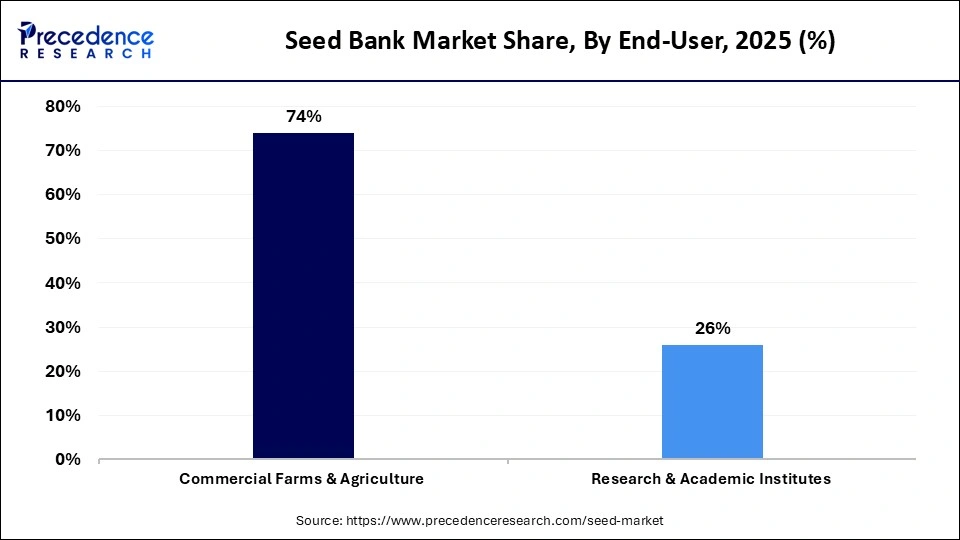
- By end-user, commercial farming and agriculture have shown rapid growth in the market size, with a market share of 74% market share in 2025.
- By end-user, the research and academic institute segment is expected to show rapid growth in genomic discovery.
What is the Seed Bank Market?
A seed bank is an organization or establishment dedicated to the preservation and storage of seeds from a variety of plant species to safeguard genetic diversity. These plants are the objects of storage that not only serve for their genetic diversity but also ensure that in the future, many different types of seed will be available. Especially designed to carry out weather-resistant activities such as radiation, flood threats, and bomb impacts, these seed banks keep seeds in cold, low-humidity environments.
All over the world, there are more than 1,000 seed banks that vary in size, content, and type. They are a vital tool to preserve genetic diversity and promote biodiversity, especially in the context of threatening conditions of climate change and global food security.
The demand for niche crops (e.g., organic, non-GMO, and low-processing oriented, high-value crops like fruits, vegetables, and grains) is the main mechanism leading to growth for seed bank industries. Seed banks are very much linked to science, education, and the preservation of indigenous cultures. However, in some areas, these seed banks may be hampered by a lack of infrastructure (such as dependable energy and transport networks). Moreover, a lack of coordinated international action might prevent them from conserving plants from extinction or by maintaining genetic diversity.
Market Trends
- Increasing Use of Organic and Non-GMO Seeds: One crucial current trend is the growth in the use of organic and non-GMO seeds, which is mainly attributed to heightened health consciousness among customers. There is a rising demand for organic seeds that align with sustainable farming practices.
- Innovations in Seed Coating and Treatment Technologie: At their most fragile, seeds need protection and nourishment, prompting the current coating methods that integrate micronutrients, biological agents, and chemical fungicides.
- Driving Up Demand for Top-End Crops from Population Growth and Dietary Changes: The urban population's inclination towards fresh vegetables, organic products, and various specialty items pushes farmers to grow many different staple grains. Crop varieties that carry higher value for money may also give farmers a higher profit margin compared to traditional grain varieties.
Impact of AI in the Seed Bank Market
Embedding artificial intelligence in seed bank operations represents a paradigm shift to strengthen resilience and make essential conservation initiatives more efficient. By way of example, improving seed bank resilience with AI is more than an automated current process; it represents an entire conceptualization of seed bank work that leverages computational capabilities to solve existing problems and illuminate emergent opportunities.
The long-term preservation of seeds is highly dependent on having the conditions for storage conditions. Seed banks in practice should ensure that sensor data are translated into AI algorithms to directly control temperature, humidity, and other environmental variables that allow the seeds to thrive, along with reducing energy consumption. Seed banks create huge volumes of data, for everything from accession records to germination test results. AI-based database systems can optimize data entry processing, improve data accuracy, and support efficient information retrieval for research and conservation objectives. AI might also help with the organization of genetic and phenotypic data to make it more accessible and applicable for future uses.
Market Scope
| Report Coverage | Details |
| Market Size in 2025 | USD 8.30 Billion |
| Market Size in 2026 | USD 9.01 Billion |
| Market Size by 2035 | USD 18.77 Billion |
| Market Growth Rate from 2026 to 2035 | CAGR of 8.50% |
| Dominating Region | North America |
| Fastest Growing Region | Asia Pacific |
| Base Year | 2025 |
| Forecast Period | 2026 to 2035 |
| Segments Covered | Crop Type, Storage Type, Technology,End-User, Application, and Region |
| Regions Covered | North America, Europe, Asia-Pacific, Latin America, and Middle East & Africa |
Segment Insights
Crop Type Insights
Traditional crops segment dominated the seed bank market by 58% market share in 2025. Traditional cereals and conventional grain continue to dominate, given their vital role in global food security. They are the dominant ones due to their large plots of cultivated areas, well-established seed-banking systems, and continuing help from the government, and are active in government. The staple food and animal feed industry has constant demand generation, which supports the need for ongoing investment in preservation and breeding infrastructure throughout the field.
Endangered & rare crops segment is growing rapidly in the forecast period as the conservation of biodiversity is gaining strategic importance, and endangered and rare crops are becoming more and more visible. Increasing awareness of genetic erosion and climate-related vulnerabilities is propelling conservation efforts. As a complement for improved agricultural resilience over time, public agencies and conservation organizations are targeting efforts towards the conservation of indigenous and underutilized varieties.
Storage Type Insights
Mid-Term Storage
The mid-term storage segment is leading the market dominance by market share of 45% in 2025. In order to maintain a price that matches regularly-distributed seed stocks and be very cost-effective for manufacturers and farmers, the most widely used storage technology nowadays is the mid-term storage model. Its stability is for several years, so there is no difficulty in building a complex infrastructure. This is why national seed banks and wholesale retailers have come to rely on it as their central mode of operation.
The long-term storage segment is rapidly growing with a CAGR of 9.2% during the forecast period of 2026 to 2035. As the interest in genetic conservation continues to grow, long-term storage solutions, especially cryopreservation, proliferate. This approach ensures that seeds survive longer, with fewer genetic modifications. Growing climate risks and international conservation obligations are pushing investments in modern technology to protect rare and high-value germplasm.
Technology Insights
Conventional Breeding Seeds
The conventional breeding seeds segment is currently leading the market dominance with a market share of 62% in 2025. Due to various reasons, like a growing market population and rising needs of sustainability, the conventional seed market is expanding rapidly. Non-GMO seeds supply is essential for a growing population. The popularity of conventional seeds is due to eco-friendly agricultural methods and the ability to protect biodiversity.
The biotechnology and genetic modification segment is rapidly growing in the market of seed banks. It is becoming very popular as the growth in the field of biotech and genetically modified organisms (GM) has developed precision breeding tools. Genome editing enables specific enhancements like drought-resistant technology and improved performance potential yield. The increasing need for enhanced productivity as a benefit to the environment is driving accelerated adoption, especially in research-based, high-technology farming settings.
End-User Insights
Commercial farming and agriculture have shown rapid growth in the market size, with a market share of 74% market share in 2025. Commercial farms are in demand due to their potential for the growth of these items. This segment could become the biggest part of the demand growth from consumers as it drives market share and profitability. They are primarily concerned with consistent yields, disease resistance, and homogeneity of crop performance. This sector remains strongly dependent on high-quality seed supplies to produce staple crops.
The research and academic institute segment is expected to show rapid growth in genomic discovery as the field of genomics and crops is developing very steadily, at the rate of the latest trends, and universities and institutions are growing in volume. Growth in funding for genomic mapping projects and research on climate-adaptation technology contributes to these institutions' influence in this area. It is the cooperative efforts of foreign researchers who, in turn, enhance the demand for diverse germplasm resources preserved.
Regional Analysis
North America Seed Bank Market Size and Growth 2026 to 2035
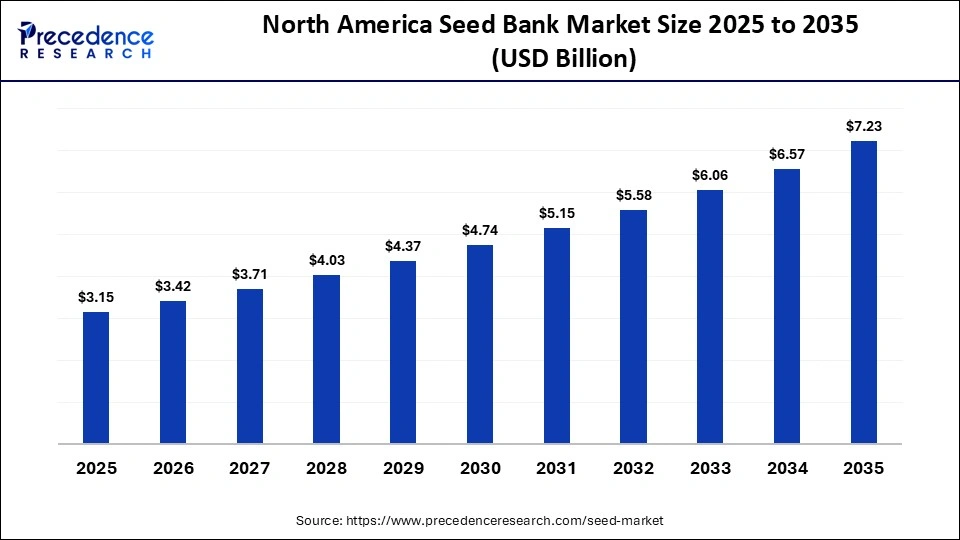
The North America seed bank market size is estimated at USD 3.15 billion in 2025 and is projected to reach approximately USD 7.23 billion by 2035, with a 8.66% CAGR from 2026 to 2035.
North America Seed Bank Market Trends
North America is leading the market of seed banks, showed the dominance by 38% market share in 2025, as North America is driven by the world's most advanced biotechnology sector and massive commercial scale in corn and soybean production. The U.S. remains the central hub for private-sector seed bank investments. Also, North America have research and development industry that invests most of its money in seed biotechnology.
U.S. Seed Bank Market Size and Growth 2026 to 2035
The U.S. seed bank market size is calculated at USD 2.37 billion in 2025 and is expected to reach nearly USD 5.46 billion in 2035, accelerating at a strong CAGR of 8.70% between 2026 and 2035.
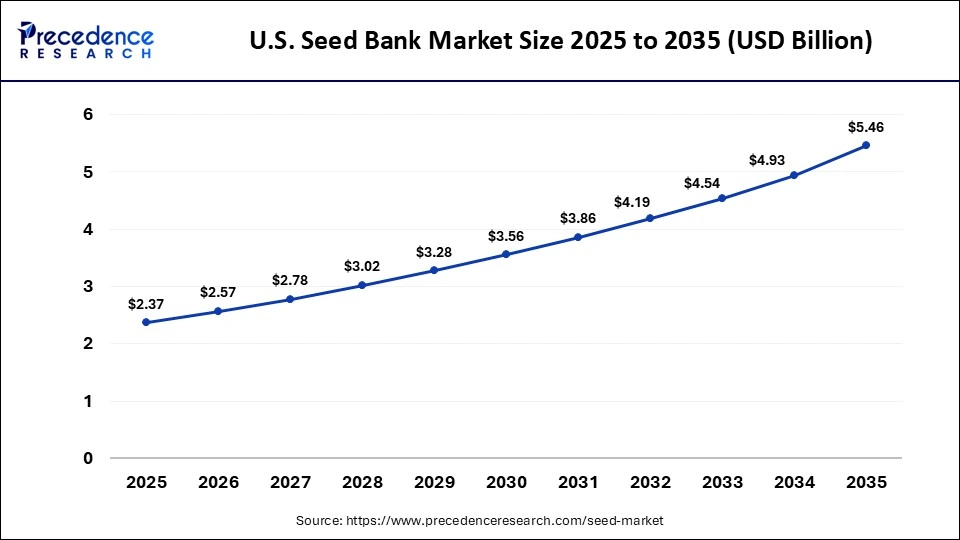
United States Driving Rapid Seed Bank Market Growth Across North America
The U.S. is leading the charge in North America due to its strict environmental regulations and strong infrastructure investment commitments. California Air Resources Board implemented shore power regulations on container, cruise, and refrigerated cargo ships on a compulsory basis.
Ports, such as Long Beach and Seattle, increased the presence of electrified berths to aid in meeting emission reduction goals. There were federal funding schemes that assisted in the electrification of ports under the maritime decarbonization infrastructure programs.
Asia-Pacific Seed Bank Market Trends
Asia-Pacific is expected to show rapid growth in the seed bank market with a projected CAGR between 7.8% to 9.0% in the forecast period of 2026 to 2035. This is possible due to high yield production of conventional crops, and also due to the expansion of the regional seed bank market. India, China, and Japan are highly investing in agriculture and agricultural technology, along with seed innovation.
India Seed Bank Market Trends:
India's seed bank market is growing fast in the Asia-Pacific region compared to other nations. As India has varied climatic conditions and crop types, it contributes as a huge market in the field of crop seeds. Crop seeds like wheat, rice, and maize are driving the Indian market. This region is also driving into vegetable seeds because of the varied food habits and urbanization.
Procedures Involved in Seed Bank Market
- Harvesting and Post-Harvest Handling
- Collecting Seeds, drying, grading, viability testing, and preserving genetic integrity.
Storage - Protecting seeds from genetic erosion by temperature and humidity controlled storge.
- Processing and Packaging
- To clean, treat, label, and pack hermetically to extend shelf life and maintain their standards.
Distribution to Wholesalers/Retailers - Ensure timely seed availability by effective stock coordination, demand outlook, and improved shelf life.
Seed Bank Market Companies
- Bayer AG
- Corteva Agriscience
- Syngenta Group
- BASF SE
- Groupe Limagrain
- KWS SAAT SE & Co. KGaA
- Sakata Seed Corporation
- Advanta Seeds (UPL)
- DLF Seeds A/S
- Enza Zaden
- Takii & Co., Ltd.
- Longping High-Tech
- Mahyco (Maharashtra Hybrid Seeds
- Rijk Zwaan
- Bejo Zaden B.V.
Recent Developments
- In January 2026, the Union Agriculture Ministry unveiled its plans to make the archaic Seed Act of India much more modern by imposing penalties of up to ₹30 lakh along with traceability requirements to combat the circulation of fake and sub-standard seeds and protect farmers.
- In October 2025, the Millennium Seed Bank, Royal Botanic Gardens, Kew (UK) quietly observed a quarter-century milestone in storing more than 2.5 billion wild plant seeds from roughly 40,000 species; this was to protect biodiversity for restoration in the future.In October 2025, National Seeds Corporation, Ltd. (India) to empower farmers with good quality seeds, introduced a seed management system and an online booking of seed, and also opened many advanced seed processing plants.(Key Segments
Segments covered in the report
By Crop Type
- Traditional Crops (Cereals/Grains)
- Endangered & Rare Crops
- Others
By Storage Type
- Mid-Term Storage
- Long-Term Storage (Cryopreservation)
By Technology
- Conventional Breeding Seeds
- Biotech / Genetically Modified (GM)
By End-User
- Commercial Farms & Agriculture
- Research & Academic Institutes
By Application
- Field Crops (Corn, Wheat, Soybean)
- Horticultural (Fruits / Vegetables)
By Region
- North America
- Europe
- Asia-Pacific
- Latin America
- Middle East & Africa
For inquiries regarding discounts, bulk purchases, or customization requests, please contact us at sales@precedenceresearch.com
Frequently Asked Questions
Tags





Ask For Sample
No cookie-cutter, only authentic analysis – take the 1st step to become a Precedence Research client
 Get a Sample



 sales@precedenceresearch.com
 Schedule a Meeting
