



Self Service Technologies Market Size, Key Companies, Company Market Share, Sales Volume, Consumer Demand, Pricing Trends, Distribution Performance, Competitive Positioning, and Growth Forecast
Self Service Technologies Market (By Type: Vending Machine, ATM, Kiosks; By End User: BFSI, Manufacturing, Hospitality, Retail, Healthcare, Offices, Education, QSR, Others) - Global Industry Analysis, Size, Trends, Leading Companies, Regional Outlook, and Forecast 2026 to 2035
Source: https://www.precedenceresearch.com/self-service-technologies-market
 Get a Sample
 Table Of Content


What is the Self Service Technologies Market Size?
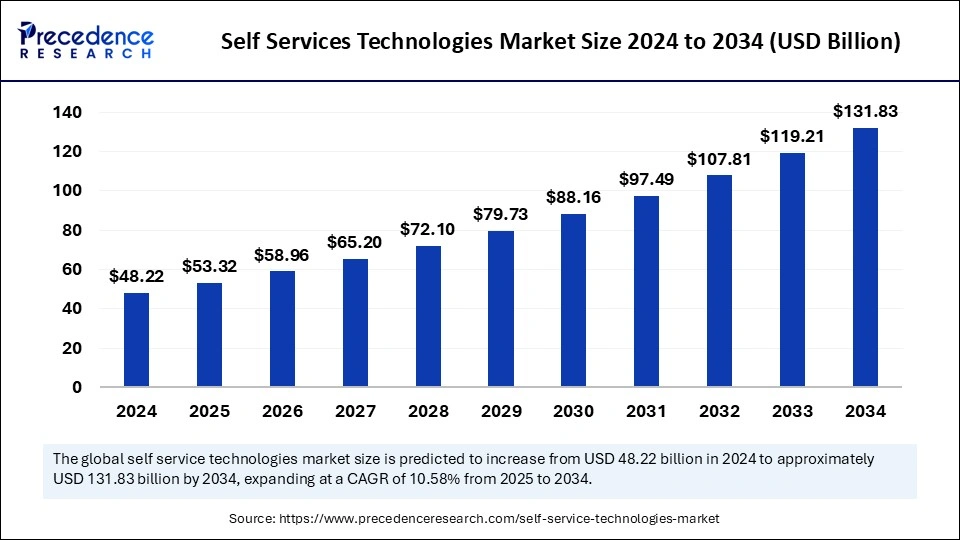
The global self service technologies market size was estimated at USD 53.32 billion in 2025 and is predicted to increase from USD 58.96 billion in 2026 to approximately USD 143.64 billion by 2035, expanding at a solid CAGR of 10.42% from 2026 to 2035. Extensive adoption of self service machines and automated devices is the key factor driving market growth. Also, numerous technological advancements like wireless communication coupled with the increasing adoption of connected systems and mobile devices can fuel market growth further.
Self Service Technologies Market Key Takeaways
- North America dominated the global self service technologies market in 2025.
- Asia Pacific is expected to grow at the fastest CAGR over the studied period.
- By type, the ATM machine segment held the largest market share in 2025.
- By type, the vending machine segment is anticipated to grow at the fastest CAGR over the forecast period.
- By end user, in 2024, the retail segment led the market by holding the largest share in 2025.
- By end user, the quick service restaurant (QSR) segment is anticipated to grow at the fastest CAGR over the projected period.
Market Overview
The self service technologies market is anticipated to grow due to the many benefits it offers to both businesses and customers. Organizations are adopting technologies to enhance their service offerings across many sectors, such as banks, airports, restaurants, and hotels. This technology has transformed human intervention in tasks like food ordering, transactions, queue management, and billing statements. The increasing adoption of technology is the major factor impacting market growth positively.
Applications of Artificial Intelligence (AI) in Customer Self Service
Artificial Intelligence technology is transforming the way businesses offer customer self service solutions. By using AI technologies, companies in the self service technologies market can optimize their customer support processes, improve user experience, and enhance customer satisfaction. Furthermore, AI-driven Natural Language Processing technology allows customers to interact with this platform utilizing natural language, which makes it sophisticated for users to get personalized assistance.
- In June 2024, Patra, a leading provider of technology-enabled insurance outsourcing and software services, announced the extension of its PolicyCheckingAI to a self-service solution that provides access to all brokers and agencies across the industry. As the first company to introduce AI for Policy Checking over a year ago, Patra's patent-pending PolicyCheckingAI ('PCAI') offers insurance professionals innovative solutions.
Self Service Technologies Market Growth Factors
- The growing trend of digital transformation in the retail sector is expected to boost self service technologies market growth soon.
- The rising prevalence of e-commerce and transformation in in-store experiences can propel market growth shortly.
- The increasing demand for contactless solutions, along with the improved data collection capabilities, will likely contribute to the market expansion over the forecast period.
Market Scope
| Report Coverage | Details |
| Market Size by 2035 | USD 143.64 Billion |
| Market Size in 2025 | USD 53.32 Billion |
| Market Size in 2026 | USD 58.96 Billion |
| Market Growth Rate from 2026 to 2035 | CAGR of 10.42% |
| Dominated Region | North America |
| Fastest Growing Market | Asia Pacific |
| Base Year | 2025 |
| Forecast Period | 2026 to 2035 |
| Segments Covered | End User, Type, and Regions |
| Regions Covered | North America, Europe, Asia-Pacific, Latin America, and Middle East & Africa |
Market Dynamics
Drivers
Improved customer experience and engagement
The use of self service technologies market to enhance customer engagement and experience is the major factor driving market growth. These technologies give customers control over all their interactions, which leads to a more personalized and satisfying service experience. In addition, Interactive mobile application and kiosks offer consumers easy access to services and information. This convenience is useful in locations such as retail establishments, healthcare institutions, and airports.
- In September 2024, Seekr announced the launch of SeekrFlow as a complete end-to-end AI platform for training, validating, deploying, and scaling trusted enterprise AI applications through an intuitive and simple-to-use web user interface (UI). Automated Deployment to launch models in five clicks, reduce errors, and monitor production health and performance in a visual real-time dashboard built exclusively for the UI.
Restraint
Concerns regarding data security
The concerns about data privacy and security pose a major hurdle to the self service technologies market. Hence, market players need to take stringent precautions to protect client data and uphold confidence. Moreover, security threats like information hacking and skimming need to be decreased over time.
Opportunity
Rising consumer preference for speed and convenience
Consumers are focusing more on speed and convenience in service delivery, which is creating future opportunities for the self service technologies market. There has been a surge in a fast-paced lifestyle, which allows consumers to find solutions that provide hassle-free and quick services. Furthermore, consumers appreciate the capability to control their interactions and transactions, which helps decrease wait times and minimize their reliance on human assistance.
- In June 2024, Pizza Hut unveiled a new prototype that places technology at the forefront of the dining experience. This innovative design, launched in Plano, Texas, represents a departure from the brand's recent focus on smaller, off-premises-focused locations and signals a renewed commitment to enhancing the in-restaurant experience while embracing the convenience of digital ordering.
Segment Insights
Type Insights
The ATM machine segment held the largest self service technologies market share in 2025. The dominance of the segment can be attributed to the increasing trend of technology up-gradation and automation. There is a growing need to decrease operational costs and increase consumer satisfaction. Additionally, the rising demand for small-value transactions among the majority of consumers across the globe is a key factor impacting segment growth positively.
- In February 2025, Hitachi Payment Services, a subsidiary company of Hitachi Limited of Japan, launched India's first-ever UPI-ATM in collaboration with the National Payment Corporation of India (NPCI). The Hitachi ATM (Automated Teller Machine), named Hitachi Money Spot UPI ATM, is a White Label ATM (WLA). The ATM will offer cardless cash withdrawals, and there will be no need to use ATM cards or PINs.
The vending machine segment is anticipated to grow at the fastest rate over the forecast period. The growth of the segment can be credited to the increasing demand for vending machines in the corporate segment, along with the rising need for reduced space, queues, and overall costs. Also, the surging number of corporate offices and commercial projects that offer faster services will likely contribute to the market expansion further.
- In November 2024, Bummer introduced India's first-ever vending machines designed to make shopping for innerwear as simple as purchasing a bottle of water. The brand's groundbreaking initiative aims to provide shoppers with a hassle-free experience while on the go, ensuring that buying quality innerwear is just a tap away.
End User Insights
The retail segment led the self service technologies market by holding the largest share. The dominance of the segment can be linked to the increasing need to offer quality service and enhanced consumer experience that encourages retailers to utilize self-service technologies. Furthermore, there is a rising adoption of self-checkout systems and interactive kiosks among many retail sectors, such as convenience stores, specialty stores, and supermarkets.
The quick service restaurant (QSR) segment is anticipated to grow at the fastest rate over the projected period. The growth of the segment can be driven by an increasing number of QSRs along with the surging consumer orders and the requirement to decrease the counter waiting time with fewer employees. However, the escalating competition among restaurants to offer sophisticated service while keeping operational costs low is a major factor boosting the segment's growth.
Regional Insights
North America dominated the global self service technologies market in 2025. The dominance of the region can be attributed to the raised expenditure on self service technology solutions in Canada and the U.S. The extensive use of these technologies in kiosks, ATMs, and vending machines is further impacting positive market growth. Moreover, increasing urbanization in these countries, along with the sudden growth in the banking sector, has fuelled market growth in the region.
Asia Pacific is expected to grow at the fastest rate in the self service technologies market over the studied period. The growth of the region can be credited to the ongoing investments in self-service technologies among major economies, including Thailand, India, China, Japan, and Indonesia. Furthermore, the rising awareness and shifting consumer preferences towards this technology are anticipated to fuel the market demand in the region. Increasing urbanization across nations like China, India, and Japan can propel market growth shortly.
What are the Advancements in the Self Service Technologies Industry in Europe?
Europe is expected to witness significant growth in the market. This growth is due to various factors such as the increasing adoption of digital solutions across various sectors, regulatory support for cashless transactions, and a growing emphasis on customer experience. Countries like Germany and the UK are leading players in the region as they have a strong push towards automation and self-service options in retail and banking.
Germany Self Service Technologies Market Trends
The country's market landscape is characterized by a strong focus on sustainability and efficiency, aligning with broader EU regulations aimed at enhancing digital infrastructure. The region is further supported by the strong adoption of automation in retail and banking.
What are the Key Trends in the Self Service Technologies Industry in Latin America?
Latin America is expected to witness substantial growth throughout the forecast years. This growth is fueled by urbanization, increasing disposable incomes, and a shift towards digital solutions, especially in countries like Brazil and Mexico. Government initiatives promoting cashless economies and smart city projects are gaining traction, driving up market expansion. The competitive landscape is marked by a mix of local and international players, all competing for market share.
Brazil Self Service Technologies Market Trends
The region is focusing on technological innovation and consumer-centric solutions, which positions it well for future growth. The region is further driven by rapid urbanization and large-scale digital infrastructure investments.
MEA's Growing Self Service Technologies Industry
The Middle East and Africa are anticipated to witness steady growth in the upcoming years, driven by increasing urbanization, a young population, and rising smartphone penetration. Governments in the region are also increasingly investing in digital infrastructure, which is expected to enhance the adoption of self-service solutions across various sectors. Countries like South Africa and the UAE are leading players, with a growing number of local and international players entering the market.
Saudi Arabia Self Service Technologies Market Trends
The country's market landscape is evolving at a steady pace, with a focus on providing innovative solutions tailored to local needs. As the region continues to develop its digital economy, the self-service technology market is poised for significant growth in the coming years.
Self Service Technologies Market Companies
- KIOSK Information System INC.
- NCR Corporation
- HESS Cash Systems GmbH and Co.
- Fujitsu
- Glory Ltd.
- Azkoyen Group
- Crane Co.
- Maas International Europe B.V.
- Vend-Rite
- IBM Corporation
Latest Announcement by Market Leaders
- In July 2024, Fujitsu announced a strategic partnership with Cohere Inc., a security and data privacy-focused enterprise AI company headquartered in Toronto and San Francisco. The strategic partnership will focus on developing and providing a large language model (LLM) that enables enterprises to leverage industry-leading Japanese language capabilities that deliver improved experiences for customers and employees.
- In August 2024, IBM and Intel announced a collaboration to deploy Intel Gaudi 3 AI accelerators as a service on IBM Cloud. This offering, which is expected to be available in early 2025, aims to help more cost-effectively scale enterprise AI and drive innovation underpinned with security and resiliency. This collaboration will also enable support for Gaudi 3 within IBM's Watson AI and data platform.
Recent Developments
- In December 2024, Smashie, an Italian Smashburger chain, partnered with Diebold Nixdorf to introduce DN Series EASY ONE self service kiosks at its Udine location. The kiosks, which handle 70% of transactions, aim to enhance customer experience by reducing wait times and streamlining the ordering process.
- In November 2024, NatWest Group is modernizing its self service banking infrastructure by partnering with NCR Atleos to upgrade over 5,500 ATMs and multi-function devices. The initiative aims to enhance customer experience with new 19" touchscreen displays, providing faster and more efficient access to financial services and reinforcing the bank's commitment to innovation and agility in self service banking.
- In January 2024, Diebold Nixdorf launched its new AI-based checkout solutions to combat shrinkage in retail. It is designed to prevent common sources of loss at self service and traditional POS checkouts. The new smart vision technology-powered offering will complement Diebold Nixdorf's already-live AI-based solutions, which reduce friction during fresh produce scanning and age verification for restricted sales.
- In May 2023, Applova Inc., a Silicon Valley-based technology company, announced a partnership with Samsung to launch a self service kiosk for restaurants. These kiosks offer contactless ordering and payment, helping restaurants streamline operations, increase sales, and boost profits.
Segments Covered in the Report
By Type
- Vending Machine
- ATM
- Kiosks
By End User
- BFSI
- Manufacturing
- Hospitality
- Retail
- Healthcare
- Offices
- Education
- QSR
- Others
By Regions
- North America
- Europe
- Asia-Pacific
- Latin America
- Middle East and Africa
For inquiries regarding discounts, bulk purchases, or customization requests, please contact us at sales@precedenceresearch.com
Frequently Asked Questions





Ask For Sample
No cookie-cutter, only authentic analysis – take the 1st step to become a Precedence Research client
 Get a Sample




 sales@precedenceresearch.com
 Schedule a Meeting
