



Smart Hospitals Market Size, Key Companies, Company Product Portfolio, Hospital Procurement Trends, Manufacturing Capacity, Sales Performance, Regulatory Approvals, Company Market Share, and Forecast
Smart Hospitals Market (By Component: Software& systems, Hardware, Service; By Product: Smart Pills, Telemedicine, M Health, Electronic Health Record; By Connectivity: Wireless, Wired) - Global Industry Analysis, Size, Trends, Leading Companies, Regional Outlook, and Forecast 2026 to 2035
Source: https://www.precedenceresearch.com/smart-hospitals-market
 Get a Sample
 Table Of Content


What is the Smart Hospitals Market Size?
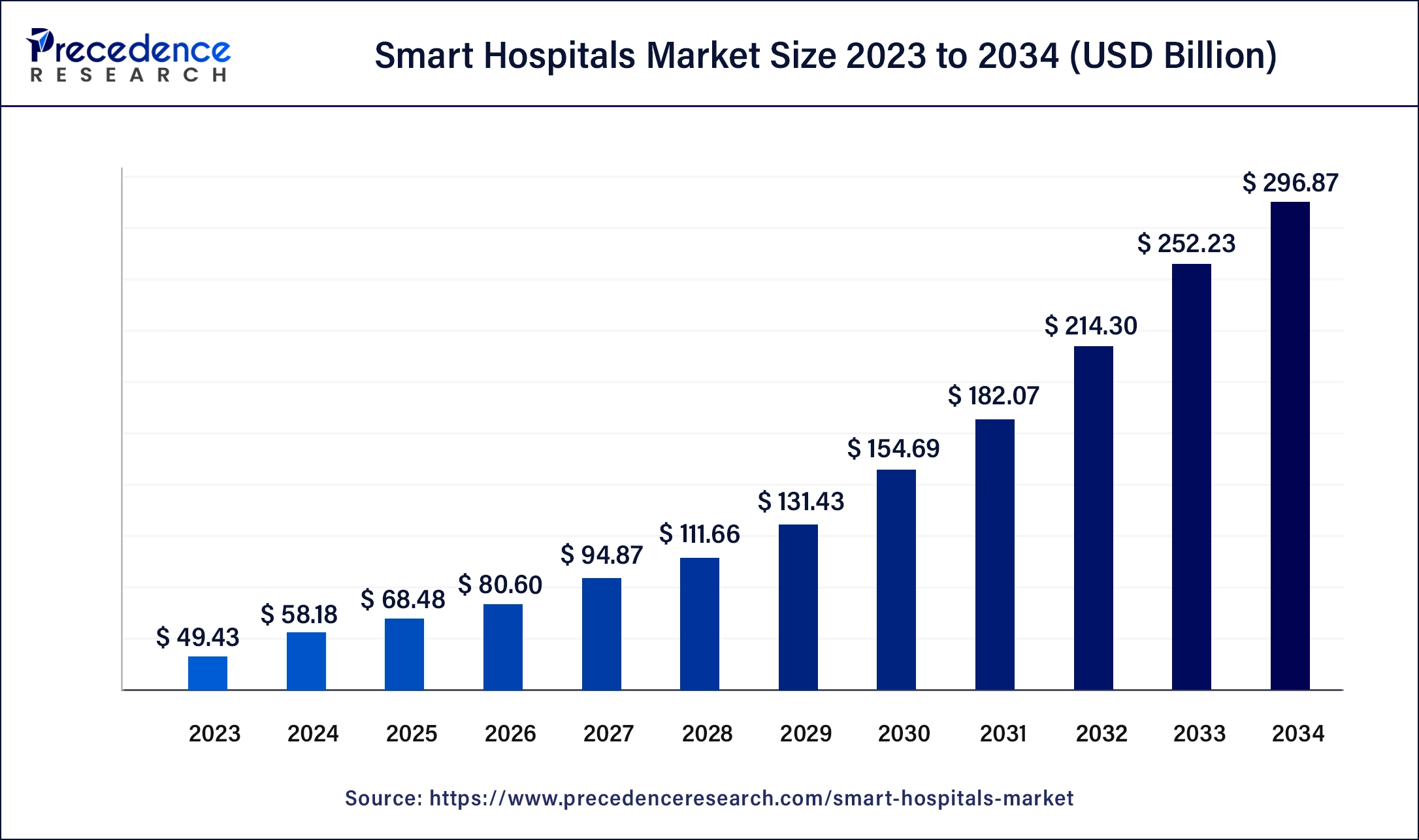
The global smart hospitals market size is calculated at USD 68.48 billion in 2025 and is predicted to increase from USD 80.6 billion in 2026 to approximately USD 337.04 billion by 2035, at a CAGR of 17.28% from 2026 to 2035.
Market Highlights
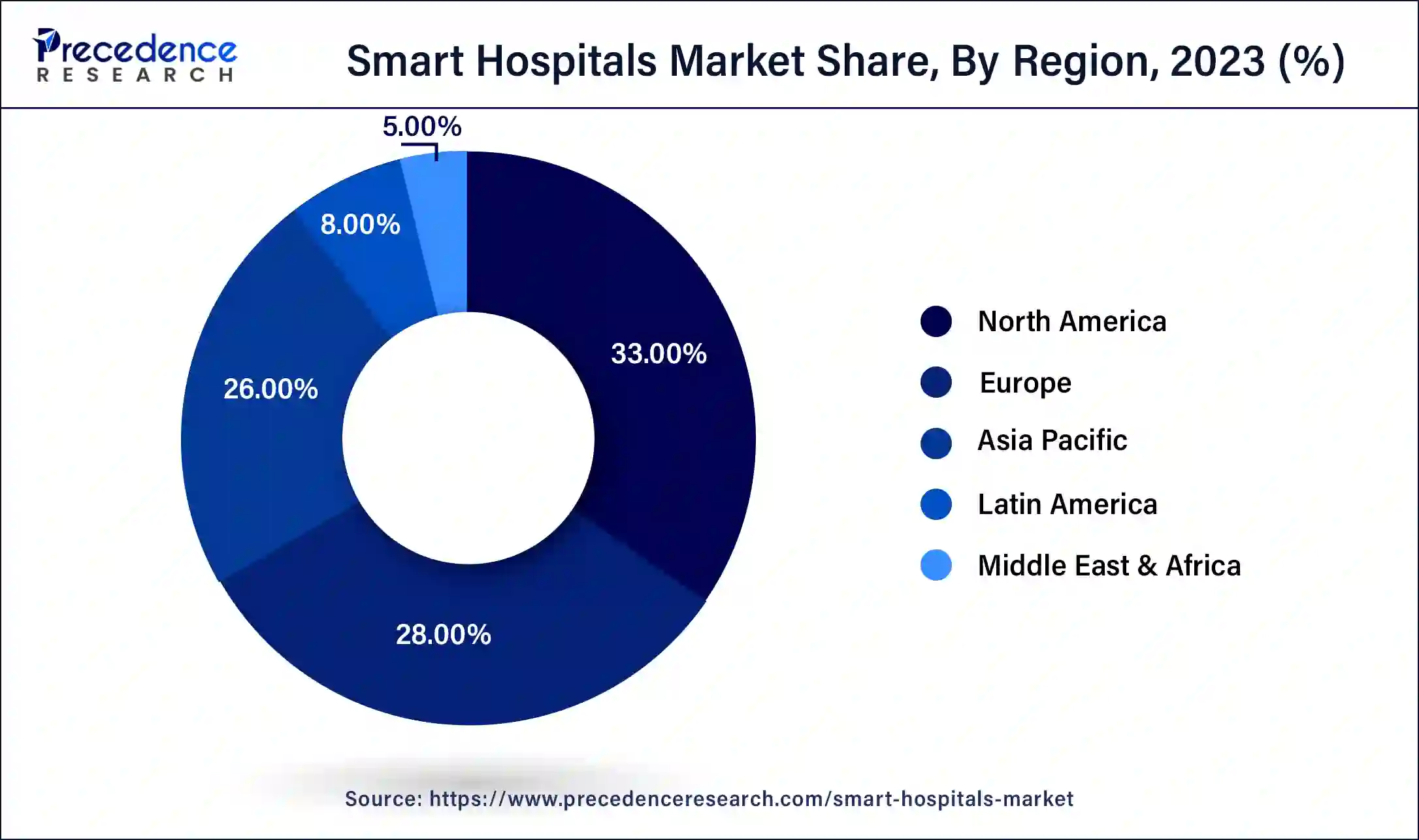
- North America led the global market with the highest market share of 33% in 2025.
- By component, the software & systems segment has held the highest market share of 45% in 2025.
- By product, the telemedicine segment captured the biggest market share in 2025.
- By connectivity, the wireless segment registered the maximum market share in 2025.
How is AI contributing to the Smart Hospitals Market?
Artificial Intelligence transforms smart hospitals by improving diagnostics through image analysis, a whole range of personalized treatment decisions, and the automation of workflows, predicting admissions, as well as staff and resource allocation optimization. The technology allows the application of remote monitoring through wearables, the provision of patient assistance via virtual bots, and the speeding up of radiology diagnostics, all while keeping the inventory and facility management predictive. AI promotes patient participation, diminishes operational heavy lifting, and enhances the accuracy of treatments. This whole scenario results in hospitals being transformed into proactive, connected, data-centric healthcare ecosystems that enjoy the benefits of being more efficient and incurring fewer costs for patient care.
Smart Hospitals Market Growth Factors
The adoption of technologically advanced software and devices in the healthcare industry across the globe has evolved the traditional hospitals into smart hospitals. The adoption of advanced technologies was powered by the growing need to reduce the operational costs and increase profitability and offer enhanced patient care services. The emergence of the wireless connectivity and latest technologies like internet of things (IoT) and artificial intelligence (AI) are expected to rapidly boost the growth of the global smart hospitals market. The growing government and corporate investments in the digitalization of the healthcare sector to improve the operational efficiency is also a significant driver. The rising prevalence of various chronic diseases among the population and growing geriatric population has increased the need for the advanced and efficient healthcare services. Moreover, the rising healthcare expenditure is also benefitting the global smart hospitals market.
The rising number of hospital admissions owing to the rising prevalence of chronic diseases, road traffic accidents, growing geriatric population, and various other factors is creating a pressure on the healthcare system. The smart hospitals will help to serve the rapidly growing inflow of patients and provide affordable treatment for various diseases. The rapidly surging technologies like AI, IoT, robotics, augmented reality, and precision medicine are expected to provide cost-efficient and sustainable healthcare solutions, thereby significantly contributing towards the growth of the global smart hospitals market. The rising adoption of telemedicine, telehealth, and electronic health record has exponential contributions in the development of the smart hospitals market.
Market Outlook
- Industry Growth Overview: Rapidly deploying smart hospitals adopting cutting-edge technology, and thus making patient-centric operations and healthcare delivery more efficient.
- Sustainability Trends: Greener medical environments are supported by digital workflows and energy-efficient infrastructure, which also reduces waste.
- Global Expansion: The adoption is widening geographically, thus facilitating care accessibility and the penetration of digital healthcare.
- Major Investors: Google and Microsoft's venture arms are the major players who not only invest heavily but also drive the innovation of smart hospitals with their strong funding interest.
- Startup Ecosystem: The development of specialized smart hospital solutions that enable operational automation and personalization is the result of the efforts of AI, IoT, and data startups.
Market Scope
| Report Highlights | Details |
| Market Size in 2025 | USD 68.48 Billion |
| Market Size in 2026 | USD 80.60 Billion |
| Market Size by 2035 | USD 337.04 Billion |
| Growth Rate from 2026 to 2035 | CAGR of 17.28% |
| Largest Market | North America |
| Fastest Growing Market | Europe |
| Base Year | 2025 |
| Forecast Period | 2026 to 2035 |
| Segments Covered | Component, Product, Connectivity, and Region |
| Regions Covered | North America, Asia Pacific, Europe, Latin America, Middle East and Africa |
Segment Insights
Component Insights
The software & systems segment dominated the largest revenue share in 2025. This is attributed to the increasing need to increase profitability by reducing the healthcare costs and improve the data management systems equipped in the smart hospitals. Furthermore, the increasing adoption of latest technologies like AI, AR, IoT, and VR is increasing the demand for the smart hospitals for its efficient services.
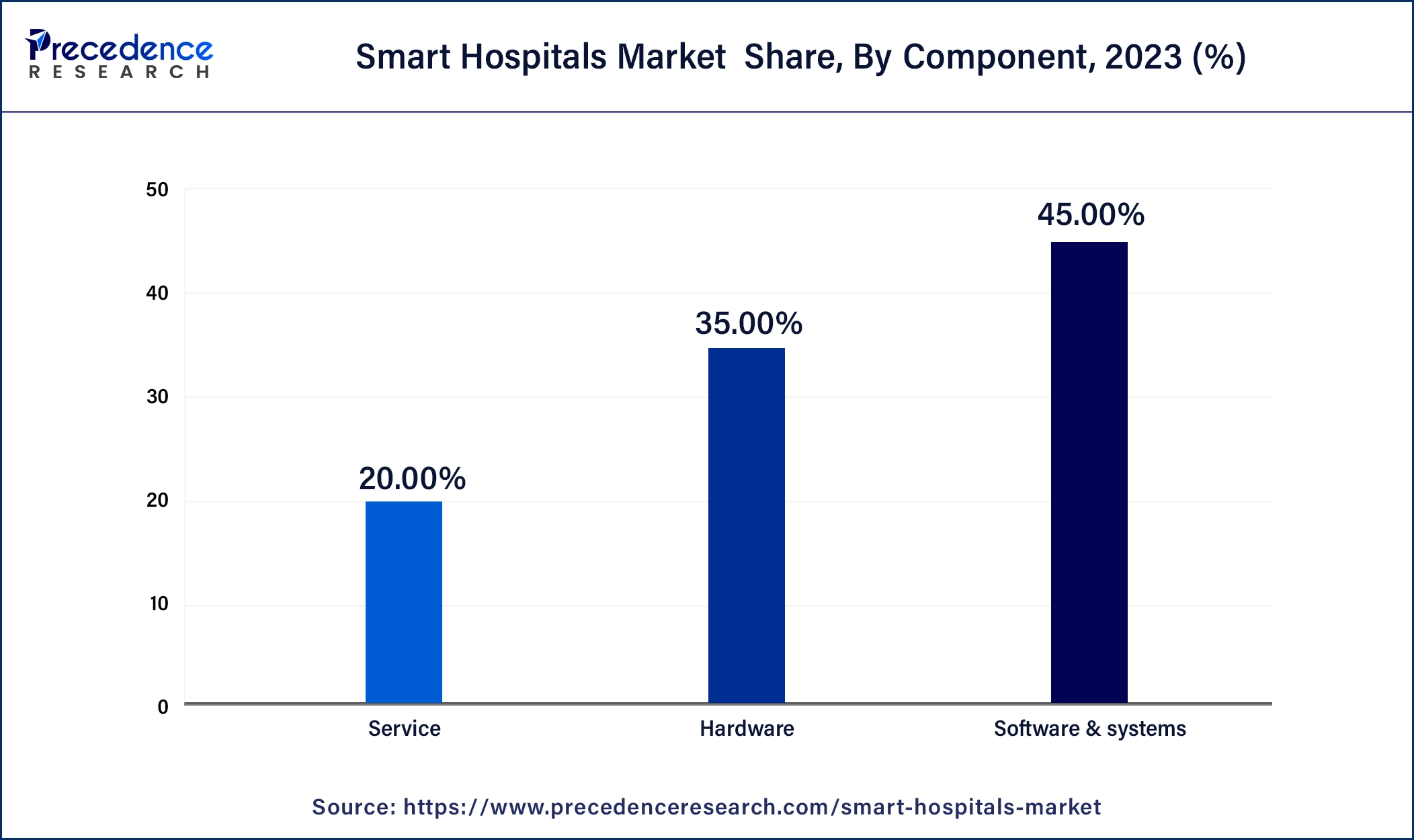
The services segment is estimated to be the most opportunistic segment during the forecast period. This is simply due to the lack of proper knowledge about handling the digital systems used in the smart hospitals setting, among the healthcare workers and professionals. Therefore, the third-party services are being increasingly adopted for the efficient utilization of advanced and various digital devices and software in order to achieve efficiency and low operational costs.
Product Insights
The telemedicine segment dominated the global smart hospitals market in 2025. This is simply due to the increased adoption of the telemedicine platforms among the consumers and the healthcare professionals. Further, the rising penetration of internet and rising adoption of smartphones along with the rising urban population has boosted the growth of this segment across the globe. According to ITU, around 4 billion people were using internet by the end of 2019. Most of the internet users operate through their smartphones. Doctors and physicians are now increasingly adopting the telehealth platforms for offering consultations and other services.
The electronic health records segment is estimated to be the fastest-growing segment during the forecast period. This is attributed to the increasing government initiatives to record the patients' details and health related data that can be utilized for the treatment of the patient. For instance, Allscripts Healthcare Solutions entered into a strategic partnership with the US Orthopedic Alliance to introduce improved electronic health records.
Connectivity Insights
The wireless segment dominated the highest revenue share in 2025. This is simply attributed to the increased adoption of various wireless technologies such as internet, cloud-based servers, and Bluetooth. The wireless connectivity offers wireless communication, easy data transfer, and remote access to the stakeholder that boosts the adoption of the wireless connectivity in the smart hospitals across the globe.
Regional Insights
U.S. Smart Hospitals Market Size and Growth 2026 to 2035
The U.S. smart hospitals market size is estimated at USD 15.85 billion in 2025 and is predicted to be worth around USD 78.55 billion by 2035, at a CAGR of 17.36% from 2026 to 2035.
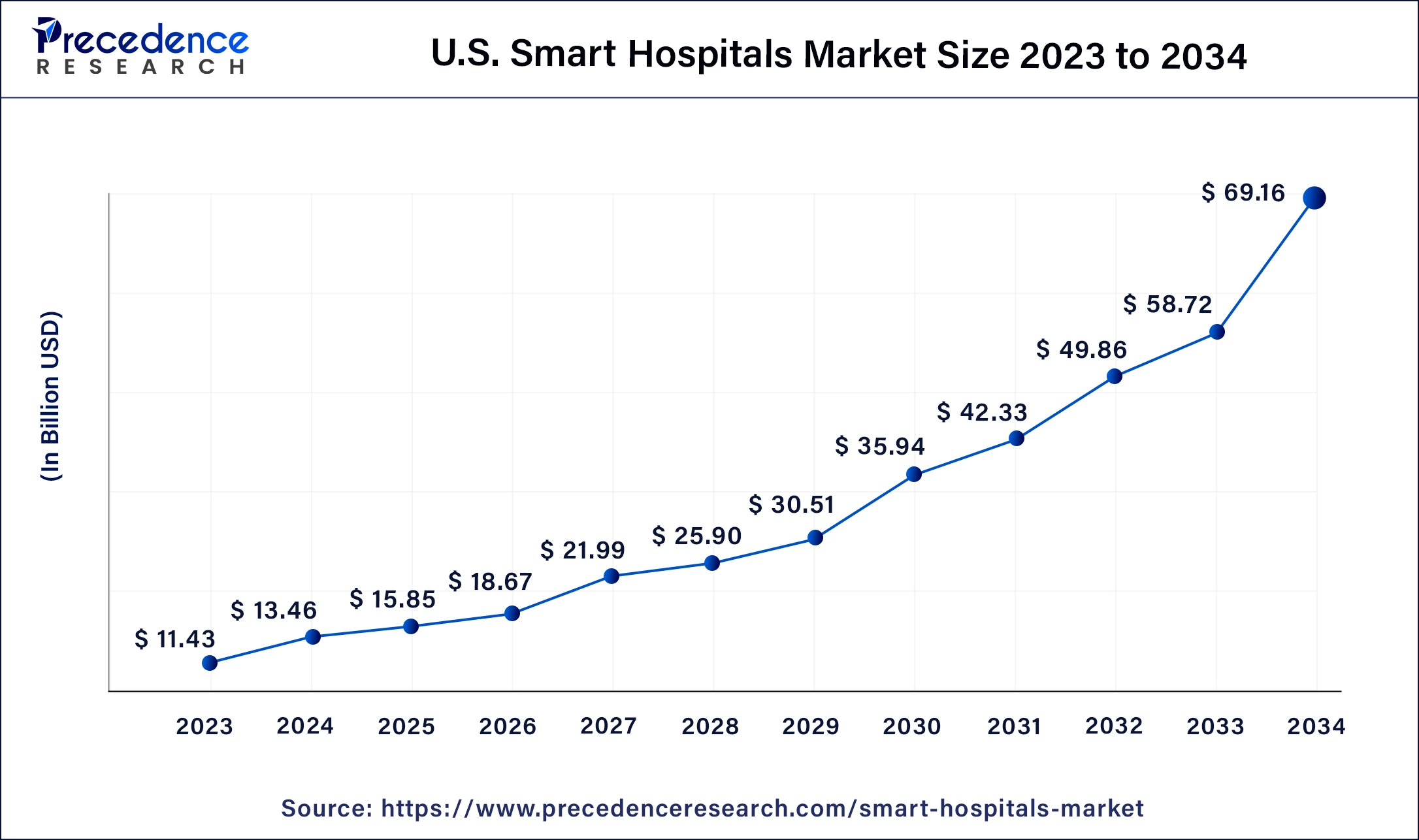
North America dominated the market with largest revenue share in 2025. This can be attributed to the higher adoption rate of the automation, digital, and advanced technologies in the healthcare industry. The increasing importance of the healthcare sectors towards the GDP contribution of the US is a major factor that states the penetration of the smart hospitals in the region. Moreover, increased per capita healthcare expenditure in the US due to the increased demand for the latest and efficient therapeutics. Moreover, the increased penetration of telehealth and electronic health records in the region has resulted in the significant growth of the smart hospitals market in North America.
How is North America leading in the Smart Hospitals Market?
The market is characterized by high adoption, which is backed by the digital infrastructure and a strong funding environment. The integration of telemedicine, remote monitoring, and AI-genomics is opening up more opportunities for advancements. The growth of the market is in line with the models of cost-efficient healthcare and the widespread adoption of smart healthcare that is eventually coming.
United States Smart Hospitals Market Trends:
The primary cause of the US leading position in the health sector is the massive investment in e-Health and the very favourable regulatory framework. The additional points include the use of virtual platforms for staff optimization, the automation of AI diagnostics, which will further improve patient flow, reduce costs, and make care more efficient.
What are the driving factors of the Smart Hospitals Market in Europe?
Europe is estimated to be the most opportunistic segment during the forecast period. This is due to the rising government expenditure on the development of healthcare infrastructure and adoption of digital technologies in the sector. Moreover, the rising number of private hospitals, clinics, and diagnostic centers in the region coupled with their heavy investments in the automation and digitalization is expected to significantly drive the market growth in the region.
In the wake of well-laid-out digital health-supporting policies, governments are funding the programs and thus focusing on their digital health sustainability. The running of AI clinical systems has the effect of improving the coordination of medical care. Also, the hospitals using eco-friendly buildings are taking a step towards modernized health service delivery.
Germany Smart Hospitals Market Trends:
In addition to the digital policies, these opportunities, such as e-prescription expansion and the use of big data, will be seen. The hospitals are already very efficient, thus making it easy the transition towards the adoption of advanced smart health technologies that are advanced.
How is Asia-Pacific performing in the Smart Hospitals Market?
The region is the fastest-growing one, characterized by the government pushing digitization in the healthcare sector. The development of hospital networks, medical tourism, and technology adoption are the factors that create new investment opportunities even in smaller cities that are developing.
India Smart Hospitals Market Trends:
The growth of the country is mainly attributed to the increasing use of telemedicine and a more developed infrastructure. Investments that are being made are aimed at modernizing hospitals, creating new facilities, and strengthening the networks of private healthcare in the emerging regions.
What Are the Driving Factors of The Smart Hospitals Market in Latin America?
Latin America is expected to grow at a significant CAGR during the forecast period. The smart hospitals market in Latin America is a promising market that is rapidly expanding with rising private investment and healthcare modernization. Telehealth, remote patient monitoring, and digital health platforms are becoming more prevalent in hospitals.
Brazil Market Trends
Brazil is making strides in smart hospital adoption with the expansion of telemedicine and connected healthcare solutions. The investment in patient monitoring devices with IoT devices is helping to enhance the quality of care and lower hospital readmission rates. With the proper application of AI and data analytics, clinical workflows can be optimized, improving operational efficiency and providing data-driven healthcare decisions.
How is the Middle East and Africa Performing in The Smart Hospitals Market?
The Middle East and Africa are expected to grow at a significant CAGR during the forecast period. The MEA market is experiencing dramatic growth, fueled by the size of the infrastructure projects in hospitals and rising investments in healthcare. Public-private partnerships are enhancing healthcare service delivery, and investments in connected technologies and smart facilities further support the development of the regional mark
UAE Market Trends
The UAE is making significant investments in digital healthcare structures and integrated electronic health record systems. Hospital operations are enhancing with the use of AI-powered facility management and infection control technologies. Chronic disease management is improving with the increased use of wearable devices and remote patient monitoring.
Value Chain Analysis
- R&D: Identifies, screens, and develops drug compounds, building an intellectual property foundation.
- Key Players: Pfizer, GSK, and Merck
- Clinical Trials & Regulatory Approvals: Test drug safety and efficacy to secure regulatory market authorization.
- Key Players: IQVIA, Parexel, and ICON plc
- Formulation & Final Dosage Preparation: Converts drug ingredients into a stable patient-ready dosage format.
- Key Players: Patheon and Catalent
- Packaging & Serialization: Prepares product for transport with traceability to prevent counterfeiting.
- Key Players: Gerresheimer AG, Amcor plc, and PCI Pharma Services
- Distribution: Delivers products to hospitals, pharmacies through compliant healthcare logistics networks.
- Key Players: Cardinal Health, Movianto, and Rhenus Logistics
Key Companies Share Insights
The market is moderately fragmented with the presence of several local companies. These market players are striving to gain higher market share by adopting strategies, such as investments, partnerships, and acquisitions & mergers. Companies are also spending on the development of improved products. Moreover, they are also focusing on maintaining competitive pricing.
In January 2020, KT Corporation and Samsung Medical Center collaborated to develop a 5G Smart Hospital.
The various developmental strategies like collaborations, acquisition and new product launches with latest and innovative features fosters market growth and offers lucrative growth opportunities to the market players.
Competitive Landscape
The smart hospitals market is semi-consolidated as technology vendors and health solution providers compete based on digital innovation. Advanced technologies in healthcare and a strong international presence endow the following companies with a strong position: Honeywell Life Care Solutions, GE Healthcare, and SAP. Investments in AI, IoT, predictive analytics, and connected healthcare platforms.
During May 2026, Dr L. H. Hiranandani Hospital furthered the digitisation of its healthcare infrastructure with the implementation of cutting-edge radiation therapy and automation of hospital logistics. Entry barriers include high implementation costs, data security, and regulations compliance. Competition will continue to be driven by AI-driven automation and integration with digital health.
Smart Hospitals Market Companies
- Microsoft: Enables hospitals to utilize AI-driven solutions for virtual healthcare, analytics, collaboration, and smart asset tracking all on the cloud.
- Allscripts (Veradigm): AI-based workflow support of the EHR systems interoperating, providing superior patient record management and operational processes.
- Medtronic: Connected medical devices with AI automation for continuous monitoring and informed clinical decisions are the company's offerings.
Other Major Key Players
- Honeywell Life Care Solutions
- GE Healthcare
- SAP
- Qualcomm Life
- Cerner Corporation
- Philips
- Stanley Healthcare
Recent Developments
- In April 2026, Apollo Hospitals launched a 400-bed smart hospital in Hyderabad, expanding its Indian network to 76. The facility features AI systems, real-time connectivity, and advanced diagnostics for enhanced patient care. (Source: https://health.economictimes.indiatimes.com)
- In April 2026, Max Smart Super Speciality Hospital Saket launched a 400-bed tower to enhance healthcare services in Delhi-NCR, integrating advanced technology for domestic and international patients. (Source: https://www.expresshealthcare.in)
- In September 2025, Hospitals face challenges in delivering patient care, ensuring staff safety, meeting regulations, optimizing resources, and managing rising costs and environmental pressures.(Source: healthtechmagazine.net)
- In July 2025, KIMS Hospitals, Thane, introduced the Thane region's first AI-integrated 5G Smart Ambulance with Medulance, enhancing emergency medical services and pre-hospital patient management. (Source: expresshealthcare.in)
Segments Covered in the Report
By Component
- Software& systems
- Hardware
- Service
By Product
- Smart Pills
- Telemedicine
- M Health
- Electronic Health Record
By Connectivity
- Wireless
- Wired
By Region
- North America
- U.S.
- Canada
- Europe
- U.K.
- Germany
- France
- Asia Pacific
- China
- India
- Japan
- South Korea
- Rest of the World
For inquiries regarding discounts, bulk purchases, or customization requests, please contact us at sales@precedenceresearch.com
Frequently Asked Questions
Tags





Ask For Sample
No cookie-cutter, only authentic analysis – take the 1st step to become a Precedence Research client
 Get a Sample
.webp)



 sales@precedenceresearch.com
 Schedule a Meeting
