



Sustainable Agriculture Market Size, Share and Trends 2026 to 2035
Sustainable Agriculture Market (By Solution Type: Sustainable Inputs, Precision Agriculture Technologies, Regenerative/Conservation Farming Practices, Other Sustainable Agriculture Solutions; By Farming Type: Conventional Farms Transitioning to Sustainable Practices, Organic Farming, Regenerative Farming; By Crop Type: Cereals & Grains, Fruits & Vegetables, Oilseeds & Pulses, Cash Crops, Other Crops; By End-User: Farmers & Growers, Agribusiness Companies/Plantation, Research Institutes & Government Programs) - Global Industry Analysis, Size, Trends, Leading Companies, Regional Outlook, and Forecast 2026 to 2035
Source: https://www.precedenceresearch.com/sustainable-agriculture-market
 Get a Sample
 Table Of Content


What is the Sustainable Agriculture Market Size?
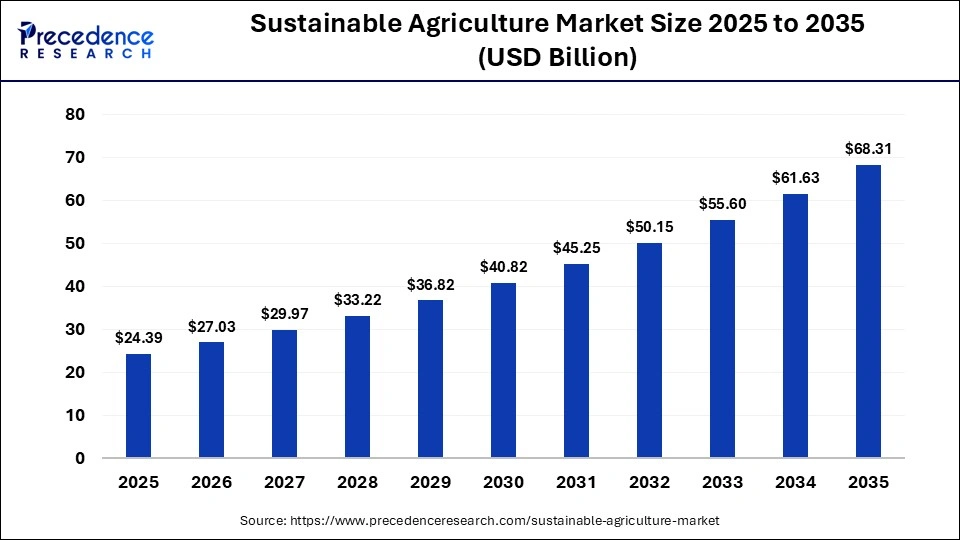
The global sustainable agriculture market size was calculated at USD 24.39 billion in 2025 and is predicted to increase from USD 27.03 billion in 2026 to approximately USD 68.31 billion by 2035, expanding at a CAGR of 10.85% from 2026 to 2035. The sustainable agriculture market is experiencing robust growth driven by the rise of AI and data-driven farming, the expansion of regenerative agriculture, and the adoption of renewable and circular systems.
Market Highlights
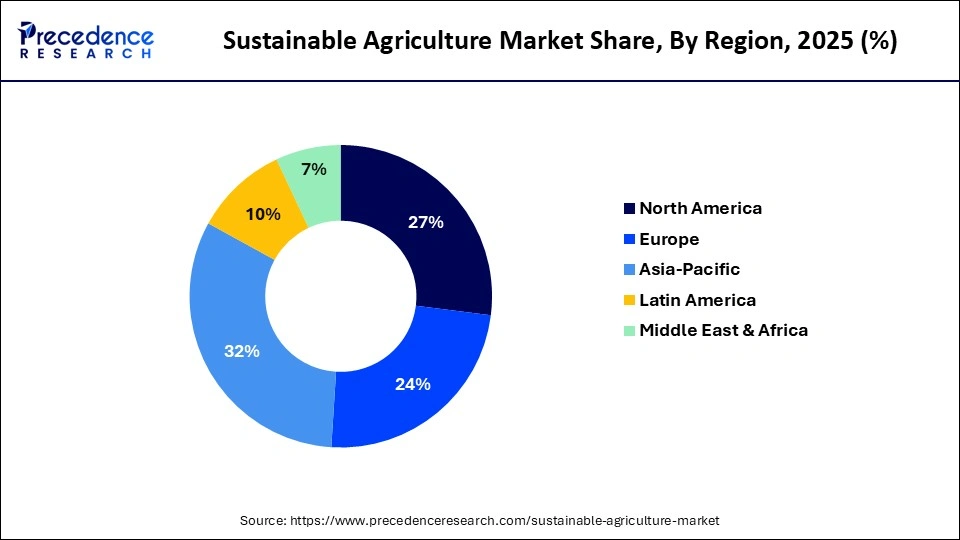
- Asia Pacific dominated the market in 2025, with a revenue share of approximately 32%.
- Latin America is expected to grow at the fastest CAGR in the market during the forecast period.
- By solution type, the sustainable inputs segment led the market in 2025, with a revenue share of approximately 41%.
- By solution type, the precision agriculture technologies segment in the sustainable agriculture market is expected to grow at the fastest CAGR in the market during the forecast period.
- By farming type, the conventional farms transitioning to sustainable practices segment dominated the market in 2025, with a revenue share of approximately 46%.
- By farming type, the regenerative farming segment is expected to grow at the fastest CAGR in the market in the coming years.
- By crop type, the cereals & grains segment held the largest revenue share of approximately 34% in 2025.
- By crop type, the fruits & vegetables segment is expected to expand rapidly in the market during the forecast period.
- By end-user, the farmers & growers segment held a major revenue share of approximately 69% in 2025.
- By end-user, the agribusiness companies/plantations segment is expected to witness the highest growth in the market over the studied years.
Global Agriculture Sector: Innovation meets Sustainability
The global sustainable agriculture market encompasses farming inputs, technologies, and practices developed to improve agricultural productivity while minimizing environmental impact, enhancing soil health, conserving water, lowering greenhouse gas emissions, and maintaining biodiversity. The market spans sustainable inputs (biofertilizers, biopesticides, biostimulants), precision farming technologies, regenerative and organic farming practices, integrated pest management, and climate-smart agriculture solutions across crop cultivation and livestock systems. Growth is driven by the impact of climate change, rising regulatory focus on chemical reduction, increasing consumer demand for sustainable food, and accelerating adoption of precision and regenerative approaches by farms globally.
However, the global agriculture sector is rapidly shifting to a climate-smart and technology-driven future. The various conferences aim to unite policymakers, startups, and world-class experts to explore next-generation farming innovations. The advanced platforms, like AgriNext, are leading due to their critical role in empowering stakeholders to establish low-carbon, resilient, and data-driven food systems.
What is the Role of AI in the Sustainable Agriculture Market?
AI plays a vital role in weather forecasting, soil and crop health monitoring systems, robotics, pest detection, and crop health monitoring using drones. AI is expanding the market by assisting farmers in precise and regulated farming. It educates farmers in crop rotation, water management, the type of crop to be cultivated, timely harvesting, pest attacks, optimal planting, and nutrition management. AI-enabled systems monitor agricultural sustainability, make weather predictions, and assess farms for the presence of pests or diseases.
Sustainable Agriculture Market Trends
- Digital and Blockchain-Based Agri Platforms: Digital transformation introduces enhanced traceability, inclusion in agriculture, and efficiency. Moreover, blockchain-based supply chains verify the sustainability and origin of agricultural products through transparent and tamper-proof records.
- Renewable and Circular Systems: The renewable energy and circular economy principles are reshaping agricultural operations and expanding market growth. There is a rising trend of solar-powered farms and photovoltaic systems that drive cooling, irrigation, and automation efficiently.
- Government Initiatives: Government bodies of different nations launch initiatives to promote environmental sustainability and adopt appropriate measures. Farmers focus on organic farming, soil health, water efficiency, and crop efficiency.
Market Scope
| Report Coverage | Details |
| Market Size in 2025 | USD 24.39 Billion |
| Market Size in 2026 | USD 27.03 Billion |
| Market Size by 2035 | USD 68.31 Billion |
| Market Growth Rate from 2026 to 2035 | CAGR of 10.85% |
| Dominating Region | Asia Pacific |
| Fastest Growing Region | Latin America |
| Base Year | 2025 |
| Forecast Period | 2026 to 2035 |
| Segments Covered | Solution Type, Farming Type, Crop Type, End-User, and Region |
| Regions Covered | North America, Europe, Asia-Pacific, Latin America, and Middle East & Africa |
Segmental Insights
Solution Type Insights
How the Sustainable Inputs Segment Dominated the Sustainable Agriculture Market?
The sustainable inputs segment dominated the market in 2025 with a revenue share of approximately 41%, owing to the major role of sustainable farming in sustainable food production, soil health and fertility, water conservation, and climate change mitigation. It is the key to ensure healthy planet and a secure food supply for future generations. The integration of ecological principles into agricultural practices supports the social and economic well-being of farmers.
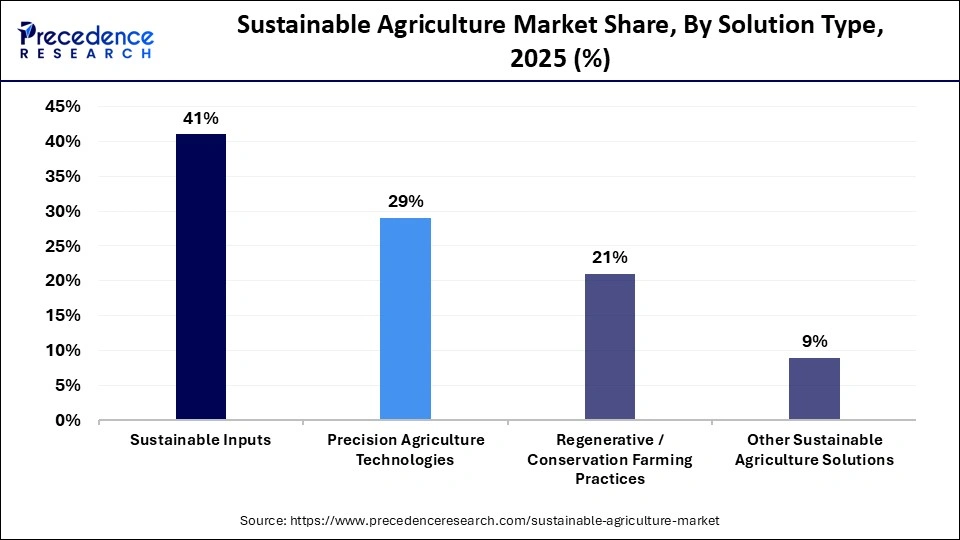
The precision agriculture technologies segment is expected to grow at the fastest CAGR in the market during the forecast period due to their importance in enhancing resource efficiency, minimizing environmental footprint, and improving crop health and productivity. They empower data-driven decision-making and promote long-term sustainability. Farmers are enabled to reduce inputs while maximizing yields and optimizing resource allocation.
Farming Type Insights
Which Farming Type Segment Dominated the Sustainable Agriculture Market?
The conventional farms transitioning to sustainable practices segment held the largest revenue share of approximately 46% in 2025, owing to the global efforts on ensuring food security, sustainability, and environmental conservation. The huge adoption of biofertilisers, organic manures, and biopesticides results in enhanced agricultural sustainability. Fertilisers are vital in providing essential nutrients to the soil, which improve soil fertility.
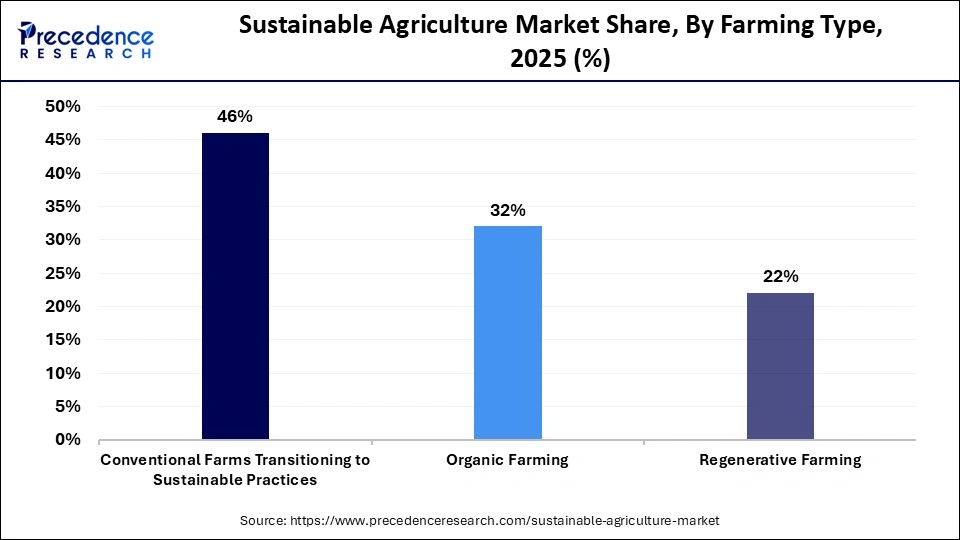
The regenerative farming segment is expected to account for the highest CAGR in the market during the predicted timeframe, due to its great impact on diversity, soil health, water management, and holistic grazing. It helps to mitigate climate change, enhance soil fertility and productivity, and make farms more resilient to environmental stresses. The ecological and economic benefits secure the future of farming families and improve livelihoods.
Crop Type Insights
How the Cereals & Grains Segment Dominated the Sustainable Agriculture Market?
The cereals & grains segment contributed the biggest revenue share of approximately 34% in 2025, owing to their central role in transforming the global food system, leading to healthier diets for the worldwide population. Enhanced nutrition and sustainability are crucial for achieving sustainable development goals. They are expanding through technological and social innovations to develop the globally leading crop production systems.
The fruits & vegetables segment is expected to grow at the fastest CAGR in the market during the upcoming period, due to their great impact on sustainable development goals and vital role in a healthy diet. The enhanced availability of these nutrient-rich foods helps communities combat hunger and improve dietary quality. Regular consumption of fruits and vegetables is associated with a reduced risk of stroke, heart disease, and certain cancers.
End-User Insights
Which End-User Segment Dominated the Sustainable Agriculture Market?
The farmers & growers segment held a major revenue share of approximately 69% in 2025, owing to the essential role of farmers in tackling climate change and delivering a sustainable and resilient future. Smallholder farmers strongly support global food security, which, with the help of decision-makers, can embrace innovative ways to reduce climate emissions. Farmers implement sustainable practices across billions of hectares of agricultural land, aiming to reduce billions of tons of carbon dioxide emissions.
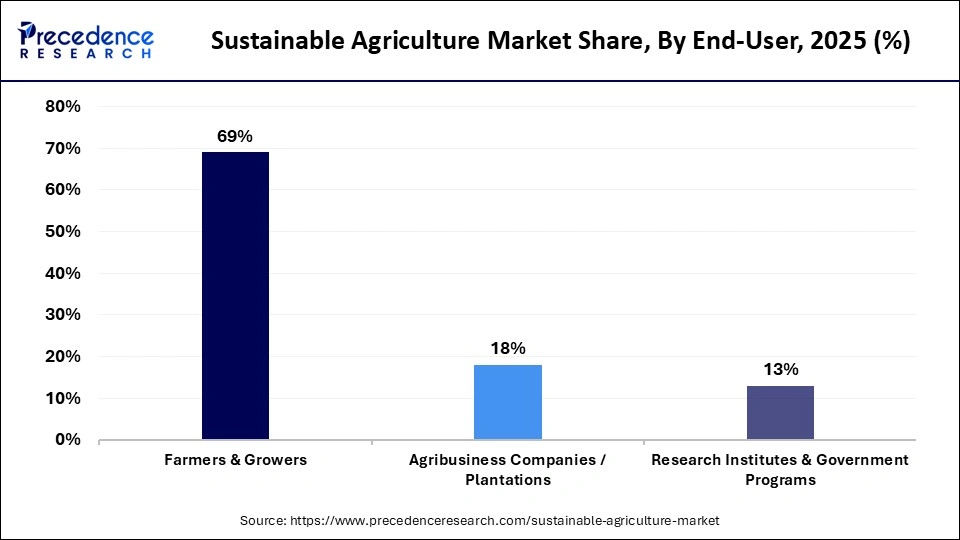
The agribusiness companies/plantations segment is expected to grow at the fastest CAGR in the market during the forecast period due to the heavy reliance of agro-based industries such as textiles, food processing, dairy, sugar, and biofuels on agricultural products as their main raw materials. These industries utilize the output of farms and transform it into value-added products. These industries create significant employment opportunities, particularly in rural areas.
Regional Insights
What is the Asia Pacific Sustainable Agriculture Market Size?
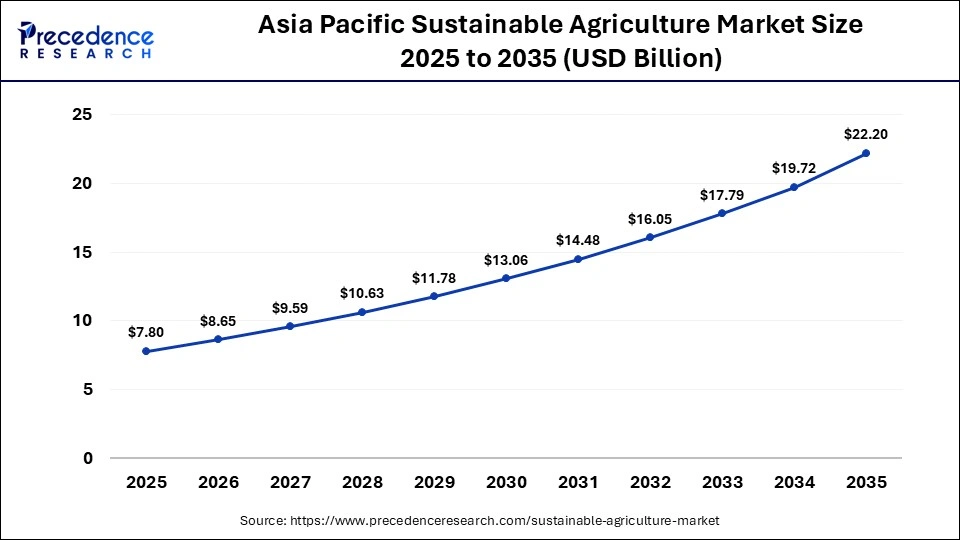
The Asia Pacific sustainable agriculture market size is expected to be worth USD 22.20 billion by 2035, increasing from USD 7.80 billion by 2025, growing at a CAGR of 11.03% from 2026 to 2035.
How Asia Pacific Dominated the Sustainable Agriculture Market in 2025?
Asia Pacific dominated the market in 2025 with a revenue share of approximately 32%, owing to the rising trends of vertical and urban farming, precision agriculture, and digital infrastructure, as well as government policies across countries like China and India. In December 2025, the Food and Agriculture Organization (FAO) regional office for Asia and the Pacific reported that the region is resolving issues related to hunger and stays committed to addressing challenges in malnutrition, unequal access to healthy diets, and food insecurity. Moreover, the Network for the Development of Agricultural Cooperatives in Asia and the Pacific (NEDAC) organized the holistic agri-tech initiative for rural value-chain enhancement & sustainable transformation (HARVEST) Asia Pacific summit to drive smart and sustainable agriculture.
India Sustainable Agriculture Market Analysis
The government of India is advancing climate-resilient research, as well as contributing to natural farming, digital agriculture, and AI. In November 2025, Varaha, a leading carbon project developer in India, received $30 million from Mirova to advance regenerative agriculture across India. This funding also aims to expand soil organic carbon practices that are driving the market to 337,000 smallholder farms across 675,000 hectares. Furthermore, the government of India reported a combined total expenditure of ₹1,01,321.61 crore to improve Krishonnati Yojana and PM Rashtriya Krishi Vikas Yojana.
What is the Potential of the Sustainable Agriculture Market in Latin America?
Latin America is expected to witness the fastest growth in the market during the forecast period due to a shift to biologicals, sustainability certifications, global export standards, and increased investments and financing in regenerative agriculture. The regional economies, such as Brazil, Mexico, and Argentina, depend on agriculture to boost their economic growth, and Latin America is a hub for global agriculture. Countries like Argentina are witnessing sustainable and resilient farming due to the integration of various technologies.
Brazil Sustainable Agriculture Market Trends
Brazil witnesses global strategic partnerships, international collaborations, and government-led sustainability programs. In December 2024, Brazil's federal government launched the Agro Brasil + Sustentável platform to advance the Brazilian agricultural sector, which will further expand the market. According to the World Bank study report published in April 2025, the new policies aim to make Brazil's agrifood sector more sustainable, competitive, and inclusive.
How Is North America Performing in The Sustainable Agriculture Market?
North America is expected to grow at a significant CAGR during the forecast period. Environmental regulation, high demand for organic food, and increased investments in climate-tech are pushing North America. Resource efficiency through precision agriculture, AI-driven machines, and IoT monitoring. Support for soil health, carbon sequestration, and emissions reduction initiatives contributes to market growth.
Canada Market Trends
Emissions reduction policies and carbon credit programs support Canada's market. Artificial Intelligence is being used to increasingly power farming equipment, satellite mapping soil, and precision conservation equipment. Climate-smart agricultural investments in crops and nitrogen-fixing microbes are increasing yields and decreasing environmental impacts.
What Are the Driving Factors of The Sustainable Agriculture Market in Europe?
Europe is expected to grow at a significant CAGR during the forecast period. The EU Farm to Fork Strategy and Common Agricultural Policy (CAP) give impetus to the expansion of the European market. These programs promote reduced synthetic fertiliser and pesticide consumption. The demand for organic farming, biological crop protection, and regenerative agriculture is growing.
Germany Market Trends
Germany has robust policies for sustainability under the European Green Deal and Farm to Fork Strategy. Agrivoltaics are growing at a fast pace and are allowing farms to be utilized for both food and electricity. There is also growing demand for biological crop protection and biostimulants, which contribute to soil health and biodiversity.
How are the Middle East and Africa Performing in The Sustainable Agriculture Market?
The Middle East and Africa are expected to grow at a significant CAGR during the forecast period. Water scarcity, climate, and land degradation issues are making the market for MEA grow. Investments in precision irrigation, water-saving technologies, and regenerative farming are growing. The initiatives taken in food security and the production of alternative proteins also contribute to market growth.
UAE Market Trends
The UAE is making significant efforts in controlled-environment agriculture to overcome climate restrictions. Vertical farms, hydroponic systems, and smart greenhouses have started to become more popular. Water-saving irrigation and desalination technologies powered by AI. Government support for plant protein and cultivated proteins is improving food security in the long-term.
Competitive Landscape
The sustainable agriculture market is fragmented, with agribusiness companies, equipment manufacturers, and agri-tech providers competing with each other. Some of the major market participants are Bayer CropScience, Cargill, John Deere, AGCO Corporation, and UPL Limited. They are known for their wide range of products, cutting-edge technologies, and presence in various countries.
Partnerships, acquisitions, product introductions, and R&D funding all help the companies expand. Digital agriculture is emerging as a key differentiator, with China's open-source artificial intelligence model for crop protection launched in May 2026. Capital needs, regulatory compliance, and technological sophistication are barriers to entry. Competition will be further enhanced by ongoing advancements in precision farming, biological inputs, and AI solutions.
Who are the Major Payers in the Global Sustainable Agriculture Market?
The major players in the sustainable agriculture market include Certis Belchim, Bayer CropScience, Cargill, John Deere, AGCO Corporation, UPL Limited, General Mills, ErfGoed, Saint-Gobain Cultilene, Flavorite Group, Ontario Plants, Pocono Organics, The Sustainable Food Trust (SFT), Metrolina Greenhouses, J.G. Boswell Company, GreenPoint Ag, CropLife America, PTx Trimble GmbH, and AgriVal.
Recent Developments
- In July 2025, Cargill collaborated with PepsiCo to empower farmers by expanding regenerative agriculture practices and advancing sustainable agriculture across 240,000 acres of Iowa farmland by 2030. The collaboration enables PepsiCo to receive ingredients from Cargill's local farmers through regenerative agriculture to produce the most iconic products.
(Source: https://www.pepsico.com) - In September 2024, the owners of Food Lion, an East Coast grocery chain, Giant Food, and Stop & Shop invested in General Mills to expand regenerative agriculture for major ingredients such as oats and wheat to reduce emissions across their shared value chain. The collaboration aims to advance regenerative practices on over 70,000 acres of farmland in Kansas and Canada's Saskatchewan province by 2025.
(Source: https://www.agriculturedive.com)
Segments Covered in the Report
By Solution Type
- Sustainable Inputs
- Biofertilizers
- Biopesticides
- Biostimulants
- Precision Agriculture Technologies
- Sensors & Io
- Drones & imaging
- Variable rate application
- Regenerative/Conservation Farming Practices
- No-till/reduced tillage
- Cover cropping
- Crop rotation
- Other Sustainable Agriculture Solutions
By Farming Type
- Conventional Farms Transitioning to Sustainable Practices
- Organic Farming
- Regenerative Farming
By Crop Type
- Cereals & Grains
- Fruits & Vegetables
- Oilseeds & Pulses
- Cash Crops
- Other Crops
By End-User
- Farmers & Growers
- Agribusiness Companies/Plantation
- Research Institutes & Government Programs
By Region
- North America
- Europe
- Asia-Pacific
- Latin America
- Middle East & Africa
For inquiries regarding discounts, bulk purchases, or customization requests, please contact us at sales@precedenceresearch.com
Frequently Asked Questions





Ask For Sample
No cookie-cutter, only authentic analysis – take the 1st step to become a Precedence Research client
 Get a Sample




 sales@precedenceresearch.com
 Schedule a Meeting
