



Terminal Tractor Market Size, Companies, Share, Vehicle Production Volume, Sales Performance, Export & Import Analysis, Technology Adoption, Competitive Positioning, and Demand Trends
Terminal Tractor Market (By Application: Warehouse & Logistics, Ports & Marine Terminals, Airport, Oil & Gas/Others; By Drive Type / Configuration: 4×2, 4×4, 6×4; By Type (Vehicle Operation): Manual, Automated) - Global Industry Analysis, Size, Trends, Leading Companies, Regional Outlook, and Forecast 2026 to 2035
Source: https://www.precedenceresearch.com/terminal-tractor-market
 Get a Sample
 Table Of Content


What is the Terminal Tractor Market Size?
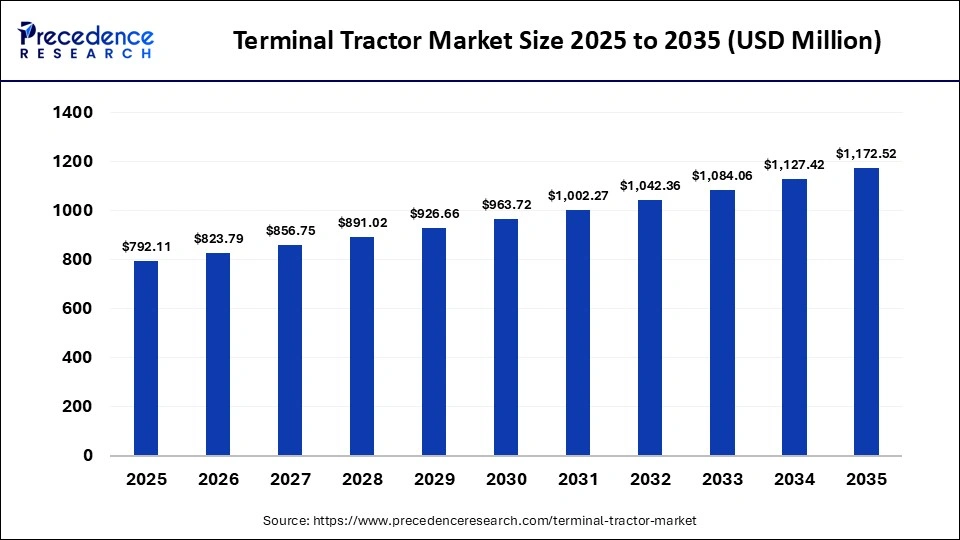
The global terminal tractor market size was calculated at USD 792.11 million in 2025 and is predicted to increase from USD 823.79 million in 2026 to approximately USD 1172.52 million by 2035, expanding at a CAGR of 4.00% from 2026 to 2035. The market comprises specialized yard trucks designed to move semi trailers and containers within cargo yards, ports, warehouses, and logistics facilities. It is driven by rising global trade volumes, expanding port infrastructure, booming e-commerce, adoption of electric models, and reduced operational costs.
Key Takeaways
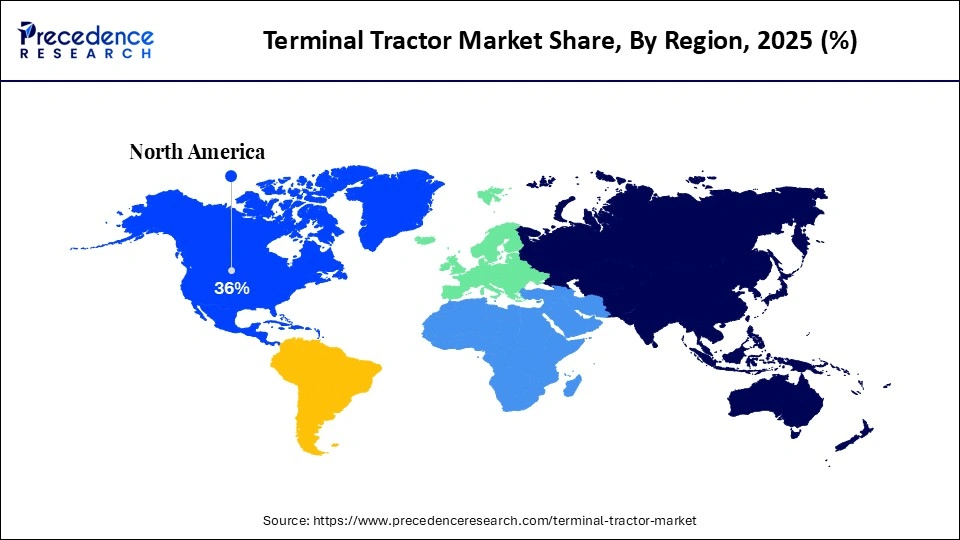
- North America dominated the terminal tractor market with the highest share of 36% in 2025.
- Asia-Pacific is expected to be the fastest-growing region with a CAGR of 4.3% in 2025.
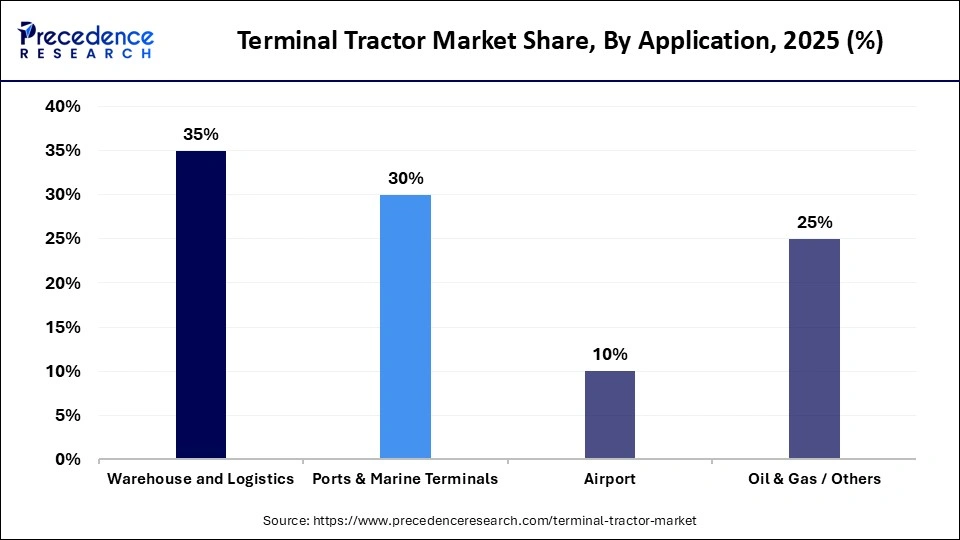
- By application, the warehouse and logistics segment held a dominant position in the market with a share of approximately 35% and is expected to expand rapidly in the market with a CAGR of 3.1% in 2025.
- By drive type/configuration, the 4x2 segment contributed the biggest revenue share of approximately 64% in the market in 2025.
- By drive type/configuration, the 6x4 segment is expected to witness the fastest growth in the market with a CAGR of 3.4% over the forecast period.
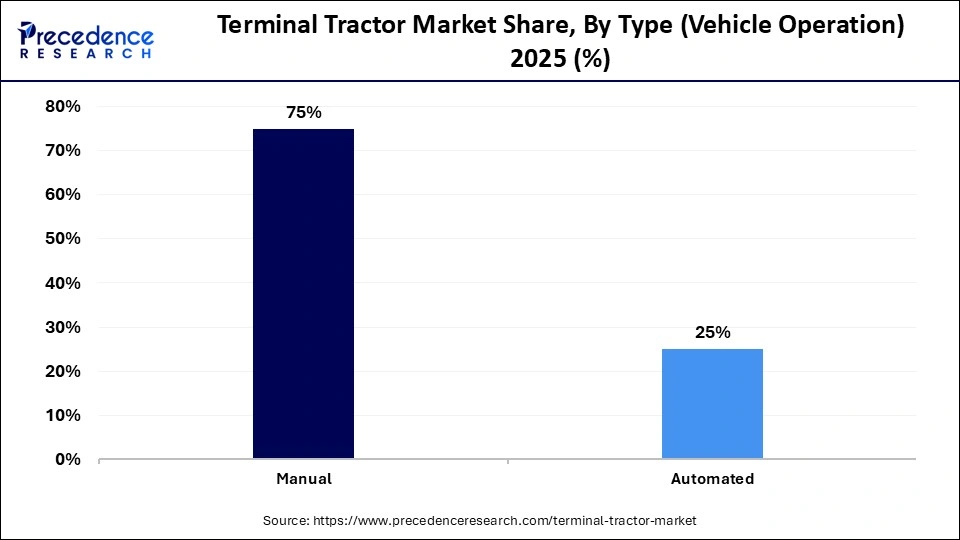
- By type (vehicle operation), the manual segment accounted for the highest revenue share of approximately 75% in the market in 2025.
- By type (vehicle operation), the automated segment is expected to gain the highest market share with a CAGR of 3.3% between 2026 and 2035.
What is the Terminal Tractor Market?
A terminal tractor is a heavy-duty vehicle designed to move semi-trailers and containers in logistics hubs, warehouses, and ports. These vehicles are crucial due to efficient cargo transport, known for their high maneuverability, rear door for quick coupling, and a low-speed, high-torque powertrain. They are also referred to as yard trucks and terminal tractors, which are vital in logistics, enhancing efficiency, safety, and speed when relocating trailers in ports, warehouses, and distribution centers.
As international trade grows, the need for vehicles that can transport containers efficiently increases, especially as ports and distribution centers expand. The rise of e-commerce and retail demands faster and more reliable operations in warehouses and trailer movements, making terminal tractors essential. The market is key in transitioning to safer, automated, and electric (EV) operations, which aim to reduce manual labor, improve driver comfort, lower emissions, and enhance safety with technologies like collision avoidance. Modern terminal tractors are increasingly incorporating IoT and AI technologies to improve productivity in warehouses and ports.
What is the Role of AI in the Terminal Tractor Market?
Artificial intelligence (AI) is transforming container terminal operations by shifting from manual to autonomous, data-driven, and proactive workflows. It increases efficiency, safety, and sustainability by optimizing container flow and movement within terminals, ports, and logistics hubs. AI algorithms help in analyzing real-time yard conditions in optimizing traffic flow while selecting the most efficient path to reduce time and prevent congestion. It also adjusts the tractor's mission in real time based on crane availability and container priority.
To avoid collisions, AI constantly processes data from sensors and identifies obstacles such as personnel or other vehicles, helping the tractor to stop automatically. With cameras paired with AI, detects anomalies in the environment, such as damaged equipment, improper tractor behavior, or unsafe container stacking. From a sustainability point of view, AI assists in reducing fuel consumption and greenhouse gas emissions. Therefore, AI transforms the tractors from machines to active, intelligent, and autonomous agents that can reduce operation costs and expenses while improving productivity.
What Are the Trends in the Terminal Tractor Market?
- Automation and Smart Integration: The automation and smart integration help in meeting the rising demand for faster, safer, and more sustainable cargo handling driven by e-commerce, international trade, and port expansion. With increasing demand from logistics centers, the need for advanced, connected, and autonomous electric terminal tractors is rising. These innovations help in enhancing efficiency and reducing costs. Automation also minimizes accidents caused by fatigue, distraction, or human error. Furthermore, adopting electric terminal tractors allows ports to adhere to strict emission regulations and lower their carbon footprint.
- Electrification and Sustainability: Electrification and sustainability play an important role as they address the urgent need to reduce operational costs, improve workplace safety, and meet stringent emission regulations. With rising e-commerce, the need for improving efficiency in short-haul, high-frequency operations makes electric models an ideal solution. Electric models eliminate the need for expensive diesel and its filtration system. Electric models with integrated real-time data monitoring help in predictive maintenance and enhanced safety with 360-degree cameras, broadening the market reach.
- Rental and Flexible Ownership: Rental and flexible ownership models are crucial in the market as they provide financial adaptability, operational agility, and access to the latest and efficient technologies without upfront capital expenditure to logistic providers and port operators. As rental providers usually handle repair and maintenance, this helps in minimizing downtime while ensuring continuous, efficient yard operations. Also, with peak seasons and fluctuating volumes, flexible and short-term rentals allow the operation scale to adapt quickly, avoiding the idling of assets. These ownership models help in maintaining competitive and high-throughput yard operations without the burden of long-term ownership.
Market Scope
| Report Coverage | Details |
| Market Size in 2025 | USD 792.11 Million |
| Market Size in 2026 | USD 823.79 Million |
| Market Size by 2035 | USD 1172.52 Million |
| Market Growth Rate from 2026 to 2035 | CAGR of 4.00% |
| Dominating Region | North America |
| Fastest Growing Region | Asia Pacific |
| Base Year | 2025 |
| Forecast Period | 2026 to 2035 |
| Segments Covered | Application, Drive Type/Configuration, Type (Vehicle Operation), and region |
| Regions Covered | North America, Europe, Asia-Pacific, Latin America, and Middle East & Africa |
Segmental Insights
Application Insights
Which Application Segment Dominated the Terminal Tractor Market?
The warehouse and logistics segment accounted for the highest revenue share of approximately 35% in the market in 2025 and is expected to grow at the fastest CAGR of 3.1% between 2026 and 2035, due to the growing need for efficient container handling. As global trade and e-commerce are growing, ports are upgrading for larger ships, which require specialized tractors for safe yard and warehouse movement. Also, with growing e-commerce, the demand for effective logistics and distribution centers is increasing.
Additionally, with high-frequency and short-distance transfers, terminal tractors improve efficiency and reduce congestion in busy terminals. Furthermore, the shift towards automation, AI, and electric vehicles in logistics is increasing the demand for advanced terminal tractors that offer lower emissions, reduced downtime, and enhanced safety.
The ports and marine terminal segment is expected to witness significant growth in the market over the forecast period, driving the demand for innovation. As global maritime trade grows, terminal tractors play an important role in efficient container transport, connecting ships to storage. Additionally, as they are designed for port use, these tractors offer excellent maneuverability, 360-degree visibility, and quick coupling to reduce turnaround times. Furthermore, ports require durable machinery for continuous operations, which makes them the main market for high-torque diesel and heavy-duty electric tractors.
Drive Type/Configuration Insights
How the 4x2 Segment Dominated the Terminal Tractor Market?
The 4x2 segment contributed the biggest revenue share of approximately 64% in the market in 2025, due to optimization for high frequency, short distances for flat terrain, yard, and port operations. 4x2 has a simple drivetrain, helping in lowering acquisition cost, reducing maintenance expenses, and having fewer parts to service.
Its shorter body and small wheelbase allows them to navigate tight, crowded, and confined spaces in warehouses and port terminals effortlessly. Their design allows for rapid uncoupling and coupling, which reduces turnaround times. Also, their suitability for flat, paved, or solid surfaces makes them the preferred choice in the market.
The 6x4 segment is expected to grow with the highest CAGR of 3.4% in the market during the studied years. The key drivers include superior traction and stability, high payload and heavy-duty capacity, improved weight distribution, operational efficiency, reduced tire wear, and road-ready capability. With four powered rear wheels, they provide superior grip in challenging, slippery, or uneven terrain, which is essential in ports with steep ramps, inclement weather, or on gravel surfaces.
Also, they are engineered for heavy-duty applications, such as moving fully loaded or overweight containers or machinery, which is crucial in bulk terminals and heavy haul environment. Also, with more wheels, the weight distribution across the rear axles reduces excessive and localized tire wear, which is beneficial in long term operational cost.
Type (Vehicle Operation) Insights
Why Did the Manual Segment Dominate the Terminal Tractor Market?
The manual segment held the largest revenue share of approximately 70% in the market in 2025, due to its cost-effectiveness, operational flexibility, minimal infrastructure, high reliability, and operator familiarity. The segmental growth is attributed to their cost-effective, versatile, and easily deployable solution for port warehouse and distribution center operations.
They are robust, enduring, and offer high torque for heavy-duty repetitive and demanding operations. Also, well-established technology makes it easier for operators to use and maintain the tractors, especially in developing regions. Additionally, they are highly adaptable to various tasks such as trailer spotting and container moving in challenging environments, fueling the market momentum.
The automated segment is expected to show the fastest growth with a CAGR of 3.3% over the forecast period, as it boosts efficiency, enhances safety, and helps with labor shortages. Automated vehicles allow for continuous, dependable, and fuel-efficient container handling, which helps ports manage rising cargo volumes, cut operational costs, and improve safety with advanced collision avoidance and remote monitoring systems.
Moreover, industries face challenges in hiring operators, where automation fills this gap, ensuring smooth operations. Additionally, automation lowers long-term costs by optimizing fuel consumption, reducing human errors, and providing more precise and consistent handling. IoT technology provides vital data that helps in better decision-making, predictive maintenance, and improved task scheduling, boosting the market performance.
Regional Insights
What is the North America Terminal Tractor Market Size?
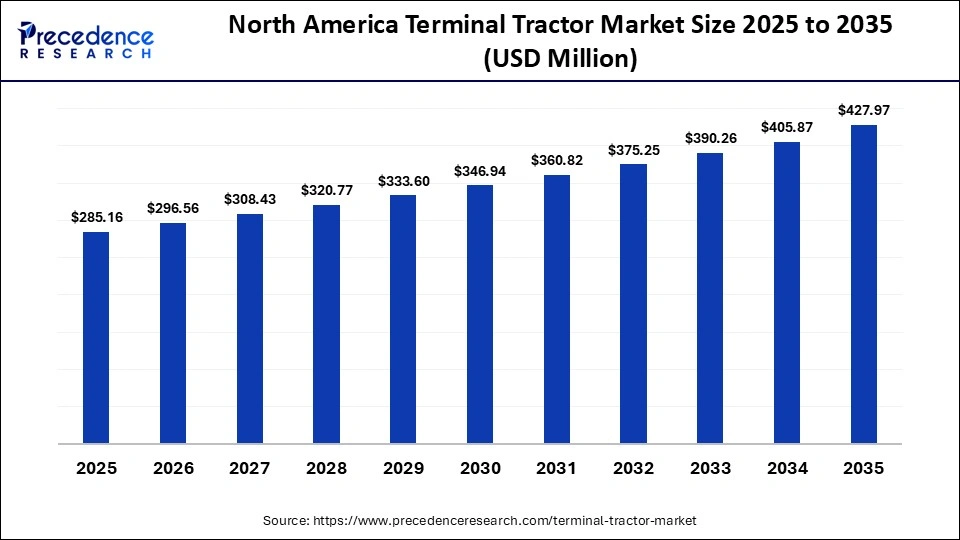
The North America terminal tractor market size is estimated at USD 285.16 million in 2025 and is projected to reach approximately USD 427.97 million by 2035, with a 4.14% CAGR from 2026 to 2035.
Which Factors Drive the Terminal Tractor Market in North America?
North America held a major market share of approximately 36% in 2025 due to its robust port facilities, efficient intermodal transport, and quick adoption of automated and electric yard equipment. Strong infrastructure boosts demand for effective goods transport at major ports and distribution centers. The focus on sustainability and efficiency drives the use of automated and electric terminal tractors. Leading manufacturers like Capacity Trucks and TICO, along with significant investments in automation, are increasing the demand for these technologies. Additionally, with an increase in funding for automation, improve the safety and cuts labor costs, while the growth of e-commerce raises the need for effective logistics management.
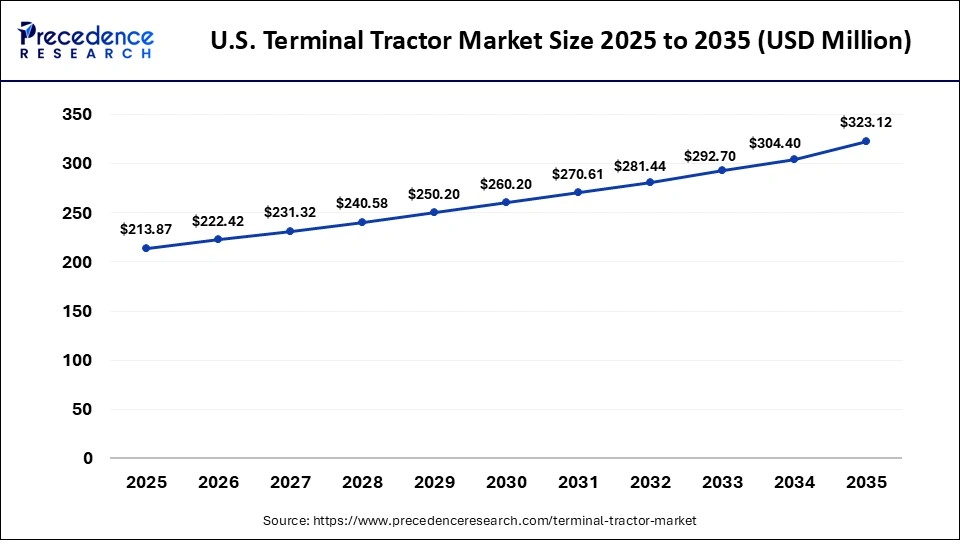
U.S. Terminal Tractor Market Size and Growth 2026 to 2035
The U.S. terminal tractor market size is calculated at USD 213.87 million in 2025 and is expected to reach nearly USD 232.12 million in 2035, accelerating at a strong CAGR of 4.21% between 2026 and 2035.
U.S. Market Trends
The U.S. leads the market because of its large-scale cargo handling and fast expansion of e-commerce, with strong warehouse logistics and early automation adoption. Also, with major investments in infrastructure, strict emission laws encouraging electric vehicles, and leading manufacturers are boosting the market further. The rise in e-commerce drives a high demand for activities in warehouses and distribution centers. Moreover, with a well-developed intermodal transport system, the US utilizes terminal tractors for the effective movement of goods between ships, trains, and trucks, broadening the market reach.
How Will the Asia-Pacific Region Grow in the Terminal Tractor Market?
The Asia Pacific region is expected to be fastest growing market over the studied period, due to rapid industrial growth, extensive port facilities, and increasing trade volumes. Growth factors also include rising logistics automation, e-commerce expansion, and improved container management needs. As a major manufacturing hub, the region's logistics demands are driving the use of terminal tractors for material handling. Furthermore, the increasing adoption of automated and electric terminal tractors boosts efficiency and reduces emissions, driven by faster turnaround times at logistics centers.
China Market Trends
China is leading in the global market due to its strong port infrastructure, quick adoption of AI automation, and government-supported green energy programs. As one of the top exporters, its large-scale, cost-efficient production and smart ports driven by 5G increase the demand and supply in logistics. With its key manufacturing centers providing low-cost equipment, it has a major price edge over global rivals, helping in accelerating market expansion.
What are the Advancements in the Terminal Tractor Market in Europe?
Europe is expected to witness significant market growth, driven by stringent environmental regulations and a strong push towards sustainability. The European Union's Green Deal and various other national initiatives are helping in fostering investments in electric and low-emission terminal tractors, aligning with the region's climate goals. Countries such as Germany, France, and the UK are leading players in the region.
Germany Market Trends
The country's market landscape is characterized by innovation in electric vehicles and automation technologies, which thus helps in enhancing operational efficiency. The country also has a strong focus on sustainability, which helps in reshaping market strategies and also fosters innovation.
What are the Key Trends in the Terminal Tractor Market in Latin America?
Latin America is expected to have significant growth throughout the forecast period, driven by increasing industrialization and urbanization. There is also a high demand for efficient logistics solutions in ports and distribution centers, further propelling market growth. Countries like Brazil and Mexico are leading players as they are supported by government initiatives in order to enhance infrastructure and logistics capabilities.
Brazil Market Trends
The country's market landscape is evolving, with a high focus on automation and smart technologies. As the region continues to invest in modernizing its logistics sector, the terminal tractor market is expected to witness significant advancements, giving rise to efficient and sustainable solutions.
How is the Middle East and Africa Region Growing in the Terminal Tractor Market?
The Middle East and Africa region is witnessing significant growth in the market, driven by increasing investments in logistics and infrastructure development. This growth and development is further being supported by government initiatives that are aimed at enhancing trade and logistics capabilities, particularly in key ports and industrial zones. Countries such as Saudi Arabia, the UAE, and South Africa are leading players.
Saudi Arabia Market Trends
The region's market landscape is characterized by a mix of local and international players, with a strong focus on adapting to regional needs. Companies are increasingly investing in technology to improve operational efficiency and reduce costs.
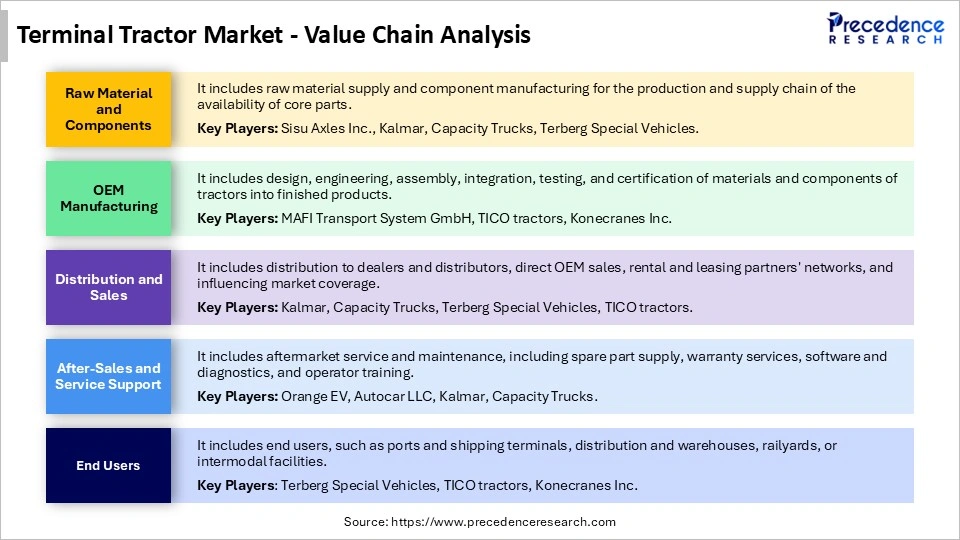
Terminal Tractor Market Value Chain Analysis
Terminal Tractor Market Companies
- Kalmar (Cargotec)
- Terberg Special Vehicles
- Capacity Trucks
- TICO Tractors (Toyota Industries)
- MAFI Transport-Systeme GmbH
- Orange EV
- Autocar, LLC
- Hyster-Yale Group
- Konecranes
- SANY Group
- Capacity Trucks
- Hyundai Tractor
- BYD Company Ltd.
- Volvo AB
- Jungheinrich
- Crown Equipment Corporation
- Hyster Yale Materials Handling
- Doosan Infracore
- Utilev
Recent Developments
- In February 2026, Kalmar Corporation launched its TT7 series of terminal tractors in the European market. This series is a robust and reliable solution in the European market for port terminals, yards, distribution, and logistics operations. It is re-engineered based on extensive customer feedback.(Source - https://www.kalmarglobal.com)
- In October 2025, Terberg special vehicles deployed their Terberg YT203-EV terminal tractors from N.C. Nielsen, which operates at the extensive DSV logistics center located in Horsens, Denmark. This series is specifically engineered for internal transportation within bustling terminals, central warehouses, and distribution hubs.(Source - https://www.terbergspecialvehicles.com)
Segments Covered in the Report
By Application
- Warehouse & Logistics
- Ports & Marine Terminals
- Airport
- Oil & Gas/Others
By Drive Type / Configuration
- 4×2
- 4×4
- 6×4
By Type (Vehicle Operation)
- Manual
- Automated
By Region
- North America
- Europe
- Asia-Pacific
- Latin America
- Middle East & Africa
For inquiries regarding discounts, bulk purchases, or customization requests, please contact us at sales@precedenceresearch.com
Frequently Asked Questions
Tags





Ask For Sample
No cookie-cutter, only authentic analysis – take the 1st step to become a Precedence Research client
 Get a Sample




 sales@precedenceresearch.com
 Schedule a Meeting
