List of Contents
What is the Thoracic Outlet Syndrome Market Size?
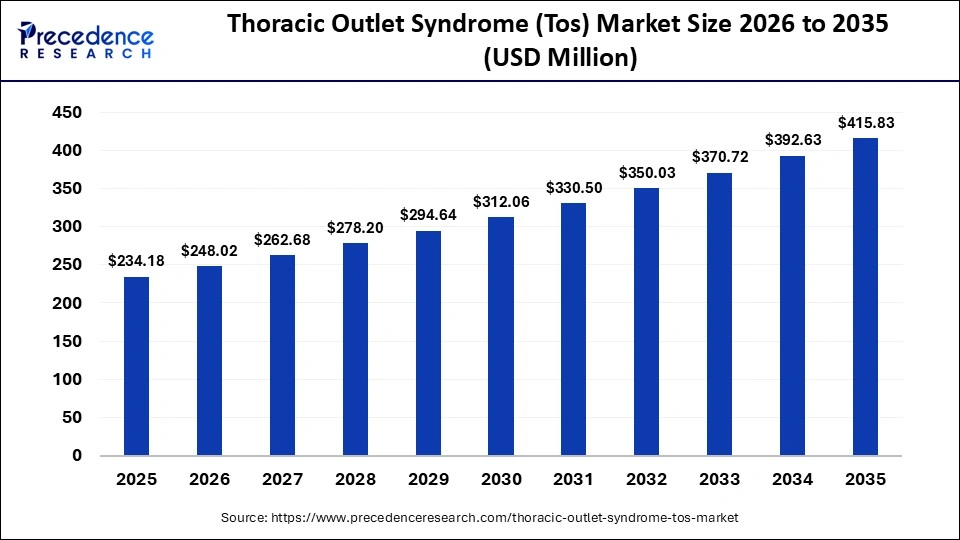
The global thoracic outlet syndrome market size is calculated at USD 234.18 million in 2025 and is predicted to increase from USD 248.02 million in 2026 to approximately USD 415.83 million by 2035, expanding at a CAGR of 5.91% from 2026 to 2035. The thoracic outlet syndrome market is driven by growing diagnostic awareness, improved minimally invasive treatments, and rising prevalence of musculoskeletal disorders.
Market Highlights
- North America dominated the market, holding the largest market share of 35% in 2025.
- Asia Pacific is expected to expand at the fastest CAGR between 2026 and 2035.
- By product type, the pharmacological treatments segment held the largest market share of 40% in 2025.
- By product type, the physical therapy and rehabilitation solutions segment is expected to grow at a remarkable CAGR between 2026 and 2035.
- By deployment type, the hospital-based treatment settings segment contributed the highest market share of 55% in 2025.
- By deployment type, the outpatient clinics / ambulatory centers segment is growing at a remarkable CAGR between 2026 and 2035.
- By application, the neurogenic thoracic outlet syndrome segment accounted for the biggest market share of 55% in 2025.
- By application, the venous thoracic outlet syndrome segment is expanding at a notable CAGR between 2026 and 2035.
- By technology/mode of action, the physical rehabilitation & manual therapy techniques segment held the major share of 35% in 2025.
- By technology/mode of action, the minimally invasive surgical technologies is poised to grow at a strong CAGR between 2026 and 2035.
- By end-user, the hospitals & specialty care centers segment accounted for the biggest market share of 50% in 2025.
- By end-user, the physiotherapy & rehabilitation clinics segment is expected to expand at a remarkable CAGR between 2026 and 2035.
Redefining Relief & Diagnosis: How Innovation Is Transforming the Thoracic Outlet Syndrome Market
The thoracic outlet syndrome market is a large area of diagnostic technologies, therapeutic therapies, surgical procedures, and rehabilitation options aimed at diagnosing neurogenic, venous, and arterial TOS, as well as treating the disorder. This market includes imaging modalities, vascular testing equipment, nerve conduction equipment, electromyography systems, physical therapy systems, pain management treatments, and superior surgical equipment used in rib resection decompression. As increased attention is paid to accuracy diagnostics and multidisciplinary treatment approaches, health care systems in all countries expand special TOS programs in hospitals, orthopedic centers, neurology clinics, and rehabilitation centers.
The expansion of markets is driven by various clinical, lifestyle, and technological factors. The development of minimally invasive vascular and neurosurgical procedures has improved patient outcomes, further increasing pressure to adopt modern TOS management solutions. Moreover, better image clarity, early adoption of screening, specialized physical therapy programs, and the combined treatment paths provided by multispecialty clinics further expedite market growth, allowing for diagnosis and providing full-fledged treatment.
Key AI Integration in the Thoracic Outlet Syndrome Market
With the development of AI, the thoracic outlet syndrome market is transforming diagnosis, treatment planning, and long-term rehabilitation, making them more specific and providing real-time decision support. Machine learning-based motion analysis devices aid clinicians in evaluating the posture, scapular, and shoulder movements to categorize biomechanical triggers in their early stages. These AI-based decision support systems allow surgeons to plan decompression activities, map anatomical differences, and develop an opinion on the likely result of the surgery with greater accuracy.
Remote physiotherapy applications are grounded in AI that tracks patients movements, provides personalized exercises, and monitors rehabilitation progress. AI analytics and wearable sensors will also contribute to continuous monitoring of nerve and vascular strain alterations throughout the day during intervention activities, improving patient recovery in clinic and home-based settings.
Thoracic Outlet Syndrome Market Outlook
- Industry Growth Overview: The industry growth is on the rise due to increasing rates of posture disorders, athletic injuries, and monotonous strain disorders. More imaging, electromyography, and specific physiotherapy are aiding in the long-term development of the industry.
- Global Expansion: In the orthopedic, neurology, and vascular care centres, North America, Europe, and the Asia-Pacific are quickly growing specialties of TOS programs. There are increasing calls for adoption internationally due to a high rate of investment in the modernisation and diagnostics of hospitals through technology.
- Major Investors: Medtronic is one of the key investors, and its application in the treatment of TOS is high in the management of neurosurgical, vascular, and decompression technologies. The innovations in surgical accuracy, nerve monitoring, and patient recovery solutions are enormous in their impact on the market.
- Startup Ecosystem: The start-up landscape is in full swing with inventors coming up with wearable devices that remedy posture, AI-driven motion-tracking devices, and even tele-rehabilitation devices in TOS. New health-tech companies are also developing device ergonomics and predictive musculoskeletal assessment software for use at an early stage.
Market Scope
| Report Coverage | Details |
| Market Size in 2025 | USD 234.18 Million |
| Market Size in 2026 | USD 248.02 Million |
| Market Size by 2035 | USD 415.83 Million |
| Market Growth Rate from 2026 to 2035 | CAGR of 5.91% |
| Dominating Region | North America |
| Fastest Growing Region | Asia Pacific |
| Base Year | 2025 |
| Forecast Period | 2026 to 2035 |
| Segments Covered | Product Type, Deployment Type, Application, Technology/Mode of Action, End-User, and Region |
| Regions Covered | North America, Europe, Asia-Pacific, Latin America, and Middle East & Africa |
Thoracic Outlet Syndrome Market Segment Insights
Product Type Insights
Pharmacological Treatments: In 2025, the pharmacological treatments segment commanded a 40% market share, i.e., thoracic outlet syndrome medication remains the first-line, most accessible, and most highly prescribed treatment for symptomatic patients across all TOS subtypes. NSAIDs remain the first-line for reducing inflammation and alleviating acute musculoskeletal pain, with the use of muscle relaxants to control tension in the cervical and shoulder girdles, which often plays a role in neurogenic compression. Neuropathic pain drugs are required in the management of nerve-related symptoms like paresthesia, radiating pain, and increased nerve sensitivity, which necessitate their use in long-term management of the symptoms. Pharmacological therapy is also desirable in cases of early intervention, the patients who are not immediate surgery candidates, and those who are receiving conservative therapy before physiotherapy or interventional procedures.
Physical Therapy & Rehabilitation Solutions: The physical therapy & rehabilitation solutions segment accounted for 25% in 2025 and proved to be the most dynamic segment due to the growing focus on posture correction, biomechanical restoration, and non-invasive long-term treatment of thoracic outlet syndrome. The programs of postural correction are specifically aimed at the muscular imbalances, scapular dysfunction, and cervical instability that usually lead to neurovascular compression and, as such, are essential for permanent relief of symptoms. Nerve-gliding methods have been widely used in the clinical management of neurogenic TOS to help patients alleviate nerve tension, improve movement, and avoid chronic entrapment. With the growing concern about musculoskeletal wellbeing, ergonomic risks, and the prevention of early intervention, physical therapy was one of the fastest-growing aspects of comprehensive TOS management.
Furnace Type Insights
Hospital-Based Treatment Settings: In 2025, this hospital-based treatment settings segment had a 55% share, as hospitals are the primary facilities with adequate space to treat the full diagnostic and treatment spectrum of thoracic outlet syndrome. There is also access to high-level imaging modalities, including MRI, CT angiography, Doppler ultrasound, and nerve conduction studies, which are vital for differentiating between neurogenic, venous, and arterial TOS. Hospitals are also where multidisciplinary teams of neurologists, vascular surgeons, orthopedic specialists, physiatrists, and pain specialists are housed and therefore better equipped for complex or severe cases. Surgeries are mainly carried out in the hospital operating suites, like first rib, scalenectomy, and vascular decompression, because they require high accuracy during surgery and postoperative care. Hospitals go further to take over because of their emergency care infrastructure, which is essential in cases of acute venous or arterial TOS presentation.
Outpatient Clinics / Ambulatory Centers: The outpatient clinics and ambulatory centers segment held a 30% share in 2025, driven by the increasing trend toward conservative, minimally invasive treatment for TOS. Such places are more accessible to patients seeking regular check-ups, physiotherapy services, ergonomic treatment, nerve-sliding therapy, and medication. Outpatient clinics are also offering more ultrasound guided injections and Botox treatments, as well as early-stage treatments that do not require hospitalization. They have an advantage in a lower price point, a reduced waiting period, and a patient-centred care design that suits individuals with mild-to-moderate neurogenic TOS. There is also an increase in outpatient use because of the expansion of a stand-alone vascular and neuromuscular diagnostic center. It is quite common in these centers;telemedicine, wearable posture determination, and online-based rehabilitation programs are used, which are more convenient and compliant.
Application Insights
Neurogenic Thoracic Outlet Syndrome: The neurogenic thoracic outlet syndrome (NTOS) segment dominated the market in 2025, accounting for 55%, as it is more prevalent than the venous or arterial varieties. NTOS is traditionally linked with bad posture, excessive working on the devices, working strains, repetitive motions of the upper limbs, and musculoskeletal imbalance all of which have increased in the contemporary lifestyle. As NTOS commonly manifests in chronic pain, paresthesia, muscle weakness, and functional impairments, it spurs the request for diagnostic testing, physiotherapy interventions, neurological assessment, and pharmaceutical interventions. Clinicians have often embraced multimodal conservative therapy of NTOS, which has led to a rise in the number of patients in both rehabilitation and outpatient facilities. The recurrence and chronicity of the condition also necessitate long-term management, another factor that increases segment share.
Venous Thoracic Outlet Syndrome: The venous thoracic outlet syndrome (VTOS) segment, which has a 25% market share, will increase substantially as more effort-induced thrombosis and vascular compression of the upper extremities are identified. Sports activities, weight lifting, and labor-intensive jobs have led to an increase in the cases of Paget-Schroetter syndrome that necessitate immediate diagnosis and treatment. The development of venous ultrasound, CT venography, and less-invasive vascular procedures has enhanced the accuracy of VTOS detection and treatment outcomes. Thrombolysis via catheter, venous, and decompression surgeries are increasingly common in specialised centres, which provides confidence in treatment. As awareness of the problem of venous complications increases and more developed healthcare systems are involved in creating vascular care pathways, the VTOS segment is heading towards further expansion over the forecast period.
Technology/Mode of Action Insights
Physical Rehabilitation & Manual Therapy Techniques: Physical rehabilitation and manual therapy accounted for 35% of the market in 2025, driven by the growing popularity of non-invasive management strategies for neurogenic TOS. The patients are continually seeking to correct their posture, restore mobility, and undergo musculoskeletal retraining to address the real cause of nerve compression, such as tightness of the scalp, unstable scapular positioning, and misalignment of the cervix. Physiotherapy via the Internet, wearable posture sensors, and AI-controlled exercise-monitoring devices have enhanced access to and adherence to therapies. Physiotherapists and rehabilitation specialists form the basis of long-term management of NTOS, especially in chronic or recurrent cases. The increasing clinical trend towards conservative patient-driven treatment pathways also reinforced the portion of rehabilitation modalities.
Minimally Invasive Surgical Technologies: The minimally invasive surgical technologies segment, with a 20% share, is set to grow strongly as patients and clinicians increasingly demand procedures that minimize recovery time, postoperative pain, and hospitalization. Minimally invasive techniques, including endoscopic decompression, thoracoscopic removal of ribs, and scalenectomy, have been proven to be more precise and less prone to complications. Even more so in terms of accuracy and safety, surgical imaging, nerve systems, and robots are used to help in surgical performance. Increased access to specialized thoracic and vascular surgeons performing minimally invasive surgery has improved the availability of the service.
End-User Insights
Hospitals & Specialty Care Centers: The hospitals & specialty care centers segment led the market, with a 50% share in 2025, due to their capacity to offer an end-to-end diagnostic-to-treatment pathway for complex cases of TOS. These centers have modern imaging units, laboratories in electrophysiology and surgery, and multidisciplinary teams required for the management of neurogenic, venous, and arterial TOS. They also have acute vascular crises, extreme thrombosis, as well as surgical decompression issues, and these demand acute clinical setups. Their ownership of superior minimally invasive devices, postoperative rehabilitation services, and permanent control over patients places them at the forefront of leadership. Hospitals are the first line of examination for patients with unclear diagnoses, serious symptoms, or complicated anatomical compression patterns.
Physiotherapy & Rehabilitation Clinics: The physiotherapy & rehabilitation clinics segment is projected to grow at a significant CAGR over the forecast period, holding a 20% share. These are clinics that have special programs such as posture correction, scapular stabilization, ergonomic re-education, nerve-gliding therapy, and strengthening programs specific to neurogenic TOS. As musculoskeletal health and posture-related disorders are increasingly being taken seriously, early intervention by the use of physiotherapy has emerged as a popular first-line treatment. Tele-rehabilitation on digital platforms, AI-based motion analysis systems, and other digital physiotherapy are increasing access and patient interaction. Rehab centers are also cheaper and readily accessible than hospital-based treatment, and hence, long-term management is more likely to prefer rehab centers.
Thoracic Outlet Syndrome Market Region Insights
The North America thoracic outlet syndrome market size is estimated at USD 81.96 million in 2025 and is projected to reach approximately USD 147.62 million by 2035, with a 6.06% CAGR from 2026 to 2035.
Why Did North America Lead the Global Thoracic Outlet Syndrome Market in 2024?
In 2025, North America was the largest market, with a 35% share of thoracic outlet syndrome, due to its well-developed system of diagnostic centers, high rates of use of modern imaging methods, and the presence of multidisciplinary specialty centers. The clinical awareness of the physicians, physiotherapists, and surgeons has led to the earlier recognition and better differentiation of neurogenic, venous, and arterial TOS. Patient access to treatment is also enhanced by minimally invasive surgical technologies, extensive rehabilitation programs, and well-developed reimbursement schemes. Moreover, the leaders of the medical devices market and research facilities in the U.S. and Canada are constantly investing in better surgical instruments, computerized diagnostics, and postural examinations, which further confirms the hegemony of the North American market in the world market.
The U.S. thoracic outlet syndrome market size is calculated at USD 61.47 million in 2025 and is expected to reach nearly USD 111.45 million in 2035, accelerating at a strong CAGR of 6.13% between 2026 and 2035.
U.S Thoracic Outlet Syndrome Market Analysis
The U.S. has been the leading player in the thoracic outlet syndrome market in North America because it has a concentration of specialty hospitals, academic health centers, and high-quality diagnostic labs unmatched elsewhere. Excellent clinical experience in vascular surgery, neurology, orthopedics, and rehabilitative care will help determine an accurate diagnosis and individual treatment pathways for all types of TOS. Early technology adoption in the U.S. healthcare ecosystem has also featured AI-assisted image-reading technology, EMG technology, digital physiotherapy, and innovations in minimally invasive surgery systems. The high rates of physical activity, labor pressures, and sedentary lifestyles result in a large number of patients who require regular assessment for neurovascular compression. Ongoing clinical studies, innovation by major med-tech firms, and the incorporation of advanced rehabilitation software have made the U.S. the most technologically advanced and commercially appealing TOS market in the world.
The Asia Pacific thoracic outlet syndrome market size is expected to be worth USD 126.83 million by 2035, increasing from USD 70.25 million by 2025, growing at a CAGR of 6.09% from 2026 to 2035.
Why Is Asia Pacific Undergoing the Fastest Growth in the Thoracic Outlet Syndrome Market?
The Asia Pacific region is experiencing the most rapid growth in the world thoracic outlet syndrome market, which has a 30% market share, driven by the rapid development of healthcare facilities, the increase in diagnostic knowledge, and the enhancement of access to specialty care. Clinical demand is being driven by an increasing number of posture-related disorders associated with prolonged digital device use, intense and heavy work-related occupations, and increased sports involvement. India, China, Japan, South Korea, and Thailand are investing in high-tech imaging services, neurology services, vascular units, and physical therapy centers, enabling neurogenic and venous TOS to be detected earlier and more accurately. In the region, there is also an increase in the number of private healthcare networks and medical tourism, in which patients are known to seek specialized care for chronic pain and thoracic compression disorder.
China Thoracic Outlet Syndrome Market Trends
The Chinese thoracic outlet syndrome market is rising rapidly due to healthcare modernization, improved outpatient diagnostic capabilities, and greater awareness of musculoskeletal disorders associated with urbanization and digital lifestyles. Repetitive strain injury among the working population in the manufacturing, logistics, and technology industries is a high-impact condition that underscores the need to measure TOS and recovery. The prevalence of physiotherapy centers, chiropractors, and posture-correction centers contributes to the use of conservative care, particularly in neurogenic TOS. Besides, the introduction of digital health, wearable posture monitoring, and AI-powered musculoskeletal assessment apps is accelerating the first-mover advantage. Government efforts to enhance musculoskeletal health and the increased insurance coverage of rehabilitation services have further shaped the market landscape.
The Europe thoracic outlet syndrome market size has grown strongly in recent years. It will grow from USD 58.55 million in 2025 to USD 106.04 million in 2035, expanding at a compound annual growth rate (CAGR) of 6.12% between 2026 and 2035.
Why Is the European Thoracic Outlet Syndrome Market Experiencing Notable Growth?
The European thoracic outlet syndrome market, with a 25% share, is recording a significant growth owing to good clinical standards, well-developed diagnostic pathways, and a highly trained multidisciplinary workforce. Germany, France, Italy, and the United Kingdom are among the countries that offer advanced vascular imaging, EMG testing, and high-level neuromuscular rehabilitation programs. Greater attention to workplace occupational health and ergonomics, as well as sports medicine, promoted early diagnosis and treatment of TOS symptoms. Europe is no exception, and it has an aging population that has an increasing musculoskeletal complication and high-need physiotherapy-based management. The joint research projects, healthcare systems funded by the government, and the ongoing implementation of digital rehabilitation technologies contribute to stable development in the region.
UK Thoracic Outlet Syndrome Market Trends
The United Kingdom has strong, stable growth in the European TOS market because it has a highly developed healthcare system, a well-organized referral system, and access to the best diagnostics. Both the NHS and private clinics provide high-quality imaging, EMG, and specialized physiotherapy programs, thereby enhancing early diagnosis of neurogenic and venous TOS. The clinical consultations have increased because more people are now aware of posture-related pain, strains at work, and musculoskeletal disorders caused by the use of digital devices. The UK is also evolving in the areas of ergonomics and occupational health procedures, which makes employers contribute to early intervention and preventive treatment.
The Middle East and Africa are on a growth path in the thoracic outlet syndrome market, with a 5% share, driven by growing healthcare infrastructure, increased investment in diagnostic imaging, and rising awareness of musculoskeletal disorders. Developing orthopedic and neurology facilities. Advanced orthopedic and neurology facilities are being developed in the Gulf countries, including the UAE, Saudi Arabia, and Qatar, that can more accurately diagnose and treat TOS. The increasing number of expatriate workers, especially in physically demanding roles, also leads to an increase in posture-related and repetitive strain injuries. Modern physiotherapy methods, nerve-sliding courses, and ergonomics are being embraced in private hospitals and rehabilitation centers to meet the rising demand.
Why Is the Latin American Thoracic Outlet Syndrome Market Emerging Rapidly?
Latin America, with a 5% market share, is a fast-emerging market due to increased investment in musculoskeletal health services, greater access to diagnostic imaging, and expanded physiotherapy infrastructure. The growing case of posture-related and occupational strain disorder in countries like Brazil, Mexico, Colombia, and Argentina culminates in the demand for TOS evaluation. Also, the growth of medical tourism and private healthcare development is increasing access to sophisticated imaging and minimally invasive surgical treatments. Education programs on ergonomics and early diagnosis are making more patients seek early care. With ongoing modernization in healthcare, Latin America is increasingly becoming a promising emerging market for TOS treatment solutions.
Top Vendors in Thoracic Outlet Syndrome Market & Their Offerings
- Medtronic
- Johnson & Johnson (DePuy Synthes)
- Stryker
- Zimmer Biomet
- Abbott
- Boston Scientific
- B. Braun
- Teleflex
- Terumo Corporation
- Cardinal Health
- Siemens Healthineers
- GE HealthCare
- Koninklijke Philips
- NuVasive
- Arthrex
- CONMED Corporation
- AngioDynamics
- Cook Medical
- Globus Medical
- Hologi
Recent Developments
- In November 2024, Researchers reported a case of neurogenic TOS in which a patient-specific 3D-printed anatomical model of the brachial plexus and adjacent bones was created entirely from MRI neurography data, used to diagnose and plan treatment. The methodology gave a clear visual representation of non-irradiated nerve impingement.(Source: https://pmc.ncbi.nlm.nih.gov)
- In October 2024, a case report presented a new diagnostic and treatment method for neurogenic TOS, which could provide improved diagnostic features and targeted treatment for subjects with misdiagnosis or underdiagnosis.
Thoracic Outlet Syndrome Market Segments Covered in the Report
By Product Type
- Pharmacological Treatments
- NSAIDs
- Muscle relaxants
- Neuropathic pain medications
- Physical Therapy & Rehabilitation Solutions
- Postural correction programs
- Nerve-gliding techniques
- Surgical Intervention Tools & Devices
- First rib resection tools
- Scalenectomy instruments
- Diagnostic Imaging & Evaluation Tools
- MRI/CT imaging systems
- Doppler ultrasound systems
- Supportive & Adjunctive Treatment Devices
- Orthotic braces
- Pain management devices
By Deployment Type
- Hospital-Based Treatment Settings
- Outpatient Clinics/Ambulatory Centers
- Home-Based & Remote Therapy Programs
By Application
- Neurogenic Thoracic Outlet Syndrome
- Venous Thoracic Outlet Syndrome
- Arterial Thoracic Outlet Syndrome
- Mixed/Non-specified TOS Conditions
By Technology/Mode of Action
- Physical Rehabilitation & Manual Therapy Techniques
- Pharmacological Pain Management
- Minimally Invasive Surgical Technologies
- Imaging & Diagnostic Modalities
- Nerve & Vascular Decompression Tools
By End-User
- Hospitals & Specialty Care Centers
- Physiotherapy & Rehabilitation Clinics
- Outpatient Surgical Centers
- Diagnostic Imaging Centers
- Other End-Users
By Region
- North America
- Europe
- Asia-Pacific
- Latin America
- Middle East and Africa
For inquiries regarding discounts, bulk purchases, or customization requests, please contact us at sales@precedenceresearch.com
Frequently Asked Questions

Ask For Sample
No cookie-cutter, only authentic analysis – take the 1st step to become a Precedence Research client