



U.S. 360 Degree Camera Market Size, Share and Trends 2026 to 2035
U.S. 360 Degree Camera Market (By Connectivity Type: Wired and Wireless; By Resolution: High Definition (HD) and Ultra-high Definition (UHD); By Camera Type: Single and Professional; By Vertical: Media & Entertainment, Consumer, Military & Defense, Travel & Tourism, Automotive, Commercial, and Healthcare) Industry Size, Share, Growth, Trends 2025-2035
Source: https://www.precedenceresearch.com/us-360-degree-camera-market
 Get a Sample
 Table Of Content


The U.S. 360 degree camera market size surpassed USD 610 million in 2025 and is predicted to reach around USD 7201.61 million by 2035, registering a CAGR of 28.00% from 2026 to 2035. The market is fueled by the growing need for immersive content, virtual reality (VR) and augmented reality (AR) uses, advanced automotive safety features, and commercial security monitoring.
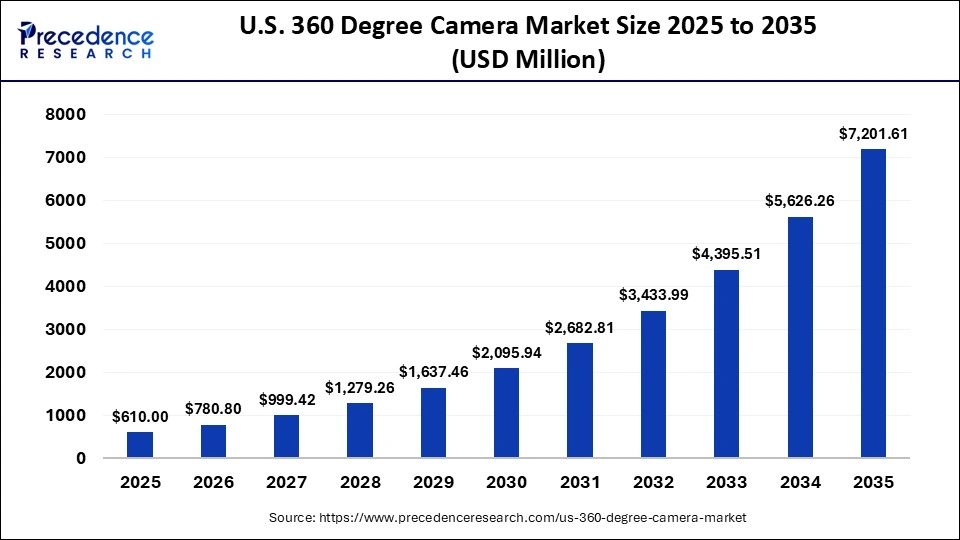
U.S. 360 Degree Camera Market Statical Scope
| Reports Attributes | Statistics |
| Market Size in 2025 | USD 610 Million |
| Market Size in 2026 | USD 780.8 Million |
| Market Size by 2035 | USD 7201.61 Million |
| CAGR 2026 to 2035 | 28.00% |
| Base Year | 2025 |
| Forecast Period | 2026 to 2035 |
The market is crucial as it promotes innovation and adoption in fast-growing areas such as automotive safety, immersive VR content creation, digital mapping in real estate, and advanced commercial security. North America, as a tech leader, significantly influences global hardware and software standards. There is a major integration of surround-view systems for Advanced Driver Assistance Systems (ADAS) and fleet telematics to minimize blind spots and comply with strict safety regulations.
Creators and live-streamers are driving high demand for 8K recordings, AI-based reframing, and platforms like YouTube. These cameras are widely used for remote monitoring, tracking progress, and offering interactive 3D virtual tours of properties. They are also deployed in enterprises for comprehensive situation awareness and risk management in both public and private areas.
U.S. 360 Degree Camera Market, By Connectivity Type, 2025 (%)
| Segments | Shares (%) |
| Wired | 35.00% |
| Wireless | 65.00% |
- Wired - The wired segment, with a share of 35% in 2025, plays a crucial role in the U.S. 360-degree camera market as it provides continuous power, instant data transfer, and high bandwidth for professional broadcasting, automotive testing, and secure commercial surveillance setups.
- Wireless - The wireless segment, with a share of 65% in 2025, is dominant in the U.S. 360-degree camera market as it improves consumer convenience, provides flexible home security integration, and enables quick mobile content sharing. Wireless and cord-free designs are used for both residential and commercial users.
U.S. 360 Degree Camera Market, By Resolution, 2025 (%)
| Segments | Shares (%) |
| High Definition (HD) | 43.00% |
| Ultra-high Definition (UHD) | 57.00% |
- High Definition (HD) - The High Definition (HD) segment, with a share of 43% in 2025, is crucial in the U.S. 360-degree camera market as it provides a good balance between cost, efficient bandwidth use, and practical functionality. It encourages widespread adoption in consumer vlogging, remote education, virtual meetings, and basic commercial surveillance without the high hardware and storage expenses associated with Ultra-HD.
- Ultra-high Definition (UHD) - The Ultra-high Definition (UHD) segment, with a share of 57% in 2025, is the leader in the U.S. 360-degree camera market as it delivers the high pixel clarity needed when panoramic videos are cropped or reframed. It supports growth in virtual reality (VR), defense surveillance, luxury real estate, and cinematic media.
U.S. 360 Degree Camera Market, By Camera Type, 2025 (%)
| Segments | Shares (%) |
| Single | 62.00% |
| Professional | 38.00% |
- Single - The single-lens or single-device product segment, with a share of 62% in 2025, often referred to as personal or consumer-grade 360-degree cameras, dominates the U.S. and global 360-degree camera markets due to its exceptional affordability, easy portability, and simple sharing options for everyday consumers and social media creators.
- Professional - The professional segment, with a share of 38% in 2025, drives significant revenue growth and high-margin expansion in the U.S. 360-degree camera market. It stimulates rapid innovation by addressing strong enterprise demand for Ultra-HD virtual reality content, advanced remote collaboration, smart-city surveillance, and immersive real estate documentation.
U.S. 360 Degree Camera Market, By Vertical, 2025 (%)
| Segments | Shares (%) |
| Media & Entertainment | 22.00% |
| Consumer | 24.00% |
| Military & Defense | 12.00% |
| Travel & Tourism | 10.00% |
| Automotive | 14.00% |
| Commercial | 10.00% |
| Healthcare | 8.00% |
- Media & Entertainment - The media and entertainment sector, with a share of 22% in 2025, plays a crucial role in the U.S. 360-degree camera market, as it supports high-demand uses such as virtual reality (VR), augmented reality (AR), and immersive live streaming. Consumers and content creators in the U.S. widely use these tools to create interactive videos for platforms like YouTube and Instagram.
- Consumer - The consumer segment, with a share of 24% in 2025, is the main driver of the U.S. 360-degree camera market, holding the largest share of revenue and volume. The growing popularity is driven by the need for affordable, easy-to-use personal devices for travel, outdoor sports, and social media content creation, with increasing consumer interest in immersive VR/AR experiences.
Competitive Landscape
The U.S. market for 360-degree cameras is dominated by leading brands such as Insta360, GoPro, and Ricoh. They excel with features like high-resolution 8K capture, durable designs
for action, and AI-driven editing tools, driven by the demand for virtual reality, real estate tours, and action sports.
- · Insta360 (Arashi Vision Inc.) offers flagship products like the Insta360 X4 (8K resolution), Insta360 X3, and modular action systems such as ONE RS. These products provide high frame-rate ultra-HD video, FlowState stabilization, invisible selfie stick effects, and AI-supported editing platforms for both mobile and desktop.
- · GoPro, Inc. features the GoPro MAX series as its flagship products. They provide dual-lens rugged 360 recording, Max HyperSmooth stabilization, 360-degree horizon leveling, and strong cloud/VR workflow integrations designed for extreme sports and outdoor activities.
- · Ricoh Company, Ltd. has the Ricoh Theta series (Theta X, Theta Z1) as its flagship products. These cameras are slim, pocket-sized, and dual-lens, heavily optimized for enterprise uses, including real estate virtual tours, construction documentation, and professional field asset mapping.
- · Kandao Technology's flagship products include the Kandao Qoocam series and Meeting Omni. They offer professional-grade multi-lens VR production and 360-degree conferencing solutions aimed at enterprise collaboration and cinematic virtual reality content creation.
- · Garmin Ltd. features the Garmin VIRB 360 as its flagship product, which provides ultra-rugged 4K recording with built-in telemetry data overlays (G-meters, speed, GPS tracks) tailored for extreme adventure tracking and monitoring in aviation and marine environments.
Segments Covered in the Report
By Connectivity Type
- Wired
- Wireless
By Resolution
- High Definition (HD)
- Ultra-high Definition (UHD)
By Camera Type
- Single
- Professional
By Vertical
- Media & Entertainment
- Consumer
- Military & Defense
- Travel & Tourism
- Automotive
- Commercial
- Healthcare
For inquiries regarding discounts, bulk purchases, or customization requests, please contact us at sales@precedenceresearch.com
Frequently Asked Questions





Ask For Sample
No cookie-cutter, only authentic analysis – take the 1st step to become a Precedence Research client
 Get a Sample




 sales@precedenceresearch.com
 Schedule a Meeting



