


U.S. & Canada Peritoneal Dialysis Catheters Market Revenue, Leading Companies, Company Technology / Innovation, Diagnostic Testing Volume, Adoption Rates, Pricing Metrics, Supply Chain Performance, Competitive Positioning, and Industry Trends
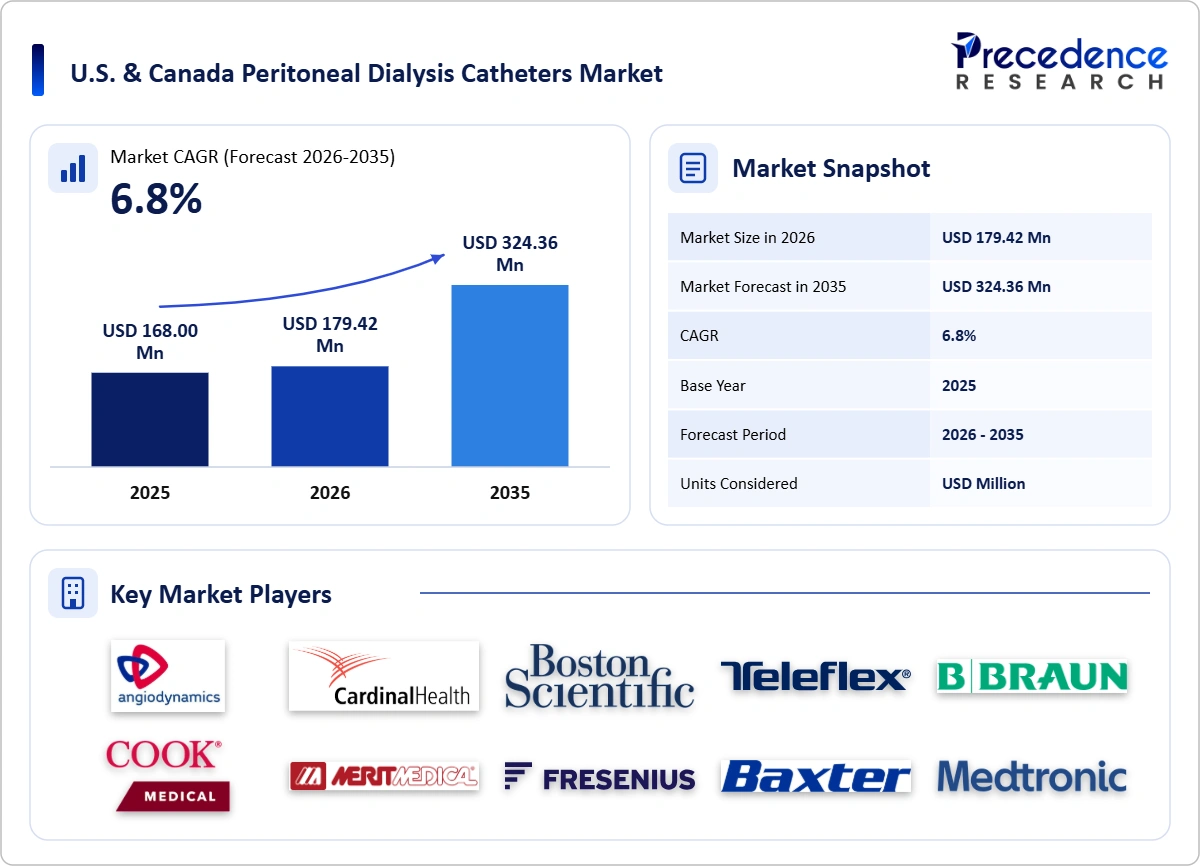
Payal Rabde, a Healthcare Industry Expert, highlights that the U.S. & Canada peritoneal dialysis catheters market has reached USD 179.42 million in 2026 and is on track to reach USD 324.36 million by 2035, advancing at a CAGR of 6.8%. Key U.S. & Canada peritoneal dialysis catheters market companies shaping the market include Medtronic, Baxter International (Vantive), Fresenius Medical Care, while major growth segments span catheter type, insertion, end-user.
Source: https://www.precedenceresearch.com/us-and-canada-peritoneal-dialysis-catheters-market
 Get a Sample
 Table Of Content
Key Takeaways
Market Size & Growth Outlook
- Market size in 2025: USD 168.00 million
- Estimated market size in 2026: USD 179.42 million
- Projected market size by 2035: USD 324.36 million
- CAGR (2026-2035): 6.8%
Regional Market Spotlight
- In 2025, the U.S. led the market with an 88% revenue share.
- Canada accounted for 12% of the market in 2025 and is projected to be the fastest-growing country, registering a CAGR of 8.20% from 2026 to 2035.
Segmental Spotlight
- Swan-Neck Catheters dominated the catheter type segment, accounting for 44% of the market in 2025.
- Laparoscopic placement led the insertion segment, holding a 46% market share in 2025.
- In 2025, Hospitals dominated the end-user segment, accounting for 52% of the market.
U.S. & Canada Peritoneal Dialysis Catheters Market Size and Forecast, 2025-2035 (USD Million)
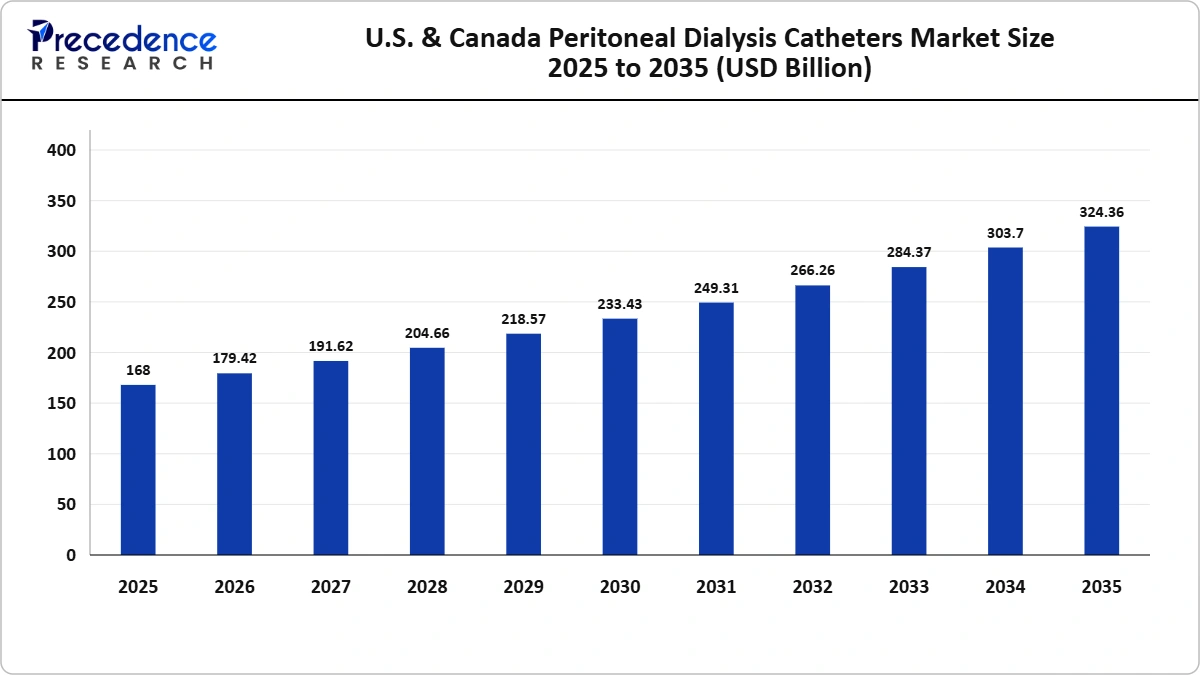
Note: 2025 is the base year; 2026-2035 values are forecasts.
Sources: Expert interviews, secondary sources, Precedence Research database, and Precedence Research analysts.
The U.S. & Canada peritoneal dialysis catheters market is projected to grow from USD 168.00 million in 2025 to USD 324.36 million by 2035, driven by increasing kidney failure cases and the growing adoption of home-based dialysis. As every peritoneal dialysis patient requires a catheter, rising patient volumes and replacement demand are supporting market expansion.
The market is expected to reach USD 233.43 million by 2030 and sustain a CAGR of 6.8% from 2026 to 2035. Home dialysis incentives, patient preference, new infusion pump-style cyclers, and digital health remote monitoring are supporting the adoption of peritoneal dialysis across the region.
Analyst View: We developed the market estimate using new peritoneal dialysis starts, catheter replacements, and average catheter and kit prices by country, cross-validated against supplier activity. Published estimates for this exact market scope are limited, and our estimate is based on available market evidence.
Market Trends
- Adoption of home dialysis is driven by supportive healthcare policies, favorable reimbursement incentives, and preference for convenient, patient-centered treatment options.
- Urgent-start peritoneal dialysis can enable earlier treatment initiation in selected patients, reduces therapy delays, and improves access to timely kidney replacement treatment.
- The increasing adoption of percutaneous catheter placement methods supports the market by minimizing procedural complexity and improving patient comfort.
- Emphasis on infection prevention encourages manufacturers to develop advanced catheter designs and effective solutions to reduce infection-related complications.
- Technological advancements in automated peritoneal dialysis cyclers enhance treatment efficiency, improve therapy flexibility, and allow patients to manage dialysis more conveniently at home.
- The established use of peritoneal dialysis in Canada, supported by established healthcare infrastructure, treatment awareness, and access to specialized renal care, contributes to regional market growth.
U.S. & Canada Peritoneal Dialysis Catheters Market Drivers, Restraints, and Opportunities
Driver
The U.S. & Canada peritoneal dialysis catheters market is supported by the prevalence of kidney failure, demand for home-based dialysis, and healthcare policies promoting home treatment. Growing patient preference for home care and the comparatively lower cost of peritoneal dialysis than in-centre hemodialysis is supporting adoption.
Advancements in automated peritoneal dialysis cyclers and remote monitoring solutions are improving treatment management and supporting the expansion of home dialysis programmes across the region.
Restraint
Catheter-related infections and catheter failure challenge the market in the United States and Canada. These complications can affect treatment continuity and increase the need for catheter replacement and additional medical intervention.
Limited surgeon training and low awareness of peritoneal dialysis restrict adoption. Reimbursement challenges associated with catheter placement can affect purchasing and treatment decisions, particularly in smaller and price-sensitive markets.
Opportunity
The growing use of urgent-start peritoneal dialysis and image-guided percutaneous catheter placement is creating opportunities for manufacturers of specialized catheters and implantation systems. These approaches can support timely access to PD in selected patients, particularly where conventional surgical scheduling or break-in periods present challenges.
Canada also offers opportunities through its established PD treatment base and provincial home dialysis programmes. Manufacturers that improve catheter positioning, exit-site accessibility, implantation efficiency and infection-prevention practices may strengthen their competitive position.
Market Drivers - Impact & CAGR Contribution (2026-2035)
| Driver | Impact | ≈ CAGR Contribution | Time Horizon | Key Regions |
| Kidney failure rises | High | +2.65 pp | Short to long term | Both countries, strongest in U.S. |
| Home dialysis incentives | Medium | +2.24 pp | Medium to long term | Both countries, fastest uptake in Canada |
| Patient preference for home care | Medium | +1.91 pp | Short to medium term | Both countries |
| Lower cost than in-centre HD | Low | +1.49 pp | Long term | U.S. and Canada |
Note: Contributions are indicative estimates of each factor's effect on annual growth.
Sources: Expert interviews, secondary sources, Precedence Research database, and Precedence Research analysts.
Rising kidney failure is a major factor driving market growth, contributing around 2.65 percentage points annually. Furthermore, home dialysis incentives and patient preference for home-based treatment are supporting demand for peritoneal dialysis catheters. The comparatively lower cost of peritoneal dialysis than in-centre hemodialysis adds support to market expansion. Together, these factors contribute approximately 8.30 percentage points to annual growth, with the strongest impact coming from the U.S. and faster adoption growth in Canada.
Market Restraints - Impact & Negative CAGR Contribution (2026-2035)
| Restraint | Impact | ≈ Negative CAGR Contribution | Time Horizon | Key Regions |
| Catheter infections and failure | High | -0.67 pp | Short to medium term | Both countries |
| Limited surgeon training | High | -0.49 pp | Medium term | Smaller and price-sensitive markets |
| Low PD awareness | Medium | -0.33 pp | Short term | U.S. and other mature markets |
Note: Contributions are indicative estimates of each factor's effect on annual growth.
Sources: Expert interviews, secondary sources, Precedence Research database, and Precedence Research analysts.
Catheter infections, catheter failure, limited surgeon training, and low awareness are expected to reduce annual market growth by roughly 1.50 percentage points. Catheter infections and failure represent the most significant restraints. These challenges are expected to moderate market expansion, resulting in a projected CAGR of 6.8% from 2026 to 2035.
U.S. & Canada Peritoneal Dialysis Catheters Market Segmentation: 2025 Share and Value
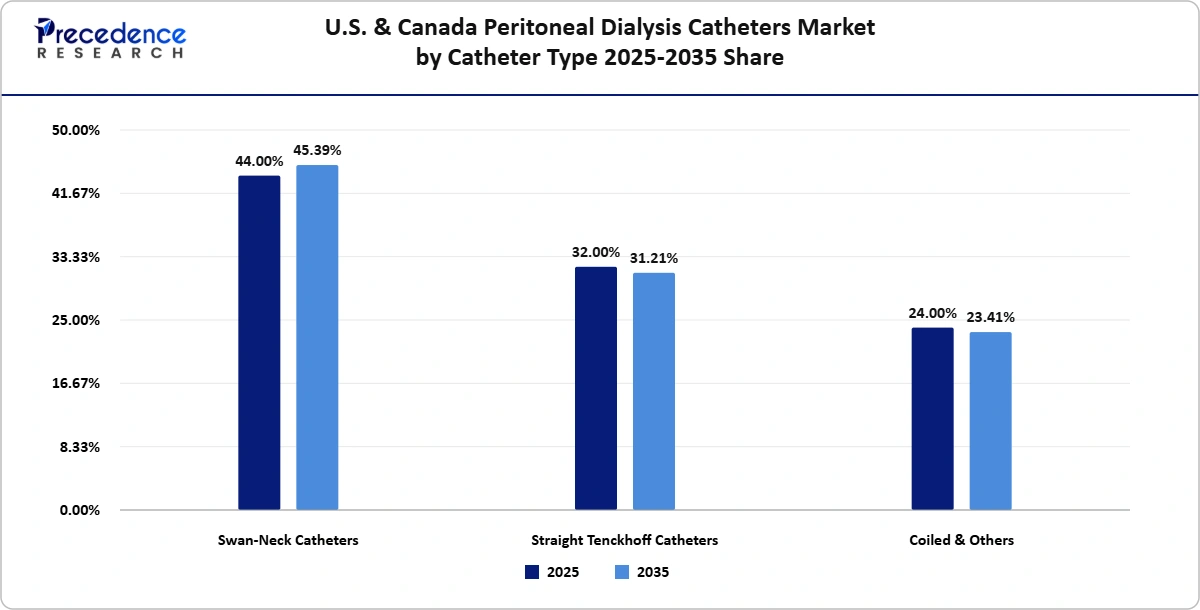
U.S. & Canada Peritoneal Dialysis Catheters Market By Catheter Type 2025-2035 Share
Note: 2025 is the base year; 2035 shares and CAGRs are forecasts.
Sources: Expert interviews, secondary sources, Precedence Research database, and Precedence Research analysts.
Swan-Neck Catheters accounted for 44% of the U.S. & Canada peritoneal dialysis catheters market in 2025, followed by Straight Tenckhoff Catheters at 32%, along with Coiled and Others at 24%. Swan-Neck Catheters dominate because their bent tunnel design helps reduce exit-site infections and catheter migration. Meanwhile, Swan-Neck Catheters are projected to record the fastest growth among catheter types through 2035.
Swan-Neck Catheters dominated the market in 2025, with a share of 44%. The segment is projected to grow at a CAGR of 7.13% from 2026 to 2035. Their bent tunnel design helps reduce exit-site infections and catheter migration, supporting their preference among healthcare providers. The segment is expected to grow faster than the overall market.
Straight Tenckhoff Catheters represented 32% of the market in 2025 and are forecast to expand at a CAGR of 6.53% through 2035. These catheters remain widely used in peritoneal dialysis procedures and continue to serve established clinical requirements. However, the segment is projected to grow at a slower pace than the overall market.
Coiled & Others accounted for 24% of the market in 2025 and are anticipated to register a CAGR of 6.53% by 2035. This segment includes coiled and other catheter designs that support different patient and clinical requirements. Demand for these products is expected to continue, with growth broadly aligned with the overall market.
Segment Outlook: Swan-Neck Catheters are set to remain the largest segment in the U.S. & Canada peritoneal dialysis catheters market, increasing their market share from 44% in 2025 to approximately 45.39% by 2035, with a CAGR of 7.13%. Straight Tenckhoff Catheters and Coiled and Others are expected to hold stable positions during the forecast period.
U.S. & Canada Peritoneal Dialysis Catheters Market By Insertion 2025 Share
| Segments | 2025 Share | 2035 Share | CAGR 2026-2035 |
| Laparoscopic | 46.00% | 43.09% | 6.11% |
| Percutaneous | 30.00% | 33.56% | 8.01% |
| Open Surgical | 24.00% | 23.34% | 6.51% |
Note: 2025 is the base year; 2035 shares and CAGRs are forecasts.
Sources: Expert interviews, secondary sources, Precedence Research database, and Precedence Research analysts.
Laparoscopic insertion accounted for 46% of the market in 2025, followed by Percutaneous at 30% and Open Surgical at 24%. Laparoscopic placement dominates because it enables precise catheter positioning. Meanwhile, Percutaneous insertion is projected to record the fastest growth across the forecast period.
Laparoscopic insertion represented 46% of the market in 2025 and is projected to grow at a CAGR of 6.11% from 2026 to 2035. This method remains widely used because it allows precise catheter positioning during placement. However, the segment is expected to grow more slowly than the overall market.
Percutaneous insertion held a 30% market share in 2025 and is expected to expand at a CAGR of 8.01% through 2035. Its growth is supported by increasing adoption among interventional radiologists and nephrologists. The segment is projected to grow faster than the overall market and gain market share during the forecast period.
Open Surgical insertion accounted for 24% of the market in 2025. The segment is anticipated to register a CAGR of 6.51% over the forecast period. This approach continues to serve specific catheter placement requirements. The segment is expected to grow broadly in line with the overall market.
Segment Outlook: Laparoscopic insertion is expected to remain the largest insertion segment through 2035, although its market share is projected to decline from 46% in 2025 to around 43.09% in 2035. Percutaneous insertion is anticipated to record the highest growth, with a CAGR of 8.01%, increasing its share to 33.56%. Open Surgical insertion will continue to serve specialized placement requirements.
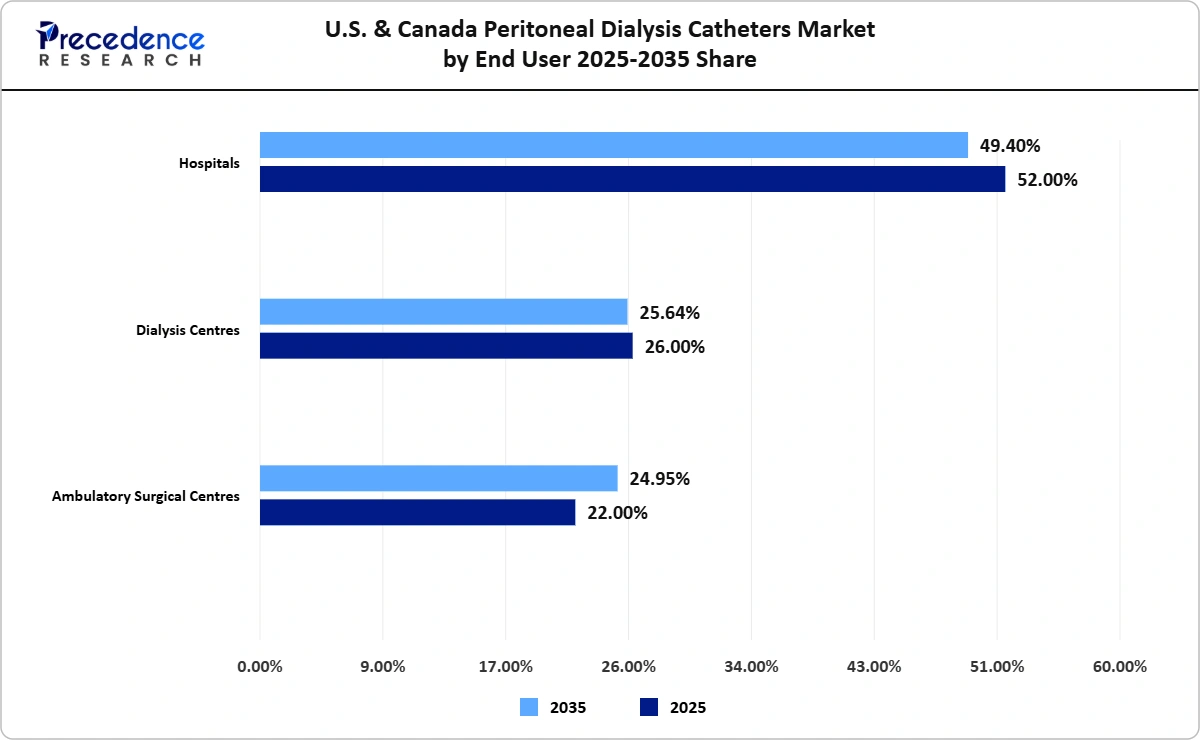
U.S. & Canada Peritoneal Dialysis Catheters Market By End User 2025-2035 Share
Note: 2025 is the base year; 2035 shares and CAGRs are forecasts.
Sources: Expert interviews, secondary sources, Precedence Research database and Precedence Research analysts.
In 2025, Hospitals accounted for 52% of the U.S. & Canada peritoneal dialysis catheters market, followed by Dialysis Centres at 26% and Ambulatory Surgical Centres at 22%. Hospitals dominate because a significant proportion of catheter placements take place in hospital operating rooms. Meanwhile, Ambulatory Surgical Centres are projected to record the fastest growth from 2026 to 2035.
Hospitals represented 52% of the market in 2025 and are projected to grow at a CAGR of 6.25% from 2026 to 2035. Hospitals remain the leading end-user segment because they provide the infrastructure and surgical facilities required for catheter placement. However, the segment is expected to grow more slowly than the overall market.
Dialysis Centres held a 26% market share in 2025 and are forecast to expand at a CAGR of 6.65% through 2035. These facilities manage peritoneal dialysis programmes and support patients undergoing continuous ambulatory and automated peritoneal dialysis. The segment is expected to grow broadly in line with the overall market.
Ambulatory Surgical Centres accounted for 22% of the market in 2025. The segment is anticipated to register a CAGR of 8.15% during 2026 to 2035. Its growth is supported by the demand for outpatient catheter placement. The segment is expected to grow faster than the overall market and gain market share throughout the forecast period.
Segment Outlook: During the forecast period, Hospitals are expected to remain the largest end-user segment, although their market share is projected to decline from 52% in 2025 to around 49.40% in 2035. Ambulatory Surgical Centres are expected to record the fastest growth, registering a CAGR of 8.15% and increasing their share to 24.95%. Dialysis Centres will continue to support the delivery and management of peritoneal dialysis programmes.
Analyst View: In our analysis, segment estimates were developed by allocating market demand according to catheter types, insertion methods, end-user requirements, and pricing. Swan-Neck Catheters, Laparoscopic insertion, and Hospitals remain the leading segments because they address the core requirements of current buyers. However, Percutaneous insertion and Ambulatory Surgical Centres are expected to gain market share as adoption of newer placement methods and outpatient procedures increases.
Country Analysis of the U.S. & Canada Peritoneal Dialysis Catheters Market
U.S. & Canada Peritoneal Dialysis Catheters Market By Country 2025 Share
| Country | 2025 Share | 2035 Share | CAGR 2026-2035 |
| U.S. | 88.00% | 86.34% | 6.60% |
| Canada | 12.00% | 13.66% | 8.20% |
Note: 2025 is the base year; 2035 shares and CAGRs are forecasts.
Sources: Expert interviews, secondary sources, Precedence Research database, and Precedence Research analysts.
In 2025, the U.S. & Canada peritoneal dialysis catheters market was dominated by the U.S., with an 88% revenue share. The country is expected to maintain its lead, supported by its large dialysis population and policies promoting home-based dialysis. Canada accounted for the remaining 12% share and is projected to record the fastest growth through 2035.
The U.S. accounted for 88% of the market in 2025 and is forecast to register a CAGR of 6.60% during the forecast period. The country benefits from a large dialysis patient population, established healthcare infrastructure, and policies supporting home dialysis adoption. Increasing patient preference for home-based treatment and advancements in peritoneal dialysis systems are expected to sustain demand. The U.S. is projected to grow broadly in line with the overall market through 2035.
Canada held a 12% market share in 2025 and is anticipated to grow at a CAGR of 8.20% from 2026 to 2035. Canada has an established peritoneal dialysis treatment base among kidney failure patients. Investment in home dialysis programmes and expanding treatment adoption are expected to support market expansion. Canada is projected to grow faster than the overall market during the forecast period.
Analyst View: In our analysis, country-level estimates were developed using demand, installed base, spending, and supplier presence across individual markets. The U.S. is expected to maintain its leading position, supported by its large dialysis population and established healthcare infrastructure. Canada is projected to experience faster growth due to its high peritoneal dialysis utilization and expanding adoption.
Competitive Landscape
Top 10 Companies in the U.S. & Canada Peritoneal Dialysis Catheters Market, 2025
| Rank | Company Name | 2025 Share (%) | Key Products / Business | Headquarters |
| 1 | Medtronic | 22.00% | Argyle PD catheters | Ireland |
| 2 | Baxter International (Vantive) | 22.00% | PD catheters and systems | United States |
| 3 | Fresenius Medical Care | 16.00% | PD catheters and products | Germany |
| 4 | Merit Medical Systems | 10.00% | PD catheters and access kits | United States |
| 5 | Cook Medical | 5.00% | PD catheter kits | United States |
| 6 | B. Braun | 4.00% | Dialysis products | Germany |
| 7 | Teleflex | 3.00% | Access products | United States |
| 8 | Boston Scientific | 2.00% | Access products | United States |
| 9 | Cardinal Health | 2.00% | Dialysis consumables | United States |
| 10 | AngioDynamics | 2.00% | Access products | United States |
Note: Company shares are 2025 estimates.
Sources: Company press releases, expert interviews, secondary sources, Precedence Research database and Precedence Research analysts.
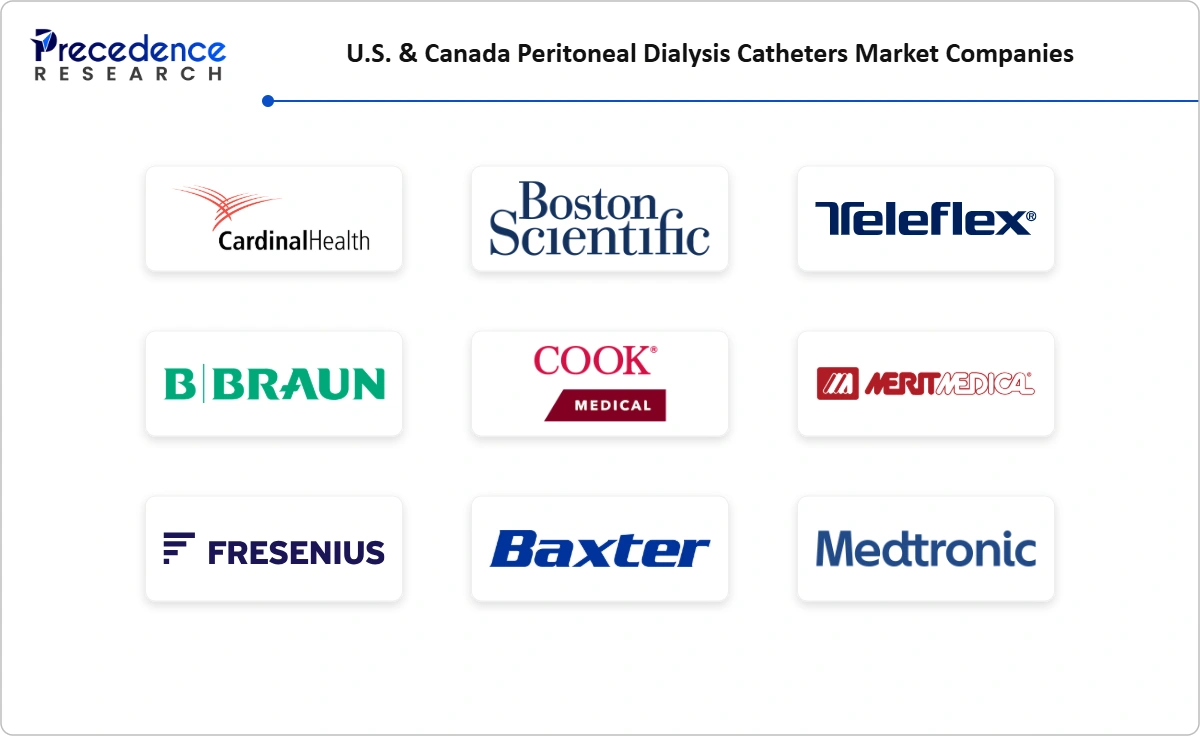
Medtronic and Baxter International (Vantive) jointly led the U.S. & Canada peritoneal dialysis catheters market, each accounting for an estimated 22% share of 2025 revenue. Fresenius Medical Care followed with a 16% share, while Merit Medical Systems accounted for 10%.
Medtronic maintains its market position through Argyle PD catheters, while Baxter International (Vantive) competes through its PD catheters and systems. Fresenius Medical Care offers PD catheters and related products, while Merit Medical Systems focuses on PD catheters and access kits.
Other prominent participants include Cook Medical, B. Braun, Teleflex, Boston Scientific, Cardinal Health, and AngioDynamics. These companies compete through PD catheter kits, dialysis products, access products, and dialysis consumables.
In 2025, the top 10 companies accounted for an estimated 88% of the market, while the remaining 12% was shared among other specialized manufacturers. The U.S. & Canada peritoneal dialysis catheters market is concentrated, with companies competing on catheter design, infection and migration rates, insertion kits, clinician training, and contracts with dialysis providers.
Company Snapshots
Medtronic: Medtronic maintained a prominent position in the U.S. & Canada peritoneal dialysis catheters market, accounting for an estimated 22% share in 2025. Its Argyle PD catheter range forms an important part of its product offerings in this category. The company features in the Leader quadrant of the Precedence Research Companies Quadrant.
Baxter International (Vantive): With an estimated 22% market share in 2025, Baxter International remained one of the key participants in the regional peritoneal dialysis catheters market. Its portfolio spans PD catheters and associated systems, reflecting its established presence in dialysis care. The company holds a Leader classification in the Precedence Research Companies Quadrant.
Fresenius Medical Care: Fresenius Medical Care represented approximately 16% of the U.S. & Canada market in 2025. The Germany-based company offers peritoneal dialysis catheters alongside related dialysis products, extending its presence across the renal care equipment landscape. Its competitive standing places it among the Leaders in the Precedence Research Companies Quadrant.
Merit Medical Systems: Merit Medical Systems contributed an estimated 10% to the regional market in 2025. Its offerings include PD catheters and access kits, addressing specific product requirements within the peritoneal dialysis segment. The company is identified as a Leader in the Precedence Research Companies Quadrant.
Cook Medical: Cook Medical accounted for around 5% of the market in 2025, with peritoneal dialysis catheter kits representing a key part of its relevant product portfolio. The U.S.-headquartered company is also included in the Leader category of the Precedence Research Companies Quadrant.
B. Braun: Germany-based B. Braun held approximately 4% of the U.S. & Canada peritoneal dialysis catheters market in 2025. Its established dialysis product portfolio underpins its participation in this segment. Within the Precedence Research Companies Quadrant, B. Braun is positioned among the Leaders.
Teleflex: In 2025, Teleflex held a relatively smaller position in the regional market, representing an estimated 3% share. Its medical access product portfolio supports its involvement in this space. The company is categorized as an Innovator in the Precedence Research Companies Quadrant.
Boston Scientific: Accounting for approximately 2% of the market in 2025, Boston Scientific participated in the competitive landscape through its medical access product offerings. The U.S.-based company's position in the Precedence Research Companies Quadrant is classified as Innovator.
Cardinal Health: Cardinal Health represented an estimated 2% of the U.S. & Canada market in 2025. Its dialysis consumables portfolio forms the basis of its participation in this product category. The company falls within the Innovator segment of the Precedence Research Companies Quadrant.
AngioDynamics: AngioDynamics held an approximately 2% share of the market in 2025, with its product portfolio focused on medical access solutions. The U.S.-based company occupies the Innovator category in the Precedence Research Companies Quadrant.
Companies Ecosystem
The U.S. & Canada peritoneal dialysis catheters ecosystem connects material suppliers, catheter manufacturers, dialysis providers, physicians, and payers and regulators. Each stage contributes to the development, production, placement, and use of peritoneal dialysis catheters across the region.
| Ecosystem Stage | Role in the Market | Key Companies |
| Material Suppliers | Supply silicone and cuffs | Silicone makers |
| Catheter Makers | Make PD catheters | Medtronic, Vantive, Fresenius, Merit Medical |
| Dialysis Providers | Run PD programmes | DaVita, Fresenius Kidney Care |
| Physicians | Place catheters | Surgeons, nephrologists, radiologists |
| Payers & Regulators | Pay and regulate | CMS, provinces, FDA |
Sources: Company press releases, expert interviews, secondary sources, Precedence Research database and Precedence Research analysts.
Material Suppliers: Key suppliers for peritoneal dialysis catheters include silicone manufacturers that provide silicone and cuffs for production.
Catheter Makers: Catheter manufacturers provide peritoneal dialysis catheters and related insertion products, with key companies including Medtronic, Vantive, Fresenius, and Merit Medical.
Dialysis Providers: Organizations such as DaVita and Fresenius Kidney Care manage peritoneal dialysis programs and provide support for patients undergoing treatment.
Physicians: Physicians, including surgeons, nephrologists, and radiologists, are responsible for catheter placement and related clinical procedures.
Payers & Regulators: Organizations such as CMS, provincial authorities, and the FDA establish reimbursement frameworks and regulate the market.
Value in the U.S. & Canada peritoneal dialysis catheters market flows from upstream material and technology suppliers to manufacturers and service providers, then through distribution partners to end users. Companies that integrate several stages or build long-term relationships with end users capture a larger share of this value.
Precedence Research Companies Quadrant
The Precedence Research Companies Quadrant positions key participants in the U.S. & Canada peritoneal dialysis catheters market by market strength, reflecting revenue scale, market share, and geographic reach, and by innovation and growth strategy, reflecting product portfolio breadth, R&D intensity, and partnerships. Positions reflect each company's estimated 2025 share of the U.S. & Canada peritoneal dialysis catheters market and our assessment of its product innovation, portfolio breadth, and partnerships.
Sources: Company press releases, expert interviews, secondary sources, Precedence Research database and Precedence Research analysts.
Leaders: Medtronic, Baxter International (Vantive), Fresenius Medical Care, Merit Medical Systems, Cook Medical, and B. Braun combine high market share with broad portfolios and strong innovation.
Innovators: Teleflex, Boston Scientific, Cardinal Health, and AngioDynamics bring specialized technologies and products.
Recent Developments
- October 2025: Simergent received FDA 510(k) clearance for its Archimedes automated peritoneal dialysis system for clinic and home use, with a U.S. launch planned for 2026, adding to home PD options.
U.S. & Canada Peritoneal Dialysis Catheters MarketSegments
By Catheter Type
- Swan-Neck Catheters
- Straight Tenckhoff Catheters
- Coiled & Others
By Insertion
- Laparoscopic
- Percutaneous
- Open Surgical
By End User
- Hospitals
- Dialysis Centres
- Ambulatory Surgical Centres
By Country
- U.S.
- Canada
Research Methodology: The U.S. & Canada peritoneal dialysis catheters market was defined as the market for catheters used in peritoneal dialysis across the United States and Canada. The assessment includes straight and coiled Tenckhoff catheters, Swan-Neck catheters, presternal and extended catheters, single and double cuffs, and insertion kits. The market covers products placed through surgical, laparoscopic, and percutaneous methods and used by hospitals, dialysis centres, and ambulatory surgical centres for patients undergoing continuous ambulatory and automated peritoneal dialysis. The 2025 base-year estimate was developed using a bottom-up analysis of demand volumes and average prices across catheter types, insertion methods, end users, and countries. The estimate was cross-validated against market-specific revenues of leading companies and published market estimates. Segment, country, and company values were allocated according to catheter type, insertion method, end-user demand, and regional consumption. Key estimates were verified by cross-checking company disclosures, regulatory and industry data, and published third-party estimates. Inputs that could not be reconciled were excluded. All segment, regional, and company figures were aligned with the same 2025 base year, and the 2026-2035 forecast was recalculated and validated using the projected CAGR.
Analyst View: The U.S. & Canada peritoneal dialysis catheters market is projected to experience steady growth through 2035, supported by rising kidney failure cases and increasing adoption of home-based dialysis. Swan-Neck Catheters will remain the leading catheter type, while Laparoscopic insertion and Hospitals will continue to represent the largest segments. However, Percutaneous insertion and Ambulatory Surgical Centres are expected to gain market share as newer placement methods and outpatient procedures expand. The U.S. will maintain market dominance with its large dialysis population and established healthcare infrastructure, while Canada is expected to record faster growth due to its high peritoneal dialysis utilization. Urgent-start PD, home dialysis programmes, and advancements in catheter designs will create further growth opportunities. However, catheter infections, limited surgeon training, and low PD awareness may restrict market expansion.
Sources and References
- BioSpace / PR Newswire. "Simergent announces FDA clearance of the Archimedes home dialysis system". October 2025. News. (Source: biospace.com)
For inquiries regarding discounts, bulk purchases, or customization requests, please contact us at sales@precedenceresearch.com
Frequently Asked Questions





Ask For Sample
No cookie-cutter, only authentic analysis – take the 1st step to become a Precedence Research client
 Get a Sample




 sales@precedenceresearch.com
 Schedule a Meeting