


U.S. & Canada Inpatient Behavioral Health Market Revenue, Leading Companies, Company Technology / Innovation, Diagnostic Testing Volume, Adoption Rates, Pricing Metrics, Supply Chain Performance, Competitive Positioning, and Industry Trends
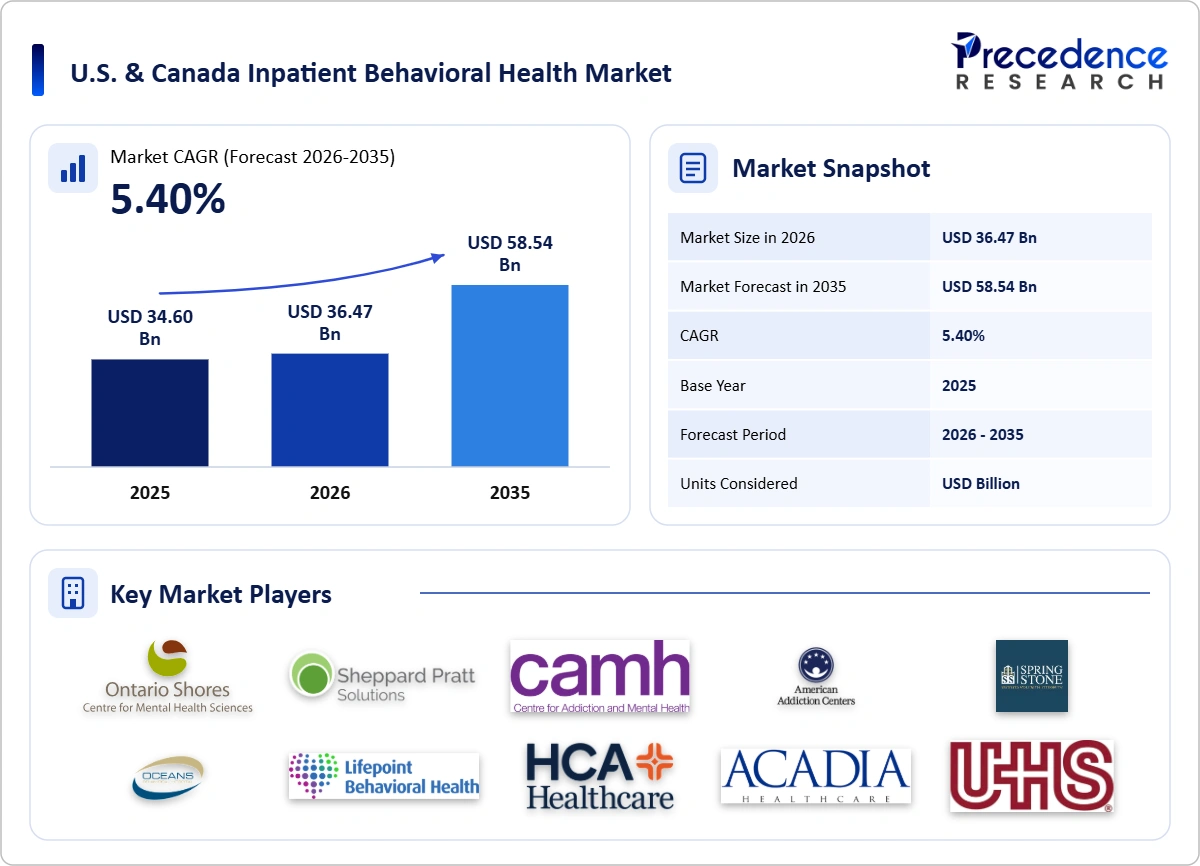
Payal Rabde, a Healthcare Industry Expert, highlights that the U.S. & Canada inpatient behavioral health market has reached USD 36.47 billion in 2026 and is on track to reach USD 58.54 billion by 2035, advancing at a CAGR of 5.40%. Key U.S. & Canada inpatient behavioral health market companies shaping the market include Universal Health Services, Acadia Healthcare, HCA Healthcare, while major growth segments span service, facility, payer.
Source: https://www.precedenceresearch.com/us-and-canada-inpatient-behavioral-health-market
 Get a Sample
 Table Of Content
Key Takeaways
Market Size & Growth Outlook
- Market size in 2025: USD 34.60 billion
- Estimated market size in 2026: USD 36.47 billion
- Projected market size by 2035: USD 58.54 billion
- CAGR (2026-2035): 5.40%
Regional Market Spotlight
- The U.S. dominated the market with a 91.00% share in 2025.
- Canada held a 9.00% share in 2025 and is projected to be the fastest-growing country, at a CAGR of 6.85% from 2026 to 2035.
Segmental Spotlight
- Acute psychiatric care contributed 56.00% of the market in 2025, positioning it as the leading service area.
- By facility, freestanding psychiatric hospitals accounted for a 46.00% share in 2025.
- In 2025, Public (Medicare & Medicaid / Provincial) represented the largest payer segment, with a 56.00% share.
U.S. & Canada Inpatient Behavioral Health Market Size and Forecast, 2025-2035 (USD Billion)
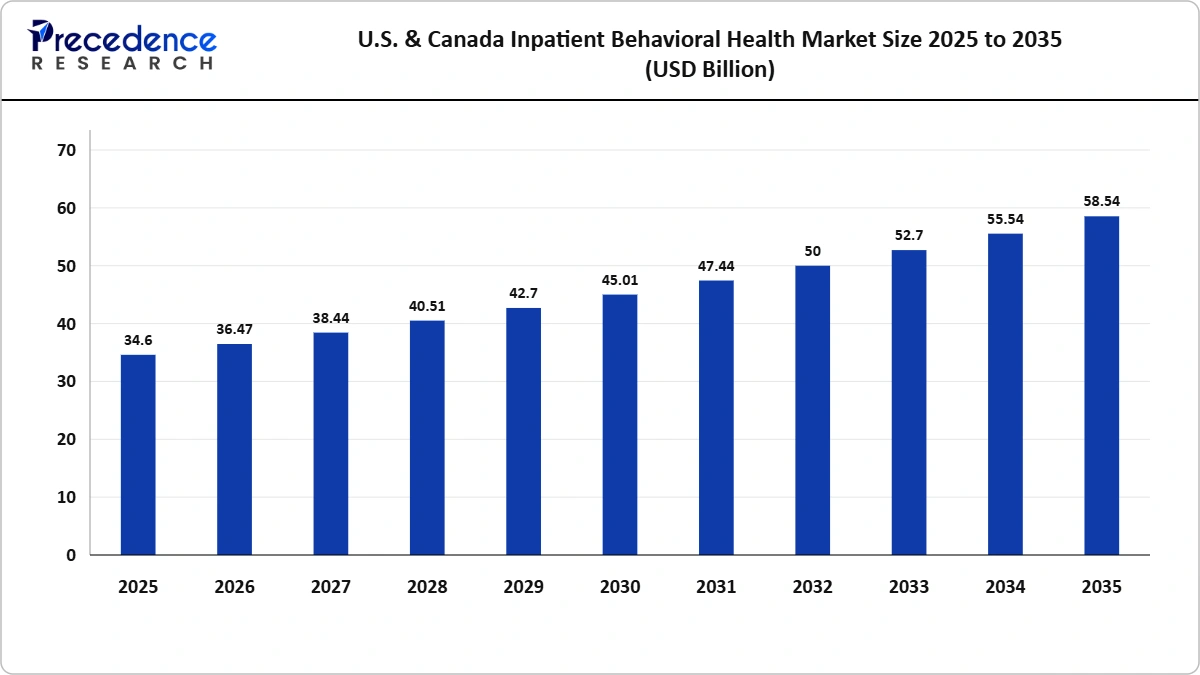
Note: 2025 is the base year; 2026-2035 values are forecasts.
Sources: Expert interviews, secondary sources, Precedence Research database, and Precedence Research analysts.
The U.S. & Canada inpatient behavioral health market is projected to grow from USD 34.60 billion in 2025 to USD 58.54 billion by 2035 because many people with severe mental illness or addiction need inpatient care, and bed shortages keep demand high. Rising mental illness, addiction, bed shortages, and parity rules support steady growth, lifting the market to USD 45.01 billion by 2030 and sustaining a 5.40% CAGR during the forecast period. Inpatient behavioral health links to outpatient behavioral health and digital health follow-up.
Analyst View: The market is expected to rise steadily due to increased incidences of mental health and drug abuse, ongoing shortages of inpatient beds, and stricter insurance parity regulations. The need for integrated care models that link inpatient services with outpatient treatment and digital health follow-up is also being reinforced by the growing demand for intensive treatment.
Market Trends
- Healthcare providers are expanding inpatient capacity through joint ventures and strategic partnerships.
- Demand for substance use disorder treatment, particularly fentanyl-related care, continues to rise.
- Stronger enforcement of mental health parity regulations is improving access to behavioral health services.
- Staffing shortages remain a key operational challenge for inpatient behavioral health facilities.
- Providers are increasingly emphasizing step-down care and transitions to outpatient services.
- Rising mental health needs among younger populations are driving demand.
Drivers, Restraints, and Opportunities
Driver
Rising mental illness and addiction rates, persistent inpatient bed shortages, stronger mental health parity laws, expanding health system partnerships, and growing youth mental health needs are driving demand for inpatient behavioral health services.
Restraint
Staffing shortages, Medicaid funding pressures, increasing regulatory scrutiny, and the gradual shift toward outpatient care may limit market growth and constrain inpatient capacity.
Opportunity
Market participants can capitalize on opportunities through joint venture hospitals, expanded addiction treatment services, increased bed capacity in Canada, growing demand for geriatric psychiatry, and the development of crisis stabilization units.
Market Drivers - Impact & CAGR Contribution (2026-2035)
| Driver | Impact | ≈ CAGR Contribution | Time Horizon | Key Regions |
| Mental illness and addiction rise | High | +2.11 pp | Short to long term | Both countries, strongest in U.S. |
| Bed shortages | Medium | +1.78 pp | Medium to long term | Both countries, fastest uptake in Canada |
| Parity laws | Medium | +1.52 pp | Short to medium term | Both countries |
| Health system partnerships | Low | +1.19 pp | Long term | U.S. and Canada |
Note: Contributions are indicative estimates of each factor's effect on annual growth.
Sources: Expert interviews, secondary sources, Precedence Research database, and Precedence Research analysts.
Taken together, these drivers add about 6.59 percentage points to the annual growth of the U.S. & Canada inpatient behavioral health market, with mental illness and addiction rise having the largest effect. Their influence is strongest in the U.S., while uptake grows fastest in Canada.
Market Restraints - Impact & Negative CAGR Contribution (2026-2035)
| Restraint | Impact | ≈ Negative CAGR Contribution | Time Horizon | Key Regions |
| Staff shortages | High | -0.53 pp | Short to medium term | Both countries |
| Medicaid funding pressure | High | -0.39 pp | Medium term | Smaller and price-sensitive markets |
| Regulatory scrutiny | Medium | -0.26 pp | Short term | U.S. and other mature markets |
Note: Contributions are indicative estimates of each factor's effect on annual growth.
Sources: Expert interviews, secondary sources, Precedence Research database, and Precedence Research analysts.
These restraints are expected to reduce annual growth of the U.S. & Canada inpatient behavioral health market by about 1.19 percentage points, led by staff shortages. Their effect eases over the forecast period as suppliers, buyers, and regulators adapt, leaving a net CAGR of 5.40% from 2026 to 2035.
Market Segmentation: 2025 Share and Size
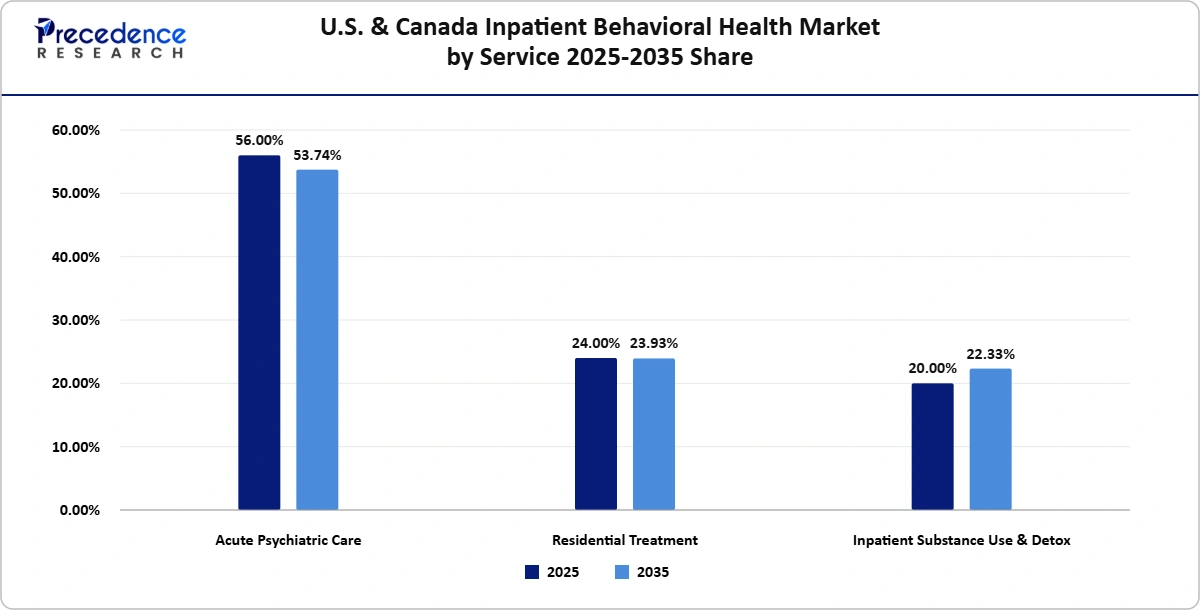
U.S. & Canada Inpatient Behavioral Health Market by Service 2025 Share
Note: 2025 is the base year; 2035 shares and CAGRs are forecasts.
Sources: Expert interviews, secondary sources, Precedence Research database, and Precedence Research analysts.
Acute Psychiatric Care accounted for 56.00% in 2025, Residential Treatment for 24.00%, and Inpatient Substance Use & Detox for 20.00%. Acute Psychiatric Care leads, while Inpatient Substance Use & Detox is growing fastest.
Acute Psychiatric Care: Accounting for 56.00% of the market in 2025, this segment is forecast to maintain steady growth at a CAGR of 4.97% over the forecast period. Acute psychiatric care leads because crisis stabilization needs 24-hour hospital care. The acute psychiatric care segment is projected to grow slower than the overall market through 2035.
Residential Treatment: The segment captured 24.00% of the total market in 2025 and is anticipated to register a CAGR of 5.37% between 2026 and 2035. Residential treatment provides longer stays. The residential treatment segment is expected to expand broadly in line with the overall market over the forecast period.
Inpatient Substance Use & Detox: The segment held a substantial 20.00% share of the market in 2025, with growth projected at a 6.57% CAGR through 2035. Inpatient substance use and detox grows fastest with the opioid and fentanyl crisis. The inpatient substance use & detox segment is expected to grow faster than the overall market from 2026 to 2035.
Segment Outlook: Acute Psychiatric Care remains the largest service segment through 2035, capturing about 53.74% of the market in 2035, while Inpatient Substance Use & Detox records the highest CAGR of 6.57% from 2026 to 2035. Although Inpatient Substance Use & Detox starts from the smallest base, its faster growth shows how demand is shifting within the U.S. & Canada inpatient behavioral health market.
U.S. & Canada Inpatient Behavioral Health Market by Facility 2025 Share
| Segments | 2025 Share | 2035 Share | CAGR 2026-2035 |
| Freestanding Psychiatric Hospitals | 46.00% | 44.09% | 4.95% |
| General Hospital Psychiatric Units | 36.00% | 35.84% | 5.35% |
| Residential Treatment Centers | 18.00% | 20.07% | 6.55% |
Note: 2025 is the base year; 2035 shares and CAGRs are forecasts.
Sources: Expert interviews, secondary sources, Precedence Research database, and Precedence Research analysts.
Freestanding Psychiatric Hospitals represented 46.00% in 2025, General Hospital Psychiatric Units at 36.00%, and Residential Treatment Centers at 18.00%. Freestanding Psychiatric Hospitals lead, while Residential Treatment Centers are growing fastest.
Freestanding Psychiatric Hospitals: In 2025, the segment represented 46.00% of the overall market and is expected to achieve a CAGR of 4.95% over the 2026-2035 period. Freestanding psychiatric hospitals lead because large operators run dedicated facilities. The freestanding psychiatric hospitals segment is projected to grow slower than the overall market during the forecast period.
General Hospital Psychiatric Units: This segment accounted for 36.00% of the U.S. & Canada inpatient behavioral health market in 2025 and is projected to expand at a CAGR of 5.35% from 2026 to 2035. General hospital units serve emergency patients. The general hospital psychiatric units segment is expected to grow broadly in line with the overall market through 2035.
Residential Treatment Centers: With a market contribution of 18.00% in 2025, residential treatment centers are expected to witness the fastest expansion at a CAGR of 6.55% from 2026 to 2035. Residential treatment centers are seeing rising demand for structured, long-term mental health and addiction care. The residential treatment centers segment is anticipated to grow faster than the overall market over the forecast period.
Segment Outlook: Freestanding Psychiatric Hospitals remain the largest facility segment through 2035, holding about 44.09% of the market in 2035, while Residential Treatment Centers record the highest CAGR of 6.55% through 2035. Although Residential Treatment Centers start from the smallest base, their faster growth shows how demand is shifting within the U.S. & Canada inpatient behavioral health market.
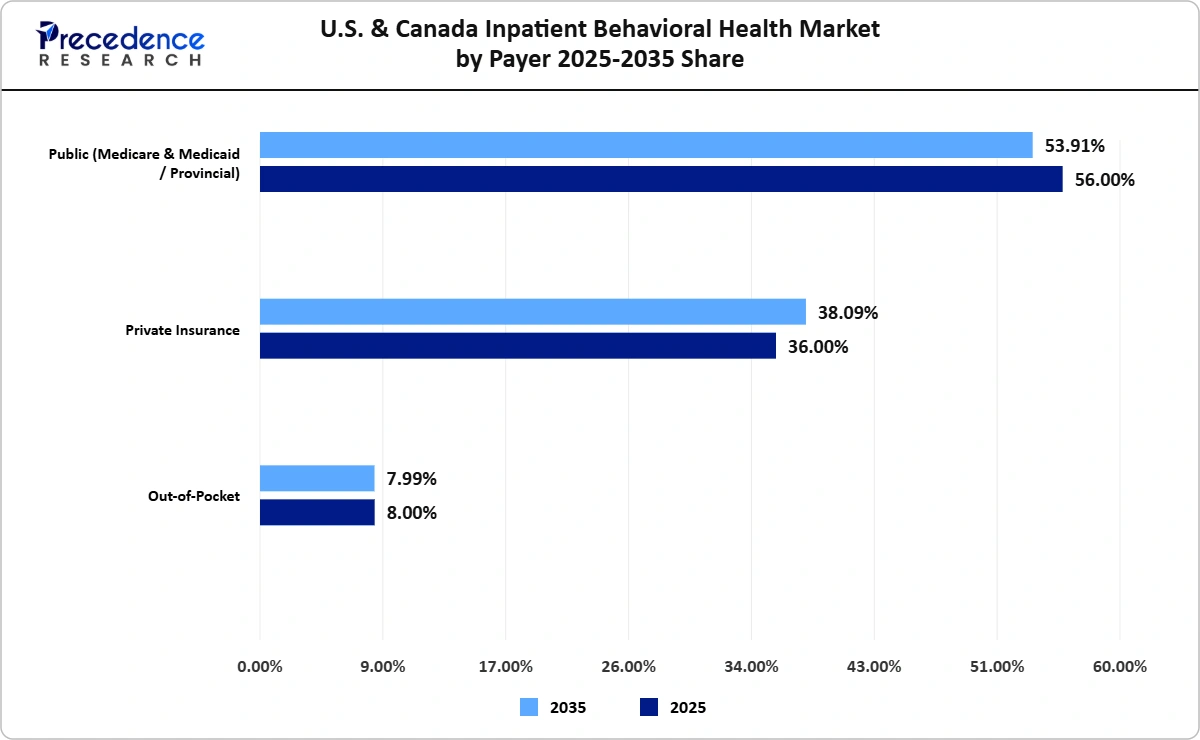
U.S. & Canada Inpatient Behavioral Health Market by Payer 2025 Share
Note: 2025 is the base year; 2035 shares and CAGRs are forecasts.
Sources: Expert interviews, secondary sources, Precedence Research database, and Precedence Research analysts.
Public (Medicare & Medicaid / Provincial) contributed 56.00% in 2025, Private Insurance at 36.00%, and Out-of-Pocket at 8.00%. Public (Medicare & Medicaid / Provincial) leads, while Private Insurance is growing fastest.
Public (Medicare & Medicaid / Provincial): This segment captured 56.00% of the market in 2025 and is projected to grow at a CAGR of 5.00% over the forecast period. Public payers lead because Medicaid, Medicare, and Canadian provinces fund most inpatient psychiatric care. The public (Medicare & Medicaid / provincial) segment is expected to expand slower than the overall market from 2026 to 2035.
Private Insurance: The segment accounted for 36.00% of the total market in 2025 and is anticipated to register a CAGR of 6.00% between 2026 and 2035. Private insurance grows with parity rules. The private insurance segment is projected to grow faster than the overall market during the forecast period.
Out-of-Pocket: Representing 8.00% of the market in 2025, the out-of-pocket segment is forecast to maintain steady growth at a CAGR of 5.40% during the forecast period. Out-of-pocket completes payment. The Out-of-Pocket segment is expected to grow broadly in line with the overall market between 2026 and 2035.
Segment Outlook: Public (Medicare & Medicaid / Provincial) remains the largest payer segment through 2035, accounting for about 53.91% of the market in 2035, while Private Insurance records the highest CAGR of 6.00% from 2026 to 2035. Out-of-Pocket holds the smallest share and serves more specialized needs within the U.S. & Canada inpatient behavioral health market.
Analyst View: The market is primarily driven by acute psychiatric care, freestanding psychiatric hospitals, and public payers, reflecting the essential role of hospital-based treatment and government-funded coverage. However, faster increases in residential treatment facilities, private insurance, and inpatient substance use & detox emphasize the need for structured long-term care, growing addiction treatment needs, and expanding insurance coverage.
Country Analysis
U.S. & Canada Inpatient Behavioral Health Market by Country 2025 Share
| Country | 2025 Share | 2035 Share | CAGR 2026-2035 |
| U.S. | 91.00% | 89.68% | 5.25% |
| Canada | 9.00% | 10.32% | 6.85% |
Note: 2025 is the base year; 2035 shares and CAGRs are forecasts.
Sources: Expert interviews, secondary sources, Precedence Research database, and Precedence Research analysts.
U.S. accounted for 91.00% in 2025 and Canada accounted for 9.00%. U.S. leads, while Canada is growing fastest.
U.S.: In 2025, the U.S. represented 91.00% of the overall market and is expected to achieve a CAGR of 5.25% over the 2026-2035 period. The U.S. leads because of its large population, many psychiatric hospitals, and higher prices. U.S. is projected to grow broadly in line with the overall market between 2026 and 2035.
Canada: With a market contribution of 44.00% in 2025, Canada is projected to witness the fastest expansion at a CAGR of 9.00% from 2026 to 2035. Canada grows fastest as provinces add mental health beds. Canada is expected to expand faster than the overall market over the forecast period.
Analyst View: The U.S. dominates the inpatient behavioral health market, supported by its extensive psychiatric hospital infrastructure, large patient population, and higher treatment costs. However, Canada is expected to experience faster growth, driven by provincial investments in mental health infrastructure and expanding inpatient bed capacity.
Competitive Landscape
Top Companies in the U.S. & Canada Inpatient Behavioral Health Market
| Rank | Company Name | 2025 Share (%) | Key Products / Business | Headquarters |
| 1 | Universal Health Services | 12.00% | Behavioral health hospitals | United States |
| 2 | Acadia Healthcare | 9.00% | Psychiatric and addiction facilities | United States |
| 3 | HCA Healthcare | 4.00% | Psychiatric units | United States |
| 4 | LifePoint Behavioral Health | 3.00% | Behavioral health hospitals and units | United States |
| 5 | Oceans Healthcare | 1.00% | Behavioral hospitals | United States |
| 6 | Springstone | 1.00% | Behavioral hospitals | United States |
| 7 | American Addiction Centers | 1.00% | Residential addiction treatment | United States |
| 8 | Centre for Addiction and Mental Health | 1.00% | Psychiatric hospital | Canada |
| 9 | Sheppard Pratt | 1.00% | Behavioral health system | United States |
| 10 | Ontario Shores Centre for Mental Health Sciences | 0.50% | Psychiatric hospital | Canada |
Note: Company shares are 2025 estimates.
Sources: Company press releases, expert interviews, secondary sources, Precedence Research database and Precedence Research analysts.
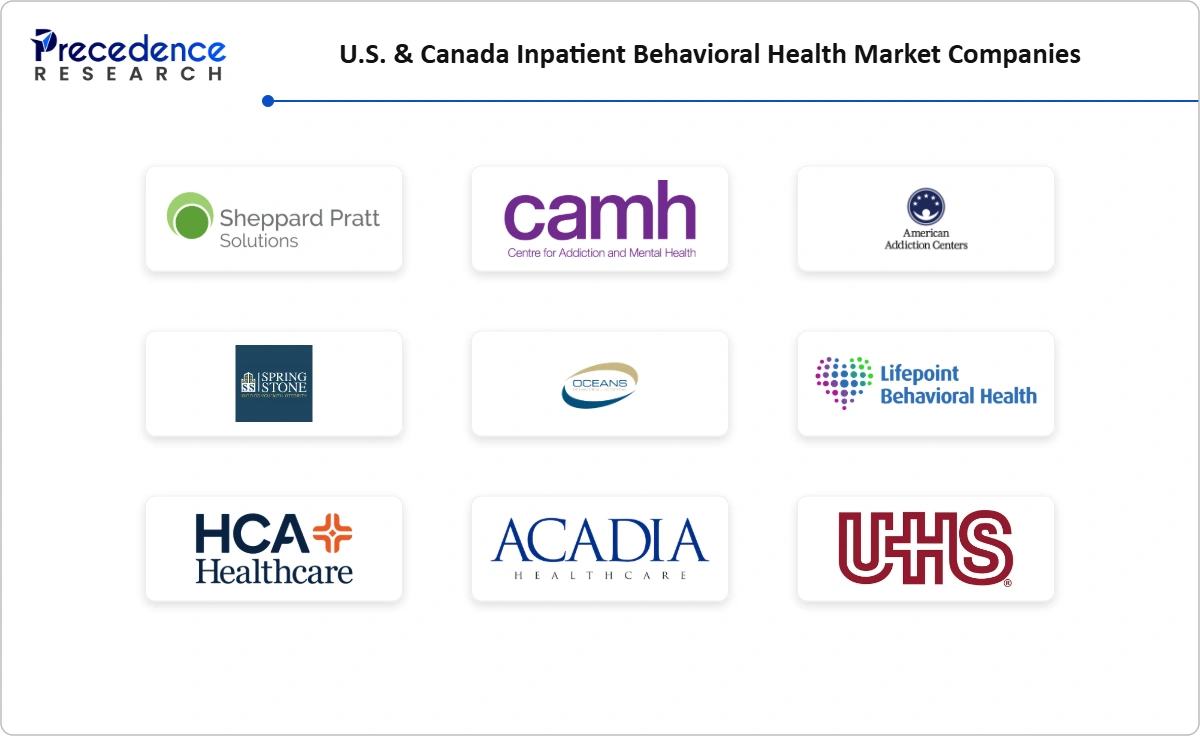
Universal Health Services led the U.S. & Canada inpatient behavioral health market with 12.00% share of 2025 revenue, followed by Acadia Healthcare at 9.00% share and HCA Healthcare at 4.00% share. Universal Health Services leads with behavioral health hospitals, Acadia Healthcare competes with psychiatric and addiction facilities, and HCA Healthcare offers psychiatric units. LifePoint Behavioral Health, Oceans Healthcare, Springstone, American Addiction Centers, Centre for Addiction and Mental Health, Sheppard Pratt, and Ontario Shores Centre for Mental Health Sciences compete through behavioral health hospitals and units, behavioral hospitals, residential addiction treatment, psychiatric hospitals, behavioral health systems, and psychiatric hospitals.
The top 10 players accounted for 33.50% of 2025 revenue, while the remaining 66.50% was shared among many non-profit, public, and state psychiatric hospitals. The U.S. & Canada inpatient behavioral health market is fragmented, and competition centers on bed capacity, payer contracts, staffing, quality and safety, joint ventures with health systems, and regulatory compliance.
Company Snapshots
Universal Health Services: Headquartered in the United States. It captured 12.00% share of the U.S. & Canada inpatient behavioral health market in 2025. Its offering centers on Behavioral health hospitals. In the Precedence Research Companies Quadrant, it is positioned as a Leader.
Acadia Healthcare: United States-based Acadia Healthcare accounted for 9.00% of the U.S. & Canada inpatient behavioral health market share in 2025. It focuses on psychiatric and addiction facilities. This company is positioned as a Leader in the Precedence Research Companies Quadrant.
HCA Healthcare: Based in the United States, this company contributed 4.00% of the U.S. & Canada inpatient behavioral health market in 2025. It specializes in psychiatric units. In the Precedence Research Companies Quadrant, it is categorized as a Leader.
LifePoint Behavioral Health: Represented 3.00% share of the market in 2025, headquartered in the United States. Its offering centers on Behavioral health hospitals and units. It is positioned as a Leader in the Precedence Research Companies Quadrant.
Oceans Healthcare: Based in the United States, Oceans Healthcare held 1.00% of the U.S. & Canada inpatient behavioral health market share in 2025. Its portfolio includes behavioral hospitals. According to Precedence Research's Companies Quadrant, it is positioned as a Leader.
Springstone: Headquartered in the U.S., Springstone captured 1.00% of the U.S. & Canada inpatient behavioral health market in 2025. The company primarily operates behavioral health hospitals and is classified as a Leader in the Precedence Research Companies Quadrant.
American Addiction Centers: American Addiction Centers, a U.S.-based provider, specializes in residential addiction treatment and accounted for an estimated 1.00% of the U.S. & Canada inpatient behavioral health market in 2025. Precedence Research positions the company in the Innovator category within its Companies Quadrant.
Centre for Addiction and Mental Health: A subsidiary of CAMH, it is headquartered in Canada. In 2025, the company held 1.00% of the market. Its offering centers on psychiatric hospitals. Precedence Research identifies the company as one of the Innovator players in its Companies Quadrant.
Sheppard Pratt: Sheppard Pratt is headquartered in the United States. It held an estimated 1.00% share of the U.S. & Canada inpatient behavioral health market in 2025. Its offering centers on a behavioral health system. In the Precedence Research Companies Quadrant, it is positioned as an Innovator.
Ontario Shores Centre for Mental Health Sciences: Ontario Shores Centre for Mental Health Sciences is headquartered in Canada. It held an estimated 0.50% share of the U.S. & Canada inpatient behavioral health market in 2025. Its offering centers on psychiatric hospitals. The company is categorized as an Innovator based on its positioning in the Precedence Research Companies Quadrant.
Companies Ecosystem
The U.S. & Canada inpatient behavioral health ecosystem links operators, health system partners, clinicians, payers, and regulators, with each stage adding value before products reach end users.
| Ecosystem Stage | Role in the Market | Key Companies |
| Operators | Run hospitals and centers | UHS, Acadia, LifePoint, public hospitals |
| Health System Partners | Form joint ventures | General hospitals |
| Clinicians | Provide care | Psychiatrists, nurses, therapists |
| Payers | Fund care | Medicaid, Medicare, insurers, provinces |
| Regulators | License and oversee | CMS, states, provinces, Joint Commission |
Sources: Company press releases, expert interviews, secondary sources, Precedence Research database, and Precedence Research analysts.
Operators: Run hospitals and centers. Key participants include UHS, Acadia, LifePoint, and public hospitals.
Health System Partners: Form joint ventures. Key participants include General hospitals.
Clinicians: Provide care. Key participants include Psychiatrists, nurses, and therapists.
Payers: Fund care. Key participants include Medicaid, Medicare, insurers, and provinces.
Regulators: License and oversee. Key participants include CMS, states, provinces, and the Joint Commission.
Value in the U.S. & Canada inpatient behavioral health market flows from upstream material and technology suppliers to manufacturers and service providers, then through distribution partners to end users. Companies that integrate several stages or build long-term relationships with end users capture a larger share of this value.
Precedence Research Companies Quadrant
The Precedence Research Companies Quadrant positions key participants in the U.S. & Canada inpatient behavioral health market by market strength, reflecting revenue scale, market share, and geographic reach, and by innovation and growth strategy, reflecting product portfolio breadth, R&D intensity, and partnerships. Positions reflect each company's estimated 2025 share of the U.S. & Canada inpatient behavioral health market and our assessment of its product innovation, portfolio breadth and partnerships.
Sources: Company press releases, expert interviews, secondary sources, Precedence Research database and Precedence Research analysts.
Leaders: Universal Health Services, Acadia Healthcare, HCA Healthcare, LifePoint Behavioral Health, Oceans Healthcare, and Springstone combine high market share with broad portfolios and strong innovation.
Innovators: American Addiction Centers, Centre for Addiction and Mental Health, Sheppard Pratt, and Ontario Shores Centre for Mental Health Sciences bring newer technologies and specialized products.
Recent Development
- August 2026: Acadia Healthcare completed Coastal Pines Behavioral Health, a 144-bed acute behavioral hospital in St. Augustine, Florida, with a ribbon-cutting ceremony on August 14. As of June 2026, Acadia operated 279 behavioral healthcare facilities with approximately 12,600 beds across 40 states and Puerto Rico.
U.S. & Canada Inpatient Behavioral Health Market Segments
By Service
- Acute Psychiatric Care
- Residential Treatment
- Inpatient Substance Use & Detox
By Facility
- Freestanding Psychiatric Hospitals
- General Hospital Psychiatric Units
- Residential Treatment Centers
By Payer
- Public (Medicare & Medicaid / Provincial)
- Private Insurance
- Out-of-Pocket
By Country
- U.S.
- Canada
Research Methodology: The market was defined as inpatient and residential behavioral health services in the U.S. and Canada, including acute psychiatric hospital care, residential treatment, and inpatient substance use disorder and detox treatment, for depression and mood disorders, schizophrenia and psychotic disorders, substance use disorders and other conditions, delivered in freestanding psychiatric hospitals, psychiatric units of general hospitals and residential treatment centers, paid by public payers, private insurance and out-of-pocket. The 2025 base year was built bottom-up from demand volumes and average prices by service, facility and payer and region, and checked top-down against the market-specific revenues of leading companies and published estimates. Segment, country and company values were allocated from service, facility and payer and country demand. Key estimates were verified by cross-checking company disclosures, regulatory and industry data and published third-party estimates, and inputs that could not be reconciled were excluded. All segment, regional and company figures were reconciled to the same 2025 base year, and the 2026-2035 forecast, which applies a constant CAGR from the 2025 base, was recalculated and validated.
Analyst View: The U.S. & Canada inpatient behavioral health market is poised for sustained growth, driven by rising mental health conditions, increasing substance use disorders, persistent inpatient bed shortages, and expanding access to behavioral healthcare. Investments in mental health facilities, joint ventures, and the rising need for specialist addiction and residential treatment services all contribute to the market's expansion. However, capacity expansion and market growth may be hampered by personnel shortages, Medicaid funding challenges, and the slow transition to outpatient treatment.
Sources and References
- Acadia completes 144-bed acute behavioral hospital in Florida". August 2026. News. https://www.beckersbehavioralhealth.com/behavioral-health-capital-investment/acadia-unveils-144-bed-acute-behavioral-hospital-in-florida
For inquiries regarding discounts, bulk purchases, or customization requests, please contact us at sales@precedenceresearch.com
Frequently Asked Questions





Ask For Sample
No cookie-cutter, only authentic analysis – take the 1st step to become a Precedence Research client
 Get a Sample




 sales@precedenceresearch.com
 Schedule a Meeting