U.S. Barge Transportation Market Size, Share and Trends 2026 to 2035
U.S. Barge Transportation Market (By Barge Fleet: Covered, Open, and Tank; By Product: Liquid Cargo, Dry Cargo, and Gaseous Cargo; By Application: Agricultural Products, Coal & Crude Petroleum, Metal Ores, Coke & Refined Petroleum Products, Food Products, Secondary Raw Materials & Wastes, Beverages & Tobacco, Rubber & Plastic, Chemicals, and Nuclear Fuel) Industry Size, Share, Growth, Trends 2025-2035
 Get a Sample
 Table Of Content


The U.S. barge transportation market size was estimated at USD 932.96 million in 2025 and is projected to be worth around USD 2303.66 million by 2035, growing at a CAGR of 9.46% from 2026 to 2035. The market is driven by cost-effective bulk cargo transport, including agricultural goods, coal, and chemicals. It relies on extensive inland waterways like the Mississippi River system and the demand for sustainable, low-emission freight options compared to trucking.
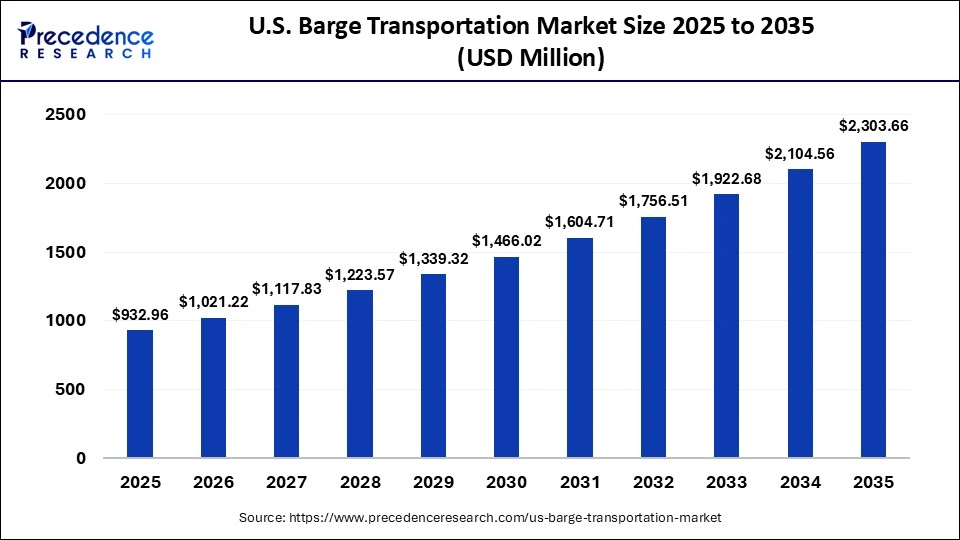
U.S. Barge Transportation Market Statical Scope
| Reports Attributes | Statistics |
| Market Size in 2025 | USD 932.96 Million |
| Market Size in 2026 | USD 1021.22 Million |
| Market Size by 2035 | USD 2303.66 Million |
| CAGR 2026 to 2035 | 9.46% |
| Base Year | 2025 |
| Forecast Period | 2026 to 2035 |
The market is a vital part of the national supply chain, transporting over a million tons of bulk cargo each year. Focused on inland river networks such as the Mississippi, it plays a crucial role in the affordable export of agricultural grains, energy products like petroleum and coal, and raw chemicals. Barges provide the lowest cost per ton-mile among all freight methods.
Additionally, water transport generates fewer greenhouse gas emissions per ton-mile than trucking. This makes it an important strategy for large companies aiming to achieve environmental goals and lower Scope 3 emissions. It also offers farmers a cost-effective way to transport large harvests from the Midwest to coastal ports for international export. Furthermore, it is crucial for the chemical and refined petroleum sectors, especially along the Gulf Coast.
U.S. Barge Transportation Market, By Barge Fleet, 2025 (%)
| Segments | Shares (%) |
| Covered | 41.80% |
| Open | 33.60% |
| Tank | 24.60% |
- Covered - The covered barge segment, with a share of 41.80% in 2025, which handles dry bulk cargo, is leading the U.S. market as it protects valuable agricultural and manufactured products from weather and moisture damage during transport.
- Open - The open barge segment, with a share of 33.60% in 2025, plays a crucial role in the U.S. market by offering the most affordable way to transport large volumes of non-perishable bulk goods, such as coal, aggregates, and ores. These barges are sturdy, can be loaded from the top, and are not affected by weather, making them fundamental to inland waterway supply chains.
U.S. Barge Transportation Market, By Product, 2025 (%)
| Segments | Shares (%) |
| Liquid Cargo | 47.30% |
| Dry Cargo | 39.50% |
| Gaseous Cargo | 13.20% |
- Liquid Cargo - The liquid cargo segment, with a share of 47.30% in 2025, dominates the U.S. barge market as it transports important goods like crude oil, refined petroleum, and liquid chemicals using tank barges. This segment is important due to its cost-effectiveness,enhanced safety for hazardous materials, and lower greenhouse gas emissions compared to rail or road transport.
- Dry Cargo - The dry cargo segment, with a share of 39.50% in 2025, is crucial as it offers a highly cost-effective, high-capacity way to transport bulk goods over long distances, directly supporting vital American sectors like agriculture, mining, and construction.
U.S. Barge Transportation Market, By Application, 2025 (%)
| Segments | Shares (%) |
| Agricultural Products | 18.70% |
| Coal & Crude Petroleum | 17.10% |
| Metal Ores | 11.60% |
| Coke & Refined Petroleum Products | 10.90% |
| Chemicals | 9.80% |
| Food Products | 9.40% |
| Secondary Raw Materials & Wastes | 8.20% |
| Rubber & Plastic | 6.70% |
| Beverages & Tobacco | 5.30% |
| Nuclear Fuel | 2.30% |
- Agricultural Products - The agricultural segment, with a share of 18.70% in 2025, dominates the U.S. barge market as it offers low-cost, high-capacity transport for bulk grains and oilseeds from the Midwest to export ports. Barges carry about 90% of U.S. grain exports through the Mississippi Gulf, enhancing global competitiveness by significantly lowering logistics expenses.
- Coal & Crude Petroleum - The Coal & Crude Petroleum segment, with a share of 17.10% in 2025, is vital to the U.S. barge market. Barges provide the most economical, high-capacity, and environmentally friendly method for moving these heavy, low-value energy products between domestic refineries, power plants, and export terminals.
Segments Covered in the Report
By Barge Fleet
- Covered
- Open
- Tank
By Product
- Liquid Cargo
- Dry Cargo
- Gaseous Cargo
By Application
- Agricultural Products
- Coal & Crude Petroleum
- Metal Ores
- Coke & Refined Petroleum Products
- Food Products
- Secondary Raw Materials & Wastes
- Beverages & Tobacco
- Rubber & Plastic
- Chemicals
- Nuclear Fuel
For inquiries regarding discounts, bulk purchases, or customization requests, please contact us at sales@precedenceresearch.com
Frequently Asked Questions





Ask For Sample
No cookie-cutter, only authentic analysis – take the 1st step to become a Precedence Research client




 sales@precedenceresearch.com
 Schedule a Meeting