



U.S. Bath and Shower Products Market Trends, Leading Companies, Company Revenue / Sales Performance, Retail Sales, Production Volume, Consumer Spending, Market Penetration, Competitive Landscape, and Industry Outlook
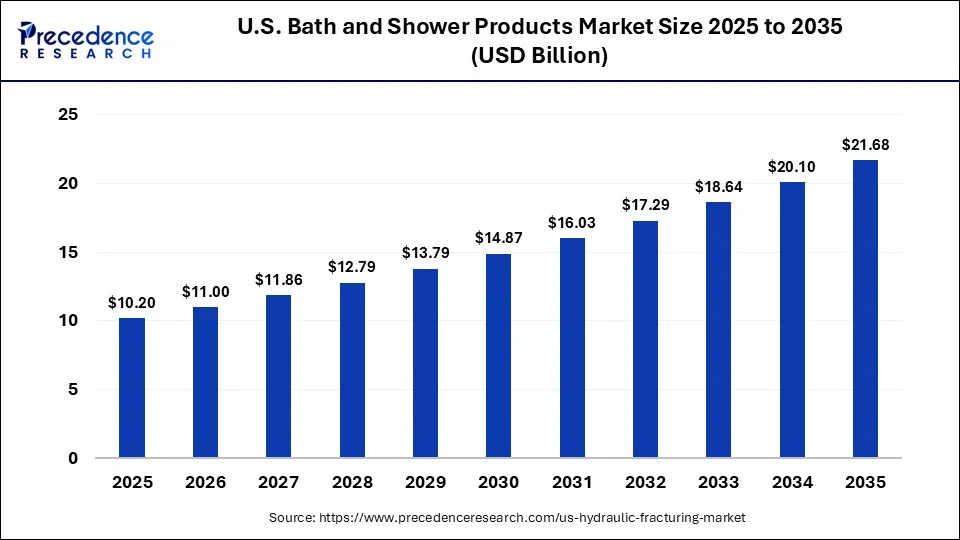
The U.S. bath and shower products market reached USD 11.00 billion in 2026. The market growth is attributed to the growing awareness of aesthetic appearance, the increasing development of personalized bathing products, and the widespread availability of cost-competitive products. These trends were analyzed by Vidyesh Swar, Senior Research Analyst, to curate this report. His report benefits multiple stakeholders, including product manufacturers, retailers, distributors, packaging suppliers, and testing laboratories.
Source: https://www.precedenceresearch.com/us-bath-and-shower-products-market
 Get a Sample
 Table Of Content


U.S. Bath and Shower Products Market Size, Demand, and Trends Analysis 2035
The U.S. bath and shower products market is forecasted to expand from USD 11.00 billion in 2026 to USD 21.68 billion by 2035, growing at a CAGR of 7.83% from 2026 to 2035. Growth is increasingly driven by premiumization, higher-value formulations, fragrance, wellness, skin-care benefits, multifunctional products, and the growing importance of body wash and shower gel compared with traditional bar soap. The market remains moderately concentrated, with Unilever, Bath & Body Works, and Procter & Gamble collectively holding approximately 39% of value sales in 2025, while specialist brands, private labels, digital-first companies, and premium players continue to compete through differentiated propositions.
Key Takeaways
- The U.S. bath and shower products market reached approximately USD 10.20 billion in 2025, with around 6% current-value growth despite cautious consumer spending.
- The U.S. population reached approximately 343 million, supporting the market's large and recurring consumption base.
- The three largest companies accounted for approximately 39% of U.S. bath and shower value sales in 2025.
- Unilever held approximately 19% of U.S. bath and shower value sales in 2025, making it the leading company in the category.
- Bath & Body Works held approximately 11% of market value sales in 2025, down from approximately 15% in 2021.
- Procter & Gamble accounted for approximately 9% of U.S. bath and shower value sales in 2025.
- Bath & Body Works' share declined by approximately 4 percentage points between 2021 and 2025, highlighting shifts in brand relevance and consumer preferences.
- As of June 30, 2026, approximately 16,398 cosmetic facility registrations and 1.30 million cosmetic product listings were active under the U.S. regulatory framework.
- L'Oréal generated €44.05 billion in global sales in 2025, including €16.09 billion from Consumer Products and €7.20 billion from Dermatological Beauty.
- The market is expected to see continued value expansion through 2035, with body wash and shower gel, premium products, wellness-oriented formulations, e-commerce.
- differentiated skin-care benefits identified as important growth pools.
Market Overview
The U.S. bath and shower products market reached approximately USD 10.20 billion in 2025, representing around 6% current-value growth despite cautious discretionary spending and softer consumer confidence. With the U.S. population reaching approximately 343 million, the category continues to benefit from its essential, high-frequency consumption profile while gaining incremental value from premium scents, multifunctional formulations, wellness-oriented routines, and skin-care ingredients.
The category is structurally mature but remains commercially dynamic because growth is increasingly being generated through value expansion rather than simple household penetration. Body wash and shower gels are gaining importance relative to traditional bar soap as consumers seek moisturising, exfoliating, fragrance-led and skin-benefit propositions. Limited-edition launches, sensorial fragrances, life-stage-specific products and social-media-led product discovery are also creating additional purchase occasions.
Competitive concentration is meaningful: the three largest companies accounted for approximately 39% of U.S. bath and shower value sales in 2025, with Unilever at about 19%, Bath & Body Works at 11%, and Procter & Gamble at 9%. Bath & Body Works' share declined from approximately 15% in 2021 to 11% in 2025, illustrating how rapidly brand relevance, channel strategy, and consumer demographics can alter competitive positions even in an established category.
Key Coverage
- 2025 market value of approximately USD 10.20 billion
- Historical value and volume development through 2021-2025
- Ten-year outlook through 2035
- Category-level growth across bar soap, body wash/shower gel, liquid soap, bath additives and other products
- Premium versus mass-market dynamics
- Offline, e-commerce and emerging retail-channel economics
- Consumer wellness, fragrance, ingredient and life-stage trends
- Company and brand-level competitive positioning
How are Premiumization and Higher-Value Product Architectures Supporting the Market?
The U.S. bath and shower products market generated approximately USD 10.20 billion in 2025, following value growth, indicating continued revenue resilience despite persistent consumer attention to household spending. The more important signal, however, is the composition of that growth: cleansing remains a high-frequency, relatively defensive purchase, while consumers are increasingly willing to trade up when products offer moisturisation, exfoliation, fragrance, sensitive-skin benefits, clinical positioning, or a more indulgent bathing experience. Our analysis indicates that this is creating a widening distinction between basic consumption growth and value-accretive premiumization, with higher-value product architectures becoming increasingly important to category revenue expansion.
Our analysis indicates that future market growth should not be interpreted through CAGR alone. A meaningful portion of revenue expansion can originate from higher average selling prices (ASPs), premium product migration and price/mix effects rather than equivalent increases in physical consumption. Our assessment is that this distinction will become increasingly important through 2035 because bath and shower products combine recurring household demand with substantial opportunities for formulation, fragrance, benefit and format differentiation.
The full market model therefore separates retail value, volume, ASP, price/mix contribution, household penetration and consumption frequency, allowing analysts to determine whether incremental revenue is being generated through additional units, pricing, premium migration or shifts in category composition.
In our view, the most significant strategic implication is that suppliers positioned around differentiated benefits may capture disproportionate value growth even if underlying category volumes remain comparatively moderate. The market's 2025 performance provides evidence of pricing and mix resilience, while the forecast framework tests whether this resilience can persist under different consumer-spending conditions.
The base case incorporates population growth and ongoing category innovation; the upside case evaluates stronger premiumization and digital discovery; while the downside case reflects persistent inflation, trading-down and weaker discretionary consumption. This scenario structure enables identification of the incremental revenue opportunity, downside exposure and the product and channel combinations most capable of sustaining value growth.
Segmentation Analysis
How are Body Wash and Shower Gel Reconfiguring the U.S. Bath and Shower Products Market?
The market is analyzed across product category, formulation/form, price tier, consumer group, ingredient positioning, and distribution channel. Body wash/shower gel is becoming a central growth engine as consumers move toward products combining cleansing with moisturization, fragrance, exfoliation and other skin-care attributes. Industry analysis indicates that body wash/shower gel is positioned to outpace bar soap as multifunctionality and scent become stronger purchase drivers.
The segmentation model distinguishes mass/economy, mid-market and premium propositions and tracks how premiumization changes revenue pools even when unit growth remains modest. Natural, organic, sensitive-skin, dermatologist-positioned, vegan, fragrance-led and ingredient-conscious products are evaluated as separate value pools where sufficiently material.
Distribution is another structural differentiator. Traditional supermarkets, hypermarkets, drugstores and mass merchants continue to provide scale, while Amazon, retailer websites, social-commerce environments and other digital channels increasingly influence discovery, replenishment and promotional mechanics. Warehouse-club purchasing is also gaining relevance where consumers prioritise value and larger pack formats.
Key Coverage
- Product/category revenue and volume
- Body wash/shower gel versus bar soap
- Liquid soap and bath additives
- Mass versus premium price tiers
- Natural/organic versus conventional formulations
- Women, men and other consumer groups
- Offline versus online distribution
- Segment CAGR and growth contribution
Market Dynamics
Which are the Major Demand Drivers and Restraints of the U.S. Bath and Shower Products Market?
The strongest demand shift is from functional cleansing toward experiential and benefit-oriented bathing. Consumers increasingly view bath and shower routines as part of personal wellness, creating opportunities for fragrance, aromatherapy-style experiences, moisturization, exfoliation and targeted skin benefits.
The market is also benefiting from the growing convergence between body care and skin care. Ingredients and claims traditionally associated with facial skin care are increasingly influencing body-care product development. At the same time, social-first launches can accelerate awareness and reduce the time required for emerging products to gain consumer attention.
Key restraints include mature household penetration, retailer bargaining power, promotional intensity, private-label competition, input-cost volatility, and consumer sensitivity to price increases. The result is a market where innovation must deliver a visible benefit rather than merely add another fragrance or packaging variation.
Key Coverage
- Premiumisation and affordable indulgence
- Skin-care/body-care convergence
- Fragrance and sensorial consumption
- Life-stage-specific product innovation
- Social-commerce and influencer discovery
- Private-label and value competition
- Consumer trading-down/up dynamics
- Ingredient transparency and formulation trends
How are Premiumization and Value-Based Pricing Reshaping the U.S. Bath and Shower Products Revenue Pool Without Sacrificing Volume?
Pricing across the U.S. bath and shower products market is increasingly defined by the tension between higher ASPs and continued mass-market volume. The analysis benchmarks ASP per unit, price per ounce, price per 100 mL/gram, promotional discounting, pack-size economics, and premium-to-mass price differentials to determine where pricing power is being created. Premium products can sustain higher price points when fragrance, packaging, ingredient credentials, clinical positioning, or multifunctionality provide consumers with a clearly differentiated benefit, while mass-market products remain important because of the category's high purchase frequency and price-sensitive demand.
Our analysis indicates that the key pricing opportunity lies not in broad-based price increases, but in selectively increasing perceived value and monetising product differentiation. Premiumization can expand the value pool when consumers perceive a meaningful benefit relative to the incremental price, whereas aggressive pricing without sufficient differentiation risks accelerating trading down. At the same time, large-format packs, multipacks, and warehouse-club formats can strengthen value perceptions by lowering the effective unit cost, allowing suppliers and retailers to address price sensitivity while maintaining household consumption volumes. Our assessment is therefore that price architecture and pack architecture are becoming as important as headline pricing in determining revenue and volume outcomes.
In our view, the most significant strategic implication is the need to manage pricing at the product-pack-channel level rather than through a single market-wide pricing strategy. Suppliers with differentiated formulations and premium credentials may have greater scope to protect or expand ASPs, while mass-market portfolios require disciplined promotional intensity and pack-size strategies to preserve penetration. The full analysis therefore evaluates retailer and distributor margins, manufacturing-cost exposure, raw-material and packaging costs, promotional intensity, and price elasticity to identify where higher pricing can translate into incremental revenue and where it may instead create volume pressure.
What Does the Demand-Supply and Value Chain Analysis Indicate?
Unlike capital-intensive industrial markets, bath and shower products have relatively flexible manufacturing structures, but the economics remain highly dependent on formulation scale, procurement, packaging, contract manufacturing, logistics, retailer terms, and marketing expenditure.
The value chain extends from surfactants, fragrances, oils, moisturizers, preservatives, and specialty ingredients through formulation and filling, packaging, brand development, warehousing, distribution, and retail. Margin pools are therefore influenced not only by manufacturing efficiency but by brand strength, innovation velocity and retailer access.
Supply-side analysis evaluates ingredient availability, packaging costs, contract manufacturing exposure, inventory cycles, and logistics costs. Demand-side analysis tracks household consumption, purchase frequency, seasonal demand, promotional events and channel shifts.
Key Coverage
- Ingredient and packaging economics
- Manufacturing and contract manufacturing
- Inventory and logistics
- Distributor economics
- Retailer margins
- Supply-demand balance
- Cost inflation and pass-through
- Value capture by stage of the chain
Technology, Innovation & Sustainability
How are Formulation Science and Packaging Innovation Becoming Commercial Differentiators?
Innovation in this market is primarily formulation- and packaging-driven, rather than dependent on complex manufacturing technology. Product developers are concentrating on skin-benefit ingredients, fragrance systems, sensitive-skin formulations, concentrated formats, refill concepts, solid formats, and packaging reduction.
Sustainability is increasingly connected to both formulation and packaging. Lightweight packaging, recycled content, refillable systems, and concentrated formulations can reduce material intensity, although environmental claims require substantiation. U.S. environmental-marketing guidance requires companies to support relevant environmental claims with appropriate evidence, increasing the importance of credible sustainability positioning.
The innovation analysis tracks product launches, formulation platforms, patents where relevant, packaging formats, sustainability investments, partnerships, and commercialization activity.
Key Coverage
- Ingredient innovation
- Sensitive-skin and dermatological positioning
- Fragrance technology
- Concentrated and solid formats
- Refillable/recyclable packaging
- Product-launch intensity
- Sustainability claims
- Innovation pipeline and commercialization
How is the Evolving U.S. Regulatory and Sustainability Framework Raising the Compliance Bar for Bath and Shower Products?
The U.S. regulatory environment is becoming a more material commercial consideration for bath and shower product manufacturers and emerging brands, particularly following the Modernization of Cosmetics Regulation Act (MoCRA). The framework introduces requirements around facility registration, product listing, safety substantiation, adverse-event processes, and ongoing regulatory information management. As of June 30, 2026, approximately 16,398 cosmetic facility registrations and 1.30 million cosmetic product listings were active, illustrating the scale of the regulated product ecosystem and the breadth of compliance data that manufacturers must manage.
Our analysis indicates that regulatory capability is increasingly becoming a scaling requirement rather than a back-office function. For established suppliers, compliance infrastructure can be integrated into product development, quality systems, and portfolio management; for smaller and emerging brands, the same requirements can increase the organizational complexity and resources required to commercialize and expand products. Our assessment is that the competitive impact will be greatest where brands rapidly expand SKUs, outsource manufacturing, enter new channels or make more sophisticated product and safety claims, because regulatory documentation and ongoing information management become more complex as portfolios broaden.
In our view, sustainability claims represent a parallel market-access and reputation issue. Environmental claims covering recyclability, recycled content, compostability, refillability and related attributes require appropriate substantiation and, in some cases, clear qualification. Broad claims such as “eco-friendly” can be difficult to substantiate, while specific claims need to accurately reflect the environmental attributes consumers are likely to understand from the messaging. This creates an opportunity for brands that can combine packaging sustainability with credible documentation and precise claims, while increasing risk for suppliers that rely on broad sustainability positioning without adequate evidence.
How is the U.S. Bath and Shower Products Market Being Rebalanced Across Sale Leaders, Premium Specialists, and Digital-First Challengers?
The U.S. bath and shower market remains moderately concentrated, but its competitive structure extends well beyond traditional FMCG scale. In 2025, the three largest participants held approximately 39% combined value share, comprising about 19% for Unilever, 11% for Bath & Body Works, and 9% for Procter & Gamble. This leaves a substantial portion of the market distributed across multinational consumer-health and beauty companies, specialist and premium brands, digitally native entrants, private labels and niche formulation companies. The competitive picture therefore combines the advantages of scale with a fragmented pool of brands competing for specific consumer occasions and higher-value segments.
Our analysis indicates that competitive advantage is increasingly determined by the interaction of distribution scale, consumer relevance and innovation velocity rather than market size alone. Scale leaders benefit from broad retail coverage, procurement leverage and extensive portfolios, while specialists can differentiate through fragrance, wellness, skin-care functionality, product experience and focused positioning.
Emerging challengers can use digital-first launches, social media, and direct-to-consumer models to build demand without relying entirely on conventional shelf access. The movement in market share further reinforces this dynamic: Bath & Body Works' share declined from approximately 15% in 2021 to 11% in 2025, demonstrating that established brand equity does not automatically translate into sustained share when consumer preferences and competitive propositions evolve.
In our view, the most significant strategic implication is that the market is developing around three distinct competitive models: scale-led mass-market competition, specialist/premium differentiation, and digitally enabled challenger strategies. Portfolio expansion is another route to strengthening competitive positioning, illustrated by Church & Dwight's acquisition of Touchland and its resulting exposure to adjacent personal-cleansing occasions. From our assessment, companies seeking incremental growth will increasingly need to balance product breadth and distribution reach with differentiated propositions, pricing power, digital engagement and adjacency expansion, rather than relying on a single source of competitive advantage.
Leading Company Universe
| Company | Headquarters | Market Position | Core Strength | Major Applications/Segments |
| Unilever | London, UK | Scale leader | Mass personal care | Body wash, soap, cleansing |
| Bath & Body Works | Columbus, U.S. | Specialty leader | Fragrance/body care | Body wash, shower products |
| Procter & Gamble | Cincinnati, U.S. | Scale leader | Brand/distribution scale | Body cleansing, personal care |
| Colgate-Palmolive | New York, U.S. | Major consumer-care player | Personal cleansing | Body wash, soap |
| Church & Dwight | Ewing, U.S. | Growth challenger | Consumer brands/acquisitions | Personal cleansing |
| Kenvue | Skillman, U.S. | Consumer-health specialist | Skin/health brands | Body and sensitive-skin care |
| L'Oréal | Clichy, France | Beauty leader | Skin-care/formulation expertise | Body care, beauty |
| Henkel | Düsseldorf, Germany | Global consumer player | Personal care portfolio | Body care/cleansing |
| Beiersdorf | Hamburg, Germany | Skin-care specialist | Dermatological positioning | Body care |
| Kao | Tokyo, Japan | Global personal-care player | Formulation/innovation | Cleansing/body care |
| Natura &Co | São Paulo, Brazil | Natural/beauty specialist | Botanical positioning | Bath/body care |
| Edgewell Personal Care | Shelton, U.S. | Personal-care specialist | Grooming/body care | Personal cleansing |
| Haleon | Weybridge, UK | Consumer-health specialist | Health positioning | Personal-care adjacencies |
| Coty | New York, U.S. | Beauty/fragrance player | Fragrance | Fragrance-led body care |
| SC Johnson | Racine, U.S. | Consumer-products player | Household/consumer brands | Adjacent personal care |
| Elida Beauty | London, UK | Beauty specialist | Mass beauty | Cleansing/body care |
| Suave Brands | U.S. | Value/mass specialist | Affordable personal care | Body wash, soap |
| L'Occitane | Luxembourg | Premium specialist | Natural/premium beauty | Bath/body care |
| Kao USA | U.S. | Regional/global player | Beauty and cleansing | Personal care |
| Combe | White Plains, U.S. | Specialty personal-care player | Targeted personal care | Hygiene/body care |
| Victoria's Secret | Reynoldsburg, U.S. | Fragrance/body-care specialist | Sensory/body products | Bath/body care |
| The Estée Lauder Companies | New York, U.S. | Premium beauty player | Prestige beauty | Premium body/fragrance adjacencies |
What is the Market Share & Competitive Ranking of the U.S. Bath and Shower Products Market?
The available 2025 competitive data indicates approximately 19% share for Unilever, 11% for Bath & Body Works, and 9% for Procter & Gamble. Together, these players represented roughly 39% of the category, leaving approximately 61% for other participants and fragmented brands.
This structure creates a competitive environment in which scale matters, but does not eliminate opportunities for specialists. The largest players benefit from retailer relationships, marketing scale, procurement leverage, and extensive portfolios; smaller players can compete through differentiated formulations, niche consumer communities, premium positioning, and digital-first distribution.
The full report quantifies Top-5 and Top-10 concentration, company share trajectories, brand-level share, share gains/losses and competitive movement from 2021-2025.
Product Portfolio Benchmarking
Broad Portfolios Compete With High-Intensity Specialist Positions
Portfolio comparison maps companies across bar soap, body wash/shower gel, liquid soap, bath additives, intimate hygiene, hand sanitisation, body powders, fragrance-led body products, and sensitive-skin formulations.
The benchmark identifies companies with broad category coverage versus specialists concentrated around fragrance, skin care, wellness, or value propositions. It also evaluates product gaps, pack sizes, ingredient claims, premium offerings and opportunities for portfolio extension.
Which Innovation Capabilities are Likely to Create Sustainable Competitive Advantage in U.S. Bath and Shower Products?
Innovation in the U.S. bath and shower market is increasingly extending beyond incremental product launches toward formulation platforms, ingredient differentiation, packaging innovation, and faster commercialization cycles. Benchmarking evaluates product launches, ingredient platforms, formulation claims, packaging formats, strategic partnerships, sustainability initiatives and launch velocity, with particular attention to skin-care-inspired body cleansing, targeted life-stage products, sensory fragrances, concentrated formats and sustainable packaging. These innovation areas can support premium positioning by adding functional or experiential benefits to otherwise routine cleansing occasions.
Our analysis indicates that the most commercially significant innovation is likely to be innovation that converts a basic cleansing product into a differentiated personal-care or wellness proposition. Skin-care-inspired formulations can broaden the perceived benefit set, while targeted life-stage products can create more specific consumer use cases; sensory fragrances and concentrated formats can strengthen experience and convenience. Our assessment is that packaging and formulation innovation become particularly valuable when they simultaneously improve consumer differentiation and provide a credible rationale for higher ASPs, rather than functioning purely as cosmetic product changes.
In our view, innovation capability should therefore be assessed through both the quality of the proposition and the speed at which companies can commercialize and scale it. The financial scale of diversified beauty portfolios illustrates the potential value of combining mass-market reach with higher-value dermatological and functional positioning: L'Oréal generated €44.05 billion in global sales in 2025, including €16.09 billion from Consumer Products and €7.20 billion from Dermatological Beauty. From our assessment, this demonstrates the strategic relevance of moving across adjacent value tiers and translating formulation or skin-health expertise into broader consumer propositions.
What is the Customer & Channel Benchmarking of the U.S. Bath and Shower Products Market?
The market is benchmarked across supermarkets, mass merchants, drugstores, specialty beauty retailers, warehouse clubs, e-commerce marketplaces, retailer websites, and direct-to-consumer channels.
Amazon and Walmart are identified as important forces in e-commerce development, while warehouse clubs are gaining relevance through bulk purchasing and value-oriented formats.
The report evaluates customer acquisition costs, retailer dependence, promotional intensity, direct-to-consumer penetration, repeat purchasing, subscription/replenishment opportunities and channel-specific ASPs.
Why is Portfolio Expansion Moving Toward Adjacent Personal-Care Occasions?
Recent strategic activity indicates continued interest in adjacent personal-care categories and high-growth consumer brands. Church & Dwight's 2025 acquisition of Touchland expanded its exposure to personal cleansing and contributed to domestic consumer-sales growth after the transaction.
At the broader competitive level, the report tracks product launches, brand acquisitions, licensing agreements, partnerships, digital-commerce investments, manufacturing changes and geographic expansion during the latest two to three years.
M&A analysis distinguishes between:
- Brand acquisition
- Category expansion
- Technology/formulation acquisition
- Geographic acquisition
- Distribution-led acquisition
- Vertical integration
What are the Opportunities and White-Space Analysis of the U.S. Bath and Shower Products Market?
The market presents several measurable white spaces:
- Multifunctional body wash combining cleansing and skin-care benefits.
- Premium-but-accessible products positioned between mass and prestige.
- Life-stage-specific formulations, including products addressing changing skin needs.
- Fragrance-led wellness rituals that increase purchase frequency and emotional value.
- Digital-first niche brands capable of building communities before broad retail distribution.
- Refill and concentrated formats reducing packaging intensity.
- Sensitive-skin and dermatologist-positioned cleansing products.
- Men's and gender-neutral body-care propositions.
- Subscription/replenishment models for high-frequency products.
- Retailer-exclusive and limited-edition products designed to generate incremental demand.
How is the Moderate Competitive Rivalry with High Brand and Retailer Influence?
- Supplier power - Medium: Core ingredients and packaging are generally available from multiple suppliers, although fragrance systems, specialty ingredients, and sustainable packaging can create higher switching barriers.
- Buyer power - High: Large retailers exert considerable influence over shelf placement, promotions, pricing and product visibility.
- Threat of new entrants - Medium: Manufacturing can be outsourced, lowering physical entry barriers, but brand-building, customer acquisition, and retail access remain significant barriers.
- Threat of substitutes - Medium: Consumers can switch between bar soap, body wash, liquid soap, specialty cleansing, and private-label alternatives.
- Competitive rivalry - High: Mature category penetration, strong brands, frequent promotions and rapid product launches create sustained rivalry.
What Does the PESTLE Analysis Indicate in the U.S. Bath and Shower Products Market?
- Political/Legal: MoCRA is increasing regulatory obligations for cosmetic facilities and marketed products.
- Economic: Inflation, household purchasing power, and promotional sensitivity affect trading-up versus trading-down behavior.
- Social: Wellness, self-care, fragrance, skin health, and ingredient transparency are redefining cleansing occasions.
- Technological: Digital discovery, social commerce, formulation science, and packaging innovation are accelerating product cycles.
- Environmental: Packaging reduction, recyclability, refillability, and substantiated environmental claims increasingly influence product development.
Market Attractiveness
Essential Consumption Supports Resilience, While Innovation Determines Where Incremental Profit Pools Form
The U.S. bath and shower market combines a large USD 10.20 billion 2025 revenue base, high purchase frequency and broad household usage with substantial competitive intensity.
The most attractive growth pockets are therefore not necessarily the largest existing categories. Higher-value opportunities increasingly emerge where premium pricing, differentiated formulations, consumer engagement and repeat purchase can coexist.
The report evaluates market attractiveness by product, price tier, customer segment, channel, innovation theme, and strategic opportunity rather than treating the overall market as homogeneous.
Which Growth Pools and Competitive Shifts will Define the U.S. Bath and Shower Products Market through 2035?
The U.S. bath and shower products market enters the 2035 outlook from a position of continued value expansion, with the 2025 market valued at approximately USD XX billion and recording 6% value growth. Through 2035, the strongest opportunities are expected to emerge where mass-market accessibility is combined with differentiated consumer benefits. Body wash/shower gel is positioned to gain relative importance, as multifunctionality and fragrance expand the value proposition beyond basic cleansing. At the same time, wellness-oriented bathing, limited-edition concepts, and skin-care-inspired body products can create additional avenues for engagement and premiumization, while e-commerce and social-first discovery can accelerate awareness and adoption of new propositions.
Our analysis indicates that the most important structural shift through 2035 will be the convergence of mass accessibility and premium consumer value. The evidence suggests that future growth will not depend solely on increasing category consumption; it will also depend on the ability of brands to migrate consumers toward higher-value products, formats and experiences while maintaining broad distribution. Our assessment is that digital commerce and social-first discovery will reinforce this shift by reducing the time between product innovation, consumer awareness, and purchase, potentially allowing differentiated products to scale more rapidly than traditional shelf-driven launches.
In our view, the 2035 market will be shaped by a balance between premiumization-led value creation and persistent price sensitivity. The base case assumes moderate category expansion supported by population growth, pricing and innovation; the upside case tests stronger premiumization, digital commerce, and successful new-product adoption; while the downside case incorporates prolonged consumer caution, greater private-label competition, promotional pressure and weaker volume growth. This scenario framework is important because the same headline market growth can produce materially different outcomes for ASP, volume, category share, and profitability depending on the strength of premium migration and competitive pricing pressure.
Key Strategic Questions Addressed
How large is the U.S. bath and shower products market in 2025, and how much incremental revenue can be created through 2030?
- How much of recent value growth is attributable to volume, pricing and premium mix?
- Which product categories are capturing the largest revenue pools?
- How quickly is body wash/shower gel gaining relative importance versus bar soap?
- Which consumer needs are generating the strongest premiumisation opportunities?
- How are mass, mid-market and premium products evolving?
- Which retail and e-commerce channels are gaining strategic importance?
- How are fragrance, wellness and skin-care benefits changing product economics?
- What impact is MoCRA having on manufacturers and emerging brands?
- How concentrated is the market, and how much share is held by the leading companies?
- Which companies have the broadest portfolios versus the strongest specialist positions?
- Which strategic acquisitions and partnerships are reshaping competitive positioning?
- Where are the largest product, customer, channel, and pricing white spaces?
- Which innovation themes are most likely to create new premium revenue pools through 2030?
- What competitive, regulatory, and consumer changes will determine the next phase of U.S. bath and shower market growth?
U.S. Bath and Shower Products Market Segments Covered in the Report
By Product Type
- Bar Soap
- Body Wash & Shower Gel
- Bath Additives
- Bath salts
- Bath bombs
- Bubble bath
- Bath oils
- Liquid Soap
- Intimate Hygiene Products
- Body Powder
- Other Bath & Shower Products
By Form
- Solid
- Liquid
- Gel
- Foam
- Powder
- Other Forms
By Price Range
- Mass
- Mid-Range
- Premium
By Consumer Group
- Men
- Women
- Unisex
- Children & Babies
By Product Positioning/Benefit
- Moisturizing & Hydrating
- Exfoliating
- Sensitive Skin
- Anti-Aging/Skin Care
- Fragrance & Sensory
- Antibacterial/Hygiene
- Natural & Organic
- Clinical/Dermatological
- Wellness & Relaxation
- Multifunctional
By Distribution Channel
- Supermarkets & Hypermarkets
- Drugstores & Pharmacies
- Convenience Stores
- Specialty Stores
- Department Stores
- Warehouse Clubs
- Online/E-commerce
- Direct-to-Consumer (DTC)
- Other Retail Channels
By Consumer Age Group
- Baby & Children
- Teens
- Adults
- Seniors
By Packaging Format
- Bottles
- Tubes
- Bars
- Pouches/Refills
- Jars/Tubs
- Pump Dispensers
- Other Formats
For inquiries regarding discounts, bulk purchases, or customization requests, please contact us at sales@precedenceresearch.com
Frequently Asked Questions





Ask For Sample
No cookie-cutter, only authentic analysis – take the 1st step to become a Precedence Research client
 Get a Sample




 sales@precedenceresearch.com
 Schedule a Meeting
