



U.S. Generic Sterile Injectable Market Size, Share and Trends 2026 to 2035
U.S. Generic Sterile Injectable Market (By Drug Type: Monoclonal Antibodies, Cytokines, Insulin, Peptide Hormones, Vaccines, Immunoglobulin, Blood Factors, Antibiotics, Others; By Therapeutic Application: Cancer, Diabetes, Cardiovascular Disease, Central Nervous System, Infectious Disorders, Musculoskeletal System, Others; By Distribution Channel: Hospitals Pharmacies, Online Pharmacies, Retail Pharmacies, Other) - Industry Analysis, Size, Trends, Leading Companies, Regional Outlook, and Forecast 2026 to 2035
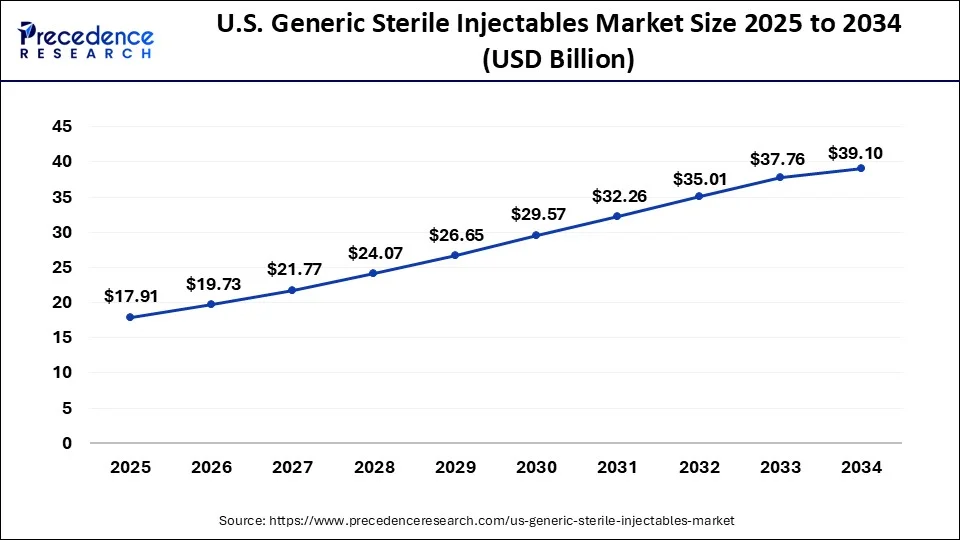
Source: https://www.precedenceresearch.com/us-generic-sterile-injectables-market
 Get a Sample
 Table Of Content


What is the U.S. Generic Sterile Injectable Market Size in 2026?
The global U.S. generic sterile injectable market size accounted for USD 17.91 billion in 2025 and is predicted to increase from USD 19.73 billion in 2026 to approximately USD 43.26 billion by 2035, expanding at a CAGR of 9.22% from 2026 to 2035. The market is witnessing substantial growth due to growing hospitalizations, rising prevalence of severe chronic diseases, and a rising demand for cost-effective therapeutic alternatives, heavily influenced by the surge in off-patent drugs and robust U.S. FDA expedited approval pathways.
Key Takeaways
- By drug type, the monoclonal antibodies (mAbs) segment contributed the highest market share in 2025.
- By drug type, the vaccines segment is expected to grow at a strong CAGR between 2026 and 2035.
- By therapeutic application, the cancer segment held a major market share in 2025.
- By therapeutic application, the diabetes segment is expected to expand at the fastest CAGR from 2026 to 2035.
- By distribution channel, the hospital pharmacies segment captured the highest market share in 2025.
- By distribution channel, the retail pharmacies segment is poised to grow at a significant CAGR between 2026 and 2035.
Market Overview
The U.S. generic sterile injectable market comprises FDA-approved, unbranded injectable drugs that provide cost-effective, bioequivalent alternatives to branded therapies. The growing demand for affordable treatments for chronic and infectious diseases is driving this market. These injectables bypass the body's natural defenses and are essential for treating life-threatening conditions in hospital and clinical settings. The growth of the market is further supported by patent expirations of branded products, healthcare cost-containment efforts, and ongoing shortages of certain injectable medicines that create opportunities for generic manufacturers.
How is AI Transforming the U.S. Generic Sterile Injectable Market?
Artificial intelligence (AI) is transforming the market by streamlining drug development, minimizing drug shortages, and improving manufacturing sterility. AI models utilize predictive modeling to optimize drug formulation and navigate patented delivery mechanisms for complex generic injectables and drug applications. AI-driven predictive analytics forecast demand and optimize supply chain logistics, helping to prevent critical drug shortages. Furthermore, AI-powered automation enables real-time environmental monitoring and predictive maintenance, reducing human error and contamination risks.
U.S. Generic Sterile Injectables Market Growth Factors
- An ageing population, an increase in the prevalence of chronic illnesses, and the need for more efficient and focused drug administration are some of the reasons driving the need for injectable drugs.
- Technological developments in manufacturing have led to the development of sterile manufacturing techniques and high-grade generic sterile injectables. Consequently, this aids in fulfilling regulatory requirements and guarantees the product's safety and effectiveness.
- The increasing product launches and collaborations are expected to propel the US generic sterile injectables market during the forecast period.
U.S. Generic Sterile Injectables Market Trends
- Growing prevalence of chronic diseases:- The growing chronic diseases like cancer, autoimmune disorders, diabetes, and cardiovascular diseases increases demand for injectable therapies. The growing demand for long-term treatments increases the adoption of generic sterile injectables. The growing demand for an affordable solution to treat chronic conditions increases demand for injectable therapies like generic sterile ones.
- Technological advancements:- The ongoing technological advancements, like innovative delivery systems, automation, and improved manufacturing processes, help in the market growth. Automation helps to streamline processes, reduce human error, and improve the consistency of sterile injectables. The advancements in manufacturing processes like advanced fill/finish techniques, aseptic processing, and lyophilization improve the overall quality of generic sterile injectables. Advancements in drug delivery systems, biotechnology utilization, and supply chain optimization using technologies help in the market growth.
- Growing demand for cost-effective treatment:- The growing demand for cost-effective treatments increases the adoption of generic sterile injectables. The generic sterile injectables doesn't requires expensive research and development. The growing healthcare costs in the nation increases demand for affordable treatments. It is cost-effective alternative for branded drugs.
- Government initiatives:- The strong government initiative for the rapid adoption of generic sterile injectables helps in the market growth. The initiative from the U.S. Food and Drug Administration is to approve generic injectables by maintaining regulatory standards and stricter safety. Government initiatives help healthcare providers and patients make informed decisions by promoting price transparency for generic sterile injectables. The various government initiatives help in the U.S. generic sterile market growth.
State-wise Insights
California US generic sterile injectables market trends
California is a major contributor to the US generic sterile injectables market. The well-established contract manufacturing facilities for generic sterile injectables help in the growth of the market. The growing population and increasing prevalence of chronic diseases like cardiovascular conditions, diabetes, and cancer increase demand for generic sterile injectables. Access to affordable healthcare and a strong biotechnology sector drive the market growth. The growing shift towards injectable treatments, aging populations, and increasing age-related conditions supports the overall growth of the market.
Market Scope
| Report Coverage | Details |
| Market Size in 2025 | USD 17.91 Billion |
| Market Size in 2026 | USD 19.73 Billion |
| Market Size by 2035 | USD 43.26 Billion |
| Market Growth Rate from 2026 to 2035 | CAGR of 9.22% |
| Base Year | 2025 |
| Forecast Period | 2026 to 2035 |
| Segments Covered | Therapeutic Application, and Distribution Channel |
Market Dynamics
Driver
Rising prevalence of chronic disease
One of the main factors propelling the growth of the US generic sterile injectables market is the rising incidence of chronic illnesses. Chronic illnesses requiring long-term care and medicine include diabetes, cancer, and cardiovascular diseases (CVDs). In the treatment of various ailments, generic injectables like insulin for diabetes, chemotherapeutic medicines for cancer, and antihypertensive drugs for cardiovascular problems are essential.
Moreover, a greater population can obtain generic injectables due to their affordability in areas that have inadequate or expensive healthcare infrastructure. Healthcare systems are also concentrating on striking a balance between cost-effectiveness and quality. Accordingly, generic injectables offer a practical choice as they offer the required medications at a far lower cost than their branded equivalents, enabling more extensive disease control and containment.
Patent Expirations and Biosimilar Adoption
The upcoming patent expirations of blockbuster biologic drugs are accelerating the adoption of generic sterile injectables and biosimilars, creating a strong growth driver for the market. As healthcare providers and payers seek more affordable treatment options, increased approvals through Abbreviated New Drug Applications (ANDAs) and faster biosimilar commercialization help reduce healthcare costs while expanding patient access to essential therapies.
Restraint
Regulatory complexity and quality control
The licensing process for generic sterile injectables might include a convoluted and stringent regulatory framework. Pharmaceutical firms have challenges in adhering to regulatory standards, including good manufacturing practices (GMP) and strict bioequivalence criteria. Overcoming these regulatory obstacles might require a lot of effort and time.
Furthermore, it is essential to guarantee the sterility and safety of injectable sterile items. It might be difficult to achieve strict sterility requirements and maintain consistent quality in manufacturing procedures. Any breaches in quality control may result in legal action, product recalls, and harm to the producers' brands. Thus, this is expected to hamper the US. generic sterile injectables market over the forecast period.
Stringent Manufacturing and Supply Chain Fragility
The market faces significant challenges due to the complexity and high costs associated with sterile manufacturing. The market is also restrained by prolonged drug shortages stemming from rigorous regulatory compliance, susceptibility to raw material disruptions, and limited economic incentives for manufacturers. Also, the need for specialized CGMP facilities, sterile fill-finish capabilities, and cold-chain logistics poses substantial barriers.
Opportunity
A rising number of branded medications patents expiring
The US generic sterile injectables market has an excellent possibility when branded injectables' patents expire. Once the patent expires, generic medicine producers are free to make and market copies of the branded product. Moreover, they may manufacture comparable drugs without having to pay for the preliminary research and development expenses, which allows them to pass the savings along to customers in the form of cheaper rates.
Since generic pharmaceuticals are bioequivalent to branded medications that have previously received regulatory clearance, they often gain approval more quickly. This shortens the time to market and increases the number of vital pharmaceuticals available to consumers. Furthermore, the widespread manufacture of pharmaceuticals that were previously prohibited by intellectual property (IP) rules is made possible by patent expiration. Consequently, the expiration of a patent facilitates the growth of the US generic sterile injectables market in the United States, so yielding advantages for both producers and end users.
Complex Formulations and Advanced Delivery Systems
Advancements in complex sterile formulations present a promising opportunity for manufacturers to increase profit margins beyond traditional commodity generics. Innovations such as ready-to-administer (RTA) formats, novel lyophilized powders, and long-acting injectables cater to critical hospital needs. These developments streamline clinical workflows, reduce medication administration errors, and provide high-value differentiation in a fiercely price-competitive market.
Segment Insights
Drug Type Insights
How did the Monoclonal Antibodies (mAbs) Segment Lead the Market?
The monoclonal antibodies (mAbs) segment led the U.S. generic sterile injectable market in 2025. This dominance is primarily attributed to the rapid approval of biosimilars, the expiration of patents on blockbuster biologics, and the growing need for targeted treatments for cancer and autoimmune diseases. The loss of intellectual property protection for foundational monoclonal therapies has opened the market to generic versions. Additionally, the increasing incidence of cancer and autoimmune disorders has created a high demand for biologic therapies that offer precise care, bolstering the segment.
The vaccines segment is expected to grow at the fastest rate during the forecast period. This growth is attributed to the rise in government-backed immunization programs, the increasing prevalence of infectious diseases, and the availability of cost-effective biosimilar vaccine alternatives. Patent expirations on branded, high-cost vaccines are allowing generic manufacturers to introduce lower-cost options, thereby improving public access. Innovations in aseptic manufacturing have also made injectable vaccines easier and safer to store and administer.
Therapeutic Application Insights
The Cancer Segment Dominates the U.S. Generic Sterile Injectable Market in 2025
The cancer segment held the dominating share of the US generic sterile injectables market in 2024. The segment expansion is attributed to the increasing prevalence of cancer in the US Moreover, cancer therapies are quite costly and frequently needed for long-term medication administration and drug combinations. Accordingly, generic injectables provide a reasonably priced substitute for name-brand medications, easing some of the financial strain on individuals and healthcare systems.
Additionally, the oncology industry has seen branded medicine patents expire, providing generic pharmaceutical companies with an opportunity to market their versions of these therapies. Furthermore, the need for generic injectables is being aided by the intricacy of cancer treatment procedures, which frequently need tailored medicines. Furthermore, injectables are more often employed when cancer therapies call for hospitalization or clinical drug administration. Thus, driving the segment growth.
Distribution Channel Insights
Hospital Pharmacies Held the Largest Share of the Market in 2025
The hospital pharmacies segment held the largest share of the U.S. generic sterile injectable market in 2025. This is mainly due to their critical role in providing specialized injectable treatments. Most generic sterile injectables are high-acuity drugs that require professional supervision when administered to hospitalized or critically ill patients. Intensive care units, surgical theaters, and emergency departments create a consistent high demand for affordable generic alternatives to branded injectables, ensuring efficient delivery within the hospital setting.
The retail pharmacies segment is anticipated to grow at a significant rate during the forecast period. The growth of the segment is driven by increasing patient preference for convenient access to medications and the expanding availability of generic sterile injectables through retail distribution channels. The rising adoption of self-administered injectable therapies, improved pharmacy infrastructure, and efforts to enhance outpatient and home-based care also drive segmental growth.
Country-Level Analysis
U.S. Generic Sterile Injectable Market
- Expanding Therapeutic Applications: Generic sterile injectables are increasingly being used across a broader range of therapeutic areas, including oncology, pain management, anesthesia, and critical care, extending well beyond traditional antibiotic treatments. This provides cost-effective alternatives to proprietary drugs and significantly increases localized healthcare demand in populous states like California and Texas.
- Surging Prevalence of Chronic Illnesses: The surging prevalence of chronic illnesses, including hospital-acquired infections, cardiovascular diseases, and cancers in highly populated states such as California, Texas, and Florida, has drastically increased demand for high-quality sterile injectable formulations.
- Business Expansions and Local Manufacturing: To avoid global supply chain bottlenecks, key market players are swiftly investing in domestic manufacturing facilities and state-of-the-art sterile fill-finish plants to enhance production capabilities.
- Joint Ventures and Strategic Alliances: Numerous generic pharmaceutical companies are forming joint ventures and strategic alliances with specialized biotechnology and drug-delivery providers. Many of these collaborations are concentrated near biotech clusters in Massachusetts and Maryland, focusing on the development of complex, stable, and ready-to-use injectable products.
- Proliferation of Ambulatory Surgical Centers: The shift toward outpatient care and the rapid expansion of hospital networks across the country have increased the need for easily accessible, cost-effective generic injectables.
- Government Initiatives and Drug Shortage Solutions: The U.S. government, alongside agencies like the FDA, has launched aggressive initiatives and expedited approval pathways to combat historic drug shortages and strengthen the domestic pharmaceutical industry.
- Investments in Infrastructure: Both private equity and government organizations are heavily investing in modernizing biotechnology and sterile manufacturing sectors, with a focus on automated production lines and advanced lyophilization techniques.
- Regulatory Approvals and Stringent Quality Control: The USFDA remains strictly engaged in enforcing compliance and verifying the efficacy of generic injectables. Consequently, pharma companies are heavily investing in rigorous clinical trials and quality control measures to safely serve U.S. consumers.
Competitive Landscape
The U.S. generic sterile injectable market is highly consolidated, influenced by the biologic patent cliff and hospitals' demand for cost-effective intravenous alternatives. Key players such as Pfizer, Fresenius Kabi, and Sandoz are navigating the low margins of traditional solid oral medications. Their strategic focus heavily emphasizes acquiring vertically integrated APIs and expanding sterile fill-finish capacities. For instance, Pfizer is developing specialized production facilities to meet the critical supply demands of essential care medications to mitigate drug shortages and ensure resilient medical supply chains.
Competition is driven by pricing pressure, manufacturing quality, regulatory compliance, supply chain resilience, and the ability to rapidly commercialize generic versions of high-value injectable drugs following patent expirations. The growing adoption of biosimilars and increasing demand for cost-effective hospital-administered therapies are further intensifying competition across the market.
US Generic Sterile Injectables Market Companies
- Pfizer
- Mylan
- Sandoz
- 3M
- Par Pharmaceutical, Inc.
- Hikma Pharmaceuticals PLC
- Gland Pharma Limited
- CIVICA
- Ascendia Pharmaceuticals
- Merck & Co., Inc.
Recent Developments
- In February 2026, Glenmark Pharmaceuticals Ltd. announced that its subsidiary, Glenmark Pharmaceuticals Inc., USA, is set to launch Sodium Phosphate Injection in the U.S. This product is expected to enhance Glenmark's portfolio of sterile injectables and strengthen its presence.(Source: https://ehealth.eletsonline.com)
- In May 2026, Dr. Reddy's Laboratories Ltd. launched its generic Semaglutide Injection in Canada, becoming one of the first to do so following Health Canada's approval. Indicated for the treatment of type 2 diabetes, the injection is available in pre-filled pens and underscores Dr. Reddy's commitment to providing affordable GLP-1 therapies.(Source: https://www.businesswire.com)
- In February 2026, PharmaTher Holdings Ltd. announced plans to seek Health Canada approval for generic Semaglutide, aiming to capitalize on the growing demand in Canada's market. CEO Fabio Chianelli emphasized the company's track record in regulatory approval and partnerships.(Source: https://www.newsfilecorp.com)
Segments Covered in the Report
By Drug Type
- Monoclonal Antibodies
- Cytokines
- Insulin
- Peptide Hormones
- Vaccines
- Immunoglobulin
- Blood Factors
- Antibiotics
- Others
By Therapeutic Application
- Cancer
- Diabetes
- Cardiovascular Disease
- Central Nervous System
- Musculoskeletal System
- Others
By Distribution Channel
- Hospitals
- Drug Stores
- Retail Pharmacies
- Others
For inquiries regarding discounts, bulk purchases, or customization requests, please contact us at sales@precedenceresearch.com
Frequently Asked Questions





Ask For Sample
No cookie-cutter, only authentic analysis – take the 1st step to become a Precedence Research client
 Get a Sample




 sales@precedenceresearch.com
 Schedule a Meeting
