



U.S. Molecular Diagnostics Market Size, Hospital Procurement Trends, Manufacturing Capacity, Sales Performance, Regulatory Approvals, Company Market Share, and Forecast
U.S. Molecular Diagnostics Market (By Product: Instruments, Reagents, and Services & Software; By Test Location: Central Laboratories, Point-of-care, and Over-the-counter or Self-test Kits; By Technology: Polymerase Chain Reaction (PCR), Isothermal Nucleic Acid Amplification Technology (INAAT), DNA Sequencing & Next-generation Sequencing (NGS), In Situ Hybridization (ISH), DNA Microarrays, and Others; By Application: Infectious Diseases, Oncology, Genetic Testing, Neurological Disease, and Microbiology; By End User: Diagnostic Laboratories, Hospitals & Clinics, and Others) Industry Size, Share, Growth, Trends 2025-2035
Source: https://www.precedenceresearch.com/us-molecular-diagnostics-market
 Get a Sample
 Table Of Content


The U.S. molecular diagnostics market size accounted for USD 14.43 billion in 2025 and is predicted to touch around USD 19.6 billion by 2035, growing at a CAGR of 3.11% from 2026 to 2035. The market is driven by the growing rates of chronic and infectious diseases, the use of precision medicine, and advancements in technologies such as PCR and next-generation sequencing.
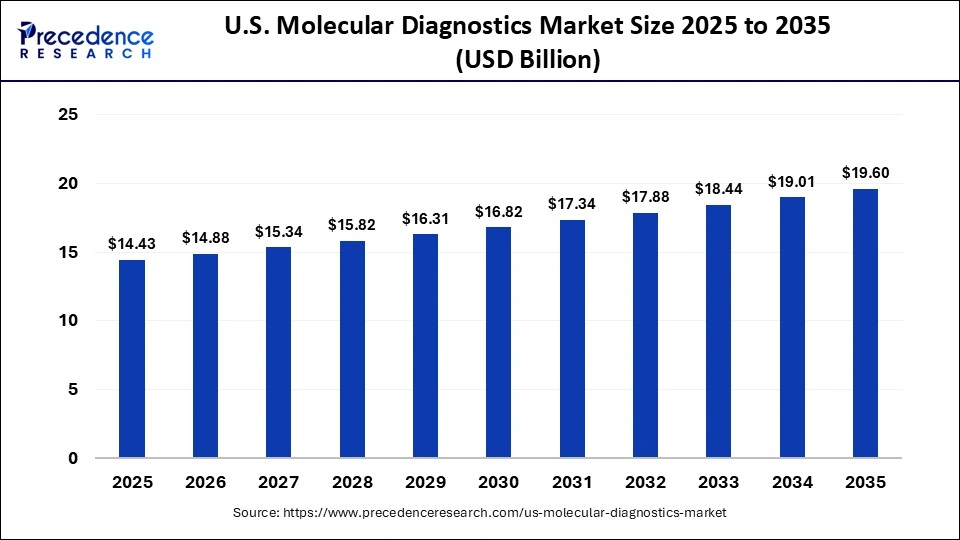
U.S. Molecular Diagnostics Market Statical Scope
| Reports Attributes | Statistics |
| Market Size in 2025 | USD 14.43 Billion |
| Market Size in 2026 | USD 14.88 Billion |
| Market Size by 2035 | USD 19.6 Billion |
| CAGR 2026 to 2035 | 3.11% |
| Base Year | 2025 |
| Forecast Period | 2026 to 2035 |
The market is crucial as it offers advanced tools for early disease detection, personalized medical treatment guidance, and public health crisis management. Molecular tests examine DNA or RNA to identify diseases before severe symptoms appear. This accuracy helps doctors to treat conditions more quickly, improving patient survival rates. The market promotes customized medical care. Technologies like next-generation sequencing pinpoint specific genetic mutations, helping doctors select targeted cancer therapies that align with a patient's individual profile.
Rapid and sensitive molecular testing is essential for monitoring and controlling outbreaks, playing a significant role in the quick identification of respiratory infections and other dangerous pathogens. The strong growth of the industry is supported by leading research centers and efficient FDA approval processes. Innovations in this field minimize the need for costly, invasive procedures, improving the overall efficiency of healthcare delivery.
U.S. Molecular Diagnostics Market, By Product, 2025 (%)
| Segments | Shares (%) |
| Instruments | 31% |
| Reagents | 55% |
| Services & Software | 14% |
- Instruments - The instruments segment, with a share of 31% in 2025, plays a crucial role in the U.S. molecular diagnostics market as it supplies essential hardware like polymerase chain reaction (PCR) machines and next-generation sequencing (NGS) platforms, which are necessary for conducting quick, automated, and precise genetic tests.
- Reagents - The reagents segment, with a share of 55% in 2025, is the largest significant aspect of the molecular diagnostics market as it generates a steady, ongoing revenue stream and provides the vital consumable materials needed for each test. The demand for consumables increases directly with the volume of testing, unlike one-time equipment purchases.
U.S. Molecular Diagnostics Market, By Test Location, 2025 (%)
| Segments | Shares (%) |
| Central Laboratories | 64% |
| Point-of-care | 25% |
| Over-the-counter or Self-test Kits | 11% |
- Central laboratories - The central laboratories segment, with a share of 64% in 2025, accounts for the largest revenue share in the U.S. molecular diagnostics market as it manages large patient volumes and conducts complex, high-throughput genomic and infectious disease testing using advanced technology.
- Point-of-care - The point-of-care (POC) segment, with a share of 25% in 2025, is crucial in the U.S. molecular diagnostics market, as it offers rapid test results right where patients receive care. Molecular diagnostics involves testing a patient's DNA or RNA to identify genetic codes of diseases. Point-of-care testing helps performing these medical tests next to the patient instead of sending samples to a large central lab.
U.S. Molecular Diagnostics Market, By Technology, 2025 (%)
| Segments | Shares (%) |
| Polymerase Chain Reaction (PCR) | 67% |
| Isothermal Nucleic Acid Amplification Technology (INAAT) | 9% |
| DNA Sequencing & Next-generation Sequencing (NGS) | 10% |
| In Situ Hybridization (ISH) | 6% |
| DNA Microarrays | 4% |
| Others | 4% |
- Polymerase Chain Reaction (PCR) - The Polymerase Chain Reaction (PCR) segment, with a share of 67% in 2025, dominates the U.S. molecular diagnostics market due to its high sensitivity, outstanding accuracy, and rapid results in identifying infectious pathogens and genetic disorders.
- Isothermal Nucleic Acid Amplification Technology (INAAT) - Isothermal Nucleic Acid Amplification Technology (INAAT), with a share of 9% in 2025, is vital in the U.S. molecular diagnostics market as it operates at a single, constant temperature, eliminating the need for costly and bulky heating-and-cooling equipment used in traditional testing.
U.S. Molecular Diagnostics Market, By Application, 2025 (%)
| Segments | Shares (%) |
| Infectious Diseases | 42% |
| Oncology | 28% |
| Genetic Testing | 16% |
| Neurological Disease | 7% |
| Microbiology | 7% |
- Infectious diseases - The infectious diseases segment, with a share of 42% in 2025, is a leading driver of the U.S. molecular diagnostics market due to its quick, highly sensitive detection of viral, bacterial, and respiratory pathogens.
- Oncology - The oncology sector, with a share of 28% in 2025, is a crucial factor in the U.S. molecular diagnostics market as it supports precision medicine, targeted treatments, and early cancer detection.
U.S. Molecular Diagnostics Market, By End User, 2025 (%)
| Segments | Shares (%) |
| Diagnostic Laboratories | 45% |
| Hospitals & Clinics | 43% |
| Others | 12% |
- Diagnostic Laboratories - The Diagnostic Laboratories sector, with a share of 45% in 2025, dominates the market share in the U.S. molecular diagnostics market as it acts as the main center for performing high-volume, complex testing for genetic and infectious diseases.
- Hospitals & Clinics - The hospitals and clinics sector, with a share of 43% in 2025, plays an essential role in the U.S. molecular diagnostics market as it is the main location for patient care that needs quick, on-site testing for important medical decisions. Molecular diagnostics are sophisticated lab tests that analyze genes, DNA, or RNA to identify diseases.
Competitive Landscape
The U.S. molecular diagnostics market is primarily driven by leading global healthcare firms that emphasize high-throughput polymerase chain reaction (PCR), next-generation sequencing (NGS), and point-of-care testing.
- F. Hoffmann-La Roche leads in high-throughput clinical diagnostics with key systems like the cobas 6800/8800 and LightCycler PCR platforms, along with AVENIO NGS oncology solutions.
- Danaher Corporation has a strong presence through its subsidiary Cepheid, which offers the GeneXpert rapid molecular testing systems that are commonly used for decentralized and point-of-care infectious disease detection.
- Abbott Laboratories is recognized for its rapid molecular solutions, especially the ID NOW platform that provides quick results for respiratory and other infectious agents.
- Hologic Inc. focuses on targeted molecular diagnostic assays, particularly noted for women's health, virology, and viral load monitoring using the Panther system.
- QIAGEN N.V. provides specialized sample preparation technologies, portable molecular testing systems, and a wide range of assays for personalized healthcare and clinical surveillance.
- Illumina, Inc. is a leading supplier of next-generation sequencing (NGS) systems and consumables that are widely utilized in oncology profiling and genetic research.
Segments Covered in the Report
By Product
- Instruments
- Reagents
- Services & Software
By Test Location
- Central Laboratories
- Point-of-care
- Over-the-counter or Self-test Kits
By Technology
- Polymerase Chain Reaction (PCR)
- Isothermal Nucleic Acid Amplification Technology (INAAT)
- DNA Sequencing & Next-generation Sequencing (NGS)
- In Situ Hybridization (ISH)
- DNA Microarrays
- Others
By Application
- Infectious Diseases
- Oncology
- Genetic Testing
- Neurological Disease
- Microbiology
By End User
- Diagnostic Laboratories
- Hospitals & Clinics
- Others
For inquiries regarding discounts, bulk purchases, or customization requests, please contact us at sales@precedenceresearch.com
Frequently Asked Questions





Ask For Sample
No cookie-cutter, only authentic analysis – take the 1st step to become a Precedence Research client
 Get a Sample




 sales@precedenceresearch.com
 Schedule a Meeting



