



Very Low Sulphur Fuel Oil Market Trends, Companies, Contract Wins / Project Pipeline, Installed Capacity, Power Generation, Government Investment, Technology Adoption, Competitive Positioning, and Growth Forecast
Very Low Sulphur Fuel Oil Market (By Sulphur Grade: 0.5% Sulphur (VLSFO), 0.1% Sulphur (ULSFO), Other Low Sulphur Grades; By Application: Container Ships, Bulk Carriers, Oil Tankers, Others (General Cargo, Ferries); By Source: Traditional refinery, Hydrocracker, Advanced processing; By End-Use: Marine Bunkering, Power generation, Industrial boilers) - Global Industry Analysis, Size, Trends, Leading Companies, Regional Outlook, and Forecast 2026 to 2035
Source: https://www.precedenceresearch.com/very-low-sulphur-fuel-oil-market
 Get a Sample
 Table Of Content


What is the Very Low Sulphur Fuel Oil Market Size?
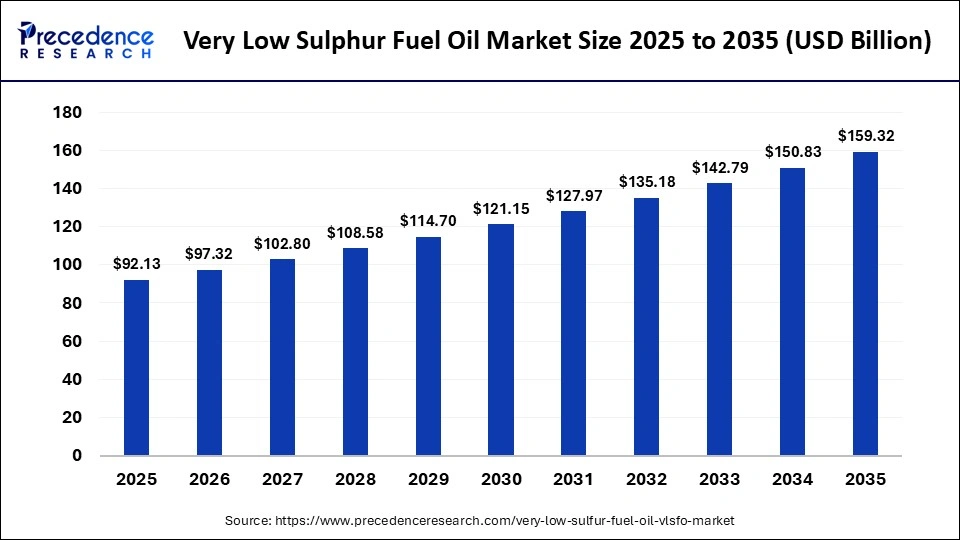
The global very low sulphur fuel oil market size was calculated at USD 92.13 billion in 2025 and is predicted to increase from USD 97.32 billion in 2026 to approximately USD 159.32 billion by 2035, expanding at a CAGR of 5.63% from 2026 to 2035.The Very Low Sulphur Fuel Oil (VLSFO) market encompasses the production, blending, and distribution of marine fuels with a maximum sulphur content of 0.50%, as mandated by the IMO 2020 regulations. It serves as the primary compliance solution for the global shipping industry, offering a cost-effective, high-energy-density alternative to distillates without requiring expensive ship retrofits.
Key Takeaways
- Asia Pacific dominated the global very low sulphur fuel oil market with the largest market share of 46.6% in 2025.
- The very low sulphur fuel oil market in the Middle East & Africa is the fastest-growing region in 2026.
- By sulphur grade, the 0.5% sulphur VLSFO segment dominated the market and accounted for the largest volume share of 68% in 2025.
- By sulphur grade, the 0.1% sulphur ULFSO segment is observed to be the fastest-growing segment.
- By application, the container ships segment dominated the market with the largest revenue volume share of 40% in 2025.
- By application, the bulk carriers' segment is observed to be the fastest-growing segment.
- By source, the traditional refinery segment dominated the market and accounted for the largest volume share of 85% in 2025.
- By source, the hydrocracker and advanced process segment is observed to be the fastest-growing segment.
- By end-use, the marine bunkering segment led the market with the largest revenue volume share of 72% in 2025.
- By end-use, the power generation segment is observed to be the fastest-growing segment.
What is Very Low Sulphur Fuel Oil (VLSFO)?
Very low sulphur fuel oil is a marine fuel developed to meet international maritime organizations 2020 regulation limiting sulphur content in marine fuels 20 .5% by mass Down from previous 3.5% cap Introduced to reduce air pollution and environmental impact from shipping emissions VLSFO serves as a cleaner alternative to traditional high sulphur heavy fuel oil it is typically produced by blending residual fuels Lighter distillates or through refining processes that lower sulphur levels compatible with Most existing ship engines VLSFO has become widely adopted compliance fuel across the global industry supported by refineries blenders traders and ship operators.
Use of Advanced Technology in Very Low Sulphur Fuel Oil (VLSFO)
Advanced refining technologies, AI-driven blending systems and digital fuel management platforms are transforming the VLSFO market. Refineries are using desulphurization and hydrocracking processes to produce imo compliant fuel more efficiently, while real-time analytics and IoT monitoring ensure fuel quality and optimise consumption. These innovations are improving compliance, cost efficiency and operational performances across the marine fuel industry.
Very Low Sulphur Fuel Oil (VLSFO) Market Trends
- Adoption of very low sulphur fuel oil is rising as shipping Power and industrial sectors comply with the IMO 2020 0.5% Sulphur. Demand is driven by regulatory pressure, limited alternative fu Cost effective compliant options and growing use of scrubbers as an alternative compliance energy.
- The very low sulphur fuel oil market faces supply chain constraints and cost pressures. As refiners navigate high processing expenses and limited capacity regional supply gaps, evolving sulphur regulations, and crude oil price swings continue to impact pricing stability and long-term scalability Creating both operational challenges and strategic opportunities for market players.
- In 2020, the International Maritime Organisation (IMO) enforced tighter sulphur limits, accelerating the shift towards VLSFO across global fleets in response to refineries upgrading operations to supply compliant fields strengthen the market momentum and reshaping the competitive landscape.
- Add International Energy Week 2024 in London, the spotlight was firmly on practical maritime decarbonisation, and ExxonMobil positioned itself at the centre of the transition by introducing advanced biomarine fuel blends such as B 25, ULSFO B3, VLSFO, etc.
- The company demonstrated that emission reduction can be achieved when it reinforced its commitment to Scale low emission fuels solution to the global industry.
- The increasing progressions in refining technology are the modern trend in the market, shaping positive market growth by permitting the manufacturing of VLSFO while sustaining overall fuel performance and quality standards. These novelties have made VLSFO an expedient option for ship operators.
Market Scope
| Report Coverage | Details |
| Market Size in 2025 | USD 92.13 Billion |
| Market Size in 2026 | USD 97.32 Billion |
| Market Size by 2035 | USD 159.32 Billion |
| Market Growth Rate from 2026 to 2035 | CAGR of 5.63% |
| Dominating Region | Asia Pacific |
| Base Year | 2025 |
| Forecast Period | 2026 to 2035 |
| Segments Covered | Component, Access Control Type, Deployment Mode, End User, and region |
| Regions Covered | North America, Europe, Asia-Pacific, Latin America, and Middle East & Africa |
Segments Insights
Sulphur Grade Insights
The 0.5% sulphur grade dominated the market with a 68.0% share, largely supported by its dominant role in marine transportation and power generation applications Its stronger market position stems from its ability to limit global emission standards while maintaining cost competitiveness for operators The grade offers broad compatibility with existing marine fuel infrastructure and engine systems reducing the need for retrofits with consistent availability across international bunkering ports.
The 0.1% sulphur grade segment is the fastest-growing over the forecast period. Rising environmental regulations, particularly within Emission Control Areas (ECAs), are accelerating their uptick. Shift to decarbonisation and cleaner fuel alternatives for the strengthening demand.
Applications Insights
The container ships segment dominated the VLSFO with 40% of market share in 2025. The dominance of the segment can be attributed to the stringent IMO emission rules and growing adoption of VLSFO by refineries to produce cleaner fuels. Furthermore, investments in refining technology enable the smooth manufacturing of VLSFO, enhancing supply availability.
Simultaneously, the bulk carrier segment is emerging as the fastest-growing application over the forecast. The growth of the segment can be credited to the growing operational efficiencies related to using compliant fuel, Industrial demand and infrastructure development. VLSFO provides a more cost-effective solution for various operators compared to other alternatives.
Source Insights
The Traditional Refinery dominates the very low sulphur fuel oil market with 85% in 2025. Established refineries continue to capitalise on their extensive infrastructure, integrated supply chains, and large-scale hydro treating and distillation capabilities to meet stringent sulphur limits. Years of technological upgrades and optimization have enabled these facilities to align production with evolving global environmental mandates.
At the same time hydro cracking an advanced processing technologies are gaining traction as one of the fastest-growing production in 2026, these processing units offer enhanced efficiency in converting heavy residual feedstocks into cleaner, high-value fuels while meeting strict Regulatory standards. Their flexibility and improved product yield profiles position They were strategic growth segment.
End-Use Insights
Marine shipping dominated the market, accounting for 72.0% of total demand in 2025. The shift is liability driven by mandatory compliance with the imo 2020SULPHUR cap Which requires vessels to limit sulphur emissions VLSFO has become preferred solution for ship owners As it enables regulatory compliance without major engine modifications And sustain strong demand across global trade routes.
Meanwhile power generation is emerging as one of the faster growing segments in the VLSFO market Utilities and captive power producers are increasingly adopting lower sulphur fuels To meet tightening emission standards while maintaining energy reliability In addition industrial boilers across manufacturing and process industries are gradually shifting toward VLSFOs to align regulations and expand Its demand beyond marine sector.
Regional Insights
What is the Asia Pacific Very Low Sulphur Fuel Oil Market Size?
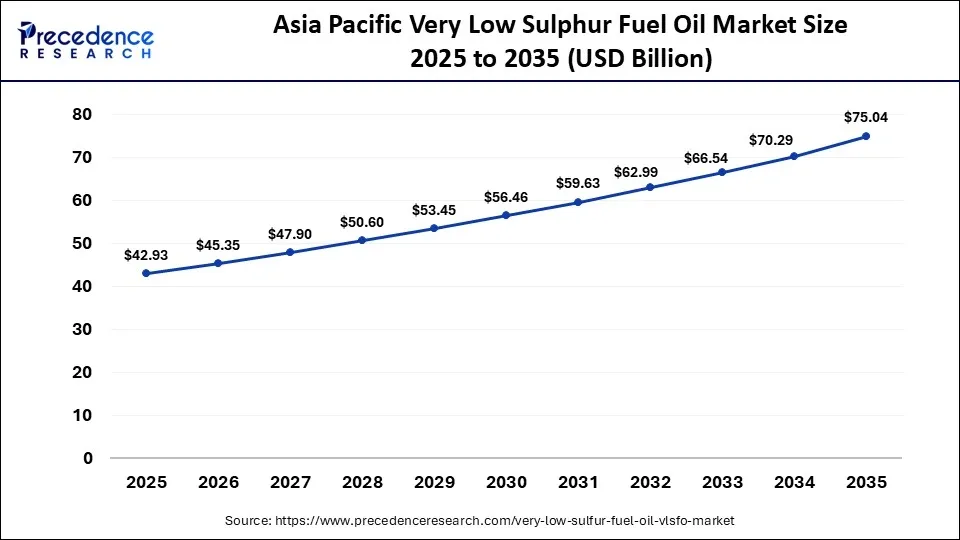
The Asia Pacific very low sulphur fuel oil market size is expected to be worth USD 75.04 billion by 2035, increasing from USD 42.93 billion by 2025, growing at a CAGR of 5.74% from 2026 to 2035.
Asia-Pacific Very Low Sulphur Fuel Oil Market
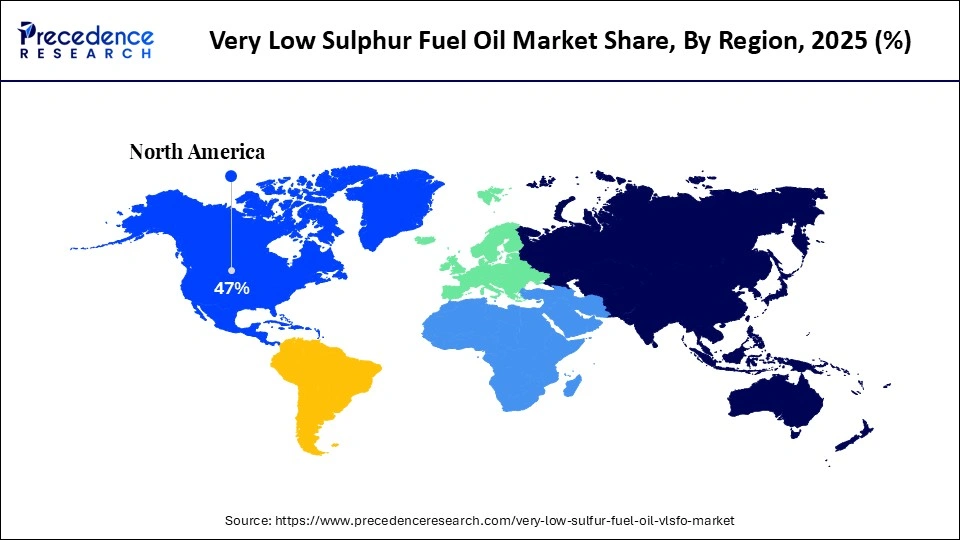
The Asia Pacific dominated the very low sulphur fuel oil market with the highest market share of 46.6% in 2025. A key factor to market demand is that it's the Home to the world's largest bunkering hubs (Singapore, Zhoushan) and dominant manufacturing/export lanes. There is a rising demand for cleaner shipping fuels Supported by strong investments and storage infrastructure. It accelerates VLSFO consumption across Asia Pacific government mandates, promoting low sulphur fuels, And Regions position as a global trade manufacturing hub are further Factors increasing bunker Demand. Surging trade volumes across major shipping routes continue to sustain the region's market dominance.
China Very Low Sulphur Fuel Oil Market
In the Asia-Pacific region, China dominated the market in Asia-Pacific region owing to stringent domestic emission regulations and ongoing investment in infrastructure development. Refinery upgrades are enhancing VLSFO for production blending capabilities and supply reliability, while strong container and bulk cargo throughput across major ports sustained consistent bunker fuel demand.
Middle East & Africa Very Low Sulphur Fuel Oil Market
The Middle East and Africa are projected to be the fastest growing VLSFO market during the forecast. Driven by rising corporate sustainability commitments and growing environmental awareness, the adoption of cleaner fuel such as VLSFO and biofuels is accelerating, strengthening economic policies and increasing exports of minerals, oil, gas and manufactured goods, which are further supporting regional market expansion.
North America Very Low Sulphur Fuel Oil Market
North America is projected to witness steady growth during the forecast. Primarily driven by rising maritime trade and the economic advantage of VLSFO compared to scrubber installations, in addition, advancements in refining technologies are enhancing the fuel production and blending efficiencies Which results in quality and supply reliability.
Demand for very low sulphur fuel oil in the U.S. is increasing consistently, supported by strong coastal trade activity and major international shipping routes. Strict emission control area (ECA) regulations along shorelines are enforcing low sulphur fuel adoption. With growth largely driven by regulatory adherence and steady port operations rather than fleet expansion, it is compliant with fuel production.
What are the Advancements in the Very Low Sulphur Fuel Oil Market in Europe?
Europe is expected to witness significant market growth, driven by the region's strong commitment to sustainability and a high focus on reducing greenhouse gas emissions. Regulatory frameworks such as the EU's Green Deal and the IMO's sulfur cap are vital aspects in driving this transition, encouraging shipping companies to adopt cleaner fuel alternatives to comply with stringent environmental standards. Countries such as Germany, France, and the UK are leading players.
Germany Market Trends
The region's market landscape is marked by collaborations between oil companies and shipping firms to develop innovative solutions that meet regulatory requirements. This high focus on sustainability is expected to further enhance market growth and attract new investments in the sector in the upcoming years.
What are the Key Trends in the Very Low Sulphur Fuel Oil Market in Latin America?
Latin America is expected to have significant growth in the market, driven by increasing shipping activities and regulatory changes. The demand for VLSFO is further being propelled by countries like Brazil and Argentina, which are implementing stricter emissions regulations to align with international standards, thus fostering a shift towards low-sulfur fuels in maritime operations.
Brazil Market Trends
The country's market landscape is characterized by a mix of local and international companies, all of which are striving to enhance their market presence through strategic partnerships and technological advancements.
How is the Middle East and Africa Region Growing in the Very Low Sulphur Fuel Oil Market?
Saudi Arabia Market Trends
This region's growth and development are driven by the government implementing stricter environmental regulations and promoting cleaner fuel alternatives in line with global standards. As the region seeks to diversify its economy and reduce its carbon footprint, the market is poised for growth, attracting both local and international investments.
Very Low Sulphur Fuel Oil Market Value Chain Analysis
- Feedstock Procurement: This is the procurement process for the feedstock required to manufacture fuels that comply with imo 2020 global sulphur cap.
Key Players: ExxonMobil, BP p.l.c, Saudi Aramco. - Chemical Synthesis and Processing: It refers to hydro treating operations and chemical treatments vital for producing VLSFO that meets global maritime sulphur limits.
Key Players: Shell International B.V, BP p.l.c, Sinopec Group. - Packaging and Labelling: This stage involves the systematic collection of fuel samples into tamper-evident containers during the bunkering process to guarantee sample integrity and prevent unauthorised alteration.
Key Players: Petrobras, Vitol Bunkers, SK Pharmteco (SK Innovation). - Regulatory Compliance and Safety Monitoring: The process focuses on regulatory adherence and the deployment of robust quality management systems to ensure hazard-free operations and total environmental compliance.
Very Low Sulphur Fuel Oil Market Companies
- Shell plc
- ExxonMobil Corporation
- BP p.l.c.
- TotalEnergies SE
- Sinopec Group
- Chevron Corporation
- PetroChina Company Limited
- Saudi Aramco
- Indian Oil Corporation Limited (IOCL)
- Neste Oyj
- Vitol Bunkers
- World Kinect Corporation
- Marathon Petroleum Corporation
- SK Pharmteco (SK Innovation)
- Gazprom Neft
Recent Developments
- In Feb 2026, fob Singapore bunker trades show very low sulphur fuel oil volumes plunged in Jan 2026, reflecting weakening VLSFO market activity and slow bunker demand in Asia.
- In October 2026, Ship-to-ship bunkering service started at Vizhinjam Port, Kerala, India, allowing direct refuelling with very low sulphur fuel oil, as opposed to a local bunkering infrastructure to reduce reliance on Colombo.
- In February 2026, Kuwait's refinery fully restarted after a fire outage, leading to VLSFO export Volumes in January. This highlights increased supply capability from Middle East refineries, influencing global bunker markets.
- In 2025, Brazil's Petrobras entered the Asian bunker market with its inaugural sale of VLSFO blended with 25% renewable content biofuel mix, illustrating industry moves toward low-carbon compliant variants.
- In December 2025, SINOVA Marine launched next-generation low-sulphur cylinder oils tuned for use with VLSFO under new emission regulations, supporting industrial innovation for operational performance.
- The energy majors (Vital, Petrobras and BP) are launching bio-blended, or co-pressed VLSFO products to meet fuel EU maritime and imo requirements while advancing sustainability.
- Feb 2026 , shall announce its review of strategic options for its Indian renewable unit, SPRNG Energy, to unlock long-term value.
Regional Insights
Segments Covered in the Report
By Sulphur Grade
- 0.5% Sulphur (VLSFO)
- 0.1% Sulphur (ULSFO)
- Other Low Sulphur Grades
By Application
- Container Ships
- Bulk Carriers
- Oil Tankers
- Others (General Cargo, Ferries)
By Source
- Traditional refinery
- Hydrocracker
- Advanced processing
By End-Use
- Marine Bunkering
- Power generation
- Industrial boilers
By Region
- North America
- Asia Pacific
- Europe
- Latin America
- Middle East & Africa
For inquiries regarding discounts, bulk purchases, or customization requests, please contact us at sales@precedenceresearch.com
Frequently Asked Questions





Ask For Sample
No cookie-cutter, only authentic analysis – take the 1st step to become a Precedence Research client
 Get a Sample




 sales@precedenceresearch.com
 Schedule a Meeting
