



Vibratory Plate Compactor Market Size, Companies, Share, Vehicle Production Volume, Sales Performance, Export & Import Analysis, Technology Adoption, Competitive Positioning, and Demand Trends
Vibratory Plate Compactor Market (By Power Source: Diesel, Gasoline, Electric; By Compacting Force: Up to 20 KN, 20 - 40 KN, Above 40 KN; By Application: Soil Compaction, Asphalt Paving, Concrete Flooring, Road Construction, Utility Trenches, Others) - Global Industry Analysis, Size, Trends, Leading Companies, Regional Outlook, and Forecast 2026 to 2035
Source: https://www.precedenceresearch.com/vibratory-plate-compactor-market
 Get a Sample
 Table Of Content


What is the Vibratory Plate Compactor Market Size?
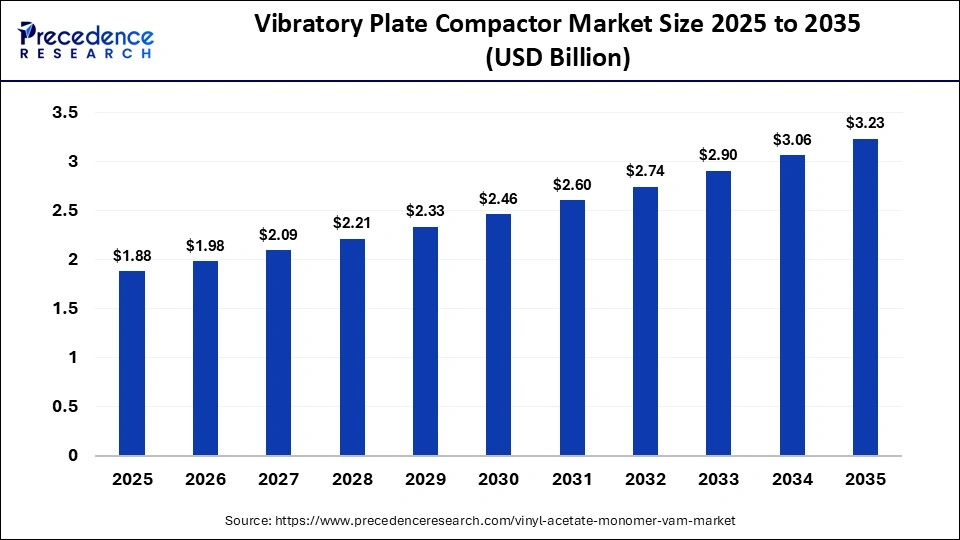
The global vibratory plate compactor market size was calculated at USD 1.88 billion in 2025 and is predicted to increase from USD 1.98 billion in 2026 to approximately USD 3.23 billion by 2035, expanding at a CAGR of 5.55% from 2026 to 2035. The market is driven by rapid urbanization, the adoption of efficient soil compaction equipment, and rising investment in infrastructure development and construction projects.
Key Takeaways
- By region, Asia Pacific led the vibratory plate compactor market in 2025.
- By region, North America is observed to be the fastest-growing region in the forecasted period.
- By power source, the gasoline segment led the market with the largest share in 2025.
- By power source, the electric segment is expected to grow at the fastest CAGR in the foreseen period.
- By compacting force, the up to 20 KN segment led the global market in 2025.
- By compacting force, the 20-40 KN segment is expected to grow at the fastest rate in the upcoming period.
- By application, the soil compaction segment led the global market in 2025.
- By application, the road construction segment is observed to be the fastest growing in the foreseeable period.
Vibratory Plate Compactor Market Overview
Vibratory plate compactors play a crucial role in delivering efficient and reliable compaction across a variety of materials, particularly in narrow and confined spaces where heavy equipment is impractical or uneconomical. Their selection is largely driven by project scope and application requirements, making them a flexible solution for diverse construction needs. By ensuring stable and durable foundations, these machines enhance structural strength and long-term performance. With fewer corrective interventions and reduced maintenance costs over time, they offer strong operational efficiency. Operating within a frequency range of 2,500 to 6,000 vpm, vibratory plate compactors combine power, precision, and versatility, enabling uniform and high-quality compaction through an advanced vibrating flat plate mechanism.
Impact of Artificial Intelligence on the Vibratory Plate Compactor Market
Integrating artificial intelligence into vibratory plate compactors is somewhat challenging, yet innovation and automation are advancing to enable real-time monitoring and control. One of the most difficult aspects of compaction is handling variable particle sizes. A single job site may contain multiple particle size distributions with drastically different stiffness profiles. To address this, machine learning models are trained on thousands of data points collected from diverse environments. AI can help monitor machine health and predict maintenance needs. Based on particle size, moisture estimates, and prior pass data, the AI-driven system can recommend optimal pass counts and roller settings. With AI, quality control, as well as pre- and post-construction testing, can be significantly enhanced.
Vibratory Plate Compactor Market Trends
- Growing urbanization and increased investments in road development, housing, and industrial facilities are creating steady demand for soil and asphalt compaction equipment.
- Governments across regions are enforcing stricter emission standards and environmental regulations, prompting manufacturers to adopt cleaner technologies.
- Advancements in technology and innovation, such as telematics, real time monitoring, GPS tracking, data analytics, and remote operation, are helping to improve the vibratory plate compactor market.
- Demand is rising for compact, easy to transport vibratory plate compactors that improve onsite mobility and operator convenience, especially in urban and small scale projects.
- Manufacturers are increasingly offering electric and battery powered compactors to meet stricter emission regulations and to address environmental concerns in noise sensitive areas.
- The increasing popularity of equipment rentals, especially among small contractors and DIY users, is expanding market reach and reducing capital expenditure barriers.
- Rapid urbanization and construction growth in regions like Asia Pacific, Latin America, and the Middle East are contributing to overall market.
Market scope
| Report Coverage | Details |
| Market Size in 2025 | USD 1.88 Billion |
| Market Size in 2026 | USD 1.98 Billion |
| Market Size by 2035 | USD 3.23 Billion |
| Market Growth Rate from 2026 to 2035 | CAGR of 5.55% |
| Dominating Region | Asia Pacific |
| Fastest Growing Region | North America |
| Base Year | 2025 |
| Forecast Period | 2026 to 2035 |
| Segments Covered | Power Source, Compacting Force, Application Outlook, and region |
| Regions Covered | North America, Europe, Asia-Pacific, Latin America, and Middle East & Africa |
Segment Insights
Power Source Insights
What Made Gasoline the Dominant Segment in the Market in 2025?
The gasoline segment dominated the vibratory plate compactor market with the largest share in 2025 due to the high-power output, easy refueling, and suitability of gasoline-powered compactors in heavy-duty applications. These compactors are known for their high power and flexibility. They are widely used in heavy construction and infrastructure projects and are popular for outdoor applications because of their robust performance. These machines generate sufficient energy to power equipment efficiently, while maintaining affordable operational costs. In addition, they typically have a lower emissions profile, resulting in a reduced environmental footprint.
The electric segment is expected to grow at the fastest CAGR during the forecast period, driven by rapid urbanization and the shift of the construction industry toward eco-friendly, low-noise equipment. Electric compactors are gaining traction as a sustainable alternative, as they reduce environmental impact and operating costs by producing less noise and emitting no exhaust fumes. With the ongoing metropolitan shift, there is a growing demand for lower operational costs and zero on-site emissions, particularly for indoor or small-scale outdoor projects, making electric compactors an increasingly attractive option. In addition, they have fewer moving parts, resulting in fewer components to maintain or replace, which saves both time and money.
Compacting Force Insights
How Did the Up To 20 KN Segment Dominate the Vibratory Plate Compactor Market?
The up to 20 KN segment dominated the market, holding a major share in 2025. The segment's leadership is driven by its high versatility, lightweight design, ease of operation, and efficient load distribution. These compactors effectively compress various materials, including soil, asphalt, and gravel. Operating at approximately 4,496 lbf of centrifugal force, they deliver stronger compaction performance, better compaction quality, lower maintenance costs, and a longer service life, collectively supporting market growth.
The 20-40 KN segment is projected to grow at the fastest rate during the forecast period. This is due to the increasing usage of these compactors in large infrastructure and road-building projects. These compactors offer superior compaction depth and coverage, ensuring enhanced durability and stability of foundations. They are widely used for compacting soil, sand, and gravel prior to pouring concrete or laying asphalt surfaces. Positioned as higher-force models, 20–40 KN compactors provide an optimal balance between power and portability and typically operate at around 2,200 bpm. Their suitability for major infrastructure projects, such as dams, highways, expressways, and bridges, is expected to significantly support overall market expansion.
Application Outlook Insights
Why Did the Soil Compaction Segment Dominate the Vibratory Plate Compactor Market?
The soil compaction segment dominated the market with the largest share in 2025, driven by expanding residential, commercial, and industrial construction activities. Growing emphasis on soil penetration keeps soil compaction at the forefront, making it the leading application for vibratory plate compactors. In addition, its widespread use in foundation works across residential, commercial, and industrial projects further supports segment growth. Soil compaction applications include terrace construction, pedestrian paths and walkways, asphalt or paving repairs on small areas, localized pothole repairs, courtyard and driveway access ramps, sidewalk and pavement sections, and finishing layers in wide trenches, as well as compaction of the final 20-30 cm of backfill, provided trench width allows safe plate operation.
The road construction segment is expected to grow at the fastest CAGR during the forecast period due to growing infrastructure development and increased government investment in highway modernization. Vibratory plate compactors are the preferred choice in civil engineering applications involving gravel, concrete, and asphalt, as they deliver more uniform and stable surfaces and are often favored over traditional road rollers in many construction scenarios. Their extensive use in road construction and ongoing maintenance, coupled with significant advancements in compaction technology, is anticipated to further accelerate market growth.
Regional Insights
What is the Asia Pacific Vibratory Plate Compactor Market Size?
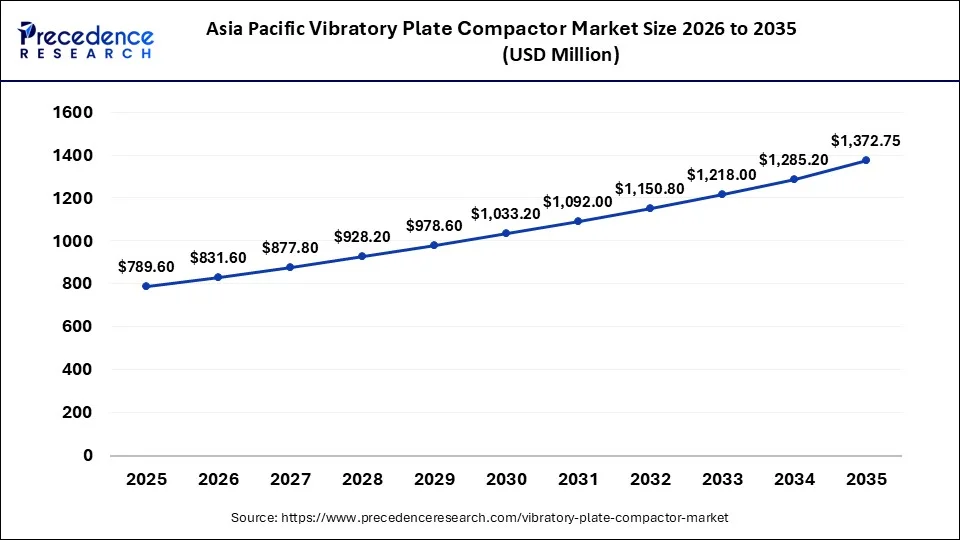
The Asia Pacific Vibratory Plate Compactor market size is calculated at USD 789.60 million in 2025 and is expected to reach nearly USD 1,372.75 million in 2035, accelerating at a strong CAGR of 5.69% between 2026 and 2035.
Which Factors Contribute to the Asia Pacific's Dominance in the Vibratory Plate Compactor Market?
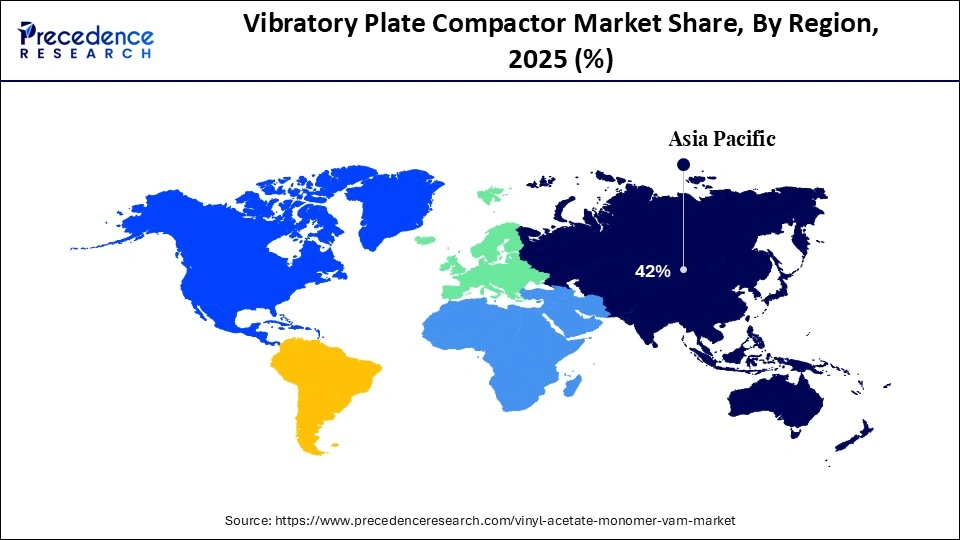
Asia Pacific dominated the vibratory plate compactor market with the largest share in 2025. This is mainly due to the increased investments in infrastructure development and rapid urbanization in countries such as China, India, and Indonesia. Demand is being further boosted by increased adoption of advanced, automation-enabled compactors, as contractors and governments prioritize higher productivity, efficiency, and sustainability. At the same time, regional export growth is influenced by shifting trade policies, tightening sustainability requirements, and currency volatility.
Government-backed programs, such as Smart City initiatives and large-scale highway and road expansion projects, are key growth catalysts. China offers significant scale and rapid technology adoption nonetheless requires strong local partnerships, robust IP protection, and careful navigation of regulatory hurdles. India remains a cost-sensitive, volume-driven market with accelerating urban demand. Furthermore, Japan and Australia are mature, high-value markets characterized by conservative purchasing behavior and stringent quality expectations. Across the region, large-scale construction of roads, highways, bridges, airports, and other public infrastructure continues to boost market expansion.
How is the Opportunistic Rise of North America in the Market?
North America is expected to grow at the fastest CAGR in the coming years, supported by a well-established construction framework and sustained capital allocation toward infrastructure development. Market expansion is further reinforced by structured project pipelines, advanced distribution networks, and the integration of new technologies across construction practices. Regulatory frameworks governing safety, environmental compliance, and data standards remain stringent, creating moderate entry barriers for new participants. In addition, the ongoing transition from equipment ownership to rental-based procurement models is reshaping demand patterns and competitive dynamics.
The U.S. leads the North American vibratory plate compactor market, driven by large-scale infrastructure rehabilitation programs and continuous residential construction activity. Federal funding directed toward road modernization and public works projects continues to generate consistent equipment demand. Canada is exhibiting steady growth, supported by incremental investment in transportation corridors and urban infrastructure enhancement initiatives.
What Drives the European Vibratory Plate Compactor Market?
The market in Europe is growing at a notable rate due to strict environmental compliance standards and a growing emphasis on sustainable construction methodologies. Demand is further supported by urban redevelopment programs and the modernization of ageing infrastructure assets. Brazil is a major contributor to the market due to the rising infrastructure expenditure and ongoing urban development initiatives. Large-scale infrastructure programs across the UAE, Saudi Arabia, and South Africa are further boosting equipment demand, particularly for soil compaction applications in transportation and urban construction projects.
Germany Market Trends
Germany leads the market in Europe because of its highly developed construction sector, efficient road renovations, and increasing investments in energy-saving construction machinery. Germany is currently experiencing an increased need for technologically sophisticated vibratory compactors, which help enhance operational efficiency.
How is Latin America Growing in the Vibratory Plate Compactor Market?
Latin America is expected to grow at a notable CAGR in the foreseeable future in the vibratory plate compactor industry, owing to urban construction activities, expansion in residential constructions, and improvements in transportation infrastructures. Road building and infrastructure improvement are key areas of focus by the government, thereby enabling the use of more effective and affordable construction machinery.
Brazil Market Trends
Brazil is one of the important countries owing to the increased road construction activities, housing constructions, and investments made in the construction of infrastructure in the country. Vibratory plate compactors have been increasingly used by construction firms to stabilize the soil during infrastructure construction.
How is the Middle East and Africa Developing in the Vibratory Plate Compactor Market?
The Middle East and Africa are considered to be a significantly growing area, owing to rising infrastructure spending, construction, and transportation projects. With the rising trend towards urbanization, there is an emphasis on building intelligent cities. The increased demand for better construction equipment, like a vibratory plate compactor, is driven by this trend.
UAE Market Trends
Growth in the UAE can be attributed to urban development, construction of business structures, and investments in smart cities. There is a higher demand for durable and efficient vibratory plate compactors in road construction, landscaping, and real estate, leading to growth in the market.
Competitive Landscape
The market for vibratory plate compactors is fairly fragmented due to the existence of international and regional construction equipment makers. Competitors differentiate themselves in terms of product durability, fuel efficiency, compaction efficiency, and price. Leading firms concentrate on making their products lighter and more maintenance-friendly. There is an increasing demand for electric and emissions-controlled compactors. Collaboration with dealers, rental firms, and infrastructure contractors is aiding companies to enhance their market penetration and intensify competition within the global market.
Vibratory Plate Compactor Market Value Chain Analysis
- Raw Material Sourcing: This stage involves sourcing high-strength metals and precision components engineered to endure intense centrifugal forces.
Key Player: AKP Ferrocast, Fermier Agency - Component Fabrication and Machining: Fabrication and machining convert raw castings and steel sections into precise, durable, vibration-resistant vibratory plate compactors.
Key Player: Uppal Ferrocast Pvt Ltd, RM Technocast, Wacker Neuson SE - Testing and Certification: Testing and certification verify compactors meet global safety, performance, and environmental standards, including HAV and emissions.
Key Players: TUV India (TUV NORD), Pilz IN, URS India - Installation and Commissioning: Installation and commissioning are simple yet crucial to avoid premature engine failure and structural damage.
Key Players: Wacker Neuson SE, BOMAG GmbH (BOMAG Service) - Distribution and Sales: Distribution relies on direct manufacturer sales, wide dealer networks, and a robust, growing equipment rental market.
Key Players: BOMAG GmbH, Wacker Neuson SE, Caterpillar Inc. - Maintenance and After-Sales Service: Maintenance for vibratory plate compactors focuses on two areas: engine reliability and vibration system integrity.
Key Player: Wacker Neuson (EquipCare), BOMAG GmbH - Product Lifecycle Management: PLM for compactors unifies design, manufacturing, and service data to manage equipment from concept to decommissioning.
Key Players: Siemens Teamcenter, PTC Windchill, SAP Product Lifecycle Management
Vibratory Plate Compactor Market Companies
- Wacker Neuson SE (Germany)
- BOMAG GmbH (Germany)
- Caterpillar Inc. (U.S.)
- Ammann Group (Switzerland)
- Atlas Copco AB (Sweden)
- Husqvarna Group (Sweden)
- Weber Maschinentechnik GmbH (Germany)
- Mikasa Sangyo Co., Ltd. (Japan)
- MBW Inc. (U.S.)
- Multiquip Inc. (U.S.)
- JCB (UK)
- Sakai Heavy Industries, Ltd. (Japan)
- Doosan Portable Power (U.S.)
- XCMG (China)
- Chicago Pneumatic (U.S.)
Recent Developments
- In January 2026, CASE Construction Equipment developed its range of BS CEV Stage V machines in Gurgaon, featuring the 450NX Mini Tandem Vibratory Compactor and 1107NX Soil Compactor. These new products by the company have been developed for sustainable construction practices in India.
(Source: https://www.autocarpro.in) - In September 2025, SANY India launched the new SSR110C-10 PRO Vibratory Soil Compactor, weighing 11 tons, which is aimed at meeting the requirements of large infrastructure projects in India. This road construction equipment combines the latest vibration technology, efficient fuel consumption, and operator-focused features.
(Source: https://www.autocarpro.in) - In 2025, SANY India introduced the SSR110C-10 PRO Vibratory Soil Compactor, an 11-ton, rugged machine engineered for high performance, operator comfort, and fuel efficiency. Manufactured at the company's Pune facility, it is specifically designed to handle India's most demanding terrains while enhancing productivity and supporting the country's ongoing infrastructure development.
(Source: https://www.manufacturingtodayindia.com) - In 2025, JCB unveiled a major innovation with the VM118D, a 12-tonne single drum soil compactor that is the first machine of its kind in the world to meet EU Stage V emissions standards without using Diesel Exhaust Fluid (DEF) or Selective Catalytic Reduction (SCR).
(Source: https://awesomeearthmovers.com)
Segments Covered in the Report
By Power Source
- Diesel
- Gasoline
- Electric
By Compacting Force
- Up to 20 KN
- 20 - 40 KN
- Above 40 KN
By Application
- Soil Compaction
- Asphalt Paving
- Concrete Flooring
- Road Construction
- Utility Trenches
- Others
By Region
- North America
- Europe
- Asia-Pacific
- Latin America
- Middle East & Africa
For inquiries regarding discounts, bulk purchases, or customization requests, please contact us at sales@precedenceresearch.com
Frequently Asked Questions





Ask For Sample
No cookie-cutter, only authentic analysis – take the 1st step to become a Precedence Research client
 Get a Sample




 sales@precedenceresearch.com
 Schedule a Meeting
