



Wound Dressing Market Trends, Leading Companies, Company Revenue / Sales Performance, Procedure Volume, Healthcare Spending, Technology Adoption, Reimbursement Analysis, Competitive Landscape, and Growth Outlook
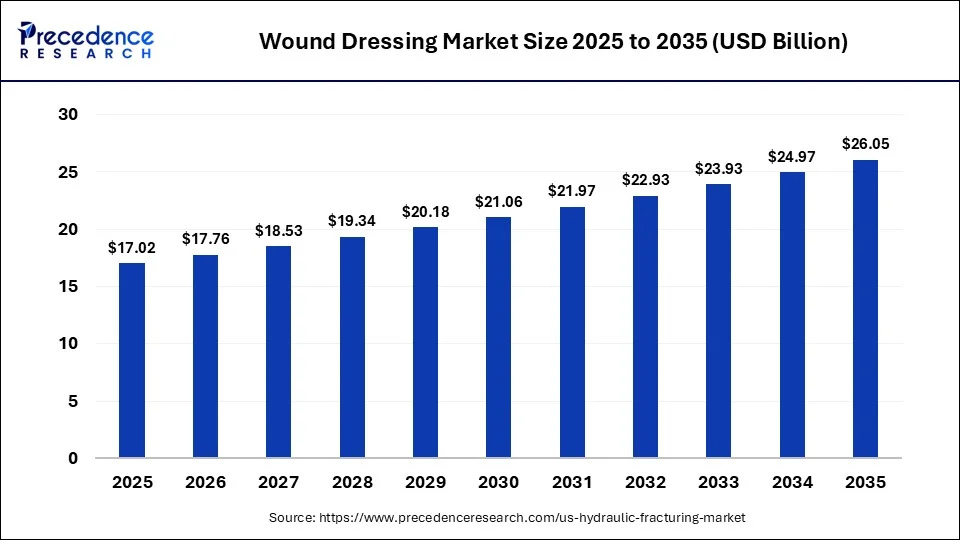
The wound dressing market was valued at USD 17.76 billion in 2026 and is projected to grow at a CAGR of 4.35% through 2035. Market growth is driven by the increasing prevalence of chronic wounds, rising surgical procedures, growing incidence of diabetes as well as pressure injuries, and expanding need for advanced wound-care solutions. Major trends include the growing adoption of foam, hydrocolloid, hydrogel, collagen, alginate, antimicrobial, and superabsorbent dressings, alongside bioactive materials and innovative wound-healing technologies. The rising healthcare expenditure, expanding outpatient and home-based wound care, and increasing emphasis on faster healing and infection prevention are anticipated to create new opportunities for wound dressing producers and advanced wound-care providers through 2035.
Source: https://www.precedenceresearch.com/wound-dressing-market
 Get a Sample
 Table Of Content


Wound Dressing Market Size Growth and Forecast 2035
The global wound dressing market is forecasted to expand from USD 17.76 billion in 2026 to USD 26.05 billion by 2035, growing at a CAGR of 4.35% from 2026 to 2035.
Key Takeaways
- Advanced wound dressings are capturing a growing share of market value, with foam, antimicrobial, superabsorbent, collagen, hydrogel, alginate, and silicone-based products gaining importance over conventional gauze and basic dressings.
- Chronic wounds remain the primary demand engine, with diabetic foot ulcers, pressure injuries, and venous leg ulcers driving sustained demand for higher-performance wound-care products.
- Foam dressings lead the advanced-dressing segment, accounting for approximately 23–24% of segment revenue due to their broad use in surgical wounds, pressure injuries, diabetic ulcers, and heavily exuding wounds.
- The market is shifting toward outcome-driven wound management, with healthcare providers placing greater emphasis on fewer dressing changes, exudate control, infection prevention, atraumatic removal, and improved healing economics.
- Home-based and outpatient wound care are creating new growth opportunities, increasing demand for easy-to-use advanced dressings that can support patient, caregiver, and home-health management.
- North America remains the largest regional revenue pool, while Asia Pacific offers the strongest growth opportunity, supported by rising healthcare infrastructure, surgical volumes, diabetes prevalence, and adoption of advanced wound-care products.
- Competitive advantage is increasingly determined by technology depth, clinical evidence, and distribution strength, with the strongest companies combining broad portfolios and manufacturing scale with differentiated technologies such as antimicrobial, superabsorbent, collagen, bioactive, and silicone-based dressings
Chronic-Wound Burden and the Shift Toward Higher-Value Dressings are Expanding a Large, Clinically Segmented Market
Market evaluations vary materially depending on whether basic dressings, advanced dressings, antimicrobial products, contact layers, superabsorbents, and adjacent wound-care technologies are included; therefore, the analysis establishes a consistent product boundary before sizing the market.
Advanced products represent the principal value-creation pool, with foam, hydrocolloid, alginate, hydrogel, collagen, film, superabsorbent, silicone-contact, and antimicrobial formats commanding higher ASPs than conventional gauze, tape, and basic absorbent products. Foam dressings alone account for roughly one-quarter of advanced dressing revenue in several market definitions, reflecting their broad use in exudate management.
Chronic wounds are the structural demand engine. Diabetes, vascular disease, obesity, aging, pressure injuries, and prolonged hospitalization increase the addressable patient population while surgical procedures, trauma, and burns sustain acute-wound demand. Chronic wounds account for approximately 65% of advanced wound-dressing application revenue in available market estimates.
North America remains the largest regional revenue pool, representing roughly 35% of global advanced dressing demand, while Asia Pacific is expected to deliver the fastest expansion as healthcare infrastructure, surgical volumes, diabetes prevalence, and adoption of advanced wound-management products increase.
The market remains moderately fragmented: a small group of global manufacturers possesses strong clinician relationships and advanced-product portfolios, while regional manufacturers compete aggressively in gauze, basic dressings, private-label products, and cost-sensitive institutional channels.
Key Coverage
- Chronic wounds represent roughly 65% of advanced-dressing demand.
- Foam is the leading advanced-dressing format, with approximately 24% share in relevant market estimates.
- North America contributes approximately 35% of advanced-dressing revenue.
- Asia Pacific represents the principal high-growth regional opportunity.
- Analysis separates traditional, advanced, and antimicrobial dressing economics.
- Market sizing is provided by product, wound type, application, end user, channel, and geography.
Segmentation Analysis - Advanced Foam, Antimicrobial and Bioactive Formats are Capturing the Highest-Value Growth
Product segmentation shows a clear economic hierarchy. Traditional dressings remain high-volume but low-ASP, while advanced dressings generate substantially greater revenue per unit because they incorporate engineered absorbency, moisture management, antimicrobial functionality, collagen, silicone interfaces, or other performance-enhancing materials.
Foam dressings lead advanced products at approximately 23-24% of segment revenue, supported by broad application across surgical wounds, pressure injuries, diabetic ulcers, and heavily exuding wounds. Hydrocolloids, alginates, and hydrogels occupy distinct clinical niches, while collagen and biomaterial-based dressings represent smaller but faster-growing premium pools.
Antimicrobial dressings represent an important value pool of approximately USD 3 billion globally, with silver and other antimicrobial technologies positioned around infection-risk management rather than basic wound coverage.
By wound type, chronic wounds generate the largest revenue pool, while acute surgical and traumatic wounds provide substantial procedure-linked volume. Hospitals remain the largest end user, but home healthcare is growing faster as wound management moves outside inpatient settings.
Key Coverage
- Foam, hydrocolloid, alginate, hydrogel, film, collagen, and antimicrobial segmentation.
- Chronic versus acute wound economics.
- Diabetic foot, pressure, venous leg, surgical, traumatic, and burn wounds.
- Hospital, clinic, ASC, long-term care, and home-health demand.
- Institutional versus retail/online channels.
- Segment revenue, share, CAGR, and growth contribution.
Market Dynamics - Aging Diabetes and Outpatient Care are Expanding Demand While Reimbursement and Evidence Requirements Raise the Bar
The largest structural driver is the expanding population vulnerable to chronic wounds. Chronic wounds affect millions of patients globally, with diabetes, vascular disease, and aging creating persistent treatment demand. India alone is expected to have approximately 93 million people with diabetes in 2025, illustrating the scale of future chronic-wound exposure in emerging healthcare systems.
A second driver is the continued shift toward outpatient and home-based wound management. Dressings that reduce change frequency, simplify application, and enable caregiver or patient self-management become economically attractive even when their unit price is higher.
The primary restraints are reimbursement pressure, clinical substitution, price competition in commodity categories, and the requirement for stronger evidence around premium technologies.
The opportunity therefore lies less in selling “more dressings” and more in demonstrating lower total treatment cost per healed wound.
Key Coverage
- Chronic-disease and demographic demand drivers.
- Surgical and trauma volumes.
- Home-care migration.
- Infection-control requirements.
- Reimbursement pressures.
- Clinical-evidence requirements.
- Commodity-price competition.
- Premiumization opportunities.
25 Companies Shaping the Market
| Company | Headquarters | Market Position | Core Strength | Major Applications/Segments |
| Smith+Nephew | UK | Global leader | Advanced wound management | Surgical, chronic, advanced |
| Solventum | U.S. | Global leader | Advanced dressings/materials | Surgical, acute, chronic |
| Mölnlycke Health Care | Sweden | Global specialist | Advanced wound dressings | Chronic, surgical |
| ConvaTec | UK | Global specialist | Foam, hydrocolloid, antimicrobial | Chronic, acute |
| Coloplast | Denmark | Global specialist | Chronic wound care | Leg and diabetic ulcers |
| Medline Industries | U.S. | Scale challenger | Broad wound portfolio | Hospital, home care |
| Cardinal Health | U.S. | Distribution/scale player | Traditional and advanced | Institutional |
| PAUL HARTMANN | Germany | European leader | Traditional and advanced | Chronic, surgical |
| B. Braun | Germany | Global healthcare supplier | Wound management | Surgical, chronic |
| URGO Medical | France | Specialty leader | Advanced healing technologies | Chronic, acute |
| Integra LifeSciences | U.S. | Specialty player | Regenerative matrices | Complex wounds |
| Johnson & Johnson / Ethicon | U.S. | Surgical specialist | Surgical wound management | Surgical |
| Advanced Medical Solutions | UK | Technology specialist | Advanced dressings | Surgical, chronic |
| Essity | Sweden | Global healthcare supplier | Compression and wound care | Leg ulcers |
| Lohmann & Rauscher | Germany/Austria | European specialist | Dressings and bandaging | Clinical, chronic |
| Winner Medical | China | Regional/global challenger | Gauze and advanced dressings | Hospital, consumer |
| Datt Mediproducts | India | Regional specialist | Advanced dressings | Chronic, surgical |
| DeRoyal Industries | U.S. | Regional specialist | Surgical wound products | Hospital |
| Hollister | U.S. | Specialty healthcare player | Skin and wound management | Chronic |
| DermaRite Industries | U.S. | Value-focused player | Advanced and traditional | Institutional |
| Advancis Medical | UK | Specialty innovator | Antimicrobial dressings | Infection management |
| MedWay Group | UK | Regional specialist | Advanced wound care | Chronic |
| PolyNovo | Australia | Biomaterial specialist | Synthetic biomaterials | Complex wounds |
| MiMedx | U.S. | Regenerative specialist | Placental/biologic technologies | Complex chronic wounds |
| Organogenesis | U.S. | Regenerative specialist | Advanced biologic wound care | Diabetic and chronic wounds |
| Smith+Nephew | UK | Global leader | Advanced wound management | Surgical, chronic, advanced |
| Solventum | U.S. | Global leader | Advanced dressings/materials | Surgical, acute, chronic |
| Mölnlycke Health Care | Sweden | Global specialist | Advanced wound dressings | Chronic, surgical |
| ConvaTec | UK | Global specialist | Foam, hydrocolloid, antimicrobial | Chronic, acute |
| Coloplast | Denmark | Global specialist | Chronic wound care | Leg and diabetic ulcers |
| Medline Industries | U.S. | Scale challenger | Broad wound portfolio | Hospital, home care |
| Cardinal Health | U.S. | Distribution/scale player | Traditional and advanced | Institutional |
| PAUL HARTMANN | Germany | European leader | Traditional and advanced | Chronic, surgical |
| B. Braun | Germany | Global healthcare supplier | Wound management | Surgical, chronic |
| URGO Medical | France | Specialty leader | Advanced healing technologies | Chronic, acute |
| Integra LifeSciences | U.S. | Specialty player | Regenerative matrices | Complex wounds |
| Johnson & Johnson / Ethicon | U.S. | Surgical specialist | Surgical wound management | Surgical |
| Advanced Medical Solutions | UK | Technology specialist | Advanced dressings | Surgical, chronic |
| Essity | Sweden | Global healthcare supplier | Compression and wound care | Leg ulcers |
| Lohmann & Rauscher | Germany/Austria | European specialist | Dressings and bandaging | Clinical, chronic |
| Winner Medical | China | Regional/global challenger | Gauze and advanced dressings | Hospital, consumer |
| Datt Mediproducts | India | Regional specialist | Advanced dressings | Chronic, surgical |
| DeRoyal Industries | U.S. | Regional specialist | Surgical wound products | Hospital |
| Hollister | U.S. | Specialty healthcare player | Skin and wound management | Chronic |
| DermaRite Industries | U.S. | Value-focused player | Advanced and traditional | Institutional |
| Advancis Medical | UK | Specialty innovator | Antimicrobial dressings | Infection management |
| MedWay Group | UK | Regional specialist | Advanced wound care | Chronic |
| PolyNovo | Australia | Biomaterial specialist | Synthetic biomaterials | Complex wounds |
| MiMedx | U.S. | Regenerative specialist | Placental/biologic technologies | Complex chronic wounds |
| Organogenesis | U.S. | Regenerative specialist | Advanced biologic wound care | Diabetic and chronic wounds |
Which Competitive Capabilities are Creating the Strongest Advantage Across the Wound Dressing Market?
The wound dressing market remains structurally fragmented across traditional dressings, advanced wound products, antimicrobial solutions, and specialty biologic or biomaterial-based technologies. Competitive differentiation increasingly depends on advanced-product exposure rather than overall healthcare scale, as foam, antimicrobial, superabsorbent, collagen, and silicone-based products command higher ASPs and address more complex wounds. Leading participants also benefit from established hospital relationships, clinical evidence, regulatory capabilities, and broad distribution networks, while regional manufacturers remain more competitive in price-sensitive conventional dressings.
Our analysis indicates that the strongest competitive positions are being created by the combination of portfolio breadth and specialty depth. Companies capable of addressing multiple wound categories, from diabetic foot ulcers and pressure injuries to surgical wounds and burns, can capture a larger share of institutional purchasing, while specialized technologies provide opportunities for premium pricing and clinical differentiation. The advanced wound-care capabilities, evidence-backed clinical performance, manufacturing scale, and homecare distribution are becoming more important sources of competitive advantage than simple product breadth. The ability to demonstrate fewer dressing changes, superior exudate management, infection control, or improved healing economics can increasingly support differentiation in procurement environments where buyers face strong cost pressure.
The key competitive divide will increasingly be between scale-driven suppliers and technology-led specialists, with the strongest players combining both capabilities. Scale provides purchasing leverage, manufacturing efficiency and distribution reach, whereas specialty capabilities create higher-value revenue pools and stronger switching barriers. This creates opportunities for established manufacturers to expand premium product penetration and for smaller specialists to compete through focused technologies such as antimicrobial dressings, advanced absorbency, collagen matrices and atraumatic silicone interfaces. The competitive assessment therefore evaluates companies across market-relevant revenue exposure, product breadth, advanced-dressing penetration, geographic reach, R&D intensity, clinical capabilities, manufacturing footprint, distribution strength and strategic activity, rather than relying solely on total corporate revenue.
Which Product Portfolio Capabilities are Creating the Strongest Competitive Advantage in the Wound Dressing Market?
The wound dressing market spans traditional products such as gauze, bandages and absorbent pads alongside higher-value advanced dressings, including foam, hydrocolloid, hydrogel, alginate, collagen, film, superabsorbent and silicone-based products, as well as antimicrobial solutions incorporating silver, iodine, PHMB and honey. Advanced and antimicrobial categories command greater strategic importance because they address more complex wounds and can support higher value realization than conventional dressings. Portfolio breadth also varies significantly by wound indication, with products targeting diabetic foot ulcers, pressure injuries, venous leg ulcers, surgical wounds, burns, and traumatic wounds.
Our analysis indicates that portfolio quality, not simply portfolio size, is becoming the more important competitive differentiator. Companies with broad coverage across wound types and care settings can capture more institutional purchasing opportunities, but the strongest positioning is increasingly linked to depth in higher-value technologies such as advanced absorbency, infection control, atraumatic interfaces, collagen-based healing, and exudate management. The portfolios combining conventional products for volume capture with differentiated advanced products for value capture are better positioned to defend pricing, expand across applications, and respond to the shift toward outpatient and home-based wound management.
The most significant implication is that portfolio gaps can directly translate into lost growth opportunities. A supplier with strong surgical-wound coverage but limited diabetic or chronic-wound capabilities, for example, may have less exposure to some of the market's structurally expanding demand pools. Conversely, focused specialists can compete effectively by establishing leadership in specific technologies or indications rather than matching the full breadth of diversified suppliers. Our analysis suggests that future portfolio competitiveness will increasingly depend on the ability to balance product breadth, technology depth, clinical differentiation, price positioning, and suitability across hospital, outpatient, specialty wound-care, and home-care settings.
Which Wound Dressing Technologies are Most Likely to Define the Next Wave of Market Value Creation?
The wound dressing market is shifting from basic protection and absorption toward technologies designed to actively manage exudate, control infection, protect newly formed tissue, and support faster healing. Advanced categories, including foam, superabsorbent, silicone contact layers, collagen, hydrogel, alginate, and antimicrobial dressings, are gaining strategic importance because they address the clinical requirements of chronic and complex wounds more effectively than conventional gauze and bandage products. Innovation is also expanding toward biomaterials, bioactive dressings, sensor-enabled wound monitoring and more sustainable materials, although adoption varies by clinical evidence, reimbursement and cost.
Our analysis indicates that innovation is increasingly being judged by measurable clinical and economic outcomes rather than by product novelty alone. Technologies that reduce dressing-change frequency, improve exudate management, minimize trauma during removal, or provide infection-control benefits have clearer potential to justify premium pricing and gain adoption in higher-acuity wound settings. The superabsorbent, antimicrobial, atraumatic silicone and collagen-based technologies are particularly well positioned where they can demonstrate a tangible improvement in wound-management efficiency or healing economics. Emerging smart and bioactive technologies represent longer-term opportunities, but their commercial scale-up is likely to depend more heavily on clinical validation, workflow integration, and reimbursement acceptance.
The most significant implication is that technology leadership will increasingly depend on converting innovation into scalable, evidence-backed products. Manufacturers that combine material science, clinical evidence, manufacturing scalability, and application-specific design can potentially create stronger differentiation than those competing primarily on incremental product modifications. This creates opportunities in high-need segments such as diabetic foot ulcers, pressure injuries, venous leg ulcers, and complex surgical wounds, where the economic cost of prolonged healing and frequent dressing changes can strengthen the value proposition of advanced technologies.
Key Strategic Questions
- How will the shift from traditional to advanced wound dressings reshape market revenue and product mix through 2035?
- Which wound dressing product categories are expected to capture the largest share of incremental market revenue through 2035?
- How will the rising prevalence of diabetic foot ulcers, pressure injuries, and venous leg ulcers affect demand for advanced wound dressings across major markets?
- Which companies are best positioned to gain market share based on advanced-product portfolios, clinical capabilities, manufacturing scale, distribution reach, and geographic presence?
- How do competitive positions differ between diversified healthcare companies, specialized wound-care manufacturers, and technology-focused players?
- Which advanced wound-care technologies offer the strongest commercial opportunities based on clinical value, pricing potential, adoption prospects, and scalability?
- How will the migration of wound management from hospitals to outpatient and home-care settings change product demand, purchasing patterns, and distribution strategies?
- Which regions and countries represent the most attractive growth opportunities for wound dressing manufacturers through 2035, and what market factors support their potential?
- Where are the largest product, application, geographic, and care-setting white spaces for new entrants and existing wound-care companies?
- How will reimbursement pressure, clinical-evidence requirements, raw-material availability, and manufacturing complexity influence pricing, margins, and competitive strategies across the wound dressing market?
Wound Dressing Market Segments
By Product Type
- Traditional Wound Dressings
- Gauze & Sponges
- Bandages
- Adhesive Dressings
- Absorbent Pads
- Non-woven Dressings
- Advanced Wound Dressings
- Foam Dressings
- Hydrocolloid Dressings
- Hydrogel Dressings
- Alginate Dressings
- Collagen Dressings
- Film Dressings
- Superabsorbent Dressings
- Silicone Contact Layers
- Antimicrobial Dressings
- Silver Dressings
- Iodine Dressings
- PHMB Dressings
- Honey-based Dressings
- Other Antimicrobial Dressings
By Wound Type
- Chronic Wounds
- Diabetic Foot Ulcers
- Pressure Ulcers
- Venous Leg Ulcers
- Arterial Ulcers
- Other Chronic Wounds
- Acute Wounds
- Surgical & Post-operative Wounds
- Traumatic Wounds
- Burns
- Other Acute Wounds
By Material
- Cotton
- Non-woven Synthetic Materials
- Polyurethane
- Silicone
- Alginate
- Hydrocolloid
- Hydrogel
- Collagen
- Cellulose
- Other Materials
By Function
- Absorbent Dressings
- Moisture-retentive Dressings
- Antimicrobial / Infection-control Dressings
- Hemostatic Dressings
- Non-adherent / Atraumatic Dressings
- Exudate-management Dressings
- Wound-healing / Bioactive Dressings
By Application
- Diabetic Wound Management
- Pressure Wound Management
- Venous Leg Ulcer Management
- Surgical Wound Management
- Burn Management
- Traumatic Wound Management
- Other Applications
By End User
- Hospitals
- Ambulatory Surgical Centers
- Specialty Wound Care Clinics
- Long-term Care Facilities
- Home Healthcare
- Physician Offices / Clinics
- Retail / Consumer
By Distribution Channel
- Direct Institutional Sales
- Medical Distributors
- Pharmacies & Drugstores
- Retail Stores
- E-commerce
- Other Channels
By Care Setting
- Inpatient Care
- Outpatient Care
- Home Care
- Long-term / Extended Care
By Region
- North America
- U.S.
- Canada
- Europe
- Germany
- UK
- France
- Italy
- Spain
- Rest of Europe
- Asia Pacific
- China
- Japan
- India
- South Korea
- Australia
- Rest of Asia Pacific
- Latin America
- Brazil
- Mexico
- Rest of Latin America
- Middle East & Africa
- GCC
- South Africa
- Rest of Middle East & Africa
For inquiries regarding discounts, bulk purchases, or customization requests, please contact us at sales@precedenceresearch.com
Frequently Asked Questions





Ask For Sample
No cookie-cutter, only authentic analysis – take the 1st step to become a Precedence Research client
 Get a Sample
.webp)



 sales@precedenceresearch.com
 Schedule a Meeting
