



Agentic AI in Digital Engineering Market Trends, Companies, Revenue / Sales Performance, Subscriber Growth, Pricing Strategies, Cloud Adoption, Infrastructure Expansion, Competitive Landscape, and Industry Outlook
Agentic AI in Digital Engineering Market (By Technology Type: Generative AI for Design, Digital Twins and Physics-based Simulation, AI in Robotics and Automation, Explainable AI (XAI); By Deployment Model: On-Premise, Cloud-Based, Hybrid; By Application Phase: Product Design and Development, Predictive Engineering Analytics, Autonomous Testing and QA, Process and Workflow Optimization) - Global Industry Analysis, Size, Trends, Leading Companies, Regional Outlook, and Forecast 2026 to 2035
Source: https://www.precedenceresearch.com/agentic-ai-in-digital-engineering-market
 Get a Sample
 Table Of Content


What is the Agentic AI in Digital Engineering Market Size in 2026?
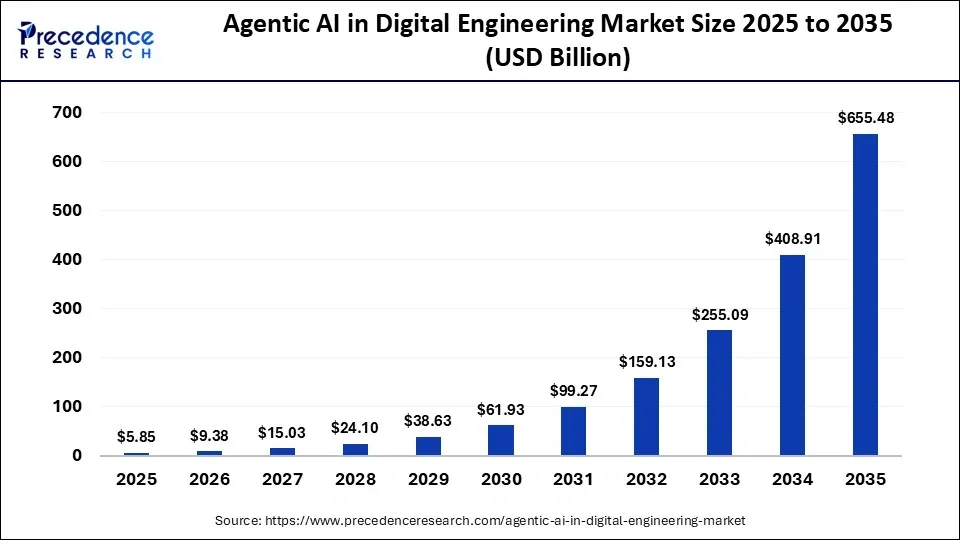
The global AI in digital engineering market size was calculated at USD 5.85 billion in 2025 and is predicted to increase from USD 9.38 billion in 2026 to approximately USD 655.48 billion by 2035, expanding at a CAGR of 60.30% from 2026 to 2035.The market is experiencing robust growth, driven by the growing need for automation, increased computational capabilities, greater availability of big data, progress in neural networks, and an emphasis on cognitive computing.
Key Takeaways
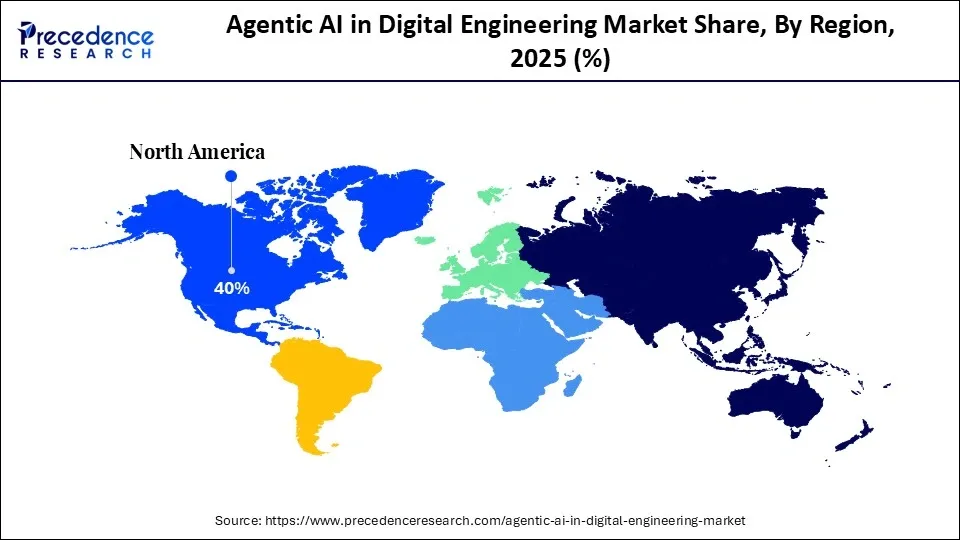
- North America dominated the global agentic AI in digital engineering market with largest share of 40% in 2025.
- Asia-Pacific is expected to grow at the fastest CAGR in the market during the forecast period.
- By technology type, the generative AI for design segment accounted for a considerable revenue share of 46% in the market in 2025.
By technology type, the AI in robotics and automation segment is expected to grow at the fastest CAGR in the market between 2026 and 2035. - By deployment model, the cloud-based segment dominated the global market in 2025.
- By deployment model, the hybrid model segment is expected to show the fastest growth over the forecast period.
- By application phase, the product design and development segment accounted for the highest revenue share in the market in 2025.
- By application phase, the predictive engineering analytics segment is expected to grow with the highest CAGR in the market during the studied years.
What is the Agentic AI in the Digital Engineering Market?
The agentic AI in digital engineering market refers to artificial intelligence (AI) systems that independently decide how they act for their tasks without human intervention during the execution of digital technology workflows. Agentic AI works to build technology, applications, and systems that can increase the efficiency of engineering processes, design, and operations through smart automation or data-driven decisions. Several factors are driving the spread of agentic AI in the digital engineering community.
As engineering projects become increasingly complex, they need better and more accurate tools and qualities that agentic AI offers through task automation and improved design. Moreover, automotive, aerospace, construction, and other industries demand faster product development times to meet a greater demand for AI systems to examine new information and adjust on demand.
In addition to this, the widespread adoption of IoT devices and smart sensors within industries generates datasets that Agentic AI can use to optimize decision-making processes and increase operational efficiencies. Finally, continuous advances in AI and ML technologies also expand the capabilities and applications of Agentic AI, creating an even more indispensable asset in digital engineering.
Impact of AI in the Agentic AI in Digital Engineering Market
AI's influence on agentic systems in digital engineering is a profound change, not a one-off improvement. It fundamentally alters the execution of engineering tasks. While prior generative tools could produce code or models on request, the role of an agentic AI can provide autonomous planning, execution, monitoring, and feedback on complex engineering actions without continuous human intervention. Agentic AI enables the rise of digital twins, virtual representations of physical assets, which serve as dynamic decision-making arenas.
In these environments, AI tools constantly assess scenarios, optimize variables, and produce insights at a speed exponentially faster than human engineers alone can manage. These agents not only respond to user-generated content but also engage in goal-oriented reasoning, explore what tool to use for the analysis, conduct simulations, and interpret results autonomously over time.
Trends Influencing the Agentic AI in Digital Engineering Market
- Autonomous Design Decision Agents: Agentic AI systems interpret performance targets, weigh performance requirements, determine parameters, and offer changes as design decision-makers or design alternatives about structure, thermal properties, or materials. Instead of waiting for instructions, these agents actively seek out results. With such a transformation, repeated modeling iterations are eliminated, enabling engineers to focus on architectural decisions rather than making continual updates.
- Developments in the Intelligent Digital Twin: From static 3D models that you saw on dashboards, digital twins have become dynamic entities with agentic AI capabilities. They are constantly gathering data about operations, running real-time simulations, and advising on optimization before they encounter problems. These self-optimizing models have closed the gap between intentions generated based on experiments and reality in the field, taking predictive engineering out of its theoretical realm and into the hands of actual companies.Workflows for Human
- Co-Engineering with AI: AI agents are now taking charge of assigning subtasks, validating simulation results, identifying discrepancies, and recommending improvements under the human eye of strategic guidance. It is a joint approach that creates more of a partnership rather than dependence upon technology; engineers directly engage with the AI, but operate on a different cognitive plane when it comes to steering smart systems and not executing with their own hands through each stage, in this case, on each iteration of testing.
Market Scope
| Report Coverage | Details |
| Market Size in 2025 | USD 5.85 Billion |
| Market Size in 2026 | USD 9.38 Billion |
| Market Size by 2035 | USD 655.48 Billion |
| Market Growth Rate from 2026 to 2035 | CAGR of 60.30% |
| Dominating Region | North America |
| Fastest Growing Region | Asia Pacific |
| Base Year | 2025 |
| Forecast Period | 2026 to 2035 |
| Segments Covered | Technology Type, Deployment Model, Application Phase, and region |
| Regions Covered | North America, Europe, Asia-Pacific, Latin America, and Middle East & Africa |
Segmental Insights
Technology Type Insights
Which Technology Type Segment Dominated the Agentic AI in Digital Engineering Market?
The generative AI for design segment held a dominant position in the market in 2025. The dominance is due to agents autonomously iterating through thousands of CAD and 3D model variations under defined physics constraints. By being able to figure out the structural feasibility at machine speed, manual prototyping cycles would be minimized drastically. Companies turned to generative design engines for extensive geometrical engineering, effective weight distribution, and stress tolerance testing, even before they ever fabricated.
Engineering teams moved from repetitive modeling to oversight and refinement, which allowed complex parts from various sectors to be commercialized faster across automotive, aerospace, and industrial machinery applications.
The AI in robotics and automation segment is expected to show the fastest growth over the forecast period, as agentic systems increasingly control physical robots and soft-bots to execute complex assembly and testing operations. Production floors and modular manufacturing have seen explosive growth driven by high interest and demand as companies want to build production floors and manufacturing units capable of more autonomous work.
Agent-driven robotics is expected to transition from scripted automation to real-time decision environments. This will continue to develop into the kind of real-time decision environment that industries are looking for as they pursue lights-out manufacturing and precision validation, with AI agents that dynamically alter production outputs with predictive corrections.
Deployment Model Insights
How the Cloud-Based Segment Dominated the Agentic AI in Digital Engineering Market?
The cloud-based segment registered its dominance over the global market in 2025, due to scalability, GPU-intensive environments that support rapid prototyping, and collaborative engineering. Centralized compute power led to faster training and simulation cycles. Cloud infrastructure is favored as a mainstay for enterprises for simulation-heavy workloads, multi-agent orchestration, and distributed design collaboration. By running on shared platforms, this model enabled geographically dispersed engineering teams to work together on this platform without the need for hardware bottlenecks, and innovation speed increased at their convenience.
The hybrid segment is expected to gain the highest market share between 2026 and 2035. The growth is due to a mix of local data processing and cloud-based model training. The combination has performance control and scalability capability. Sensitive engineering data needs processing on-premise, while more advanced AI model training benefits from cloud compute clusters. This mixed format is expected to be the best choice for enterprises wanting compliance guarantees without sacrificing computational agility.
Application Phase Insights
Which Application Phase Segment Led the Agentic AI in Digital Engineering Market?
The product design and development segment led the market in 2025, due to autonomous drafting, material selection, and structural optimization capabilities. Agentic AI greatly reduced the friction faced in the early stages of engineering. Smart agents were used in engineering to evaluate product durability, propose lighter alternatives, and fine-tune configurations before tools were started. This allowed for shorter design cycles, fewer design recalls, and visible cost reductions in high-value manufacturing sectors.
The predictive engineering analytics segment is expected to expand rapidly in the market in the coming years, due to agents that monitor system health and independently trigger maintenance orders. The real benefit is to avoid downtime rather than respond to a failure. Agentic analytics platforms are anticipated to combine operational telemetry, digital twins, and anomaly detection algorithms as unified dashboards. With growing interconnectivity of industrial systems, predictive intelligence might progress from an optional embellishment to a fundamental part of operations.
Regional Insights
North America Agentic AI in Digital Engineering Market Size and Growth 2026 to 2035
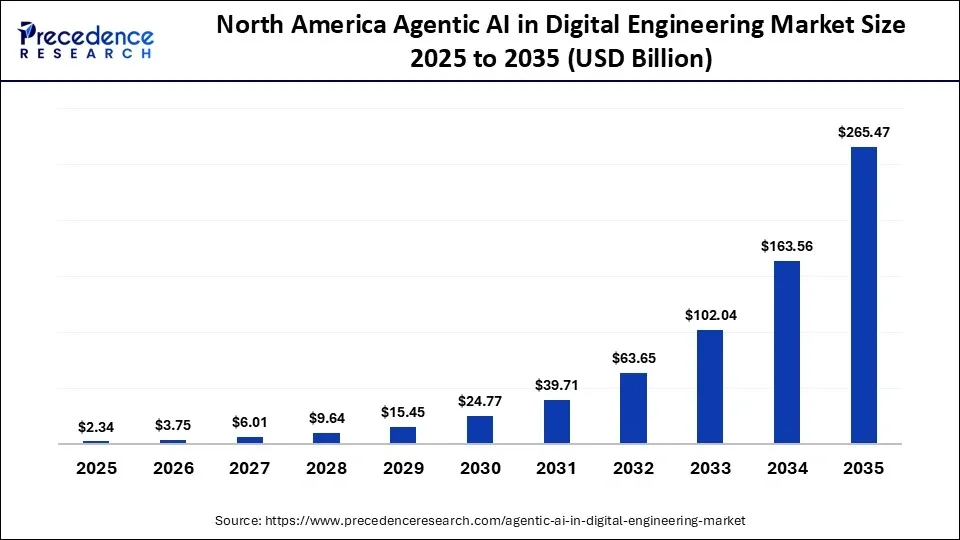
The North America agentic AI in digital engineering market size is estimated at USD 2.34 billion in 2025 and is projected to reach approximately USD 265.47 billion by 2035, with a 60.50% CAGR from 2026 to 2035.
Why North America Dominated the Agentic AI in Digital Engineering Market?
North America held a major market share in 2025, due to the presence of an advanced digital infrastructure combined with aggressive enterprise technology spending. An early investment in cloud-native engineering and AI research ecosystems, as well as industrial automation in the region, provided the foundation for extensive agentic deployment. Aerospace, automotive, semiconductor, and advanced manufacturing companies used autonomous agents in simulation pipelines, product lifecycle management systems, and digital twin frameworks well before other areas moved beyond pilot projects.
U.S. Agentic AI in Digital Engineering Market Size and Growth 2026 to 2035
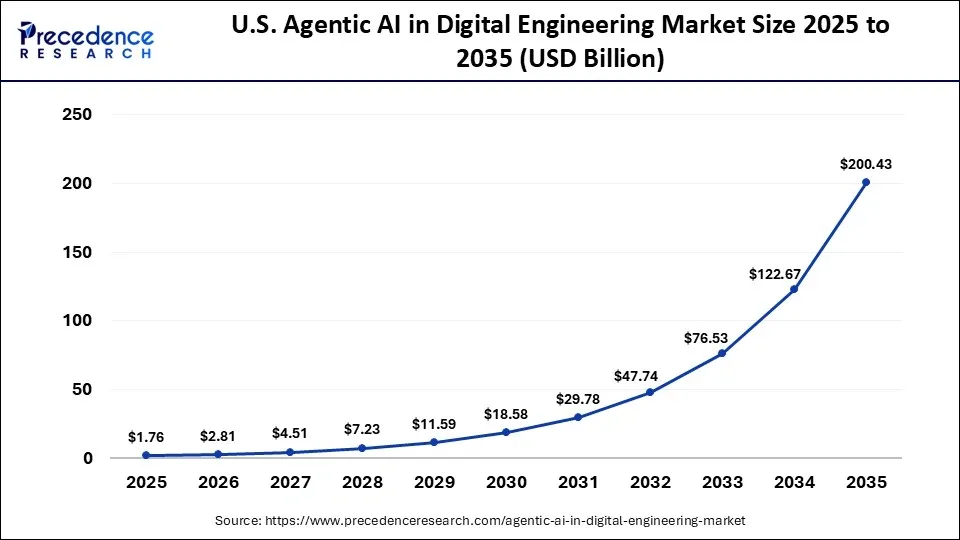
The U.S. agentic AI in digital engineering market size is calculated at USD 1.76 billion in 2025 and is expected to reach nearly USD 200.43 billion in 2035, accelerating at a strong CAGR of 60.56% between 2026 and 2035.
U.S. Market Trends
The U.S. dominates the market in North America, due to the presence of technology companies, R&D partners, and venture investors in AI start-ups that have accelerated AI ecosystem commercialization. U.S. organizations moving beyond pilots are learning that real impact comes from engineering precision, modular architecture, orchestrated collaboration, and trust-driven governance.
How is Asia-Pacific Growing in the Agentic AI in Digital Engineering Market?
Asia-Pacific is expected to experience the fastest growth during the predicted timeframe, driven by ever-broadening industrial digitization projects, production restructuring, and a robust government backing at the interface for AI initiatives. The market is also driven by an increase in efficiency and global competitiveness, which is why enterprises here are adopting agentic AI as a transformative technology, as an improvement and not an incremental addition. Several industries adopt agentic systems for predictive engineering analytics, automated validation processes, and intelligent design optimization, including electronics, automotive, industrial equipment production, and software services.
India Market Trends
India is expected to be the fastest-growing country in Asia-Pacific due to its rapidly expanding pool of engineering talent, along with more use and adoption of AI among software development companies, and significant investments in digital transformation efforts. Using autonomous design agents along with predictive analytical and simulation optimization techniques that reduce development time and improve productivity, Indian companies have positioned themselves favorably to do so at an international scale with cheaper and more innovative solutions.
Agentic AI in Digital Engineering Market Companies
- Accenture PLC
- Adept AI Labs Inc.
- Ampcome Technologies Pvt. Ltd
- Anthropic
- Beam AI
- Blue Yonder Inc.
- Capgemini SE
- Coupa Software Inc.
- Creole Ventures Pvt. Ltd.
- HCL Technologies Ltd.
- DevCom
- DevSquad
- EffectiveSoft Corp.
- Google Cloud
- H.AI SAS
- INORU
- NVIDIA Corporation
- OpenAI
- SAP SE
- Siemens AG
- Synopsys Inc.
- UiPath Inc.
- Zycus Inc.
Recent Developments
- In February 2026, SoftServe, Inc. launched its Agentic Engineering Suite, a systematic approach and centralized offering for modernizing and/or designing, developing, testing, and deploying software solutions using Agentic AI. The platform leverages intelligent AI agents that can automate every phase of the software development lifecycle (SDLC) from planning to deployment, reducing manual effort by up to 90%.(Source: https://www.marketwatch.com)
- In January 2026, Cognizant Technology Solutions Corporation announced a collaboration with Google Cloud to implement enterprise-scale workflows powered by agentic AI within software engineering and digital transformation initiatives. This collaboration promotes the adoption of remote agent-based reasoning in organizations whose focus is on modernization for large-scale enterprise applications and improvement of engineering output.(Source: https://timesofindia.indiatimes.com)
- In July 2025, Atos announced the launch of the Atos Polaris AI Platform, a comprehensive system of AI agents that works autonomously to orchestrate complex business workflows. The platform supports engineers at all stages of the development process, accelerating digital transformation by driving universal automation of business processes. (Source: https://atos.net)
Segments Covered in the Report
By Technology Type
- Generative AI for Design
- Digital Twins and Physics-based Simulation
- AI in Robotics and Automation
- Explainable AI (XAI)
By Deployment Model
- On-Premise
- Cloud-Based
- Hybrid
By Application Phase
- Product Design and Development
- Predictive Engineering Analytics
- Autonomous Testing and QA
- Process and Workflow Optimization
By Region
- North America
- Asia Pacific
- Europe
- Latin America
- Middle East & Africa
For inquiries regarding discounts, bulk purchases, or customization requests, please contact us at sales@precedenceresearch.com
Frequently Asked Questions





Ask For Sample
No cookie-cutter, only authentic analysis – take the 1st step to become a Precedence Research client
 Get a Sample




 sales@precedenceresearch.com
 Schedule a Meeting
