



Agentic AI in Clinical Development Market Size, Share and Trends 2026 to 2035
Agentic AI in Clinical Development Market (By Component: Software Platforms, AI/ML Models & Engines, Autonomous Agent Frameworks, Data Integration & Orchestration Tools, Services; By Deployment Mode: Cloud-Based, On-Premise, Hybrid; By Application: Clinical Trial Design & Protocol Optimization, Patient Recruitment & Site Feasibility, Adaptive Trial Management, Real-Time Data Monitoring, Safety Signal Detection & Pharmacovigilance, Regulatory Submission Automation, Trial Close-Out & Reporting; By Therapy Area: Oncology, Neurology, Cardiovascular, Immunology & Autoimmune, Infectious Diseases, Rare Diseases; By Distribution Channel: Direct Enterprise Sales, Technology Integrators, CRO Partnerships, Cloud Marketplaces) - Global Industry Analysis, Size, Trends, Leading Companies, Regional Outlook, and Forecast 2026 to 2035
Source: https://www.precedenceresearch.com/agentic-ai-in-clinical-development-market
 Get a Sample
 Table Of Content
What is Agentic AI in Clinical Development Market Size?
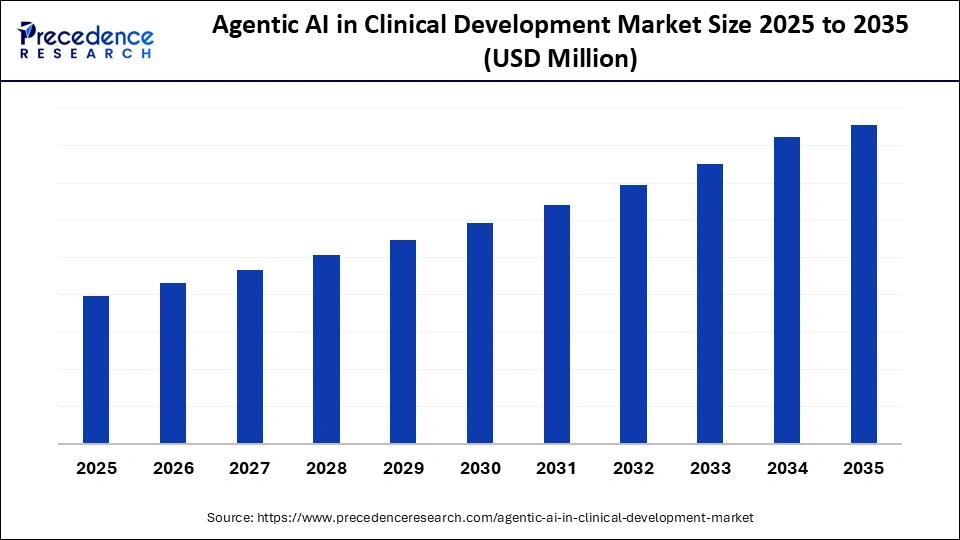
Agentic AI is accelerating clinical development with smarter automation, faster trial insights, and improved R&D decision-making across the biopharma landscape The market for agentic AI in clinical development is primarily driven by the rising need to streamline the complexities of clinical trials, ensuring better compliance and transparency.
Market Highlights
- North America dominated the market, holding the largest market share in 2025.
- The Asia Pacific is expected to grow at the fastest CAGR between 2026 and 2035.
- By component, the software platforms segment contributed the highest market share in 2025.
- By component, the autonomous agent frameworks segment is growing at a remarkable CAGR from 2026 to 2035.
- By deployment mode, the cloud-based segment held the highest market share in 2025.
- By application, the patient recruitment and site feasibility segment generated the highest market share in 2025.
- By application, the adaptive trial management segment is expanding at a remarkable CAGR between 2026 and 2035.
- By therapy area, the oncology segment captured the largest market share in 2025.
- By therapy area, the rare diseases segment is set to grow at a remarkable CAGR between 2026 and 2035.
- By distribution channel, the direct enterprise sales segment accounted for the highest market share in 2025.
- By distribution channel, the CRO partnerships segment is projected to grow at a significant CAGR between 2026 and 2035.
Reimagining Life Science Enterprises With Agentic AI
The global agentic Artificial Intelligence in clinical development market includes autonomous, goal-oriented artificial intelligence systems designed to plan, execute, adapt, and optimize clinical development workflows with minimal human intervention. Agentic AI systems operate as intelligent software agents that manage protocol design, patient recruitment, adaptive trial management, site optimization, data monitoring, safety signal detection, and regulatory documentation through multi-step decision-making capabilities. These systems integrate large language models (LLMs), reinforcement learning, autonomous agents, predictive analytics, and real-world data to accelerate clinical timelines, reduce operational costs, improve protocol adherence, and enhance patient-centric trial designs.
Agentic AI in Clinical Development Market Outlook
- Industry Growth Overview: Between 2025 and 2030, the industry is expected to experience accelerated growth. The growth of the market is driven by rising complexity of clinical trials, demand for decentralized clinical trials (DCTs), high failure rates in late-stage trials, increasing R&D costs, and the pharmaceutical industry's shift toward AI-first development models.
- Global Expansion: Several leading players in the agentic AI in clinical development market are expanding their geographical presence through strategic mergers and acquisitions (M&A), partnerships, and new product launches. For instance, in March 2025, Microsoft Corp. unveiled Microsoft Dragon Copilot, the first AI assistant for clinical workflow that brings together the trusted natural language voice dictation capabilities of DMO with the ambient listening capabilities of DAX, fine-tuned generative AI, and healthcare-adapted safeguards. Part of Microsoft Cloud for Healthcare. Clinician burnout in the U.S. dropped from 53% in 2023 to 48% in 2024, in part due to technology advancements.
- Major Investors: Several major venture capital firms and corporate investors are investing heavily in funding companies that use Agentic AI in clinical development and drug discovery. These investments are likely to accelerate the adoption and development of agentic AI solutions, which enable autonomous decision-making and task execution to optimize clinical trials, streamline drug discovery, and improve patient care.
Market Scope
| Report Coverage | Details |
| Dominating Region | North America |
| Fastest Growing Region | Asia Pacific |
| Base Year | 2025 |
| Forecast Period | 2026 to 2035 |
| Segments Covered | Type, Application, and Region |
| Regions Covered | North America, Europe, Asia-Pacific, Latin America, and Middle East & Africa |
Segmental Insights
Component Insights
What Factors Make the Software Platforms Segment Dominate the Agentic AI Market in Clinical Development?
- Software Platforms: The software platforms segment held the largest market share in 2024. Agentic AI software accelerates the lengthy drug development process by automating biomedical data analysis and molecular target identification. Software platforms reduce administrative burdens on healthcare professionals, accelerate research, and shorten time-to-market for new drugs.
- Autonomous Agent Frameworks: The segment is expected to grow at a remarkable CAGR between 2025 and 2034. Autonomous agent frameworks help build, manage, and scale specialized AI systems without constant human intervention. This framework is crucial for enabling the complex, multi-step tasks required in drug discovery and clinical trials. These frameworks accelerate drug discovery and clinical trial processes, leading to faster time-to-market for new therapies.
- Data Integration & Orchestration Tools: The data integration and orchestration tools segment is anticipated to grow rapidly, driven by the need for agentic AI systems to seamlessly access, combine and manage data from sources such as clinical trials, EHRs and genomic databases. These tools enable AI models to pull structured and unstructured data in real time, resolve inconsistencies, and standardize formats so downstream analytics can operate without manual intervention. They are also becoming essential for harmonizing multi-modal datasets used in precision medicine, including imaging archives, proteomic profiles and longitudinal patient records.
Deployment mode Insights
Which Segment Is Dominated by the Deployment Mode in the Agentic AI in Clinical Development Market?
- Cloud-Based: This segment contributed the highest revenue share in the agentic AI in clinical development market and is expected to further grow at the fastest CAGR. Cloud-based solutions are highly adopted, owing to their ability to provide the massive computing power, flexibility, and storage required for AI agents to process vast medical datasets. Cloud-based platforms offer flexibility, which is vital for managing the fluctuating demands of clinical research workloads.
- Hybrid: The hybrid segment is expected to grow significantly, driven primarily by the increasing adoption of hybrid architectures in the healthcare industry. Additionally, the hybrid architectures enable AI agents to interact with existing systems locally while using cloud capabilities for data analysis and integration across different platforms. This setup allows hospitals and research centers to keep sensitive patient information on premises while leveraging cloud based compute power for large scale model inference, multi site data sharing and advanced analytics.
Application Insights
What Causes the Patient Recruitment & Site Feasibility Segment to Dominate the Agentic AI in Clinical Development Market?
- Patient Recruitment & Site Feasibility: The patient recruitment & site feasibility segment is dominating the agentic AI in clinical development market. Agentic AI transforms patient recruitment and site selection by accelerating overall trial timelines and reducing the costs of the screening and documentation process. Traditional recruitment methods are expensive and time-consuming, which leads to trials often facing delays.
- Adaptive Trial Management: The segment is the fastest growing in the agentic AI in clinical development market. Agentic AI automates many time consuming aspects of adaptive trials, like real time data collection, processing and analysis, which assists in reducing the time to analyze vast datasets to inform decisions during a trial and accelerating overall trial cycles. These systems can automatically flag safety signals, adjust dosing arms, and modify patient stratification rules based on predefined criteria, which allows trial teams to make evidence based decisions without delay.
- Real-Time Data Monitoring: The real-time data monitoring segment is anticipated to grow at a considerable rate. Real-time data monitoring is one of the most dynamic applications in the market. AI agents can make real-time adjustments to trial designs, which reduces costs, increases efficiency, and improves the ethical conduct of studies. Real-time monitoring allows for timely and data-driven interventions. Real-time data is integrated into Clinical Decision Support Systems (CDSS) applications, which provide healthcare professionals with valuable clinical insights and evidence-based recommendations.
Therapy area Insights
Why Is Oncology Dominating the Agentic AI in Clinical Development Market?
- Oncology: The segment dominates the agentic AI in clinical development market. The rising cases of cancer around the world create a significant demand for innovative diagnostic and treatment options. Agentic AI can process large datasets, enhance early detection, and personalize treatment plans to optimize outcomes, reduce side effects, and improve patient outcomes.
- Rare Diseases: The segment is the fastest growing in the agentic AI in clinical development market, set to grow at a significant CAGR. The segment's growth is primarily driven by the growing need to address challenges associated with rare conditions, including diagnostic delays, a lack of available treatments and others. Agentic AI helps overcome these barriers by rapidly analyzing genomic datasets, identifying potential therapeutic targets and supporting patient stratification for small and highly heterogeneous patient groups. It also assists researchers in locating eligible patients across multiple clinical sites, improving recruitment for rare disease trials that traditionally struggle with enrollment.
- Neurology: The segment is expected to grow rapidly, driven by the growing adoption of agentic AI in neurology. Agentic AI can provide data-driven support in diagnosis, treatment planning, and patient monitoring for health conditions such as Parkinson's, Alzheimer's, epilepsy, stroke, and others. AI agents can analyze complex neuroimaging data, such as CT scans, MRIs, and EEGs, with high precision and speed.
Distribution Channel Insights
What Has Led the Direct Enterprise Sales Segment to Dominate the Agentic AI in Clinical Development Market?
- Direct Enterprise Sales: The segment is dominating the agentic AI in clinical development market. The direct enterprise sales segment is a dominant distribution channel for complex agentic AI solutions in healthcare, especially for B2B transactions involving pharmaceutical companies, hospitals and research institutions. These buyers typically require customized deployments, advanced integration support and long-term service agreements that are best delivered through direct sales teams rather than intermediaries. Direct enterprise engagement also allows vendors to tailor agentic AI platforms to existing clinical trial workflows, data infrastructures and regulatory compliance requirements, which strengthens adoption across large organizations.
- CRO Partnerships: The segment is the fastest growing segment of the agentic AI in clinical development market. CRO partnerships are a rapidly expanding distribution channel for agentic AI solutions in the market. CRO partnerships provide AI vendors with access to a large client base of biotech, pharmaceutical and medical device companies. These collaborations allow agentic AI tools to be embedded directly into trial design, data management and monitoring workflows that CROs already operate across multiple global study sites. By integrating AI capabilities into established CRO platforms for patient recruitment, biomarker analysis and safety signal detection, vendors can accelerate adoption and demonstrate value across diverse therapeutic areas.
- Cloud Marketplaces: The cloud marketplaces segment is expected to increase at a considerable rate. Cloud marketplaces are emerging as a vital distribution channel for agentic AI solutions in the healthcare industry. Cloud marketplaces simplify the procurement, deployment, and management of cloud-based AI software for healthcare organizations. Cloud marketplaces manage the complexities of billing and subscription management. The automation ensures accurate usage tracking and significantly reduces administrative burden for both vendors and customers.
Regional Insights
How Can North America Dominate the Agentic AI in Clinical Development Market?
North America dominates the agentic AI in clinical development market. The region has a highly established healthcare IT infrastructure that facilitates the integration and implementation of advanced AI solutions. The region is experiencing significant public and private sector investments in AI research and digital health initiatives, accelerating the development and commercialization of innovative technologies. The region is home to major global technology and pharmaceutical companies actively developing and deploying agentic AI solutions, including Google, Microsoft, IBM, and NVIDIA, along with innovative startups.
US Agentic AI in Clinical Development Market Trends
The United States leads the agentic AI in clinical development market. The country is the primary contributor to this regional dominance. The country's regulatory bodies, like the U.S. Food and Drug Administration (FDA), have established guidelines and pathways for Artificial Intelligence (AI) and Machine Learning (ML) based medical devices and software, which encourages rapid innovation.
How Is the Asia Pacific Region the Fastest-Growing in the Agentic AI in Clinical Development Market?
The Asia-Pacific region is the fastest-growing market for agentic AI in clinical development, fueled by the growing healthcare sector, supportive government policies, and rising integration of advanced technology. The region is experiencing the adoption of cloud infrastructure, developer ecosystems, and AI research. Several key players in countries like China, India, and South Korea by increasingly investing in promoting AI innovation and adoption, particularly in healthcare.
India Agentic AI in Clinical Development Market Trends
India's agentic AI in clinical development market is experiencing growth. India's healthcare market is expanding rapidly, supported by the favorable policy that provides a strong push toward AI-driven research and development hubs and digital pharma innovation. India is increasingly leveraging its diverse and populous base to become a hub for technology-enabled clinical research.
Is the Europe Region Responsible for Growth in the Agentic AI in Clinical Development Market?
The European market is experiencing notable growth. The growth of the region is attributed to the well-established healthcare infrastructure, a robust startup ecosystem, rising government initiatives, rapid technological improvements, and unique demographic factors. The growing adoption of cloud computing and the integration of advanced technologies provide the necessary infrastructure for scalable and accessible agentic AI solutions. The favorable policy of the European region provides a strong push toward AI-driven research and development hubs and digital pharma innovation.
Germany Agentic AI in Clinical Development Market Trends
Germany is poised for significant growth, supported by the strong government support, a robust research infrastructure, and growing demand for personalized medicine. Germany's robust pharmaceuticals & biotech industry, high research and development (R&D) spending, and government-backed innovation funding are anticipated to propel the growth of the country. The country's market expansion is also driven by the increasing need for AI solutions that can seamlessly integrate with existing clinical systems, such as Electronic Health Records (EHRs) and other medical devices.
Agentic AI in Clinical Development Market Companies
- Microsoft Corporation: Develops advanced AI and cloud infrastructure through Azure, supporting healthcare automation, clinical decision tools, and large-scale data analytics. Microsoft also integrates generative AI into electronic health records, patient engagement, and administrative workflows.
- NVIDIA Corporation: Provides high-performance GPUs and healthcare-optimized platforms such as NVIDIA Clara for medical imaging, drug discovery, and real-time clinical AI inference. NVIDIA's edge and cloud computing frameworks enable scalable deployment of AI assistants and automation tools.
- IBM Corporation: Offers AI-driven healthcare solutions through Watson Health technologies, focusing on clinical insights, operational automation, and predictive analytics. IBM's hybrid-cloud architecture supports secure, large-scale processing of medical data.
- Google DeepMind: Specializes in advanced generative and predictive AI models applied to clinical decision support, diagnostics, and medical research. DeepMind collaborates widely with health systems to develop safe, high-accuracy medical AI applications.
- Oracle: Provides cloud infrastructure and healthcare IT systems, including Oracle Health (Cerner), integrating AI for scheduling, documentation automation, and clinical workflow optimization. Its data platform supports secure patient data management and analytics.
- Hippocratic AI: Develops safety-focused large language models for healthcare tasks such as triage, patient education, and clinical support. The company emphasizes high-accuracy, low-risk generative AI tailored for regulated medical environments.
- Cognigy: Provides enterprise conversational AI platforms enabling automated patient communication, virtual agents, and workflow orchestration. Cognigy is used in healthcare operations to reduce administrative burden and improve service efficiency.
- Amelia US LLC: Specializes in AI-powered digital employees that automate front-office and back-office healthcare operations. Amelia supports payer, provider, and revenue cycle management workflows with human-like conversational capabilities.
- Beam AI: Specializes in AI-powered digital employees that automate front-office and back-office healthcare operations. Amelia supports payer, provider, and revenue cycle management workflows with human-like conversational capabilities.
- Thoughtful Automation Inc.: Provides healthcare-focused automation using AI agents and RPA to manage claims, billing, prior authorization, and patient data workflows. The company targets efficiency improvements for payers and provider networks.
Recent Developments
- In June 2025, IQVIA announced that it is launching multiple AI orchestrator agents in collaboration with NVIDIA. These specialized agentic systems are designed to manage and accelerate complex pharmaceutical development workflows for IQVIA's thousands of pharmaceuticals, biotech, and medical device customers across the globe. IQVIA and NVIDIA harmonize to accelerate clinical research and commercialization with AI agents
- In September 2025, Saama, an established leader in AI-driven solutions and services within Health Sciences, unveiled industry-first modular Clinical AI Agents to help sponsors drive rapid innovation and efficiencies on existing platform investments from Study Start to Submission. Developed using Saama's state-of-the-art Agentic AI platform, these Clinical Agents are designed to function on "partial autonomy," which enables appropriate human oversight and controls. Saama's Clinical AI Agents are capable of extensive independent reasoning, planning, and execution. (Source: https://www.marketwatch.com)
Segments Covered in the Report
By Component
- Software Platforms
- AI/ML Models & Engines
- Autonomous Agent Frameworks
- Data Integration & Orchestration Tools
- Services (Implementation, Training, Managed Services)
By Deployment Mode
- Cloud-Based
- On-Premise
- Hybrid
By Application
- Clinical Trial Design & Protocol Optimization
- Patient Recruitment & Site Feasibility
- Adaptive Trial Management
- Real-Time Data Monitoring
- Safety Signal Detection & Pharmacovigilance
- Regulatory Submission Automation
- Trial Close-Out & Reporting
By Therapy Area
- Oncology
- Neurology
- Cardiovascular
- Immunology & Autoimmune
- Infectious Diseases
- Rare Diseases
By Distribution Channel
- Direct Enterprise Sales
- Technology Integrators
- CRO Partnerships
- Cloud Marketplaces
By Region
- North America
- Europe
- Asia Pacific
- Latin America
- Middle East & Africa
For inquiries regarding discounts, bulk purchases, or customization requests, please contact us at sales@precedenceresearch.com
Frequently Asked Questions





Ask For Sample
No cookie-cutter, only authentic analysis – take the 1st step to become a Precedence Research client
 Get a Sample




 sales@precedenceresearch.com
 Schedule a Meeting
