



Agentic AI In Labor Market Trends, Companies, Revenue / Sales Performance, Subscriber Growth, Pricing Strategies, Cloud Adoption, Infrastructure Expansion, Competitive Landscape, and Industry Outlook
Agentic AI In Labor Market (By Solution Type: Autonomous Workflows, Intelligent Virtual Assistants, Decision-Support Agents, Task-Autonomous Agents; By Workforce Function: Recruitment & Talent Acquisition, Human Resources (HR) Operations, Customer Service, Sales & Marketing, IT & Cybersecurity; By Organization Size: Large Enterprises, Small & Medium Enterprises; By Deployment Mode: Cloud-Based, On-Premise) - Global Industry Analysis, Size, Trends, Leading Companies, Regional Outlook, and Forecast 2026 to 2035
Source: https://www.precedenceresearch.com/agentic-ai-in-labor-market
 Get a Sample
 Table Of Content


What is the Agentic AI In Labor Market Size in 2026?
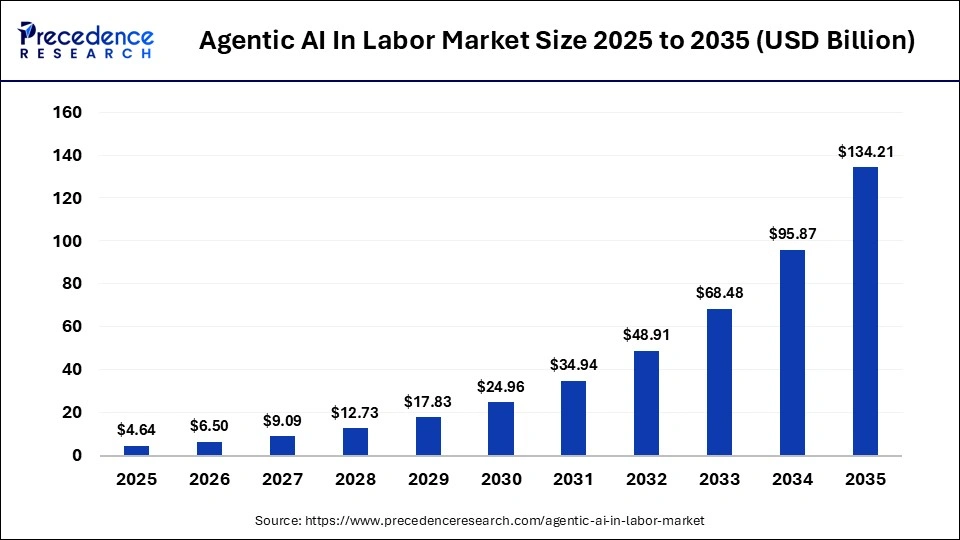
The global agentic AI in labor market size was calculated at USD 4.64 billion in 2025 and is predicted to increase from USD 6.50 billion in 2026 to approximately USD 134.21 billion by 2035, expanding at a CAGR of 40 .00% from 2026 to 2035. The market is driven by rising demand for autonomous systems that improve productivity and automate complex tasks.
Key Takeaways
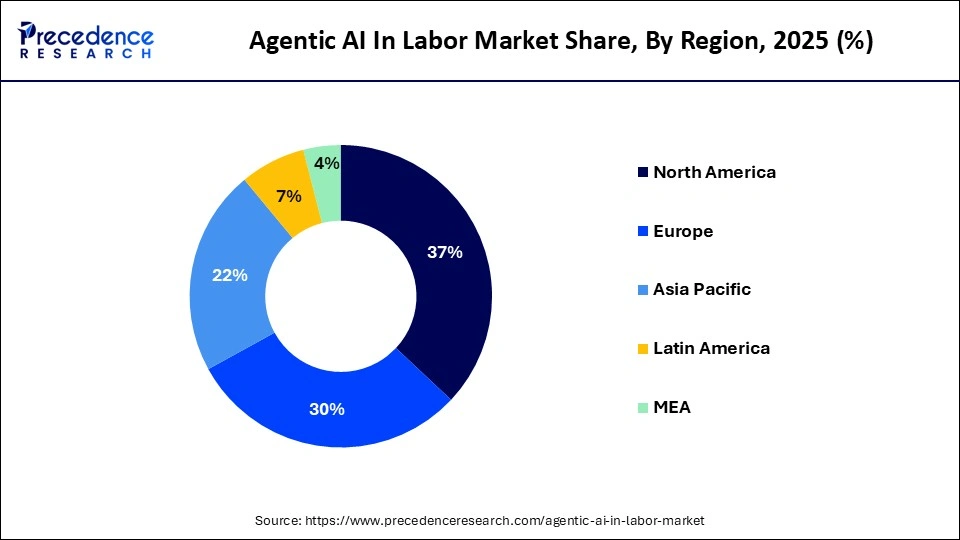
- North America accounted for the largest share of 37% in 2025.
- The Asia Pacific is expected to witness the fastest growth over the forecast period.
- By solution type, the autonomous workflows segment held a significant share of the market in 2025.
- By solution type, the decision-support agents segment is expected to grow at the fastest rate in the market over the forecast period.
- By workforce function, the recruitment & talent acquisition segment held a significant share of the market in 2025.
- By workforce function, the customer service segment is anticipated to grow at the fastest rate in the market over the forecast period.
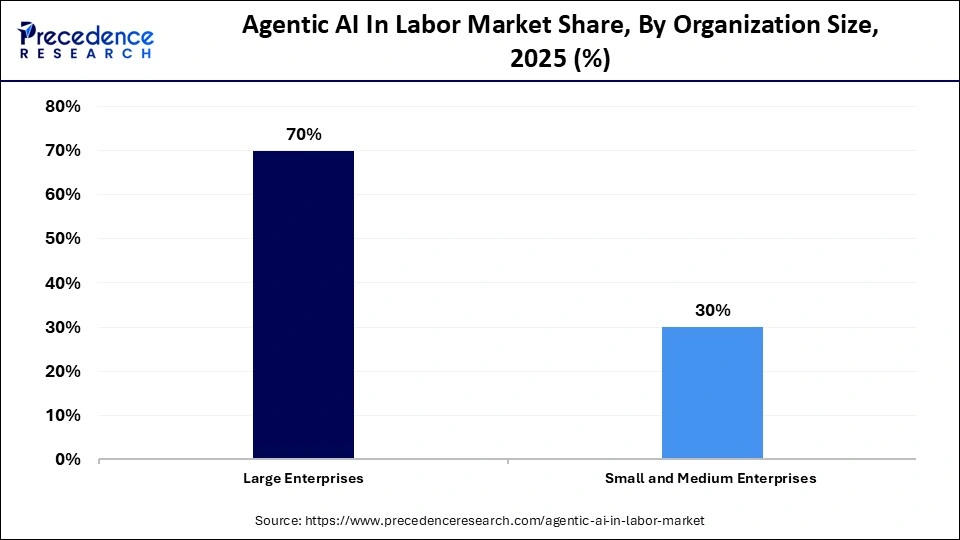
- By organization size, the large enterprises segment contributed the highest market share of 70% in 2025.
- By organization size, the small & medium enterprises segment is expected to grow at a rapid pace in the market over the forecast period.
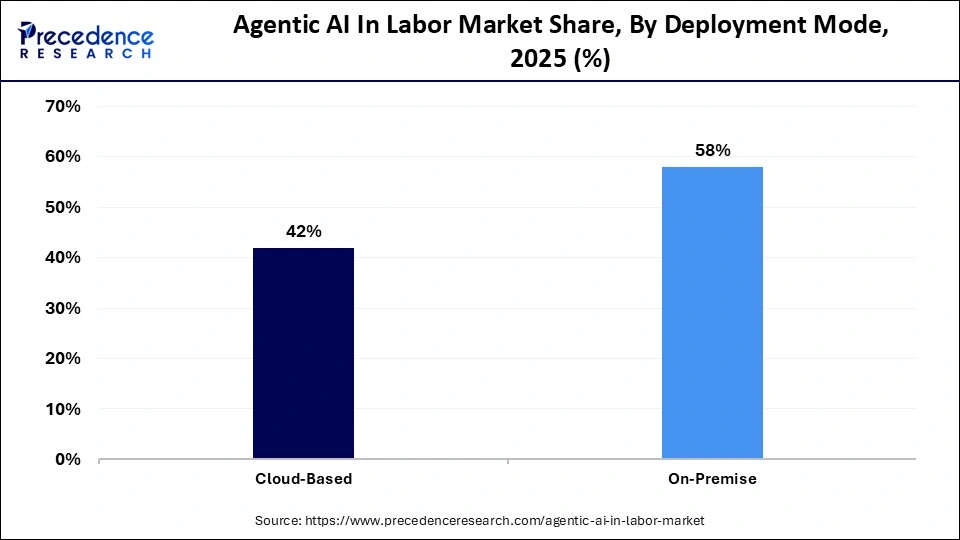
- By deployment mode, the cloud-based segment held a major market share of 58% in 2025.
- By deployment mode, the on-premise segment is expected to expand at a significant rate in the market over the forecast period.
Market Overview
The agentic AI in labor market comprises artificial intelligence systems that can autonomously make decisions, set goals, execute tasks, and learn and adapt their behavior within the workplace settings. In contrast to conventional automation tools, agentic AI systems are capable of planning on their own, dynamically responding, working with human workers, and optimizing workflows. These are intelligent agents that are being more extensively used in IT services, finance, health, manufacturing, customer support, and logistics fields. The market is experiencing significant growth due to the growing need to boost productivity, employment, and cut the cost of operation. Moreover, the growing focus of corporations on digital transformation and workflow automation is driving increased adoption of connected packaging in corporate settings.
AI standards to ensure accountability and responsible AI implementation in the workplace.
Cloud-Based AI Ecosystems Enable Scalable Automation: The proliferation of cloud-based AI platforms and API-driven architectures is making agentic AI solutions more scalable, allowing small and mid-sized organizations to deploy intelligent automation without significant infrastructure investments.
Agentic AI in Labor Market Trends
- Autonomous AI Agents Transform Knowledge Work: The rapid adoption of autonomous AI agents within company processes is reshaping knowledge work by enabling tasks to be executed independently, enhancing decision-making, and facilitating real-time collaboration across departments with minimal human intervention.
- Integration of Large Language Models Expands Capabilities: Incorporating large language models into enterprise systems is extending agentic AI capabilities, allowing contextual understanding, automatic reporting, intelligent customer interactions, and problem-solving across multiple sectors.
- AI Copilots and Virtual Agents Augment the Workforce: The use of AI copilots and virtual agents is increasingly automating repetitive cognitive tasks, boosting workforce productivity, and freeing employees to focus on higher-value, strategic activities.
- Human-AI Collaboration Drives Governance and Ethics: A growing emphasis on human-AI collaboration is encouraging the development of governance frameworks, transparency tools, and ethical
Market Scope
| Report Coverage | Details |
| Market Size in 2025 | USD 4.64 Billion |
| Market Size in 2026 | USD 6.50 Billion |
| Market Size by 2035 | USD 134.21 Billion |
| Market Growth Rate from 2026 to 2035 | CAGR of 40 .00% |
| Dominating Region | Asia Pacific |
| Fastest Growing Region | North America |
| Base Year | 2025 |
| Forecast Period | 2026 to 2035 |
| Segments Covered | Solution Type, Workforce Function, Organization Size, Deployment Mode, and region |
| Regions Covered | North America, Europe, Asia-Pacific, Latin America, and Middle East & Africa |
Segment Insights
Solution Type Insights
Why Did the Autonomous Workflows Segment Hold a Dominant Position in the Market?
The autonomous workflows segment holds a dominant position in the agentic AI in labor market in 2025 because of its ability to autonomously handle structured and semi-structured workforce processes with minimal human interventions. Organizations are increasingly focused on full process automation to enhance productivity, reduce operational costs, and accelerate decision-making within HR and labor management functions. Autonomous AI agents are widely deployed across employee onboarding, payroll validation, workforce scheduling, compliance documentation, performance monitoring, and internal workflow coordination. This growing adoption was further driven by digital transformation initiatives and the broader trend of automating enterprise operations at scale.
The decision-support agent segment is expected to grow at the fastest CAGR between 2026 and 2035, driven by the growing preference for AI systems that augment human decision-making rather than fully automate it. Organizations are increasingly adopting intelligent agents that provide predictive insights, scenario modeling, workforce analytics, and real-time guidance for managers and HR professionals. These tools support strategic initiatives such as talent acquisition, performance evaluations, workforce allocation, compensation benchmarking, and employee retention. Additionally, advances in big data processing and integration with enterprise resource planning (ERP) systems are further enhancing the effectiveness and adoption of these decision-support solutions.
Workforce Function Insights
Why Did the Recruitment & Talent Acquisition Segment Dominate the Agentic AI in Labor Market?
The recruitment & talent acquisition segment dominated the market in 2025 due to the growing demand for faster, data-driven, and scalable hiring solutions. Organizations increasingly adopted agentic AI systems capable of autonomously sourcing candidates, screening resumes, conducting pre-interviews, and shortlisting talent based on predefined competency frameworks. The rise of remote and hybrid work models expanded global talent pools, making candidate evaluation more complex and further highlighting the need for intelligent automation. Agentic AI is particularly valuable in areas where enterprises struggle to identify passive candidates and forecast future workforce requirements.
The customer service segment is expected to grow at the highest CAGR between 2026 and 2035 due to the increasing need for personalized, 24/7 customer interactions. Companies are actively moving to agentic AI solutions capable of autonomously handling complex queries, managing service tickets, and communicating across multiple channels, including chat, email, voice, and social media. Unlike conventional chatbots, agentic AI agents can understand context, adapt to customer sentiment, escalate issues when needed, and learn from ongoing interactions. By deploying these automated AI agents, companies can enhance the customer experience, maintain round-the-clock support, and achieve operational efficiencies without a proportional increase in workforce size.
Organization Size Insights
Why Did the Large Enterprises Segment Lead the Agentic AI in Labor Market?
The large enterprises segment registered its dominance in the global agentic AI in labor market in 2025 because of their huge financial strength, their advanced digital infrastructure, and their usage of new technologies first. Big organizations have a complicated workforce structure in various geographies, and hence, such organizations are the first to implement agentic AI systems that can perform well independently in recruitment, workforce planning, employee engagement, compliance checks, and performance analytics. These companies require scalable and smart solutions to handle labor allocation, reduce operational inefficiencies, and enhance strategic decision-making. Moreover, large companies typically have huge database sets, and that is why the agentic AI models work more correctly.
The small & medium enterprises segment is expected to grow at the fastest rate over the forecast period, driven by the growing accessibility to cheap AI solutions and cloud-based services. SMEs have traditionally faced constraints due to limited budgets and technical expertise, but today they can leverage subscription-based AI models, low-code deployment platforms, and scalable digital infrastructure. Growing competition in regional and international markets is motivating SMEs to adopt intelligent automation to improve operational efficiency and reduce administrative costs. Additionally, government initiatives promoting digitalization among small enterprises are further driving AI adoption in this segment.
Deployment Mode Insights
Why Did the Cloud-Based Segment Dominate the Agentic AI in Labor Market?
The cloud-based segment led the global market in 2025 due to its flexibility, scalability, and cost-effectiveness. Cloud deployment can help organizations to enjoy the advanced agentic AI ability without incurring huge upfront infrastructure costs. Through subscription-based models, businesses can quickly automate recruitment, analyze employees, provide customer support, and plan their workforce practices with AI agents. Clouds will also help to have smooth updates, real-time data processing, and third-party integration with HR, CRM, and enterprise systems. The skills to serve remote and hybrid employees also enhanced the pressure on the application of cloud-based solutions.
The on-premise segment is expected to expand rapidly in the coming years because of the growing data privacy concerns, regulatory requirements, and the issue of cybersecurity. Banking, government, healthcare, and defense are some of the industries that may demand high levels of control over sensitive employee and customer information, and on-premises deployment can be a better choice. As more organizations shift to agentic AI systems, which access and manage employee-level data and strategic decision-making procedures, the priority has moved to secure infrastructures managed internally. Premise solutions are more custom, have more control of integrations, and better data governance.
Region Insights
North America Agentic AI In Labor Market Size and Growth 2026 to 2035
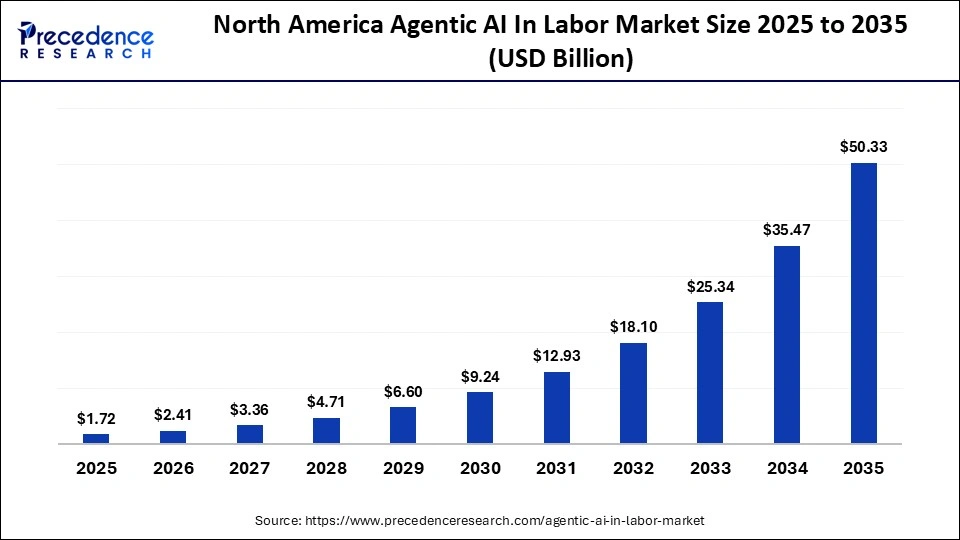
The North America agentic AI in labor market size is estimated at USD 1.72 billion in 2025 and is projected to reach approximately USD 50.33 billion by 2035, with a 40.16% CAGR from 2026 to 2035.
Why Did North America Lead the Global Agentic AI in Labor Market?
North America led the agentic AI in labor market by holding a major share in 2025. This is mainly due to the proactive adoption of advanced AI technologies, strong digital infrastructure, and the presence of leading AI research institutions and technology companies. Businesses in the U.S. and Canada rapidly integrated agentic AI systems into their operations to boost productivity, automate cognitive tasks, and enhance decision-making. The region's robust startup ecosystem and substantial venture capital funding further supported AI innovation. Additionally, labor shortages and rising operational costs have driven the deployment of autonomous AI agents across customer service, IT support, analytics, and administrative functions.
U.S. Agentic AI In Labor Market Size and Growth 2026 to 2035
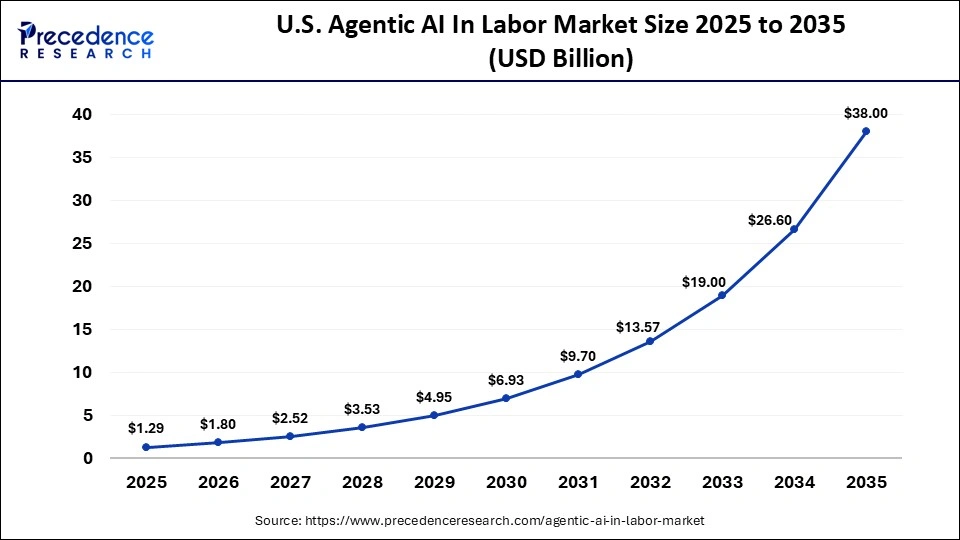
The U.S. agentic AI in labor market size is calculated at USD 1.29 billion in 2025 and is expected to reach nearly USD 38.00 billion in 2035, accelerating at a strong CAGR of 40.26% between 2026 and 2035.
Why is Asia Pacific Experiencing the Fastest Growth in the Agentic AI in Labor Market?
Asia Pacific is expected to grow at the fastest CAGR during the forecast period because of the high pace of digital transformation and the growing enterprise automation efforts. China, India, Japan, and South Korea are some of the countries that are investing heavily in AI infrastructure, cloud computing, and smart enterprise technologies. The mass introduction of AI-based automation in the manufacturing, e-commerce, fintech, and customer service industries is stimulating the rise in the need for autonomous AI agents. The increased cost of labor in some economies is leading to increased use of smart digital agents to streamline operations within the business.
Why is the European Agentic AI in Labor Market Experiencing Notable Growth?
Europe is expected to grow at a notable rate in the upcoming period because of highly regulated markets and increasing corporate interest in the responsible use of AI. Ethical AI governance and strict data protection regulations by the European Union have encouraged formal and transparent implementation of agentic AI systems across industries. European companies are leveraging agentic AI to address workforce shortages, enhance productivity, and improve decision-making. Furthermore, cross-border digital innovation initiatives and public-private partnerships are facilitating large-scale AI integration across the region.
Agentic AI in Labor Market Companies
- Aisera Inc.
- Amazon Web Services Inc.
- Automatic Data Processing Inc.
- Conversica Inc.
- Counsel AI Corp.
- Cresta
- Google LLC
- International Business Machines Corp.
- Microsoft Corp.
- Outreach Corp.
- Salesforce Inc.
- ServiceNow Inc.
- ThoughtSpot Inc.
- UiPath Inc.
- UKG Inc.
- Verint Systems Inc.
- Workday Inc.
Recent Development
- In October 2025, Salesforce and Google announced the expansion of their strategic relationship to speed up enterprise AI innovation. The cooperation combined the best models of Google (Gemini) with Salesforce with its new Agentforce 360 Platform to augment autonomous AI and business productivity.(Source: https://www.salesforce.com)
Segments Covered in the Report
By Solution Type
- Autonomous Workflows
- Intelligent Virtual Assistants
- Decision-Support Agents
- Task-Autonomous Agents
By Workforce Function
- Recruitment & Talent Acquisition
- Human Resources (HR) Operations
- Customer Service
- Sales & Marketing:
- IT & Cybersecurity
By Organization Size
- Large Enterprises
- Small & Medium Enterprises
By Deployment Mode
- Cloud-Based
- On-Premise
By Region
- North America
- Asia Pacific
- Europe
- Latin America
- Middle East & Africa
For inquiries regarding discounts, bulk purchases, or customization requests, please contact us at sales@precedenceresearch.com
Frequently Asked Questions





Ask For Sample
No cookie-cutter, only authentic analysis – take the 1st step to become a Precedence Research client
 Get a Sample




 sales@precedenceresearch.com
 Schedule a Meeting
