



AI Agents for Clinical Documentation Market Size, Companies, Share, Patient Volume, Treatment Adoption Rates, Pricing Analysis, Regulatory Landscape, Competitive Positioning, and Demand Forecast
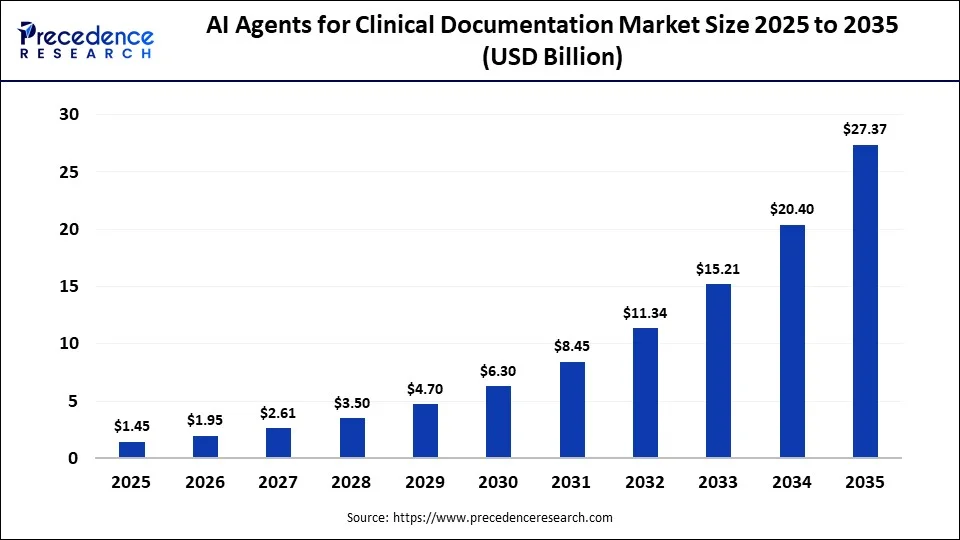
Payal Rabde is a healthcare technology and digital health market research analyst. She tracked the adoption of AI agents, clinical documentation, AI with EHRs, and regulatory omissions impacting documentation in healthcare using AI. Her research is used to assess competitive positioning and strategic opportunities around AI-powered clinical workflows by healthcare providers, technology vendors, health systems, and investors. The market is expected to reach $27.37 billion by 2035.
Source: https://www.precedenceresearch.com/ai-agents-for-clinical-documentation-market
 Get a Sample
 Table Of Content


AI Agents for Clinical Documentation Market Size and Forecast 2025 to 2035
According to Payal Rabde, who has more than 5 years' experience in healthcare research analysis. AI agents are widely used for traditional transcription services. They are replacing manual data entry and making it more efficient by minimizing errors. The need for technology that makes clinical daily tasks more efficient is driving the growth in the global AI agents for clinical documentation market. The global AI agents for clinical documentation market is projected to experience robust growth over the forecast period, as the increasing burden of documentation for physicians. This enhances clinical workflow efficiency are all contributing factor. Payal Rabde believes that the shift from passive AI transcription to agentic clinical documentation is a significant market transition.
Key Takeaways
- By end user, the hospitals & health systems segment led the market with a 44% share in 2025.
- By technology, the generative AI segment captured a major revenue share of 28% in 2025.
- By deployment mode, the cloud-based segment captured the largest AI agents for clinical documentation market share of 61% in 2025.
Market Sizing & Core Statistics
AI Agents for Clinical Documentation Market Size 2025-2035
From a 2026 base of USD 1.95 billion, a CAGR of 34.15% lifts the market to approximately USD 27.37 billion by 2035, close to a 19x expansion across the decade. It's actually very unusual for the healthcare technology market, especially when considering that most of the healthcare technology markets are not compounding at this rate, even in their strongest adoption phase. A technology with a fairly short adoption curve, and only recently receiving peer-reviewed evidence. That supports vendor claims, tends to compound more quickly than one where most buyers have already made their purchase decision.
Key Insight: This is one of the fastest growing healthcare technology categories tracked anywhere, with compound growth of 34.15% per year and a forecasted year 2035 value of nearly 19x that of year 2025, indicating a growth trajectory typical of an emerging technology category, and not a mature market.
Source: Precedence Research Database
AI Agents for Clinical Documentation Market Companies
| Company | Headquarters | Role in Market | Strategic Relevance |
| Abridge | Pittsburgh, Pennsylvania, US | Major/independent | Ambient clinical documentation leader with deep Epic integration; Best in KLAS for Ambient AI 2025 and 2026; ~$800M raised, $5.3B valuation. |
| Microsoft Nuance (Dragon Copilot/DAX) | Burlington, Massachusetts, US | Major/incumbent | Major/incumbent Acquired by Microsoft for $19.7B in 2022; its Dragon Ambient AI technology now also powers Epic's native AI Charting tool. |
| Epic Systems | Verona, Wisconsin, US | Major/incumbent (EHR platform) | Dominant US EHR vendor (~38% inpatient market share); launched native ambient scribe "Art" in partnership with Microsoft in 2025. |
| Oracle Health | Austin, Texas, US | Major/incumbent (EHR platform) | EHR platform (formerly Cerner) with Clinical AI Agent "Clinical Note"; expanded to UK NHS deployment in February 2026. |
| athenahealth | Watertown, Massachusetts, US | Major/incumbent (EHR platform) | Ambulatory-focused EHR vendor; launched athenaAmbient as a free native scribe for its customer base in 2026. |
| Ambience Healthcare | San Francisco, California, US | Major/independent | Full-workflow ambient documentation platform spanning 100+ specialties, including coding assistance; $1.25B valuation as of July 2025. |
| Suki AI | Redwood City, California, US | Specialist/SME | AI voice assistant for clinical documentation; over $165M raised to date, positioned as an independent alternative to EHR-native tools. |
| Nabla | Paris, France / New York, US | Specialist/SME | Ambient AI copilot for clinicians; over $120M raised, positioned across US and European health systems |
| Commure | San Francisco, California, US | Specialist/SME | Enterprise ambient scribe platform built from the Augmedix and Athelas acquisitions; reports 75,000+ clinicians and 25M+ annual encounters. |
| Solventum (Fluency, formerly 3M M*Modal) | Maplewood, Minnesota, US | Specialist/SME |
Hospital speech-recognition heritage; Fluency Direct for dictation and Fluency Align for ambient note generation. |
Top 10 Strategic Insights
Physicians Spend Nearly Two Hours on the EHR for Every Hour of Direct Patient Care
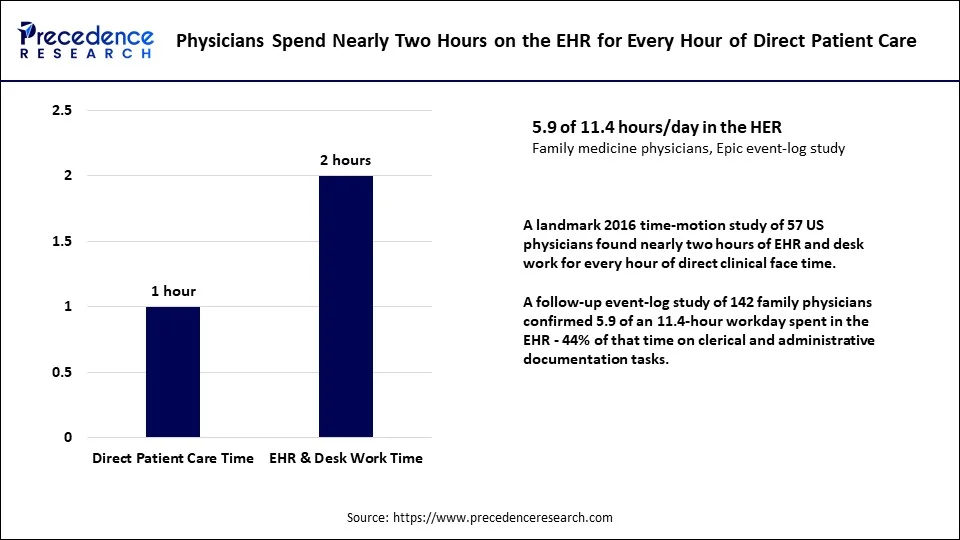
Years before the advent of ambient AI as a product, two historic time-motion studies measured the documentation burden for physicians. A 2016 direct observation study revealed that physicians were spending approximately 2 hours per day on EHR and desk work during each hour of direct patient care. An accompanying EHR event-log analysis of family medicine doctors showed that 44% of the 5.9 hours spent on EHR by a workday were used on clerical and administrative tasks, not on clinical decision-making itself.
My interpretation of that 44% is that it's probably the more derogatory of the two numbers. It's the work that has no real clinical judgment in it, the kind of work that an AI agent is best suited to learn. That burden is still there 10 years after it was clearly documented, and has been the target of years of efforts to make EHRs more usable, is not a coincidence.
Key Insight: The persistence of this burden a decade after it was first rigorously documented, despite years of EHR usability initiatives. This is precisely why the addressable market for AI documentation agents is as large as it is: incremental EHR fixes have not solved a problem that ambient AI approaches in a structurally different way.
Source: Sinsky et al., "Allocation of Physician Time in Ambulatory Practice," Annals of Internal Medicine (2016); Sinsky et al., Annals of Family Medicine (2016)
AI Scribe Adoption Is Linked to 16 Fewer Minutes of Documentation and Nearly One More Weekly Visit
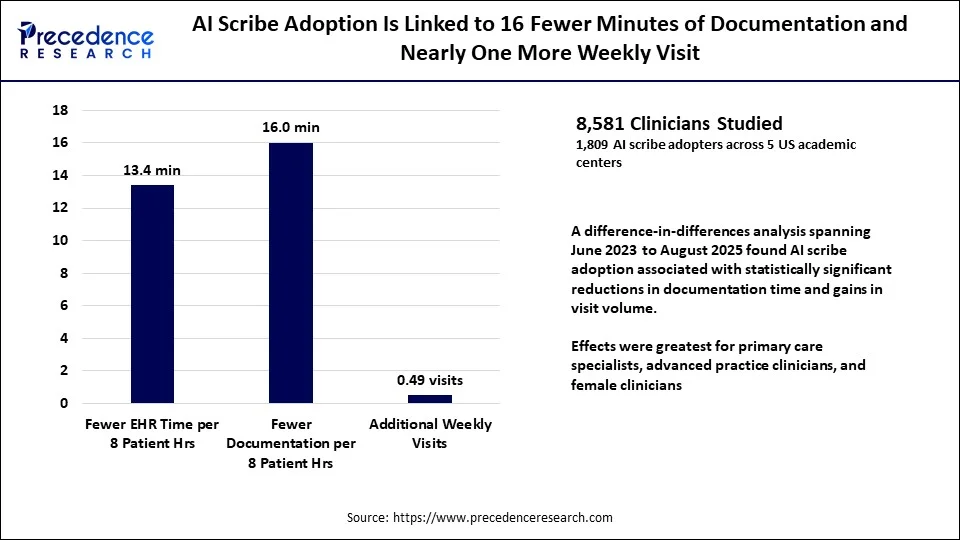
In April 2026, the authors published the largest peer-reviewed multisite study of the adoption of ambient AI scribes to date. That included a difference-in-differences analysis of 8,581 clinicians, including 1,809 who had adopted AI scribes, from June 2023 to August 2025 in five academic health care institutions across the United States. Adopters saw EHR time fall by 13.4 minutes (95% CI, 9.1 to 17.7), documentation time fall by 16.0 minutes (95% CI, 13.7 to 18.3), and weekly visit volume rise by 0.49 visits (95% CI, 0.17 to 0.81).
The point estimates here are not really precise to the decimal, and the lower limit of each interval is certainly meaningful enough for clinical workflow changes. The study found effects were most pronounced in primary care specialists, advanced practice clinicians, and female clinicians. Something that most vendor-commissioned studies would not have the statistical power, or frankly the incentive, to reveal on its own.
Key Insight: The study made clear that primary care specialists, advanced practice clinicians, and female clinicians were more prone to showing effects. Thus, the productivity case for AI documentation agents is not consistent across a health system and should be deployed to these higher-response clinician populations first.
Source: JAMA, "Changes in Clinician Time Expenditure and Visit Quantity With Adoption of AI-Powered Scribes: A Multisite Study," published online April 1, 2026
In the Emergency Department, AI Scribes Save Physicians 24 Minutes Across an 8-Hour Shift
| Metric | Data |
| 72.6 sec | Reduction in on-shift documentation time per ED encounter (95% CI: 63.8–81.4 seconds; P<.001) |
| ~24 min | Estimated time saved across an 8-hour shift, assuming use across 20 encounters |
| 690 chars | Decrease in note character count Suggesting more concise AI-assisted notes without loss of content |
In a tertiary academic medical center, a retrospective cohort study of adult emergency department (ED) presentations reported that on-shift documentation time was reduced by 72.6 seconds per presentation (95% CI 63.8 to 81.4, P<.001) or 690 characters per average note length (95% CI 593 to 787, P<.001) across an 8-hour shift with 20 presentations. This is a more statistically convincing per-encounter effect. Also, the narrow confidence interval and small p-value fall into a level of statistical significance that most studies of a single-site healthcare technology fall short of achieving. What I would flag as the more interesting finding sits one level below the headline time-savings number.
Key Insight: The impact was the same for high- and low- or moderate-use physicians, indicating that the time benefit is not dependent on user skill. This is a far more manageable barrier to adoption than many enterprise software categories have, and is more conducive to quicker adoption.
Source: "Ambient AI Scribes and Emergency Department Documentation Burden: Retrospective Cohort Study" (2026)
Burnout Among Ambulatory Clinicians Fell From 52% to 39% Within 30 Days of AI Scribe Adoption
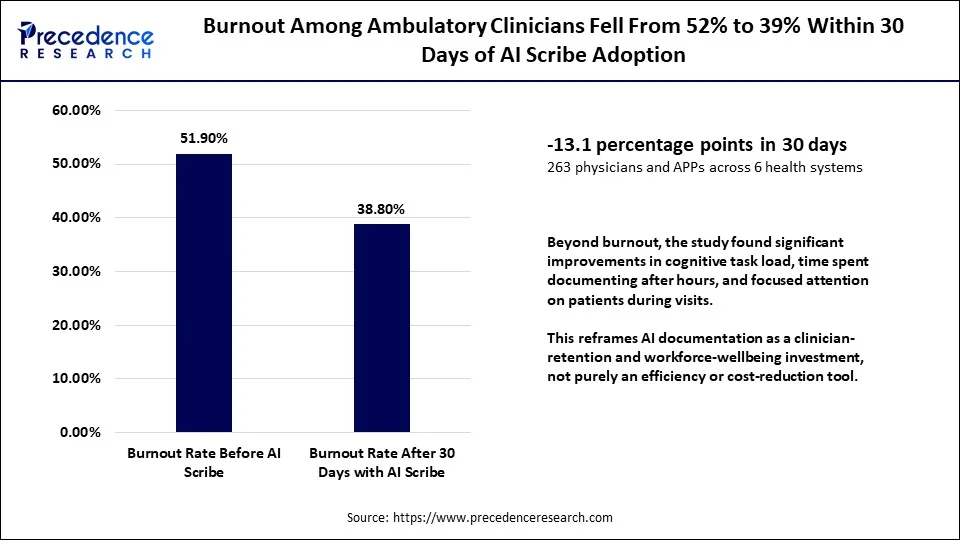
A six-state quality improvement study of 263 physicians and advanced practice practitioners in six health care systems assessed physician burnout before and 30 days after adopting ambient AI scribes, revealing a 13.1% drop in the overall rate of physician burnout from 51.9% to 38.8% in just 30 days. Aman, looking at this data, noted that it is a larger and faster impact than most organizational burnout interventions have after many years of spending. This does change the spending paradigm of AI documentation. It is no longer a productivity tool and begins to seem like a clinician-reduction investment. That has a tangible, quick impact, and that matters a great deal to health system executives who keep a closer eye on clinician burnout than they do on documentation minutes and on whom it costs much more.
Key Insight: In 30 days, the 13.1-point reduction in burnout is a materially greater impact than most organizational burnout interventions over years and years. Further making AI documentation spend an ROI clinician-retention investment and not just a productivity tool.
Source: "Use of Ambient AI Scribes to Reduce Administrative Burden and Professional Burnout" (quality improvement study)
Venture Capital Has Valued the Ambient Documentation Category at Over $25 Billion Combined
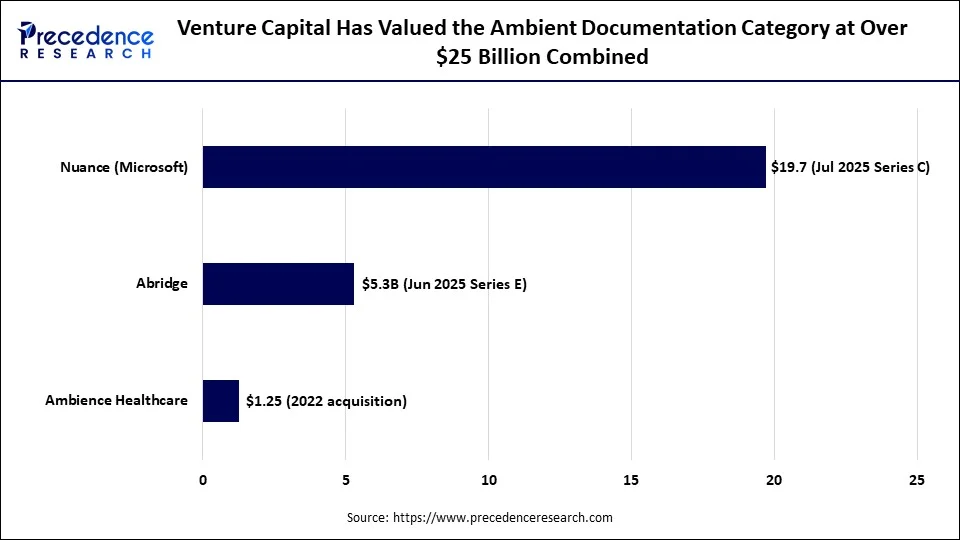
The three most prominent platforms in the category have disclosed valuations that total USD 25 billion or more. The three fundraisings were Ambience Healthcare's USD 1.25 billion Series C in July 2025, Abridge's USD 5.3 billion Series E in June 2025, and Microsoft's biggest in kind of the three, the USD 19.7 billion acquisition of Nuance in 2022.
I'd caution a bit against comparing these numbers directly, as one is an acquisition price and the other two are private venture valuations with wildly different assumptions of liquidity and control. That's a lot to take into account, but Microsoft's Nuance purchase was finalized years ago, before the current ambient AI funding craze. That seems to be more than just prescient these days. It placed Epic in the driver's seat for the 2025 rollout of its native AI Charting offering. Thus turning the deal into a platform partnership and reaping the profits a second time.
Key Insight: Microsoft's USD 19.7 billion Nuance acquisition, which took place years before the current ambient AI funding craze, now seems to have been prescient in direction, as Microsoft will provide the underlying technology for Epic's 2025 native AI Charting feature, and can monetize the acquisition again via a platform partnership.
Source: Fierce Healthcare; Sacra; Contrary Research; Fortune - company funding and acquisition disclosures, 2022-2026
The Largest Independent Accuracy Validation to Date Covers Over 4 Million Patient Encounters
| Metric | Data |
| 1,306 | Clinicians Included in the Largest published indipendent ambient AI scribe validiation study |
| 8,986 | Individual Note-Quality Ratings collected and analyzed across the study period |
| 4M+ | Patient Encounters Covered over the 6-month study window, across a large integrated health system |
The largest independent study of ambient AI scribe validation to date was conducted over six months with over 1,306 clinicians at a large integrated health system, resulting in more than four million ratings of note quality. This is a rare study of its kind, one which is not vendor-funded or vendor-driven, but rather an independent study, in a field dominated by vendor-funded or vendor-done studies. Once the market has moved beyond first-generation studies, which only ask if the technology saves time. It becomes the next real differentiator between the various platforms as accuracy and note quality are measured.
Key Insight: With the market coming of age beyond first-generation ‘does it save time' studies, accuracy and note-quality benchmarking at this scale is the next competitive differentiator that will set apart vendors who can publish independent validation data comparable to these from the market versus those who can only present vendor-reported data.
Source: NEJM AI (2025) independent ambient AI scribe validation study, as reported by industry review sources
Every AI Documentation Agent Runs the Same Four-Stage Capture-to-Chart Pipeline
| Layer | Description |
| Capture Layer | Ambient microphone, conversational interface, or dictation captures the patient-clinician encounter |
| Generation Layer | LLMs and generative AI structure the conversation into a draft clinical note (SOAP or specialty format) |
| Review & Edit Layer | Clinician reviews, edits, and approves the draft note before it is finalized - the human-in-the-loop step |
| EHR Commit Layer | Approved note is written into the EHR/EMR, often alongside coding and billing suggestions |
All agent types are based on the same four-layer technical architecture in this market. Capture is a recording device that captures the patient-clinician interaction using an ambient microphone, a conversational interface, or a dictation tool. Generation uses large language models and generative AI to organize that conversation into a first draft of a clinical note.
Review and edit is where a clinician reviews and edits the draft and approves it before it goes final. A note is approvingly written by EHR Commit in the record, often with coding/billing recommendations. It's that third-stage review and edit is more nuanced in the agent-type segment, where both agent types are in fact doing it today, but one is doing it at a significantly higher rate of growth than the other.
Key Insight: The review and edit layer is the structural explanation that, despite both autonomous agents and assistive agents needing to go through this stage now, any time spent by the clinician reducing the time they must spend in this layer is directly equal to an opportunity to expand the potential autonomous-agent market. This is making the review step the most valuable point of competitive R&D investment in the entire pipeline.
Source: Precedence Research Database
EHR Integration Depth Now Rivals Note Quality as the Deciding Purchase Factor
| Integration Model | 2025 Market Share | 2035 Market Share | CAGR | Description |
| EHR/EMR Integrated | 58.00% | 66.00% | 35.50% | Direct integration into Epic, Oracle Health, and other EHRs is now the dominant model |
| Standalone | 18.00% | 12.00% | 29.20% | Fast to deploy but losing share as buyers prioritize native workflow embedding |
| API-Based | 12.00% | 13.00% | 35.00% | Connects agents across multiple clinical and administrative systems |
In 2025, the market share of EHR/EMR Integrated agents already leads the pack at 58.0%. Further, in 2035 will account for as much as 66.0% at a CAGR of 35.5%, the highest among all five integration models. The one integration model actually seeing a decreasing market share is standalone tools. That slipped from 18.0% to 12.0% of the market, but still recorded a solid 29.2% CAGR on its own.
I think that combination is the single most instructive data point in this section, because it shows growth alone does not guarantee relative position. The other smaller share categories are API-Based, Hospital Information System Integrated, and Health Information Exchange Integrated, which don't come close to EHR/EMR Integrated. The contours of the market clearly favor deeper integration in the market than standalone vendors can achieve.
Key Insight: Even among a fast-growing product category, standalone tools are losing absolute ground from 18.0% to 12.0% of market share, while maintaining a 29.2% CAGR, illustrating that the structural preference of the market can quickly overtake growth of an individual product category.
Source: Precedence Research Database
Regional Intelligence
North America's Share Declines as Asia-Pacific Captures the Fastest Regional Gain
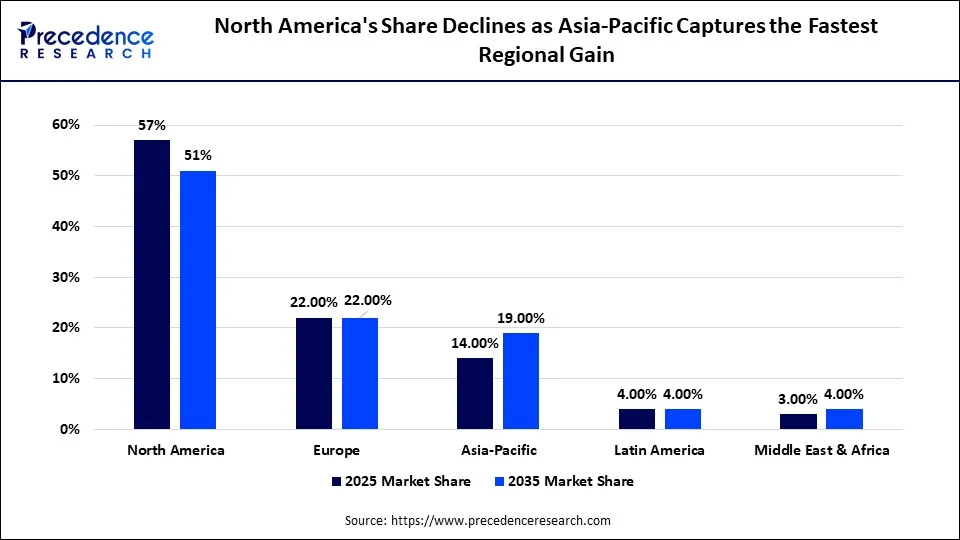
Aditi noted that North America accounted for the highest share with 57.0% in 2025. That would see the share drop compared to all of the other segmentation tables she had seen elsewhere in the data set. While the region continues to expand in absolute dollar value throughout the forecast period, market share drops 6% by 2035 to 51.0%.
Europe is a close runner-up at 22.0% market share in both years. The region that's making up for the lost ground is actually Asia-Pacific, which grew by 5 points to 19.0% market share, with a smaller 1-point gain in the Middle East and Africa from 3.0% to 4.0% and a 0-point increase in Latin America (4.0%). It's a different phenomenon altogether to lose market share but still gain dollar volume.
Key Insight: The biggest region-to-region share loss in any of the market's segmentation tables is experienced by the top region, North America, as it drops from 57.0% to 51.0% of the market and gains in absolute dollar terms. This is a market where the leader loses relative position simply because the world catches up with healthcare documentation digitization.
Source: Precedence Research Database
Every Region Grows Faster Than 30% Annually, a Rarity Among Healthcare Technology Markets
| Region | CAGR (2025-2035) | Underlying Growth Driver |
| Asia-Pacific | 37.80% | Rapid digital-health expansion, large patient volumes, AI investment |
| Middle East & Africa | 37.10% | Healthcare digitization and AI-enabled hospital transformation |
| Latin America | 34.20% | Growing health-tech adoption and EHR modernization |
| Europe | 34.20% | Healthcare digitization, AI regulation maturity, workforce pressures |
| North America | 32.90% | Strong EHR penetration and ambient-scribe adoption; largest existing base |
Asia-Pacific is on top in terms of CAGR, with the region boasting 37.8% growth as digital health technologies are quickly gaining traction, the patient population is high, and investments in AI are growing. The Middle East and Africa market is closely following, with a CAGR of 37.1%. Driven by the digitization of healthcare and the transformation of hospitals with the aid of AI. The other surprise was the Middle East and Africa posting the second-highest CAGR in the entire time series, ahead of the evergreen Europe, which I was not expecting given how small the market is.
Both Latin America and Europe are growing at 34.2% CAGR, with neither side holding the higher ground. Tied exactly, though for different reasons: health-tech adoption and EHR modernization in Latin America against healthcare digitization, AI regulation maturity, and workforce pressures in Europe. Among the five, North America is the slowest region with 32.9% CAGR driven by high penetration of EHRs, investments in healthcare AI, and the fact that ambient-scribe adoption is taking place from a much larger base.
Key Insight: North America will continue to dominate the absolute size of the market during the forecast period. The narrow CAGR spread – 32.9% to 37.8% – is unusually small for the global technology market. That indicates that this is indeed a global adoption wave and not one solely focused on North America or two key markets.
Source: Precedence Research Database
Segment Deep-Dives
Ambient Agents Dominate Today and Are Still Gaining Share a Decade Out
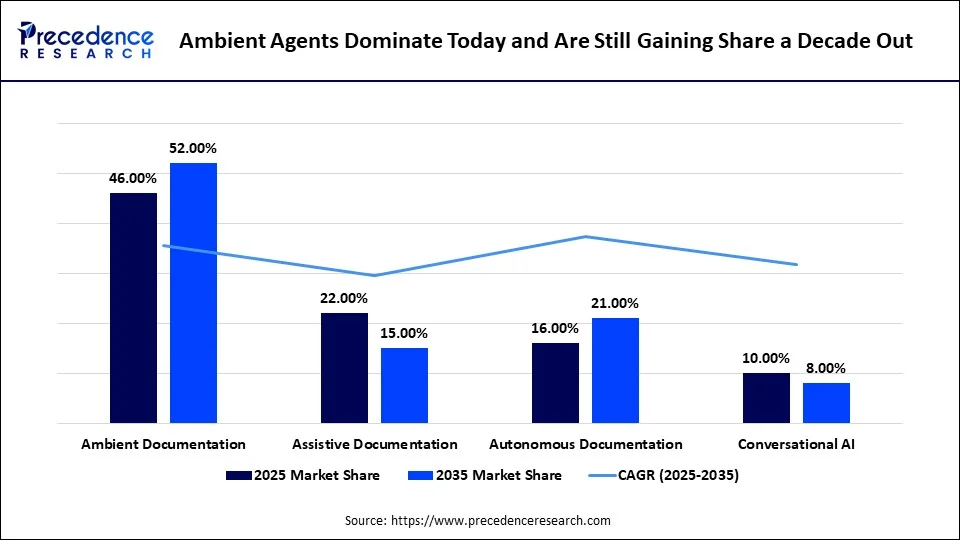
| Agent Type | 2025 Market Share | 2035 Market Share | CAGR (2025-2035) | Description |
| Ambient Documentation | 46.00% | 52.00% | 35.60% | Ambient listening and automatic note generation directly cut documentation burden |
| Assistive Documentation | 22.00% | 15.00% | 29.60% | Human-in-the-loop remains important but loses share to autonomous workflows |
| Autonomous Documentation | 16.00% | 21.00% | 37.40% | Agentic workflows enable documentation with limited manual intervention |
| Conversational AI | 10.00% | 8.00% | 31.70% | Voice-driven interaction improves documentation speed and accessibility |
Ambient clinical documentation agents already hold the largest market share, 46.0%, in 2025. This market share continues to rise at an unusually high rate of 35.6% CAGR, to reach 52.0% by 2035. The autonomous clinical documentation agents will see the highest growth of all types of agents as they expand from 16.0% to 21.0% market share at a 37.4% CAGR. On the other hand, the assistive clinical documentation agents will actually lose market share from 22.0% to 15.0% at a comparatively slower 29.6% CAGR, as a direct result of the less amount of clinician review time required by autonomous agents. The smaller of these groups is filled by conversational and specialty-specific agents, who do not pose a threat to either of the leaders.
Key Insight: Ambient agents have increased their market share in the most dominant of leading market segments, from 46.0% to 52.0%, and their CAGR of 35.6% is unusual for a leading market segment that has such a strong market share, as normally this type would be seeing share erosion as the market diversifies, but not here.
Source: Precedence Research Database
Physician Practices Are Growing Faster Than Hospitals Despite a Smaller Base
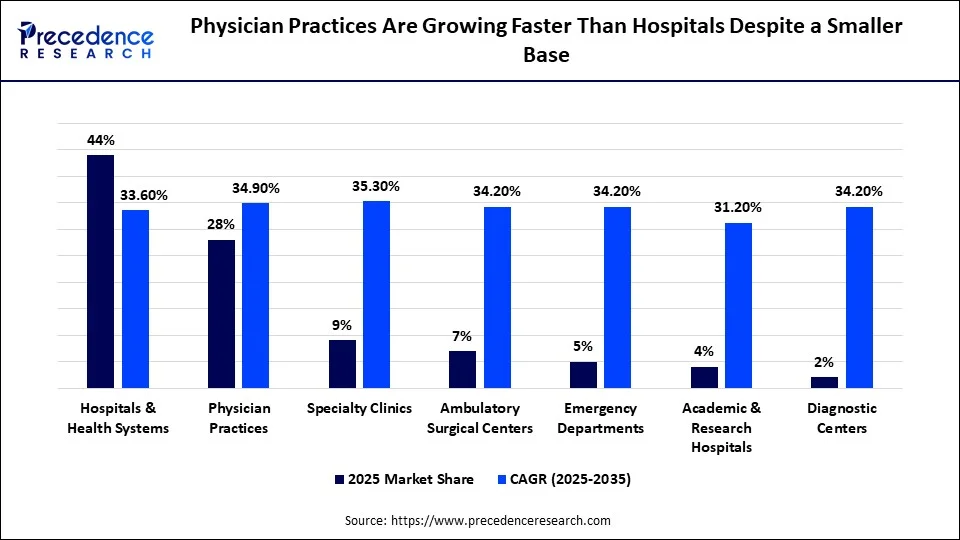
Hospitals and health systems are expected to have the largest end-user market in 2025 with a 44.0% share, given that they have the highest dollar IT budgets and the longest vendor relationships of all buyer groups. Despite the paltry 28.0% share of the market, physician practices still outpace hospitals on CAGR, 34.9% to 33.6%. I think the more interesting number sits in what that gap implies about unit economics rather than about ambition. A smaller, more resource-constrained buyer category may have to face a more significant bottom line impact from the documentation burden. This may be why its adoption rate has been so much faster than that of independent and group practices, which don't have the large IT budgets that health systems do.
Key Insight: Independent and group practices currently make up just 28.0% of the market compared to 44.0% for hospitals and health systems. Independent practices are growing at least as quickly as hospitals and health systems, at 34.9% CAGR compared to 33.6% CAGR.
Source: Precedence Research Database
Large Language Models Are Growing Faster Than Legacy NLP and Speech Recognition
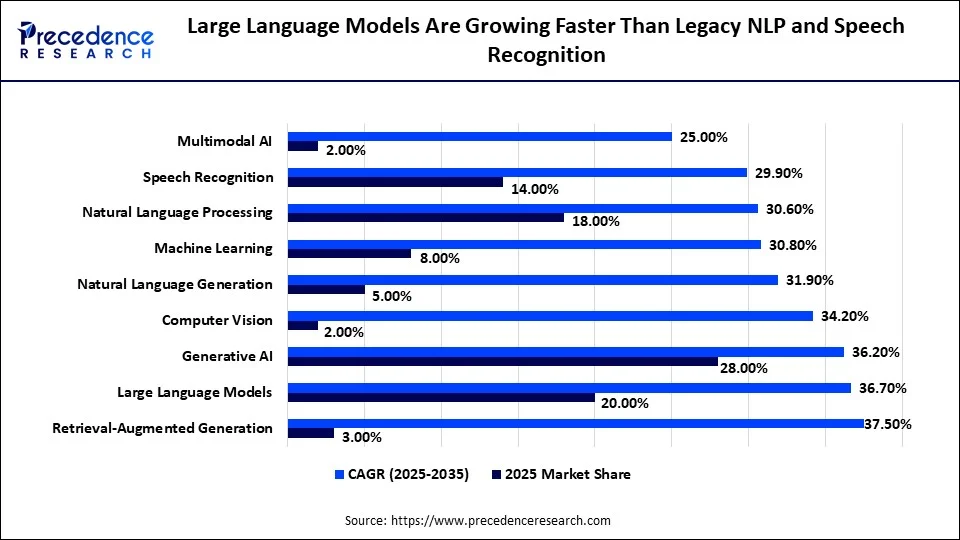
Generative AI is the technology with the most direct connection to the modern ambient scribe products. Thus, the technology with the largest market share of the nine technologies in 2025, at 28.0%. Large language models are closely followed with a 20.0% market share. However, despite being the smallest, at 3.0% of the total market, Retrieval-Augmented Generation is the fastest-growing technology in the entire category, with a CAGR of 37.5%.
I would call that a whiff of a trend, rather than a trend, given that it's the smallest share and the fastest CAGR at the same time, with a 3.0% base. Despite that, there is a serious basis for this. The grounding notes directly tackle hallucination and factual-accuracy issues. This continues to be the top clinical-safety concern for widespread autonomous-agent use in the real clinical setting. While the newer generative and retrieval-based technologies are still several steps ahead, legacy technologies such as natural language processing (18.0% share, 30.6% CAGR) and speech recognition (14.0% share, 29.9% CAGR, the slowest of the nine) are still a long way behind.
Key Insight: Despite having the smallest market share of any technology (3.0%), with a CAGR of 37.5%, ground-based retrieval is the only technology to directly address the hallucination and factual-accuracy issue. That is the single greatest clinical safety concern for broader adoption of autonomous agents, making it the fastest-growing underlying technology.
Source: Precedence Research Database
Cloud Deployment Will Command 70% of the Market by 2035
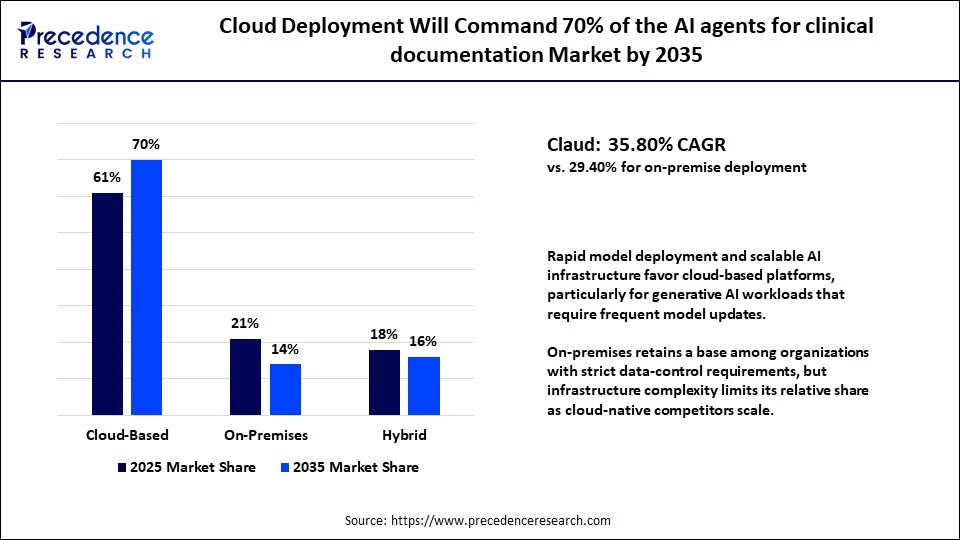
Cloud-based deployment already holds the largest market share of the three deployment models at 61.0% in 2025. That market share extends further to 70.0% by 2035 at a 35.8% CAGR, the fastest of the three. The only deployment model that is losing both market share and relative CAGR is on-premises deployments, falling from 21.0% to 14.0%.
On-premises plus cloud deployments have the highest CAGR of the three, at 34.7%. On-premises deployment doesn't seem to be a vanishing technology, or a vanishing portfolio of middle-market solutions. But rather a winnowing option that will continue to be a presence, particularly for the more data-heavy healthcare organizations in this architecture space.
Key Insight: On-premises deployment is the only model that saw market share decline as well as a negative relative CAGR for a technology this compute-intensive and update-dependent. That makes on-premises deployment a shrinking niche of the market for the most data-sensitive healthcare organizations-and not a viable middle-market option.
Source: Precedence Research Database
Recent Developments
August 20, 2025 - Epic Systems: Announced native AI Charting ("Art"), powered by Microsoft Dragon Ambient AI
- What Happened: Announced native AI Charting ("Art") by Microsoft Dragon Ambient AI
- What Happened: During its annual Users Group Meeting, Epic announced the implementation of its native Ambient AI scribe feature, which was built with the aid of Microsoft's Dragon Ambient AI (previously Nuance DAX) transcription engine, and connected to Epic's Cosmos database of over 16 billion clinical data points.
- Why It Matters: Epic is estimated to have 38% of the U.S. market for inpatient EHR and is used by 3,620 hospitals and health systems. A native scribe built directly into a top EHR platform is an equalizer for third-party ambient documentation companies.
- Business Impact: The launch was widely reported as a threat to the standalone ambient scribe market. While third-party vendors are still an option, the native offering raises the bar on performance and value expectations for standalone products that are competing with bundled EHR functionality, Epic said.
Source: Fierce Healthcare; Healthcare IT News; STAT News, August 2025 - February 2026
June 2025 - Abridge: Raised $300M Series E at a $5.3B valuation
- What Happened: In a Series E funding round that was led by Andreessen Horowitz, Abridge raised an additional $300 million, more than doubling its valuation from $2.75-2.8 billion after its Series D in February 2025 to $5.3 billion and raising total funding to approximately $800 million.
- Why It Matters: It's one of the biggest healthcare AI investment rounds ever, and investors are recognizing ambient clinical documentation as a mature market category, even with the growing number of EHR-native solutions.
- Business Impact: Abridge has been named Best in KLAS for Ambient AI in both 2025 and 2026, and the round funded expansion into revenue-cycle intelligence and real-time prior authorization beyond core documentation.
Source: Fierce Healthcare, "Generative AI Company Abridge Scores $300M Series E," June 2025; Sacra company profile
February 12, 2026 - Oracle Health: Launched Clinical AI Agent ("Clinical Note") generally available in the UK NHS
- What Happened: Oracle Health introduced its ambient AI documentation agent to the NHS trust and private practice community in the UK, following successful pilots at Barts Health NHS Trust, Imperial College Healthcare NHS Trust and Milton Keynes University Hospital.
- Why It Matters: The launch is one of the biggest single-market transitions that any other major provider has made to a public national healthcare system, as opposed to the deployments of other providers, which are largely U.S.-based.
- Business Impact: In more than 300 organizations around the world, the tool was deployed, saving more than 200,000 clinician hours and cutting down on documentation time by about 40%, Oracle Health says in the business impact section. NHS trials showed a 23.5% rise in patient interaction time and a 13.4% higher number of emergency patients per shift.
Source: Oracle press release, February 12, 2026; Healthcare IT News
July 2025 - Ambience Healthcare: Raised $243M Series C at a $1.25B valuation
- What Happened: Ambience Healthcare secured $243 million in Series C funding, raising its total capital to ~$320-345 million, and valuing the company at $1.25 billion. Kleiner Perkins, Andreessen Horowitz, and the OpenAI Startup Fund were among the investors.
- Why It Matters: Ambience is not a pure-play scribe service provider, but rather offers coding support, such as automated ICD-10/CPT extraction, and ambient documentation in over 100 specialties along with referral letters.
- Business Impact: Investors continue to show their interest in full-documentation workflow platforms, despite increased EHR vendor offerings of native scribing functionality, suggesting continued market opportunities for scribing specialists who offer more comprehensive functionality.
Source: Contrary Research company profile; Odelle Technology market analysis, 2025-2026
Throughout 2026 - U.S. Department of Veterans Affairs: Expanding ambient AI scribe technology to all VA medical centers nationwide
- What Happened: Following a successful pilot program, the VA is expanding ambient AI scribe deployment across its entire national medical center network throughout 2026, representing the largest government healthcare AI deployment in the United States.
- Why It Matters: After a successful pilot, the VA is rolling out Ambient AI Scribe to its national medical centre network nationwide in 2026, the largest government healthcare AI rollout in the U.S.
- Business Impact: The VA anticipates that adoption at the government scale will impact other large public and quasi-public health systems that are considering ambient AI documentation providers when making their procurement decisions.
Source: SOAPNoteAI, "Healthcare AI Trends 2026," industry roundup citing VA nationwide expansion announcement
February 2026 - athenahealth: Launched athenaAmbient as a free native ambient scribe for all customers
- What Happened: athenahealth introduced athenaAmbient, a natively developed ambient documentation tool, to its entire customer base at no extra charge.
- Why It Matters: A no-additional-cost bundling model from a large ambulatory EHR vendor directly challenges the business model of the standalone EHR vendors, especially in the small-to-mid-sized physician practice market.
- Business Impact: The launch follows a longer-term shift in EHR providers, such as Epic, Oracle Health, and athenahealth, to incorporate ambient documentation as a native functionality of their platforms, rather than a paid add-on.
Source: SOAPNoteAI, "Healthcare AI Trends 2026" industry roundup
Expert Insights
AI-agent-driven workflow is providing opportunities throughout the healthcare delivery landscape. The most promising opportunities are going to be at the nexus where ambient clinical intelligence meets generative AI. AI agents can go beyond just transcription and help interpret clinical conversations, structure information, and compose clinical notes for physicians. I believe the next ten years will have a lot to do with the administrative burden on clinicians, the lack of healthcare workers, and pressure to increase productivity in the market.
I also expect greater demand for the following features, including ambient listening platforms, autonomous documentation agents, specialty-specific solutions, and workflow automation tools. They are all being prioritized by healthcare providers as they seek to be more efficient. Organizations with the ability to create clinically reliable AI agents that can integrate with current healthcare IT systems. They have robust data-security measures will be well positioned. Those that can show measurable savings in documentation time, that will likely be well positioned to leverage the increasing demand for intelligent clinical documentation solutions.
Our Experts
Payal Rabde has spearheaded the main market research, methodology preparation, market segmentation, application analysis, competitive developments, analysis, and forecasting for the report, making it the analytical underpinning of the report.
Aman handled the collection and validation of government publications, company disclosures, technology investment data, infrastructure statistics, and other independently sourced quantitative data that contributed to a robust evidence base for the market estimates.
Aditi checked the entire research paper, did quality checks, confirmed the findings, altered the paper for refinement, removed inconsistencies, and finalized the research paper, making it accurate and understandable.
Agents for Clinical Documentation Market Segmentation
By Documentation Type
- Clinical Notes
- Progress Notes
- Consultation Notes
- Discharge Summaries
- Operative Notes
- Emergency Department Notes
- Nursing Documentation
- Referral & Care Coordination Notes
- Medical Coding & Documentation
- Other Documentation
By Clinical Workflow
- Patient Encounter Documentation
- Physician Note Generation
- Medical History Documentation
- Clinical Decision Support Documentation
- Discharge Documentation
- Referral Documentation
- Care Plan Documentation
- Follow-up Documentation
- Coding & Billing Documentation
By Specialty
- General Medicine
- Primary Care
- Cardiology
- Oncology
- Neurology
- Orthopedics
- Pediatrics
- Obstetrics & Gynecology
- Emergency Medicine
- Psychiatry
- Gastroenterology
- Pulmonology
- Other Specialties
By Agent Function
- Clinical Note Generation
- Medical Transcription
- Clinical Summarization
- Patient History Extraction
- Coding Assistance
- Documentation Quality Improvement
- Physician Query Assistance
- Discharge Summary Generation
- Referral Letter Generation
- Clinical Documentation Compliance
- Documentation Analytics
By Region
- North America (U.S., Canada, Mexico)
- Europe (Germany, U.K., France, Italy, Spain, Netherlands, Switzerland, Rest of Europe)
- Asia-Pacific (China, Japan, India, South Korea, Australia, Singapore, Rest of Asia-Pacific)
- Latin America (Brazil, Argentina, Mexico, Rest of Latin America)
- Middle East & Africa (UAE, Saudi Arabia, Israel, South Africa, Rest of Middle East & Africa)
Questions This Report Deliberately Leaves Open
- Which of the five regions provides the most attractive risk-adjusted entry opportunity for a new AI documentation vendor: the fastest-growing region, Asia-Pacific, at a 37.8% CAGR, or the largest-share region, North America, where Epic's native scribe now competes directly?
- With Epic's native "Art" launch and athenahealth's free athenaAmbient, what differentiated value proposition enables independent vendors such as Abridge and Ambience to maintain per-seat pricing against bundled EHR alternatives?
- Since RAG has a 37.5% CAGR from the smallest current share, and core LLM capability a 36.7% CAGR from the largest share, which should be the focus of vendor R&D?
- What is the realistic addressable opportunity as review-layer automation becomes more mature with the decreasing share of Assistive Documentation (22.0% to 15.0%) and increasing share of Autonomous Documentation (16.0% to 21.0%)?
- With the proven 13.1-point decrease in burnout after 30 days, how can health systems design procurement business cases that will include clinician-retention value in addition to direct productivity ROI?
- Which vertical expansion opportunity is the most capital-efficient for a mid-sized documentation vendor to pursue specialty-specific capabilities-Cardiology, which has 35.4% CAGR and a 9.0% share, or Oncology, which has 36.0% CAGR and an 8.0% share?
- With the entry of EHR-native competitors like Epic Art, Oracle Clinical Note, and athenaAmbient, what is the true extent of the exposure of an incumbent's current customer base to the threat of being displaced, and what are the likely switching costs needed to fend off such a challenge?
- Given that the NEJM AI validation study, which included 1,306 clinicians and over 4 million encounters, is one of the few large-scale independent references, what accuracy and safety benchmarking standard should the market take, as a whole?
- Is it worth investing in the Middle East & Africa, which has a high growth rate but low market size, as the absolute market size is still small, as it accounts for a 3.0% share of the market and has a 37.1% CAGR?
- What is the realistic total addressable market for physician-practice-specific deployments given that Physician Practices are growing at a higher rate (34.9% CAGR) than Hospitals & Health Systems (33.6%), with a smaller base of deployments?
- Should the M&A strategy consider the precedent set by the auctions of Augmedix and Athelas by Commure, and what are the other independent specialists that make good targets when the category matures?
- How much revenue opportunity does the clinician miss out on throughout the entire life of the clinic, including subscription, per-encounter, and coding assistance upselling, and how does this differ between those vendors that provide supplemental workflow functions and those that are pure-play scribes?
- Which integration model has a higher CAGR (35.0% vs. 35.5%) and a larger share (58.0%) for a vendor that has not yet become an integrated part of Epic or Oracle Health?
- What will be the difference in sequencing of regional expansion for a vendor that wants to focus on revenue in the near future, when North America is expected to hold a dominant 51.0% share by 2035, and one that wants to be positioned for long-term growth in the Asia-Pacific region where the growth rate is expected to be faster?
- How can smaller physician practices and specialty clinics use AI documentation at a price point similar to what larger health systems have negotiated?
- Is the Conversational AI Documentation Agents segment (10.0% share, 8.0% down) at risk of becoming part of the ambient and autonomous agent categories?
- How will Abridge, Ambience, Suki, and Nabla react as the VA's national rollout of its 2026 offering and Oracle Health's rollout of Oracle Health in the NHS create new markers for government-scale adoption?
- Which two or three documentation types - Operative Notes (36.0% CAGR) or Emergency Department Notes (37.0% CAGR) - offer the best combination of high growth and specialized workflow complexity for a differentiated product line?
- How should vendors approach quantifying and presenting the clinical-safety case when hallucination and factual-accuracy issues continue to be top barriers cited throughout the technology segmentation?
- With Coding Assistance already having a 35.2% CAGR in its own right as an agent function, what is the realistic bundling opportunity between AI documentation and revenue-cycle or coding automation?
References
- Precedence Research Database
"AI Agents for Clinical Documentation Market-Market Size, Segmentation, and Regional Data, 2025-2035"-Supplied by Precedence Research
https://www.precedenceresearch.com
Data used: Market size, CAGR, all segment and regional share/CAGR tables - Sinsky et al.
"Allocation of Physician Time in Ambulatory Practice: A Time and Motion Study"-Annals of Internal Medicine, 2016
https://pnhp.org/news/physicians-spend-two-hours-on-ehrs-and-desk-work-for-every-hour-of-direct-patient-care/
Data used: Documentation burden ratio (2 hours EHR per 1 hour patient care) - Sinsky et al.
"EHR Event Log Study of Family Medicine Physicians"-Annals of Family Medicine, 2016
https://poconoai.com/ehr-burden-research.html
Data used: 5.9 of 11.4-hour workday EHR time; 44% clerical/admin share - JAMA
"Changes in Clinician Time Expenditure and Visit Quantity with Adoption of AI-Powered Scribes: A Multisite Study"- Published online April 1, 2026
https://pubmed.ncbi.nlm.nih.gov/41920565/
Data used: 8,581-clinician multisite time-savings study - Journal / Retrospective Cohort Study
"Ambient AI Scribes and Emergency Department Documentation Burden"-2026
https://pubmed.ncbi.nlm.nih.gov/42391625/
Data used: ED encounter-level documentation time reduction - Quality Improvement Study
"Use of Ambient AI Scribes to Reduce Administrative Burden and Professional Burnout"- 2025-2026
https://www.ncbi.nlm.nih.gov/pmc/articles/PMC12492056/
Data used: Clinician burnout reduction data - Fierce Healthcare
"Generative AI Company Abridge Scores $300M Series E Backed by a16z and Khosla Ventures"-June 2025
https://www.fiercehealthcare.com/ai-and-machine-learning/ambient-ai-startup-abridge-scores-300m-series-e-backed-a16z-and-khosla
Data used: Funding landscape; recent development - Sacra
"Abridge Revenue, Valuation & Funding"- 2026
https://sacra.com/c/abridge/
Data used: Abridge valuation and funding detail - Fierce Healthcare
"Epic to Launch AI Scribe with Microsoft, Unveils RCM, ERP Tools"- August 2025
https://www.fiercehealthcare.com/health-tech/epic-unveils-major-ai-features-ai-charting-microsoft-cosmos-ai-risk-prediction-and-rcm
Data used: Epic native AI Charting recent development - Oracle
"Oracle Health Clinical AI Agent, Clinical Note Helps UK Doctors Spend More Time on Patient Care"- February 12, 2026
https://www.oracle.com/news/announcement/oracle-health-clinicalai-agent-helps-uk-doctors-spend-more-time-on-patient-care-2026-02-12/
Data used: Oracle Health NHS deployment recent development - SOAPNoteAI
"Healthcare AI Trends 2026: What Providers Need to Know"- 2026
https://www.soapnoteai.com/soap-note-guides-and-example/healthcare-ai-trends-2026/
Data used: VA nationwide expansion; athenahealth
For inquiries regarding discounts, bulk purchases, or customization requests, please contact us at sales@precedenceresearch.com
Frequently Asked Questions





Ask For Sample
No cookie-cutter, only authentic analysis – take the 1st step to become a Precedence Research client
 Get a Sample
.webp)



 sales@precedenceresearch.com
 Schedule a Meeting
