



AI-Based Image Analysis Market Trends, Companies, Revenue / Sales Performance, Manufacturing Yield, Fab Capacity, Export & Import Dynamics, Supply Chain Analysis, Competitive Landscape, and Growth Forecast
AI-Based Image Analysis Market (By Algorithm: Deep Learning, Machine Learning, Pattern Recognition; By Application: Medical Imaging, Industrial Inspection, Retail Analytics, Security and Surveillance, Autonomous Vehicles; By Deployment Type: Cloud-based, On Premises) - Global Industry Analysis, Size, Trends, Leading Companies, Regional Outlook, and Forecast 2026 to 2035
Source: https://www.precedenceresearch.com/ai-based-image-analysis-market
 Get a Sample
 Table Of Content


What is AI-Based Image Analysis Market Size in 2026?
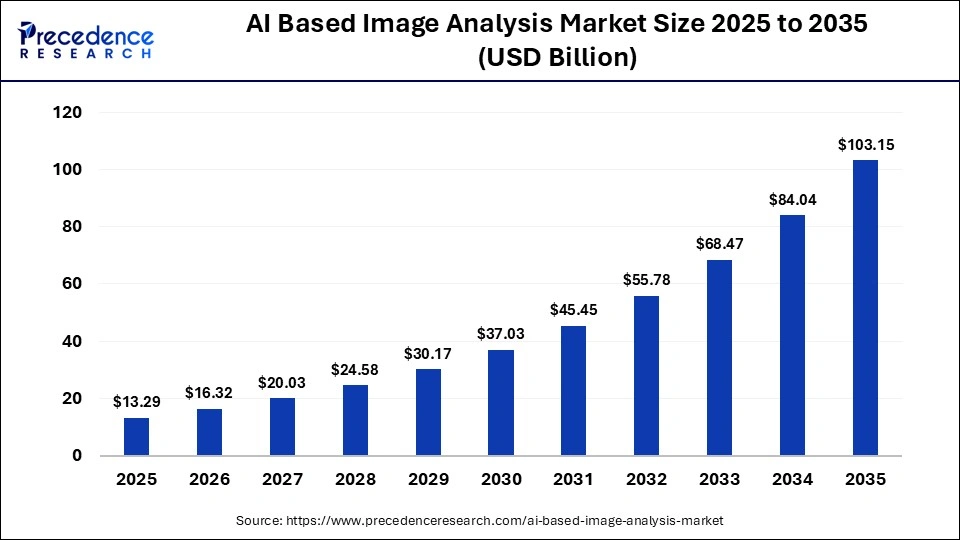
The global AI-based image analysis market size was calculated at USD 13.29 billion in 2025 and is predicted to increase from USD 16.32 billion in 2026 to approximately USD 103.15 billion by 2035, expanding at a CAGR of 22.74% from 2026 to 2035. The market is driven by the rapid adoption of AI in healthcare diagnostics, advancements in deep learning models, and the rising use of edge computing for real-time image analysis. Moreover, supportive government initiatives for automated surveillance and smart city projects are likely to contribute to market growth.
Key Takeaways
- By region, North America held the largest market share in 2025.
- By region, Asia Pacific is expected to witness the fastest growth during the foreseeable period.
- By algorithm, the deep learning segment held the largest market share in 2025.
- By algorithm, the machine learning segment is projected to grow at the fastest CAGR during the foreseeable period.
- By application, the medical imaging segment held the largest market share in 2025.
- By application, the autonomous vehicles segment is projected to grow at the fastest CAGR during the foreseeable period.
- By deployment type, the cloud-based segment held the largest market share in 2025.
- By deployment type, the on-premises segment is projected to grow at the fastest CAGR during the foreseeable period.
Market Overview
The Artificial Intelligence-based image analysis market deals with the development of software and systems or platforms that leverage cutting-edge technologies like machine learning, computer vision, and deep learning, which can automatically detect, classify, and offer deep image analysis without human interference. The market is rapidly growing due to the increasing demand for image data analysis in the leading sectors like healthcare, automotive, and manufacturing.
There is increasing adoption of advanced algorithms such as convolutional neural networks (CNNs) to detect patterns, objects, and defects in images with greater precision and speed than human analysis. The growth of the market is also driven by rising demand for automation, improved operational efficiency, cost optimization, and the need for real-time insights from visual data.
AI-Based Image Analysis Market Trends
- Shift toward Edge AI: The market is witnessing a growing shift toward edge AI deployment instead of cloud-based image analysis. Companies are prioritizing on-device processing on drones, cameras, and robots, enabling real-time image recognition while reducing latency, bandwidth usage, and enhancing data privacy.
- Rise of Explainable AI: Explainable AI (XAI) is gaining traction as organizations seek models that not only analyze images but also provide clear explanations for their conclusions. This transparency improves trust and adoption in sensitive sectors such as healthcare.
- Growth of Multimodal AI: AI models are increasingly becoming multimodal, integrating image data with text, audio, and sensor inputs. This enables systems to interpret context more effectively by combining multiple data sources, similar to human perception.
- Advancements in Deep Learning Architectures: Rapid advancements in deep learning architectures, particularly convolutional neural networks (CNNs), are improving object detection, pattern recognition, and semantic segmentation, allowing highly precise identification of subtle defects and changes in image analysis.
Market Scope
| Report Coverage | Details |
| Market Size in 2025 | USD 13.29 Billion |
| Market Size in 2026 | USD 16.32 Billion |
| Market Size by 2035 | USD 103.15 Billion |
| Market Growth Rate from 2026 to 2035 | CAGR of 22.74% |
| Dominating Region | North America |
| Fastest Growing Region | Asia Pacific |
| Base Year | 2025 |
| Forecast Period | 2026 to 2035 |
| Segments Covered | Algorithm, Application, Deployment Type, and Region |
| Regions Covered | North America, Europe, Asia-Pacific, Latin America, and Middle East & Africa |
Segment Analysis
Algorithm Insights
Why Did the Deep Learning Segment Dominate the AI-Based Image Analysis Market?
The deep learning segment dominated the market with the largest share in 2025, as it offers excellent accuracy in complex and unstructured data analysis backed by convolutional neural networks and transformer models. Deep learning algorithms offer precise object recognition, classification, and segmentation. Large datasets are able to be analyzed accurately with deep learning models, which are specifically required in healthcare diagnostics and security surveillance. Also, the expansion of HPCs and cloud-based infrastructure enables training for highly complex, deep, and multi-layered models.
The machine learning segment is projected to grow at the fastest CAGR during the foreseeable period due to its ability to analyze and interpret complex visual datasets more quickly than human operators. Machine learning algorithms find diverse applications in various industries. Machine learning in medical imaging allows doctors to precisely interpret data from CT scans, MRIs, and X-rays. While in E-commerce, it offers accurate recommendations of products by analyzing consumers by clicking rates and identifying personal choices.
Application Insights
What Made Medical Imaging the Leading Segment in the AI-Based Image Analysis Market?
The medical imaging segment led the market, holding the largest share in 2025, due to its ability to address key healthcare challenges such as high diagnostic workloads, a shortage of skilled radiologists, and the growing demand for accurate and timely diagnoses. AI-powered image analysis helps reduce the burden on radiologists by automating tasks such as tumor detection with high precision. Additionally, the rising prevalence of chronic diseases, including cardiovascular diseases and cancer, is accelerating the adoption of AI-based imaging solutions powered by machine learning models. According to various studies, AI systems have achieved accuracy rates of around 94.5% in mammogram-based cancer detection, in some cases outperforming traditional human analysis methods.
The autonomous vehicles segment is projected to grow at the fastest CAGR during the foreseeable periods, driven by the need to analyze high-speed visual data for safe and reliable navigation. AI-powered image analysis enables vehicles to detect and classify road objects, including other vehicles, pedestrians, and obstacles, helping prevent potential collisions. Additionally, the rapid expansion of advanced driver-assistance systems (ADAS) is accelerating demand for sophisticated vision systems, further supporting growth in this segment.
Deployment Type Insights
Why Does the Cloud-Based Segment Dominate the AI-Based Image Analysis Market?
The cloud-based segment dominated the market while holding the largest share in 2025, owing to its ability to provide high computational power using GPUs and TPUs for processing massive datasets without the need for on-premises hardware scaling. Cloud deployment enables remote access to updated AI models, enhanced collaboration, and pre-built AI frameworks and APIs, facilitating faster deployment and improved accuracy in image analysis. Additionally, cloud providers offer robust security features such as data encryption and regulatory compliance, which are essential for information-sensitive sectors like healthcare and autonomous driving.
The on-premises segment is projected to grow at the fastest CAGR during the foreseeable period, driven by its strong advantages in robust security and near-zero latency for edge data processing. Applications such as automated manufacturing inspection, advanced driver-assistance systems (ADAS), and surveillance are increasingly adopting on-premises deployment due to the sensitive, high-volume, and continuous nature of the data they handle. On-premises solutions allow organizations to maintain full control over data privacy, manage AI model updates internally, and mitigate risks associated with third-party cloud data breaches.
Regional Analysis
What Made North America the Dominant Region in the AI-Based Image Analysis Market?
North America dominated the AI-based image analysis market by capturing the largest share in 2025 due to several factors, including the presence of leading tech giants like Google, Microsoft, and NVIDIA, huge investments in AI technologies, and increasing adoption of AI-based image analysis across sectors like automotive and security for precise outcomes. The region's advanced semiconductor infrastructure, strong cloud adoption for large-scale data processing, and significant R&D investments further support market growth. There is a high adoption of AI in the healthcare sector for medical imaging diagnostics to bridge the gap between the increasing demand for radiologists and the unavailability of skilled professionals. Huge investment from both public and private sectors in AI research & development is driving continuous innovation in the market within North America.
U.S. AI-Based Image Analysis Market Trends
The U.S. is a major contributor to the North American AI-based image analysis market, driven by substantial investments in cloud-based platforms and AI-powered analytics tools that offer scalable and cost-effective solutions for diverse clients. Additionally, increasing government support through funding initiatives and policies aimed at developing smart cities and strengthening digital infrastructure is accelerating market growth. The country is also home to a large number of market players, which are continuously investing in R&D to set high-quality standards for AI-based systems.
Why is Asia Pacific Rapidly Growing in the AI-Based Image Analysis Market?
Asia Pacific is expected to witness the fastest growth during the forecast period, driven by increasing digitalization, widespread adoption of 5G and IoT, and government-backed initiatives that accelerate AI deployment across sectors such as quality control and robotic automation. AI-based machine vision is being rapidly adopted by factories to enhance product inspection and quality. Significant investments in 5G, IoT, and cloud infrastructure are creating a favorable environment for AI adoption across industries. The healthcare and retail sectors are leading the region in implementing AI-based image analysis to improve outcomes and cater to consumer preferences, further expanding the market reach in Asia Pacific.
Japan AI-Based Image Analysis Market Trends
The market in Japan is driven by labor shortages, demographic shifts, advanced manufacturing, and government initiatives aimed at leveraging AI's capabilities. Key trends include machine vision in manufacturing, edge AI for real-time data analysis, and medical image analysis using deep learning models for anomaly detection. Additionally, the Japanese government is actively investing in the GENIAC project, providing computing resources and support for the development of large language models (LLMs), further accelerating AI adoption in the region.
Japan is actively working to secure AI technology patents for various purposes. For instance, in February 2025, Focus System Corporation applied for a patent application in collaboration with Tottori University, aiming to use AI technology to automate the diagnosis of bedsores with the image analysis AI app.
Top Companies Operating in the AI-Based Image Analysis Market
- NVIDIA
- Intel
- AMD
- Qualcomm
- TSMC
- Amazon Web Services (AWS)
- Microsoft Azure
- Google Cloud
- IBM
- Oracle
- Scale AI
- Labelbox
- Appen
- SuperAnnotate
- Sama
- GE HealthCare
- Siemens Healthineers
- Aidoc
- Enlitic
- Tempus AI
- Mobileye
- Tesla
- Waymo
- Luminar
- Trax Retail
- Standard AI
- ViSenze
- Zebra Technologies
- Industrial & Security
- Cognex
- Keyence
- Hikvision
- Verkada
- Axis Communications
Recent Developments
- In March 2026, a leading commercial-stage medical technology company, Perimeter Medical Imaging AI, Inc., announced that they have received approval from the U.S. FDA for ‘Claire', which is the first AI-driven imaging device in the U.S. It is specially designed for intraoperative breast cancer margin assessment.(Source: https://www.prnewswire.com)
- In February 2026, a leading tech giant, Google, rolled out its new update with the Nano Banana 2 model, which offers enhanced speed, text rendering, and follow requests more precisely for AI-powered image and video generation. (Source: https://www.cnbc.com)
- In July 2025, Japan-based LPIXEL Inc. partnered with the University of Dundee and MMV to advance the discovery of novel antimalarial drugs. Supported by the Global Health Innovative Technology Fund (GHIT Fund), the collaboration will develop an advanced platform that combines image analysis and machine learning to analyze stained malaria parasite cells, enabling rapid insights into how potential compounds affect the parasite and their mode of action. (Source: https://www.mmv.org)
Segments Covered in the Report
By Algorithm
- Deep Learning
- Machine Learning
- Pattern Recognition
By Application
- Medical Imaging
- Industrial Inspection
- Retail Analytics
- Security and Surveillance
- Autonomous Vehicles
By Deployment Type
- Cloud-based
- On Premises
By Region
- North America
- Asia Pacific
- Europe
- Latin America
- Middle East & Africa
For inquiries regarding discounts, bulk purchases, or customization requests, please contact us at sales@precedenceresearch.com
Frequently Asked Questions





Ask For Sample
No cookie-cutter, only authentic analysis – take the 1st step to become a Precedence Research client
 Get a Sample




 sales@precedenceresearch.com
 Schedule a Meeting
