



AI-Enabled Sorting Systems for Dark Plastics Market Size, Share and Trends 2026 to 2035
AI-Enabled Sorting Systems for Dark Plastics Market (By End-use/Application: MRFs & recycling plants, Packaging recycling, Large-scale sorting hubs, Urban recycling, Municipal recycling, Precision recycling; By Sorting System/Type: Optical + AI sorters, NIR + AI hybrid systems, Conveyor-integrated AI sorters, Compact AI sorters, Others; By Material Stream: Black & dark plastics, Dark rigid packaging, Mixed dark polymers, Dark mixed plastics, Others; By Technology: Hyperspectral imaging + AI classification, Deep-learning vision systems , Real-time AI material recognition, Cost-optimized AI algorithms, Others) - Global Industry Analysis, Size, Trends, Leading Companies, Regional Outlook, and Forecast 2026 to 2035
 Get a Sample
 Table Of Content


What is the AI-Enabled Sorting Systems for Dark Plastics Market Size?
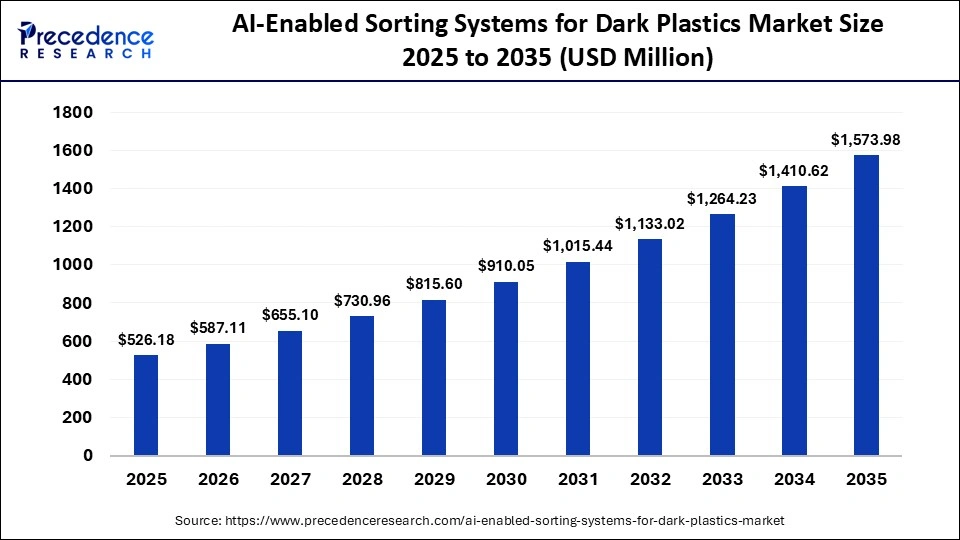
The global AI-enabled sorting systems for dark plastics market size accounted for USD 526.18 million in 2025 and is predicted to increase from USD 587.11 million in 2026 to approximately USD 1,573.98 million by 2035, expanding at a CAGR of 11.58% from 2026 to 2035. The market is primarily driven by the rising volume of plastic waste, the limitations of conventional manual and optical sorting methods in identifying dark plastics, and increasingly stringent environmental regulations imposed on manufacturers. In addition, continuous innovations in AI-powered automated sorting technologies aimed at improving recycling efficiency and reducing plastic waste are further accelerating market expansion.
Market Highlights
- North America held the largest market share in 2025.
- Asia Pacific is expected to grow at the fastest CAGR during the foreseeable period of 2026-2035.
- By end use/application, the MRFs & recycling plants segment held the largest market share in 2025.
- By end use/application, the large-scale sorting hubs segment is expected to grow at the fastest CAGR during the foreseeable period.
- By sorting system/type, the Optical + AI sorters segment held the largest market share in 2025.
- By sorting system/type, the NIR + AI hybrid systems segment is projected to grow at the fastest CAGR during the foreseeable period.
- By material stream, the black & dark plastics segment held the largest market share in 2025.
- By material stream, the dark rigid packaging segment is expected to grow at a notable rate during the foreseeable period.
- By technology, the hyperspectral imaging + AI classification segment held the largest market share in 2025.
- By technology, the real-time AI material recognition segment is expected to grow at the fastest CAGR during the foreseeable period.
Market Overview
The AI-enabled sorting systems for dark plastics market refer to the separation and identification of dark plastics, which are generally hard to find with traditional near-infrared sensors. These systems leverage deep learning and computer vision and prominently increase the purity of recycled materials, which transform the previously non-recyclable waste stream into valuable plastic feedstock. This system outperforms the detection of dark plastics by traditional NIR sensors. Management of plastic waste is a challenging task that needs innovative, scalable, and accurate solutions like AI-enabled sorting systems designed for dark plastic detection, fueling the market's growth globally.
Key Technological Shifts in the AI-Enabled Sorting Systems for Dark Plastics Market
The market is observing key technological shifts where hyperspectral imaging is fused with sensors to identify material properties of various types of plastics, including dark plastics that are invisible to the human eye. Companies like IRIS Technology are leading the way in material detection with the help of hyperspectral imaging for the RECLAIM project. The company has built a prototype system around hyperspectral imaging with advanced AI algorithms, which capture detailed spectral data for every pixel presented in an image, and each pixel carries a unique spectral signature that shows the chemical composition of the material. This is viewed as a major technological shift in the plastic waste sorting sector due to its detailed subclassification of plastics.
AI-Enabled Sorting Systems for Dark Plastics Market Trends
- The market is witnessing a strong shift toward AI-powered robotic arms capable of separating materials with high precision, significantly improving sorting productivity and output purity.
- Widespread adoption of smart sorting systems using deep learning algorithms and convolutional neural networks (CNNs) enables faster and more accurate identification and classification of plastic types compared to conventional sorting methods.
- AI-driven dark plastic detection reduces contamination rates, lowers carbon emissions, and supports compliance with strict environmental certifications through reliable, data-backed sorting processes.
- Advanced hyperspectral imaging combined with edge computing is enhancing traceability and quality control by capturing data beyond the visible spectrum and enabling rapid chemical-level polymer segregation.
- AI models trained on large datasets can recognize specific brands, polymer types such as PET and HDPE, and packaging shapes, achieving sorting accuracy levels exceeding 95%.
Market Scope
| Report Coverage | Details |
| Market Size in 2025 | USD 526.18 Million |
| Market Size in 2026 | USD 587.11 Million |
| Market Size by 2035 | USD 1,573.98 Million |
| Market Growth Rate from 2026 to 2035 | CAGR of 11.58% |
| Dominating Region | North America |
| Fastest Growing Region | Asia Pacific |
| Base Year | 2025 |
| Forecast Period | 2026 to 2035 |
| Segments Covered | End-use/Application, Sorting System/Type, Material Stream, Technology, and Region |
| Regions Covered | North America, Europe, Asia-Pacific, Latin America, and Middle East & Africa |
Segment Insights
End Use/Application Insights
Why Does the MRFs & Recycling Plants Segment Dominate the AI-Enabled Sorting Systems for Dark Plastics Market?
The MRFs & recycling plants segment dominated the market by holding the largest share in 2025, driven by the adoption of advanced AI-enabled vision systems capable of identifying, sorting, and separating dark plastics that traditional NIR sensors fail to detect due to black carbon pigmentation. These AI-powered solutions accurately recognize and segregate polymer types such as PET, PP, and HDPE regardless of color, ensuring higher purity and quality of recycled outputs. This enables recycling facilities to achieve higher-quality outputs, reduce contamination, and comply with stringent recycling regulations.
The Large-scale sorting hubs segment is expected to grow at the fastest CAGR during the foreseeable period, as these facilities provide the high-throughput infrastructure needed to make advanced AI-based sorting and robotic systems economically viable. Their ability to process massive and diverse waste streams allows machine learning and computer vision technologies to accurately detect dark plastics, even when embedded within mixed waste, helping recover food-grade materials and prevent downcycling. In addition, strict regulatory compliance requirements and ambitious sustainability targets are pushing large sorting hubs to adopt AI-enabled sorting solutions at scale.
Sorting System/Type Insights
What Made Optical + AI Sorters the Leading Segment in the AI-Enabled Sorting Systems for Dark Plastics Market?
The optical + AI sorters segment led the market with the largest share in 2025, as these systems effectively overcome the traditional NIR “black plastic blind spot” and enable accurate identification of high-value dark plastics. By combining multisensory technologies such as NIR and hyperspectral imaging with advanced AI algorithms, these solutions deliver significantly higher sorting accuracy and material purity. Owing to their superior performance and efficiency, many leading players are actively investing in the development and deployment of optical + AI sorting systems.
- For instance, in March 2024, Cimbria launched a highly advanced AI-driven control system called BRAIN in its top range optical sorters league and offers increased efficiency up to 18% for optical sorting.
The NIR + AI hybrid systems segment is expected to grow at the fastest CAGR during the foreseeable period, as conventional NIR sensors alone struggle to detect dark plastics due to light absorption rather than reflection. The integration of AI technologies, such as OBJECT.ai, enables systems to identify, sort, and classify materials based on shape, color, texture, and chemical signatures, overcoming these limitations. By automating the entire sorting process and significantly improving speed, accuracy, and recovery rates, these hybrid systems are becoming increasingly attractive to recycling facilities.
Material Stream Insights
Why Did the Black & Dark Plastics Segment Lead the AI-Enabled Sorting Systems for Dark Plastics Market?
The black & dark plastics segment led the market, holding the largest market share in 2025. This is due to strict environmental and recycling regulations, particularly in the European Union, which mandate the recovery of complex and dark-colored plastic materials that are difficult to identify using traditional methods. Conventional sorting technologies struggle with black plastics, creating a strong need for AI-enabled systems that can accurately detect and separate these materials. According to industry reports, AI-powered robots and vision systems significantly reduce contamination, improve plastic purity, and enhance recycling efficiency, reinforcing the segment's market leadership.
The dark rigid packaging segment is expected to grow at a notable growth rate during the foreseeable period, as AI-enabled sorting systems overcome the limitations of traditional NIR methods in detecting black plastics. Advanced AI-driven vision systems accurately identify different shapes, colors, and surface features of rigid dark plastics, enabling automated high-purity sorting. This not only improves overall operational efficiency but also ensures effective recycling of previously unsorted plastics, helping facilities meet stringent sustainability and environmental goals.
Technology Insights
Why Does the Hyperspectral Imaging + AI Classification Technology Segment Dominate the Market?
The hyperspectral imaging + AI classification segment dominated the AI-enabled sorting systems for dark plastics market with the largest share in 2025 due to its broad spectral range, high-purity sorting, and ability to handle massively contaminated wastes. AI-driven hyperspectral imaging and AI classification technology offer nearly 96% of purity in plastic sorting, which is highly crucial for recycling. As these systems are able to automate sorting processes efficiently, they further replace risky and manual sorting methods. Hyperspectral imaging can cover a wide spectral range of 400-5200 nm that allows 360-degree analysis of various plastic layers.
The real-time AI material recognition segment is expected to grow at the fastest CAGR during the foreseeable period due to its unmatched offerings like efficient real-time data analytics, reduced contamination, and automation in material recovery facilities with the AI integration. These systems can easily analyze and sort waste data in real-time, which allows rapid adjustment to detect mixed waste streams and higher output than traditional or manual ways of sorting. Automation is another key factor in making labor costs lower and enhancing work efficiency in sorting dark plastics.
Regional Insights
What Made North America the Dominant Region in the AI-Enabled Sorting Systems for Dark Plastics Market?
North America dominated the market while holding the largest share in 2025. The region's leadership in the market is driven by strict environmental regulations, advanced recycling infrastructure, and substantial investments in AI-enabled sorting technologies to overcome the limitations of manual dark plastic sorting. The region benefits from a strong presence of AI technology developers, including NVIDIA and Rockwell Automation, whose innovative tools and sensor-based solutions accelerate the adoption of automated sorting. Additionally, large-scale investments by major firms in recycling projects are strengthening circular economy initiatives, further boosting market growth.
U.S. AI-Enabled Sorting Systems for Dark Plastics Market Trends
The U.S is a major contributor to the North American market. The market in the U.S. is fueled by trends such as technological convergence, rising demand for high-purity feedstock, and rapid industrial-scale adoption of AI-enabled sorting. Leading companies like AMP Robotics are establishing fully automated facilities, such as their Ohio plant, capable of processing up to 55,000 tons of mixed plastics per year, reducing reliance on manual labor for high-risk tasks. Growing corporate sustainability mandates and the push for high-quality recycled plastics further enhance the market's value and adoption.
What Makes Asia Pacific the Fastest-Growing Region in the AI-Enabled Sorting Systems for Dark Plastics Market?
Asia Pacific is expected to grow at the fastest CAGR during the foreseeable period of 2026-2035 due to the urgency to sort out high-volume black plastic waste to comply with stringent regulations. Increasing investment to build robust recycling infrastructure, aiming to clean several areas in the city, further drives the market.
The integration of artificial intelligence and robotics in recycling facilities has greatly enhanced sorting accuracy and processing speed while reducing reliance on manual labor. This aligns with strict environmental regulations and growing consumer demand for sustainable packaging, motivating companies in the Asia Pacific to minimize plastic use and prioritize materials with lower environmental impact. Additionally, rapid urbanization and increasing municipal solid waste generation are driving significant investments in AI-enabled dark plastic sorting systems to address labor shortages and improve recycling efficiency.
China AI-Enabled Sorting Systems for Dark Plastics Market Trends
China is a major player in the market within Asia Pacific due to the rising adoption of AI-enabled sorting systems, driven by strict regulation and waste reduction policies, and the need to recycle complex materials like black polymers. The key trends include the integration of AI with advanced hyperspectral imaging to sort materials like PE, PP, and PET.
China's increasing focus on the circular economy has further driven the market expansion with the development of AI-powered automated robots that use AI and NIR systems to sort dark plastic waste. For example, China's first automated carton-sorting center for low-value recyclables has launched in Xiamen city, where the plant uses AI technology and NRI sensors to detect complex materials.
AI-Enabled Sorting Systems for Dark Plastics Market Value Chain Analysis
Who are the Major Players in the Global AI-Enabled Sorting Systems for Dark Plastics Market?
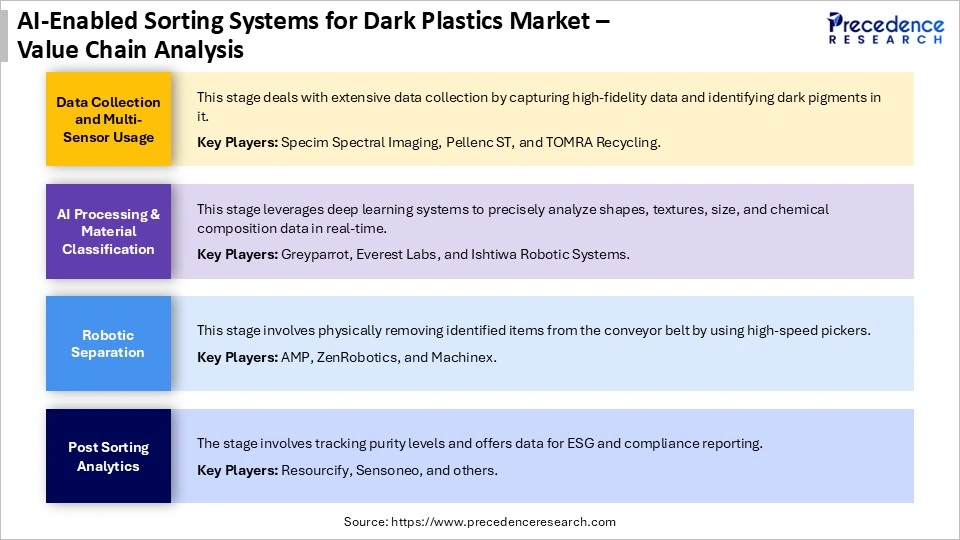
The major players in the AI-enabled sorting systems for dark plastics market include TOMRA Recycling, AMP (formerly AMP Robotics), Greyparrot, Pellenc ST, ZenRobotics, Steinert, Everest Labs, Machinex, Specim, and BHS (Bulk Handling Systems).
Recent Developments
- In January 2026, a dedicated AI innovation hub will showcase the recently developed AI-powered solutions for plastic recycling at the Plastic Recycling Show Europe Exhibition and conference, which will be held at RAI Amsterdam from May 5-6, 2026. It includes a live show of swarm robot sorting technology from Antfarm and a phone-based AI material analysis solution built by Safi.(Source: https://www.recyclingproductnews.com)
- In April 2025, an AI-driven sorting system with deep learning technology, GAINnext, which was introduced by TOMRA Recycling, was awarded as a ‘Recycling Machinery Innovation of the Year' in 2025 at the 8th annual awards ceremony, which was held during PRSE 2025 in Amsterdam.(Source: https://www.tomra.com)
Segments Covered in the Report
By End-use/Application
- MRFs & recycling plants
- Packaging recycling
- Large-scale sorting hubs
- Urban recycling
- Municipal recycling
- Precision recycling
By Sorting System/Type
- Optical + AI sorters
- NIR + AI hybrid systems
- Conveyor-integrated AI sorters
- Compact AI sorters
- Others
By Material Stream
- Black & dark plastics
- Dark rigid packaging
- Mixed dark polymers
- Dark mixed plastics
- Others
By Technology
- Hyperspectral imaging + AI classification
- Deep-learning vision systems
- Real-time AI material recognition
- Cost-optimized AI algorithms
- Others
By Region
- North America
- Europe
- Asia-Pacific
- Latin America
- Middle East & Africa
For inquiries regarding discounts, bulk purchases, or customization requests, please contact us at sales@precedenceresearch.com
Frequently Asked Questions





Ask For Sample
No cookie-cutter, only authentic analysis – take the 1st step to become a Precedence Research client




 sales@precedenceresearch.com
 Schedule a Meeting



