



AI-Enabled Digital Pathology Software Market Size, Share and Trends 2026 to 2035
AI-Enabled Digital Pathology Software Market (By Function: Image Analysis, Predictive Analytics, Workflow Management; By Application: Disease Diagnosis, Drug Discovery & Development; By Technology: Deep Learning/CNNs, Generative AI (GANs)) - Global Industry Analysis, Size, Trends, Leading Companies, Regional Outlook, and Forecast 2026 to 2035
Source: https://www.precedenceresearch.com/ai-enabled-digital-pathology-software-market
 Get a Sample
 Table Of Content
What is the AI-Enabled Digital Pathology Software Market Size?
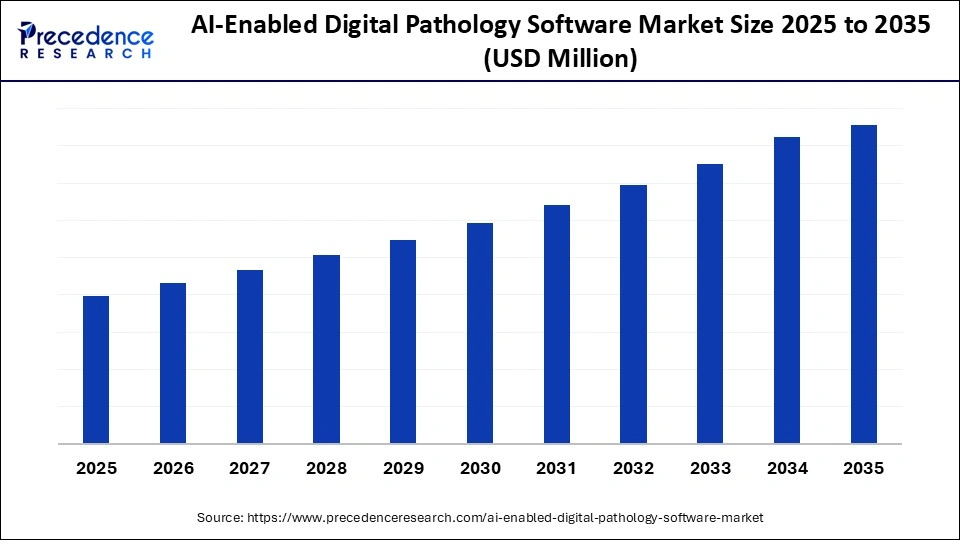
The global AI-enabled digital pathology software market supports early disease detection using advanced AI algorithms. It enables scalable, efficient, and accurate pathology services. The market is expanding due to the need for higher precision for cancer diagnostics, growing biopsy volumes, and the increasing shift toward personalized medicine.
Market Highlights
- North America held the largest market share of nearly 44.3% in 2025.
- Asia Pacific is expected to grow at the fastest CAGR during the foreseeable period.
- By function, the image analysis segment held the largest market share of nearly 45% in 2025.
- By function, the predictive analytics segment is expected to grow at the fastest CAGR during the foreseeable period.
- By application, the disease diagnosis segment held the largest market share of nearly 62.3% in 2025.
- By application, the drug discovery & development segment is expected to grow at the fastest CAGR during the foreseeable period.
- By technology, the deep learning/CNNs segment held the largest market share in 2025.
- By technology, the generative AI segment is expected to grow at the fastest CAGR during the foreseeable.
Market Overview
The market deals with the application of AI, ML, and computer vision technologies that integrate with software applications to analyze digitized pathology slides or whole slide images, which is a critical factor in the broader digital pathology sector and transforming how tissue samples are examined, diagnosed, and reported within accelerated workflows. This integration further enhances accuracy automatically and minimizes the manual workload of pathologists. The market is rapidly expanding due to the rising cancer cases, increasing geriatric population, and the launch of automated tools enabled by AI for pre-scanning that allow pathologists to deal with core problems.
AI-Enabled Digital Pathology Software Market Trends
- There is a rising adoption of AI algorithms for cancer detection and biomarker quantification, which significantly reduces bias in manual testing.
- Pathologists are increasingly using AI tools to minimize extra workload and increase turnaround times, which addresses the shortage of skilled professionals in pathology.
- The increasing transition toward cloud-native image management systems is enabling remote consultations and fully digital workflows, similar to radiology.
- Integration of AI with pathology software is advancing beyond image analysis, combining multi-omics data like genomics and proteomics to provide personalized disease insights.
- Strategic partnerships between leading players are emerging to leverage specialized hardware and software for AI-driven digital pathology solutions.
Market Scope
| Report Coverage | Details |
| Dominating Region | North America |
| Fastest Growing Region | Asia Pacific |
| Base Year | 2025 |
| Forecast Period | 2026 to 2035 |
| Segments Covered | Function, Application, Technology, and Region |
| Regions Covered | North America, Europe, Asia-Pacific, Latin America, and Middle East & Africa |
Segment Insights
Function Insights
Why Does the Image Analysis Segment Dominate the AI-Enabled Digital Pathology Software Market?
The image analysis segment dominated the market by holding the largest share of nearly 45% in 2025. This is mainly due to its ability to address the labor-intensive and subjective nature of traditional tissue interpretation, which was previously done with a microscope with manual observation. Pathological workflows have shifted from glass slides to digital-driven analysis, which is possible due to AI-driven tools that accelerate diagnostics, improve precision, and assist in managing human workload, especially in cancer detection. AI algorithms further enable automated and precise quantification of biomarkers, which is a crucial factor in designing personalized medicines and therapies, reinforcing the segment's leading position.
The predictive analytics segment is expected to grow at the fastest CAGR during the foreseeable period, as it allows pathology to move beyond traditional diagnostics toward proactive, precision-based medicine. Predictive analytics provide detailed information on forecasting disease progression, repetitive disease patterns, and how patients will probably respond to the curated treatment as per their medical history and present medical condition. Also, predictive tools are able to sharply find out and quantify complex biomarkers that are impossible to detect solely by human efforts, boosting the adoption of predictive analytics solutions.
Application Insights
Why Did the Disease Diagnostics Segment Lead the AI-Enabled Digital Pathology Software Market?
The disease diagnosis segment led the market with the largest share of nearly 62.3% in 2025 due to the shortage of acute pathologists and the growing prevalence of cancer that requires an efficient detection system like AI-driven diagnostics. AI tools offer unprecedented accuracy in image analysis at a faster pace than manual analysis, which is highly effective in the oncology sector. Cancer cases are rising rapidly, which is expected to reach nearly 35 million by 2050. AI algorithms further surpass human judgment to detect cancer cells efficiently with accuracy and speed up diagnostic procedures and offer more profound results with high clarity, which helps in decision-making.
The drug discovery & development segment is expected to grow at the fastest CAGR during the foreseeable period, as AI-enabled digital pathology software allows researchers to analyze complex tissue and biomarker data at unprecedented speed and accuracy. This accelerates preclinical and clinical studies by identifying drug targets, predicting patient responses, and optimizing trial design. Additionally, AI integration with multi-omics data supports precision medicine approaches, reducing R&D costs and improving the success rate of new therapeutics.
Technology Insights
What Made Deep Learning/CNNs the Leading Segment in the AI-Enabled Digital Pathology Software Market?
The deep learning/CNNs segment led the market with a major revenue share in 2025, owing to its exceptional ability to automate high-resolution tissue image analysis with unmatched accuracy, surpassing manual diagnostics. CNNs can detect and quantify subtle patterns such as tumor cells, abnormal tissue growth, and morphology changes that are often missed by the human eye. Their adaptability to analyze gigapixel images and extract cellular- and tissue-level insights makes them highly efficient in AI-powered digital pathology applications.
The generative AI segment is expected to grow at the fastest CAGR during the forecast period due to its ability to produce realistic data while overcoming data scarcity and reducing failure rates in digital pathology analysis. Unlike traditional AI, generative AI does not require massive, specialized, and labeled datasets for each task. This makes it faster, cost-effective, and easier to implement in data-intensive applications. Its multimodal capabilities, combining image, text, and genomic data, enable comprehensive insights that support personalized medicine and precise diagnostics.
Regional Insights
What Made North America the Dominant Region in the AI-Enabled Digital Pathology Software Market?
North America registered dominance in the AI-enabled digital pathology software market by holding the largest share of nearly 44.3% in 2025. The region's dominance in the market is attributed to a combination of factors like early adoption of advanced healthcare technologies, robust infrastructure, and strong government support through funding and regulatory approvals. FDA clearance for digital pathology systems for primary disease diagnosis has accelerated large-scale adoption in hospitals and pathology labs. Additionally, the presence of key industry players and innovative startups, such as PathAI, Roche Diagnostics, and Paige, has driven the rapid development and deployment of AI-enabled solutions across the region.
U.S. AI-Enabled Digital Pathology Software Market Analysis
The U.S. is a major contributor to the North American AI-enabled digital pathology software market due to widespread adoption of AI-integrated digital pathology in hospitals and healthcare networks. Approximately 65% of large hospital systems have implemented digital pathology workflows, supported by 1,500 high-resolution scanners to meet rising demand for faster and more collaborative diagnostics. The country's high per capita healthcare spending, advanced medical infrastructure, and integration of AI-driven diagnostic technologies are expected to sustain its market dominance.
Why is Asia Pacific Rapidly Expanding in the AI-Enabled Digital Pathology Software Market?
Asia Pacific is expected to grow at the fastest CAGR during the foreseeable period due to the rising prevalence of chronic diseases and increasing demand for precise diagnostic capabilities beyond traditional healthcare systems. According to a recent survey, nearly 86% of clinicians and executives are already using AI tools in their organizations, highlighting AI penetration in the Asian healthcare sector. Additionally, substantial government investments in drug discovery and biomarker research, which rely heavily on AI-powered digital pathology for data analysis, are further driving market growth.
China AI-Enabled Digital Pathology Software Market Analysis
China is leading the market in Asia Pacific due to widespread adoption of AI for tissue image analysis and digital slide scanning, which helps hospitals reduce labor costs and manage workflows efficiently while addressing the shortage of highly skilled pathologists. The country's growth is further fueled by active digital transformation initiatives in healthcare, supported by energy-efficient AI hardware and software solutions that enhance diagnostic precision and scalability.
For example, in China, Tsinghua University's Agent Hospital houses have 42 AI doctors across 21 clinical specialties, and they are trained on vast datasets to handle nearly 10 common conditions. This system has leveraged half a million synesthetic patient cases to enhance their diagnostic accuracy. The AI models can treat 10,000 patients with 93% precision, which would take human doctors several years to treat such cases in large numbers. Another example is DeepSeek AI, which has deployed its medical LLM in 260 hospitals in China, where this system can analyze nearly 3,000 pathological slides per day at Ruijin hospital that ultimately supports telemedicine and chronic disease management in the region
How is the Opportunistic Rise of Europe in the Market?
Europe is witnessing an opportunistic rise in the AI-enabled digital pathology software market due to increasing adoption of AI-driven diagnostics in hospitals and research institutes, supported by strong healthcare infrastructure and regulatory frameworks like CE marking for medical devices. Growing government funding for cancer research, precision medicine, and biomarker discovery is accelerating demand for digital pathology solutions. Additionally, the presence of leading industry players and collaborative initiatives between AI startups and established diagnostics firms is further strengthening the region's position in the market.
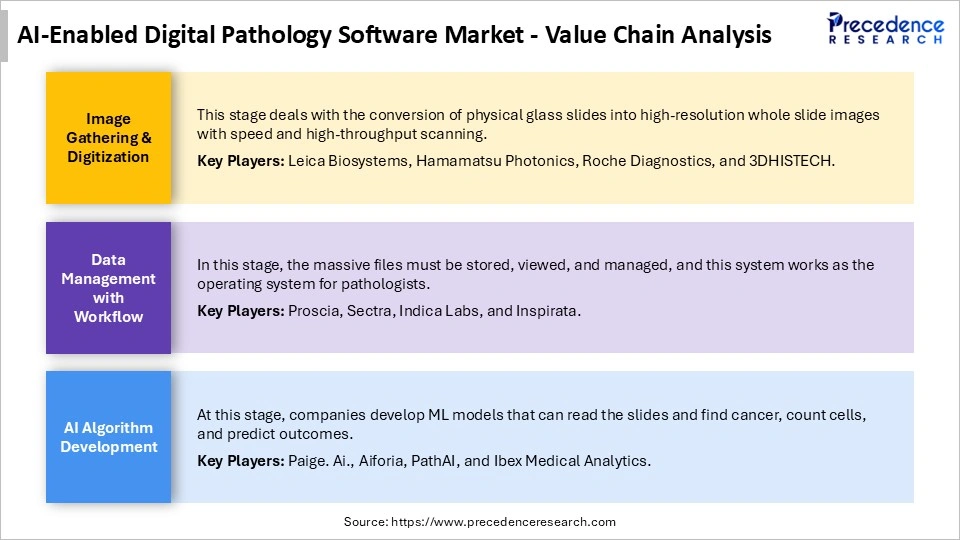
AI-Enabled Digital Pathology Software Market Value Chain Analysis
Who are the Major Players in the Global AI-Enabled digital pathology software Market?
The major players in the AI-enabled digital pathology software market include Roche (F. Hoffmann-La Roche Ltd), Paige AI, Ibex Medical Analytics, Philips (Koninklijke Philips N.V, Indica Labs, Aiforia Technologies, Proscia, Tempus, Visiopharm A/S, and PathAI.
Recent Developments
- In February 2026, a leading digital pathology company integrated with AI-powered diagnosis, OptraSCAN, announced the launch of BactoSiA, which is an AI-assisted TB treatment monitoring and follow-up solution designed to help in TB care.(Source: https://natlawreview.com)
- In January 2026, Fujifilm Healthcare Americans Corp, and Voicebrook,Inc. Have announced a strategic partnership to integrate a platform with Fujifilm's Synapse Pathology that is able to streamline case management via proprietary advances in image digitization.(Source: https://www.itnonline.com)
- In March 2025, Techcyte launched Fusion, the first open SaaS platform that unifies anatomic and clinical pathology workflows, integrating teams, IT systems, and AI to improve diagnostic accuracy, interoperability, and eliminate workflow silos.(Source: https://techcyte.com)
Segments Covered in the Report
By Function
- Image Analysis
- Predictive Analytics
- Workflow Management
By Application
- Disease Diagnosis
- Drug Discovery & Development
By Technology
- Deep Learning/CNNs
- Generative AI (GANs)
By Region
- North America
- Europe
- Asia-Pacific
- Latin America
- Middle East & Africa
For inquiries regarding discounts, bulk purchases, or customization requests, please contact us at sales@precedenceresearch.com
Frequently Asked Questions





Ask For Sample
No cookie-cutter, only authentic analysis – take the 1st step to become a Precedence Research client
 Get a Sample




 sales@precedenceresearch.com
 Schedule a Meeting
