



AI Hallucination Detection Market Trends, Companies, Revenue / Sales Performance, Subscriber Growth, Pricing Strategies, Cloud Adoption, Infrastructure Expansion, Competitive Landscape, and Industry Outlook
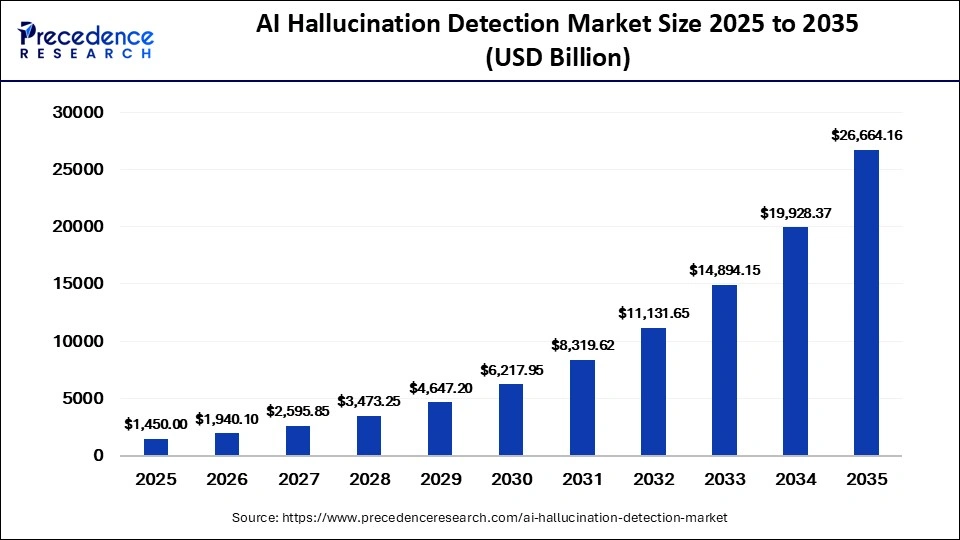
ICT industry specialist Shivani Zoting estimates the AI hallucination detection market at USD 1,940.10 billion in 2026, with continued technology adoption expected to take the market to USD 26,664.16 billion by 2035 at a CAGR of 33.80%. Leading AI hallucination detection market providers such as IBM, Microsoft, Google are expanding their capabilities across segments including component, deployment mode, detection method, application, end-use industry.
Source: https://www.precedenceresearch.com/ai-hallucination-detection-market
 Get a Sample
 Table Of Content


AI Hallucination Detection Market Size and Forecast 2026 to 2035
The global AI hallucination detection market size was calculated at USD 1,450.00 billion in 2025 and is predicted to increase from USD 1,940.10 billion in 2026 to approximately USD 26,664.16 billion by 2035, expanding at a CAGR of 33.80% from 2026 to 2035. The market is driven by the escalating integration of large language models (LLMs) into high-risk, regulated industries.
Key Takeaways
- North America dominated the global AI hallucination detection market with a share of 42% in 2025.
- Asia-Pacific is expected to grow at the fastest CAGR of 39.8% during the forecast period.
- By component, the software platforms segment led the global market with a share of 78% in 2025.
- By component, the services segment is expected to grow at the highest CAGR of 36.5% between 2026 and 2035.
- By deployment mode, the cloud-based segment accounted for the highest revenue share of 63% in the market in 2025 and is expected to sustain its dominance with a CAGR of 36.7% in the coming years.
- By deployment mode, the hybrid segment held the second-largest market share of 20% in 2025.
- By detection method, the retrieval verification segment held the largest revenue share of 28% in the AI hallucination detection market in 2025.
- By detection method, the model evaluation and benchmarking segment is expected to grow rapidly with a CAGR of 36.9% between 2026 and 2035.
- By application, the generative AI monitoring segment dominated the market with a share of 28% in the market in 2025.
- By application, the AI governance and compliance segment is expected to witness the fastest growth with a CAGR of 38.5% between 2026 and 2035.
- By end-use industry, the IT and telecommunications segment accounted for the highest revenue share of 24% in the market in 2025.
- By end-use industry, the healthcare and life sciences segment is expected to grow at the fastest 37.4% CAGR between 2026 and 2035.
Market Overview
The AI hallucination detection industry refers to the ecosystem of software and services programmed to identify, flag, or prevent fabricated, inaccurate, or unsupported information generated by AI models. As businesses increasingly deploy generative AI, these detection tools act as vital quality control, catching errors before they reach customers or impact decision-making. It is mainly driven by enterprises scaling GenAI in mission-critical sectors, such as healthcare, law, and finance, the demand to avoid reputational damage, and strict regulatory compliance mandates like the EU AI Act.
AI Hallucination Detection Market Trends
- With the proliferation of autonomous AI agents, static filtering isn't enough. The industry is rapidly accepting dynamic, real-time correction systems. Tools now frequently use multi-agent pipelines to actively detect, explain, and even surgically correct hallucinations as they happen.
- Companies are shifting toward Retrieval Augmented Generation (RAG) along with automated reasoning guardrails to ground LLM responses in verifiable, fact-driven data rather than solely relying on a model's internal training weights.
- There is a rising influence on benchmarking AI reliability. Open-source toolkits and evaluation frameworks are becoming standard to assist developers in accurately measuring hallucination rates across different models.
- Legal, healthcare, and financial sectors face mounting regulatory pressure. Because AI errors in these domains carry significant legal and safety liabilities, reliable hallucination-detection mechanisms have become strict prerequisites for enterprise deployment.
Market Report Coverage and Key Metrics
| Report Coverage | Details |
| Market Size in 2025 | USD 1,450.00 Billion |
| Market Size in 2026 | USD 1,940.10 Billion |
| Market Size by 2035 | USD 26,664.16 Billion |
| Market Growth Rate from 2026 to 2035 | CAGR of 33.80% |
| Dominating Region | North America |
| Fastest Growing Region | Asia Pacific |
| Base Year | 2025 |
| Forecast Period | 2026 to 2035 |
| Segments Covered | Component, Deployment Mode, Detection Method, Application, End-Use Industry, and Region |
| Regions Covered | North America, Europe, Asia-Pacific, Latin America, and Middle East & Africa |
Market Dynamics
Drivers
Shift to Autonomous AI Agents
The shift to autonomous AI agents drives the market because these agents independently reason, plan, and execute real-world tasks without human oversight. When agents trigger financial transactions, update enterprise databases, or interact with users, a single hallucination causes immediate operational, legal, and even reputational damage.
Restraint
High Costs of Implementation
High costs act as a major restraint for the AI hallucination detection market as businesses must navigate the "hallucination tax." Every time an AI makes a fabricated mistake, firms incur major expenses for manual fact-checking, rework, and even potential legal or compliance penalties.
Opportunity
Enterprise AI Scaling
Enterprise AI scaling acts as the primary catalyst for the market, as businesses move from experimental chatbots to deploying automated agents, the operational and legal liabilities of AI errors skyrocket. Hallucination detection solutions thus act as a mandatory governance layer, enabling safe, trusted AI-at-scale.
Market Segmentation Analysis
Component Insights
The Software Platforms Segment Held the Largest Market Share of 78% in 2025
The software platforms segment dominated the AI hallucination detection market with a share of 78% in 2025, owing to its growing deployment of AI observability tools and rising demand for automated hallucination detection. As AI use expands into sensitive domains such as healthcare, legal, and finance, regulatory frameworks demand greater AI transparency and accountability, making audit trails of model outputs mandatory.
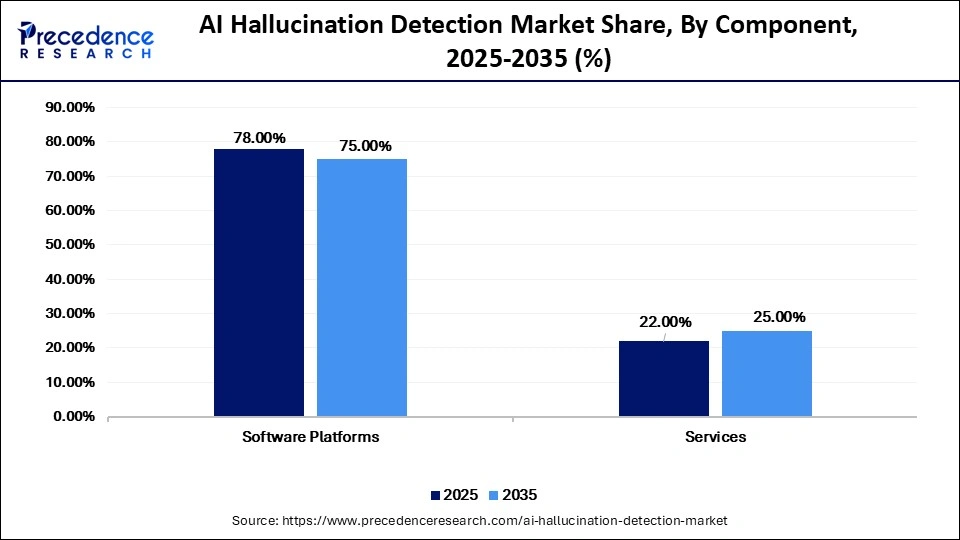
The services segment held a 22% share of the market in 2025 and is expected to grow at the fastest CAGR of 36.5% during the projection period. This is mainly due to growth in AI governance implementation projects and the need for customization and integration services. Companies are moving past basic chatbots and deploying autonomous AI agents to handle complex customer service and data workflows. These systems demand automated reasoning and even real-time hallucination correction to prevent cascading errors across systems.
Deployment Mode Insights
The Cloud-Based Segment Dominated the Market with a Share of 63% in 2025
The cloud-based segment dominated the AI hallucination detection market with a share of 63% in 2025 and is expected to witness the fastest growth with a CAGR of 36.7% over the studied period, owing to the scalability for large language model monitoring, lower deployment costs, and integration with enterprise AI ecosystems. AI is probabilistic, and models tend to sound overconfident when fabricating incorrect information. These "hallucinations" in regulated sectors such as healthcare, law, and finance can result in severe legal liabilities and lost sales deals.
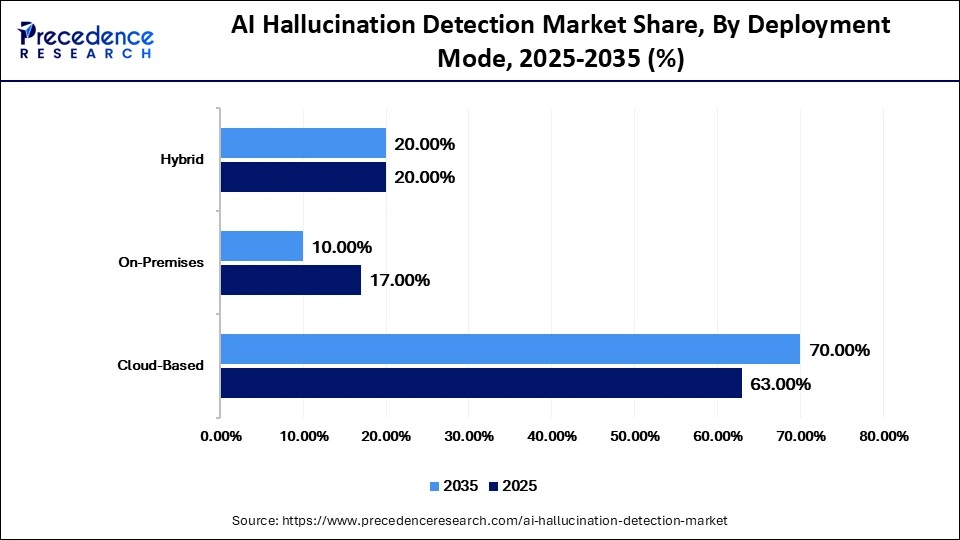
The hybrid segment held a 20% share of the market in 2025 and is expected to grow at a CAGR of 32.8% during the projection period. This is mainly due to the need for flexible governance frameworks and a balance between security and scalability. As AI became deeply integrated into business operations, confident but incorrect AI outputs caused massive losses. In regulated sectors like pharmaceuticals, law, and banking, fabricated information and even fake citations exposed firms to lawsuits and strict compliance violations.
The on-premises segment held a 17% share of the market in 2025 and is expected to grow at a CAGR of 22.1% during the projection period. This is due to data privacy and security requirements, internal control over AI systems, and compliance-driven deployment preferences. Highly regulated sectors, like finance, healthcare, and legal, require strict data residency and privacy controls. Firms in these domains cannot send proprietary or personal data to public cloud APIs for auditing. On-premises detection tools enable organizations to monitor AI outputs for factual consistency against strictly verified databases without violating data sovereignty laws.
Detection Method Insights
Why Did the Retrieval Verification Segment Lead the AI Hallucination Detection Market?
The retrieval verification segment held a dominant position in the market with a 28% share in 2025, driven by the increasing need for source validation, expansion of enterprise knowledge systems, and rising demand for factual accuracy. As organizations increasingly deploy autonomous AI agents for high-stakes decision-making, the consequences of unverified AI content have become severe. Inaccurate AI outputs have contributed to significant operational blunders, compliance risks in finance, and legal sanctions.
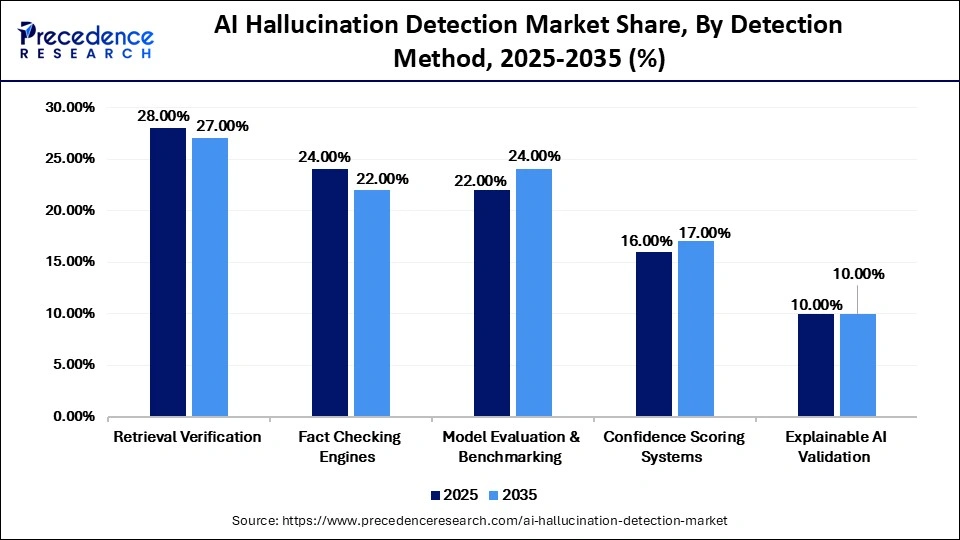
The model evaluation and benchmarking segment held a 22% share of the market in 2025 and is expected to grow at the fastest CAGR of 36.9% during the projection period. This is mainly due to the rapid growth in LLM deployment, the need for continuous model performance monitoring, and increasing AI quality assurance initiatives. The transition of AI from simple chatbots to autonomous agents executing complex workflows has highlighted new risks. Current autonomous agents frequently struggle with reliable tool selection and context-specific factuality, demanding dedicated auditing and validation platforms.
The fact-checking engines segment held a 24% share of the market in 2025 and is expected to grow at a CAGR of 31.8% during the projection period. This is due to rising misinformation concerns, growing regulatory requirements for AI outputs, and increasing enterprise content validation needs. Organizations face massive operational disruptions, leading to significant global business losses and professional liability claims for utilizing unverified AI-generated content. In legal and healthcare sectors, unmitigated hallucinations have even contributed to compounding court-related and safety hazards.
Application Insights
How the Generative AI Monitoring Segment Dominated the AI Hallucination Detection Market?
The generative AI monitoring segment contributed the biggest revenue share of 28% in 2025. This is due to the rapid deployment of generative AI systems, increasing concerns about hallucinated outputs, and the need for real-time monitoring frameworks. Enterprises are facing measurable consequences from AI inaccuracy. When models hallucinate confident falsehoods, firms suffer from failed sales deals, compliance infractions, and wasted operational hours validating bad data. This directly translates into massive budgets allocated to monitoring, along with evaluation platforms to shield brand integrity.
AI Hallucination Detection Market Share, By Application, 2025-2035 (%)
| Application | 2025 | 2035 | CAGR (%) |
| Generative AI Monitoring | 28.00% | 29.00% | 35.4% |
| LLM Evaluation & Testing | 23.00% | 25.00% | 37.1% |
| Conversational AI Validation | 17.00% | 16.00% | 32.4% |
| Content Verification | 14.00% | 12.00% | 30.7% |
| AI Governance & Compliance | 12.00% | 13.00% | 38.5% |
| Enterprise Knowledge Management | 6.00% | 5.00% | 31.5% |
The AI governance and compliance segment held a 12% share of the market in 2025 and is expected to grow at the fastest CAGR of 38.5% during the projection period. This is mainly due to the increasing AI regulations globally, rising enterprise governance initiatives, and expansion of responsible AI programs. As enterprises move from generative text drafting to autonomous AI agents that make live decisions in highly regulated fields such as healthcare, legal, and finance.
The LLM evaluation and testing segment held a 23% share of the market in 2025 and is expected to grow at a CAGR of 37.1% during the projection period. This is due to rising adoption of large language models, the need for continuous performance validation, and increasing benchmark testing requirements. Generative AI tools and systems are probabilistic, meaning they usually prioritize sounding confident over factual accuracy. The inability to easily distinguish between fact and fiction has led to global business losses, with legal liabilities and lost sales severely affecting revenue scaling. Organizations, thus, increasingly depend on tools to monitor and avoid these risks.
End-Use Industry Insights
What Made the IT and Telecommunications Segment Dominant in the AI Hallucination Detection Market?
The IT and telecommunications segment dominated the global market with the largest share of 24% in 2025. This is due to the large-scale deployment of generative AI tools, the expansion of AI-enabled software development, and the growing need for model monitoring. Telecom networks depend on automated systems to manage complex data, network optimization, and even customer service. An AI hallucination can cause poor routing or expose secure infrastructure, driving a strong need for real-time monitoring.
AI Hallucination Detection Market Share, By End-use Industry, 2025-2035 (%)
| End-Use Industry | 2025 | 2035 | CAGR (%) |
| BFSI | 19.00% | 18.00% | 32.1% |
| Healthcare & Life Sciences | 16.00% | 18.00% | 37.4% |
| IT & Telecommunications | 24.00% | 25.00% | 35.9% |
| Government & Defense | 12.00% | 11.00% | 31.2% |
| Retail & E-commerce | 11.00% | 10.00% | 33.6% |
| Manufacturing | 8.00% | 8.00% | 31.5% |
| Media & Entertainment | 6.00% | 6.00% | 34.2% |
| Others | 4.00% | 4.00% | 30.8% |
The healthcare and life sciences segment held a 16% share of the market in 2025 and is expected to grow at the fastest CAGR of 37.4% during the projection period. This is mainly due to increasing adoption of medical AI assistants, growing regulatory oversight, and rising investments in healthcare AI platforms. Regulatory bodies impose strict requirements on AI-allowed medical devices and data usage. Authorities such as the US FDA and the UK's MHRA are increasing audits, forcing firms to implement proactive post-market surveillance tools to trace and mitigate AI failures.
The BFSI segment held a 19% share of the market in 2025 and is expected to grow at the fastest CAGR of 32.1% during the projection period. This is mainly due to the need for trustworthy financial recommendations and increasing fraud detection applications. Financial services are bound by strict regulatory bodies, like the RBI, SEBI, or IRDAI. If an AI tool outputs fabricated disclosures or incorrect legal clauses in contracts, it can trigger heavy compliance penalties and legal liabilities. Tools that verify, ground, and audit AI-generated content are now required to maintain compliance.
Market Regional Analysis: North America, Europe, Asia-Pacific
U.S. AI Hallucination Detection Market Size and Growth 2026 to 2035
The U.S. AI hallucination detection market size was evaluated at USD 456.75 billion in 2025 and is projected to reach around USD 6,705.00 billion by 2035, growing at a CAGR of 31.60% from 2026 to 2035.
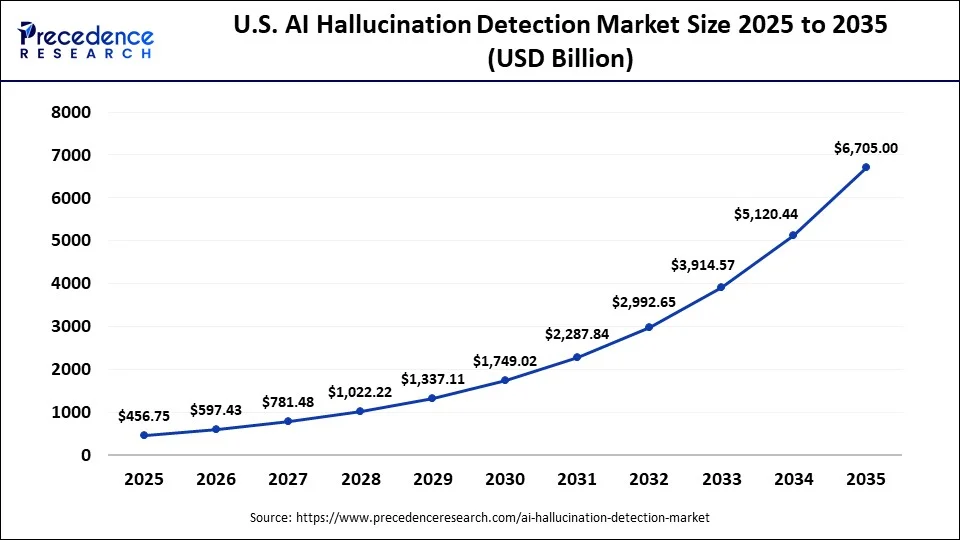
What Led the Global North American AI Hallucination Detection Market Grow in 2025?
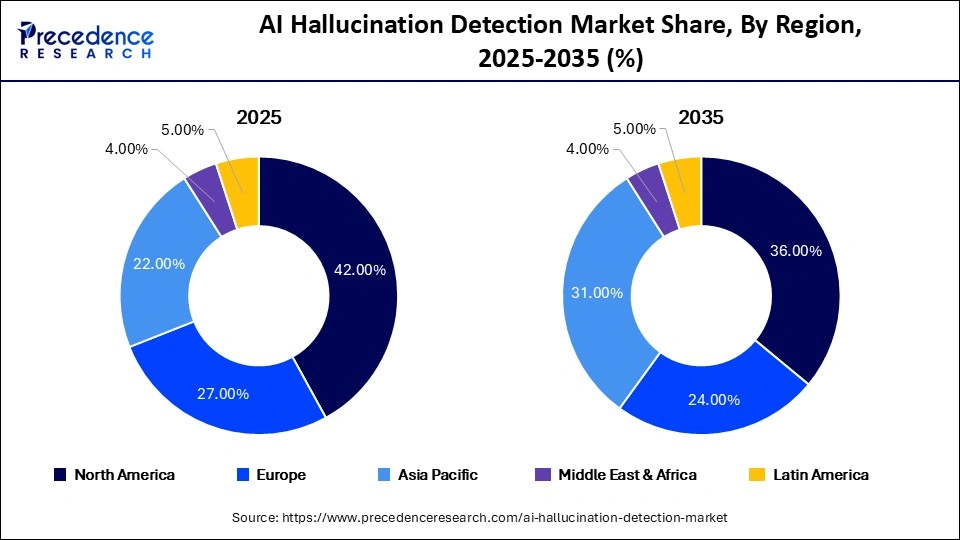
North America held a major market share of 42% in 2025. This is due to the rapid enterprise adoption of generative AI, growing AI governance requirements, and increasing regulatory scrutiny of AI outputs. The push for strict AI governance and transparency frameworks requires that organizations validate the accuracy and fairness of AI outputs. Firms are relying on real-time hallucination monitoring and even auditing services to comply with tightening regulatory frameworks.
U.S. Market Analysis
The U.S. market is driven by the escalating frequency of unverified, AI-generated fabrications, the massive financial risks of acting on "AI slop", along with tighter regulatory mandates demanding transparency and accountability in automated systems.
Europe: The Second-Largest Market
Europe held the second-largest share at 27% in 2025 and is expected to grow at a notable CAGR of 31.5% during the projection period, driven mainly by the expansion of AI Act compliance initiatives, rising demand for trustworthy AI systems, and increasing enterprise AI deployments. The enforcement of frameworks such as the European Union Artificial Intelligence Act mandates strict transparency and accountability for high-risk AI systems, forcing enterprises to adopt real-time hallucination-tracking platforms.
UK Market Analysis
The UK market is driven by the increasing number of AI hallucination cases. As of March 2026, the count for the total AI hallucination cases reached 60 in the UK. The UK government has launched several initiatives to support AI tools and provide investments to build a suitable infrastructure.
Asia-Pacific: The Fastest-Growing Region
Asia-Pacific held a 22% share of the market in 2025 and is expected to grow at the fastest CAGR of 39.8% during the projection period, driven by increasing cloud-based AI deployments and growing demand for localized LLM validation. Rapid enterprise integration of Large Language Models (LLMs) into high-risk sectors, like the region's massive Banking, Financial Services, and Insurance (BFSI) and healthcare markets, demands real-time hallucination tracking to prevent faulty automated decisions.
China Market Analysis
The Chinese market experienced rapid growth due to strict government regulations mandating AI compliance, the widespread, mass-scale adoption of generative AI in enterprise operations, along with the persistent need for native LLMs to mitigate unverified outputs across specific languages and cultural contexts.
What Drives the AI Hallucination Detection Market in Latin America?
Latin America held a 5% share of the market in 2025 and is expected to grow at a significant CAGR of 31.9% during the projection period, driven by increasing enterprise AI adoption, growing demand for content validation tools, and rising investments in cloud technologies. Governments and oversight bodies across Latin America are putting a sharper aim on AI transparency and ethics. As regional AI strategies mature, businesses are thus forced to invest in robust governance infrastructure to remain compliant.
Brazil Market Analysis
The growth of the market in Brazil is mainly driven by massive GenAI adoption in high-risk sectors, strict data privacy laws (LGPD), and the push for comprehensive AI legislation (PL 2338/2023). Localized friction, like structurally fragmented environments and strict compliance needs, has made validation and auditing services a necessity.
Will the Middle East and Africa Grow in the AI Hallucination Detection Market?
The Middle East and Africa region held a 4% share of the market in 2025 and is expected to grow at a notable CAGR of 32.4% during the projection period, driven by the rising AI adoption in public sector organizations, expansion of digital transformation initiatives, and increasing AI risk management awareness. Sovereign wealth funds across the Gulf Cooperation Council (GCC) are channeling billions into local AI infrastructure, accelerating commercial deployments, and necessitating robust auditing and testing tools to prevent faulty AI decisions.
Saudi Arabia Market Analysis
The Saudi Arabian market is growing rapidly due to the Kingdom's massive acceptance of enterprise Generative AI, strict national data governance frameworks, and a strong government mandate for AI trust and even accuracy driven by the Saudi Vision 2030 agenda.
Market Competitive Landscape: Leading Companies and Strategies
The AI hallucination detection market is highly competitive, driven by increasing enterprise adoption of generative AI and growing concerns over model reliability. Major players include OpenAI, Google DeepMind, Anthropic, IBM, and specialized startups like Vectara, Giskard, and Patronus AI. Competition centers on real-time fact verification, explainability, guardrails, model evaluation, and monitoring solutions. Vendors differentiate via detection accuracy, integration capabilities, scalability, domain-specific validation, and compliance features. Strategic partnerships, funding activities, and the growth of AI governance regulations are intensifying innovation and market expansion across industries.
AI Hallucination Detection Market Companies
- IBM
- Microsoft
- Amazon Web Services
- NVIDIA
- DataRobot
- Fiddler AI
- Arthur AI
- Credo AI
- Truera
- WhyLabs
- Apori
- Galileo
- Weights & Biases
- Patronus AI
Recent Developments AI Hallucination Detection Market (2025-2026)
- In June 2026, V2 AI and Anthropic developed an AI assistant for Allianz Retire+, programmed for financial advisers using the insurer's retirement income products. It is intended to assist advisers, paraplanners, and a few financial services users navigate Allianz Guaranteed Income for Life, or AGILE, by answering questions and drawing on approved product documentation and internal calculation tools.(Source: https://www.allianzretireplus.com.au)
- In June 2025, Independent inventor Michael A. Russell filed a comprehensive patent portfolio that removes AI hallucinations and introduces a new class of digital cognition. This marks the official beginning of what Russell calls the Truth-Aligned Intelligence Era, a complete break from the restrictions of traditional artificial intelligence.(Source: https://www.newswire.com)
Segments Covered in the Report
By Component
- Software Platforms
- Services
By Deployment Mode
- Cloud-Based
- On-Premises
- Hybrid
By Detection Method
- Retrieval Verification
- Fact Checking Engines
- Model Evaluation and Benchmarking
- Confidence Scoring Systems
- Explainable AI Validation
By Application
- Generative AI Monitoring
- LLM Evaluation and Testing
- Conversational AI Validation
- Content Verification
- AI Governance and Compliance
- Enterprise Knowledge Management
By End-Use Industry
- BFSI
- Healthcare and Life Sciences
- IT and Telecommunications
- Government and Defense
- Retail and E-commerce
- Manufacturing
- Media and Entertainment
- Others
By Region
- North America
- Latin America
- Europe
- Asia-pacific
- Middle and East Africa
For inquiries regarding discounts, bulk purchases, or customization requests, please contact us at sales@precedenceresearch.com
Frequently Asked Questions





Ask For Sample
No cookie-cutter, only authentic analysis – take the 1st step to become a Precedence Research client
 Get a Sample




 sales@precedenceresearch.com
 Schedule a Meeting
