



AI in Meeting Assistants Market Trends, Companies, Revenue / Sales Performance, Subscriber Growth, Pricing Strategies, Cloud Adoption, Infrastructure Expansion, Competitive Landscape, and Industry Outlook
AI in Meeting Assistants Market (By Deployment Type: Cloud-Based, On-Premises; By Application: Corporate Sector, Education, Healthcare, Legal Sector, Others; By End-Use: Small Enterprises, Medium Enterprises, Large Enterprises, Others) - Global Industry Analysis, Size, Trends, Leading Companies, Regional Outlook, and Forecast 2026 to 2035
Source: https://www.precedenceresearch.com/ai-in-meeting-assistants-market
 Get a Sample
 Table Of Content


What is the AI in Meeting Assistants Market Size in 2026?
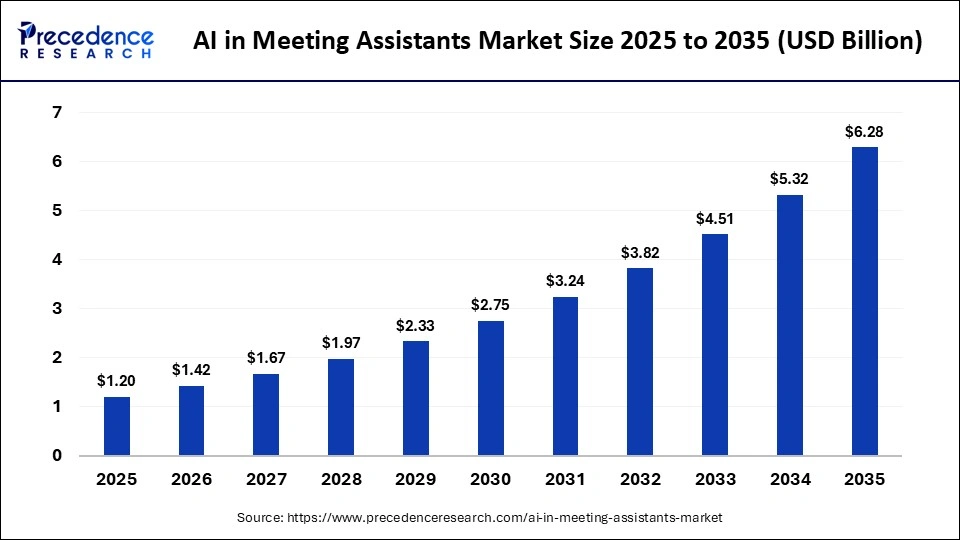
The global AI in meeting assistants market size accounted for USD 1.20 billion in 2025 and is predicted to increase from USD 1.42 billion in 2026 to approximately USD 6.28 billion by 2035, expanding at a CAGR of 18.00% from 2026 to 2035. The market growth is mainly driven by increasing hybrid/remote work culture, adoption of advanced Gen AI systems, and growing demand for automated note-taking across industries.
Key Takeaways
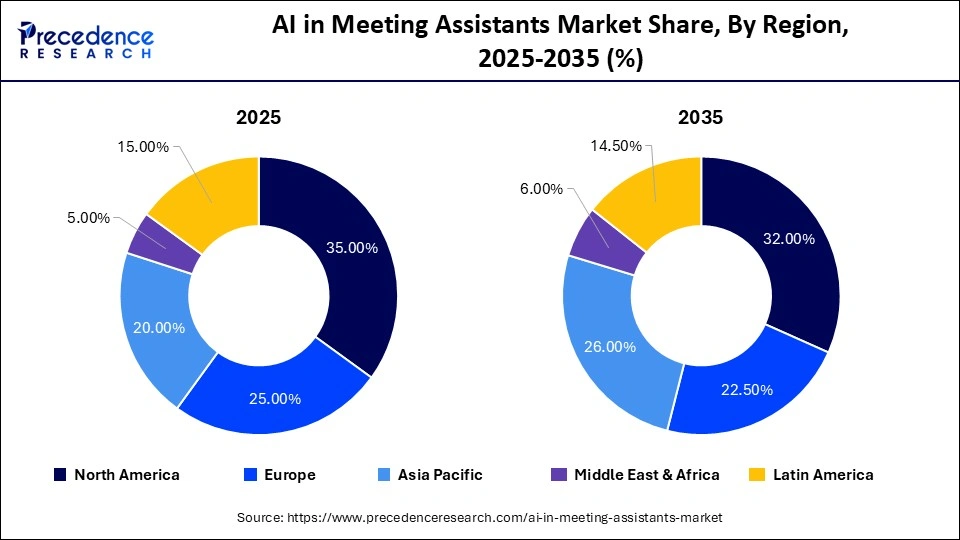
- North America dominated the AI in meeting assistants market, accounting for a 35% share in 2025.
- The Asia Pacific is expected to grow at the fastest CAGR during the foreseeable period.
- By deployment type, the cloud-based segment dominated the market with a 75% share in 2025.
- By deployment type, the on-premises segment is the second-largest shareholder and is expected to grow at a significant CAGR of 15% between 2026 and 2035.
- By application, the corporate sector segment dominated the market with a 40% share in 2025.
- By application, the education segment is the second-largest shareholder and is expected to grow at a significant CAGR of 16.5% between 2026 and 2035.
- By end use, the large-enterprises segment dominated the market with a 35% share in 2025.
- By end use, the medium enterprises segment is the second-largest shareholder and is expected to grow at a significant CAGR of 17.5% between 2026 and 2035.
Market Overview
The AI in meeting assistants market comprises software tools that leverage AI & ML models and natural language processing to automate, analyze, and support business meetings. These tools work as a digital assistant that captures, summarizes, and acts on meeting content. It offers active collaboration rather than just passive transcription. These tools provide core functionalities like real-time transcription, speaker identification, intelligent summarization, and sentiment analysis with meeting intelligence.
The market is being driven by the rise of hybrid and remote work models, along with increasing demand for productivity automation and advanced natural language processing capabilities. Companies are focusing on features such as real-time transcription, automated meeting summaries, and CRM integration to improve workflow efficiency. Key industries, including finance, legal, and healthcare, are rapidly adopting AI-powered meeting assistance tools, further accelerating global market growth.
AI in Meeting Assistants Market Trends
- AI meeting assistants are moving beyond just transcription by using generative AI to produce customized summaries, highlight key notes, and extract actionable insights, significantly improving post-meeting productivity.
- AI assistants are rapidly integrating into well-known video platforms like Zoom, Teams, and Google Meet, as well as CRM systems like HubSpot and Salesforce. This enables automated data updates and seamless workflow management.
- The market is also seeing strong growth in multilingual and real-time capabilities, where advanced natural language processing enables live transcription and translation, helping teams collaborate effectively across geographies.
- AI meeting assistants are becoming an integral part of hybrid work mode by bridging the gap between in-office and remote participants, ensuring equal access to meeting context and notes.
- Rising demand for customized AI solutions is also driving growth, with features like real-time coaching, conversational intelligence, and sentiment analysis helping organizations enhance engagement and improve revenue outcomes.
Market Scope
| Report Coverage | Details |
| Market Size in 2025 | USD 1.20 Billion |
| Market Size in 2026 | USD 1.42 Billion |
| Market Size by 2035 | USD 6.28 Billion |
| Market Growth Rate from 2026 to 2035 | CAGR of 18.00% |
| Dominating Region | North America |
| Fastest Growing Region | Asia Pacific |
| Base Year | 2025 |
| Forecast Period | 2026 to 2035 |
| Segments Covered | Deployment Type, Application, End-Use, and Region |
| Regions Covered | North America, Europe, Asia-Pacific, Latin America, and Middle East & Africa |
Market Dynamics
Drivers
Increasing Shift Toward Hybrid/Remote Work
The AI in meeting assistants market is majorly driven by the rapid shift toward hybrid or remote work environments, where AI models have become an essential tool to collaborate with team members on the same platform. Distributed teams require precise transcription, automated summarization, and action-item tracking to ensure alignment across different time zones. As a result, many organizations are rapidly integrating AI meeting assistants to minimize administrative workload and resolve meeting fatigue, allowing employees to focus more on discussions and enhance productivity after meetings.
Restraint
Potential Data Leakage
Despite high adoption and several benefits of AI meeting assistants, the market faces challenges related to data privacy and the risk of leakage of sensitive information. Meetings often involve confidential, legal, and corporate data, making organizations cautious about sharing data with third-party AI providers due to potential misuse or breaches. Compliance requirements such as GDPR and HIPAA further slow adoption, particularly in highly regulated industries like finance and healthcare. Also, the potential risk of shadow AI, where employees may use prohibited AI tools, may lead to significant security issues.
Opportunity
Integration with Enterprise Ecosystems
Rising integration of AI meeting assistance into enterprise ecosystems like CRM platforms and unified communication tools, such as Teams, Google Meet, and Zoom, creates immense opportunities in the market. The future of AI meeting assistants is largely driven by their ability to work as a proactive collaborator while moving beyond just a note-taking, passive tool. The integration-first platform shows significantly higher engagement and trial-to-paid conversion, while providing seamless workflows.
Segment Insights
Deployment Type Insights
AI in Meeting Assistants Market Share, By Deployment Type, 2025-2035 (%)
| Deployment Type | 2025 | 2035 | CAGR (%) |
| Cloud-Based | 75.00% | 78.00% | 19.50% |
| On-Premise | 25.00% | 22.00% | 15.00% |
The Cloud-Based Segment Held the Largest Market Share of 75% in 2025
The cloud-based segment dominated the AI in meeting assistants market with the highest share of 75% in 2025. This is mainly due to its offerings, such as high scalability, flexibility, and the ability to integrate remote work seamlessly. As remote and hybrid work has become a new normal in the corporate sector, many companies are increasingly adopting cloud-based AI tools like meeting summarizers. Cloud-based meeting assistants ensure stable productivity across different locations and time zones.
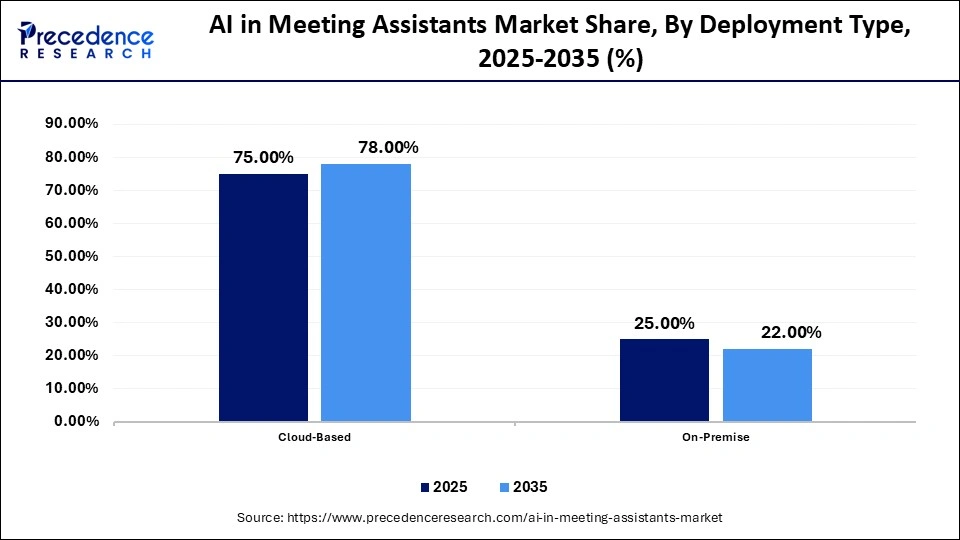
The on-premises segment was the second-largest shareholder in 2025, holding a share of 25%, and is expected to grow at a significant CAGR of 15% during the period of 2026-2035. The segment's growth is primarily driven by growing concerns over data privacy and security compliance. Industries like healthcare and BFSI are actively using on-premises AI meeting assistants due to strict data privacy policies and the need for complete control over their meeting data.
Application Insights
AI in Meeting Assistants Market Share, By Application, 2025-2035 (%)
| Application | 2025 | 2035 | CAGR (%) |
| Corporate Sector | 40.00% | 43.00% | 18.00% |
| Education | 20.00% | 19.50% | 16.50% |
| Healthcare | 15.00% | 16.00% | 18.50% |
| Legal Sector | 10.00% | 9.00% | 14.00% |
| Others | 15.00% | 13.50% | 16.00% |
The Corporate Sector Segment Held a Major Market Share of 40% in 2025
The corporate sector dominated the AI in meeting assistants market with a share of 40% in 2025. This is mainly due to the need to enhance operational efficiency and manage large volumes of data generated by hybrid and remote work environments while maintaining compliance standards. AI-enabled solutions help automate meeting summaries, task assignments, and action tracking, streamlining workplace productivity. As a result, organizations are increasingly adopting AI meeting assistants to reduce manual effort and minimize dependence on human intervention.
The education segment was the second-largest shareholder in 2025, holding a share of 20%, and is expected to grow at a significant CAGR of 16.5% during the forecast period. This growth is driven by the rise of hybrid and virtual learning models, increasing administrative workloads, and a strong shift toward personalized education. AI meeting assistants are highly beneficial to the education sector, as they simplify complex discussions through automated summaries and structured notes, making learning more efficient and accessible.
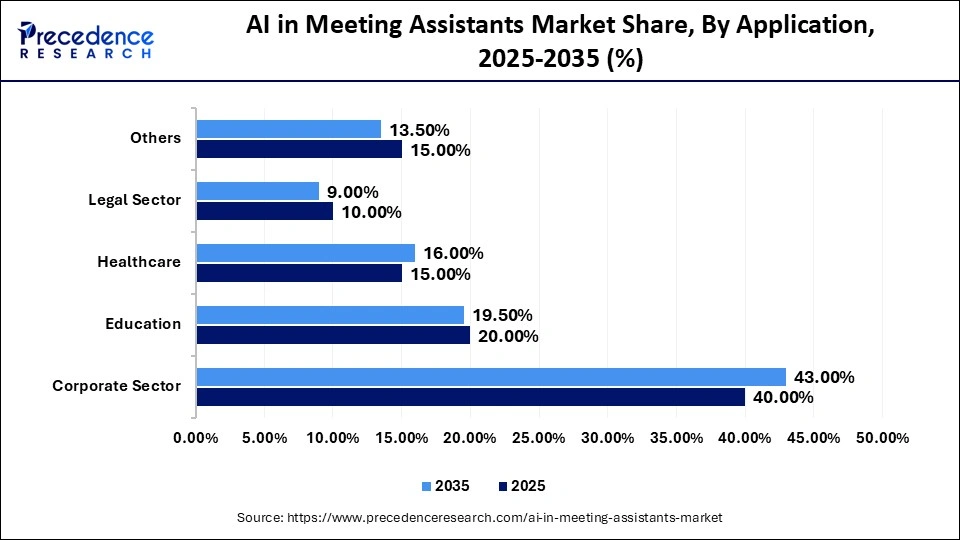
The healthcare segment held a 15% share of the market in 2025 and is expected to grow at the highest CAGR of 18.5% during the projection period. The segment is growing due to the intense pressure to handle high-volume patient data, shortage of skilled professionals, and the need to minimize administrative burden to focus on patient care. Modern AI assistants like Medical DeepScribe can record patients' interactions without interruption, which helps maintain transparency in clinical records.
The legal sector segment held a market share of 10% in 2025 and is projected to grow at a robust CAGR of 14% between 2026 and 2035. The segment is expanding due to the critical need to automate tedious and document-heavy tasks in the legal sector. As professionals face mounting pressure to immediately handle client queries and work transparency, it has become essential to adopt AI in meeting assistants. AI has further evolved with more context-aware algorithms and law-aware models that can generate secure returns on investment for clients.
End Use Insights
The Large Enterprises Segment Dominated the Market in 2025
The large enterprise segment dominated the AI in meeting assistants market with a 35% share in 2025. This is mainly due to their high investments in digital transformation, large-scale automation, and the growing need for secure, integrated workflows in hybrid and remote work environments. These organizations increasingly adopt AI meeting assistants to manage information overload, reduce employee fatigue, and improve clarity around key discussion points. By enabling automated transcription, summarization, and note-taking without disrupting meetings, AI tools significantly enhance productivity and support the segment's continued growth.
The medium enterprise segment was the second-largest shareholder in 2025, holding a share of 30%, and is projected to grow at the fastest CAGR of 17.5% during the forecast period. The segment growth is driven by the convergence of high operational needs, adoption of agility, and growing demand for scalable and cost-effective AI solutions to expand the enterprise's reach. According to sources, medium-scale firms have reported saving nearly 5 to 7 hours per week per employee on manual note-keeping tasks and other administrative work by leveraging AI capability to replace constant human intervention.
The small enterprises segment held a significant market share of 25% in 2025 and is anticipated to grow at a CAGR of 14% during the foreseeable period. This is mainly due to the increasing focus of small enterprises on saving time and resources by automating administrative and mundane tasks like note-taking or summarizing meeting discussions. Small businesses often work with limited manual resources and are increasingly adopting AI tools like note takers to stay competitive and generate maximum revenue annually with cost savings.
Regional Insights
North America AI in Meeting Assistants Market Size and Growth 2026 to 2035
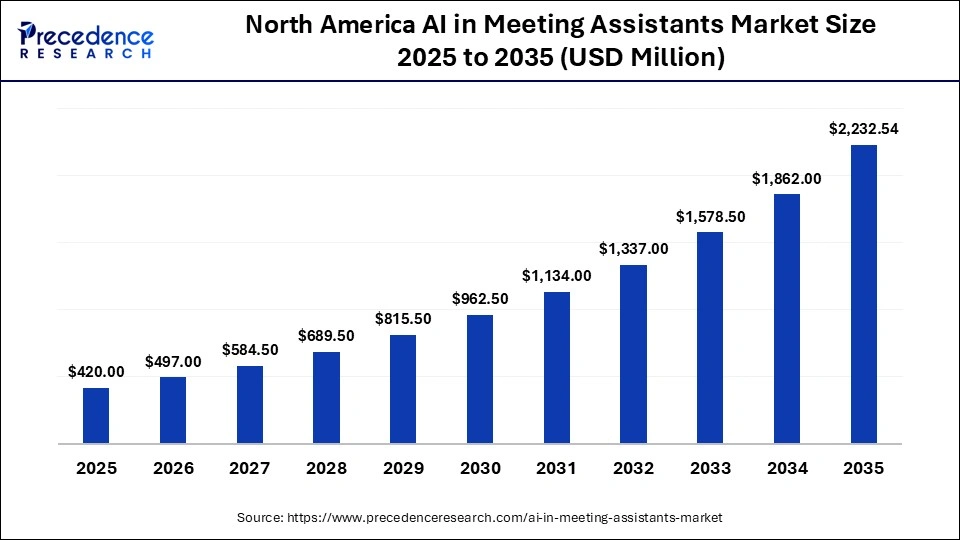
The North America AI in meeting assistants market size is estimated at USD 420.00 million in 2025 and is projected to reach approximately USD 2,232.54 million by 2035, with a 18.18% CAGR from 2026 to 2035.
North America Held a Major Market Share of 35% in 2025
North America dominated the AI in meeting assistants market while holding a major share of 35% in 2025, driven by the rapid adoption of advanced technologies across corporate and healthcare sectors. There is a high adoption of AI-powered tools for automated transcription, summarization, and productivity enhancement, particularly in hybrid work environments. The strong presence of major tech players such as Google Meet, Zoom, and Microsoft Teams has also created a well-established ecosystem for developing and deploying innovative AI solutions.
There is a rapid shift toward remote and hybrid work models, mandating a robust virtual assistant that can collaborate as a complete team on one platform and share the same details, supporting the demand for AI note keepers and AI-based voice assistants in the region. Also, the region has the highest adoption rate of AI assistants in every sector, including corporate, backed by robust cloud infrastructure.
U.S. AI in Meeting Assistants Market Size and Growth 2026 to 2035
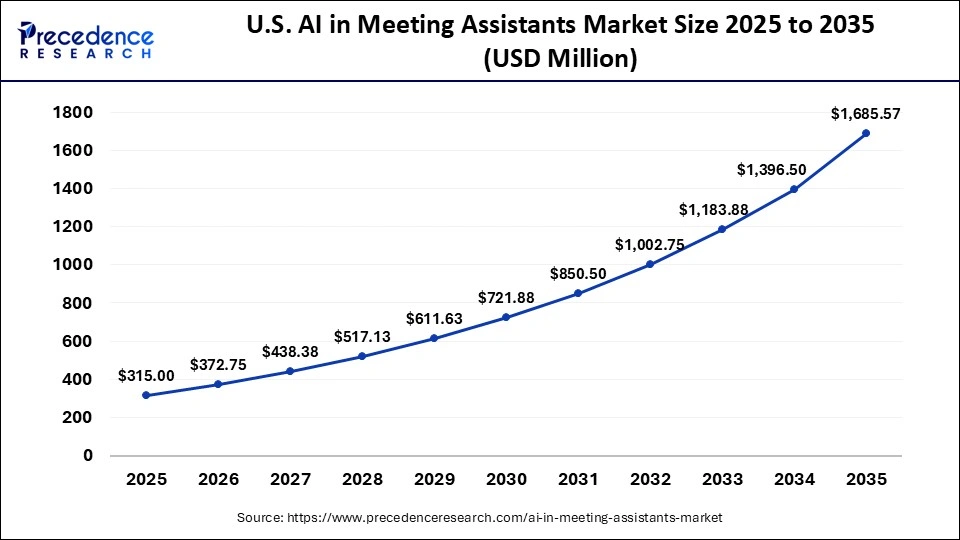
The U.S. AI in meeting assistants market size is calculated at USD 315.00 million in 2025 and is expected to reach nearly USD 1,685.57 billion in 2035, accelerating at a strong CAGR of 18.26% between 2026 and 2035.
U.S. AI in Meeting Assistants Market Analysis
The U.S. is a major contributor to the North American AI in meeting assistants market due to the presence of top-tier AI talent, strong private sector investment, and the growing integration of generative AI into widely used enterprise software suites. Significant funding for AI development, largely supported by private companies, has accelerated the expansion of meeting assistant technologies across industries. Additionally, the country's mature corporate culture, focused on productivity and efficiency, is increasingly adopting AI tools as part of everyday workflows to maximize business outcomes.
Europe: The Second-largest Market
Europe is the second-largest market, holding a 25% share in 2025, and is projected to grow at a significant rate during the foreseeable period. The region's growth is largely driven by strong regulatory compliance requirements in corporate and legal sectors, alongside the EU AI Act, which provides a clear and trusted framework for AI adoption. The widespread shift toward remote and hybrid work has further increased demand for tools that enhance collaboration and reduce meeting fatigue through automated summaries and key insights. Additionally, funding initiatives such as Horizon Europe and the Digital Europe Programme are supporting the expansion and adoption of AI meeting assistant solutions across the region.
Germany AI in Meeting Assistants Market Analysis
Germany is experiencing rapid growth in the market, driven by Industry 4.0 initiatives, automation, and the country's national AI strategy. Government support through programs such as the “High-Tech Agenda 2025” and investments in cloud infrastructure are further accelerating AI adoption across enterprises. Additionally, advancements in natural language processing (NLP) are enabling highly accurate, multilingual capabilities that can be tailored to diverse business needs, strengthening market expansion.
Asia Pacific: The Fastest-Growing Region
Asia Pacific held a market share of 20% in 2025 and is expected to grow at the fastest CAGR during the forecast period. This growth is driven by increasing demand for AI assistance across key sectors such as education, manufacturing, and healthcare. Employees in the region are also adopting generative AI tools at a faster pace, compared to global peers, further supporting market expansion. Moreover, enterprises in Asia Pacific are increasingly integrating AI meeting assistants to improve customer engagement, enhance operational efficiency, and reduce reliance on manual note-taking during meetings.
China AI in Meeting Assistants Market Analysis
China is at the forefront of AI adoption, supported by vast and diverse datasets that are crucial for training advanced AI models, along with its ambition to become an AI-sovereign nation. The State Council's “AI Plus Action Plan” targets widespread AI integration across industries, aiming for up to 90% deployment by 2030. This strategic push is accelerating the use of AI meeting assistants in corporate environments to generate summaries and extract actionable insights. Additionally, the release of open-source AI models by major tech companies such as Alibaba, Baidu, and Tencent is further strengthening market growth and innovation.
AI in Meeting Assistants Market Companies
- Otter.ai
- Rev.com, Inc.
- Fireflies.ai
- Fathom
- x.ai
- Chorus.ai
- Grain.co
- Deepgram
- Sonix.ai
- Symbl.ai
- Verbit
- MeetGeek
- Miro
- Avoma
- Trello (Atlassian)
Recent Developments
- In April 2026, Beaver introduced a totally new approach to AI-driven meetings, with the launch of Magic Whiteboard, which can offer real-time transcription, agenda tracking, and Live AI analysis without recording the data. They prioritized a privacy-first approach while providing an AI-backed meeting assistant.(Source: https://www.clarionledger.com)
- In September 2025, a popular notetaking app, GoodNotes, introduced new features specially designed to help professionals. It includes a new collaborative whiteboard tool, the ability to generate documents with an AI assistant aiming to guide users in creating and summarizing content.(Source: https://techcrunch.com)
Segments Covered in the Report
By Deployment Type
- Cloud-Based
- On-Premises
By Application
- Corporate Sector
- Education
- Healthcare
- Legal Sector
- Others
By End-Use
- Small Enterprises
- Medium Enterprises
- Large Enterprises
- Others
By Region
- North America
- Latin America
- Europe
- Asia-pacific
- Middle and East Africa
For inquiries regarding discounts, bulk purchases, or customization requests, please contact us at sales@precedenceresearch.com
Frequently Asked Questions





Ask For Sample
No cookie-cutter, only authentic analysis – take the 1st step to become a Precedence Research client
 Get a Sample




 sales@precedenceresearch.com
 Schedule a Meeting
