



AI Language Translator Tool Market Trends, Companies, Revenue / Sales Performance, Subscriber Growth, Pricing Strategies, Cloud Adoption, Infrastructure Expansion, Competitive Landscape, and Industry Outlook
AI Language Translator Tool Market (By User Type:Educational Institutions,Individuals,Large Enterprises,Small Enterprises;By Technology:Speech Recognition,Natural Language Processing,Machine Translation;By Application:Business Communication,Customer Support,E-Learning,Healthcare,Travel and Tourism;By Deployment Type:Cloud-Based,Hybrid,On-Premise) - Global Industry Analysis, Size, Trends, Leading Companies, Regional Outlook, and Forecast 2026 to 2035
Source: https://www.precedenceresearch.com/ai-language-translator-tool-market
 Get a Sample
 Table Of Content


What is the AI Language Translator Tool Market Market Size in 2026?
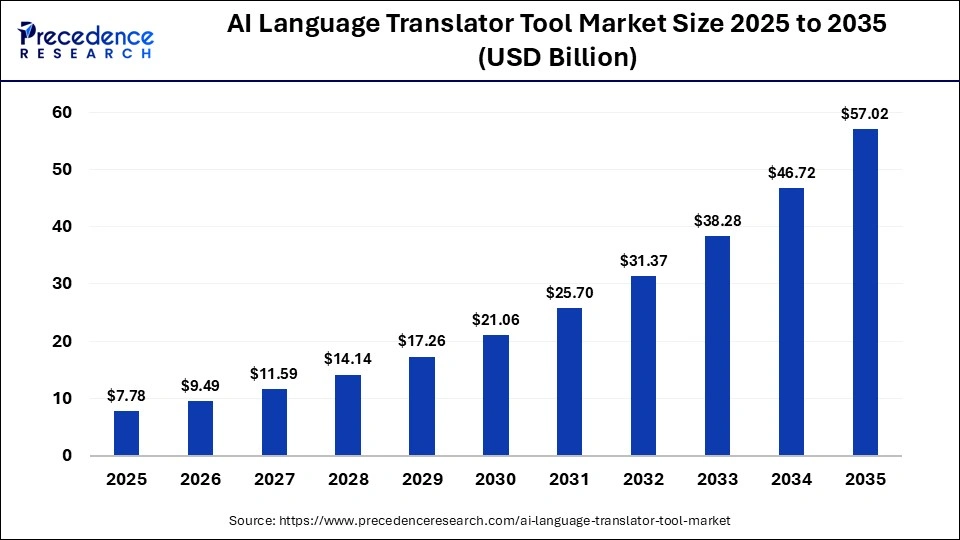
The global AI language translator tool market size accounted for USD 7.78 billion in 2025 and is predicted to increase from USD 9.49 billion in 2026 to approximately USD 57.02 billion by 2035, expanding at a CAGR of 22.04% from 2026 to 2035. Market growth is attributed to the increasing demand for real-time, accurate, and context-aware multilingual communication across enterprises and digital platforms.
Key Takeaways
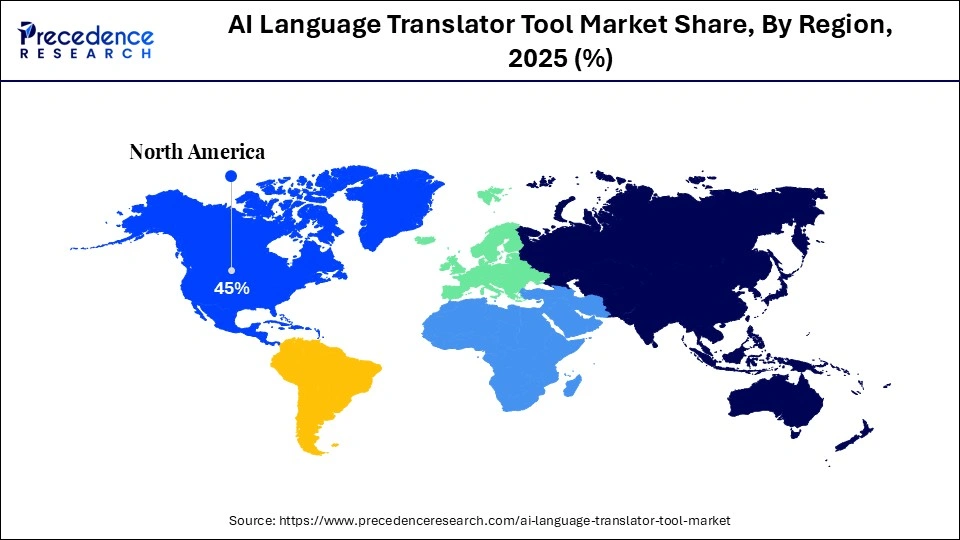
- North America dominated the market with the biggest market share of 45% in 2025.
- Asia-Pacific is expected to grow at the fastest CAGR between 2026 and 2035.
- By user type, the individuals segment contributed the highest AI language translator tool market share in 2025.
- By user type, the large enterprises segment is expected to grow at a fast CAGR between 2026 and 2035.
- By technology, the machine translation segment held a major market share in 2025.
- By technology, the natural language processing segment is expected to expand at a rapid pace from 2026 to 2035.
- By application, the customer support segment captured the highest market share in 2025.
- By application, the e-learning segment is poised to grow at a fast CAGR between 2026 and 2035.
- By deployment type, the cloud-based segment generated the biggest market share in 2025.
- By deployment type, the hybrid segment is expected to expand at the highest CAGR between 2026 and 2035.
Which Factors Drive the AI Language Translator Tool Market?
The rapid global demand for inclusive digital communication is driving widespread adoption of AI language translation tools. These applications apply neural machine translation (NMT) and large language models (LLMs) to automatically translate text and speech between several languages. The technology provides improved, fast, scalable, and more accurate communication in multiple languages compared to traditional methods.
The adoption of AI translation tools in the enterprise is accelerating, and by 2024, approximately 65% of organizations will have adopted AI translation tools. Furthermore, with rising investment and policy frameworks further supporting global participation in economic, social, and cultural activities, and reinforcing the drive toward inclusive digital communication for the global population.
AI Language Translator Tool Market Trends
- Real-Time Multilingual AR Communication: Live translation overlay is now added to augmented reality (AR) devices so that individuals can view translated text in real time when conversing or reading foreign signage. This trend minimizes language barriers in tourism, field service, and international events. This technology is progressively being incorporated into businesses and device manufacturers to improve in-store and online experiences.
- Hybrid Human-AI Collaboration Platforms: Businesses use procedures when AI translators provide the first drafts, which are improved by human translators to provide both speed and quality accuracy. This collaborative model enhances creativity and dependability in the controlled sectors such as legal, medical, and financial records. The demand is rising because organizations are focusing on precision and not compromising turnaround time.
Growth Factors
- Rising Demand for Global Remote Collaboration: Increasing multinational workforce adoption is driving AI translation tools to support seamless cross-border communication.
- Growing E-Learning and Online Education Penetration: Expansion of digital learning platforms is boosting the need for multilingual content translation worldwide.
- Advancements in Neural Machine Translation Technology: Continuous improvements in context-aware algorithms are propelling more accurate and faster translations for enterprises and consumers.
- Expansion of Multilingual Customer Support Services: Businesses are increasingly adopting AI translators, fueling efficient, real-time support across diverse languages.
Inside the Global Surge of AI-Powered Language Translation Technologies
- In June 2024, Google significantly expanded global access to AI translation by adding 110 new languages to Google Translate, enabling translation support for over 614 million additional speakers worldwide and representing the largest language expansion in the platform's history.
- In 2025, Meta's omnilingual speech recognition models were reported to support over 1,600 languages, including around 500 low-resource languages, reflecting rapid progress in expanding global language coverage within AI systems.
- By 2024, approximately 65% of global enterprises had integrated AI translation tools into their localization and multilingual communication workflows, reflecting rapid adoption of automated language technologies for global operations and digital content distribution. translation-industry-statistics/?utm)
- Around 73% of Fortune 500 companies had incorporated AI-driven translation systems into localization pipelines by the end of 2023, enabling multinational organizations to manage multilingual websites, product documentation, and customer support content at scale.
- The BharatGen AI initiative, supported by the Government of India, aims to develop large-scale multilingual AI models capable of supporting all 22 constitutionally recognized Indian languages by 2026, strengthening language AI infrastructure for government services, education, and public digital platforms.
- In 2025, YouTube introduced AI-powered automatic dubbing technology that allows creators to generate translated audio tracks for videos in multiple languages simultaneously, expanding accessibility of digital media content to global audiences.
Market Scope
| Report Coverage | Details |
| Market Size in 2025 | USD 7.78 Billion |
| Market Size in 2026 | USD 9.49 Billion |
| Market Size by 2035 | USD 57.02 Billion |
| Market Growth Rate from 2026 to 2035 | CAGR of 22.04% |
| Dominating Region | North America |
| Fastest Growing Region | Asia Pacific |
| Base Year | 2025 |
| Forecast Period | 2026 to 2035 |
| Segments Covered | User Type, Technology, Application, Deployment Type, and region |
| Regions Covered | North America, Europe, Asia-Pacific, Latin America, and Middle East & Africa |
Segmental Insights
User Type Insights
Which User Type Segment Dominated the AI Language Translator Tool Market?
The individuals segment held a dominant market share in 2025, as translation apps were commonly used by personal users with the purpose of traveling, communicating, or performing their everyday chores. The increasing integration of NMT into phones and wearables being made on the go enables translation to be available even without complicated configuration and enterprise budgets. Social networking and text messaging applications with inbuilt translation systems minimized language barriers among friends and international societies.
The large enterprises segment is expected to gain the highest market share between 2026 and 2035, owing to the increased reliance of the global business on automated translation in carrying out complex multilingual activities. It is expected that multinational companies incorporate high-performance translation solutions in customer support processes. Additionally, the rising global competition and the need for a consistent corporate voice across regions demand that enterprise translation is projected to sustain rapid growth.
Technology Insights
How Machine Translation Emerged as the Dominant Technology in AI Translation?
The machine translation segment held the largest revenue share in the AI language translator tool market in 2025, due to its proven ability to deliver fast, automated text conversion across numerous languages with improved accuracy. NMT research and advancements led to a significant improvement in the quality of translation and a reduction in errors. Strong utility and broad deployment facilitate the machine translation's largest share across technology segments.
The natural language processing segment is expected to witness the fastest growth in the market over the forecast period, as it broadens translation capabilities beyond text conversion to include understanding, reasoning, and contextual generation of language. Research on multilingual NLP tasks is expanding the use of translation systems into more interactive and richer applications. Furthermore, NLP is estimated to outpace other technologies in adoption growth, with growing interest in NLP technologies.
Application Insights
How the Customer Support Segment Dominated the AI Language Translator Tool Market?
The customer support segment dominated the market in 2025, due to the global enterprises increasingly integrating automated multilingual translation into their support systems to serve international customers efficiently. Large companies projected that clients who practiced the use of their native language received improved levels of satisfaction.
This increased the customer retention rates directly in the coming years. Furthermore, as businesses expanded remote service hubs and contact centers in multiple regions, increasing demand for seamless automated translation technologies.
The e-learning segment is expected to grow at the fastest CAGR in the coming years, as educational platforms increasingly rely on AI translation to deliver localized and culturally adaptive learning experiences.
The increasing adoption of remote education, particularly in Asia, Africa, and Latin America, is also pushing the need to use AI-powered subtitle generation and adaptive translation capabilities for individual learners. Moreover, the ongoing development of contextual translation models of academic terminology is expected to fuel the segment's growth.
Deployment Type Insights
Which Deployment Type Segment Led the AI Language Translator Tool Market?
The cloud-based segment led the market in 2025, as on-premise alternatives are slowly replaced by scalable on-demand translation services by the enterprises. Cloud solutions provide organizations with dozens of language pairs in real time. They are offering fast language updates and improvements, without significant IT resources. Furthermore, cloud-hosted translation workflows improve operational efficiency for companies serving diverse global audiences, thus facilitating the demand for cloud-based AI translation technologies.
The hybrid deployment segment is expected to expand rapidly in the market in the coming years, as organizations seek the balance of on-premises control and cloud flexibility for sensitive or regulated data environments. The need to handle low-latency processing and edge computing requirements is expected to push toward hybrid adoption as businesses are doing real-time audio and text translation.
Regional Insights
North America AI Language Translator Tool Market Market Size and Growth 2026 to 2035
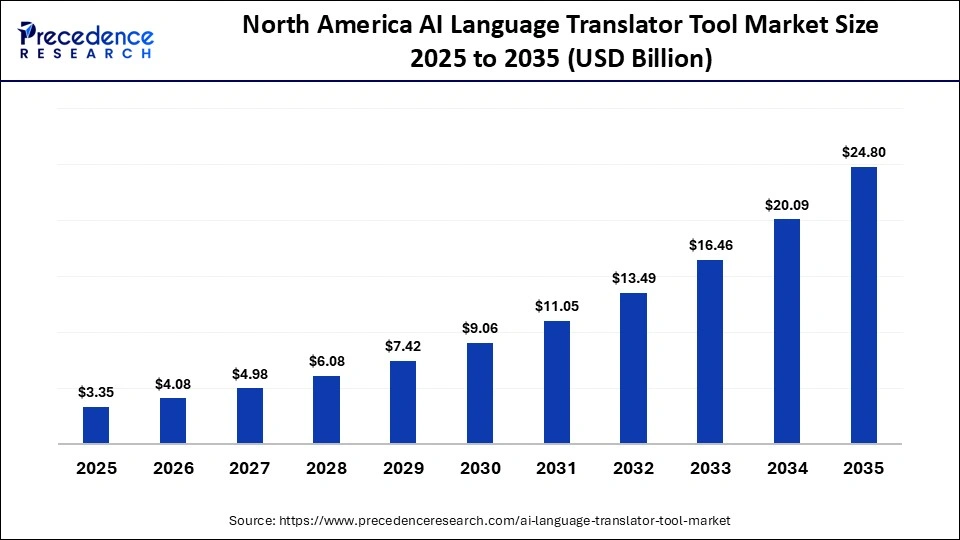
The North America AI language translator tool market size is exhibited at USD 3.35 billion in 2025 and is projected to be worth around USD 24.80 billion by 2035, growing at a CAGR of 22.16% from 2026 to 2035.
How North America Led the Global AI Language Translator Tool Market?
North America held a major revenue share of the market in 2025, due to early adoption of AI and NLP and the high presence of big technology firms like Microsoft, Google, IBM, and Amazon. They had substantial investment in language technology platforms. North America was the strongest in the region since sophisticated digital infrastructure and high velocity integration into enterprises resulted in the popularisation of automated translation technologies.
U.S. AI Language Translator Tool Market Market Size and Growth 2026 to 2035
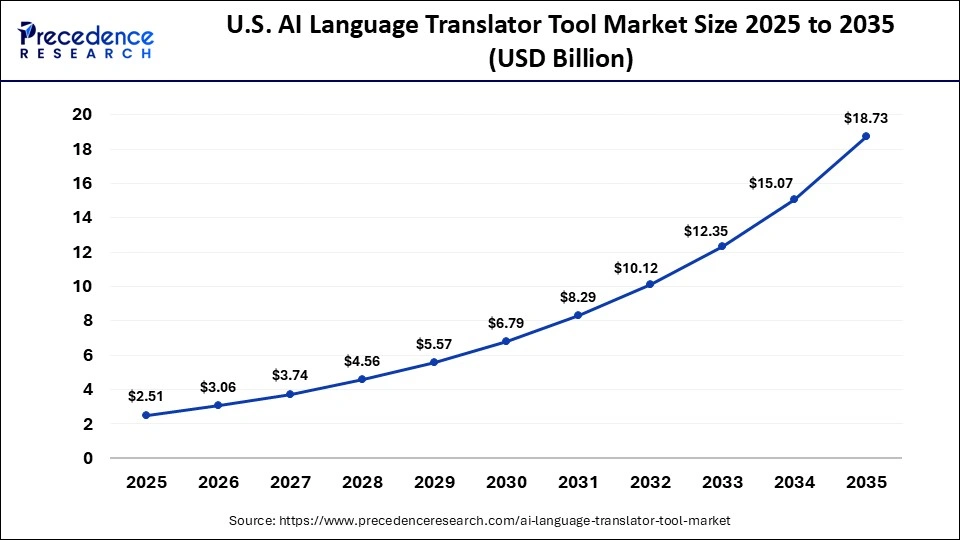
The U.S. AI language translator tool market size is evaluated at USD 2.51 billion in 2025 and is projected to be worth around USD 18.73 billion by 2035, growing at a CAGR of 22.26% from 2026 to 2035.
U.S. Leads AI Translation Innovation
U.S. leads the market, owing to its position as a global hub for AI innovation and multilingual technology development. The increasing demand for AI translation in government services is noted in government and institutional translation programs. Such as automated translation initiatives at the National Weather Service to provide over 68.8 million non-English speakers with its services. Furthermore, the U.S. also aims to sustain strong leadership in automated translation usage and continued investment in language technology in the coming years.
Which Factors Fuel Asia-Pacific's Surge in the AI Language Translator Tool Market?
Asia-Pacific is expected to experience the fastest growth during the predicted timeframe, as a result of the digital transformation and the cross-border economic growth. The high rate of internet penetration and growth in enterprise IT spending in the region has prompted high adoption of automated translation to e-commerce, education, and mobile platforms. Government programs encourage AI research and digital literacy, increasing the speed of localized tools and leading to the increased implementation of translation in various sectors.
China's Linguistic Leap: Driving Asia-Pacific's AI Translation Revolution
China is leading the charge in the Asia-Pacific market, owing to the rapid AI adoption and strong government support for language technology innovation. The nation significantly outpaces many other countries and fuels the demand for AI-powered translation across sectors such as telecommunications, e-commerce, and services. Additionally, strategic investments in AI infrastructure stimulated the adoption of AI translation solutions in enterprises to facilitate internal and regional digital communication projects.
For instance,
- A survey of global industry decision makers indicated that 83% of decision makers in China had turned to generative AI.
What are the Boosting Factors of the AI Language Translator Tool Market in Europe?
Europe is considered to be a significantly growing area, due to the increasing adoption of advanced translation solutions by educational institutions and several language-based disparities in European nations. Moreover, the rapid deployment of cloud-based translation software by large enterprises to translate languages, along with the rising popularity of e-commerce platforms, is playing a prominent role in driving the industry.
Germany Market Analysis
The growing demand for advanced translation tools from the industrial sector to solve technical complexities, along with the increasing adoption of hybrid translation tools by e-learning institutes, is an ongoing trend in the industry.
What is the Trend of the AI Language Translator Tool Market in Latin America?
Latin America is expected to grow at a considerable CAGR in the upcoming period. The surging integration of AI-based translation software in the tourism sector across Brazil and Argentina, as well as the proliferation of emerging AI startups, has accelerated the market growth. Additionally, the growing focus of governments on digitalizing the healthcare sector, coupled with the deployment of NLP models in the BPO industry, is contributing to industrial development.
Brazil Market Analysis
The increasing focus of the sporting teams to use AI chatbots to communicate with foreign players, coupled with the rising deployment of speech recognition systems in retail outlets, has accelerated the market expansion.
What are the Drivers of the AI Language Translator Tool Market in Middle and East Africa?
The Middle East and Africa region is expected to grow at a notable CAGR in the foreseeable future. The increasing use of advanced translation tools in the logistics sector to facilitate cross-border trade activities, along with the surging investment by tech companies to strengthen the AI infrastructure, has fostered the market expansion. Also, the availability of high-speed Wi-Fi access, coupled with the opening of AI labs in Dubai and Qatar, is helping the industry to grow significantly.
UAE Market Trends
Healthcare providers in the UAE are integrating AI-enabled translator tools to enhance the communication between doctors and foreign patients. In addition, the rapid investment by the Dubai government to integrate AI in its manufacturing industries to enhance operational efficiency has contributed to the development of the industry.
AI Language Translator Tool Market Supply Chain Analysis
- Data Collection & Multilingual Dataset Development
Collection of large-scale multilingual text, speech, and parallel corpora to train AI translation models.
Key Players: Google, Meta Platforms, Mozilla (Common Voice), AI4Bharat, NLLB Research Community - AI Model Training & Algorithm Engineering
Training neural machine translation models using advanced algorithms for accurate multilingual translation.
Key Players: Google Research, Microsoft Azure AI, OpenAI, Baidu, iFLYTEK - Platform & Software Development
Integration of trained models into apps, APIs, and cloud services for real-time translation and localization.
Key Players: Google Translate, Microsoft Translator, Amazon Translate, IBM Watson Language Translator - Deployment & Integration Services
Implementation of AI translation tools across cloud, enterprise systems, and public platforms for multilingual communication.
Key Players: Microsoft Azure, AWS, Google Cloud, Smartcat, Lokalise, OneSky
AI Language Translator Tool Market Companies
- Copy.AI, Inc.
- DeepL SE
- Microsoft
- OpenAl
- Sonix
- Systran
- Wordly Inc.
- Quillbot
- Tilde
- Smartcat
- Taia
Recent Developments
- In May 2026, Therap Services launched an AI-enabled translator tool. This translator tool was designed to support providers with service-related documentation into multiple languages, improving understanding among families, individuals, and care teams. (Source: https://www.morningstar.com)
- In May 2026, TruTxt launched an AI-based translation solution. This solution was designed to cater to the requirements of the publishers. The platform offers real-time article translation, video subtitle localization, audience and revenue analytics, and international enhancement. (Source: https://www.exchangewire.com)
- In March 2026, MCIS Language Solutions launched Linguify, an advanced AI-powered translation solution to streamline multilingual communication. Linguify delivers instant, accurate translations across multiple languages, enabling businesses and communities to connect seamlessly. The platform aims to simplify translation for both organizations and individual users, enhancing accessibility and efficiency in global communications. (Source: https://www.mcislanguages.com)
- In February 2026, Google launched TranslateGemma, a collection of open AI translation models supporting 55 languages, including offline capabilities for mobile devices. Built on the Gemma 3 model family, these models are available for developers and researchers to adapt for their applications, emphasizing on-device AI deployment instead of relying on cloud infrastructure. (Source: https://blog.google)
- In January 2026, OpenAI rolled out ChatGPT Translate, a standalone web-based translation tool supporting over 50 languages. Positioned as a competitor to Google Translate, the tool features two interactive text boxes for input and output alongside dropdown menus to select source and target languages. (Source: https://www.theverge.com)
Segments Covered in the Report
By User Type
- Educational Institutions
- Individuals
- Large Enterprises
- Small Enterprises
- By Technology
- Speech Recognition
- Natural Language Processing
- Machine Translation
By Application
- Business Communication
- Customer Support
- E-Learning
- Healthcare
- Travel and Tourism
By Deployment Type
- Cloud-Based
- Hybrid
- On-Premise
By Region
- North America
- Latin America
- Europe
- Asia-pacific
- Middle and East Africa
For inquiries regarding discounts, bulk purchases, or customization requests, please contact us at sales@precedenceresearch.com
Frequently Asked Questions





Ask For Sample
No cookie-cutter, only authentic analysis – take the 1st step to become a Precedence Research client
 Get a Sample




 sales@precedenceresearch.com
 Schedule a Meeting
