



AI Maturity Assessment Market Trends, Companies, Revenue / Sales Performance, Subscriber Growth, Pricing Strategies, Cloud Adoption, Infrastructure Expansion, Competitive Landscape, and Industry Outlook
AI Maturity Assessment Market (By Component: Software Platforms/Assessment Tools, Services; By Assessment Type: AI Readiness & Strategy Assessment, Data & Infrastructure Maturity Assessment, MLOps / Model Lifecycle Maturity Assessment, AI Governance, Risk & Compliance (GRC) Assessment, GenAI Adoption & Use-case Prioritization Assessment, By Industry Vertical: BFSI, IT & Telecom, Healthcare & Life Sciences, Manufacturing, Retail & E-commerce, Government & Public Sector, Energy & Utilities, Automotive & Mobility, Other Industries) - Global Industry Analysis, Size, Trends, Leading Companies, Regional Outlook, and Forecast 2026 to 2035
Source: https://www.precedenceresearch.com/ai-maturity-assessment-market
 Get a Sample
 Table Of Content


What is the AI Maturity Assessment Market Size?
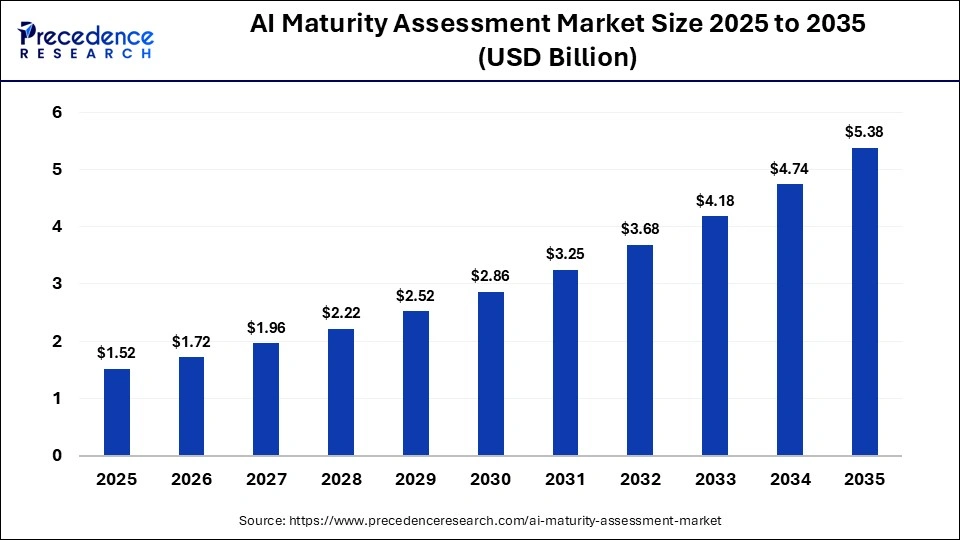
The global AI maturity assessment market is predicted to increase from USD 1.72 billion in 2026 to approximately USD 5.38 billion by 2035, expanding at a CAGR of 13.48% from 2026 to 2035. The market is significantly growing as organizations seek to evaluate, optimize, and scale their AI capabilities for measurable business impact while ensuring compliance and security.
Market Highlights
- By region, North America held the largest market share of nearly 41% in 2026.
- By region, Asia Pacific is expected to grow at the fastest CAGR during the foreseeable period.
- By component, the services segment held the largest market share of nearly 57% in 2026.
- By component, the software platforms / assessment tools segment is expected to grow at the fastest CAGR during the foreseeable period.
- By assessment type, the AI readiness & strategy assessment segment held the largest market share of nearly 31% in 2026.
- By assessment type, the GenAI adoption & use-cases prioritization assessment segment is expected to grow at the fastest CAGR during the foreseeable period.
- By industry vertical, the BFSI segment held a significant market share of nearly 17% in 2026.
- By industry vertical, the government & public sector segment is expected to grow at the fastest CAGR during the foreseeable period.
Market Overview
The global AI maturity assessment market includes tools, frameworks, platforms, and consulting services used to evaluate an organization's readiness, capability, and governance maturity for adopting and scaling artificial intelligence. These assessments measure dimensions such as data readiness, model lifecycle practices, MLOps maturity, AI governance, talent capability, infrastructure preparedness, security/compliance, and business alignment. The market supports enterprises in benchmarking AI adoption stages, defining transformation roadmaps, prioritizing use cases, and improving operationalization of AI and GenAI initiatives.
AI Maturity Assessment Market Trends
- Widespread AI Adoption: A major trend shaping the market is the rapid adoption of AI by leading technology firms. According to industry sources, nearly 78% of companies now use AI in their operations, up from 55% in the previous year, highlighting the need to assess AI readiness and maturity.
- Rise of Agentic AI: The emergence of agentic AI is accelerating demand for AI maturity assessments, as autonomous AI agents are increasingly expected to perform complex tasks with minimal human intervention. Experts estimate that around 40% of business applications will integrate task-specific AI agents, increasing the need for structured evaluation frameworks.
- Focus on AI Governance and Ethics: Strengthening AI governance, ethics, and compliance has become a critical trend due to stricter safety regulations and growing concerns around algorithmic bias. AI maturity assessments play a key role in ensuring trustworthy, transparent, and compliant AI systems.
- Adoption of Small Language Models (SLMs): Small language models are gaining traction among enterprises due to their lower computational requirements compared to large language models (LLMs). Their ability to support on-device processing, edge computing, and SME adoption further reinforces the need for AI maturity and capability assessments.
Segment Insights
Component Insights
Why Did the Services Segment Dominate the AI Maturity Assessment Market in 2026?
The services segment dominated the market with the largest share of 57% in 2026 due to key reasons like identifying crucial gaps in data governance and bridging the production gap. Services offer a structured, actionable roadmap that helps AI to upgrade as per enterprises' demand with operationalized systems, as internal teams often tend to overlook internal issues, which is a significant barrier for scaling. Consultants, on the other hand, bring expertise and knowledge of MLOps platforms with technical infrastructure. The lack of in-house AI expertise across many enterprises and the need for customized, industry-specific assessments reinforced demand for professional services over standalone tools.
The software platforms / assessment tools segment is expected to grow at the fastest CAGR during the projection period due to their unmatched offerings like speed, objectivity, high scalability, and constant monitoring, bypassing the limitations of slow and overhead manual consulting. Automated platforms offer a quick snapshot and status of AI capabilities that assist companies in moving faster than conventional long-term engagements. They further eliminate human biases, subjectivity, and ensure assessment done only based on data for fair evaluation with comprehensive evaluation areas. Additionally, the increasing demand for self-service assessments, real-time analytics, and integration with enterprise systems is driving the adoption of software-based tools.
Assessment Type Insights
What Made AI Readiness & Strategy Assessment the Leading Segment in the AI Maturity Assessment Market?
The AI readiness & strategy assessment segment led the market while holding the largest share of around 31% in 2026, as it identifies gaps and missing values in unstructured data, which is a major cause of AI failure in terms of clarity and insights. AI thrives on clean data and assessments to offer rigorous data evaluation, along with assessments for IT infrastructure. Companies prioritized understanding their data maturity, infrastructure readiness, governance frameworks, and strategic alignment to avoid costly failures and fragmented deployments. Additionally, as enterprises moved from experimentation to value-driven AI adoption, demand grew for assessments that could define roadmaps, prioritize use cases, and align AI investments with measurable business outcomes.
The GenAI adoption & use-cases prioritization assessment segment is expected to grow at the fastest CAGR during the foreseeable period, as organizations seek to move beyond experimentation and identify high-value, scalable generative AI applications. Enterprises need structured assessments to evaluate data readiness, model suitability, risk exposure, and ROI potential before deploying GenAI across functions. Additionally, rising concerns around security, governance, and ethical use of GenAI, along with pressure to justify investments, are driving demand for assessments that help organizations prioritize use cases, mitigate risks, and accelerate value realization.
Industry Vertical Insights
Why Did the BFSI Sector Dominate the AI Maturity Assessment Market in 2026?
The BFSI segment dominated the market with a considerable share of nearly 17% in 2026, as the industry moves from back-office automation to consumer-facing and high-risk decision-making, where maturity assessment is highly crucial for compliance and avoiding biased or fraudulent decisions. In this environment, AI maturity assessments became critical to ensure regulatory compliance and to prevent biased or fraudulent outcomes.
These assessments also help financial institutions uncover hidden inefficiencies and data silos within legacy systems that limit AI scalability. As a result, BFSI organizations are prioritizing high-impact use cases such as fraud detection, risk management, and AI-driven anti–money laundering (AML) systems, further driving demand for AI maturity assessment solutions.
The government & public sector segment is expected to grow at the fastest CAGR during the foreseeable period, driven by increasing recognition of the potential of AI and machine learning technologies to build internal capabilities while maintaining high levels of security and compliance. Governments are increasingly adopting standardized AI maturity frameworks to assess current capabilities and develop clear roadmaps for future AI initiatives. Models such as the CNA AI Maturity Model enable agencies to evaluate AI readiness across critical domains essential for effective AI utilization and generative AI implementation, particularly as the technology continues to evolve at a rapid pace.
Regional Insights
How Big is the North America AI Maturity Assessment Market Size?
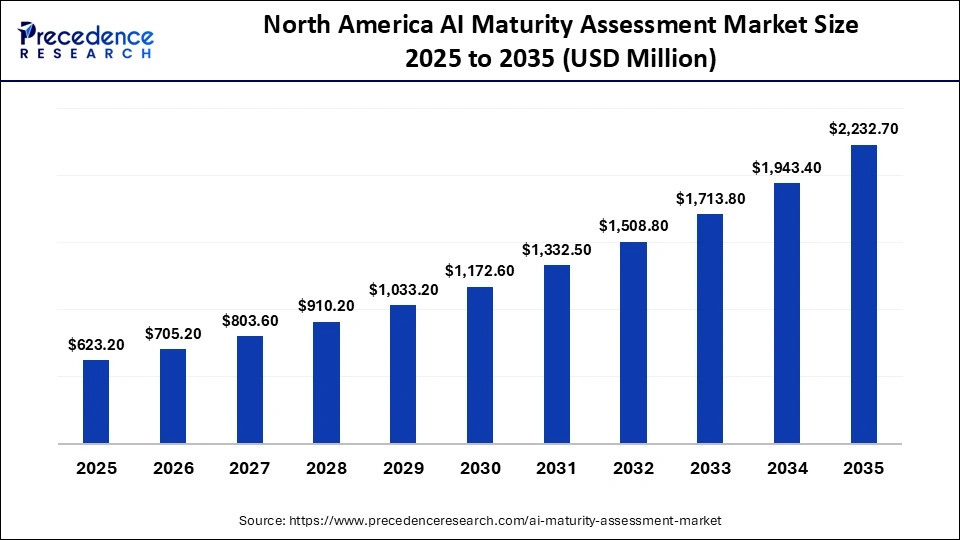
The North America AI maturity assessment market size is estimated at USD 623.20 million in 2026 and is projected to reach approximately USD 2,232.69 million by 2035, with a 13.61% CAGR from 2026 to 2035.
What Made North America the Dominant Region in the AI Maturity Assessment Market?
North America dominated the AI maturity assessment market with the largest share of approximately 41% in 2026, driven by accelerated AI adoption and rapid technological advances such as generative AI and agentic AI across leading sectors, including finance, healthcare, and BFSI. These industries operate under stringent regulatory requirements related to safety, governance, and data sovereignty, increasing the need for structured AI maturity assessments. According to industry sources, around 7% of firms in North America have reached an advanced level of AI maturity, enabling them to fully leverage AI capabilities, while an additional 18% have progressed to a level that allows seamless operational deployment, further reinforcing the region's market leadership.
Rising investments in AI are putting pressure on businesses in North America to deliver high ROI and measurable impact from their AI initiatives. Companies are increasingly focusing on AI maturity assessments to ensure data quality, trustworthy outcomes, and compliance with regulations such as the California Consumer Privacy Act (CCPA). This emphasis on accountability, governance, and performance is driving substantial growth in the market across the region.
What is the Size of the U.S. AI Maturity Assessment Market?
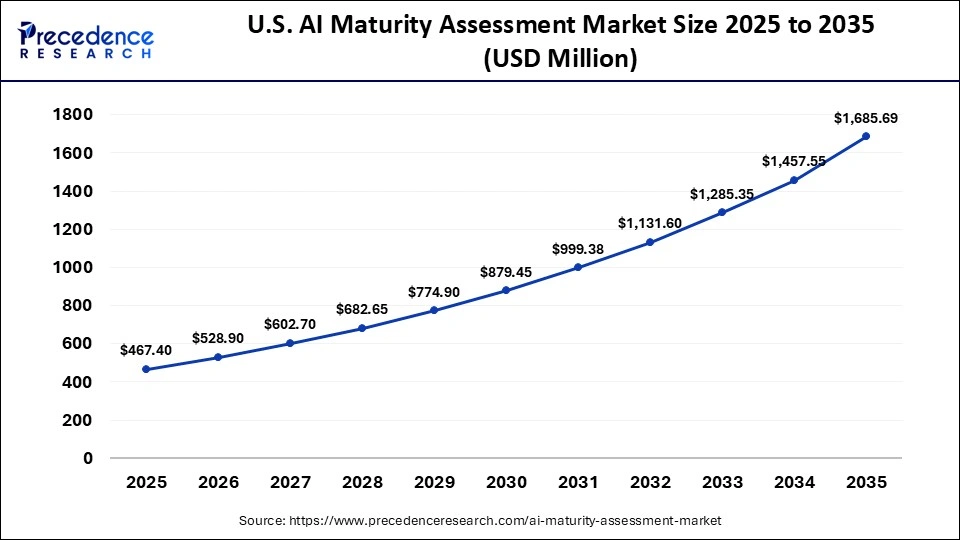
The U.S. AI maturity assessment market size is calculated at USD 528.90 million in 2026 and is expected to reach nearly USD 1,685.69 million in 2035, accelerating at a strong CAGR of 13.69% between 2026 and 2035.
U.S. AI Maturity Assessment Market Analysis
The U.S. is a major contributor to the market in North America, as leading tech companies are heavily investing in AI startups to achieve breakthroughs and novelty that accelerates the need for AI maturity assessment. Many AI-driven firms are focused on reducing operational costs and maximizing revenue through AI systems, increasing reliance on structured assessments. At the same time, growing scrutiny of AI-driven decisions is creating a stronger demand for AI maturity assessments to ensure ethical, transparent, and compliant AI practices, further boosting the market's value on a global scale.
Why is Asia Pacific Considered the Fastest-Growing Region in the AI Maturity Assessment Market?
Asia Pacific is expected to grow at the fastest CAGR during the foreseeable period, driven by the rapid shift from experimental AI projects to ROI-focused, large-scale AI implementations. As AI adoption in the region accelerates, so do the associated risks and governance challenges, making AI maturity assessments essential for ensuring safety, compliance, and ethical deployment. To gain a competitive edge and build consumer trust, governments in leading countries are investing heavily in robust AI infrastructure and promoting initiatives around AI sovereignty, further fueling market growth.
China AI Maturity Assessment Market Trends
China is making significant investments to accelerate AI adoption across key sectors, with the generative AI ecosystem entering an aggressive growth phase through platforms like Tencent Yuanbao and Doubao, which are transforming digital interactions for consumers. Over 50% of Chinese firms plan to implement AI agents within the next few years, driving strong demand for AI maturity assessments to ensure safer AI deployment, ethical compliance, and higher ROI amid substantial investments in AI technologies.
How is the Opportunistic Rise of Europe in the AI Maturity Assessment Market?
Europe is experiencing an opportunistic rise in the market due to its strong focus on AI adoption, ethical governance, and regulatory compliance across multiple industries. Leading countries are leveraging well-established AI research ecosystems, robust digital infrastructure, and standardized frameworks to evaluate AI readiness and ensure responsible deployment. Additionally, initiatives to promote AI transparency, trustworthy systems, and generative AI adoption, combined with growing investments in enterprise AI, are fueling demand for structured AI maturity assessments, positioning Europe as a rapidly emerging market in this space.
Germany AI Maturity Assessment Market Trends
The market in Germany is growing due to its robust technology infrastructure, advanced AI research ecosystem, and strong industrial base. The country's enterprises and public institutions are increasingly adopting AI across sectors like manufacturing, finance, and healthcare, driving demand for structured AI maturity assessments to ensure compliance, governance, and ethical deployment. Additionally, Germany's emphasis on AI standardization, regulatory frameworks, and collaborations with academic and research centers reinforces its leadership role in Europe's AI maturity assessment market.
Who are the Major Players in the Global AI Maturity Assessment Market?
The major players in the AI maturity assessment market include NVIDIA, Microsoft, Alphabet, Meta Platforms, IBM, Accenture, Deloitte, SAP, and Salesforce.
Recent Developments
- In January 2026, a global AI-centered technology research and advisory firm, Information Services Group, acquired a SaaS platform of AI Maturity Index that offers AI readiness of their workforce and its assessment, aiming to enhance employees' capability to use AI technology.(Source: https://www.businesswire.com)
- In December 2025, by collaborating with the leading tech giant Accenture, the Software Engineering Institute (SEI) initiated development of an AI adoption maturity model that can be leveraged by enterprises for creating a roadmap of predictable AI adoption and AI benefits at its peak.(Source: https://www.sei.cmu.edu)
AI Maturity Assessment Market Segments
By Component
- Software Platforms/Assessment Tools
- Diagnostic dashboard
- Benchmark scoring engines
- AI readiness analytics
- Services
- Consulting & advisory
- Workshops & stakeholder interviews
- Roadmap building & change management
By Assessment Type
- AI Readiness & Strategy Assessment
- Data & Infrastructure Maturity Assessment
- MLOps / Model Lifecycle Maturity Assessment
- AI Governance, Risk & Compliance (GRC) Assessment
- GenAI Adoption & Use-case Prioritization Assessment
By Industry Vertical
- BFSI
- IT & Telecom
- Healthcare & Life Sciences
- Manufacturing
- Retail & E-commerce
- Government & Public Sector
- Energy & Utilities
- Automotive & Mobility
- Other Industries
By Region
- North America
- Europe
- Asia-Pacific
- Latin America
- Middle East & Africa
For inquiries regarding discounts, bulk purchases, or customization requests, please contact us at sales@precedenceresearch.com
Frequently Asked Questions





Ask For Sample
No cookie-cutter, only authentic analysis – take the 1st step to become a Precedence Research client
 Get a Sample




 sales@precedenceresearch.com
 Schedule a Meeting
