



AI Sales Assistant Software Market Trends, Companies, Revenue / Sales Performance, Subscriber Growth, Pricing Strategies, Cloud Adoption, Infrastructure Expansion, Competitive Landscape, and Industry Outlook
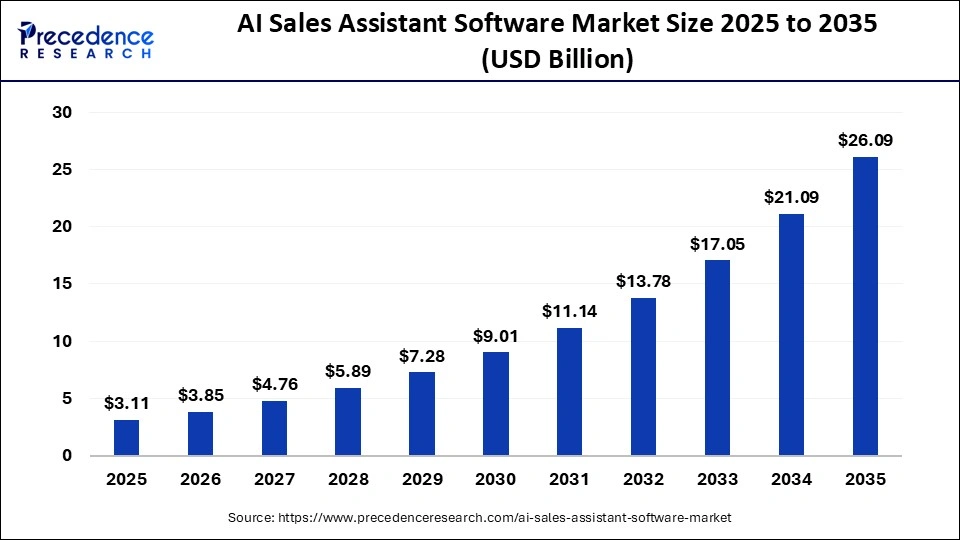
ICT industry specialist Gautam Mahajan estimates the AI sales assistant software market at USD 3.85 billion in 2026, with continued technology adoption expected to take the market to USD 26.09 billion by 2035 at a CAGR of 23.70%. Leading AI sales assistant software market providers such as Salesforce, Microsoft, HubSpot, Oracle, SAP are expanding their capabilities across segments including By Technology, By Functionality, By Deployment Mode, By Organization Size, By End-use Industry.
Source: https://www.precedenceresearch.com/ai-sales-assistant-software-market
 Get a Sample
 Table Of Content


What is the AI Sales Assistant Software Market Size in 2026?
The global AI sales assistant software market size was calculated at USD 3.11 billion in 2025 and is predicted to increase from USD 3.85 billion in 2026 to approximately USD 26.09 billion by 2035, expanding at a CAGR of 23.70% from 2026 to 2035. The market is significantly expanding due to the increasing demand for sales automation, enhanced lead conversion rates, and the rapid integration of generative AI to achieve maximum consumer engagement.
Key Takeaways
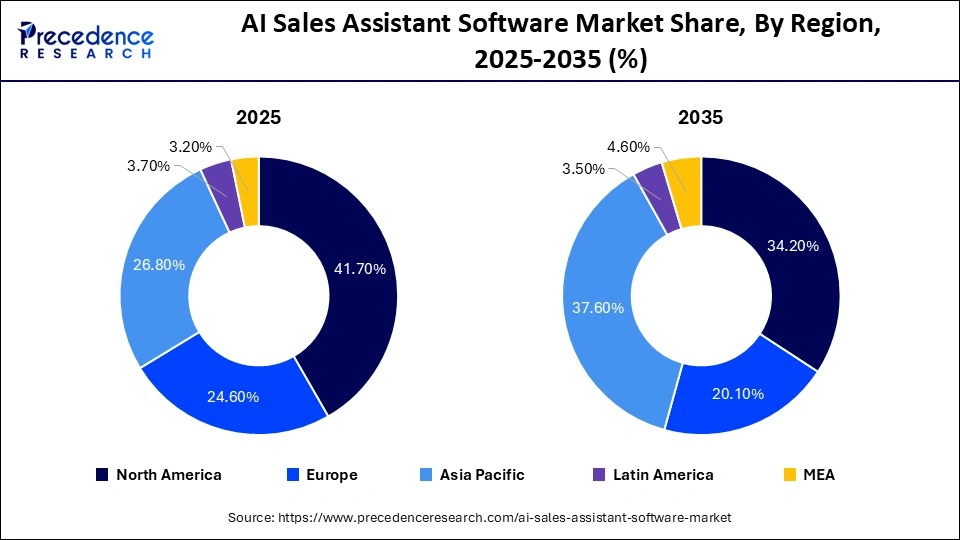
- North America held the largest market share of nearly 41.7% in 2025.
- The Asia Pacific is projected to register the fastest CAGR during the forecast period.
- By technology, the generative AI-based assistants segment led the market with a 38.6% share in 2025.
- By functionality, the sales engagement and outreach assistants segment held a 24.6% share in 2025.
- By functionality, the proposal generation and sales content assistants segment is projected to grow at the fastest CAGR during the foreseeable period.
- By deployment mode, the cloud-based software segment held the largest market share of nearly 71.8% in 2025.
- By deployment mode, the hybrid deployment segment is projected to expand at the fastest CAGR during the projection period.
- By organization size, the large enterprises segment held the largest market share of 56.7% in 2025.
- By organization size, the startups segment is projected to witness the fastest growth during the foreseeable period.
- By end use industry, the BFSI segment held a 22.6% share in 2025.
- By end use industry, the retail and e-commerce segment is projected to grow at the fastest CAGR during the foreseeable period.
Market Overview
AI sales assistant software refers to intelligent software solutions that leverage artificial intelligence to automate, augment, and optimize sales processes across lead generation, engagement, pipeline management, and deal closure. These tools use generative AI, machine learning, and conversational analytics to provide real-time insights, automate repetitive tasks, and enhance sales productivity. The market includes standalone platforms and AI capabilities embedded within CRM, sales engagement, and marketing automation systems, delivered via cloud or hybrid models with subscription-based and usage-based pricing structures.
AI Sales Assistant Software Market Trends
- There is a rapid shift from basic chatbots to autonomous AI agents due to their ability to perform complex, human-like tasks. AI agents can now handle end-to-end tasks like scheduling, autonomous outreach, and updating CRM records without human support.
- Growing focus on enhancing customer experience also drives a shift toward AI solutions. AI systems can analyze user behavior and engagement data to generate highly personalized outreach strategies, including customized messages and even tailored video content, significantly improving customer engagement.
- AI capabilities are increasingly being integrated into various CRM systems like Dynamics 365, Salesforce, and HubSpot that offer contextual suggestions with existing workflows.
- Key industries such as retail, e-commerce, and fintech are increasingly adopting AI-powered sales assistant solutions to boost conversion rates and maintain continuous, personalized customer engagement.
Market Scope
| Report Coverage | Details |
| Market Size in 2025 | USD 3.11 Billion |
| Market Size in 2026 | USD 3.85 Billion |
| Market Size by 2035 | USD 26.09 Billion |
| Market Growth Rate from 2026 to 2035 | CAGR of 23.70% |
| Dominating Region | North America |
| Fastest Growing Region | Asia-Pacific |
| Base Year | 2025 |
| Forecast Period | 2026 to 2035 |
| Segments Covered | Technology, Functionality, Deployment Mode, Organization Size, End-use Industry, and Region |
| Regions Covered | North America, Europe, Asia-Pacific, Latin America, and Middle East & Africa |
Market Dynamics
Drivers
Increasing Demand for Sales Automation
The increasing burden on sales teams is boosting the demand for automation solutions, which is driving the AI sales assistant software market. Many enterprises are actively looking for AI support for managing tasks, such as lead optimization, customized follow-ups, data entry, and meeting scheduling. By automating these repetitive tasks, AI sales assistant software enables sales representatives to focus on building and closing deals and improve conversation among maximum consumers.
Restraint
Over Reliance on Personal Data
Despite having excellent features and offerings of AI sales assistant software, there are still areas that need to be looked after. AI sales assistant solutions are largely dependent on personal and behavioral consumer data. This creates a barrier for AI adoption in highly sensitive sectors due to security issues and potential data breaches. If the AI system is trained on biased datasets, the results may be highly ineffective, which is a major factor limiting the market growth.
Opportunity
Rise of Agentic AI
The rapid shift from passive AI assistants to contextually active agentic AI systems that can execute multistep workflows without explicit human support creates immense opportunity in the market. AI agents not just follow instructions to offer information, but they proactively define high-intent prospects and research the company's goals. They further draft a personalized email to a specific group of consumers and schedule follow-up meetings based on the replies they get. This increases the opportunity to get a maximum number of leads without any intervention by humans. It is highly beneficial for B2B companies that are looking to expand their sales development representative teams.
Segment Insights
Technology Insights
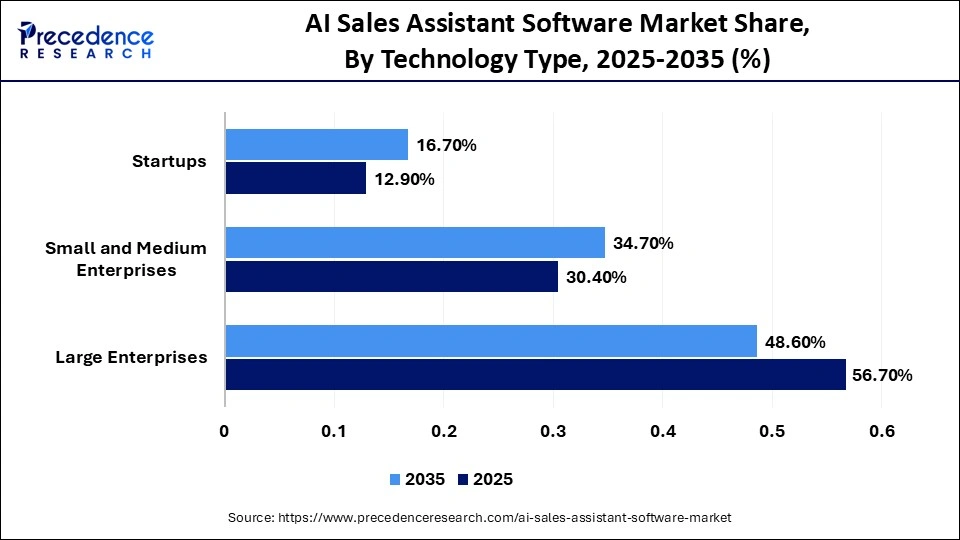
AI Sales Assistant Software Market Share, By Technology Type, 2025-2035 (%)
| Technology Type | 2025 | 2035 |
| Generative AI-Based Assistants | 38.60% | 46.80% |
| Predictive AI and Machine Learning Assistants | 24.70% | 20.60% |
| Natural Language Processing-Based Assistants | 18.60% | 15.10% |
| Conversational AI and Voice Assistants | 18.10% | 17.50% |
What Made Generative AI-Based Assistants the Dominant Segment in the Market?
The generative AI-based assistants segment dominated the AI sales assistant software market with a 38.6% share in 2025 and is expected to grow at the fastest CAGR during the forecast period. This is mainly due to its ability to create highly personalized, context-aware interactions at scale, significantly improving customer engagement and conversion rates. Unlike traditional rule-based or predictive systems, these solutions leverage advances in Generative AI to autonomously draft emails, generate sales scripts, and tailor messaging based on real-time customer data and behavior. Additionally, their seamless integration with CRM platforms and ability to continuously learn and optimize outreach strategies made them the preferred choice for enterprises seeking efficiency and revenue growth.
Functionality Insights
Why Did the Sales Engagement and Outreach Assistants Segment Dominate the Market?
The sales engagement and outreach assistants segment dominated the AI sales assistant software market with a 24.6% share in 2025 due to their ability to reduce manual efforts, provide precise and measurable ROI with conversion rates, and scale pipeline generation with the help of advanced natural language generation and sentiment analysis in real-time. These functions manage multiple outreach channels, including LinkedIn, Text SMS, email, and others at the same time. This approach is highly anticipated in finding and engaging prospects in a digital-first environment. They can create context-aware and tailored messages that enhance engagement rates.
AI Sales Assistant Software Market Share, By Functionality, 2025-2035 (%)
| Functionality | 2025 | 2035 |
| Lead Generation Assistants | 18.70% | 16.40% |
| Sales Engagement and Outreach Assistants | 24.60% | 21.80% |
| CRM Data Entry and Automation Assistants | 14.30% | 11.70% |
| Sales Forecasting and Pipeline Intelligence Assistants | 13.80% | 15.20% |
| Conversation Intelligence and Call Analysis Assistants | 11.60% | 13.40% |
| Proposal Generation and Sales Content Assistants | 9.40% | 14.80% |
| Revenue Operations and Deal Coaching Assistants | 7.60% | 6.70% |
The proposal generation and sales content assistants segment is expected to witness the fastest growth during the foreseeable period, as they effectively address some of the most time-consuming bottlenecks in the sales cycle, including content creation, personalization, and speed to lead. These features automate the development of high-quality sales materials and marketing content, enabling teams to scale outreach efforts efficiently while maintaining consistency. Moreover, in an increasingly competitive landscape where generic outreach is ineffective, these solutions leverage data-driven insights to analyze consumer behavior and deliver precise, personalized recommendations that maximize conversion rates.
Deployment Mode Insights
AI Sales Assistant Software Market Share, By Deployment Mode, 2025-2035 (%)
| Deployment Mode | 2025 | 2035 |
| Cloud-based Software | 71.80% | 76.40% |
| On-premise Software | 12.60% | 6.80% |
| Hybrid Deployment | 15.60% | 16.8 |
What Made Cloud-Based Software the Leading Segment in the AI Sales Assistant Software Market?
The cloud-based software segment led the market while holding the largest share of nearly 71.8% in 2025, owing to its superior scalability, cost-effectiveness, and rapid deployment. This deployment offers seamless CRM integration and remote accessibility to real-time data analytics that enable companies to easily adopt generative AI tools for higher efficiency without substantial infrastructure investment. Cloud solutions allow businesses to scale AI tools as per their needs, offering low entry barriers. This deployment enables the seamless integration of AI assistants into CRM platforms like HubSpot and Salesforce. It enhances customer data analysis, automates tasks, and enhances chances of lead generation.
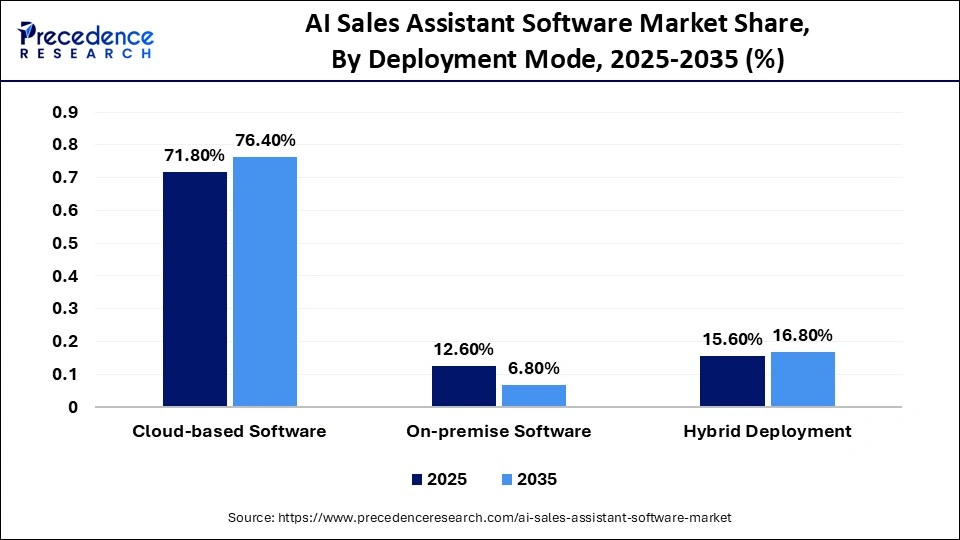
The hybrid deployment segment is projected to grow at the fastest CAGR during the projection period, driven by its ability to combine the security of on-premises systems with the flexibility of cloud-based solutions. This approach allows organizations to store and manage sensitive data locally while leveraging advanced AI capabilities in the cloud for analytics and decision-making, ensuring both compliance and scalability. Additionally, hybrid systems reduce latency by enabling edge-level data processing and help optimize infrastructure costs and performance, making them particularly well-suited for highly regulated sectors such as BFSI and healthcare.
Organization Size Insights
AI Sales Assistant Software Market Share, By Organization Size, 2025-2035 (%)
| Organization Size | 2025 | 2035 |
| Large Enterprises | 56.70% | 48.60% |
| Small and Medium Enterprises | 30.40% | 34.70% |
| Startups | 12.90% | 16.70% |
How Does the Large Enterprises Segment Dominate the AI Sales Assistant Software Market?
The large enterprises segment held the largest market share of 56.7% in 2025 due to their strong capability to adopt advanced, scalable AI solutions to enhance operational efficiency, consumer engagement, and make data-driven decisions. These organizations tend to prefer customized SaaS-based tools that align with complex business needs, while also prioritizing data security, regulatory compliance, and seamless integration with existing CRM systems. This strategic adoption enables them to gain a competitive advantage and accelerate sales pipeline generation at scale.
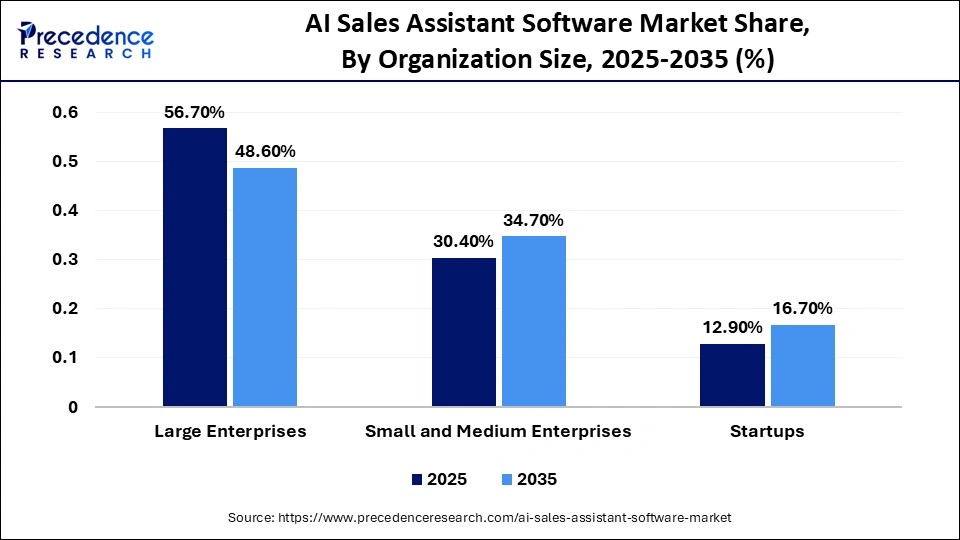
The startups segment is projected to witness the fastest growth in the upcoming period due to their ability to deliver highly specialized solutions such as GPT-driven personalization and niche CRM tools that significantly enhance lead scoring and sales conversion rates. These companies offer superior ROI compared to traditional systems by focusing on rapid deployment, AI-powered automation, and customized content generation tailored to specific business needs. Additionally, startups often target niche verticals such as healthcare and fintech, enabling them to provide highly focused and differentiated solutions that address industry-specific challenges effectively.
End-Use Industry Insights
Why Did the BFSI Segment Lead the AI Sales Assistant Software Market?
The BFSI segment led the market by holding a significant share of 22.6% in 2025. This is primarily due to the urgent need for fraud detection systems, operational cost reduction, and compliance with strict regulations. The BFSI industry requires hyper-personalized consumer interactions, 24/7 engagement, and automated risk management that can be achieved by AI agents. Technologies like machine learning and NLP speed up complex underwriting processes, handle vast consumer queries at the same time, and manage portfolios efficiently.
AI Sales Assistant Software Market Share, By End-use Industry, 2025-2035 (%)
| End-use Industry | 2025 | 2025 |
| BFSI | 22.60% | 19.10% |
| Retail and E-commerce | 18.70% | 22.40% |
| IT and Telecom | 17.80% | 18.30% |
| Healthcare and Life Sciences | 12.60% | 13.70% |
| Manufacturing | 14.30% | 12.80% |
| Others | 14.00% | 13.70% |
The retail and e-commerce segment is projected to expand at the fastest CAGR during the foreseeable period due to the increasing use of AI to deliver personalized product recommendations and human-like interactions that replicate in-store experiences remotely. By breaking geographical barriers, these solutions allow consumers to shop for products from anywhere, supporting cross-border business expansion. Additionally, AI-powered tools enable demand forecasting and dynamic pricing, helping companies optimize inventory and respond to real-time market trends efficiently.
Regional Insights
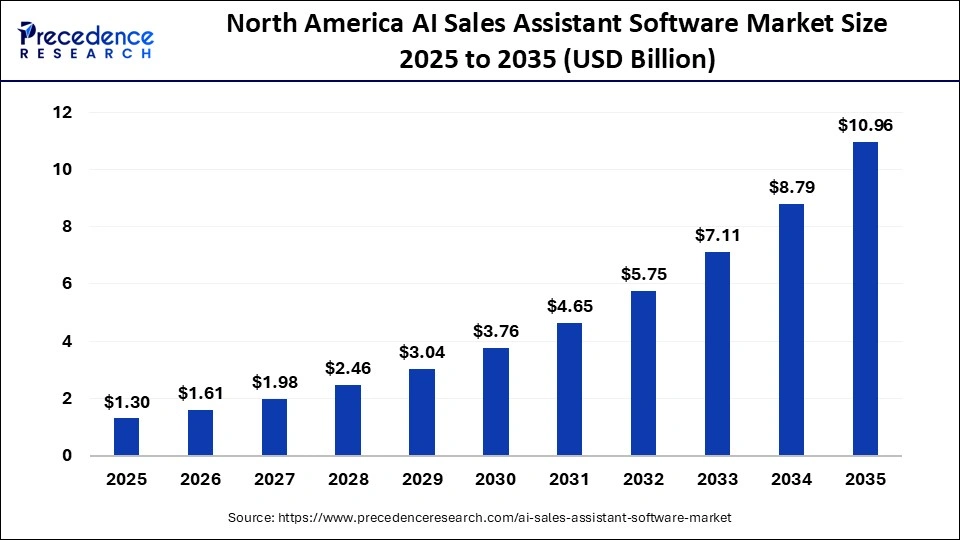
North America AI Sales Assistant Software Market Size and Growth 2026 to 2035
The North America AI sales assistant software market size is estimated at USD 1.30 billion in 2025 and is projected to reach approximately USD 10.96 billion by 2035, with a 23.76% CAGR from 2026 to 2035.
What Made North America the Dominant Region in the AI Sales Assistant Software Market?
North America dominated the AI sales assistant software market while capturing the largest share of nearly 41.7% in 2025. The region's dominance is attributed to factors like early adoption of AI/ML technologies, substantial investments in R&D to develop novel AI solutions, a mature tech ecosystem backed by active technology marketers like Microsoft, NVIDIA, and AWS, and massive venture capital.
There is a rapid integration of AI tools into CRM platforms that enhance sales velocity and revenue management. The rapid adoption of generative AI in platforms like Regie.ai enables the generation of highly customized email sequences at scale that significantly improve consumer engagement, supporting the region's dominance in the market.
The North American government has fostered a favorable AI ecosystem through strategic investments and policy initiatives aimed at maintaining technological leadership. By prioritizing the development of safe, secure, and unbiased AI, the region has strengthened its innovation infrastructure and regulatory framework. Initiatives such as the National AI Initiative Act underscore North America's strategic vision and readiness to advance AI adoption across industries.
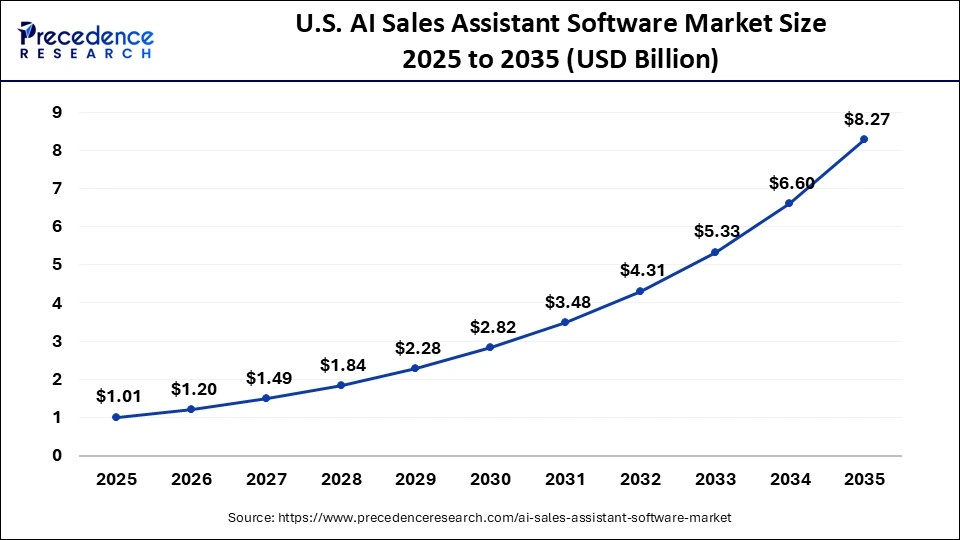
U.S. AI Sales Assistant Software Market Size and Growth 2026 to 2035
The U.S. AI sales assistant software market size is calculated at USD 1.01 billion in 2025 and is expected to reach nearly USD 8.27 billion in 2035, accelerating at a strong CAGR of 23.90% between 2026 and 2035.
U.S. AI Sales Assistant Software Market Analysis
The U.S. is the major contributor to the North American market, driven by substantial investments in AI technology, the government's adoption of a comprehensive AI action plan, and strategic funding partnerships. Recent initiatives include global collaborations for inclusive AI development and significant funding for AI capacity building, reinforcing the country's leadership in the field. These efforts have accelerated AI integration across sectors, including sales through AI assistants, stimulating the market and setting benchmarks for enterprise adoption nationwide.
Why is Asia Pacific Rapidly Expanding in the AI Sales Assistant Software Market?
Asia Pacific is projected to witness the fastest growth during the foreseeable period due to the intense digital transformation, expanding e-commerce sectors backed by AI assistance with strong government support. According to sources, nearly 78% of workers in Asia Pacific are utilizing AI tools, highlighting the massive AI penetration in the region. A rapid surge in digital commerce has increased demand for AI chatbots and intelligent agents to handle massive customer interactions effectively. Moreover, the increasing investments in cloud computing and data centers are further creating a robust foundation for SaaS-based AI applications.
China AI Sales Assistant Software Market Analysis
China is at the forefront of the AI adoption, backed by heavy government investment, huge data availability and ambitious ‘AI+' initiatives to integrate AI within every sector by 2027. There is a strong emphasis on reducing operational costs, improving efficiency, and supporting the rapidly expanding e-commerce sector. For example, Chinese companies like JD leverage AI-powered digital humans to assist nearly 40,000 merchants in livestreaming, significantly lowering operational expenses and boosting scalability.
AI Sales Assistant Software Market Companies
- Salesforce
- Microsoft
- HubSpot
- Oracle
- SAP
- Zoho Corporation
- Freshworks
- Gong
- Outreach
- Clari
- Drift
- Intercom
- InsideSales (XANT)
- People.ai
- Apollo.io
Recent Developments
- In March 2026, the global leader in the athletic footwear and apparel giant PUMA announced a plan to launch an interactive AI tool for brick-and-mortar shoppers. It exclusively debuts an AI-powered device called ‘AI store Concierge' at Las Vegas flagship store.
(Source: https://chainstoreage.com) - In March 2026, the leading marketers like Alibaba, Shopify, FedX and Mastercard have shifted from assistive AI to Agentic AI system designed to complete tasks across workflows where customers judge quickly.(Source: https://www.cxtoday.com)
Segments Covered in the Report
By Technology
- Generative AI-based assistants
- Predictive AI and machine learning assistants
- Natural language processing-based assistants
- Conversational AI and voice assistants
By Functionality
- Lead generation assistants
- Sales engagement and outreach assistants
- CRM data entry and automation assistants
- Sales forecasting and pipeline intelligence assistants
- Conversation intelligence and call analysis assistants
- Proposal generation and sales content assistants
- Revenue operations and deal coaching assistants
By Deployment Mode
- Cloud-based software
- On-premise software
- Hybrid deployment
By Organization Size
- Large enterprises
- Small and medium enterprises
- Startups
By End-use Industry
- BFSI
- Retail and e-commerce
- IT and telecom
- Healthcare and life sciences
- Manufacturing
- Others
By Region
- North America
- Latin America
- Europe
- Asia-pacific
- Middle and East Africa
For inquiries regarding discounts, bulk purchases, or customization requests, please contact us at sales@precedenceresearch.com
Frequently Asked Questions





Ask For Sample
No cookie-cutter, only authentic analysis – take the 1st step to become a Precedence Research client
 Get a Sample




 sales@precedenceresearch.com
 Schedule a Meeting
