



AI in Space Exploration Market Trends, Companies, Revenue / Sales Performance, Subscriber Growth, Pricing Strategies, Cloud Adoption, Infrastructure Expansion, Competitive Landscape, and Industry Outlook
AI in Space Exploration Market (By Component: Software, Hardware Services; By Application: Mission Planning & Optimization, Autonomous Navigation & Guidance, Earth Observation & Data Analysis, Spacecraft Health Monitoring & Predictive Maintenanc, Robotics & Planetary Exploration; By Platform: Satellites, Space Probes & Rovers, Launch Vehicles Space Stations & Habitats; By End User: Government Space Agencies, Commercial Space Companies, Defense Organizations, Research & Academic Institutions) - Global Industry Analysis, Size, Trends, Leading Companies, Regional Outlook, and Forecast 2026 to 2035
Source: https://www.precedenceresearch.com/ai-in-space-exploration-market
 Get a Sample
 Table Of Content


What is the AI in Space Exploration Market Size?
The global AI in space exploration market size was calculated at USD 6.18 billion in 2025 and is predicted to increase from USD 8.24 billion in 2026 to approximately USD 110.20 billion by 2035, expanding at a CAGR of 33.40% from 2026 to 2035.The AI in space exploration market is driven by rising demand for autonomous mission operations, an increase in the number of satellite constellations, and significant investment by governments and private companies in deep space and planetary exploration missions.
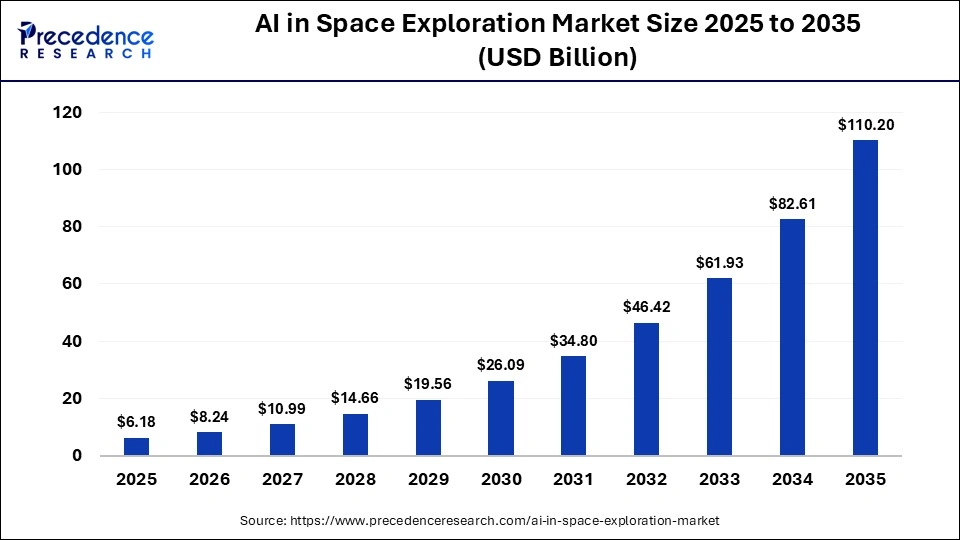
Market Highlights
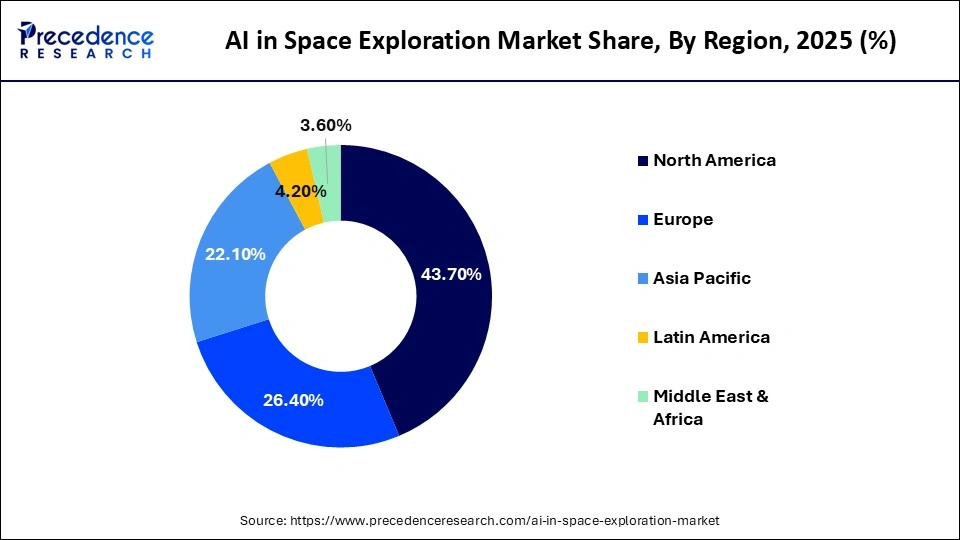
- North America led the AI in space exploration market with the largest share of 43.7% in the global market in 2025.
- Asia-Pacific is expected to grow at the highest CAGR during the forecast period.
- By component type, the software segment led the market and held approximately 46.80% share in 2025 and is expected to grow at the fastest CAGR during 2026-2035.
- By component type, the services segment is expected to grow at a notable CAGR during the forecast period.
- By application type, the mission planning & optimization segment dominated the market with approximately 24.70% share in 2025.
- By application type, the robotics & planetary exploration segment is expected to grow at the highest CAGR between 2026 and 2035.
- By platform type, the satellites segment led the market and captured 42.8% share in 2025.
- By platform type, the space probes & rovers segment is expected to expand at the highest CAGR from 2026 to 2035.
- By end user type, the Government space agencies segment led the market with approximately 44.90% share in 2025.
- By end user type, the commercial space companies segment is expected to expand at the highest CAGR from 2026 to 2035.
What is the AI in Space Exploration Market?
The AI in space exploration market has been growing rapidly, with governments and private companies investing in advanced space technologies. Applications of AI in space technology range from guiding autonomous spacecraft and controlling satellites to the analysis of huge space datasets and precision mapping of planets and asteroids. AI facilitates real-time decision-making in harsh and remote environments where immediate human intervention is not possible. The market growth is driven by ambitious Mars and lunar missions, increased satellite constellations, and commercial space activities.
Technology Shifts in AI in Space Exploration Market
The rapid pace of innovation in AI technologies is driving significant technological shifts in the market. For instance, autonomous navigation is being used to plan routes for robots on planetary surfaces and asteroids. There are AI-based data analysis applications that process satellite and telescopic data to facilitate faster mapping and detection of anomalies and objects. Advanced technologies such as predictive maintenance for improved reliability and swarm intelligence applications for satellite coordination are being widely adopted in the market. The applications that integrate artificial intelligence and machine learning, along with quantum computing, have been developed.
AI in Space Exploration Market Trends
- Collaborations & Partnerships: Space agencies are collaborating with technology companies to integrate AI in mission-critical applications. The collaborations aim to develop autonomous navigation and decision-making, as well as real-time analytics. For instance, NASA has collaborated with IBM to leverage AI in the processing of satellite and planetary data.
- Government Initiatives: Governments are investing in the adoption of AI technologies in space exploration to improve the efficiency of missions. Governments are also promoting the development of AI technologies specifically for robotics, deep space missions, and earth observation. For instance, the Indian Space Research Organization(ISRO) launched the Chandrayaan mission with AI-based terrain observation systems.
- Business Expansions: Space technology companies are expanding their AI portfolios to meet the increasing demand for intelligent space missions. They are providing AI-based satellite services. For instance, Maxar Technologies is expanding its geospatial AI capabilities to provide real-time intelligence and useful parameter insights.
Market Scope
| Report Coverage | Details |
| Market Size in 2025 | USD 6.18 Billion |
| Market Size in 2026 | USD 8.24 Billion |
| Market Size by 2035 | USD 110.20 Billion |
| Market Growth Rate from 2026 to 2035 | CAGR of 33.40% |
| Dominating Region | North America |
| Fastest Growing Region | Asia Pacific |
| Base Year | 2025 |
| Forecast Period | 2026 to 2035 |
| Segments Covered | Component, Application, Platform, End User , and Region |
| Regions Covered | North America, Europe, Asia-Pacific, Latin America, and Middle East & Africa |
Segmental Insights
Component Type Insights
Why Did the Software Segment Dominate the AI in Space Exploration Market?
The software segment led the market and held approximately 46.8% share in 2025 and is estimated to be the fastest CAGR during the forecast period. The market growth of this segment can be attributed to rising needs for intelligent data processing and mission automation. Spacecrafts and satellites generate copious volumes of complicated data every day. AI software is necessary for the analysis, filtration, and interpretation of this data effectively. Advanced algorithms and machine learning models have become an integral part of autonomous navigation systems. Software for image recognition and terrain mapping enhances the landing accuracy and mission safety.
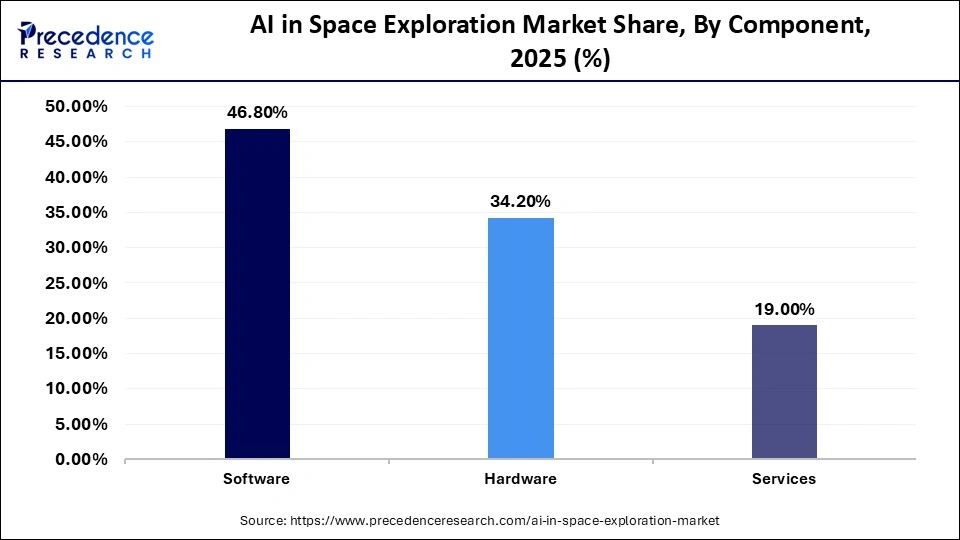
The services segment is expected to grow at a significant CAGR during the forecast period. The market growth of this segment is due to escalating demand for AI integration services, testing, and support services. Space agencies need expertise to effectively use AI-based platforms. The increased intricacy in autonomous systems is boosting demand for consulting services, customization, and maintenance services. Data analytics and AI model training services are also experiencing a surge in demand due to increased volumes of satellite data. The market growth of this segment is further driven by the rise in software dependency in space missions, which require technical support and augmentation.
Application Type Insights
Why Did the Mission Planning & Optimization Segment Dominate the AI in Space Exploration Market?
The mission planning & optimization segment dominated the market with approximately 24.7% share in 2025. The market growth of this segment can be attributed to the growing need for precise trajectory design, fuel optimization, and risk assessment. AI algorithms help simulate various mission scenarios. These systems enhance launch timing, orbital adjustments, and launching accuracy. The market growth of this segment is further driven by increasing complexity and frequency of space missions and the rising demand for intelligent mission planning solutions.
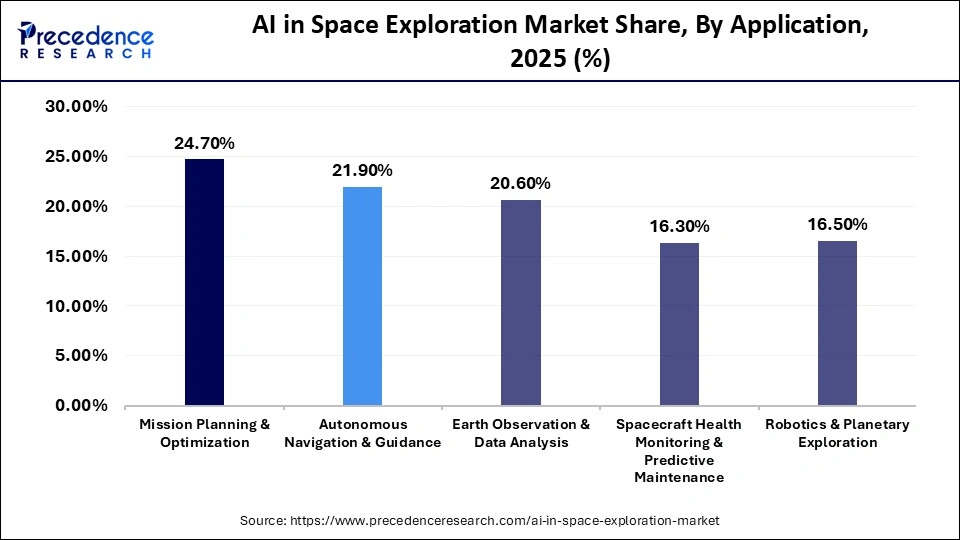
The robotics & planetary exploration segment is expected to grow at the highest CAGR between 2026 and 2035. The market growth of this segment is due to an increase in deep space missions and lunar and Mars exploration programs. AI-based robotic systems facilitate autonomous navigation, surface analysis, and obstacle avoidance on distant planetary missions. AI-assisted robotic arms and rovers make it easier to collect samples. As agencies focus on missions that are longer in duration and the exploration of outer space, the need for superior robotics integrated with AI is growing faster than ever.
Platform Type Insights
Why Did the Satellites Segment Dominate the AI in Space Exploration Market?
The satellites segment led the market and captured 42.80% share in 2025. The market growth of this segment can be attributed to the rapid proliferation of communication, navigation, and Earth observation satellites. AI is being extensively used in the satellite platform for onboard data processing and real-time analytics. AI facilitates autonomous orbit control, collision avoidance, and system health monitoring. The market growth of this segment is further driven by growing commercial and government satellite programs.
The space probes & rovers segment is expected to expand at the highest CAGR from 2026 to 2035. The market growth in this segment is due to increased investments in missions to the moon, mars and deep space. This segment facilitates autonomous navigation, terrain mapping, and obstacle avoidance in hostile and remote areas. Space probes and rovers employ intelligent systems to function, decreasing reliance on real-time communication from Earth. This segment enables enhanced decision-making for more efficient mission and scientific data collection.
End User Type Insights
Why Did the Government Space Agencies' Segment Dominate the AI in Space Exploration Market?
The Government space agencies segment led the market with approximately 44.90% share in 2025. The market growth of this segment is because of large-scale investments in national space exploration programs. Government agencies invest in deep space exploration missions, satellite launches, and other missions that demand high-end AI technology. The market growth of this segment is further driven by significant budget allocation and long-term space exploration programs.
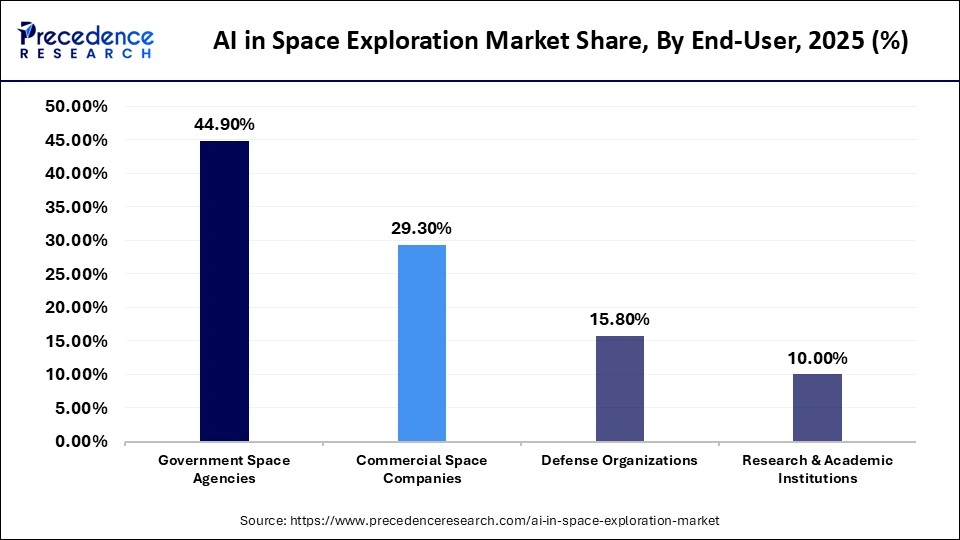
The commercial space companies segment is expected to expand at the highest CAGR from 2026 to 2035. The market growth of this segment is due to the growth of satellite constellations and launch programs carried out by companies. Private companies are actively investing in AI for autonomous spacecraft operations, real-time data analytics, and cost optimization. The rising trend of commercialization of space programs, including earth observation, is further driving the need among private companies for sophisticated AI solutions.
Regional Insights
How Big is the North America AI in Space Exploration Market Size?
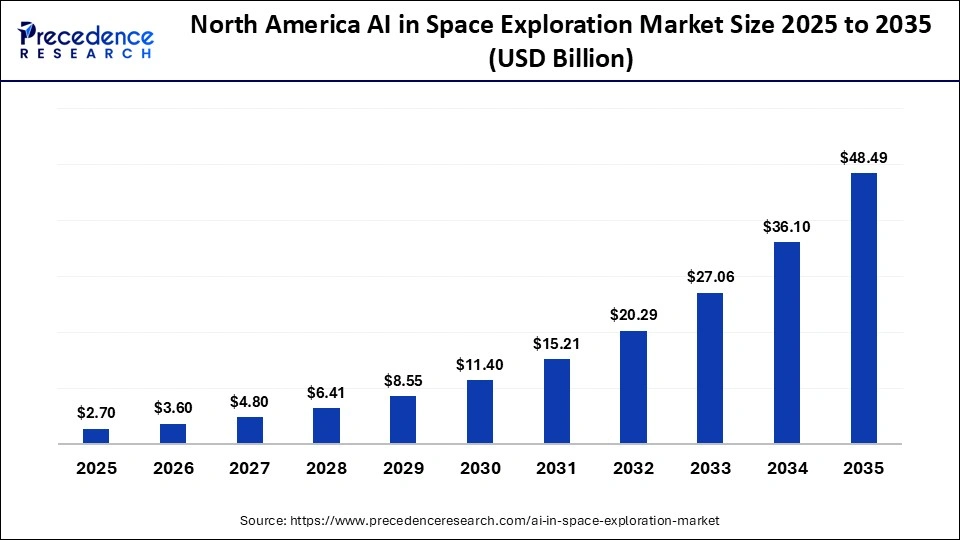
The North America AI in space exploration market size is estimated at USD 2.70 billion in 2025 and is projected to reach approximately USD 48.49 billion by 2035, with a 33.48% CAGR from 2026 to 2035.
What Made North America the Leading Region in the AI in Space Exploration Market? 
North America led the market with the largest share of 43.7% in the global market in 2025. The market growth in this region can be attributed to its robust space ecosystem and early adoption of advanced technologies. This region has a significant presence of prominent space agencies and leading private space companies driving large-scale missions and satellite deployments. Advanced AI developers, semiconductor firms, and aerospace manufacturers form a powerful technology backbone. The market growth in this region is further driven by collaboration between the government and private companies for research and development of AI in space technologies.
What is the Size of the U.S. AI in Space Exploration Market?
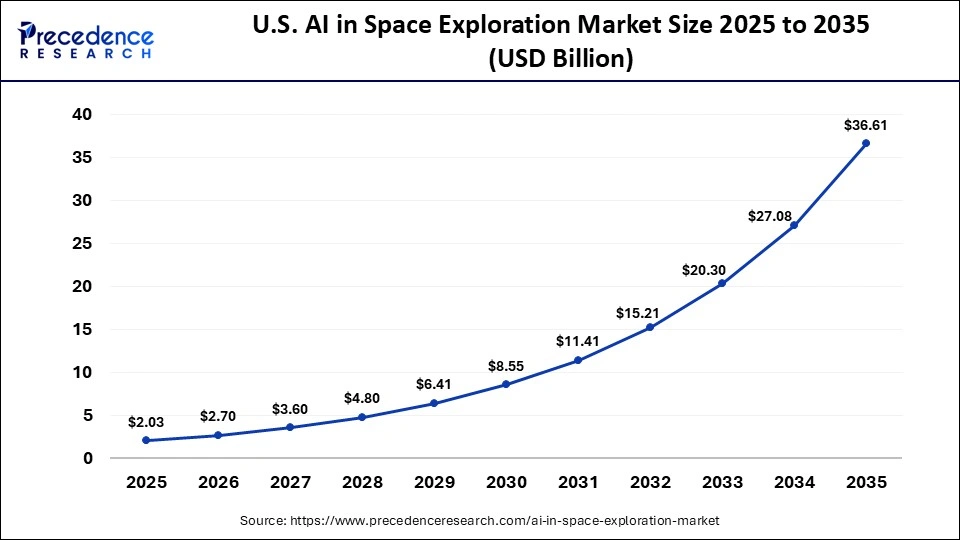
The U.S. AI in space exploration market size is calculated at USD 2.03 billion in 2025 and is expected to reach nearly USD 36.61 billion in 2035, accelerating at a strong CAGR of 33.54% between 2026 and 2035.
U.S AI in Space Exploration Market Analysis
The U.S. leads the market in North America due to well developed space industry with robust federal and private funding. NASA contributes significantly to the market by developing space programs that perform deep space missions with the integration of AI, along with autonomous spacecraft systems and planetary exploratory programs. This country has a presence of prominent technology companies that provide AI chips and software specific to the field. The market growth in the U.S is further driven by robust defense spending, satellite launch programs, and rapid innovation in the integration of AI in space technologies.
Why is Asia Pacific the Fastest Growing Region in the AI in Space Exploration Market?
Asia-Pacific is expected to grow at the highest CAGR during the forecast period. The market growth in this region can be attributed to significant spending on AI research and incorporating intelligent systems into space vehicles, satellites, and ground operations. The increase in the number of commercial space startups is another factor contributing to the demand for AI solutions in the region. The market growth in this region is further driven by rising emphasis on earth observation, defense surveillance, and satellite communication.
China AI in Space Exploration Market Trends
China led the market in the Asia Pacific due to significant investments in cutting-edge technologies in deep space missions and satellite technology. China is using AI technology in its space exploration programs on the moon and Mars, and in the space stations it has built. There is a rapid growth in the Chinese satellite system used in communication and navigation satellites. The market growth in this country is further driven by the rising number of space programs and emphasis on technological independence.
Who are the Major Players in the Global AI in Space Exploration Market?
The major players in the AI in space exploration market include NASA, European Space Agency (ESA), SpaceX, Blue Origin, Lockheed Martin Corporation, Northrop Grumman Corporation, Boeing, Airbus Defense and Space, Thales Alenia Space, Maxar Technologies
Recent Developments
- In August 2025, Wukong AI launched the Wukong AI assistant, which is capable of navigation, planning, and coordination on the Tiangong space station. This product is one of the first AI assistants to be deployed on a crewed spacecraft. This AI assistant helps the crew plan trajectory and spacecraft safety surveillance. (Source: https://www.techinasia.com)
- In June 2025, Planetek Italia launched AIX-1 with the support of the European Space Agency's InCubed program, which comprises small satellites capable of supporting AI and machine learning applications. These applications facilitate edge computing and data processing in orbit to support more efficient and smarter earth observation activities.(Source: https://www.planetek.it)
Segments Covered in This Report
By Component
- Software
- Hardware
- Services
By Application
- Mission Planning & Optimization
- Autonomous Navigation & Guidance
- Earth Observation & Data Analysis
- Spacecraft Health Monitoring & Predictive Maintenance
- Robotics & Planetary Exploration
By Platform
- Satellites
- Space Probes & Rovers
- Launch Vehicles
- Space Stations & Habitats
By End User
- Government Space Agencies
- Commercial Space Companies
- Defense Organizations
- Research & Academic Institutions
By Region
- North America
- Europe
- Asia-Pacific
- Latin America
- Middle East & Africa
For inquiries regarding discounts, bulk purchases, or customization requests, please contact us at sales@precedenceresearch.com
Frequently Asked Questions





Ask For Sample
No cookie-cutter, only authentic analysis – take the 1st step to become a Precedence Research client
 Get a Sample




 sales@precedenceresearch.com
 Schedule a Meeting
