



AI and ML in Oil and Gas Market Trends, Companies, Revenue / Sales Performance, Subscriber Growth, Pricing Strategies, Cloud Adoption, Infrastructure Expansion, Competitive Landscape, and Industry Outlook
AI and ML in Oil and Gas Market (By Operation: Upstream (Exploration & Production), Midstream (Pipeline & Storage), Downstream (Refining & Distribution); By Technology: Machine Learning (ML), Deep Learning and Neural Networks, Computer Vision Natural Language Processing (NLP); By Application: Predictive Maintenance, Production Optimization, Exploration and Reservoir Modeling, Safety & Emissions Monitoring; By Component: Software, Hardware (Sensors/Edge Devices), Services (Consulting/Integration)) - Global Industry Analysis, Size, Trends, Leading Companies, Regional Outlook, and Forecast 2026 to 2035
Source: https://www.precedenceresearch.com/ai-and-ml-in-oil-and-gas-market
 Get a Sample
 Table Of Content


What is the AI and ML in Oil and Gas Market Size in 2026??
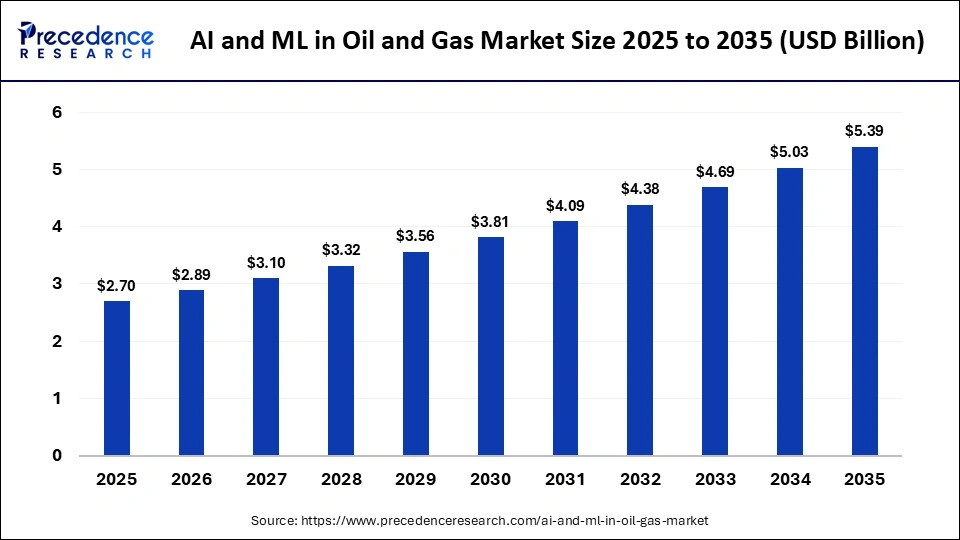
The global AI and ML in oil and gas market size was calculated at USD 2.70 billion in 2025 and is predicted to increase from USD 2.89 billion in 2026 to approximately USD 5.39 billion by 2035, expanding at a CAGR of 7.15% from 2026 to 2035.The market growth is primarily driven by the rising need for enhanced safety, operational efficiency, and sustainable practices across the oil and gas sector.
Key Takeaways
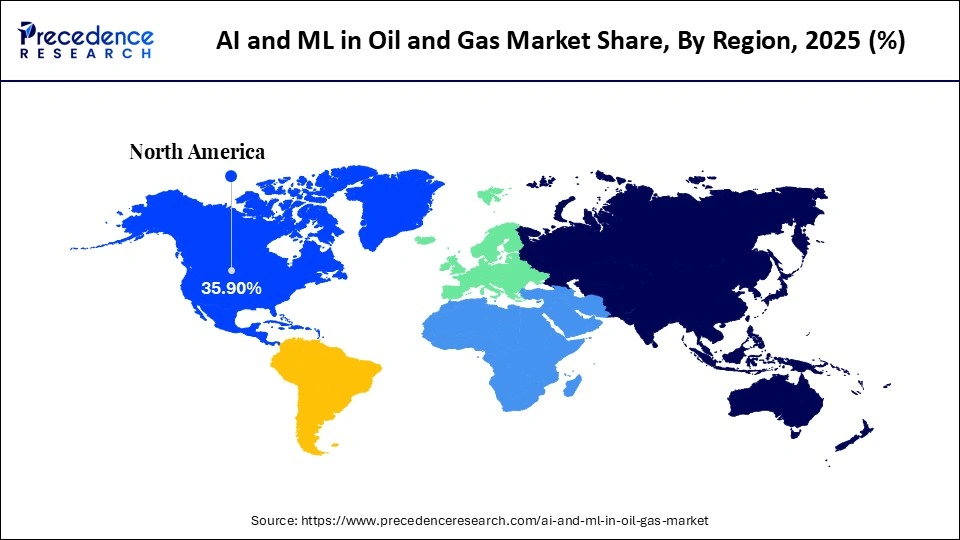
- By region, North America held the largest market share of nearly 35.9% in 2025.
- By region, Asia Pacific is expected to grow at the fastest CAGR during the foreseeable period.
- By operation, the upstream segment held the largest market share of nearly 45.8% in 2025.
- By operation, the midstream segment is projected to grow at the fastest CAGR during the foreseeable period.
- By technology, the machine learning segment held the largest market share of nearly 49.2% in 2025.
- By technology, the deep learning and neural networks segment is expected to grow at the fastest CAGR of nearly 14.7% during the foreseeable period.
- By application, the predictive maintenance segment held a major market share of nearly 29.2% in 2025.
- By application, the safety and emission monitoring segment is projected to grow at the fastest CAGR of nearly 15.2% during the foreseeable period.
- By component, the software segment held the largest market share of nearly 47.1% in 2025.
- By component, the hardware segment is projected to grow at the fastest CAGR in the coming years.
Market Overview
The AI and ML in oil and gas market refers to the integration of AI technologies in the oil & gas sector to increase operational efficiency, safety, and sustainability across the entire energy value chain, including upstream and downstream. The sector is rapidly shifting toward data-driven autonomous operations from manual processes to reduce costs, optimize production, and comply with environmental, social, and governance standards. AI and ML leverage vast amounts of seismic and geological data to detect drilling locations with high potential, accelerating further operations in less time than traditional methods.
The market is rapidly growing due to the rise of generative AI, edge AI, and digital twins to simulate, monitor, and optimize performance in real time. Additionally, the ability of AI and ML technologies to process massive datasets, automate complex decision-making in real time, and optimize exploration, drilling, and production activities is further accelerating adoption.
AI and ML in Oil and Gas Market Trends
- The industry is rapidly shifting toward predictive algorithms and Agentic AI to make real-time decisions for drilling, production, and refining processes without human support.
- There is a high need for predictive and prescriptive maintenance, where AI analyzes sensor data to anticipate equipment failures before they occur, providing sufficient time for repairs or replacements. This approach is transforming traditional preventive maintenance into more advanced self-healing methods, enhancing operational efficiency and reducing downtime.
- The use of generative AI is increasing for knowledge management, analyzing massive unstructured datasets such as reports and technical papers to accelerate research, ensure compliance, and support faster, more informed decision-making.
- The implementation of edge AI on remote offshore rigs and isolated pipelines to handle low latency is another significant trend in the market, fueling the growth of the market.
Market Scope
| Report Coverage | Details |
| Market Size in 2025 | USD 2.70 Billion |
| Market Size in 2026 | USD 2.89 Billion |
| Market Size by 2035 | USD 5.39 Billion |
| Market Growth Rate from 2026 to 2035 | CAGR of 7.15% |
| Dominating Region | North America |
| Fastest Growing Region | Asia Pacific |
| Base Year | 2025 |
| Forecast Period | 2026 to 2035 |
| Segments Covered | Operation, Technology, Application, Component, and Region |
| Regions Covered | North America, Europe, Asia-Pacific, Latin America, and Middle East & Africa |
Segment Insights
Operation Insights
Why Did the Upstream Segment Dominate the AI and ML in Oil and Gas Market?
The upstream segment dominated the market with the largest share of nearly 45.8% in 2025. This is because exploration and production activities generate massive volumes of complex data from seismic surveys, drilling operations, and reservoir monitoring, which require AI and ML for real-time analysis and decision-making. Implementing predictive maintenance, automated drilling optimization, and reservoir modeling allows companies to reduce operational risks, improve efficiency, and lower costs, making AI integration particularly critical in upstream operations.
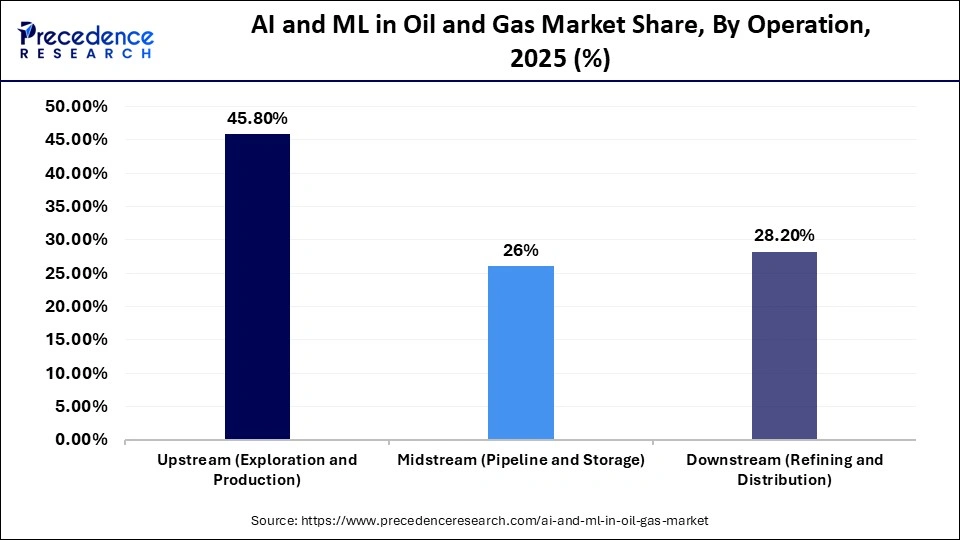
The midstream segment is expected to grow at the fastest CAGR during the foreseeable period due to increasing demand for real-time monitoring, predictive maintenance, and optimization of pipelines, storage facilities, and transportation networks. AI and ML enable operators to detect leaks, predict equipment failures, optimize flow rates, and improve safety and efficiency across long-distance transmission systems, driving higher adoption in midstream operations.
Technology Insights
Why Does the Machine Learning Segment Lead the AI and ML in Oil and Gas Market?
The machine learning segment led the market, holding the largest share of nearly 49.2% in 2025 due to its ability to directly resolve complex issues regarding predictive maintenance, drilling optimization, and interpretation of seismic data that eventually offers a rapid return on investment. Machine learning possesses the ability to analyze complex and huge volumes of data, allowing engineers to identify exact spots of oil/gas reservoirs with higher accuracy than conventional methods. ML can identify unusual patterns present in IoT data to find out pipeline leakage and reduce risks and save costs as well.
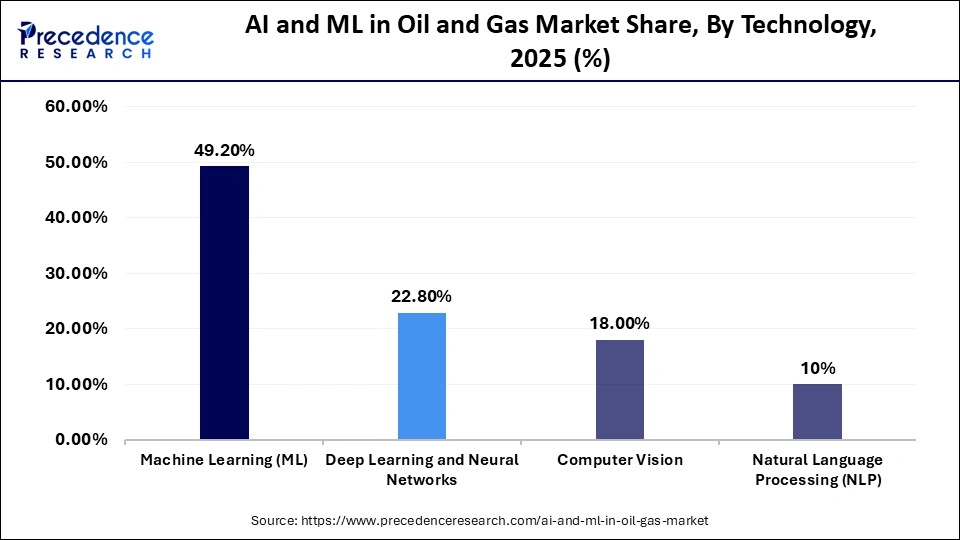
The deep learning and neural networks segment is expected to grow at the fastest CAGR of nearly 14.7% during the foreseeable period. This is because these technologies are crucial for interpreting a vast amount of 3D seismic data and surface imagery to detect the reservoir's location. The high-velocity time series data can be analyzed with the help of neural networks from sensors and detect anomalies, predicting failure possibilities, which significantly prevents costly downtime. Deep learning and neural networks are crucial even for drilling optimization, as they analyze drilling parameters like speed, weight, or bit.
Application Insights
Why Did the Predictive Maintenance Segment Dominate the Market?
The predictive maintenance segment dominated the AI and ML in oil and gas market by holding a major share of nearly 29.2% in 2025 thanks to its ability to anticipate equipment failures, lower maintenance costs, and prolong the life of critical assets. By detecting potential issues early, companies can reduce operational downtime and improve overall process efficiency. This approach enables maintenance only when necessary, delivering strong ROI while enhancing safety and reliability across oil and gas operations, further driving adoption in the sector.
The safety and emission monitoring segment is expected to grow at the fastest CAGR of nearly 15.2% during the foreseeable period, driven by stringent environmental and safety regulations and the financial imperative to prevent unplanned shutdowns. Regulatory frameworks such as the EPA Act in the U.S. and EU environmental directives are compelling oil and gas companies to implement continuous emission monitoring systems. This ensures compliance, reduces environmental risks, and supports operational efficiency, boosting demand for AI- and ML-enabled monitoring solutions.
Component Insights
What Made Software the Leading Segment in the Market?
The software segment led the AI and ML in oil and gas market with the largest share of nearly 47.1% in 2025. This is mainly due to its crucial role in enabling digital transformation in the oil and gas industry, with the urgent need to process vast and complex datasets and increase safety measures through predictive analytics. The software acts as the core foundation to develop and deploy AI/ML models to regulate critical tasks like device maintenance, demand forecasting, and the prediction of reservoirs with exact location via analyzing IoT sensor data.
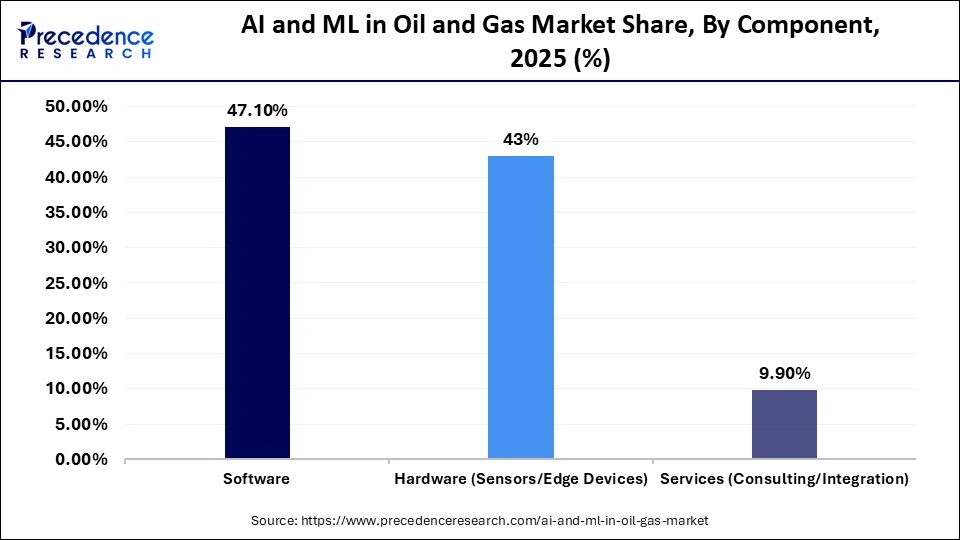
The hardware segment is expected to grow at the fastest CAGR during the foreseeable period, driven by the increasing need for on-site processing to manage, control, and optimize operations like drilling without relying on cloud computing. The widespread deployment of IIoT sensors on wells, pipelines, and machinery is critical for collecting high-fidelity data to feed AI models. These devices ensure precise, real-time data capture, making the hardware segment an essential component of AI-driven oil and gas operations.
Regional Analysis
North America AI and ML in Oil and Gas Market Size and Growth 2026 to 2035
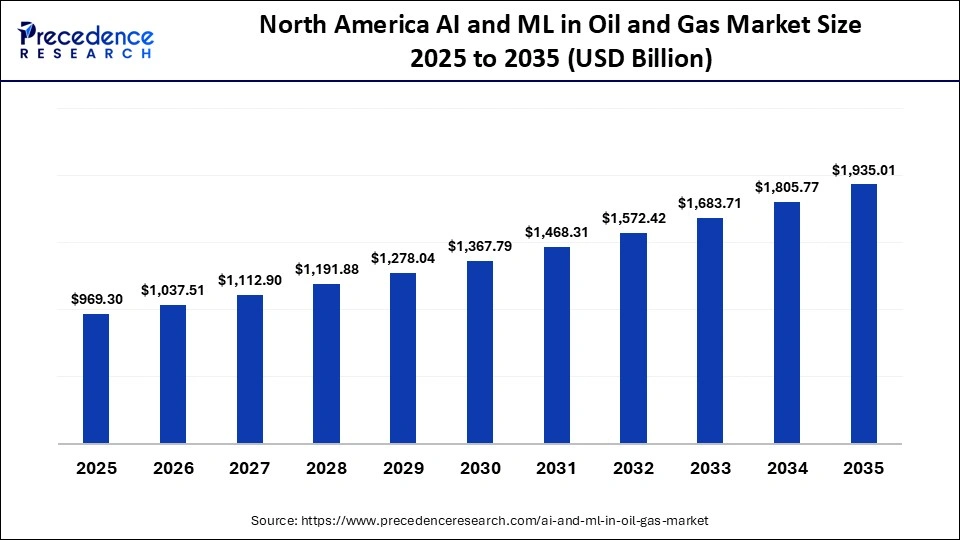
The North America AI and ML in oil and gas market size is estimated at USD 969.30 billion in 2025 and is projected to reach approximately USD 1935.01 billion by 2035, with a 2% CAGR from 2026 to 2035.
What Made North America the Dominant Region in the AI and ML in Oil and Gas Market?
North America dominated the AI and ML in oil and gas market by capturing the largest share of nearly 35.9% in 2025. The region's dominant position in the market is attributed to a combination of factors like its mature digital infrastructure, substantial research & development investments, and an early adoption of AI technologies in various industries, including oil & gas. The region also benefits from a skilled workforce and a widespread implementation of predictive maintenance and automation. Strong government and private investments for developing AI/ML models tailored to upstream, midstream, and downstream operations also reinforce the region's dominance in the market.
U.S. AI and ML in Oil and Gas Market Size and Growth 2026 to 2035
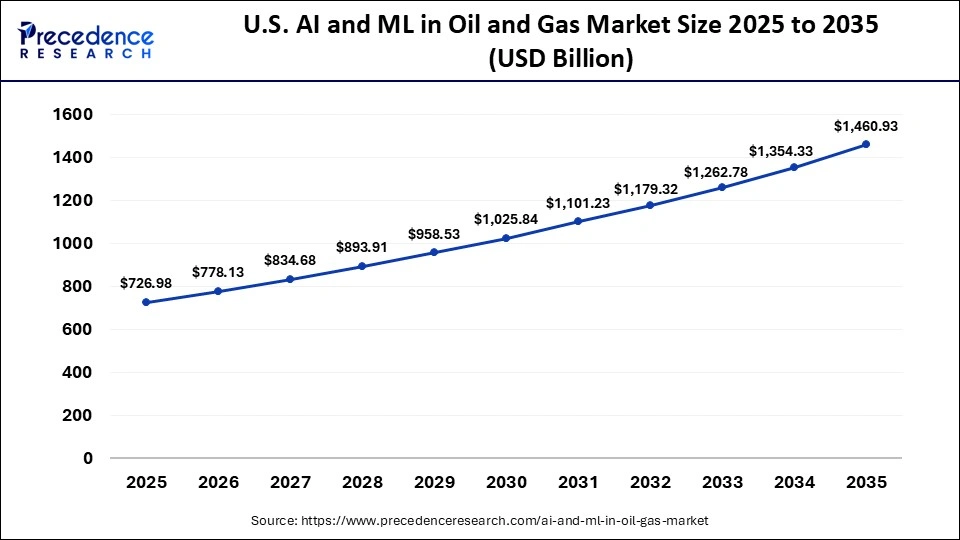
The U.S. AI and ML in oil and gas market size is calculated at USD 726.98 billion in 2025 and is expected to reach nearly USD 1,460.93 billion in 2035, accelerating at a strong CAGR of 7.23% between 2026 and 2035.
U.S. AI and ML in Oil and Gas Market Analysis
The U.S. is a major contributor to the North American market, supported by a robust ecosystem of AI/ML technologies, digital twins, and automated drilling methods. The country's energy sector is rapidly evolving under the Industry 4.0 revolution, requiring advanced AI solutions to optimize operations and ensure long-term sustainability. By integrating AI/ML expertise with upstream, midstream, and downstream oil and gas operations, the U.S. reinforces its position as the leading contributor to regional market growth.
What Makes Asia Pacific the Fastest-Growing Region in the AI and ML in Oil and Gas Market?
Asia Pacific is expected to grow at the fastest CAGR during the foreseeable period, driven by strong government initiatives supporting digitalization across upstream and downstream operations. The adoption of AI-driven drilling, predictive maintenance, and process optimization is rising across the region, enabling faster and more efficient production compared to conventional methods. Key countries in the region are heavily investing in smart infrastructure and IoT technologies, providing the critical foundation for AI/ML integration and fueling market expansion.
China AI and ML in Oil and Gas Market Analysis
The AI and ML in oil and gas market in China is rapidly expanding as the country prioritizes intelligent, automated, and green energy infrastructure alongside strategic modernization of its energy sector. Leading state-owned enterprises such as CNPC, CNOOC, and Sinopec are actively deploying AI/ML models for predictive maintenance, operational optimization, and efficiency improvements, further reinforcing the region's market growth. The government's push for industrial digitalization, coupled with increasing demand for efficient production and predictive maintenance, is accelerating adoption.
How is Europe Growing in the AI and ML in Oil and Gas Market?
Europe is considered to be a significantly growing area, due to the increasing demand for energy security, operational efficiency, and stringent decarbonization mandates. In response to geopolitical disruptions, European producers are leveraging AI to enhance the reliability of their supply chains and maximize efficiency in mature, high-cost fields. Strict EU environmental policies are compelling companies to utilize AI for monitoring methane emissions and improving sustainability.
Germany Market Trends
Germany is spearheading the green industrial revolution by integrating advanced AI, the IIoT, and digital twin technology. The country is home to the world's first fully AI-driven adaptive plant in Erlangen. By employing predictive maintenance, energy-efficient software, and AI-driven renewable forecasting, the manufacturing sector is transforming ESG standards into high-efficiency, real-time industrial operations.
Which Factors Drive the AI and ML in Oil and Gas Market in Latin America?
Latin America is expected to grow at a notable CAGR in the foreseeable future, primarily due to the urgent need to optimize mature and ultra-deepwater assets and the necessity for cost efficiency in volatile markets. The high upfront CAPEX and operating costs are driving the adoption of ML for predictive maintenance to reduce unplanned downtime. Concession contracts in Brazil are pushing companies to invest in research and development, resulting in a surge of AI projects focused on IoT sensors aimed at maximizing recovery rates.
Brazil Market Trends
Brazil is transforming, with Petrobras revolutionizing deepwater extraction and evolving into a global AI-driven energy powerhouse. This transition includes advancements in subsea machine learning, a large-scale rollout of ChatPetrobras GenAI, and the adoption of digital twin technology. These initiatives are maximizing production efficiency, reducing drilling costs, and decreasing carbon footprints in the complex pre-salt region.
Will the Middle East and Africa Grow in the AI and ML in Oil and Gas Market?
The Middle East and Africa are expected to experience notable growth in the coming years. This growth is primarily driven by the urgent demand for cost reduction, operational efficiency, and environmental compliance, which is transforming AI from a pilot project into a foundational technology. National oil companies in the UAE and Saudi Arabia are adopting AI aggressively to fulfill national visions, making substantial investments in digital infrastructure for monitoring emissions and managing carbon capture.
UAE Market Trends
The UAE is positioning itself as the world's most AI-native energy company, spearheading a significant investment boom through ADNOC and initiatives like ENERGYai and the AIQ joint venture by integrating intelligent technology across the value chain, from minimizing shutdowns to fostering local manufacturing for sustainable, AI-driven energy production, and setting a benchmark in the industry.
Supply Chain Analysis - AI and ML in Oil and Gas Market
- Research and Exploration
This focuses on identifying, evaluating, and modeling potential oil and gas reservoirs using AI to process huge datasets, reducing exploration risks and speeding up the decision-making process.
Key Players: Schlumberger, Halliburton, Baker Hughes, Shell, BP, and Earth Analytics. - Drilling and Field Development
In this, AI is applied to optimize the drilling process, improve wellbore stability, and enhance safety.
Key Players: ADNOC and G42, Schlumberger, ExxonMobil, and Equinor. - Production and Operation Optimization
This involves managing active wells and surface equipment to maximize yield, minimize downtime, and reduce operational expenses.
Key Players: C3.ai, SparkCognition, Akselos, ABB, Honeywell, and Siemens. - Logistics, Transportation, and Storage
This focuses on AI, which optimizes the movement of raw hydrocarbons from production sites to refineries, ensuring pipeline integrity and improving supply chain efficiency.
Key Players: Satelytics, Master of Code Global, DNV, and IBM.
AI and ML in Oil and Gas Market Companies
- Emerson Electric Co. (USA)
- Schlumberger (SLB) (USA)
- Halliburton (USA)
- Baker Hughes (USA)
- IBM Corporation (USA)
- Microsoft (Azure AI) (USA)
- Google (DeepMind/Cloud) (USA)
- NVIDIA Corporation (USA)
- Aspen Technology, Inc. (USA)
- C3.ai, Inc. (USA)
- Schneider Electric (France)
- Siemens AG (Germany)
- ABB Ltd. (Switzerland)
- Honeywell International Inc. (USA)
- AIQ (Joint venture between ADNOC and G42, UAE)
Recent Developments
- In January 2026, ONGC went live with Pragya-AIX, its AI and Innovation Exchange, integrating 26 intelligent applications into a unified digital platform. This marks a significant leap in digital transformation for the national oil company, bringing AI from pilot projects to a practical ecosystem that enhances daily operations across its workcentres. (Source: https://www.psuconnect.in)
- In November 2025, ADNOC partnered with SLB and Cognite to launch an AI-powered production optimization platform across its upstream operations, aiming to enhance productivity and decision-making. Announced at ADIPEC 2025, the phased deployment will cover all 25 onshore and offshore fields by 2027. The AiPSO platform integrates millions of real-time data points and uses advanced analytics and machine learning to predict issues, optimize performance, and boost production capacity.(Source: https://finance.yahoo.com)
Segments Covered in the Report
By Operation
- Upstream (Exploration & Production)
- Midstream (Pipeline & Storage)
- Downstream (Refining & Distribution)
By Technology
- Machine Learning (ML)
- Deep Learning and Neural Networks
- Computer Vision
Natural Language Processing (NLP)
By Application
- Predictive Maintenance
- Production Optimization
- Exploration and Reservoir Modeling
- Safety & Emissions Monitoring
By Component
- Software
- Hardware (Sensors/Edge Devices)
- Services (Consulting/Integration)
By Region
- North America
- Europe
- Asia-Pacific
- Latin America
- Middle East & Africa
For inquiries regarding discounts, bulk purchases, or customization requests, please contact us at sales@precedenceresearch.com
Frequently Asked Questions





Ask For Sample
No cookie-cutter, only authentic analysis – take the 1st step to become a Precedence Research client
 Get a Sample




 sales@precedenceresearch.com
 Schedule a Meeting
