



Apparel Market Size, Companies, Share, Sales Volume, Consumer Demand, Pricing Trends, Distribution Performance, Competitive Positioning, and Growth Forecast
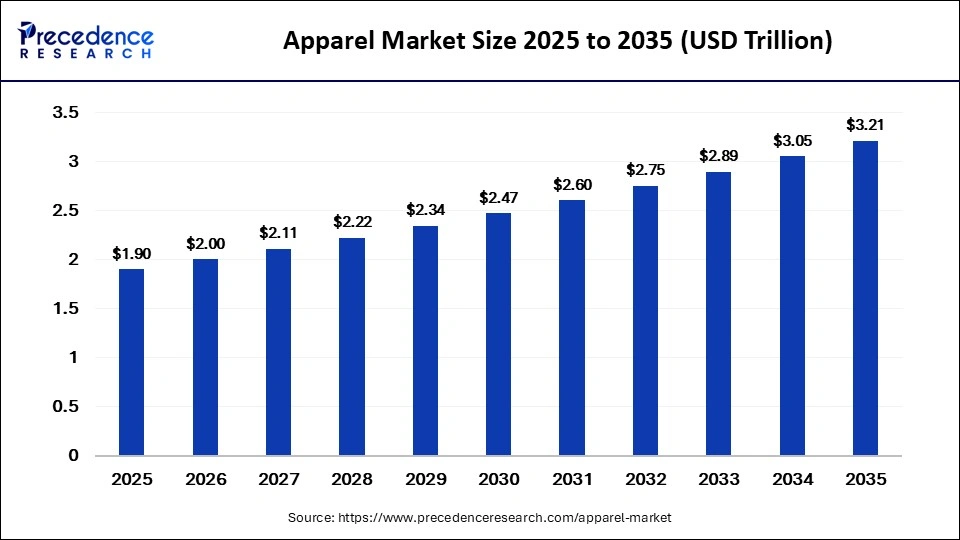
Vidyesh Swar, a Consumer Goods Industry Expert, finds that the apparel market has reached USD 2.00 trillion in 2026 and is projected to reach USD 3.21 trillion by 2035, growing at a CAGR of 5.40%. Leading apparel market brands and companies such as Nike, Adidas, Inditex (Zara), H&M are competing across high-demand segments including By Product Type, By Material, By Sales Channel, By End-Use Industry, By Price Range.
Source: https://www.precedenceresearch.com/apparel-market
 Get a Sample
 Table Of Content


What is the Apparel Market Size in 2026?
The global apparel market size was estimated at USD 1.90 trillion in 2025 and is predicted to increase from USD 2.00 trillion in 2026 to approximately USD 3.21 trillion by 2035, expanding at a CAGR of 5.40% from 2026 to 2035. The market is driven by the rapid growth of digital commerce and social media integration.
Apparel Market Key Takeaways
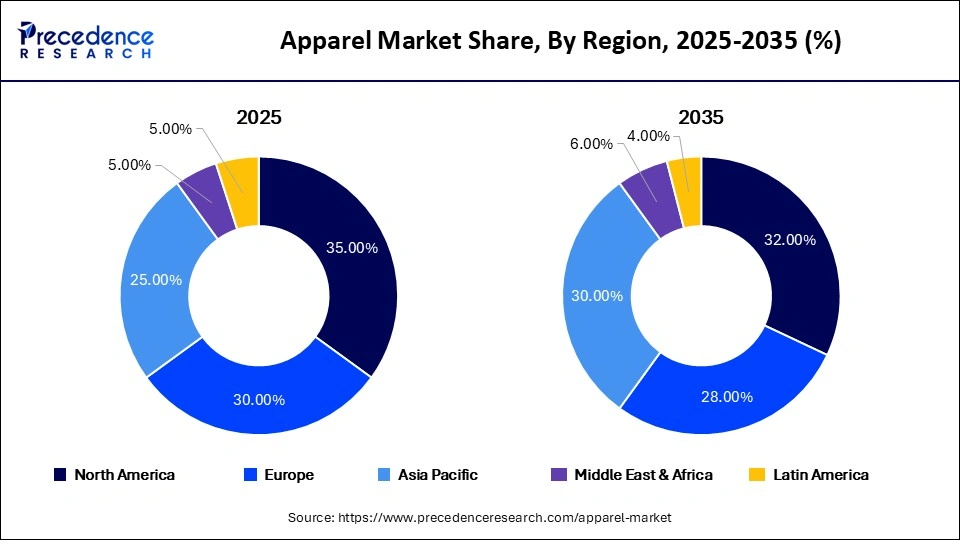
- North America dominated the global apparel market with a share of 35% in 2025.
- Asia-Pacific is expected to grow at the fastest CAGR of 7% during the forecast period.
- By product type, the women's apparel segment led the global market with a share of 40% in 2025 and is expected to grow at the fastest CAGR of 5.6% in the coming years.
- By product type, the men's apparel segment is the second-largest shareholder and is expected to grow at a 4.8% CAGR between 2026 and 2035.
- By material, the cotton segment accounted for a revenue share of 40% in the market in 2025.
- By material, the synthetic fabrics segment is expected to grow at a 6.0% CAGR between 2026 and 2035.
- By sales channel, the offline (retail stores, malls) segment accounted for a revenue share of 55% in the apparel market in 2025.
- By sales channel, the online (e-commerce platforms) segment is expected to grow at the fastest 9% CAGR between 2026 and 2035.
- By end-use, the fashion segment accounted for a revenue share of 55% in the market in 2025.
- By end-use, the sports and activewear segment is expected to grow at the fastest 7% CAGR between 2026 and 2035.
Market Overview
The apparel market refers to the global business sector involved in the design, manufacturing, distribution, and retailing of all types of clothing. It includes garments designed for men, women, and children, mainly sold to end consumers for daily wear, specialized use, or fashion purposes. It is driven by the rapid digitalization and e-commerce expansion, changing consumer lifestyles, the rise of fast fashion fueled by social media, and the increasing need for sustainable and ethical clothing.
Apparel Market Trends
- The focus is changing from "fast fashion" to the circular economy. This includes accelerating resale markets, garment recycling, and even upcycling to reduce environmental impact. Brands are increasing the usage of sustainable materials such as recycled polyester, nylon, and organic fabrics.
- Brands are increasingly bypassing traditional retail to sell directly to users via online platforms. This enables better personalization and customized shopping experiences, catering to user demands for unique products.
- In response to global disruptions, firms are mitigating risks by localizing supply chains or diversifying sourcing. Transparency is paramount, as users increasingly demand to know the origin of their clothes, which includes labor conditions and environmental practices.
How is AI Influencing the Apparel Market?
Artificial Intelligence (AI) is transforming the market by accelerating design cycles, enabling hyper-personalization, and even optimizing supply chains, with the global market growing rapidly. Algorithms analyze social media, sales data, and search trends to predict future styles decreasing overproduction. It facilitates mass customization, tailoring products to individual preferences. AI assists merchandisers in allocating stock to stores based on local need and optimizes inventory levels. AI-driven sewing machines and automated cutting systems increase production efficiency.
Market Scope
| Report Coverage | Details |
| Market Size in 2025 | USD 1.90 Trillion |
| Market Size in 2026 | USD 2.00 Trillion |
| Market Size by 2035 | USD 3.21 Trillion |
| Market Growth Rate from 2026 to 2035 | CAGR of 5.40% |
| Dominating Region | North America |
| Fastest Growing Region | Asia Pacific |
| Base Year | 2025 |
| Forecast Period | 2026 to 2035 |
| Segments Covered | Product Type, Material, Sales Channel, End-Use Industry, Price Range, and Region |
| Regions Covered | North America, Europe, Asia-Pacific, Latin America, and Middle East & Africa |
Market Dynamics
Driver
Expansion of Digital-First Brands
The expansion of digital-first brands is driving the apparel market by leveraging high-speed, data-driven, and even direct-to-consumer models that meet the need for trendy, affordable fashion from Gen Z and millennial users. Digital-first brands are expanding faster than traditional, legacy brands, thus acting as the primary growth engine for the industry, mainly in emerging markets such as India. By interacting directly with users, these brands collect data to create highly personalized, community-led, and niche fashion experiences.
Restraint
Economic Pressures to Regulatory Challenges
Economic pressures and regulatory challenges are considered major restraints for the market because they simultaneously squeeze profit margins, restrict consumer spending, and even force costly operational restructuring. Rising raw materials, energy, and transportation costs have made production more expensive. Cotton prices, for instance, have increased, making it harder to maintain profitability.
Opportunity
Technological Innovation
Technological innovation acts as a key opportunity for the market by driving sustainability, improving personalization, and optimizing supply chains via AI, 3D design, and digital, on-demand production. It enables brands to decrease waste, meet fast-evolving consumer demands for customization, and bridge the gap between digital and physical retail. Technologies such as 3D printing and advanced on-demand knitting enable bespoke products, enabling brands to cater directly to individual consumer preferences.
Segmental Analysis
Product Type Insights
The Women's Apparel Segment Held 40% of Apparel Market Share in 2025
The women's apparel segment dominated the market with a share of 40% in 2025 and is expected to grow at the highest CAGR of 5.6% during the forecast period, owing to the increasing fashion-consciousness among women, the rising need for sustainable and eco-friendly fashion, and the expansion of online retail offerings for women's fashion. The growth of conscious consumerism has driven the need for sustainable clothing, while increasing the adoption of inclusive practices, such as plus-size and adaptive clothing, has expanded the consumer base.
The men's apparel segment held 35% of the market share in 2025 and is expected to grow at a CAGR of 4.8% during the projection period. This is mainly due to the growing need for formal and casual wear, and the growing adoption of activewear and athleisure. Easy online access to diverse products has remarkably boosted sales, particularly among younger demographics. Users are prioritizing long-lasting clothing, leading to premiumization and an aim for better construction.
The children's apparel segment held 25% of the market share in 2025 and is expected to grow at a CAGR of 4.5% during the projection period, driven by growing demand for comfortable and durable children's clothing along with increasing adoption of branded kids' fashion. The "mini-me" trend, where children are now dressed in outfits matching their parents or popular influencers, thus drives high-frequency purchasing. Parents are increasingly accepting of sustainable, organic, and comfortable materials, such as cotton, that are safe for children, driving growth in the premium segment.
Apparel Share, By Product Type, 2025-2035 (%)
| Product Type | 2025 | 2035 | CAGR (%) |
| Men's Apparel | 35.00% | 33.00% | 4.80% |
| Women's Apparel | 40.00% | 42.00% | 5.60% |
| Children's Apparel | 25.00% | 25.00% | 4.5% |
Material Insights
Why Did the Cotton Segment Lead the Apparel Market in 2025?
The cotton segment held a dominant position in the market, with a share of 40% in 2025, driven by the rising user preference for breathable and soft fabrics, and is broadly used in casualwear and comfortable clothing. Cotton is favored now for being comfortable and suitable for a broad range of clothing, from everyday basics to premium apparel.
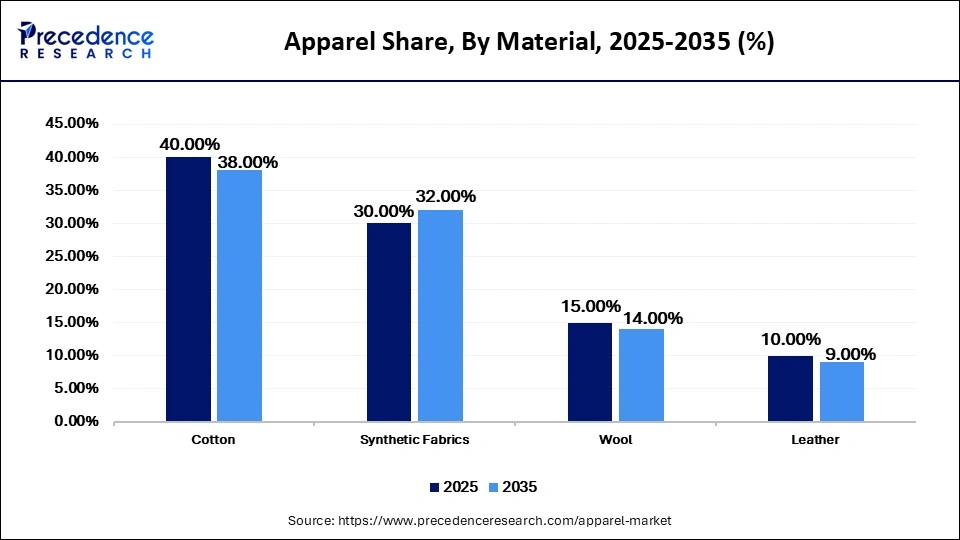
The synthetic fabrics segment held 30% of the market share in 2025 and is expected to grow at the fastest CAGR of 6.0% during the projection period. This is mainly due to the growing need for lightweight, moisture-wicking, and even durable fabrics, increasing use of synthetic fabrics in activewear and athleisure, combined with the rising adoption of synthetic materials in eco-friendly fashion. Synthetic fabrics offer desirable performance characteristics such as stretch spandex, wrinkle resistance, moisture-wicking, and superior durability.
The leather segment held 10% of the market share in 2025 and is expected to grow at a CAGR of 4.2% during the projection period, driven by the strong need for leather jackets, footwear, and accessories. There is an increasing usage of synthetic leather in sustainable fashion, along with the growing popularity of premium and luxury leather products. Genuine leather is widely considered a high-quality, durable material, usually associated with status and premium fashion. Digital, online, and social media marketing have even made it easier to market luxury goods, expanding the user base and enhancing sales.
Apparel Share, By Material, 2025-2035 (%)
| Material | 2025 | 2035 | CAGR (%) |
| Cotton | 40.00% | 38.00% | 4.50% |
| Synthetic Fabrics | 30.00% | 32.00% | 6.00% |
| Wool | 15.00% | 14.00% | 3.80% |
| Leather | 10.00% | 9.00% | 4.20% |
Sales Channel Insights
What Made the Offline (Retail Stores, Malls) Segment Dominant in the Apparel Market?
The offline (retail stores, malls) segment dominated the global market with the largest share of 55% in 2025, because of its strong traditional presence of fashion brands in physical stores, expansion in brick-and-mortar retail growth in emerging markets, and the increasing need for personalized shopping experiences. Consumers increasingly use a hybrid model, researching online but preferring to pick up and return items at a physical location to save on shipping fees.
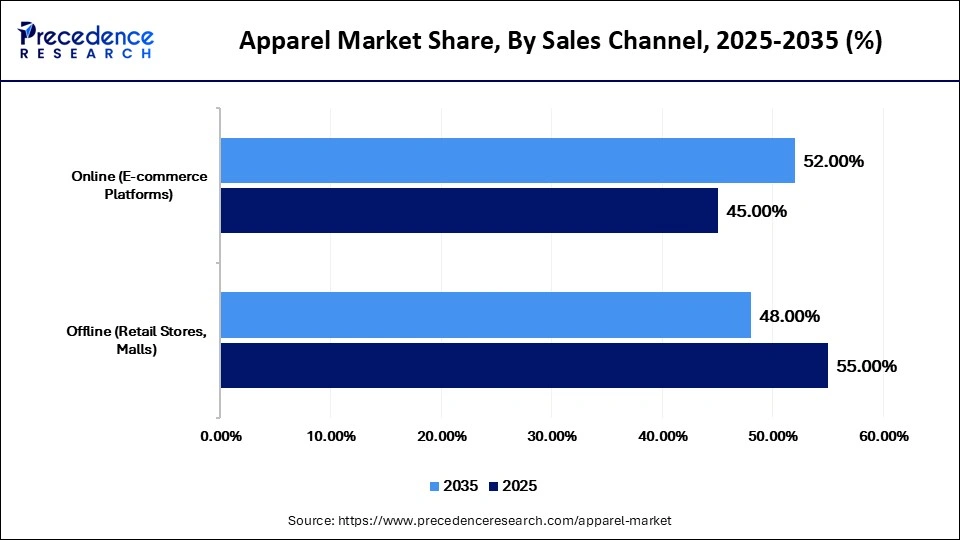
The online (e-commerce platforms) segment held 45% of the market share in 2025 and is expected to grow at the fastest CAGR of 9.0% during the projection period. This is mainly due to the rapid growth of online apparel shopping platforms, the convenience of home delivery, virtual try-ons, and the increasing use of social media and influencer marketing. High-speed internet and smartphone proliferation have made mobile commerce seamless. Technologies such as artificial intelligence, virtual try-ons, and augmented reality have enhanced the shopping experience.
Apparel Share, By Sales Channel, 2025-2035 (%)
| Sales Channel | 2025 | 2035 | CAGR (%) |
| Offline (Retail Stores, Malls) | 55.00% | 48.00% | 4.00% |
| Online (E-commerce Platforms) | 45.00% | 52.00% | 9.0% |
End-Use Industry Insights
The Fashion Segment Held 55% of the Apparel Market Share in 2025
The fashion segment held a dominant position in the market with a share of 55% in 2025 because of the strong need for fashionable apparel and the increasing consumer spending on lifestyle and fashion products. Homegrown brands such as Zudio and D2C startups like Snitch, Newme, and Freakins are capturing market share by aiming at trend-conscious, value-oriented consumers.
The sports and activewear segment held 20% of the market share in 2025 and is expected to grow at the fastest CAGR of 7% during the projection period. This is mainly due to growing participation in sports and fitness activities, and the rising popularity of athleisure and performance apparel. Consumers are prioritizing comfort, contributing to the dominance of apparel that bridges the gap between gym wear and casual fashion. High-performance fabrics that provide durability, moisture management, and comfort are driving demand and allowing for premium pricing.
The casualwear segment held 15% of the market share in 2025 and is expected to grow at a CAGR of 4.2% in the upcoming period, driven by the increasing preference for comfortable and versatile clothing and the rising trend of comfortable clothing in professional environments. Social media, influencers, along with e-commerce, have shortened fashion cycles, enabling rapid adoption of new trends and increased need for affordable, fashionable, and comfortable clothing.
Apparel Share, By End-Use Industry, 2025-2035 (%)
| End-Use Industry | 2025 | 2035 | CAGR (%) |
| Fashion | 55.00% | 58.00% | 5.50% |
| Sports & Activewear | 20.00% | 22.00% | 7.00% |
| Casualwear | 15.00% | 14.00% | 4.20% |
| Formalwear | 10.00% | 6.00% | 3.00% |
Regional Analysis
North America Apparel Market Size and Growth 2026 to 2035
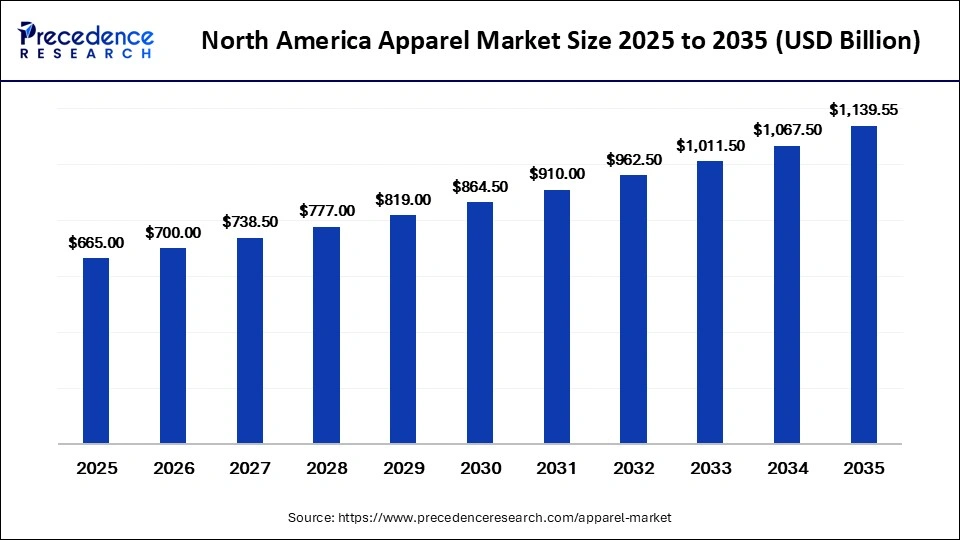
The North America apparel market size was evaluated at USD 665.00 billion in 2025 and is predicted to reach around USD 1,139.55 billion by 2035, expanding at a CAGR of 5.53 % from 2026 to 2035.
Which Factors Drive the Apparel Market in North America?
North America led the market by holding a major share of 35% in 2025. This is due to the strong presence of global apparel brands, fashion-conscious consumers, and high disposable income, along with an increasing shift toward e-commerce and online shopping. Increased need for sustainable, ethically produced clothing and also inclusive sizing attracts modern, conscious consumers.
U.S. Apparel Market Size and Growth 2026 to 2035
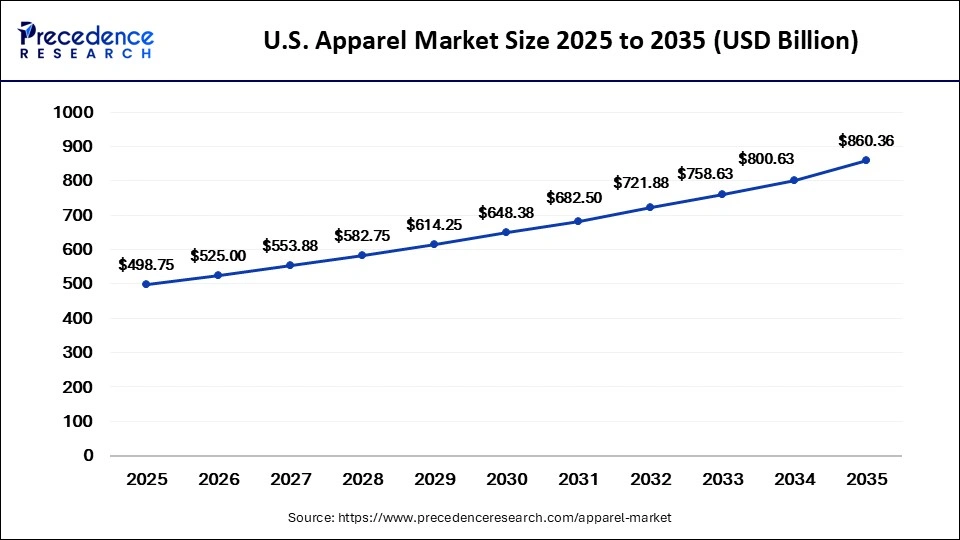
The U.S. apparel market size surpassed USD 498.75 billion in 2025 and is projected to be worth around USD 860.36 billion by 2035, growing at a CAGR of 5.60% from 2026 to 2035.
U.S. Market Analysis
The U.S. leads the North American market, which is driven by high user spending power, a strong preference for branded products, and fast e-commerce adoption. Despite inflation impacting prices, U.S. users continue to show high demand for fashion, mainly as the market pivots toward sustainable and ethical, locally produced alternatives.
How is Europe Growing in the Apparel Market?
Europe held the second-largest market share of 30% in 2025 and is expected to grow at a notable CAGR of 4.8% during the projection period, driven primarily by the high fashion adoption and luxury goods demand, strong presence of leading apparel companies, and even rising need for ethically sourced and sustainable materials. The EU is the world's largest apparel importer, allowing rapid sourcing and product variety, while simultaneously being a top exporter. Paris, Milan, and London remain global fashion capitals, thus anchoring the market's high-end and luxury segments.
France Market Analysis
The French market is growing due to a combination of historic prestige, unrivaled luxury brand dominance, and strategic innovation in sustainability. France is pioneering the fight against fast fashion by setting high sustainability standards, like enacting legislation to combat its ecological footprint. Paris, along with cities such as Lyon, acts as a global center for fashion weeks, trade exhibitions, and sourcing, attracting professionals worldwide.
Will the Asia-Pacific grow in the Apparel Market?
Asia-Pacific held 25% of the market share in 2025 and is expected to grow at the fastest CAGR of 7.0% during the projection period, driven by the rapid urbanization and an expanding middle class, high user demand for affordable and trendy fashion, combined with rising online retailing and access to global fashion brands. The rapid expansion of e-commerce platforms and the adoption of digital tools such as AI and AR by brands to enhance customer experience have accelerated online sales.
Japan Market Analysis
Japan leads the market in Asia-Pacific via a blend of high-quality craftsmanship, innovative functional technology, such as Heattech, and a strong fusion of traditional aesthetics with modern trends. The industry aims for "functional clothing," utilizing advanced materials that provide comfort, performance, and durability, which drives both domestic consumption as well as global export appeal.
Top Companies in the Apparel Market
- Nike
- Adidas
- Inditex (Zara)
- H&M
- Uniqlo
- LVMH (Louis Vuitton)
- PVH Corp.
- Gap Inc.
- Under Armour
- Kering
- Ralph Lauren
- Lululemon
- Next Plc
- Bestseller
- Hanesbrands
Recent Developments
- In February 2026, Ralph Lauren presented its Fall 2026 women's collection with gray-toned corset blazers, velvet dresses, and crystal brooches ahead of the official start of New York Fashion Week. The New York-driven apparel maker's fashion show comes after it raised its annual sales and margin outlook last week. Its core dress and suits designs, combined with price increases, have assisted Ralph Lauren in luring more wealthy Gen Z shoppers. (Source: https://www.reuters.com)
- In December, 2025, H&M announced a collaboration with renowned designer and sustainability pioneer Stella McCartney. The announcement of this pioneering partnership comes almost exactly 20 years to the day Stella McCartney and H&M's debut collaboration launched, H&M's second-ever design collaboration. (Source: https://hmgroup.com)
Segments Covered in the Report
By Product Type
- Men's Apparel
- Women's Apparel
- Children's Apparel
By Material
- Cotton
- Synthetic Fabrics
- Wool
- Leather
- Others
By Sales Channel
- Offline (Retail Stores, Malls)
- Online (E-commerce Platforms)
By End-Use Industry
- Fashion
- Sports & Activewear
- Casualwear
- Formalwear
By Price Range
- Luxury
- Premium
- Mid-range
- Economy
By Region
- North America
- Latin America
- Europe
- Asia-pacific
- Middle and East Africa
For inquiries regarding discounts, bulk purchases, or customization requests, please contact us at sales@precedenceresearch.com
Frequently Asked Questions
Tags





Ask For Sample
No cookie-cutter, only authentic analysis – take the 1st step to become a Precedence Research client
 Get a Sample




 sales@precedenceresearch.com
 Schedule a Meeting
