



Arbovirus Testing Market Size, Companies, Share, Patient Volume, Treatment Adoption Rates, Pricing Analysis, Regulatory Landscape, Competitive Positioning, and Demand Forecast
Arbovirus Testing Market (By Type: ELISA-based Tests, RT-PCR-Based Tests, Other Test Types; By End-Use: Diagnostic Laboratories, Hospitals, Research Centers, Other End-Use) - Global Industry Analysis, Size, Trends, Leading Companies, Regional Outlook, and Forecast 2026 to 2035
Source: https://www.precedenceresearch.com/arbovirus-testing-market
 Get a Sample
 Table Of Content


What is the Arbovirus Testing Market Size in 2026?
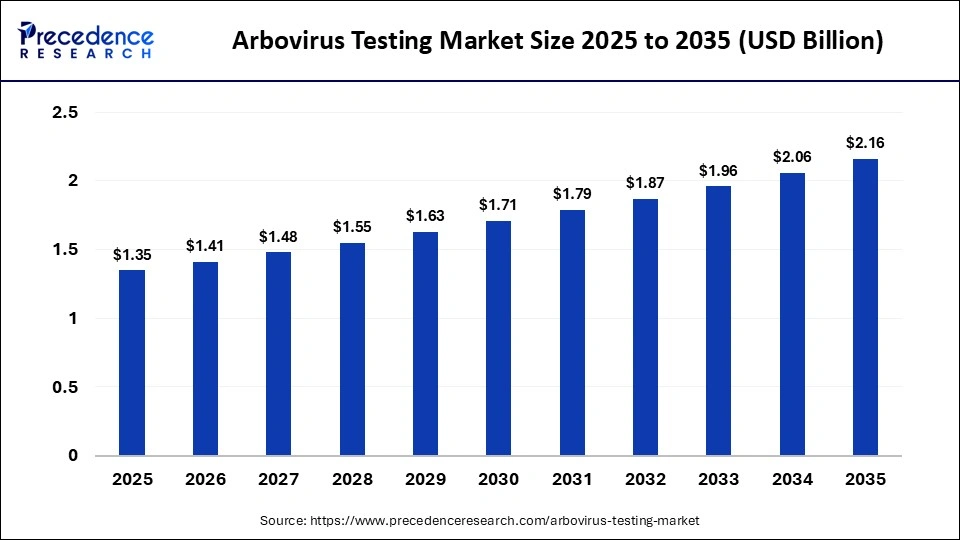
The global arbovirus testing market size was calculated at USD 1.35 billion in 2025 and is predicted to increase from USD 1.41 billion in 2026 to approximately USD 2.16 billion by 2035, expanding at a CAGR of 4.80% from 2026 to 2035.This market is growing due to the rapidly rising global incidence of dengue and Zika outbreaks, which are largely driven by climate change and expanding urbanization.
Key Takeaways
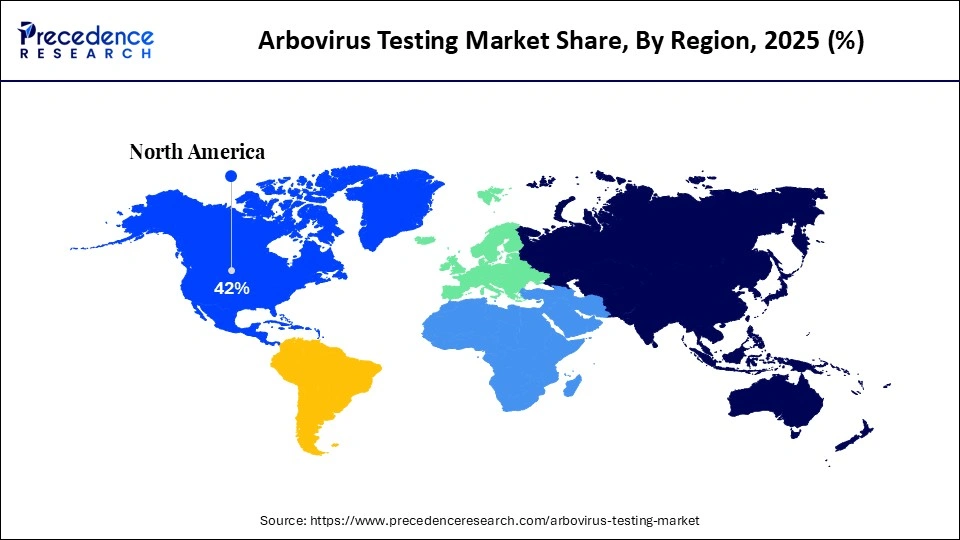
- North America dominated the global arbovirus testing market with the largest share of 42% in 2025.
- Asia-Pacific is expected to grow at the fastest CAGR between 2026 and 2035.
- By type, the ELISA-based tests segment held a dominant position in the market with highest share of 49% in 2025.
- By type, the RT-PCR-based tests segment is expected to expand at the fastest CAGR between 2026 and 2035.
- By end-use, the diagnostic laboratories segment held a major revenue share of the market in 2025.
- By end-use, the research centers segment is expected to expand rapidly between 2026 and 2035.
What Drives the Arbovirus Testing Market?
The arbovirus testing industry is mainly driven by the increasing global incidence of mosquito-borne diseases such as dengue, Zika, and chikungunya, along with climate change expanding vector habitats. Innovation in molecular diagnostics, like RT-PCR and point-of-care testing, e.g., LAMP-based devices, enables faster, more accurate, and even decentralized testing. Increased funding for surveillance, along with the launch of programs such as the WHO Global Arbovirus Initiative improve diagnostic capabilities and infrastructure.
How is AI Influencing Arbovirus Testing?
AI is transforming the market by improving diagnostic accuracy to over 99%, reducing false positives by 22% through machine learning (ML) analysis, and even shortening turnaround times to under 65 minutes via automated, extraction-free workflows. AI-driven ELISA readers and molecular diagnostics raise precision in serotype differentiation, decreasing cross-reactivity. ML enhances pattern recognition in amplification curves, remarkably reducing false positives. AI determines large, complex datasets to predict disease outbreaks, track mosquito vectors, and even create predictive models for transmission dynamics.
What are the Key Trends Influencing the Arbovirus Testing Market?
- Climate Change and Vector Expansion: Warmer temperatures and shifting weather patterns are now expanding the range of Aedes aegypti and a few mosquito vectors, introducing arboviruses into new, previously unaffected regions, which boosts higher testing demand.
- Technological Advancements in Diagnostics: Development of faster and more accurate molecular diagnostic techniques, like PCR, and improved serological assays (ELISA), enables early, accurate detection, usually within point-of-care settings.
- Surge in Disease Prevalence & Outbreaks: A significant raise in reported cases of dengue and Zika globally has thus created an urgent demand for accurate, rapid diagnostic tools to handle outbreaks.
- Rapid Urbanization: Increased population density along with urbanization in tropical regions is thus facilitating rapid transmission of mosquito-borne diseases, and even putting immense pressure on healthcare infrastructure for testing.
Future Arbovirus Testing Market Overview
- Expansion in Emerging Markets – This shift is fueled by a high, growing incidence of diseases such as dengue and chikungunya, alongside raised government investment in diagnostic infrastructure. Further, governments in emerging economies are heavily investing in public health to handle this burden. For example, India has established 805 Sentinel Surveillance Hospitals with many laboratories to support enhancing dengue diagnostic capabilities.
- Infrastructure Development – Infrastructure investment aims on deploying rapid, portable, and easy-to-use molecular tests, for instance, isothermal amplification, in rural and remote locations. This decreases reliance on centralized labs, which currently restrict testing in low-resource settings. The development of integrated, digitized surveillance systems enables real-time monitoring and faster response to outbreaks. This involves the integration of telemedicine for remote consultations and even test orders in underserved areas.
Market Scope
| Report Coverage | Details |
| Market Size in 2025 | USD 1.35 Billion |
| Market Size in 2026 | USD 1.41 Billion |
| Market Size by 2035 | USD 2.16 Billion |
| Market Growth Rate from 2026 to 2035 | CAGR of 4.80% |
| Dominating Region | North America |
| Fastest Growing Region | Asia Pacific |
| Base Year | 2025 |
| Forecast Period | 2026 to 2035 |
| Segments Covered | Type, End-Use, and region |
| Regions Covered | North America, Europe, Asia-Pacific, Latin America, and Middle East & Africa |
Segmental Insights
Type Insights
Which Type Segment Led the Arbovirus Testing Market?
The ELISA-based tests segment led the market in 2025. ELISA tests effectively detect both current and past infections by identifying antigens and antibodies like IgM and IgG, vital for clinical diagnosis and even seroprevalence surveys. Inexpensive, reliable, alongside scalable diagnostic tools, they are now preferred for large-scale screenings and public health monitoring, mainly in low- and middle-income countries. Continuous innovations in ELISA technology, which include automated and multiplex assays, enhance diagnostic accuracy and speed.
The RT-PCR-based tests segment is expected to show the fastest growth over the forecast period. This is due to their high sensitivity, specificity, and capacity for early-infection screening, thus making them the gold standard for detecting viruses such as dengue and Zika. RT-PCR provides superior accuracy in detecting viral RNA compared to conventional serological methods, which usually suffer from cross-reactivity. Expansion of laboratory infrastructure, mainly in developing regions, has increased the availability and acceptance of molecular diagnostics.
End-Use Insights
Why Did the Diagnostic Laboratories Segment Dominate the Arbovirus Testing Market?
The diagnostic laboratories segment contributed the biggest market share in 2025. This is due to their superior infrastructure, high throughput, alongside capacity for accurate molecular testing, such as RT-PCR and serological testing, like ELISA. Their vital role in large-scale disease surveillance, rapid, accurate results, and even handling rising endemic cases solidifies their leading position. The rising global incidence of vector-borne diseases drives the need for professional, reliable, and even swift diagnostic services. They are early adopters of advanced diagnostics, which include automated molecular diagnostics and also rapid, high-sensitivity tests.
The research centers segment is expected to expand rapidly in the market in the coming years. Research centers are heavily targeted on developing new, fast, and accurate diagnostic tools, like CRISPR and isothermal tests, catering to the demand for rapid detection of emerging virus variants. The increased focus on pandemic preparedness and the demand to understand arbovirus behavior led to the high need for research-driven testing solutions.
Regional Insights
North America Arbovirus Testing Market Size and Growth 2026 to 2035
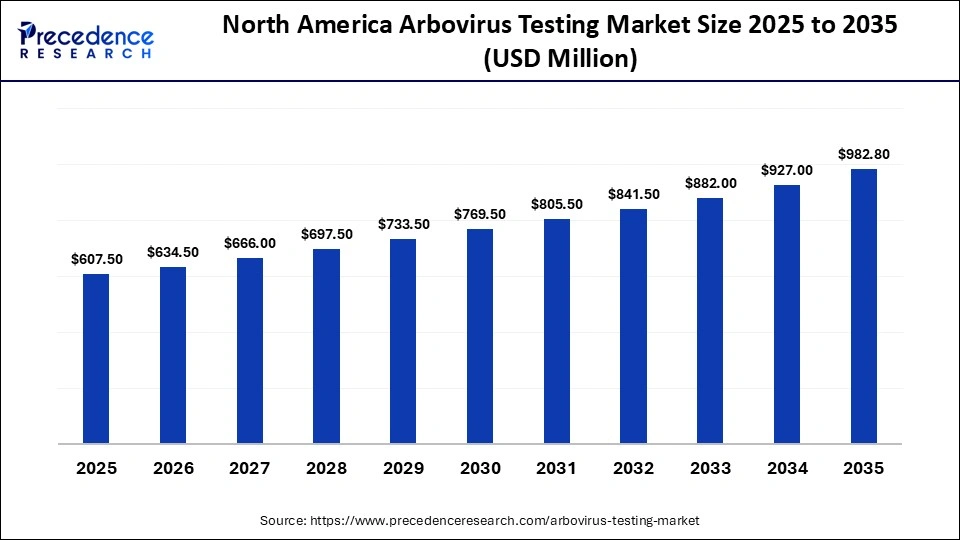
The North America arbovirus testing market size is estimated at USD 607.50 million in 2025 and is projected to reach approximately USD 982.80 million by 2035, with a 4.93% CAGR from 2026 to 2035.
What made North America the Dominant Region in the Arbovirus Testing Market?
North America held a major market share in 2025. It is driven by a combination of epidemiological, infrastructure, technological, and regulatory factors, which together create a strong need for sophisticated testing and surveillance systems. The region has a well-known healthcare system with widespread clinical laboratory networks, research institutions, and public health laboratories capable of performing molecular and serological testing. Meanwhile, investments in outbreak preparedness, epidemiological research support, and vector monitoring systems, as well as consistent procurement of testing solutions.
U.S. Arbovirus Testing Market Size and Growth 2026 to 2035
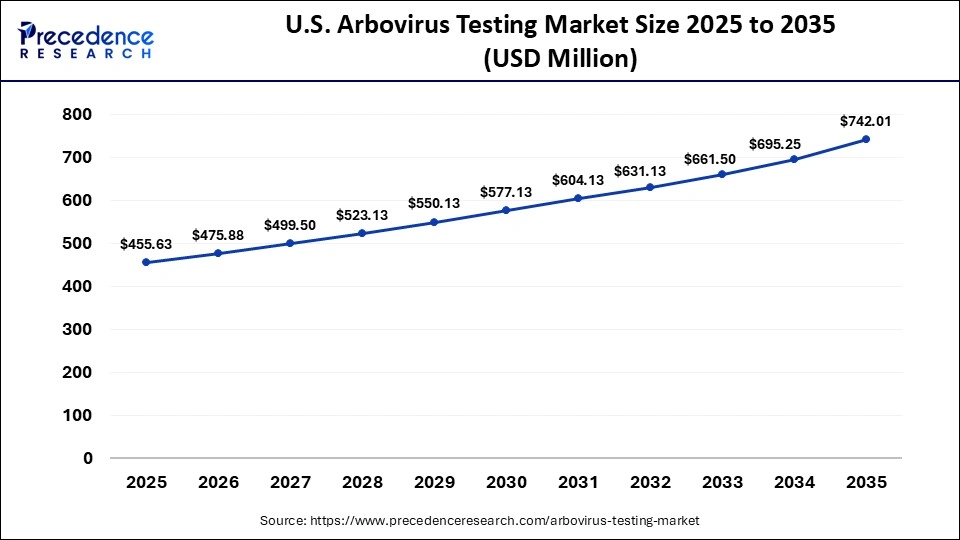
The U.S. arbovirus testing market size is calculated at USD 455.63 million in 2025 and is expected to reach nearly USD 742.01 million in 2035, accelerating at a strong CAGR of 5.02% between 2026 and 2035.
U.S. Market Trends
The U.S. leads the market due to the adoption of molecular diagnostics, like RT-PCR, and rapid point-of-care tests to handle climate-driven outbreaks. There is a strong aim towards rapid diagnostics, which includes CRISPR-assisted molecular tools and AI-improved ELISA readouts, which enhance accuracy and speed. There is a need to shift toward quick, decentralized, and even portable testing solutions for faster results, mainly in areas with limited infrastructure.
What Makes Asia-Pacific the Fastest-Growing Region in the Arbovirus Testing Market?
Asia-Pacific is expected to experience the fastest growth during the predicted timeframe, due to the tropical and subtropical climates, which present ideal conditions for vectors such as Aedes aegypti, thus sustaining transmission and testing needs. Governments in the region have now strengthened public health infrastructure, which includes diagnostic laboratories, surveillance networks, and even fever clinics, partly to enhance early detection and outbreak response. Many countries in the Asia Pacific, for instance, India and Thailand, undergo frequent and large outbreaks of arboviral diseases like dengue and other mosquito-borne infections. These diseases are endemic with seasonal surges, rising routine and outbreak testing needs.
China Market Trends
China's market is driven by increased local transmission of viruses such as dengue and chikungunya in southern China, growing climate change-based mosquito populations, and even strengthened public surveillance systems. Thus, increased outbreaks in southern China, mainly in Guangdong, are fueling the need for local testing solutions.
What Makes Europe a Significant Region in the Arbovirus Testing Market?
Europe is expected to grow at a significant CAGR throughout the forecast period. It is driven by the rising prevalence of vector-borne diseases. Europe presents a compelling opportunity because of its expanding healthcare infrastructure, increasing awareness of arboviral threats like Zika, dengue, chikungunya, and West Nile virus, and an increasing need for advanced diagnostic solutions.
UK Market Trends
The UK's market is driven by the increased usage of tests that can detect multiple pathogens simultaneously, enhancing diagnostic efficiency. Furthermore, there is a shift towards rapid molecular diagnostics, mainly isothermal amplification techniques, which provide faster, cost-effective options to conventional, slower, lab-based tests.
What Makes Latin America a Notable Region in the Arbovirus Testing Market?
Latin America is expected to grow at a notable CAGR throughout the forecast period. It is driven by high infection rates and even significant government investment in diagnostics. High rates of underreporting in rural areas, combined with the need for better differentiation between co-circulating viruses like dengue, Zika, and chikungunya, drive the need for advanced, multiplexed diagnostic solutions. Moreover, to combat high infection rates, regional governments are now heavily investing in public health infrastructure and deploying millions of rapid diagnostic tests as well as molecular tests like RT-PCR.
Brazil Market Trends
Brazil's market is driven by its hyper-endemic status, huge infection volume, and high need for immediate diagnostic solutions. The market is undergoing rapid growth driven by the urgent demand to distinguish between overlapping symptoms of diseases such as dengue, Zika, and chikungunya. The rapid spread of these diseases, mainly in urban areas, forces a high need for testing kits to quickly distinguish between viruses for effective patient treatment.
Will the Middle East and Africa Grow in the Arbovirus Testing Market?
The Middle East and Africa are expected to grow at a considerable CAGR in the upcoming period. It is driven by a combination of high disease burden, rapid urbanization, and increased investment in healthcare infrastructure to combat tropical diseases. The region's market is anticipated to see a significant rise in demand, mainly in GCC countries, which are heavily investing in diagnostic capacity. There is a vast investment in healthcare, with Saudi Arabia, for example, investing significantly in health infrastructure along with laboratory modernization under initiatives such as Vision 2030. Sub-Saharan Africa is thus planning major investments in hospital development.
UAE Market Trends
The UAE's market is driven by a confluence of high disease prevalence, advanced healthcare infrastructure, and aggressive government-driven adoption of rapid, point-of-care (POC) testing technologies. There is a surge in need for and adoption of POC diagnostics that offer results in minutes, vital for immediate management of infectious diseases. The UAE is actively localizing the manufacturing of medical diagnostics to guarantee supply chain security, with projects aimed at building rapid test manufacturing facilities.
Arbovirus Testing Market Value Chain Analysis
- Research and Development
The latest research related to arbovirus testing focuses on rapid, multiplex molecular diagnostics, including advanced genomic and isothermal amplification technologies.
Key Players: Abbott Laboratories, Merck, and F. Hoffmann-La Roche. - Clinical Trials and Regulatory Approval
Novel molecular diagnostics are assessed for their accuracy, efficacy, and precision among humans affected with arboviruses. These devices are then approved by regulatory agencies.
Key Players: BioMérieux, IQVIA, and ICON plc. - Distribution to Hospitals, Pharmacies
Arbovirus testing devices are distributed to hospitals and pharmacies either directly through manufacturers, distributors/wholesalers, or through online platforms.
Key Players: Thermo Fisher Scientific, GT Molecular, and Response Biomedical - Patient Support and Services
Patient support refers to assisting patients with the use of arbovirus testing kits and guiding them about reading results.
Arbovirus Testing Market Companies
- Abbott: Abbott is providing a comprehensive portfolio of rapid point-of-care and molecular assays to diagnose and differentiate diseases such as Dengue, Zika, and Chikungunya. Their specialized solutions are programmed to deliver rapid, accurate results at every clinical stage of infection.
- Thermo Fisher Scientific Inc.: Thermo Fisher Scientific provides rapid, high-throughput real-time PCR kits and assays, like the TaqMan Arbovirus Triplex Kits and TaqPath Tropical Virus Panel. These solutions allow labs to simultaneously detect and differentiate viruses such as dengue, Zika, and chikungunya from a single patient sample.
- NovaTec Immundiagnostica GmbH: NovaTec Immundiagnostica GmbH provides a comprehensive portfolio of ELISA-driven diagnostic test kits specifically designed for the qualitative detection of antibodies such as IgM and IgG, against major arthropod-borne viruses such as Dengue and Zika.
- Agilent Technologies, Inc.: Agilent Technologies, Inc. offers critical analytical instrumentation, software, along with assay solutions used by public health laboratories and researchers for host-pathogen metabolic studies, virology, and arbovirus surveillance.
- QIAGEN: QIAGEN provides an end-to-end "Sample to Insight" workflow for the market, supplying clinical and even research laboratories with automated nucleic acid extraction kits, highly sensitive QIAcuity digital PCR solutions, along with syndromic testing platforms to accurately detect vector-borne diseases such as Dengue, Zika, Chikungunya, and Yellow Fever.
- Bio-Rad Laboratories, Inc.: Bio-Rad Laboratories offers vital tools to the market, aiming on molecular and serological diagnostics. Their core contributions include automated real-time PCR multiplex assays.
Other Major Key Players
- EUROIMMUN Medical Laboratory Diagnostics AG
- Merck KGaA
- F. Hoffmann-La Roche Ltd
- Siemens Healthineers AG
- GT Molecular
- Response Biomedical
- Grifols Diagnostic Solutions
Recent Developments
- In March 2025, Bolivia started its emergency response capabilities for dengue outbreaks with financial assistance from the Directorate-General for European Civil Protection and Humanitarian Aid Operations (DG ECHO). Key actions included the establishment of clinical leaders' network, improved lab diagnostics, and the strengthening of entomology lab networks. (Source: https://www.paho.org)
- In January 2025, QIAGEN declared the U.S. regulatory clearance of the first-in-a-series of QIAstat-Dx Gastrointestinal Panel tests for clinical usage. This clearance by the U.S. Food and Drug Administration (FDA) states the second mini syndromic panel in the U.S. that is made available for use with QIAstat-Dx systems, funding QIAGEN's strategy to enhance patient treatment options.(Source: https://corporate.qiagen.com)
- In April 2024, Grifols declared that it received the CE mark for its latest Procleix ArboPlex Assay under the In Vitro Diagnostic Regulation (IVDR). This assay is an automated nucleic acid test (NAT) for the detection of arboviruses like dengue, chikungunya, Zika viruses, and even West Nile.
Segments Covered in the Report
By Type
- ELISA-based Tests
- RT-PCR-Based Tests
- Other Test Types
By End-Use
- Diagnostic Laboratories
- Hospitals
- Research Centers
- Other End-Use
By Region
- North America
- Asia Pacific
- Europe
- Latin America
- Middle East & Africa
For inquiries regarding discounts, bulk purchases, or customization requests, please contact us at sales@precedenceresearch.com
Frequently Asked Questions
Tags





Ask For Sample
No cookie-cutter, only authentic analysis – take the 1st step to become a Precedence Research client
 Get a Sample
.webp)



 sales@precedenceresearch.com
 Schedule a Meeting
