



Battery Recycling Market Size, Key Companies, Company Market Share, Chip Production Volume, Wafer Capacity, Technology Adoption, Pricing Trends, Competitive Positioning, and Demand Analysis
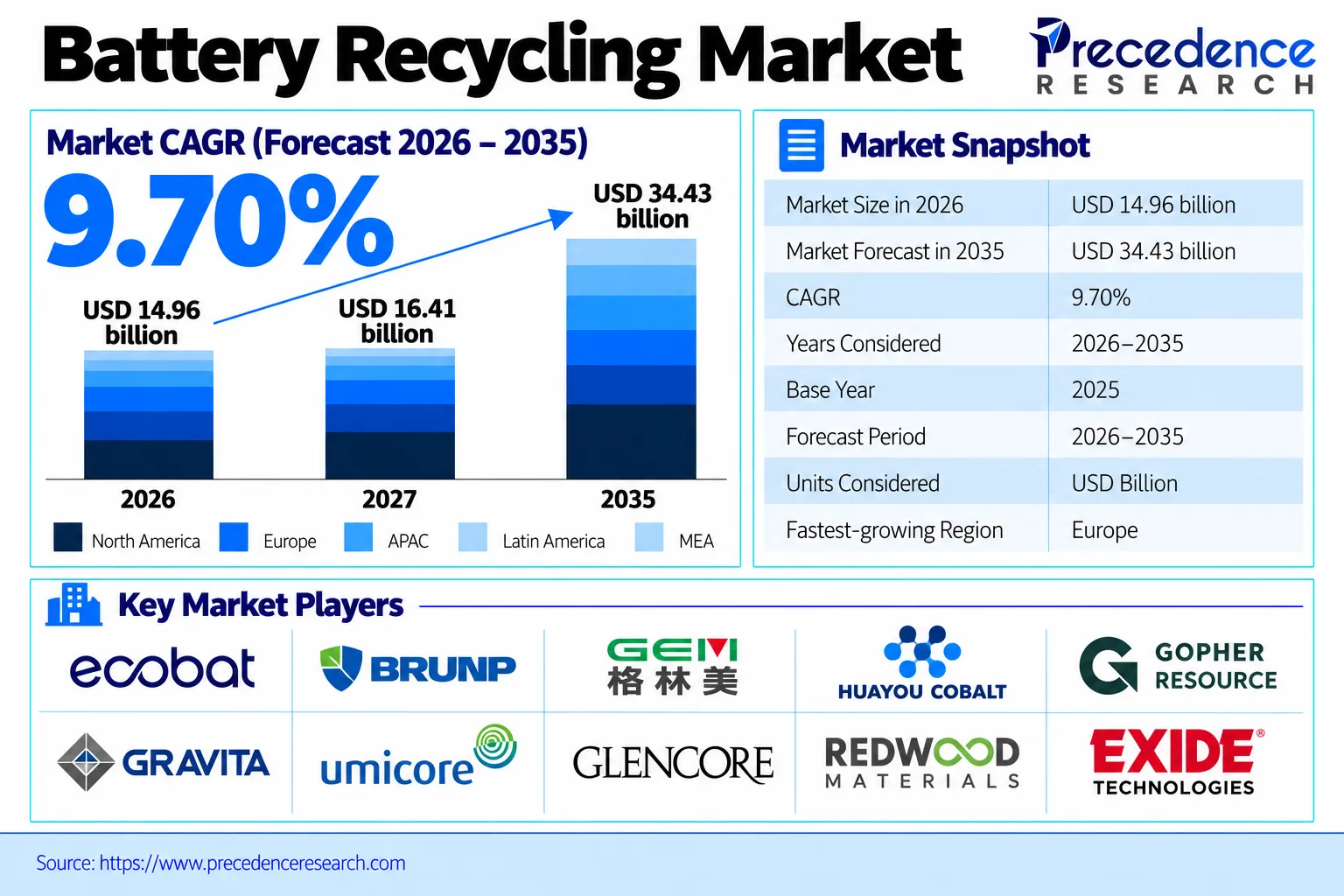
According to semiconductor and electronics specialist Laxmi Narayan, the battery recycling market is valued at USD 14.96 billion in 2026 and is forecast to reach USD 34.43 billion by 2035, reflecting a CAGR of 9.70%. Leading battery recycling market companies, including Ecobat, Brunp Recycling, GEM Co., Huayou Cobalt, are strengthening their presence across key segments such as chemistry, source, process, and region.
Source: https://www.precedenceresearch.com/battery-recycling-market
 Get a Sample
 Report Description


Battery Recycling Market Size, Share and Forecast 2026-2035
The battery recycling market is estimated at USD 14.96 billion in 2026 and is likely to reach USD 34.43 billion by 2035, expanding at a CAGR of 9.70% from 2026 to 2035. The battery recycling market was valued at USD 13.64 billion in 2025, the base year.
The battery recycling market covers the collection, processing and recovery of materials from spent lead acid, lithium-ion, nickel-based and other batteries, including lead, lithium, nickel, cobalt, manganese, copper and plastics, through pyrometallurgical, hydrometallurgical and mechanical processes.
 Key Takeaways
Market Size & Growth Outlook
- Market size in 2025: USD 13.64 billion
- Estimated market size in 2026: USD 14.96 billion
- Projected market size by 2035: USD 34.43 billion
- CAGR (2026-2035): 9.70%
Market Share Across Regions
- Asia Pacific led the market with a 48.60% (USD 6.63 billion) share in 2025.
- Europe accounted for 21.80% (USD 2.97 billion) of the market in 2025 and is projected to be the fastest-growing region, at a CAGR of 10.67% from 2025 to 2035.
- North America captures 20.40% (USD 2.78 billion) of the market in 2025.
Segmental Spotlight
- By chemistry, Lead Acid dominated the market in 2025, capturing a 58.40% share valued at USD 7.97 billion.
- By source, Automotive accounted for 64.60% (USD 8.81 billion) in 2025.
- In 2025, Pyrometallurgy represented 46.20% of the market, reaching a value of USD 6.30 billion.
Battery Recycling Market Size and Forecast, 2025-2035 (USD Billion)
Lead acid batteries accounted for the largest chemistry share in 2025, at 58.40%, because almost all spent automotive and industrial lead batteries are collected and smelted in well-established closed loops. Asia Pacific accounted for 48.60% of revenue in 2025, supported by large lead and lithium-ion recycling capacity in China, India and South Korea. Demand is driven by the growing volume of retired EV and consumer batteries and production scrap, recycled content and recovery targets under the EU Batteries Regulation and the need for secure domestic supplies of critical minerals. Large recycling campuses are starting up in the United States and Europe, while the sector consolidates after the failure of some early recyclers.
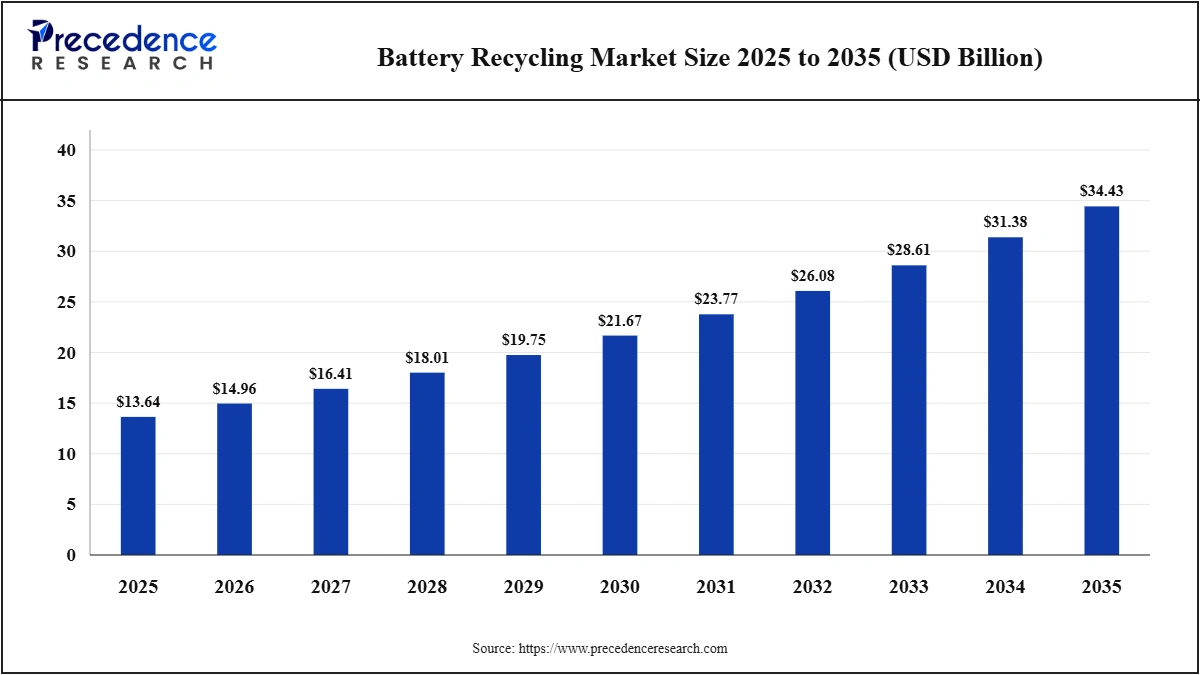
Note: 2025 is the base year; 2026-2035 values are forecasts.
Sources: Expert interviews, secondary sources, Precedence Research database and Precedence Research analysts.
The battery recycling market is projected to grow from USD 13.64 billion in 2025 to USD 34.43 billion by 2035.Growth is driven by high recycling rates for lead-acid batteries and rising volumes of lithium-ion production scrap and end-of-life EV and consumer batteries.
Recycled-content requirements and critical mineral policies are further supporting investment in recycling capacity. The market is expected to reach USD 21.67 billion by 2030, growing at a CAGR of 9.70% from 2026 to 2035.
- Analyst View: We estimated the market using battery volumes available for recycling, collection and recovery rates, recovered material values, and recycling fees. The estimate was cross-checked against leading recyclers' revenues and published market data. Growth reflects stable lead-acid recycling and rising lithium-ion battery volumes, partly offset by metal price volatility.
Market Trends
- EV production scrap is the main lithium-ion feedstock today.
- Hydrometallurgy is gaining share for high-purity metal recovery.
- Recycled content rules are shaping European capacity.
- Large recycling campuses are starting up in the United States.
- Lead recyclers are recovering antimony and tin as critical minerals.
- The lithium-ion recycling sector is consolidating.
Key Market Dynamics
Driver
Rising volumes of end-of-life EV, storage, and consumer batteries, along with cell production scrap, are increasing demand for recycling. EU collection, recovery, and recycled-content targets, combined with efforts to secure domestic supplies of lithium, nickel, cobalt, and lead, are further supporting market growth.
Restraint
Lithium, nickel and cobalt prices are volatile, and low prices can make recycling uneconomic. Many EV batteries will not retire in large numbers for several years, which limits feedstock for new plants. Collection, transport and safe handling of lithium-ion batteries are costly.
Opportunity
Direct recycling and improved hydrometallurgy can raise recovery rates and lower costs. Partnerships with vehicle and battery makers can secure long-term feedstock and offtake. Recycling of energy storage batteries and recovery of critical minerals from lead batteries open new revenue streams.
Battery Recycling Market Segmentation: 2025 Share and Value
By Chemistry
| Segments | 2025 Share | 2025 Market Value |
| Lead Acid | 58.40% | USD 7.97 billion |
| Lithium-ion | 36.80% | USD 5.02 billion |
| Nickel-based | 3.20% | USD 0.44 billion |
| Others | 1.60% | USD 0.22 billion |
Note: 2025 is the base year.
Sources: Expert interviews, secondary sources, Precedence Research database and Precedence Research analysts.
Lead-acid batteries dominated the market in 2025, accounting for 58.40% (USD 7.97 billion), driven by established collection networks and high recycling rates for spent automotive and industrial batteries. Recovered lead is reused in new battery production. Lithium-ion batteries accounted for 36.80% (USD 5.02 billion) and represent the fastest-growing segment, supported by cell manufacturing scrap and the growing volume of retired electric vehicle, energy storage, and consumer batteries containing lithium, nickel, and cobalt. Nickel-based batteries held a 3.20% share (USD 0.44 billion), while other chemistries accounted for 1.60% (USD 0.22 billion).
By Source
| Segments | 2025 Share | 2025 Market Value |
| Automotive | 64.60% | USD 8.81 billion |
| Industrial | 16.20% | USD 2.21 billion |
| Consumer Electronics | 12.40% | USD 1.69 billion |
| Energy Storage & Others | 6.80% | USD 0.93 billion |
Note: 2025 is the base year.
Sources: Expert interviews, secondary sources, Precedence Research database and Precedence Research analysts.
Automotive batteries accounted for 64.60% (USD 8.81 billion) in 2025, including starter batteries and EV packs. Industrial batteries, such as forklift and backup batteries, account for 16.20% (USD 2.21 billion), consumer electronics for 12.40% (USD 1.69 billion) and energy storage and other sources for 6.80% (USD 0.93 billion), the fastest-growing source as early grid batteries reach end of life.
By Process
| Segments | 2025 Share | 2025 Market Value |
| Pyrometallurgy | 46.20% | USD 6.30 billion |
| Hydrometallurgy | 38.60% | USD 5.27 billion |
| Mechanical & Direct Recycling | 15.20% | USD 2.07 billion |
Note: 2025 is the base year.
Sources: Expert interviews, secondary sources, Precedence Research database and Precedence Research analysts.
Pyrometallurgy held the largest market share in 2025 at 46.20% (USD 6.30 billion), driven by established lead smelting operations and high-temperature processing of lead-acid and certain lithium-ion batteries. Hydrometallurgy accounted for 38.60% (USD 5.27 billion), supported by high-purity recovery of lithium, nickel, and cobalt from lithium-ion battery black mass. Mechanical and direct recycling represented 15.20% (USD 2.07 billion), including shredding, material separation, and processes that recover or restore cathode materials.
- Analyst View: Segment values were allocated by matching recyclable volumes by chemistry and source to process routes and recovered material values. Lead acid leads because of its very large and mature recycling loop, while lithium-ion carries higher material value per ton. We expect lithium-ion, energy storage sources and hydrometallurgy to gain share as EV retirements accelerate.
Regional Analysis
| Region | 2025 Share | 2025 Market Value |
| Asia Pacific | 48.60% | USD 6.63 billion |
| Europe | 21.80% | USD 2.97 billion |
| North America | 20.40% | USD 2.78 billion |
| Latin America | 5.00% | USD 0.68 billion |
| Middle East & Africa | 4.20% | USD 0.57 billion |
Note: 2025 is the base year.
Sources: Expert interviews, secondary sources, Precedence Research database and Precedence Research analysts.
Asia Pacific led the battery recycling market in 2025, with a 48.60% share valued at USD 6.63 billion, reflecting its strong battery production base and established recycling capacity in China, India, and South Korea. Europe held a 21.80% share (USD 2.97 billion) and emerged as the fastest-growing region, supported by EU Batteries Regulation requirements for recycled content and material recovery, alongside new lithium-ion recycling capacity. North America accounted for 20.40% (USD 2.78 billion), driven by lead-acid recycling and investments in large-scale lithium-ion recycling facilities. Latin America held a 5.00% share (USD 0.68 billion), while the Middle East and
Africa accounted for 4.20% (USD 0.57 billion), with both markets driven mainly by lead-acid battery recycling.
Asia Pacific accounted for 48.60% (USD 6.63 billion) in 2025. Large battery production and recycling capacity in China, India and South Korea drive the market.
Europe held 21.80% (USD 2.97 billion) in 2025 and is the fastest-growing region. The EU Batteries Regulation sets recovery and recycled content targets.
North America captures 20.40% (USD 2.78 billion) in 2025. Mature lead recycling and new lithium-ion campuses support growth.
Latin America reported 5.00% (USD 0.68 billion) in 2025. Lead acid recycling in Brazil and Mexico supports the market.
The Middle East and Africa accounted for 4.20% (USD 0.57 billion) in 2025. Lead acid recycling supports most activity.
- Analyst View: Regional shares were built from recyclable battery volumes by chemistry, recycling capacity and recovered material values in each region. Asia Pacific leads because it handles most battery production scrap and has the largest recycling capacity. We assign Europe the highest growth premium because the EU Batteries Regulation creates binding recovery and recycled content targets that drive new lithium-ion capacity.
Top 10 Companies in the Battery Recycling Market
| Rank | Company Name | Market-Specific Revenue (USD Billion) | 2025 Share | Key Products / Business | Headquarters |
| 1 | Ecobat | 1.4 | 10.26% | Lead acid and lithium-ion battery recycling | United States |
| 2 | Brunp Recycling | 1.2 | 8.80% | Lithium-ion battery recycling and materials | China |
| 3 | GEM Co. | 1.1 | 8.06% | Battery and metal recycling and precursors | China |
| 4 | Huayou Cobalt | 0.6 | 4.40% | Lithium-ion battery recycling | China |
| 5 | Gopher Resource | 0.55 | 4.03% | Lead acid battery recycling | United States |
| 6 | Gravita India | 0.45 | 3.30% | Lead and battery recycling | India |
| 7 | Umicore | 0.4 | 2.93% | Battery recycling and metals refining | Belgium |
| 8 | Glencore | 0.35 | 2.57% | Battery recycling and metals recovery, including former Li-Cycle assets | Switzerland |
| 9 | Redwood Materials | 0.3 | 2.20% | Lithium-ion battery recycling and materials | United States |
| 10 | Exide Technologies | 0.3 | 2.20% | Lead acid battery recycling | France |
Note: Company revenues and shares are 2025 estimates.
Sources: Company press releases, expert interviews, secondary sources, Precedence Research database and Precedence Research analysts.
Ecobat held the largest market share in 2025 at an estimated 10.26% (USD 1.40 billion), followed by Brunp Recycling at 8.80% (USD 1.20 billion) and GEM at 8.06% (USD 1.10 billion). Ecobat focuses on lead-acid battery recycling in Europe and North America, while Brunp, part of CATL, and GEM maintain significant lithium-ion recycling capacity in China. The top 10 companies collectively accounted for 48.75% of revenue (USD 6.65 billion), leaving 51.25% (USD 6.99 billion) to regional lead smelters, established recyclers, and emerging lithium-ion recycling companies. Market competition centres on access to battery waste, recovery efficiency, metal purity, operating costs, and partnerships with battery and vehicle manufacturers. The presence of established lead recyclers, Chinese materials groups, and new western entrants keeps the market fragmented.
Recent Developments
- August 2023: The EU Batteries Regulation entered into force, setting targets for battery collection, material recovery and minimum recycled content in new batteries.
- August 2025: Glencore completed its acquisition of Li-Cycle's lithium-ion battery recycling assets after Li-Cycle's bankruptcy, covering sites with combined capacity of 61,000 tons a year.
- November 2025: Redwood Materials began recovering cobalt, lithium, nickel and copper from used batteries at its USD 3.5 billion campus in Berkeley County, South Carolina.
- May 2026: Clarios named Indiana, South Carolina and Texas as candidate sites for new critical minerals recycling facilities under its USD 6 billion US manufacturing plan.
Segments Covered in the Report
By Chemistry
- Lead Acid
- Lithium-ion
- Nickel-based
- Others
By Source
- Automotive
- Industrial
- Consumer Electronics
- Energy Storage & Others
By Process
- Pyrometallurgy
- Hydrometallurgy
- Mechanical & Direct Recycling
By Region
- North America (U.S., Canada, Mexico)
- Europe (Germany, U.K., France, Italy, Spain, Rest of Europe)
- Asia Pacific (China, Japan, India, South Korea, Taiwan, Rest of Asia Pacific)
- Middle East & Africa (GCC, South Africa, Rest of MEA)
Research Methodology
The battery recycling market covers the collection, processing, and recovery of materials from spent lead-acid, lithium-ion, nickel-based, and other batteries, as well as battery manufacturing scrap worldwide. The market is measured by recycling revenue.
The 2025 base year was built bottom-up from recyclable battery and scrap volumes by chemistry, collection and recovery rates and recovered material values, and checked top-down against the recycling revenue of leading lead smelters and lithium-ion recyclers.
Segment, regional and company values were allocated from chemistries, sources, process routes and regional recycling capacity. Key estimates were verified by cross-checking company disclosures, regulatory and industry data and published third-party estimates, and inputs that could not be reconciled were excluded. All segment, regional and company figures were reconciled to the same 2025 base year, and the 2026-2035 forecast, which applies a constant CAGR from the 2025 base, was recalculated and validated.
Analyst View: Overall Market
The battery recycling market combines a large, mature lead acid loop with a fast-growing lithium-ion segment that depends on EV retirements and production scrap. Our estimate links demand to recyclable volumes, recovery rates and recovered material values, so the forecast follows battery retirements and metal prices. The main upside comes from rising EV retirements and recycled content rules, while the main risks are metal price volatility and the slow arrival of large end-of-life volumes.
Sources and References
SC Daily Gazette. "SC battery company begins recycling operations in the Lowcountry". 2025-11-13. Redwood Materials South Carolina recycling start-up. https://scdailygazette.com/2025/11/13/sc-battery-company-begins-recycling-operations-in-the-lowcountry/
Waste Dive. "Glencore completes takeover of Li-Cycle battery recycling assets". 2025-08-08. Glencore acquisition of Li-Cycle assets. https://www.wastedive.com/news/glencore-completes-takeover-of-li-cycle-battery-recycling-assets/757199/
Clarios. "Clarios provides one-year update on USD 6B U.S. energy manufacturing strategy". 2026-05-08. Candidate recycling sites. https://www.clarios.com/insights/news/news-details/one-year-update-on-6b-us-energy-strategy
Industrial Info Resources. "Redwood Materials raises USD 1 billion". 2023-08-31. Redwood funding and projects. https://www.industrialinfo.com/iirenergy/industry-news/article/us-battery-recycling-and-materials-company-redwood-materials-raises-1-billion--323301
For inquiries regarding discounts, bulk purchases, or customization requests, please contact us at sales@precedenceresearch.com
Frequently Asked Questions





Ask For Sample
No cookie-cutter, only authentic analysis – take the 1st step to become a Precedence Research client
 Get a Sample




 sales@precedenceresearch.com
 Schedule a Meeting
