


Black Mass Recycling Market Size, Key Companies, Company Market Share, Power Generation Capacity, Energy Consumption, Pricing Trends, Investment Analysis, Competitive Positioning, and Demand Forecast
According to energy and power expert Laxmi Narayan, the black mass recycling market has reached USD 6.22 billion in 2026 and is expected to grow to USD 22.93 billion by 2035, registering a CAGR of 15.60%. The black mass recycling market companies such as Brunp Recycling, GEM Co., Huayou Cobalt, Umicore are playing a key role in market expansion, with major opportunities emerging across technology, battery source, becovered material and region segments.
Source: https://www.precedenceresearch.com/black-mass-recycling-market
 Get a Sample
 Table Of Content


Black Mass Recycling Market Size, Share and Forecast 2026-2035
The black mass recycling market is estimated at USD 6.22 billion in 2026 and is projected to reach USD 22.93 billion by 2035, expanding at a CAGR of 15.60% from 2026 to 2035. The black mass recycling market was valued at USD 5.38 billion in 2025, the base year.
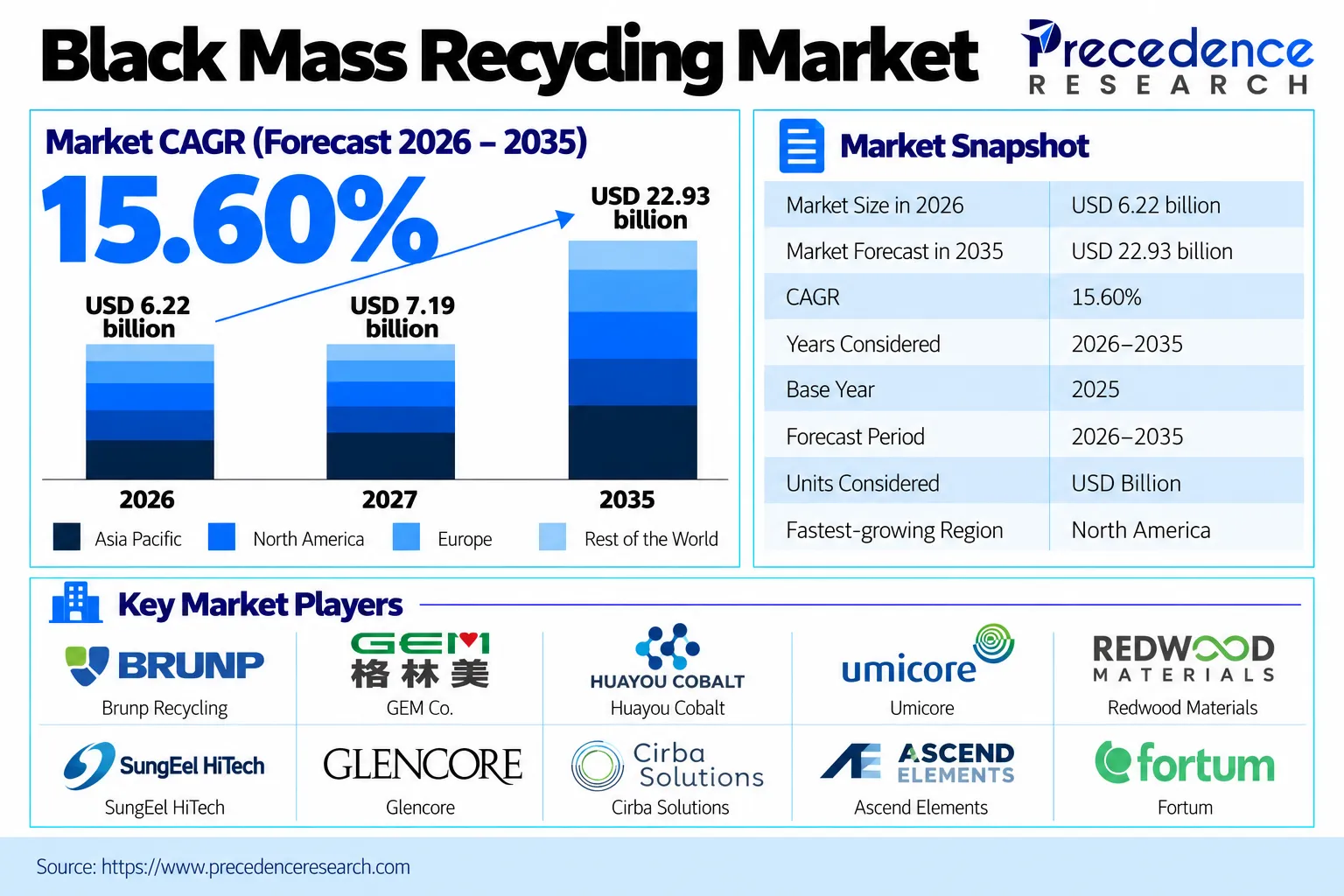 Key Takeaways
Market Size & Growth Outlook
- Market size in 2025: USD 5.38 billion
- Estimated market size in 2026: USD 6.22 billion
- Projected market size by 2035: USD 22.93 billion
- CAGR (2026-2035): 15.60%
Regional Market Spotlight
- Asia Pacific led the market with a 62.40% (USD 3.36 billion) share in 2025.
- Europe accounted for 17.80% (USD 0.96 billion) of the market in 2025.
- North America captures 13.60% (USD 0.73 billion) of the market in 2025 and is projected to be the fastest-growing region, at a CAGR of 17.55% from 2025 to 2035.
Black Mass Recycling Market Segmental Breakdown and Revenue Insights
- By technology, Hydrometallurgical holds 54.20% (USD 2.92 billion) in 2025.
- By battery source, Manufacturing Scrap accounted for 42.60% (USD 2.29 billion) in 2025.
- By recovered material, Nickel captures 28.40% (USD 1.53 billion) in 2025.
- By battery chemistry, NMC & NCA leads with 58.60% (USD 3.15 billion) in 2025.
Black Mass Recycling Market Size and Forecast, 2025-2035 (USD Billion)
The black mass recycling market covers the production and refining of black mass, the shredded active material from spent lithium-ion and nickel-metal hydride batteries and cell production scrap, to recover lithium, nickel, cobalt, manganese, copper and graphite through hydrometallurgical, pyrometallurgical and direct recycling processes. Hydrometallurgical processing accounted for the largest technology share in 2025, at 54.20%, because it recovers lithium, nickel and cobalt at battery-grade purity with lower energy use than smelting.
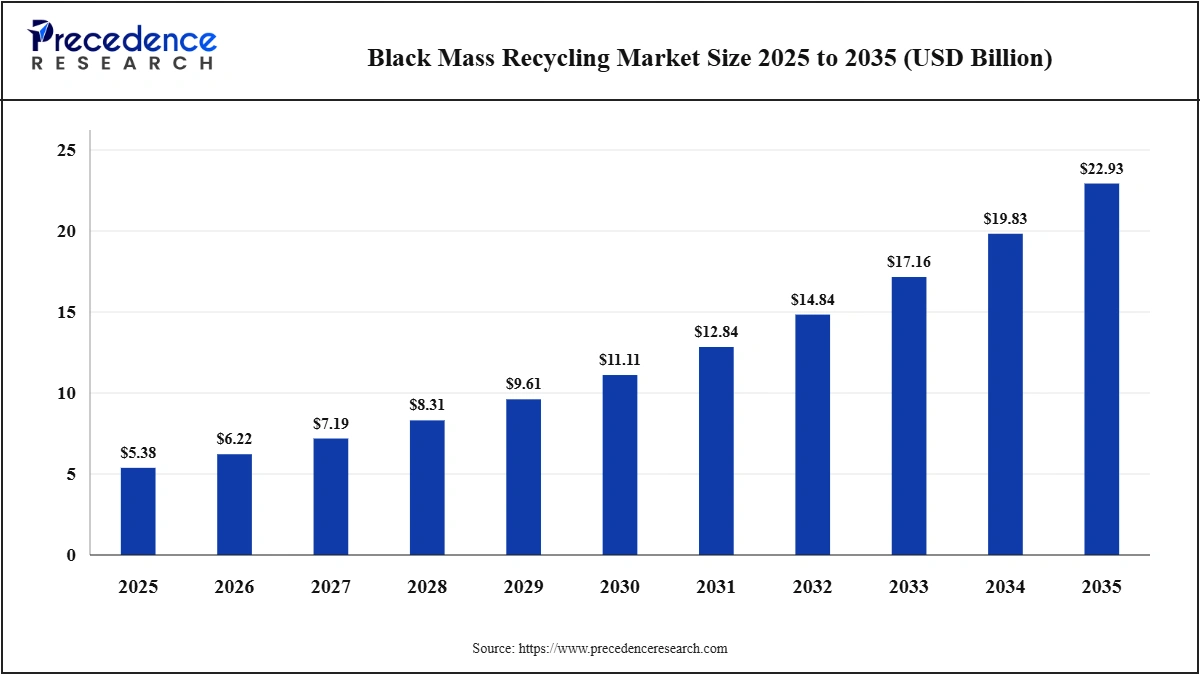
Note: 2025 is the base year; 2026-2035 values are forecasts.
Sources: Expert interviews, secondary sources, Precedence Research database and Precedence Research analysts.
The black mass recycling market is expected to grow from USD 5.38 billion in 2025 to USD 22.93 billion by 2035. This growth is driven by rising battery production scrap and increasing volumes of end-of-life EV, energy storage, and consumer batteries. The market is projected to reach USD 11.11 billion by 2030, growing at a CAGR of 15.60% from 2026 to 2035.
- Analyst View: We estimated the market based on the volume of lithium-ion and nickel-metal hydride batteries processed, recovered metal values, and processing fees. The estimate was cross-checked against leading recyclers' revenues and the broader battery recycling market. Growth reflects rising EV battery retirements and production scrap, partly offset by volatility in lithium, nickel, and cobalt prices.
Market Trends
- Production scrap remains the main black mass feedstock.
- Lithium-first processes are raising lithium recovery rates.
- LFP black mass is becoming a larger share of feedstock.
- Black mass plants are starting up in Europe and the United States.
- Direct recycling is being tested to restore cathode materials.
- Recyclers are consolidating after early project failures.
- Black Mass Recycling
Drivers, Restraints and Opportunities
Driver
Rising battery production scrap and end-of-life EV, storage, and consumer batteries are increasing black mass supply. EU recycled-content and recovery targets are driving demand for recovered metals. Critical mineral policies in the US and Europe are supporting domestic refining capacity.
Restraint
Volatile lithium, nickel, and cobalt prices can reduce refining margins, while the lower metal value of LFP black mass limits profitability. Limited near-term EV battery retirements and cost overruns among early recyclers further constrain market growth.
Opportunity
Lithium-first and direct recycling processes can improve economics, especially for LFP batteries. Long-term feedstock and offtake agreements with vehicle and cell makers can stabilise volumes. Local refining in Europe and North America can replace exports of black mass to Asia.
Black Mass Recycling Market Segmentation: 2025 Share and Value
By Technology
| Segments | 2025 Share | 2025 Market Value |
| Hydrometallurgical | 54.20% | USD 2.92 billion |
| Pyrometallurgical | 24.60% | USD 1.32 billion |
| Direct & Hybrid Recycling | 21.20% | USD 1.14 billion |
Note: 2025 is the base year.
Sources: Expert interviews, secondary sources, Precedence Research database and Precedence Research analysts.
Hydrometallurgical processing led the market in 2025, accounting for 54.20% (USD 2.92 billion), driven by its ability to recover high-purity metals for new cathodes. Pyrometallurgical processing held 24.60% (USD 1.32 billion), but recovers less lithium. Direct and hybrid recycling accounted for 21.20% (USD 1.14 billion) and is the fastest-growing segment, as it aims to restore cathode materials with fewer processing steps.
By Battery
| Segments | 2025 Share | 2025 Market Value |
| Manufacturing Scrap | 42.60% | USD 2.29 billion |
| EV Batteries | 26.40% | USD 1.42 billion |
| Consumer Electronics | 19.20% | USD 1.03 billion |
| Industrial & Energy Storage | 11.80% | USD 0.63 billion |
Note: 2025 is the base year.
Sources: Expert interviews, secondary sources, Precedence Research database and Precedence Research analysts.
Manufacturing scrap accounted for 42.60% (USD 2.29 billion) in 2025 because cell plants generate steady volumes of clean, well-characterised scrap during ramp-up and production. EV batteries, at 26.40% (USD 1.42 billion), are the fastest-growing source as early electric vehicles retire, consumer electronics account for 19.20% (USD 1.03 billion) and industrial and energy storage batteries for 11.80% (USD 0.63 billion).
By Recovered Material
| Segments | 2025 Share | 2025 Market Value |
| Nickel | 28.40% | USD 1.53 billion |
| Cobalt | 22.60% | USD 1.22 billion |
| Lithium | 19.80% | USD 1.07 billion |
| Copper | 9.20% | USD 0.49 billion |
| Graphite | 8.40% | USD 0.45 billion |
| Manganese | 5.20% | USD 0.28 billion |
| Others | 6.40% | USD 0.34 billion |
Note: 2025 is the base year.
Sources: Expert interviews, secondary sources, Precedence Research database and Precedence Research analysts.
In 2025, nickel held the largest share of the black mass recycling market at 28.40% (USD 1.53 billion), followed by cobalt at 22.60% (USD 1.22 billion), reflecting their high value in NMC and NCA batteries. Lithium represented 19.80% (USD 1.07 billion) and is expected to grow fastest as recovery technologies improve and LFP battery volumes increase. Copper, graphite, manganese, and other materials accounted for 9.20% (USD 0.49 billion), 8.40% (USD 0.45 billion), 5.20% (USD 0.28 billion), and 6.40% (USD 0.34 billion), respectively.
By Battery Chemistry
| Segments | 2025 Share | 2025 Market Value |
| NMC & NCA | 58.60% | USD 3.15 billion |
| LFP | 18.40% | USD 0.99 billion |
| LCO | 15.60% | USD 0.84 billion |
| NiMH & Others | 7.40% | USD 0.40 billion |
Note: 2025 is the base year.
Sources: Expert interviews, secondary sources, Precedence Research database and Precedence Research analysts.
NMC and NCA batteries accounted for 58.60% (USD 3.15 billion) in 2025 because their nickel and cobalt content make recycling most profitable. LFP batteries, at 18.40% (USD 0.99 billion), are growing fastest as LFP use in vehicles and storage rises, LCO batteries from consumer electronics account for 15.60% (USD 0.84 billion) and nickel-metal hydride and other chemistries for 7.40% (USD 0.40 billion).
- Analyst View: Segment values were allocated by matching black mass volumes by source and chemistry to process routes and recovered metal values. Hydrometallurgy and NMC chemistries lead because they generate the most recoverable value, while manufacturing scrap is the largest feedstock today. We expect EV batteries, LFP chemistries, lithium recovery and direct recycling to gain share as retirements grow and processes improve.
Regional Analysis
| Region | 2025 Share | 2025 Market Value |
| Asia Pacific | 62.40% | USD 3.36 billion |
| Europe | 17.80% | USD 0.96 billion |
| North America | 13.60% | USD 0.73 billion |
| Latin America | 3.40% | USD 0.18 billion |
| Middle East & Africa | 2.80% | USD 0.15 billion |
Note: 2025 is the base year.
Sources: Expert interviews, secondary sources, Precedence Research database and Precedence Research analysts.
Asia Pacific dominated the black mass recycling market in 2025, with a 62.40% share (USD 3.36 billion), driven by China's battery manufacturing and refining capacity and recycling activity in South Korea and Japan. Europe accounted for 17.80% (USD 0.96 billion), supported by EU regulations and new refining facilities. North America held 13.60% (USD 0.73 billion) and is the fastest-growing region, driven by recycling investments and critical mineral incentives in the US and Canada. Latin America and the Middle East and Africa accounted for 3.40% (USD 0.18 billion) and 2.80% (USD 0.15 billion), respectively, with activity focused mainly on battery collection and pre-processing.
Asia Pacific accounted for 62.40% (USD 3.36 billion) in 2025. China's production scrap and refining capacity dominate the market.
Europe captures 17.80% (USD 0.96 billion) in 2025. The EU Batteries Regulation and new black mass plants support growth.
North America holds 13.60% (USD 0.73 billion) in 2025 and is the fastest-growing region. New recycling campuses and critical mineral incentives drive growth.
Latin America accounted for 3.40% (USD 0.18 billion) in 2025. Battery collection and pre-processing support early activity.
The Middle East and Africa represents 2.80% (USD 0.15 billion) in 2025. Collection and export of black mass support a small market.
- Analyst View: Regional shares were built from black mass volumes from production scrap and end-of-life batteries in each region, weighted by refining capacity and metal values. Asia Pacific leads because most cells are made and refined there. We assign North
America the highest growth premium because new black mass and refining capacity is being added from a small base under critical mineral policies.
Top 10 Companies in the Black Mass Recycling Market
| Rank | Company Name | Market-Specific Revenue (USD Billion) | 2025 Share | Key Products / Business | Headquarters |
| 1 | Brunp Recycling | 0.98 | 18.22% | Black mass recycling and precursor materials | China |
| 2 | GEM Co. | 0.82 | 15.24% | Battery recycling and precursor production | China |
| 3 | Huayou Cobalt | 0.48 | 8.92% | Battery recycling and refining | China |
| 4 | Umicore | 0.3 | 5.58% | Battery recycling and refining | Belgium |
| 5 | Redwood Materials | 0.24 | 4.46% | Battery recycling and materials | United States |
| 6 | SungEel HiTech | 0.22 | 4.09% | Black mass production and hydrometallurgical recovery | South Korea |
| 7 | Glencore | 0.18 | 3.35% | Battery recycling and refining, including former Li-Cycle assets | Switzerland |
| 8 | Cirba Solutions | 0.12 | 2.23% | Battery collection and black mass processing | United States |
| 9 | Ascend Elements | 0.1 | 1.86% | Hydro-to-cathode battery recycling | United States |
| 10 | Fortum | 0.06 | 1.12% | Battery recycling and hydrometallurgical recovery | Finland |
Note: Company revenues and shares are 2025 estimates.
Sources: Company press releases, expert interviews, secondary sources, Precedence Research database and Precedence Research analysts.
Brunp Recycling led the market in 2025 with an estimated 18.22% share (USD 0.98 billion), followed by GEM at 15.24% (USD 0.82 billion) and Huayou Cobalt at 8.92% (USD 0.48 billion). Their competitive position is supported by large-scale hydrometallurgical capacity and links to battery cell and precursor production. The top 10 companies accounted for an estimated 65.06% (USD 3.50 billion) of market revenue, while smaller refiners, regional processors, and start-ups held the remaining 34.94% (USD 1.88 billion). Competition centres on feedstock access, metal recovery rates, product purity, processing costs, and partnerships with battery and automotive manufacturers, with Chinese players, Western refiners, and emerging companies competing for market share.
Recent Developments
- March 2022: Aurubis started test operation of a pilot black mass recycling plant in Hamburg using a hydrometallurgical process that extracts lithium first and works with NMC and LFP chemistries.
- June 2025: BASF started its black mass plant in Schwarzheide, Germany, able to process up to 15,000 tonnes a year of spent lithium-ion batteries and production scrap.
- August 2025: Glencore completed its acquisition of Li-Cycle's battery recycling assets, including sites with combined capacity of 61,000 tons a year.
- November 2025: Redwood Materials began recovering cobalt, lithium, nickel and copper from used batteries at its USD 3.5 billion campus in South Carolina.
Black Mass Recycling Market Segments
By Technology
- Hydrometallurgical
- Pyrometallurgical
- Direct & Hybrid Recycling
By Battery Source
- Manufacturing Scrap
- EV Batteries
- Consumer Electronics
- Industrial & Energy Storage
By Recovered Material
- Nickel
- Cobalt
- Lithium
- Copper
- Graphite
- Manganese
- Others
- By Battery Chemistry
- NMC & NCA
- LFP
- LCO
- NiMH & Others
By Region
- North America (U.S., Canada, Mexico)
- Asia Pacific (China, Japan, India, South Korea, Taiwan, Rest of Asia Pacific)
- Latin America (Brazil, Argentina, Rest of Latin America)
- Middle East & Africa (GCC, South Africa, Rest of MEA)
Research Methodology
The black mass recycling market was defined as production and refining of black mass from spent lithium-ion and nickel-metal hydride batteries and cell production scrap worldwide, measured by recycling and refining revenue. The 2025 base year was built bottom-up from black mass tonnage from production scrap and end-of-life batteries, recovered metal content and metal values, and checked top-down against the recycling revenue of leading black mass producers and refiners and the overall battery recycling market.
Segment, regional and company values were allocated from technologies, battery sources, recovered materials, chemistries and regional refining capacity. Key estimates were verified by cross-checking company disclosures, regulatory and industry data and published third-party estimates, and inputs that could not be reconciled were excluded. All segment, regional and company figures were reconciled to the same 2025 base year, and the 2026-2035 forecast, which applies a constant CAGR from the 2025 base, was recalculated and validated.
Analyst View: Overall Market
The black mass recycling market is growing quickly on production scrap today and will increasingly depend on EV battery retirements. Our estimate links demand to black mass tonnage, recovered metal content and metal values, so the forecast follows battery production, retirements and metal prices. The main upside comes from EV retirements and better lithium recovery, while the main risks are metal price volatility and project execution.
Sources and References
electrive. "BASF begins production of black mass in Germany". 2025-06-03. Schwarzheide black mass plant. https://www.electrive.com/2025/06/03/basf-begins-production-of-black-mass-in-germany/
electrive. "Aurubis starts battery recycling test operation in Hamburg pilot plant". 2022-03-22. Aurubis hydrometallurgical pilot plant. https://electrive.com/2022/03/22/aurubis-starts-battery-recycling-test-operation-in-hamburg-pilot-plant
Waste Dive. "Glencore completes takeover of Li-Cycle battery recycling assets". 2025-08-08. Glencore acquisition of Li-Cycle assets. https://www.wastedive.com/news/glencore-completes-takeover-of-li-cycle-battery-recycling-assets/757199/
SC Daily Gazette. "SC battery company begins recycling operations in the Lowcountry". 2025-11-13. Redwood Materials South Carolina start-up. https://scdailygazette.com/2025/11/13/sc-battery-company-begins-recycling-operations-in-the-lowcountry/
For inquiries regarding discounts, bulk purchases, or customization requests, please contact us at sales@precedenceresearch.com
Frequently Asked Questions





Ask For Sample
No cookie-cutter, only authentic analysis – take the 1st step to become a Precedence Research client
 Get a Sample



 sales@precedenceresearch.com
 Schedule a Meeting