



Solar Components Recycling Market Trends, Companies, Contract Wins / Project Pipeline, Installed Capacity, Power Generation, Government Investment, Technology Adoption, Competitive Positioning, and Growth Forecast
Solar Components Recycling Market (By Component Type: Panels, Inverters, Electrical BOS, Structural BOS, Others; By Material: Glass, Aluminum, Copper, Silicon, Others; By End User: Utility-Scale, Commercial and Industrial, Residential) - Global Industry Analysis, Size, Trends, Leading Companies, Regional Outlook, and Forecast 2026 to 2035
Source: https://www.precedenceresearch.com/solar-components-recycling-market
 Get a Sample
 Table Of Content


What is the Solar Components Recycling Market Size?
The global solar components recycling market size was calculated at USD 368.19 billion in 2025 and is predicted to increase from USD 423.12 billion in 2026 to approximately USD 1,479.2 billion by 2035, expanding at a CAGR of 14.92% from 2026 to 2035. The growth of the market is driven by the growing focus of energy providers on developing advanced recycling solutions, along with numerous government initiatives aimed at raising the adoption of clean energy sources.
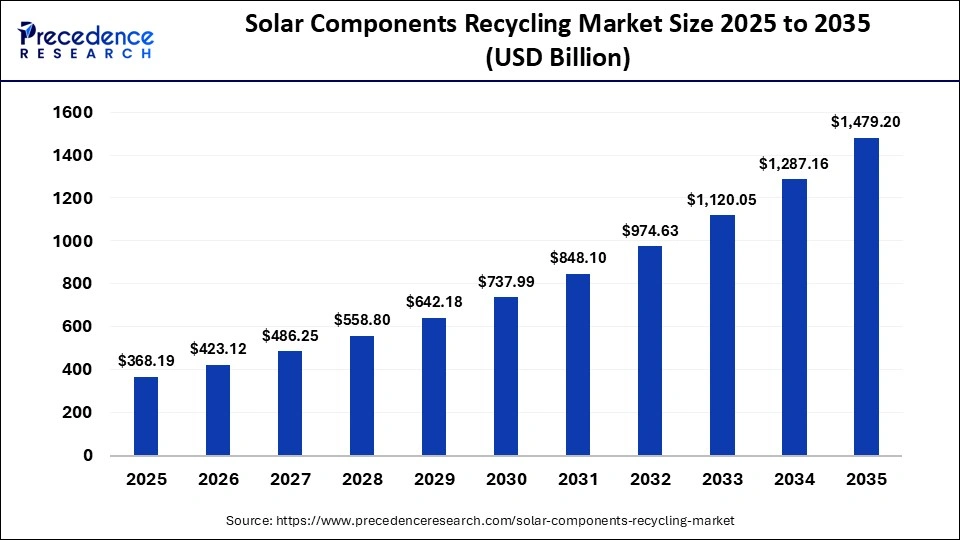
Key Takeaways
- Asia Pacific led the market with the largest share in 2025.
- North America is expected to grow at a significant CAGR during the forecast period.
- By component type, the panels segment held the largest share of the market in 2025.
- By component type, the inverters segment is expected to expand at the fastest CAGR during the forecast period.
- By material, the glass segment held the largest share of the market in 2025.
- By material, the silicon segment is expected to grow at the highest CAGR between 2026 and 2035.
- By end-user, the utility-scale segment held the highest share of the market in 2025.
- By end-user, the commercial and industrial segment is expected to grow at the fastest CAGR during the forecast period.
Market Overview
The solar components recycling market is a crucial branch of the energy and power industry. This market deals with the distribution of advanced recycling solutions to the solar power industry. Solar component recycling is the industrial process of dismantling, collecting, and recovering valuable materials from hardware components. The market is growing as the adoption of solar energy grows worldwide. Increasing environmental regulations and the need for sustainable waste management are driving innovation in recycling technologies and circular economy practices.
Why is AI integral in the Solar Components Recycling Industry?
Artificial Intelligence is becoming crucial in the overall development of the solar components recycling industry. AI helps in optimizing complex systems, enhancing grid stability, and renewable energy forecasting. Additionally, AI-based platforms are used to predict energy demand along with the detection of early faults. Nowadays, solar components recycling companies have started deploying AI in their solutions to maximize material recovery rate, lowering operational cost, and advancing sorting capabilities. Furthermore, AI supports data-driven decision-making for scaling recycling capacities, improving material recovery rates, and ensuring compliance with environmental regulations, making the industry more sustainable and economically viable.
- In August 2025, the Researchers at the University of New England (UNE) launched a new AI-based platform. This new AI-enabled platform is designed to enhance the capabilities of solar recycling in Europe.
Solar Components Recycling Market Trends
- Surging Installation of Solar Photovoltaic Cells: The rising installation of solar photovoltaic panels in different nations, to derive a high amount of clean energy, is an ongoing trend in the market. According to Our World in Data, around 1852.36 GW of energy was captured from solar photovoltaic panels globally in 2024.
- Government Initiatives: Governments of various countries, such as the U.S, India, South Korea, and Denmark, are launching various initiatives for adopting solar energy sources. For instance, in January 2025, the government of India launched an initiative named ‘PM Surya Ghar Muft Bijli Yojana'. This initiative is aimed at providing free electricity to the people of India from solar energy.
- Opening of Solar Panel Recycling Plants: Numerous energy companies are engaged in opening solar panel recycling centers to maintain sustainability. For instance, in December 2025, Jackson Engineers announced the inauguration of a solar recycling plant in Madhya Pradesh, India. This new plant is established to recycle around 300 MW of solar panels every year.
- Collaborations: Various companies are collaborating with environmental service providers to establish new recycling plants across the world. For instance, in September 2025, Tradebe Environmental Services collaborated with Greening Group. This collaboration is done to inaugurate a solar panel recycling plant in Granada, Spain.
- Investments: Several capital investors have started funding solar companies to enhance their recycling capabilities. For instance, in April 2025, Khasma Capital announced the investment of around US$7 million in OnePlanet Solar Recycling LLC. Through this investment, OnePlanet Solar Recycling will set up a state-of-the-art solar module recycling facility in the U.S.
- Advances in Recycling Technologies: Advanced recycling technologies and high‑value material recovery are emerging, moving beyond basic mechanical processes to hybrid, thermal, chemical, and laser‑based systems that improve recovery of valuable components like silicon and silver.
- Regulatory Frameworks: Stronger regulatory frameworks and circular economy mandates are driving structured recycling programs, extended producer responsibility (EPR), and take‑back initiatives that accelerate adoption and compliance globally.
Market Scope
| Report Coverage | Details |
| Market Size in 2025 | USD 368.19 Billion |
| Market Size in 2026 | USD 423.12 Billion |
| Market Size by 2035 | USD 1,479.2 Billion |
| Market Growth Rate from 2026 to 2035 | CAGR of 14.92% |
| Dominating Region | Asia Pacific |
| Fastest Growing Region | North America |
| Base Year | 2025 |
| Forecast Period | 2026 to 2035 |
| Segments Covered | Component Type, Material, End-User, and region |
| Regions Covered | North America, Europe, Asia-Pacific, Latin America, and Middle East & Africa |
Segment Insights
Component Type Insights
Why Did the Panels Segment Dominate the Solar Components Recycling Market?
The panels segment dominated the market while holding the largest share in 2025. This is because solar panels constitute the largest and most valuable portion of end-of-life solar installations, containing recoverable materials such as silicon, silver, aluminum, and glass. Their high volume and extended deployment in utility-scale and commercial solar farms generate a consistent feedstock for recycling facilities. Additionally, advances in recycling technologies have made it economically viable to efficiently recover and reuse materials from panels, further driving the dominance of this segment.
The inverters segment is expected to grow at the fastest CAGR during the forecast period. This is because solar inverters are composed of essential materials such as silicon and aluminum that are readily recyclable, which leads to a rising volume of end-of-life and replacement inverters. Also, the increasing use of AI-enabled solutions for recycling components of solar inverters is contributing to segmental growth. Additionally, technological advancements in inverter recycling, along with stricter environmental regulations and extended producer responsibility (EPR) initiatives, are encouraging the collection and processing of these components.
Material Insights
What Made Glass the Leading Segment in the Solar Components Recycling Market?
The glass segment led the market in 2025. This is due to the increased use of tempered glass in the production of solar panels, along with the surging emphasis of market players in developing advanced recycling solutions to efficiently separate glass from photovoltaic cells. Moreover, the growing adoption of specialized thermal-mechanical technologies by solar companies to remove iron-poor glass from solar components is reinforcing the segment's dominance.
The silicon segment is expected to expand at the highest CAGR between 2026 and 2035. The growth of the segment is attributed to the increasing use of silicon in solar wafers and photovoltaic cells, along with technological advancements in chemical depolymerization methods to enhance silicon recycling capabilities. Additionally, the growing focus of the solar recycling companies on opening new centers to extract silicon from PV modules is expected to accelerate the segmental growth.
End-User Insights
Why Did the Utility-Scale Segment Dominate the Solar Components Recycling Market?
The utility-scale segment dominated the market with a major share in 2025. This is due to the high use of solar energy sources by grid operators to generate clean electricity for delivering power to the end-users. Also, the increasing focus of the utility companies on disposing of waste materials during upgradation is contributing to the segmental expansion. Moreover, the deployment of automated solar recycling systems in the utility sector has fostered the growth of this segment.
- In January 2026, Comstock Metals inaugurated a solar panel recycling facility in Nevada, U.S. This new recycling plant will accept solar waste from the utility sector.
The commercial and industrial segment is expected to expand at the fastest CAGR during the forecast period. This is because these industries typically involve large-scale solar systems, generating higher volumes of end-of-life panels, inverters, and other components compared with residential setups. Growing investments by the government in developing new recycling solutions for the commercial sector are also contributing to segmental growth. Additionally, partnerships among manufacturing companies and recycling service providers, along with the surging installation of solar inverters in warehouses, are playing a prominent role in driving segmental growth. Moreover, the rising focus of solar energy companies on opening new solar component recycling facilities to cater to the needs of the commercial and industrial sectors is expected to accelerate the growth of this segment.
- In June 2025, Qcells announced the inauguration of a new solar panel recycling center in Georgia, U.S. This new recycling plant was established to dispose of the solar waste derived from the commercial sector.
Regional Insights
Why Did Asia Pacific Dominate the Solar Components Recycling Market?
Asia Pacific dominated the solar components recycling market by capturing the largest share in 2025. This is due to the rapid adoption of solar panels in the residential sector across various countries, including China, India, South Korea, Japan, and Australia. Also, numerous government initiatives aimed at enhancing solar panel recycling capabilities, along with the rise in the number of solar energy startups, have played a crucial role in shaping the market's landscape. Moreover, the presence of several market players, such as Reclaim PV Recycling, Veolia Energy, Inc., Zenviro Solar Panel Recycling, and Jakson, which are focusing on innovations and business expansions, is reinforcing the region's leading position in the market.
- In January 2026, the government of Australia announced an investment of around US$16.5 million. This investment is made to support the recycling of decommissioned solar photovoltaic (PV) panels in this country.
China Solar Components Recycling Market Analysis
China is a major contributor to the solar components recycling market within APAC. This is due to the abundance of skilled workforces, along with the surging adoption of automated recycling solutions by the concerned authorities. Moreover, the increasing focus of the government on setting up new solar recycling plants, as well as continuous research and development activities performed by scientists, is playing a vital role in shaping the market in a positive direction.
How is the Opportunistic Rise of North America in the Market?
North America is expected to expand at a significant CAGR during the forecast period. This is mainly due to the increasing focus of the government on raising awareness about clean energy sources, along with technological advancements in the power and energy sector. The surging demand for solar inverters from the commercial sector, as well as the rapid investment by solar companies in developing advanced recycling solutions, is positively contributing to the market. Moreover, partnerships among energy providers and recycling companies to establish advanced solar recycling facilities and the presence of several market players such as First Solar Inc, Eco Environmental, the Retrofit Companies Inc, and Solarcycle Inc are expected to proliferate the growth of the market in the upcoming years.
- In February 2026, Solarcycle opened a next-gen solar recycling plant in the U.S. This plant is capable of recycling around 5-GW of solar panels annually.
U.S. Solar Components Recycling Market Analysis
The U.S. leads the North American solar components recycling market. This is due to the increasing demand for solar energy sources from the industrial sector, as well as the integration of AI in the solar recycling centers. Moreover, the rising interest of the startups in delivering recycling services to the end-users, along with joint ventures among market players and environmental agencies, to extend the capabilities of solar components recycling, is positively contributing to the industry.
How is Latin America Growing in the Solar Components Recycling Market?
Latin America is quickly becoming an emerging player in the market as both the number of solar installations in the region rises and the growing awareness surrounding renewable waste management. Governments and energy companies throughout Latin America are beginning to seek out recycling partnerships and develop systems to environmentally dispose of old solar panels. Additionally, increased foreign direct investment into the renewable infrastructure sector is helping to advance Latin America towards developing its own solar panel recycling capacities.
Brazil Market Trends
Brazil is one of the dominant participants in the Latin American market as a result of the rapid increase in the installation of solar energy systems, and due to the support of renewable energy incentives and public policies that support this type of energy. Increased residential and commercial building solar systems should lead to an increased future demand for recycling those systems. The Brazilian government is also working towards promoting sustainable waste management and investing in clean energy in order to enhance the environmental protection efforts taken by the country.
Solar Components Recycling Market Comapnies
- First Solar, Inc. (U.S.)
- Reclaim PV Recycling (Australia)
- Enva (U.K.)
- Reiling GmbH & Co. KG (Germany)
- Silcontel Ltd. (Israel)
- SOLARCYCLE, Inc. (U.S.)
- Echo Environmental, LLC (U.S.)
- Rinovasol Global ServicesV. (Netherlands)
- The Retrofit Companies, Inc. (U.S.)
- PVRE Cycle / Resource Recycling (Belgium)
- Meyer Burger Technology AG (Switzerland)
- We Recycle Solar (U.S.)
- Canadian Solar Inc. (Canada)
Recent Developments
- In February 2026, Won Kwang S&T launched a mobile solar panel recycling solution. This recycling solution is capable of recycling around 2.5 tons of solar modules per day.
(Source: https://www.pv-magazine.com) - In May 2025, Ecoprogetti launched an automated photovoltaic recycling in Italy. This recycling system is able to recycle several materials, including aluminum, copper, plastic, silicon, and glass from solar panels.
(Source: https://www.pv-magazine-india.com) - In January 2025, SolarPanelRecycling.com (SPR) launched a bifacial solar panel recycling line in the U.S. This recycling solution enables clean glass separation of bifacial modules at recovery rates of 99 percent or higher.(Source: https://www.recyclingtoday.com)
Segments Covered in the Report
By Component Type
- Panels
- Inverters
- Electrical BOS
- Structural BOS
- Others
By Material
- Glass
- Aluminum
- Copper
- Silicon
- Others
By End User
- Utility-Scale
- Commercial and Industrial
- Residential
By Region
- North America
- Europe
- Asia-Pacific
- Latin America
- Middle East & Africa
For inquiries regarding discounts, bulk purchases, or customization requests, please contact us at sales@precedenceresearch.com
Frequently Asked Questions





Ask For Sample
No cookie-cutter, only authentic analysis – take the 1st step to become a Precedence Research client
 Get a Sample




 sales@precedenceresearch.com
 Schedule a Meeting
