



Nanomaterials for Energy Market Size, Share and Trends 2026 to 2035
Nanomaterials for Energy Market (By Material/Nanomaterial Type: Nanoparticles, Nanocomposites, Nanostructured Coatings & Surfaces; By Energy Application: Energy Storage, Energy Efficiency & Thermal Management, Hydrogen & Alternative Fuels, Grid & Electrical Systems; By End-Use Sector: Electric Vehicles & Mobility, Renewable Power General, Buildings & Construction; By Manufacturing/Production Type: Bulk Nanomaterials Production, Specialized/Functional Nanomaterial, Recycling & Sustainable Nanomaterials Production; By Sales Channel/Business Model: Direct Sales to OEMs & Energy Device Manufacturer, Online/Platform Sales for Research & Small-Batch Users; By Technology Readiness/Maturity: Emerging/R&D Stage Nanomaterial, Commercially Deployed Nanomaterials, Fully Integrated Nanomaterials in Products) - Global Industry Analysis, Size, Trends, Leading Companies, Regional Outlook, and Forecast 2026 to 2035
Source: https://www.precedenceresearch.com/nanomaterials-for-energy-market
 Get a Sample
 Table Of Content

What is the Nanomaterials for Energy Market Size?
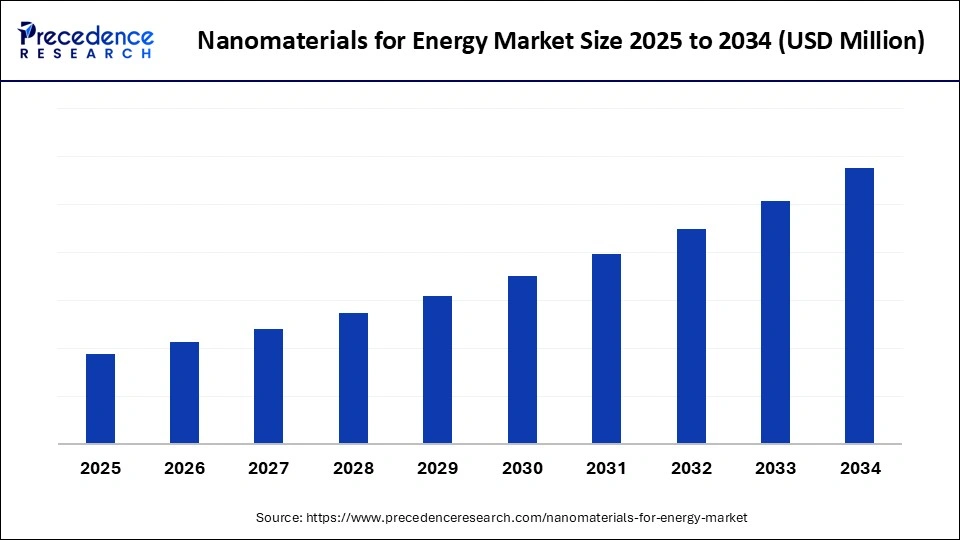
The global nanomaterials for energy market is growing rapidly as industries adopt advanced nanotech solutions to enhance energy storage, conversion, and efficiency. The nanomaterials market for energy is driven by the growing demand for efficient, lightweight, and high-performance materials to enhance energy storage, conversion, and sustainability technologies.
Market Highlights
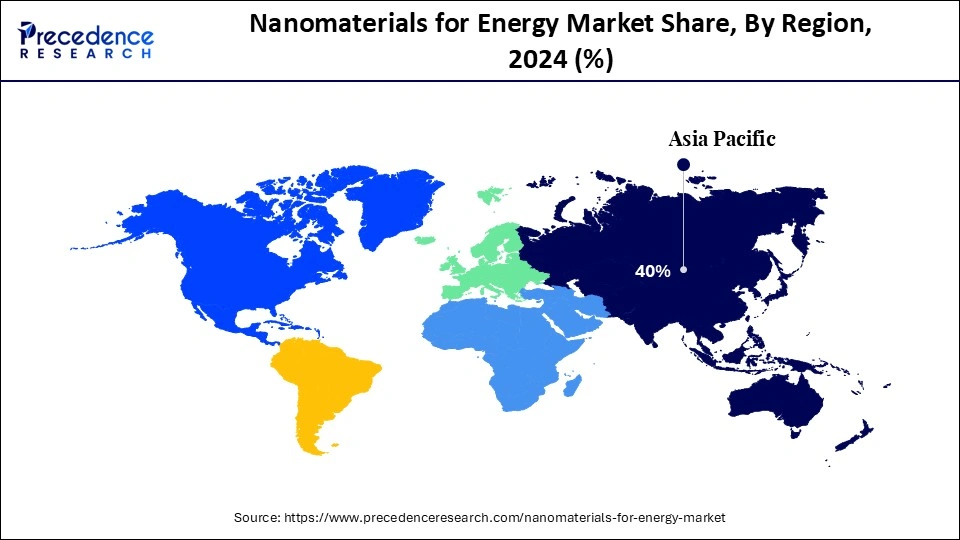
- Asia Pacific dominated the market, holding the largest market share of 40% in 2025.
- The North America is expected to expand at the fastest CAGR of 23% between 2026 and 2035.
- By material/nanomaterial type, the nanoparticles segment held the largest market share of 45% in 2025.
- By material/nanomaterial type, the nanotubes and nanowires segment is expected to grow at a remarkable CAGR of 20% between 2026 and 2035.
- By energy application, the energy storage segment contributed the largest market share of 35% in 2025.
- By energy application, the hydrogen & alternative fuels segment is growing at a strong CAGR of 22% between 2026 and 2035.
- By end-use sector, the electric vehicles & mobility segment generated the major market share of 30% in 2025.
- By end-use sector, the renewable power generation is set to grow at a remarkable share of 21% CAGR between 2026 and 2035.
- By manufacturing/production type, the bulk nanomaterials production segment held the largest market share of 50% in 2025.
- By manufacturing/production type, the specialized/functional nanomaterials segment is expected to expand at a healthy CAGR of 18% between 2026 and 2035.
- By sales channel/business model, the direct sales to OEMs & energy device manufacturers segment recorded the biggest market share of 55% in 2025.
- By sales channel/business model, the platform/online sales for research & small-batch users segment is expanding at a solid CAGR of 19% between 2026 and 2035.
- By technology readiness/maturity, the commercially deployed nanomaterials segment held the major market share of 60% in 2025.
- By technology readiness/maturity, the integrated nanomaterials in products segment is growing at the fastest CAGR of 20% between 2026 and 2035.
Revolutionizing Sustainable Energy: How Nanomaterials Are Powering the Next Generation of Energy Technologies
The global nanomaterials for energy market is a fast-growing branch of the materials science and clean energy sectors, encompassing the design, production, and use of nanoscale materials, including nanoparticles, nanowires, nanotubes, nanosheets, and nanocomposites. The materials are significant for improving the performance and efficiency of contemporary energy systems, such as batteries, supercapacitors, fuel cells, solar cells, thermoelectric devices, and hydrogen storage technologies. Catalytic activity, mechanical strength, thermal stability, and high-quality conductive nanomaterials are also proving invaluable in the transition to sustainable, high-performance energy infrastructure.
The market is growing as the global movement shifts toward efficient, lighter, cleaner energy technologies. The increase in the use of electric cars, renewable energy sources, and large-scale energy storage systems is creating an enormous demand for materials that can maximize power generation and reliability. Efficient energy conversion and reduced system weight should be considered essential for next-generation nanomaterial-enabled technologies. Furthermore, global sustainability efforts, pressure to reduce emissions through regulations, and the need to extend the lifecycles of portable devices are also hastening investment and innovation in nanomaterials for energy use worldwide.
Key AI Integration in the Nanomaterials for Energy Market
Artificial intelligence is transforming nanomaterials for the energy market by accelerating research, development, and deployment. AI-based models and machine learning algorithms enable rapid discovery of materials that optimally combine nanostructures and compositions for energy conversion, storage, and thermal performance. With the aid of AI, scientists can identify correlations between material properties and performance results, which shortens experimentation time by several folds and minimizes costs.
AI can be used in the manufacturing industry to achieve high accuracy and real-time tracking, improving the consistency and production of nanomaterials. This concept of the convergence of AI and nanotechnology is endorsing innovation, faster commercialization, and supporting the transition to more efficient, durable, and sustainable energy-related technologies, marking a new era of smart materials engineering in global energy.
Nanomaterials for Energy Market Outlook
- Industry Growth Overview: The market is also experiencing strong growth because of the growing demand for lightweight and high-performance materials that promote energy efficiency and durability of the device. Further technological developments are accelerating the integration of nanomaterials into renewable power and electric mobility.
- Global Expansion: The world is dominated by Asia-Pacific and North America, which are characterized by high levels of investments in research and development, vast manufacturing capacities, and promoting policies on clean energy. Europe is also becoming a significant player, focusing on sustainable production and circular economy initiatives.
- Major Investors: Major investors will be technology giants, energy companies, and venture capital companies that specialize in advanced materials and renewable technologies. Some companies currently investing in nanomaterials for energy solutions include BASF, Dow, LG Chem, and Panasonic.
- Startup Ecosystem: It is establishing an active start-up community and creating new companies that make nanomaterials that will be used in batteries, hydrogen storage, and the next generation solar cell. These startups are attracting international investment because they can achieve efficiency, scalability, and sustainability in the power industry transformation.
Market Scope
| Report Coverage | Details |
| Dominating Region | North America |
| Fastest Growing Region | Asia Pacific |
| Base Year | 2025 |
| Forecast Period | 2026 to 2035 |
| Segments Covered | Material/Nanomaterial Type, Energy Application, End-Use Sector, Manufacturing/Production Type, Sales Channel/Business Model, Technology Readiness/Maturity, and Region |
| Regions Covered | North America, Europe, Asia-Pacific, Latin America, and Middle East & Africa |
Nanomaterials for Energy Market Segment Insights
Material / Nanomaterial Type Insights
Why Did the Nanoparticles Segment Hold a 45% Share in 2025?
Nanoparticles: The nanoparticles segment accounted for 45% of the nanomaterials for energy market in 2025, thanks to their excellent electrochemical, thermal, and catalytic properties. They enhance energy conversion and storage, as well as system performance. TiO2, ZnO, and Fe2O3 are widely used metal oxide nanoparticles in batteries, solar cells, and as photocatalysts due to their high surface area and chemical stability. Ni, Co, Pt, and Cu are also metals and alloy nanoparticles that play an essential role in fuel cells and hydrogen production systems, enhancing reaction efficiency. They are highly conductive, tunable particle size, economical, and essential for the creation of efficient, long-lasting next-generation energy-based technologies.
Nanotubes & Nanowires: The nanotubes and nanowires market segment is expected to grow at a CAGR of more than 20% over the forecast period, as these materials are prized for their high electrical conductivity, flexibility, and high aspect ratios, which facilitate efficient charge transport. Carbon nanotubes (CNTs) are widely used in batteries, supercapacitors, and hydrogen storage to increase energy density and cycle life. Their lightweight design, high strength, and high conductivity are propelling clean, portable, and renewable energy technologies worldwide.
Nanosheets & Nanofilms: Other nanothermal architectures, including nanosheets and nanofilms such as graphene, graphene oxide, and 2D transition metal dichalcogenides (TMDCs), are emerging as novel materials for the future of nanomaterials for energy market. Graphene films increase electrode conductivity and enhance energy storage, whereas TMDCs (e.g., MoS2 and WS2) are used in solar, catalytic, and thermoelectric devices due to their tunable electronic properties. With the increased adoption of innovation, nanosheets and nanofilms are assuming a significant role in high-performance, sustainable energy generation and storage technologies worldwide.
Energy Application Insights
Why Did the Energy Storage Segment Hold a 35% Share in the Nanomaterials for Energy Market During 2025?
Energy Storage: The energy storage sector accounted for 35% of the nanomaterials for energy market in 2025 due to the high adoption of electric vehicles, the integration of renewable power, and the increasing demand for effective grid storage technology. Nanomaterials are transforming Lithium-ion and sodium-ion batteries by increasing the electrode conductivity, charge capacity, and cycle life. They enhance power density and charge rates in supercapacitors, facilitating high-performance energy storage systems. With the growing need worldwide for clean, reliable energy solutions, the use of nanomaterials in storage technologies is becoming imperative to achieve next-generation efficiency and sustainability.
Hydrogen & Alternative Fuels: The segment is expected to grow at a 22% CAGR in the nanomaterials for energy market during the coming years, driven by global initiatives to shift to cleaner energy carriers. Advanced catalysts for electrolyzers are developed using nanomaterials, improving the efficiency and durability of hydrogen production. Nanostructured materials have high hydrogen storage capacity and are safe and lightweight. With the growing trend toward hydrogen in transport and industrial decarbonization, nanomaterials are central to enhancing the efficiency of production, storage, and conversion throughout the hydrogen value chain.
Renewable Energy Conversion: The renewable energy sector is also growing rapidly, driven by increased investment in solar, fuel cells, and other clean power technologies. The use of nanomaterials for enhancing photovoltaic performance includes quantum dots, perovskites, and graphene, which improve light absorption and charge-transfer efficiency. Nanocatalysts in fuel cells (PEM and SOFC) increase reaction rates and reduce material costs. As governments and industries invest in renewable infrastructure, nanomaterial innovations are helping maximize energy output and accelerate the rapid transition to low-carbon, high-performance energy conversion technologies worldwide.
End-Use Sector Insights
Why Did Electric Vehicles & Mobility Lead the Nanomaterials for Energy Market in 2025?
Electric Vehicles & Mobility: The segment had the highest value share of 30% in 2025. Nanomaterials benefit batteries by increasing energy density and charge rate, extending battery life, reducing weight, and lowering cost. They have been used in lithium-ion and solid-state batteries to enable longer driving ranges and faster charging. Also, lightweight composites and nanocoatings enhance the efficiency and durability of vehicles. Governments intensify EV adoption policies and charging infrastructure, and automakers invest heavily in nanomaterial-based systems to achieve superior performance and sustainability, addressing this segment.
Renewable Power Generation: The renewable power generation segment, including solar and energy storage applications, is set to grow at a significant 21% CAGR during the forecast period. Perovskites, graphene, and metal oxides are nanomaterials that can improve the efficiency, durability, and light absorption of photovoltaic cells. Nanostructured materials have been used to enhance the energy storage of batteries and supercapacitors, enabling their integration with solar systems on a stable basis. As the world invests in clean energy and grid modernization, nanomaterial-based developments will become an important factor in advancing the efficiency of renewable energy generation and storage.
Consumer Electronics and Energy Devices: The industry has been recording strong growth driven by the use of nanomaterials to transform portable and wearable energy technologies. Application in miniature batteries and supercapacitors enhances energy density, charging speed, and overall duration. Examples of nanotechnology products that enhance the performance of smartphones, laptops, and other IoT devices. The continuous implementation of nanomaterial-based solutions is being adopted across the global technological and energy industries.
Manufacturing/Production Type Insights
Why Did the Bulk Nanomaterials Production Segment Hold a 50% Share in 2025?
Bulk Nanomaterials Production: The bulk nanomaterials production segment accounted for 50% of the nanomaterials for energy market in 2025. Mass production enables cost savings and the use of higher-quality materials. Metal oxides, carbon-based nanomaterials, and nanocomposites are well-manufactured in large quantities for use in lithium-ion batteries, supercapacitors, and fuel cells. The current developments in the synthesis techniques, such as chemical vapor deposition and sol-gel, have enhanced scalability and purity. The growing demand for low-cost, high-performance nanomaterials in energy systems further strengthens the segments leadership.
Specialized/Functional Nanomaterials: The specialized/functional nanomaterials segment is set to expand at an 18% CAGR in the energy nanomaterials market over the coming years, driven by increasing demand for customized nanomaterials with specific performance specifications. Applications of these materials include advanced catalysts, solid-state electrolytes, and thermoelectric materials. Functional nanomaterials offer high electrochemical stability, conductivity, and surface activity, which are critical for the next generation of energy devices. As the energy industry moves towards high-performance and sustainable solutions, the application of specialized nanomaterials becomes increasingly critical for innovation and differentiation.
Co-manufacturing/Custom Nanomaterial Services: These segments are gaining momentum as energy companies seek scalable solutions and relationships. This division provides contract production and optimisation of nanomaterials for specific energy applications. Smaller energy companies and manufacturers with greater research capacity collaborate with large energy companies to jointly develop new technologies in battery materials, hydrogen systems, and solar cells. Custom manufacturing enables quicker prototyping, reduced research and development costs, and improved performance outcomes.
Sales Channel/Business Model Insights
Why Did the Direct Sales to OEMs & Energy Device Manufacturers Segment Lead the Nanomaterials for Energy Market in 2025?
Direct Sales to OEMs & Energy Device Manufacturers: The nanomaterials for energy market accounted for a dominant 55% share of direct sales to OEMs and energy device manufacturers in 2025. This superiority has been driven by robust collaborations between manufacturers of nanomaterials and energy equipment on a large scale. Battery, solar, and hydrogen system manufacturers engage in direct sourcing to achieve high quality, performance stability, and a reliable supply chain. Direct sales have remained the model of choice for companies that are strategically focused on producing energy worldwide as demand for high-efficiency materials increases.
Platform/Online Sales for Research & Small-Batch Users: Platform/online sales research and the small-batch users segment is set to grow at a 19% CAGR between 2025-2034, and are expected to maintain high growth rates over the forecast period. The increasing demand from research institutes, startups, and prototype developers is driving the need to access small-batch nanomaterials flexibly. B2B digital markets and online markets have a broad selection of materials, open pricing, and simple order processing. With the digitalization of material commerce, online sales platforms are transforming accessibility, enabling faster, more innovative development and supporting decentralized nanomaterial research and testing worldwide.
Distributors & Traders of Nanomaterials: The nanomaterials for energy market relies on distributors and traders as critical intermediaries to connect producers and final consumers across industries and geographic locations. The distributors handle import/export, warehousing, and technical assistance to facilitate easier procurement of materials. This segment is increasingly becoming significant in emerging markets where OEM alliances are in the process of growth. As the world moves towards an energy transition, distributors are ensuring that materials are available consistently and at competitive prices throughout the value chain.
Technology Readiness/Maturity Insights
Why Did the Commercially Deployed Nanomaterials Segment Lead the Nanomaterials for Energy Market in 2025?
Commercially Deployed Nanomaterials: The segment dominated the nanomaterials for energy market in 2025, with a 60% share, as this leadership is based on performance, regulatory approvals, and high adoption in batteries, solar cell systems, and hydrogen systems. Manufacturers have achieved process standardization, scale-up, and cost-effectiveness for carbon nanotubes, metal oxides, and graphene derivatives. These nanomaterials are an important component of renewable and storage solutions because of their ability to enhance durability, conductivity, and overall energy conversion efficiency.
Integrated Nanomaterials in Products: The INP segment is expected to grow at a 20% CAGR in the market during the forecasted period, since this type of nanomaterial is incorporated directly into devices used by the mass market, including electric cars, solar cells, and consumer batteries. Its development is driven by increased product commercialization, the need for high-performance solutions, and the demand for lightweight, energy-saving solutions. Integrated nanomaterials enhance product lifespans, charge density, and power output, enabling compact, sustainable designs. The rapid pace of technological change and government policies supporting green energy are increasing adoption.
Emerging/R&D-Stage Nanomaterials (lab scale): R&D-stage and emerging nanomaterials are important for innovation in the nanomaterials energy market. They consist of new nanostructures, 2D materials, and hybrid composites, which will offer a higher efficiency and sustainability. Although not fully commercialized, significant investment has been made in improving hydrogen generation, thermoelectrics, and advanced storage systems. These materials are transitioned to commercialization through R&D and will be very important in future energy architectures that will be much more efficient and have less environmental impact.
Nanomaterials for Energy Market Region Insights
Why Did Asia Pacific Lead the Global Nanomaterials for Energy Market in 2025?
Asia Pacific had the largest market share of 40% in the global market in 2024, driven by high levels of industrialization, clean energy infrastructure, and the ability to generate energy in large quantities. The countries at the forefront of developing nanomaterials for battery, fuel cell, and solar system manufacturing are China, Japan, and South Korea. Government efforts to encourage the use of renewable energy and electric mobility also help expand the market. China is particularly at the forefront of global nanomaterial exports and research on the use of graphene and carbon nanotubes. Its swift investment in energy storage and green hydrogen technologies solidifies the regions leadership. Asia Pacific has the potential to be a major hub for innovation, scaling, and implementation of nanomaterials to provide sustainable energy solutions.
- In June 2025, engineered nanomaterials were used to break a sodium-ion battery technology, which was realized by scientists in the Jawahar Lal Nehru Centre of Advanced Scientific Research (JNCASR) in India. The new anode material, which had been enhanced with nanoscale EV particles and a carbon coating, delivered 80% charge in 6 minutes and could withstand more than 3,000 charge cycles.
China Nanomaterials for Energy Market Trends
China controls most of the nanomaterials energy market in the Asia Pacific region due to its superior production capacity, strong government support, and rapid adoption of clean energy technologies. Carbon-neutral policies over a period of 2060 have hastened the incorporation of nanomaterials into renewable energy systems. Chinese firms are increasing their production capacity and partnering with research organizations worldwide to develop superior nanocomposites and catalysts.
Why Is North America Undergoing the Fastest Growth in the Nanomaterials for Energy Market?
North America is estimated to achieve the highest CAGR throughout the forecast period, driven by robust federal investments in clean energy breakthroughs, nanotechnology research, and the availability of large EV and battery manufacturers. The U.S. and Canada are working hard to produce nanomaterials domestically to increase their energy independence and sustainability. Universities and startups, coupled with government labs, are accelerating the commercialization of advanced storage and hydrogen solutions. This rapid growth is driven by demand for high-performance, high-efficiency energy materials for power and mobility applications in renewable energy. North America is taking the centre stage as a prime location for next-generation nanomaterial-based energy systems.
U.S Nanomaterials for Energy Market Trends
The U.S. nanomaterials market for energy is growing dynamically due to increased investment in clean energy innovation, electrification, and advanced materials research. Production is speeding up at home through federal efforts to support sustainable technologies and to fund nanotechnology research and development. The U.S. companies are leading the way in using graphene, carbon nanotubes, and metal oxides in batteries, hydrogen fuel cells, and solar panels. The high uptake of EVs in the country, combined with the developed industrial relationships between research laboratories and the industrial alliance, substantiates massive commercialization. Moreover, the need to minimize carbon emissions and improve grid efficiency is driving the demand for nanomaterials to create lightweight, robust, and efficient energy infrastructure.
Why Is the European Nanomaterials for Energy Market Experiencing Notable Growth?
The European nanomaterials for energy market is experiencing significant growth due to its high sustainability policies, high-speed shift to renewable energy, and attention to the principles of a circular economy. The net-zero targets and the Green Deal of the European Union have quickened the investment in nanomaterial batteries, hydrogen storage, and photovoltaic systems. Countries such as Germany, France, and the Netherlands are at the forefront of R&D on nanostructured catalysts and 2D materials for cleaner energy conversion. University-industry collaboration fosters steady advances in large-scale nanomaterials for renewable and mobility initiatives. Europe, with a well-established regulatory framework and growing interest in local manufacturing, is consolidating its status as a global leader in nanomaterial innovation for sustainable energy.
UK Nanomaterials for Energy Market Trends
The UK is also becoming a centre of breakthroughs in nanomaterials for energy technologies. Funding initiatives and academic collaborations with the government are fuelling developments in graphene-based batteries, fuel cells, and solar materials. British startups have been looking to scale up production of nanomaterials for electric vehicles, hydrogen systems, and energy-efficient infrastructure. The countrys national target to achieve net-zero emissions by 2050 has heightened focus on R&D for lightweight, recyclable, and high-performance nanomaterials. The University of Manchester Graphene Institutes partnership with major energy companies illustrates how the country was a leader in applied nanotechnology.
Nanomaterials for Energy Market Companies
- BASF SE: Develops advanced nanomaterials for lithium-ion batteries, fuel cells, and hydrogen storage systems, focusing on sustainable chemistries. The company emphasizes low-carbon manufacturing and high-performance energy materials.
- LG Chem Ltd: Provides nanostructured battery materials used in high-energy-density EV batteries. LG Chem focuses on improved charge rates, longer cycle life, and enhanced thermal stability through engineered nanoscale cathode and anode materials.
- Arkema S.A.: Supplies graphene, carbon nanotubes, and high-performance polymer nanocomposites for renewable energy and battery systems. Arkema supports enhancing conductivity and integrating lightweight materials into energy storage.
- Cabot Corporation: Produces conductive carbons, carbon nanotubes, and engineered nanomaterials for lithium-ion batteries and supercapacitors. Its additives improve conductivity, energy density, and cycle stability in advanced storage systems.
- Forge Nano: Specializes in atomic layer deposition (ALD) coatings for nanoscale battery materials to improve durability, thermal stability, and charge performance. The company supports high-performance batteries, hydrogen technologies, and solar applications.
- A123 Systems LLC: Produces silver nanowires, nano-oxides, and CNT-based materials for electronics, sensors, and energy devices. ANP supports improved conductivity and performance in next-generation batteries.
- Aspen Aerogels Inc: Manufactures aerogel-based nanomaterials for thermal management in EV batteries and energy systems. Its ultralight insulation materials improve battery safety and reduce heat-related degradation.
- Black Diamond Structures LLC: Uses proprietary MOLECULAR REBAR nanotube technologies to increase energy density, lifespan, and stability of lithium-ion batteries. The company enhances electrode durability through engineered nanostructures.
- The Chemours Company: Provides advanced fluoropolymer nanomaterials and additives used in battery separators, electrolytes, and hydrogen fuel cells. Chemours supports high-efficiency, chemically stable energy systems.
- Honeywell International Inc.: Develops nanostructured materials and membranes for hydrogen storage, advanced electrolytes, and energy-efficient systems. Honeywell focuses on integrating high-performance materials into clean energy technologies.
Recent Developments
- In July 2025, Nanovace Technologies Ltd, a subsidiary of PCBL Chemical Ltd, announced that it had secured a patent from the US for its proprietary method of developing nanomaterials targeted at next-generation energy storage technologies. The patent marks a significant boost for the companys R&D efforts, bolstering its intellectual property portfolio in the energy storage space, according to a regulatory filing.(Source: https://www.ptinews.com)
- In February 2025, researchers from Jiangsu University are exploring amorphous/crystalline heterostructured nanomaterials (AC-HNMs) as promising electrode materials, which leverage synergistic interactions between their amorphous and crystalline phases, along with interface effects, to enhance capacity output and accelerate mass and charge transfer dynamics in electrochemical energy storage devices. (Source: https://onlinelibrary.wiley.com)
Nanomaterials for Energy Market Segments Covered in the Report
By Material/Nanomaterial Type
- Nanoparticles
- Metal Oxide Nanoparticles (TiO₂, ZnO, Fe₂O₃)
- Metal & Alloy Nanoparticles (Ni, Co, Pt, Cu)
- Nanotubes & Nanowires
- Carbon Nanotubes (CNTs)
- Metal/Alloy Nanowires
- Nanosheets & Nanofilms
- Graphene & Graphene-Oxide Sheets
- 2D Transition Metal Dichalcogenides (TMDCs)
- Nanocomposites & Hybrid Nanomaterials
- Polymer-Nano fillers
- Carbon-Hybrid Nanomaterials
- Nanostructured Coatings & Surfaces
- Anti-corrosion / Thermal barrier coatings
- Photocatalytic/solar absorption coatings
By Energy Application
- Energy Storage
- Lithium-Ion/Sodium-Ion Batteries
- Supercapacitors
- Renewable Energy Conversion
- Photovoltaics (solar cells)
- Fuel Cells (PEM, SOFC)
- Energy Efficiency & Thermal Management
- Thermal barrier coatings
- Insulation nano-materials
- Hydrogen & Alternative Fuels
- Electrolyzer catalysts
- Hydrogen storage materials
- Grid & Electrical Systems
- Conductive nanomaterials for wiring, sensors, and smart grid devices
By End-Use Sector
- Electric Vehicles (EVs) & Mobility
- Renewable Power Generation
- Consumer Electronics & Energy Devices
- Industrial/Infrastructure (grid, utilities, storage)
- Buildings & Construction (energy-efficiency materials)
By Manufacturing/Production Type
- Bulk Nanomaterials Production
- Specialized/Functional Nanomaterials (high-purity, engineered)
- Co-manufacturing / Custom Nanomaterial Services
- Recycling & Sustainable Nanomaterials Production
By Sales Channel/Business Model
- Direct Sales to OEMs & Energy Device Manufacturers
- Distributors & Traders of Nanomaterials
- Integrated Supply Chain Partnerships (Nano + Device)
- Online/Platform Sales for Research & Small-Batch Users
By Technology Readiness/Maturity
- Emerging/R&D Stage Nanomaterial
- Commercially Deployed Nanomaterials
- Fully Integrated Nanomaterials in Products
By Region
- North America
- Europe
- Asia-Pacific
- Latin America
- Middle East & Africa
For inquiries regarding discounts, bulk purchases, or customization requests, please contact us at sales@precedenceresearch.com
Frequently Asked Questions





Ask For Sample
No cookie-cutter, only authentic analysis – take the 1st step to become a Precedence Research client
 Get a Sample




 sales@precedenceresearch.com
 Schedule a Meeting
