



LiFSI for Lithium-Battery Electrolyte Market Trends, Companies, Contract Wins - Project Pipeline, Installed Capacity, Power Generation, Government Investment, Technology Adoption, Competitive Positioning, and Growth Forecast
LiFSI (Lithium bis(fluorosulfonyl)imide) for Lithium-Battery Electrolyte Market (By Purity/Grade: Battery-grade Ultra-High Purity (≥99.9% / 99.99%), Technical/Research Grade (>99.0%); By Product Form: Anhydrous LiFSI Powder (dry salt), Pre-dissolved Electrolyte Solutions (LiFSI in EC/EMC or other solvent blends), Blended Additive Packs/Concentrated Solutions; By Application/End-Use: Electric Vehicles (EVs) & Hybrid Vehicles, Stationary Energy Storage Systems (ESS), Consumer Electronics (smartphones, laptops), Industrial & Specialty Batteries (power tools, medical); By Function in Electrolyte: Primary Salt, Co-salt/Additive; By Production/Technology Route: Conventional batch synthesis, Continuous/Modular processes, High-purity finishing & recrystallization) - Global Industry Analysis, Size, Trends, Leading Companies, Regional Outlook, and Forecast 2026 to 2035
Source: https://www.precedenceresearch.com/lifsi-for-lithium-battery-electrolyte-market
 Get a Sample
 Table Of Content


What is the LiFSI (Lithium bis(fluorosulfonyl)imide) for Lithium-Battery Electrolyte Market Size in 2026?
The global LiFSI (Lithium bis(fluorosulfonyl)imide) for lithium-battery electrolyte market size accounted for USD 885.00 million in 2025 and is predicted to increase from USD 1,004.48 million in 2026 to approximately USD 3,139.80 million by 2035, expanding at a CAGR of 13.50% from 2026 to 2035. The increasing adoption of electric vehicles (EVs) and robust energy storage systems due to high energy demand by developing technologies is fueling the need for exceptional battery electrolyte solutions like LiFSI, propelling the markets growth on a global scale.
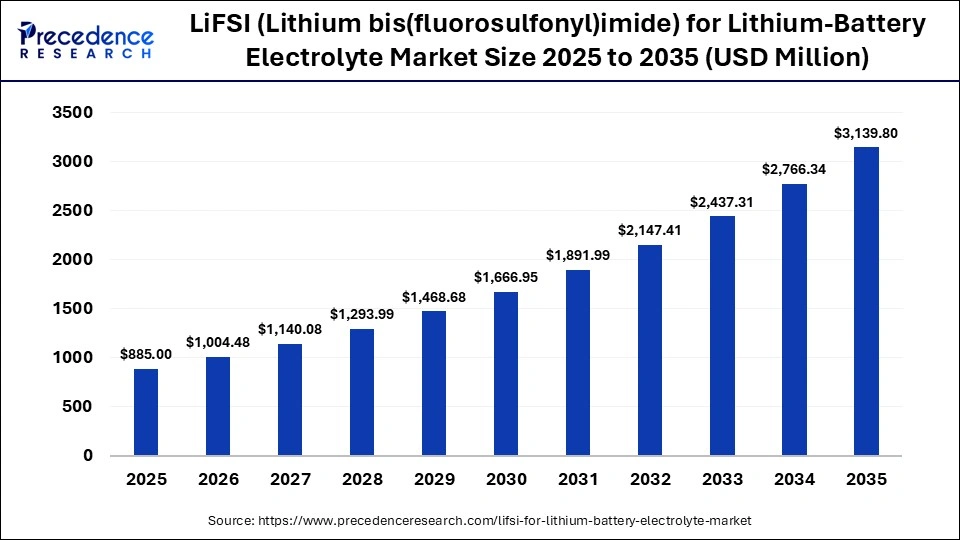
Key Takeaways
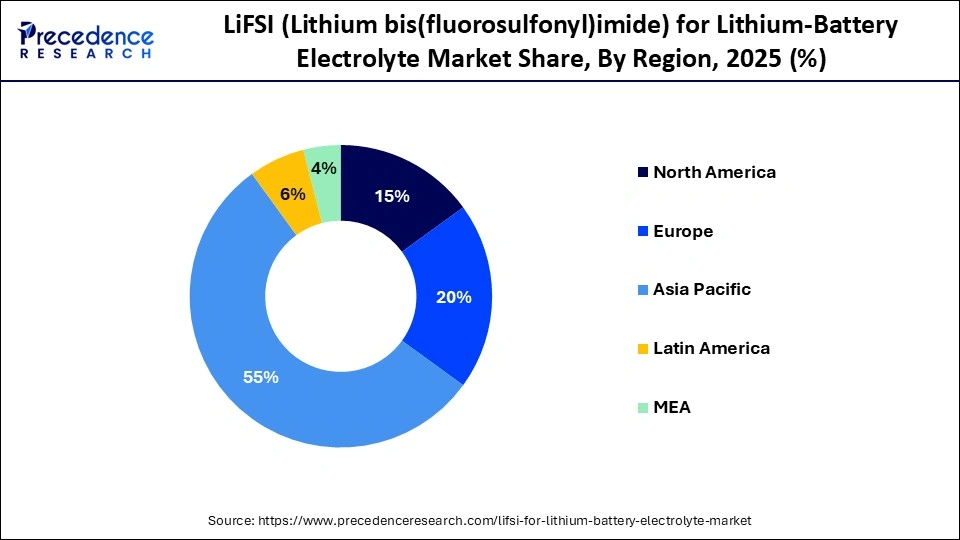
- Asia-Pacific held the largest market share of nearly 55% in 2025.
- Europe is expected to witness the fastest CAGR during the foreseeable period.
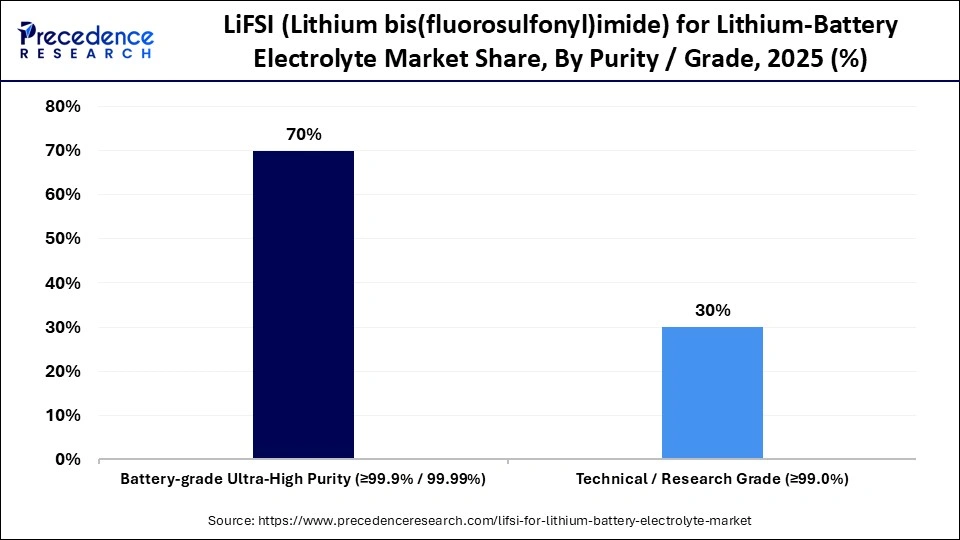
- By purity/grade, the battery-grade ultra-high purity segment held the largest LiFSI (Lithium bis(fluorosulfonyl)imide) for lithium-battery electrolyte market share
- of nearly 70% in 2025 and is expected to expand rapidly in the market in the coming years.
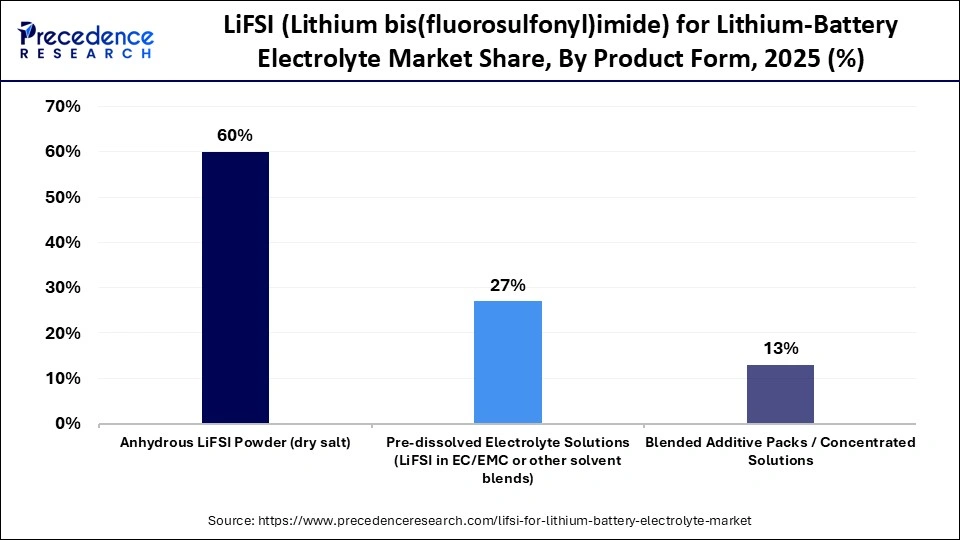
- By product form, the anhydrous LiFSI powder segment held a dominant market share of nearly 60% in 2025.
- By product form, the pre-dissolved electrolyte solutions segment is expected to grow at the fastest CAGR in the market between 2026 and 2035.
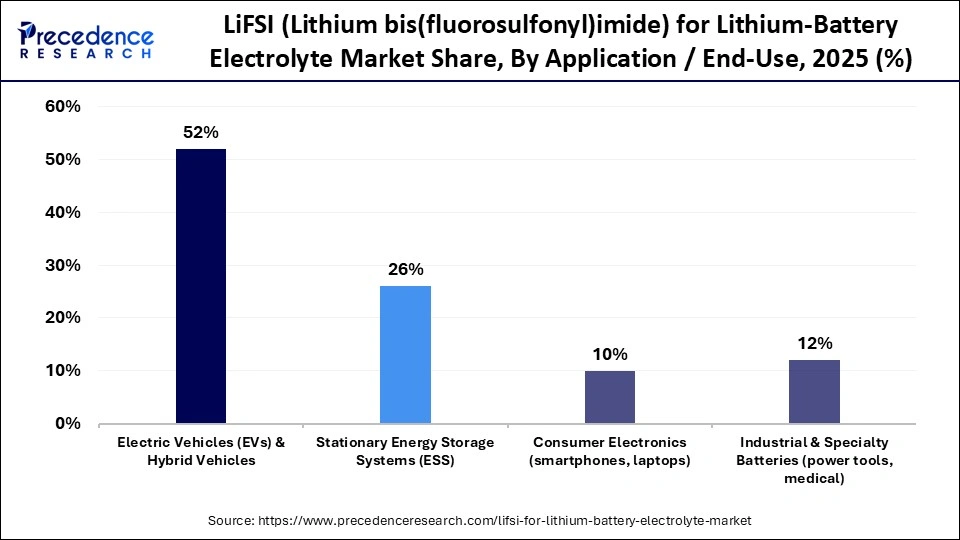
- By application/end-use, the electric vehicles (EVs) and hybrid vehicles segment contributed the biggest market share of nearly 52% in 2025.
- By application/end-use, the stationary energy storage systems (ESS) segment is expected to grow with the highest CAGR in the market during the studied years.
- By function in electrolyte (use case), the primary salt segment accounted for the highest market share of nearly 65% in 2025.
- By function in electrolyte (use case), the co-salt/additive segment is expected to gain the highest market share between 2026 and 2035.
- By production/technology route, the conventional batch synthesis segment held the largest market share of nearly 65% in 2025.
- By production/technology route, the continuous/modular processes segment is expected to witness the fastest CAGR during the foreseeable period.
What is LiFSI for Lithium-Battery Electrolyte?
The LiFSI (lithium bis(fluorosulfonyl)imide) for lithium-battery electrolyte market refers to a high-purity lithium salt used as a primary electrolyte salt or additive in lithium-ion battery electrolytes. Compared with conventional LiPF6, LiFSI offers improved thermal and hydrolytic stability, better low-temperature performance, superior ionic conductivity, and improved high-voltage/cycling characteristics.
The market covers ultra-high-purity LiFSI salts (industrial & battery grades), formulation/solution supply (pre-dissolved electrolyte blends), contract manufacturing, and supply-chain services (packaging, traceability, certification for battery-grade use). Demand is driven by EVs, energy storage systems (ESS), high power electronics, and the shift to more robust electrolyte systems for fast charging and high-voltage cells.
AI Shifts in the LiFSI (Lithium bis(fluorosulfonyl)imide) for Lithium-Battery Electrolyte Market
The integration of artificial intelligence (AI) with LifSI for the lithium battery electrolyte sector can be transformed by material discovery, optimal electrolyte formulation, and deep knowledge of interfacial chemistry. AI/ML models can further help accelerate manufacturing and quality control for solutions like LifSI for lithium batteries. Manufacturing and quality control are a crucial part of the market, which can be handled by the AI/ML model effectively.
AI can be used to streamline battery production by recognizing bottlenecks and optimizing crucial manufacturing parameters that include temperature, pressure, and drying time during cell assembly. Moreover, AI models help analyze manufacturing data to draw the final performance metrics like battery capacity and internal resistance way before it leaves the floor, allowing manufacturers to ensure higher quality yields and customize battery types for various applications.
LiFSI (Lithium bis(fluorosulfonyl)imide) for Lithium-Battery Electrolyte Market Outlook
- Industry Growth Overview: The market is witnessing a robust growth rate due to the increasing demand for high-performance batteries for EVs, consumer electronics, and ESS. The market is majorly driven by excellent ionic conductivity and superior thermal stability of LiFSI as compared to conventionally used LiPF6 electrolytes.
- Sustainability Trends: The increasing demand for lithium-ion batteries further fuels the focus on sustainable end-of-life management. Traditional methods of recycling include shredding and extracting metals, which are hazardous to the environmental balance. Thus, improving the production process of LiFSI is aggressively underway, aiming to reduce the cost of treating by-products having contents like fluorine, chlorine, and sulfur.
- Major Investors: Leading key industry players and financial entities are heavily investing in LiFSI and battery electrolyte areas by recognizing its potential. Key industry players like Tinci Materials Technology from China, Nippon Shokubai from Japan, and others are heavily investing in developing lithium battery electrolyte solutions. Also, strategic collaborations and acquisitions among marketers are significantly transforming the market.
Market Scope
| Report Coverage | Details |
| Market Size in 2025 | USD 885.00 Million |
| Market Size in 2026 | USD 1,004.48 Million |
| Market Size by 2035 | USD 3,139.8 Million |
| Market Growth Rate from 2026 to 2035 | CAGR of 13.50% |
| Dominating Region | Asia Pacific |
| Fastest Growing Region | Europe |
| Base Year | 2025 |
| Forecast Period | 2026 to 2035 |
| Segments Covered | Purity/Grade, Product Form, Application/End-Use, Function in Electrolyte, Production/Technology Route, and Region |
| Regions Covered | North America, Europe, Asia-Pacific, Latin America, and Middle East & Africa |
Segmental Insights
Purity/Grade Insights
Which Purity/Grade Segment Dominated the Market?
The battery-grade ultra-high purity segment held a dominant position in the LiFSI (Lithium bis(fluorosulfonyl)imide) for lithium-battery electrolyte market with a share of approximately 70% in 2025 and is expected to grow at the fastest CAGR in the market between 2026 and 2035, due to smaller trace impurities that can also damage the cell and degrade its performance, safety, and lifespan. Interfering with the solid electrolyte interphase (SEI) and parasitic side activities can severely impact a batterys ability to deliver charge.
Ultra-high purity is a crucial factor for next-gen and high-performing lithium-ion batteries, especially used for EVs. This purity helps batteries to gain high energy density and stable operations with long lifecycles. Hence, LiFSI is an excellent option for conventional LiPF6, along with its extreme purity.
Product Form Insights
How the Anhydrous LiFSI Powder Segment Dominated the Market?
The anhydrous LiFSI powder segment registered its dominance over the LiFSI (Lithium bis(fluorosulfonyl)imide) for lithium-battery electrolyte market with a share of approximately 60% in 2025, due to the increasing demand for advanced battery chemistry, including solid-state technologies and silicon anodes, which comply with strict regulations on the purity of electrolyte solutions used for batteries. LiFSI is predominantly used as a co-salt to improve the performance of contemporary LIBs, particularly in the EV field.
The pre-dissolved electrolyte solutions segment is expected to grow with the highest CAGR in the market during the studied years. These solutions offer superior electrochemical performance. Increased manufacturing efficiency and enhanced safety to manage LiFSI solutions in powder form boost the segments growth. Ready-made pre-dissolved electrolyte solutions eliminate the need for specially preparing a solution.
Application/End-Use Insights
Why Did the Electric Vehicles (EVs) and Hybrid Vehicles Segment Dominate the Market?
The electric vehicles (EVs) and hybrid vehicles segment dominated the LiFSI (Lithium bis(fluorosulfonyl)imide) for lithium-battery electrolyte market with a share of approximately 52% in 2025, due to the massive demand for high-performing, safer, and long-lasting lithium-ion batteries, which are offered by LiFSI solution. EVs need high-energy-density batteries for longer working hours. Also, LiFSI offers superior safety due to its excellent thermal stability. The increasing manufacturing of EVs and hybrid vehicles propels the segment growth.
The stationary energy storage systems (ESS) segment is expected to expand rapidly in the market in the coming years, as LiFSI-powered batteries can enhance the lifecycle of batteries by 30-40% in stationary applications. It also offers better thermal stability with high hydrolysis resistance, which is critical for grid-scale storage systems. The growing energy consumption and the intermittent nature of renewable sources require grid-connected ESS with higher capacities.
Function in Electrolyte (Use Case) Insights
What Made Primary Salt the Dominant Segment in the Market?
The primary salt segment held the largest revenue share of approximately 55% in the LiFSI (Lithium bis(fluorosulfonyl)imide) for lithium-battery electrolyte market in 2025, due to the ability of primary salt to offer superior ionic conductivity, electrochemical stability, and its potential to build the SEI layer, which plays a critical role for battery life and safety in various applications like EVs, while offering robust resistance to corrosion caused by moisture.

The co-salt/additive segment is expected to witness the fastest growth in the market over the forecast period. These additives are highly beneficial for enhanced battery performance, longevity, and safety. These characteristics are highly in demand for major applications like ESS and EVs. Co-salt or additives can significantly enhance the performance of lithium-ion batteries.
Production/Technology Route Insights
Which Production/Technology Route Segment Led the Market?
The conventional batch synthesis segment led the LiFSI (Lithium bis(fluorosulfonyl)imide) for lithium-battery electrolyte market with a share of nearly 65% in 2025. The segment is dominating due to the high purity requirement for battery production on a large scale. High capital expenditure needs a dedicated, continuous-flow system, which is not suitable for specialty chemicals with a moderate volume of production. This production method further offers economic viability and flexibility for manufacturers.
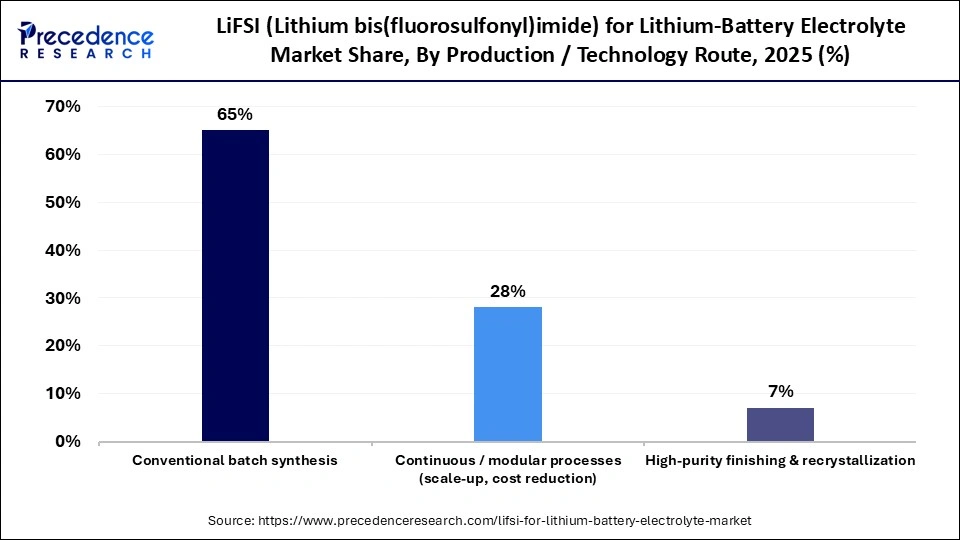
The continuous/modular processes segment is expected to gain the highest market share between 2026 and 2035. Continuous processes involve advanced, modular, multi-stage synthesis, using microreactors. They reduce downtime for cleaning and setting up between batches. It leads to higher yield with less operational expenses, along with better quality control and enhanced safety.
Regional Insights
Asia Pacific LiFSI (Lithium bis(fluorosulfonyl)imide) for Lithium-Battery Electrolyte Market Size and Growth 2026 to 2035
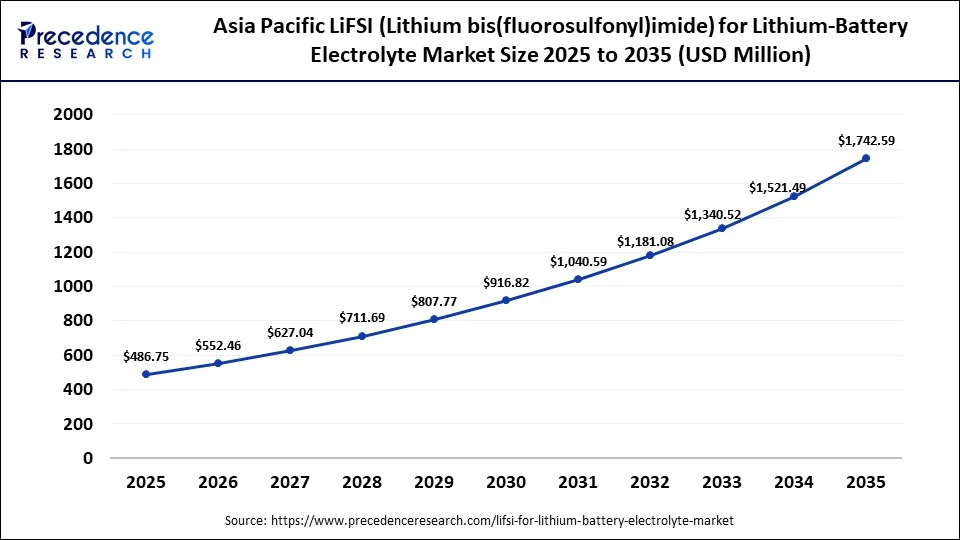
The Asia Pacific LiFSI (Lithium bis(fluorosulfonyl)imide) for lithium-battery electrolyte market size is expected to be worth USD 1,742.59 million by 2035, increasing from USD 486.75 million by 2025, growing at a CAGR of 13.60% from 2026 to 2035.
Why Asia-Pacific Dominated the Market?
Asia-Pacific held a major market share of nearly 55% in the LiFSI (Lithium bis(fluorosulfonyl)imide) for lithium-battery electrolyte market in 2025, due to the region strong hold in the broader lithium-ion battery supply chain, governments strong support with subsidies, and huge investments to propel the energy sector with robust batteries. The rapid expansion of EVs further encourages manufacturers in the leading countries like China, Korea, and India to offer localized production of LiFSI solution for batteries. Also, companies in the Asia-Pacific are heavily investing in the R&D of efficient battery solutions and ESS, which is another key driver of the regions growth.
China Market Trends
China leads the market in Asia-Pacific due to its huge contribution as a manufacturer and consumer as well. Its leading position in EV adoption and sales is supported by large battery producers like CATL, making it a dominant force in the Asia-Pacific. Favorable government policies and leading marketers presence in the region are driving the countrys growth for this market.
How is Europe Expanding in the Market?
Europe is expected to witness the fastest CAGR in the LiFSI (Lithium bis(fluorosulfonyl)imide) for lithium-battery electrolyte market during the foreseeable period. The region is expanding due to its ambition to reduce dependency on the Asian supply chain for battery solutions and establish local manufacturing in Europe itself. High adoption rates of EVs and regulatory support to leverage lithium batteries and their potential to comply with stringent safety regulations by major marketers are key drivers of the market expansion in Europe.
Additionally, strong regulatory pushes like EU regulations named the phase-out of internal combustion engines by 2035, along with initiatives like the battery passport, are highlighting mandatory higher safety and efficiency standards, fueling the market growth in Europe.
Germany Market Trends
Germany is a leading hub for investment in battery technology like LiFSI to support initiatives in Europe, like the green transition to reduce carbon footprints and save the environmental balance. Leading companies in the country are actively developing and deploying LiFSI with the help of collaboration and research activities with academic institutions. Many start-ups are entering the market with the ambition to offer specialized and novel LiFSI-based solutions for highly efficient manufacturing processes.
Will North America Grow in the Market?
North America is expected to grow at a notable CAGR in the LiFSI (Lithium bis(fluorosulfonyl)imide) for lithium-battery electrolyte market in the foreseeable future. The region is growing due to the increasing demand for EVs and robust ESS, along with rising investments in local supply chains to minimize dependency on battery imports. Also, the strategic partnership between electrolyte producers and battery manufacturers, along with research and development activities in the area, further supports the market growth.
U.S.Market Trends
The U.S. market is driven by the growing demand for high-performance lithium batteries due to the growing adoption of EVs. LiFSI is considered a next-gen electrolyte salt, which is crucial to improve battery performance by increasing conductivity, thermal stability, and a longer lifecycle. Also, the growing number of battery manufacturing plants, increased focus on research and development by marketers, and collaborations among market players are augmenting the market.
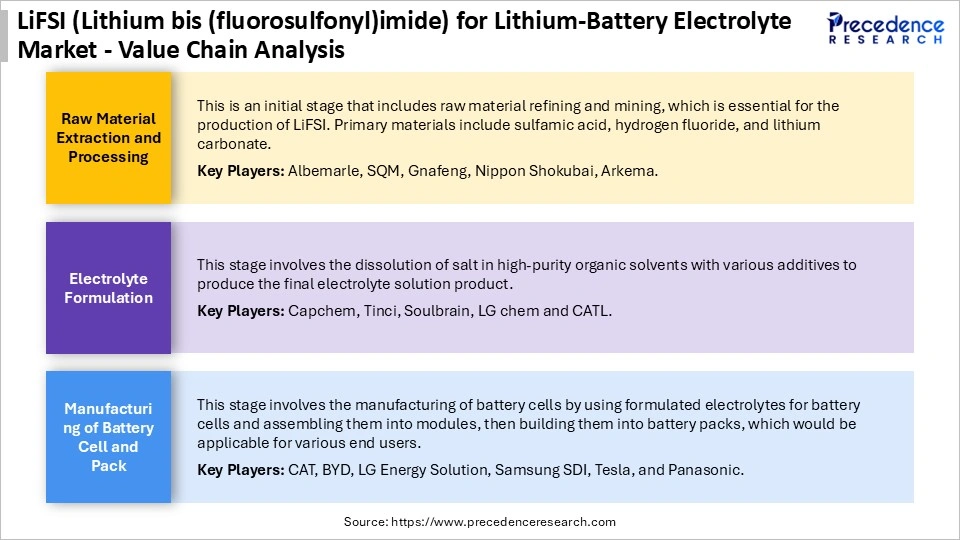
LiFSI (Lithium bis(fluorosulfonyl)imide) for Lithium-Battery Electrolyte Market Value Chain Analysis
LifSI (Lithium bis(fluorosulfonyl)imide) for Lithium-Battery Electrolyte Market Companies
- Arkema
- Nippon Shokubai
- Solvay
- Mitsubishi Chemical
- BASF SE
- LG Chem/LG Energy Solution
- Tinci Materials Technology Co., Ltd.
- Capchem Technology Co., Ltd.
- ChemSpec
- Suzhou Huayi New Energy Technology
- Zhejiang Fluorine Chemical New Material Co., Ltd.
- Fortek
- Syensqo
- Longshine/Hangzhou Longshine Bio-Tech
- Radiant
Recent Developments
- In November 2025, researchers from Southern University of Science and Technology in Shenzhen developed a new electrolyte solution for lithium batteries operating under extremely low temperatures (down to -60 °C). The electrolyte may significantly reduce the production costs of next-gen lithium battery production. (Source: https://globalenergyprize.org/en)
- In October 2025, MIT researchers developed a new model that can explain lithium intercalation rates in lithium-ion batteries. Intercalation is a process that explains how lithium ions insert themselves into the solid electrode of a lithium-ion battery, which guides the designs of more powerful and faster charging lithium-ion batteries.(Source: https://news.mit.edu)
Segments Covered in the Report
By Purity/Grade
- Battery-grade Ultra-High Purity (≥99.9% / 99.99%)
- Technical/Research Grade (≥99.0%)
By Product Form
- Anhydrous LiFSI Powder (dry salt)
- Pre-dissolved Electrolyte Solutions (LiFSI in EC/EMC or other solvent blends)
- Blended Additive Packs/Concentrated Solutions
By Application/End-Use
- Electric Vehicles (EVs) & Hybrid Vehicles
- Stationary Energy Storage Systems (ESS)
- Consumer Electronics (smartphones, laptops)
- Industrial & Specialty Batteries (power tools, medical)
By Function in Electrolyte (use case)
- Primary Salt
- Co-salt/Additive
By Production/Technology Route
- Conventional batch synthesis
- Continuous/Modular processes
- High-purity finishing & recrystallization
By Region
- North America
- Europe
- Asia-Pacific
- Latin America
- Middle East & Africa
For inquiries regarding discounts, bulk purchases, or customization requests, please contact us at sales@precedenceresearch.com
Frequently Asked Questions





Ask For Sample
No cookie-cutter, only authentic analysis – take the 1st step to become a Precedence Research client
 Get a Sample




 sales@precedenceresearch.com
 Schedule a Meeting
