



Cardiac AI Monitoring and Diagnostics Market Size, Companies, Share, Patient Volume, Treatment Adoption Rates, Pricing Analysis, Regulatory Landscape, Competitive Positioning, and Demand Forecast
Cardiac AI Monitoring and Diagnostics Market (By Solution Type:AI cardiac monitoring software, AI cardiac diagnostic software, AI-enabled cardiac imaging analysis platforms, AI-powered remote cardiac monitoring platforms, AI clinical decision support systems for cardiology; By Technology: Machine learning algorithms, Deep learning algorithms, Natural language processing, Predictive analytics engines, Computer vision algorithms; By Application: Arrhythmia detection, Heart failure monitoring, Coronary artery disease diagnosis,Stroke risk prediction, Cardiac imaging interpretation, Other cardiovascular disease monitoring; By End User: Hospitals, Cardiology clinics, Diagnostic centers, Ambulatory surgical centers, Home healthcare providers, Research institutions) - Global Industry Analysis, Size, Trends, Leading Companies, Regional Outlook, and Forecast 2026 to 2035
Source: https://www.precedenceresearch.com/cardiac-ai-monitoring-and-diagnostics-market
 Get a Sample
 Table Of Content


What is the Cardiac AI Monitoring and Diagnostics Market Size in 2026?
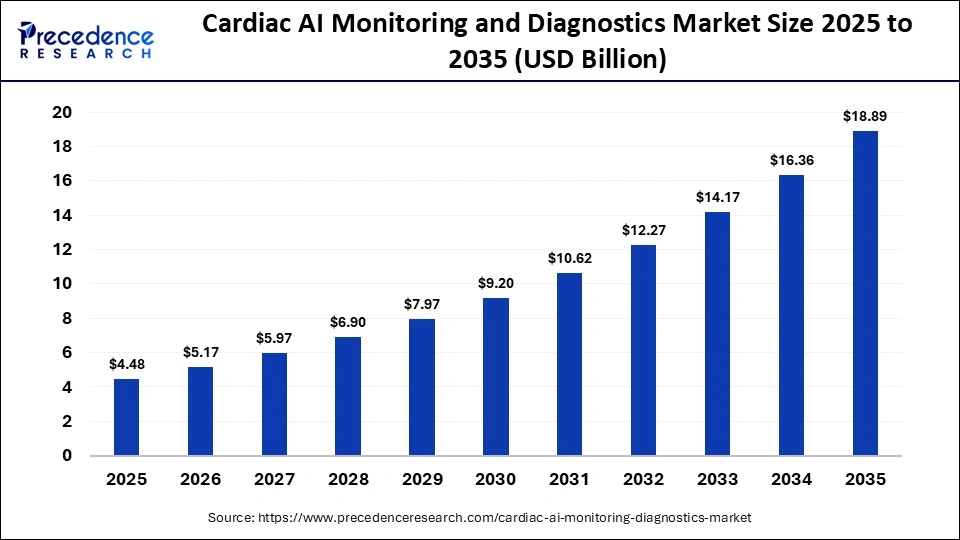
The global cardiac AI monitoring and diagnostics market size was estimated at USD 4.48 billion in 2025 and is predicted to increase from USD 5.17 billion in 2026 to approximately USD 18.89 billion by 2035, expanding at a CAGR of 15.48% from 2026 to 2035. The healthcare facilities are prioritizing automation of routine tasks, adoption of wearable devices, and implementing a preventive cardiology approach for early and accurate detection.
Key Takeaways
- North America dominated the market in 2025, with a revenue share of 42.70%.
- Asia Pacific is expected to grow at the fastest CAGR in the market during the forecast period.
- By solution type, the AI cardiac monitoring software segment dominated the market in 2025, with a revenue share of 28.70%.
- By solution type, the AI-powered remote cardiac monitoring platforms segment in the market is expected to grow at the fastest CAGR in the market during the forecast period.
- By technology, the machine learning algorithms segment dominated the cardiac AI monitoring and diagnostics market in 2025, with a revenue share of 31.60%.
- By technology, the deep learning algorithms segment is expected to grow at the fastest rate in the market in 2025.
- By application, the arrhythmia detection segment dominated the market in 2025, with a revenue share of 34.60%.
- By application, the stroke risk prediction segment is expected to grow at the fastest CAGR in the market during the forecast period.
- By end user, the hospitals segment dominated the market in 2025, with a revenue share of 46.80%.
By end user, the home healthcare providers segment is expected to grow at the fastest CAGR in the market during the forecast period.
Cardiac AI Monitoring and Diagnostics: Ensuring High Diagnostic Accuracy
The cardiac AI monitoring and diagnostics market includes artificial intelligence platforms, software tools, and integrated systems that analyze cardiovascular data to improve the detection, monitoring, and management of heart diseases. These solutions process ECG signals, imaging data, wearable device information, and electronic health records to support arrhythmia detection, heart failure monitoring, risk prediction, and diagnostic decision support. The market covers AI algorithms embedded in monitoring devices, cloud analytics platforms, and clinical decision systems deployed across hospitals, cardiology clinics, and remote patient monitoring programs.
What are the benefits of AI in the Market?
AI is transforming cardiovascular diagnostics by enhancing clinical decision-making, risk mitigation, and early disease detection. AI-driven diagnostic tools offer high accuracy across cardiovascular applications. AI helps to interpret electrocardiographic signals and contributes to expanding the cardiac AI monitoring and diagnostics market. It also predicts adverse cardiovascular outcomes and detects structural abnormalities. AI-based imaging tools are widely used in clinical practice, while explainable AI models are used to support transparent clinical decision-making. AI enables personalized care and analyzes cardiac imaging and electrocardiograms.
Cardiac AI Monitoring and Diagnostics Market Trends
- Adoption of Wearables: The applications of wearable technology include the monitoring of heart rhythm, heart rate, and other biological signals. There is a great accuracy and functionality of blood pressure monitors, electrocardiograms, defibrillators, activity trackers, fitness trackers, and sleep trackers.
- AI-Enhanced Implantable Devices: Cardiac implantable electronic devices include implantable cardioverter defibrillators, pacemakers, and cardiac resynchronisation therapy (CRT) devices. They generate vast amounts of data in both inpatient and remote settings that help to boost the growth of the cardiac AI monitoring and diagnostics market. AI techniques are widely used to enhance the management of these devices and the patients who rely on them.
- Point-of-Care Decentralized Care: The rising trends in decentralized care are AI-enhanced point-of-care ultrasound, expanding wearable and home diagnostics, growth of retail, and integration of primary care. The major companies adopting this decentralized care are Abbott, Siemens Healthineers, GE HealthCare, and Philips. Moreover, the AI specialists include AliveCor, iRhythm Technologies, Aidoc, and HeartFlow.
Market Scope
| Report Coverage | Details |
| Market Size in 2025 | USD 4.48 Billion |
| Market Size in 2026 | USD 5.17 Billion |
| Market Size by 2035 | USD 18.89 Billion |
| Market Growth Rate from 2026 to 2035 | CAGR of 15.48% |
| Dominating Region | North America |
| Fastest Growing Region | Asia Pacific |
| Base Year | 2025 |
| Forecast Period | 2026 to 2035 |
| Segments Covered | Solution Type, Technology, Application, End User, and region |
| Regions Covered | North America, Europe, Asia-Pacific, Latin America, and Middle East & Africa |
Segmental Insights
Solution Type Insights
How did the AI Cardiac Monitoring Software Segment Dominate the Market in 2025?
The AI cardiac monitoring software segment dominated the market in 2025 with a revenue share of 28.70%, owing to the immense potential of AI-imaging algorithms and AI-based software to detect, scan, and analyze heart-related images. AI-driven technologies are expanding the diagnostic approach to cardiovascular diseases, with their wide applications in ECG and cardiovascular imaging. AI tools became important in clinical settings, followed by the growing demand for AI technologies such as ECG-GPT and PanEcho.
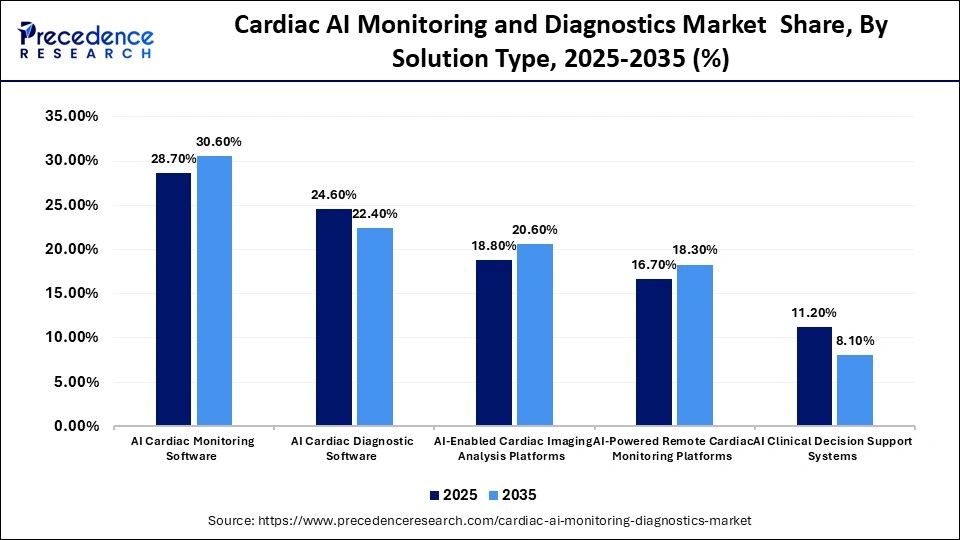
The AI-powered remote cardiac monitoring platforms segment is expected to grow at the fastest CAGR in the cardiac AI monitoring and diagnostics market during the forecast period due to the key benefits associated with AI-enabled remote patient monitoring. These benefits include timely intervention, reduced hospitalization, data-driven insights, and improved patient outcomes. Wearable devices and sensors integrated with AI technology continuously collect patient data and ensure a constant stream of information.
Technology Insights
What made Machine Learning Algorithms the Dominant Segment in the Market in 2025?
The machine learning algorithms segment dominated the market in 2025 with a revenue share of 31.60%, owing to their importance in early disease detection, real-time data processing, and personalized treatment planning. The ML models help to detect left ventricular dysfunction and silent atrial fibrillation. They also contribute to the better prediction of patients' responsiveness to treatments like Cardiac Resynchronization Therapy (CRT).
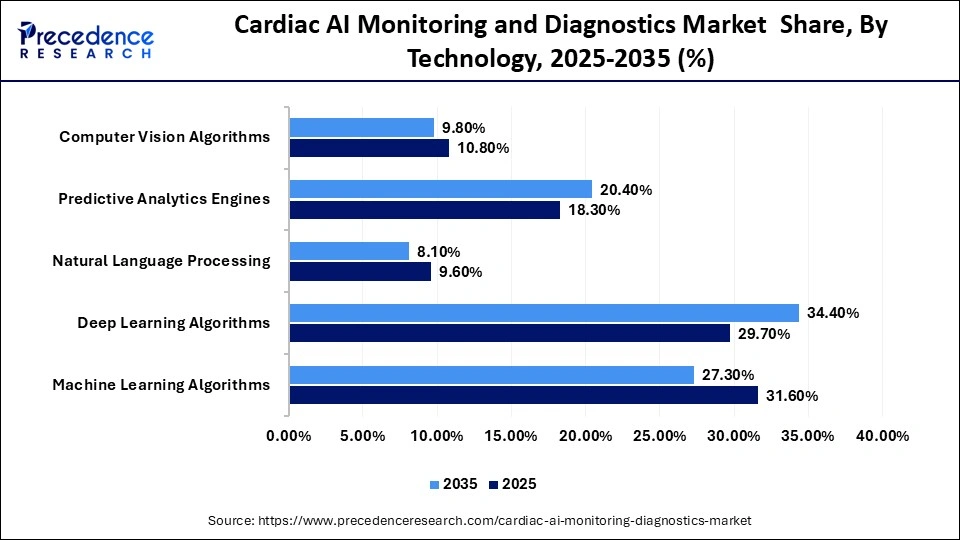
The deep learning algorithms segment is estimated to grow at the fastest rate in the cardiac AI monitoring and diagnostics market during the predicted timeframe due to their integral role in automated diagnostic precision, remote and continuous monitoring, predictive analytics, risk mitigation, and workflow optimization. The convolutional neural networks are widely used for medical imaging, which drive over 90% accuracy to detect anomalies in cardiac ECGs, echocardiograms, and CT scans. The deep learning algorithms enable consumer devices like smartwatches and patches to facilitate heart failure risk profiling and medical-grade arrhythmia detection.
Application Insights
How did the Arrhythmia Detection Segment Dominate the Market in 2025?
The arrhythmia detection segment dominated the market in 2025 with a revenue share of 34.60%, owing to the advanced features of neural network models to forecast ventricular arrhythmias up to 30 days in advance. Hospitals, diagnostic centers, and home care settings are prioritizing arrhythmia detection. The deep learning models used for arrhythmia detection in clinical and hospital settings perform better than expert cardiologists in diagnostic accuracy.
The stroke risk prediction segment is anticipated to grow at the fastest rate in the cardiac AI monitoring and diagnostics market during the upcoming period due to the primary role of AI technologies in providing real-time and continuous assessment of irregular heart rhythms and blood pressure fluctuations. They contribute to early detection of atrial fibrillation, personalized risk profiling, and enhanced imaging diagnostics. These technologies also assist in continuous blood pressure monitoring and operational efficiency.
Cardiac AI Monitoring and Diagnostics Market Share, By Application, 2025-2035 (%)
| Application | 2025 | 2035 | CAGR 2025 to 2035 |
| Arrhythmia Detection | 34.60% | 31.80% | 13.40% |
| Heart Failure Monitoring | 21.70% | 23.90% | 15.10% |
| Coronary Artery Disease Diagnosis | 16.40% | 14.70% | 12.30% |
| Stroke Risk Prediction | 12.80% | 14.60% | 15.80% |
| Cardiac Imaging Interpretation | 9.30% | 10.70% | 14.90% |
| Other Cardiovascular Disease Monitoring | 5.20% | 4.30% | 11.10% |
End User Insights
Why did the Hospitals Segment dominate the Market in 2025?
The hospitals segment dominated the market in 2025 with a revenue share of 46.80%, owing to the increased focus on workflow optimization by automating routine time-consuming tasks by AI platforms, such as Holter analysis and image segmentation. These technologies and routine techniques reduce clinician workloads. AI models in emergency departments assist in predicting patient needs for urgent ECG at triage.
The home healthcare providers segment is predicted to grow at a rapid rate in the cardiac AI monitoring and diagnostics market during the studied period due to the wide adoption of AI algorithms to analyze real-time data from wearable biosensor patches. Smartwatches and portable devices use deep learning to detect health conditions that require clinical visits, including structural heart disease, atrial fibrillation, and heart failure. AI models offer personalized care and management based on the age, gender, and medical history of patients.
Cardiac AI Monitoring and Diagnostics Market Share, By End User, 2025-2035 (%)
| End User | 2025 | 2035 | CAGR 2025 to 2035 |
| Hospitals | 46.80% | 41.70% | 12.40% |
| Cardiology Clinics | 22.70% | 24.60% | 14.60% |
| Diagnostic Centers | 13.40% | 11.60% | 11.70% |
| Ambulatory Surgical Centers | 6.30% | 6.10% | 12.80% |
| Home Healthcare Providers | 6.80% | 11.70% | 18.20% |
| Research Institutions | 4.00% | 4.30% | 13.30% |
Regional Insights
North America Cardiac AI Monitoring and Diagnostics Market Size and Growth 2026 to 2035
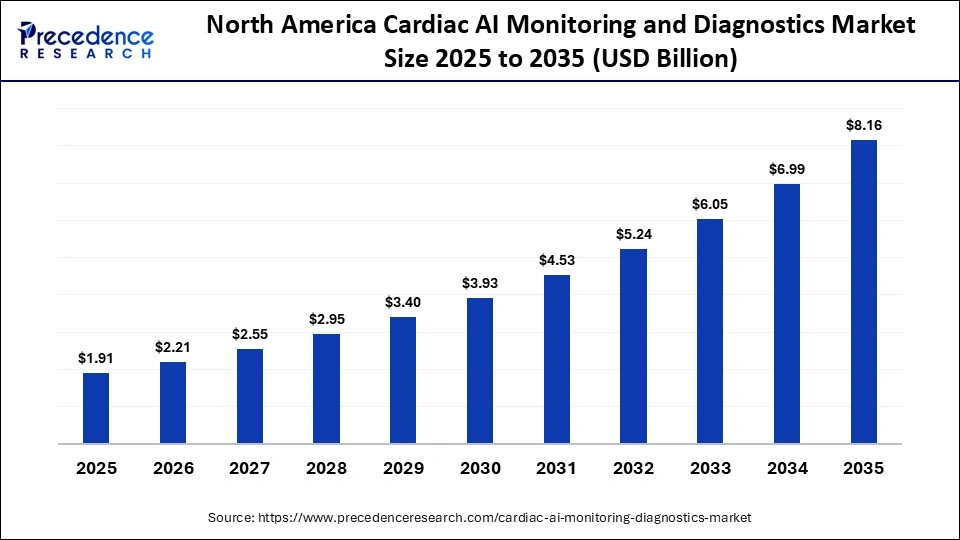
The U.S. cardiac AI monitoring and diagnostics market size is evaluated at USD 1.91 billion in 2025 and is projected to be worth around USD 8.16 billion by 2035, growing at a CAGR of 15.63% from 2026 to 2035.
How does North America dominate the Market in 2025?
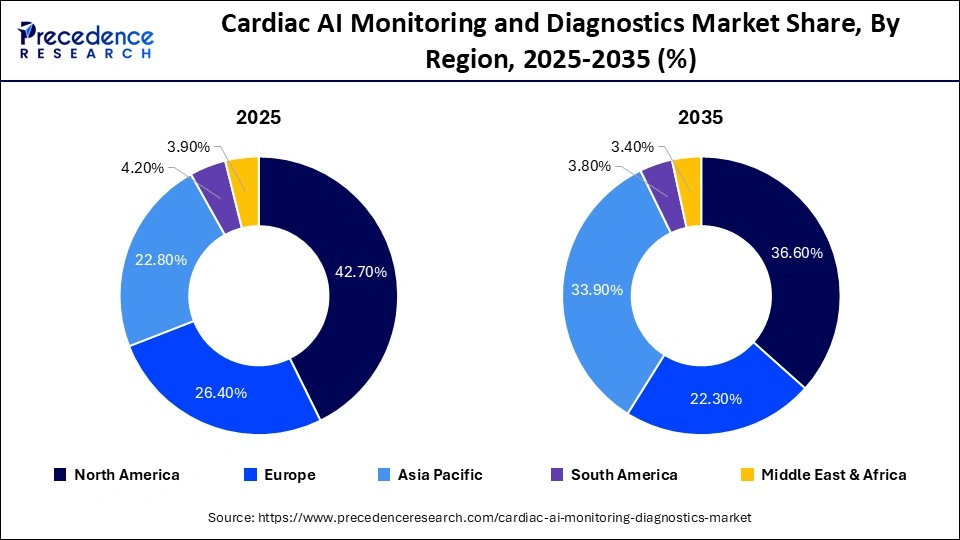
North America dominated the market in 2025 with a revenue share of 42.70%, owing to favorable reimbursement frameworks, the rising disease burden, and technological innovations like advanced wearables and multimodal AI. The Centers for Medicare and Medicaid Services (CMS) launched a program that allows for direct reimbursement of cardiac assessments using AI algorithms. The National Institutes of Health (NIH) provided financing to accelerate biomedical research. The NIH also plays an important role in changing diagnosis and treatment for chronic diseases like heart failure.
U.S. Cardiac AI Monitoring and Diagnostics Market Size and Growth 2026 to 2035
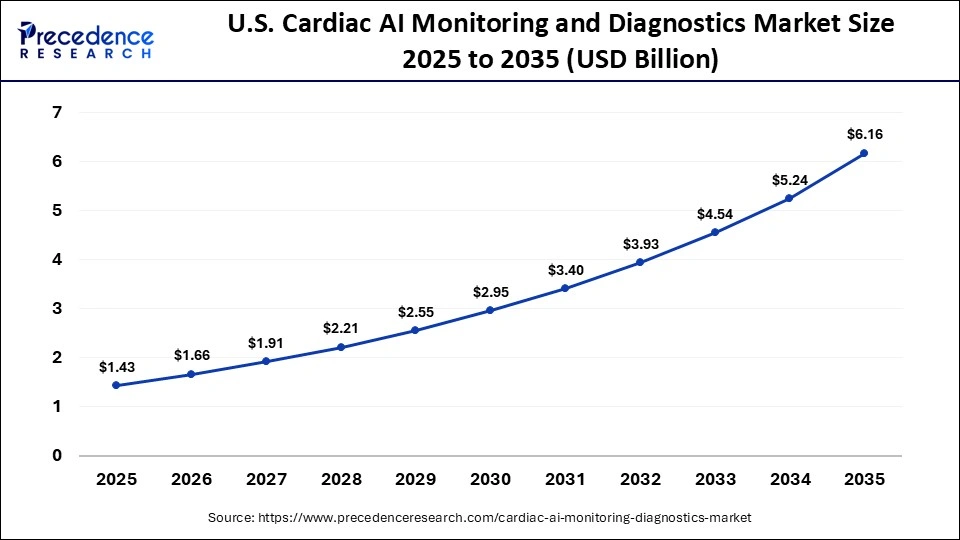
The U.S. cardiac AI monitoring and diagnostics market size is exhibited at USD 1.43 billion in 2025 and is projected to be worth around USD 6.16 billion by 2035, growing at a CAGR of 15.72% from 2026 to 2035.
U.S. Market Analysis
The U.S. greatly contributes to the industrial expansion through the regulatory support for cardiology algorithms and the commercialization of new technologies in the expanding cardiac AI monitoring and diagnostics market. In November 2025, Naples Comprehensive Health (NCH) became the first U.S. hospital to use AI that detects hidden heart attack risk.
Why is the Asia Pacific region considered the Fastest-Growing in the Market?
Asia Pacific is expected to grow at the fastest CAGR in the market during the forecast period due to government initiatives, supportive policies, and significant investments in digital health infrastructure. Asian Pacific governments have expanded AI-driven cardiac monitoring and diagnostic programs to fight against cardiovascular diseases. The National Heart Centre Singapore launched a nationwide SENSE initiative, which uses machine learning to interpret heart scans within 10 minutes.
India Cardiac AI Monitoring and Diagnostics Market Analysis
The Indian market is transitioning due to a shift towards preventive and remote care and rapid consumer adoption of AI-enabled remote monitoring platforms and wearables. In March 2026, the state government of Andhra Pradesh launched an AI pilot in 18 government hospitals to improve diagnosis and deliver enhanced patient care.
Why is Europe a Notable Region in the Cardiac AI Monitoring and Diagnostics Market?
Europe is expected to grow at the fastest rate in the market due to financial incentives for hospitals to adopt mobile monitoring, value-based care, and shift towards reducing hospital readmissions. The European regulations, government, and European programs, and comprehensive AI law are driving the cardiac AI monitoring and diagnostics market. In July 2025, Powerful Medical received a €40 million grant to boost early diagnosis of cardiovascular diseases with AI.
Germany Cardiac AI Monitoring and Diagnostics Market Trends
The simplified access to health data, reimbursement for remote monitoring, and the surging demand for AI-enabled cloud analytics and implantable loop recorders have expanded the cardiac AI monitoring and diagnostics market in Germany. In May 2024, Cardiomatics made a partnership with BIOTRONIK in Germany, which aims to expand the market access of its advanced AI-powered ECG analysis solution.
Supply Chain Analysis
- R&D
This stage includes development, data reprocessing, clinical purpose, clinical validation, regulatory implementation, and post-market evaluation.
Key Players: GE HealthCare, Medtronic, Koninklijke Philips N.V., Boston Scientific, Siemens Healthineers, Abbott Laboratories, iRhythm Technologies, Viz.ai, Tempus AI, Cleerly Inc., Eko Health, Ultromics. - Distribution to Hospitals, Pharmacies
This stage is expanding due to partnerships between manufacturers and specialized cardiology centers to deploy connected care systems.
Key players: Koninklijke Philips N.V., Microsoft Corporation, Siemens Healthineers AG, NVIDIA Corporation, Epic Systems Corporation, GE Healthcare, and Medtronic. - Patient Support & Services
This stage encompasses the assessment of patient education provided by clinical teams, technical setup, and real-time support.
Key Players: Medtronic, GEHealthCare, Koninklijke Philips N.V., Abbott Laboratories, Boston Scientific, iRhythm Technologies, Viz.ai, Biofourmis, AliveCor, Tempus, InfoBionic.Ai.
Cardiac AI Monitoring and Diagnostics Market Companies
- GE HealthCare
- Siemens Healthineers
- Philips Healthcare
- Medtronic
- Abbott Laboratories
- Boston Scientific
- AliveCor
- iRhythm Technologies
- HeartFlow
- Tempus AI
- Viz.ai
- Eko Health
- Clearly
- Biofourmis
- Cardiologs
Recent Developments
- In August 2025, GE HealthCare launched integrated cardiology care pathway solutions and new AI-driven innovations at the 2025 congress of the European Society of Cardiology (ESC). The company has also launched its latest suite of cardiology innovations. These are specifically designed to improve workflow efficiency, enhance clinical decision-making, and support earlier diagnosis and treatment of cardiovascular diseases. (Source: https://www.gehealthcare.com)
- In January 2025, Philips Healthcare launched AI-enabled CT 5300 at the 2025 Asian Oceanian Congress of Radiology (AOCR). The company also celebrated the installation of 1500+ Helium Free 1.5T wide Bore (70 cm) MRI systems globally. (Source: https://www.philips.co.in)
Segments Covered in the Report
By Solution Type
- AI cardiac monitoring software
- AI cardiac diagnostic software
- AI-enabled cardiac imaging analysis platforms
- AI-powered remote cardiac monitoring platforms
- AI clinical decision support systems for cardiology
By Technology
- Machine learning algorithms
- Deep learning algorithms
- Natural language processing
- Predictive analytics engines
- Computer vision algorithms
By Application
- Arrhythmia detection
- Heart failure monitoring
- Coronary artery disease diagnosis
- Stroke risk prediction
- Cardiac imaging interpretation
- Other cardiovascular disease monitoring
By End User
- Hospitals
- Cardiology clinics
- Diagnostic centers
- Ambulatory surgical centers
- Home healthcare providers
- Research institutions
By Region
- North America
- Latin America
- Europe
- Asia-pacific
- Middle and East Africa
For inquiries regarding discounts, bulk purchases, or customization requests, please contact us at sales@precedenceresearch.com
Frequently Asked Questions





Ask For Sample
No cookie-cutter, only authentic analysis – take the 1st step to become a Precedence Research client
 Get a Sample




 sales@precedenceresearch.com
 Schedule a Meeting
