



Circadian Rhythm Sleep Disorders Market Size, Companies, Share, Patient Volume, Treatment Adoption Rates, Pricing Analysis, Regulatory Landscape, Competitive Positioning, and Demand Forecast
Circadian Rhythm Sleep Disorders Market (By Treatment Type: Devices, Medications; By Disorder: Delayed Sleep Phase Syndrome (DSPS), Advanced Sleep Phase Syndrome (ASPS), Irregular Sleep-Wake Disorder (ISWD), Shift Work Disorder, Free-Running Type, Jet Lag) - Global Industry Analysis, Size, Trends, Leading Companies, Regional Outlook, and Forecast 2026 to 2035
Source: https://www.precedenceresearch.com/circadian-rhythm-sleep-disorders-market
 Get a Sample
 Table Of Content


What is the Circadian Rhythm Sleep Disorders Market Size in 2026?
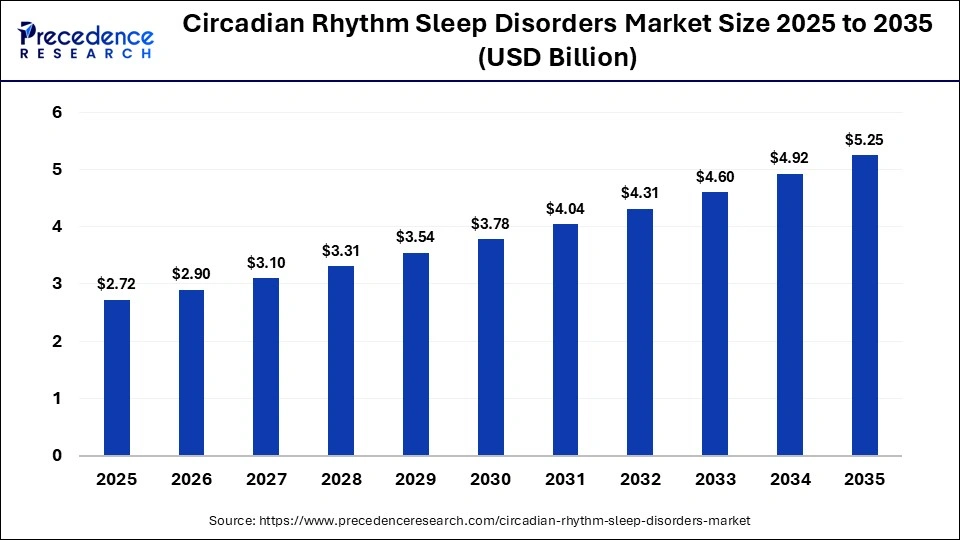
The global circadian rhythm sleep disorders market size was calculated at USD 2.72 billion in 2025 and is predicted to increase from USD 2.90 billion in 2026 to approximately USD 5.25 billion by 2035, expanding at a CAGR of 6.80% from 2026 to 2035. The circadian rhythm sleep disorders market is observed to grow rapidly due to factors such as sleep disturbances, improper sleep cycle, stress, and various other medical issues. The industry also observes growth due to factors such as non-traditional working hours, change in time zones due to traveling, or excessive screen time observed, especially in the teenage and Gen Z age groups.
Key Takeaways
- North America led the global circadian rhythm sleep disorders market in 2025.
- Asia Pacific is observed to be the fastest-growing region in the foreseeable period.
- By treatment type, the devices segment had a major dominance over the market, accounting for a 19% share in 2025.
- By treatment type, the medications segment is observed to have the highest CAGR in the forecast period.
- By disorder type, the delayed sleep phase syndrome (DSPS) segment had the largest market revenue of 36% in 2025.
- By disorder type, the shift work disorder segment is observed to have the highest CAGR in the expected years.
What is the Circadian Rhythm Sleep Disorders Market?
The circadian rhythm sleep disorders market is observed to grow rapidly due to growing sleep disorders in people of different age groups, along with the growing importance of a healthy sleep to stay at bay from different types of health disorders. Use of technological devices to keep track of sleep cycle and intervention also fuels the market's growth. The market's growth is also driven by personalized therapy options, innovations in non-pharmacological treatments, higher adoption of home care settings, and other similar facilities. Lifestyle-related issues, growing stress, and physical and mental disorders are also some of the growing concerns disturbing an individual's sleep.
Role of Technology in the Growth of Circadian Rhythm Sleep Disorders Market
- Higher Usage of Wearable Devices: Wearable trackers are helpful to keep track of an individual's sleep cycles, and actigraphy sensors help to keep track of body movements to measure circadian rhythm.
- Digital Therapeutics and AI: Today, consumers prefer to use different types of sleep tracking applications with facilities such as tips to maintain sleep hygiene to improve sleep quality, along with sleep improvement treatment plans.
- Advanced Diagnostics: The segment involves suggesting tests that help to measure melatonin levels in saliva or blood to assess the circadian phase.
Circadian Rhythm Sleep Disorders Market Trends
- Sleep Disturbing Factors: Factors such as sleep disturbances, improper sleep cycle, growing screen time, and various other issues disturbing the sleep are some of the major factors contributing to the growth of the industry.
- Technological Advancements: Higher usage of wearables with advanced technology to keep track of sleep cycle and suggest remedies to improve sleep is also one of the major drivers of the market.
- Growing Aging Population: The aging population often faces sleep issues and wakes up at irregular intervals, adding to the market's growth.
- Growing Awareness: Growing awareness of the importance of sleep to avoid different types of health issues is also a contributor to the growth of the circadian rhythm sleep disorders industry.
- Growing Home Care Preference: Consumers also prefer homecare settings to provide a comfortable environment to a patient for effective and early recovery.
Market Scope
| Report Coverage | Details |
| Market Size in 2025 | USD 2.72 Billion |
| Market Size in 2026 | USD 2.90 Billion |
| Market Size by 2035 | USD 5.25 Billion |
| Market Growth Rate from 2026 to 2035 | CAGR of 6.80% |
| Dominating Region | Asia Pacific |
| Fastest Growing Region | North America |
| Base Year | 2025 |
| Forecast Period | 2026 to 2035 |
| Segments Covered | Treatment Type, Disorder, and region |
| Regions Covered | North America, Europe, Asia-Pacific, Latin America, and Middle East & Africa |
Segmental Insights
Treatment Type Insights
Which Component of the Treatment Segment led the Global Market in 2025?
The devices segment dominated the circadian rhythm sleep disorders market in 2025. Use of different types of technologically advanced devices helps to regulate the body's internal cycle and improve sleep patterns to avoid different types of sleep issues. Wearable technology is one of the most highly opted devices to treat various forms of sleep disorders. Such devices help to keep track of an individual's sleep cycle, suggest remedies to improve sleep cycle, suggest sleep hygiene tips, and treat the issues with ease. Patients today also prefer homecare settings for effective results and quicker recovery, further propelling the growth of the market.
The medications segment is observed to have the highest CAGR in the forecast period. The main aim of the segment involves the use of medications that are melatonin-based, such as melatonin receptor agonists, benzodiazepines, non-benzodiazepine hypnotics, and orexin receptor antagonists. Such medications help in mimicking sleep-wake cycle hormones, boost improvement in sleep cycles to improve the sleep and waking up pattern, manage acute insomnia, and manage short-term management of sleep disorders. Hence, medications are highly suggested by healthcare advisors and medical professionals.
Disorder Insights
Which Component of the Disorder Segment led the Global Market in 2025?
The delayed sleep phase syndrome (DSPS) segment had a major revenue share of the circadian rhythm sleep disorders market in 2025 and is also observed as the fastest-growing segment in the forecast period. The segment involves treating patients suffering from sleep issues, leading to sleeping time being delayed until late at night, and facing difficulty waking up early in the morning. The issue is highly observed in adolescents and teenagers due to growing screen time affecting their sleep cycle. Bright light therapy is a major treatment option used to effectively treat the issue. Factors such as growing awareness of the importance of sleep, use of technology to treat sleep issues, and higher screen time also have a major contribution to the industry's growth.
The shift work disorder segment is observed to have the highest CAGR in the circadian rhythm sleep disorders market in the expected years due to the rapid, global expansion of 24-hour industries, which forces millions into nontraditional work schedules. This shift-work-induced circadian desynchronization leads to high rates of chronic, severe insomnia and excessive sleepiness. Increased awareness, coupled with a higher demand for pharmacological therapies like wakefulness-promoting agents, drives rapid market adoption. Furthermore, the growing recognition of long-term health risks, such as cardiovascular issues and obesity associated with SWD, is accelerating demand for effective, specialized treatments.
Regional Insights
Why did North America lead the Global Market in 2025?
North America led the global circadian rhythm sleep disorders market in 2025. The market is observing a rapid growth in the region due to factors such as a growing population of the aging segment, irregular work shifts, growing screen time, stress, health issues, and other similar issues. The growing importance of a healthy sleep to avoid different types of health issues also propels the growth of the circadian rhythm sleep disorders industry. The market of the region majorly focuses on factors such as treating delayed sleep phase disorder, shift work disorder, and non-24-hour sleep wake disorder. The market also focuses on the usage of melatonin-based medications with light therapy and cognitive behavioral therapy.
The U.S. Circadian Rhythm Sleep Disorders Market Trends
The U.S. has a major contribution to the market's growth, mainly due to factors such as growing shift work patterns, high stress, and growing deprived sleep patterns, as well. Higher usage of melatonin-based medications and light therapy devices is also one of the major market drivers. Such treatment options help to improve the internal body clock. Up to 3% of the U.S. adult population suffers from a circadian rhythm sleep disorder (CRSD), with higher, often undiagnosed, rates in adolescents.
The Canada Circadian Rhythm Sleep Disorders Market Trends
The market in Canada is driven by rising awareness of sleep health and increasing cases of shift-work disorders, with a significant shift toward digital diagnostic tools and personalized therapy. Key trends include higher adoption of specialized pharmacotherapies (such as melatonin agonists) and a growing focus on light therapy to manage disorders like Delayed Sleep Phase Syndrome. Increased investment in home sleep testing services is accelerating, offering better access to diagnosis for non-traditional work schedules.
Why is the Asia Pacific Observed to be the Fastest Growing Region in the Foreseen Period?
Asia Pacific is observed to have the highest CAGR in the forecast period. The market in the region is observed to grow due to factors such as stress, lifestyle-related issues, growing prevalence of shift-based work, and other similar symptoms. Growing incidences of DSPS, jet lag, and other similar factors propel the industry's growth. The growing population of adolescents and the aging population, which is highly affected by sleep disorders, also contributes to the growth of the circadian rhythm sleep disorders industry. Higher usage of technologically advanced treatment options, such as wearable devices, melatonin-based medications, and natural and herbal remedies to improve sleep, is one of the treatment options used in the region to treat different types of sleep issues.
China Circadian Rhythm Sleep Disorders Market Trends
China has a major contribution to the market's growth due to the growing number of sleep disorders in the region. Such issues are observed due to a growing population, growing stress, growing night shifts, and other similar issues. Growing healthcare, increased awareness of sleep health, and high-stress lifestyles also boost the market. Higher usage of treatment options in the form of wearables and melatonin-based medications also propels the market in the region.
India Circadian Rhythm Sleep Disorders Market Trends
In India, the market is experiencing rapid expansion due to rising insomnia and sleep apnea cases driven by lifestyle shifts and high-stress metropolitan work environments. There is a pronounced increase in awareness regarding sleep health, leading to higher demand for OTC sleep aids, melatonin supplements, and diagnostic sleep studies. Furthermore, a notable trend is the growing integration of traditional, herbal-based wellness remedies alongside modern therapeutic solutions.
Europe Circadian Rhythm Sleep Disorders Market Trends
The Europe market is experiencing significant growth driven by heightened awareness of sleep health, an aging population, and the rising prevalence of disorders like shift work sleep disorder. Key trends include increased demand for advanced diagnostics, melatonin receptor agonists, and innovative wearable technologies designed to track sleep-wake cycles. The market is rapidly evolving with a focus on personalized digital health solutions and therapeutic options, as European countries invest in better sleep hygiene practices and diagnostic infrastructures.
UK Circadian Rhythm Sleep Disorders Market Trends
In the UK, the market is heavily influenced by high-intensity work schedules, causing widespread disruption to natural circadian rhythms and increasing demand for specialized therapies, including light therapy and prescription medications. The UK market is characterized by a growing focus on integrating digital health tools to monitor circadian health and a strong emphasis on addressing insomnia, which is highly prevalent. Public and private sectors are increasingly prioritizing sleep disorders, driving the need for better diagnosis and treatment of conditions like Delayed Sleep-Wake Phase Disorder, particularly within the NHS.
How is the Circadian Rhythm Sleep Disorders Market Evolving in Latin America?
Latin America is expected to grow at a lucrative CAGR during the forecast period. It is driven by rising stress levels, excessive screen time, and increased sleep awareness, though the market remains constrained by historical gaps in medical education, along with access. Regional initiatives, like the Latin American Sleep Congress and specific Chronobiology Working Groups, are transforming academic research into practical sleep medicine. This is expanding the diagnosis of CRSDs, which were previously frequently misdiagnosed as standard insomnia.
Brazil Market Analysis
The Brazilian market is driven by rising knowledge of circadian health and even modernized healthcare. The localized sleep disorder treatment market in Latin America is supported by a change toward personalized medicine. Delayed sleep phase disorder (DSPD), along with irregular sleep-wake rhythms (ISWR), represent common difficulties in Brazil's major metropolitan hubs, such as São Paulo and Rio de Janeiro.
Why is the Circadian Rhythm Sleep Disorders Market Gaining Attention in the Middle East and Africa?
The Middle East and Africa are expected to grow at a notable CAGR during the forecast period. This is due to a convergence of lifestyle changes, severe environmental stressors such as extreme heat, and an ongoing paradigm change in consumer health priorities. Excessive exposure to blue light from electronic devices disrupts natural melatonin production, remarkably increasing the prevalence of delayed sleep phase disorder in urbanized areas.
Saudi Arabia Market Analysis
The Saudi Arabian market is driven by a high prevalence of sleep deprivation, changing lifestyle habits, and even increased modernization. The market represents an emerging opportunity for pharmaceutical therapies along with specialized care. Shift workers, students, and the rising geriatric population are the primary demographics driving the need for sleep management solutions.
Circadian Rhythm Sleep Disorders Market Companies
- Pfizer Inc.: Pfizer contributes to the wider sleep-wake and insomnia therapeutics market via legacy medications, consumer health knowledge initiatives, and licensing or divesting early-stage neurological assets.
- Vanda Pharmaceuticals Inc.: Vanda Pharmaceuticals Inc. mainly by offering Hetlioz, an FDA-approved, selective melatonin receptor agonist. It treats conditions such as Non-24-Hour Sleep-Wake Disorder along with nighttime sleep disturbances linked with Smith-Magenis Syndrome.
- Mylan N.V.: Mylan N.V. contributes to the circadian rhythm sleep disorders along with broader sleep medicine markets by supplying generic, wake-promoting pharmacological therapies.
- Merck & Co., Inc.: Merck & Co., Inc. led to the circadian rhythm sleep disorders market via research-driven drug development, specifically aiming on insomnia and neurological therapies. They leverage clinical trial pipelines to manufacture innovative formulations of orexin receptor antagonists and modulators designed to enhance sleep-wake cycles.
- Eisai Co., Ltd.: Eisai Co., Ltd. is a major driver in the circadian rhythm sleep disorders and insomnia markets. Their main contribution centers on the development of innovative targeted therapies which regulate the brain's sleep-wake cycle and arousal mechanisms.
Other Major Key Players
- Takeda Pharmaceutical Company Limited
- Teva Pharmaceutical Industries Ltd.
- Sanofi S.A.
- Jazz Pharmaceuticals plc
- Koninklijke Philips N.V.
- ResMed Inc.
- Fisher & Paykel Healthcare Corporation Limited
- Natus Medical Incorporated
- Compumedics Limited
- Becton
- Dickinson and Company
- Medtronic plc
Recent Developments
- In October 2025, PD Hinduja Hospital and Medical Research Centre launched a specialized sleep clinic to help patients understand, manage, and overcome sleep-related problems with expert medical and psychological care.(Source: https://medicaldialogues.in)
- In September 2025, Samsung is pioneering personalized, preventative health by addressing the "sleep gap" and enhancing overall wellness through innovative technology. Key offerings include the Galaxy Watch8 series with advanced sleep monitoring, such as apnea detection and vascular load tracking, complemented by the Samsung Health SDK to foster healthier habits. (Source: https://news.samsung.com)
- In September 2024, Australian sleep-tech firm Re-Time, a Motherson and Flinders University partnership, launched a Kickstarter for its third-generation wearable, Retimer 3. This innovative device aims to fix circadian rhythm sleep disorders, targeting improved quality of life for millions. (Source: https://iotm2mcouncil.org)
Segments Covered in the Report
By Treatment Type
- Devices
- Medications
By Disorder
- Delayed Sleep Phase Syndrome (DSPS)
- Advanced Sleep Phase Syndrome (ASPS)
- Irregular Sleep-Wake Disorder (ISWD)
- Shift Work Disorder
- Free-Running Type
- Jet Lag
By Region
- North America
- Latin America
- Europe
- Asia-pacific
- Middle and East Africa
For inquiries regarding discounts, bulk purchases, or customization requests, please contact us at sales@precedenceresearch.com
Frequently Asked Questions





Ask For Sample
No cookie-cutter, only authentic analysis – take the 1st step to become a Precedence Research client
 Get a Sample
.webp)



 sales@precedenceresearch.com
 Schedule a Meeting
