



Combined Heat and Power Market Size, Key Companies, Company Market Share, Power Generation Capacity, Energy Consumption, Pricing Trends, Investment Analysis, Competitive Positioning, and Demand Forecast
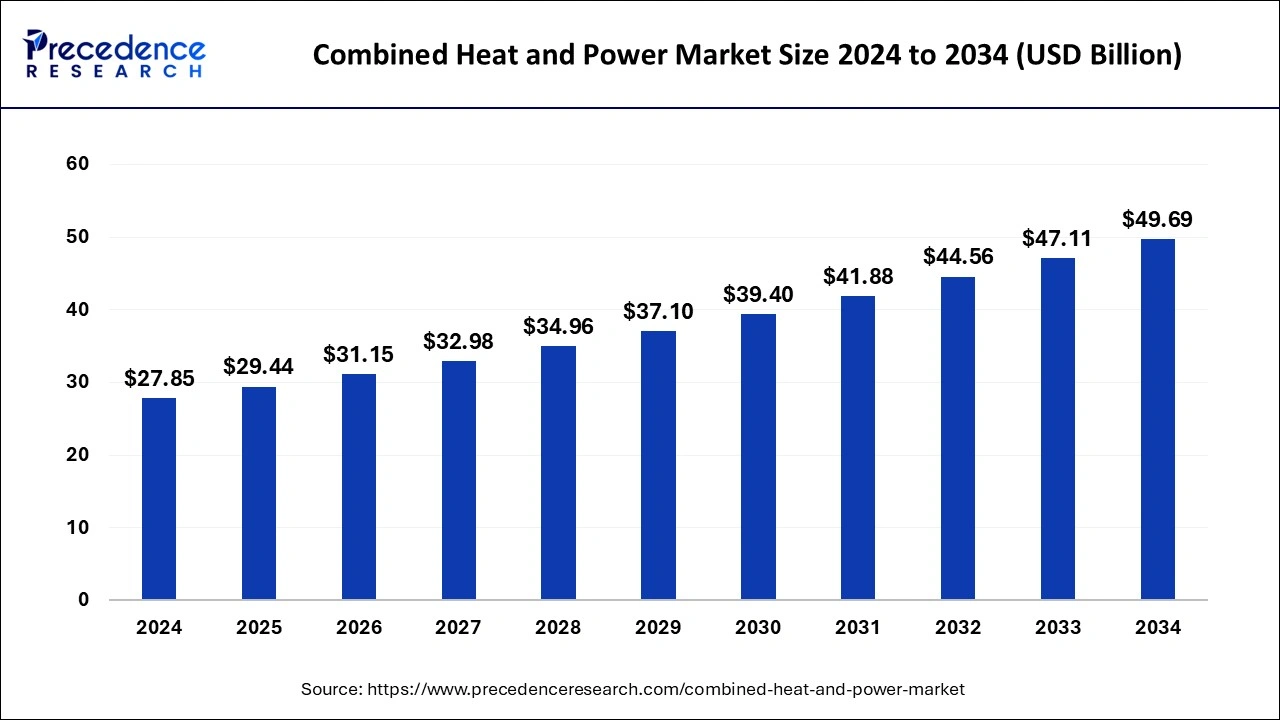
According to energy and power expert Laxmi Narayan, the combined heat and power market has reached USD 31.15 billion in 2026 and is expected to grow to USD 49.69 billion by 2034, registering a CAGR of 5.96%. The combined heat and power market companies such as Wartsila, Doosan Fuel Cell America, Inc., Caterpillar are playing a key role in market expansion, with major opportunities emerging across type, fuel, technology, capacity, end user, region.
Source: https://www.precedenceresearch.com/combined-heat-and-power-market
 Get a Sample
 Table Of Content


What is the Combined Heat and Power Market Size?
The global combined heat and power market size is calculated at USD 29.44 billion in 2025 and is predicted to increase from USD 31.15 billion in 2026 to approximately USD 49.69 billion by 2034, expanding at a CAGR of 5.96% from 2025 to 2034. The legislative support, environmental sustainability, energy efficiency, technological upgrading, renewable energy incorporation, energy reliability, and increased industrialization fueled the growth of the combined heat and power market.
Combined Heat and Power Market Key Takeaways
- The global combined heat and power market was valued at USD 31.15 billion in 2026.
- It is projected to reach USD 49.69 billion by 2034.
- The combined heat and power market is expected to grow at a CAGR of 5.96% from 2026 to 2034.
- Europe dominated the global market with the largest market share of 51% in 2024.
- Asia Pacific is projected to expand at the notable CAGR during the forecast period.
- By type, the large scale segment contributed the highest market share in 2024.
- By type, the small scale segments is estimated to be the fastest-growing segment during the forecast period.
- By technology , the CHP frameworks segment captured the biggest market share in 2024.
- By fuel, the flammable gas segment has held the largest market share in 2024.
AI in the Combined Heat and Power Market
Artificial Intelligence and Machine Learning play an increasingly significant role in improving the forecasting ability of combined heat and power (CHP) systems, with the capability to forecast energy demand and optimize operations. The research conducted by the National Renewable Energy Laboratory (NREL) corroborates that the adoption of AI algorithms in combined heat and power systems can significantly improve system efficiency by up to 15%. Advanced automation technologies revolutionize the combined heat and power (CHP) industry by promoting higher efficiency, reliability, and sustainability in energy production. The automation necessary to achieve this includes advanced control mechanisms, real-time monitoring, and predictive maintenance to reduce operational costs. Smart sensors and data analytics enable CHP systems to adapt to varying energy demands and environmental conditions. Consequently, this results in increased energy output with less waste and emissions. This new shift toward smart energy solutions supports global sustainability goals, heralding a new era of power generation and management.
- In September 2024, Power technology company Infinity Turbine launched a new heat reuse system for AI data centers which it says can harness the warmth created by servers to produce clean electricity. The Cluster Mesh Power Generation System can help data center operators reduce the need for cooling water and power, the company claims.
(Source: https://www.datacenterdynamics.com )
Market Overview
During the projection time frame, the Combined Heat and Power (CHP) market is being driven by unofficial laws and motivations, as well as an ascent in the utilization of flammable gas for power age. Cogeneration is one more term for consolidated intensity and power. This approach creates both intensity and power simultaneously. A framework recuperates lost energy by using waste intensity to give intensity to the power plant or structures connected to the power plant through a steam pipe organization. A portion of the essential drivers driving the development of the CHP market incorporate the expanded organization of CHP innovations, the interest for energy productivity, and the rising use of government impetuses to support cogeneration.
CHP is an energy-proficient innovation that is preferred over conventional techniques for power age since it utilizes less fuel to make energy. Moreover, CHP frameworks eliminate transmission and dispersion (T&D) misfortunes, lessen network blockage during top influence interest, and wipe out the requirement for T&D foundation development. Accordingly, the power-age offices of CHP, as well as extensive monetary and ecological advantages, are probably going to fuel market development all through the projection period.
Market Outlook
- Industry Growth Overview: The combined heat and power market is projected to grow rapidly from 2025 to 2034, driven by rising demand for energy efficiency and reliable on-site power solutions, alongside a growing emphasis on reducing emissions. A supportive regulatory environment, rising electricity costs, and technological advancements are also driving widespread adoption of CHP systems across industries.
- Global Expansion: The market is expanding globally due to rising demand for highly efficient energy systems that generate electricity and heat simultaneously. Supportive regulations, cleaner fuel adoption, and increased focus on energy security and emissions reduction are driving installations across industries and commercial sectors. Emerging regions offer significant opportunities as industrialization and urbanization drive energy demand, creating a need for cost-effective, high-efficiency CHP systems and renewable-integrated solutions.
- Major Investors: Major investors in the market include energy companies, industrial conglomerates, and technology providers such as Siemens, GE Power, Caterpillar, and Mitsubishi Power, who contribute by developing and deploying advanced CHP systems. They drive market growth through investments in research and development, large-scale project implementation, and the introduction of efficient, low-emission technologies that meet industrial and commercial energy needs.
- Startup Ecosystem: The market's startup ecosystem is vibrant, with emerging ventures developing modular biomass and low-carbon cogeneration systems. These startups focus on digitalization, fuel-flexibility (biogas, hydrogen blends), and micro-Combined Heat and Power units to address decentralized energy needs, enhancing agility and sustainability in the energy-efficient generation sector.
Combined Heat and Power Market Growth Factors
- Expanding power constancy and cost investment funds are driving business sector development. The advantages of joined intensity and power (CHP) incorporate lower modern cycle costs because of less unnecessary energy use. Energy might be resourced by utilizing waste assets.
- The overall joined intensity and power industry is being driven by the sending of consolidated intensity and power (CHP) innovation, the expanded utilization of government motivators to advance cogeneration, and the interest in energy proficiency.
- Legislatures in different regions are pushing joined intensity and power (CHP) innovation through an assortment of ideal long-haul strategies and monetary motivating forces, which are supposed to drive consolidated intensity and power (CHP) market development over the evaluation period.
- Moreover, the presence of countless associations that give CHP establishment administrations is speeding market extension. By 2032, the petroleum gas fuel classification in the CHP market is assessed to arrive at USD 11.5 billion. Flammable gas is the most frequently involved fuel in CHP innovation. Its cost is supposed to ascend in contrast with different choices because to its extraordinary proficiency, extended worldwide assembling, and much lower fossil fuel by-products. Legislatures all through the world are endeavoring to support how much cleaner energies are in their energy blend, which will drive petroleum gas interest before long. Besides, thorough administrative regulations and fossil fuel by-product targets would force policymakers to embrace cleaner energy, including petroleum gas, driving the portion of the overall industry of flammable gas as a fuel.
- Lower discharge rates, as well as cost seriousness with its rivals, will energize utilization of this innovation. The quick reception of gas innovation all through created countries because of developing stresses over the fast consumption of conventional assets will help industry income. Moreover, developing overall energy requests will urge specialists to increment flammable gas yield, which will drive CHP market improvement through the projection period.
Market Scope
| Report Coverage | Details |
| Market Size in 2025 | USD 29.44 Billion |
| Market Size in 2026 | USD 31.15 Billion |
| Market Size by 2034 | USD 49.69 Billion |
| Market Growth Rate from 2026 to 2034 | CAGR of 5.96% |
| Largest Market | Europe |
| Base Year | 2025 |
| Forecast Period | 2026 to 2034 |
| Segments Covered | Type, Fuel, Technology, Capacity, End user, and Region |
| Regions Covered | North America, Europe, Asia-Pacific, Latin America and Middle East & Africa |
Status of Combined Heat and power market
Most the people see Combine heat and power market as a developed technology. The major industrial and large commercial/institutional sectors have a significant deployment of 126 technology. CHP is cost-effective for high thermal demand applications in the size range of over 5MW thanks to the economies of scale. When sizing for thermal demand, 1-5 MW systems are typically cost-effective, but when connecting with their electric utility, they may encounter significant obstacles regarding interconnection standards, utility rates, such as stand by and opportunities to sell electricity back to the grid, such as net metering. These obstacles might affect the total cost of the system.
CHP is a crucial source of electricity generation for the United States. The 82 GW of CHP capacity now in use at more than 3,700 industrial and commercial establishments accounts for about 12 percent of all MWh and around 8 percent of the country's total generating capacity. The CHP is widely used in various applications. The following graph shows the utilization of CHP in various sectors.
87% of the current capacity is utilized in the industrial sector, providing power to various industries including chemicals, paper, refining, food processing, metals, and manufacturing. Various fuels are currently used to produce electricity through CHP. Moreover, natural gas is used commonly accounting the 72% share of the overall capacity. Moreover, CHP saves nearly 2 quads of energy annually as compared to the electricity produced through fossil fuels.
Type Insights
The large scope type area represented highest share in 2024. This item is generally utilized in the business and modern areas. In 2020, the worldwide huge scope joined intensity and power establishment framework drove the general interest for enormous scope CHP establishment. Developing requirement for energy from huge scope areas like substance, concrete, mash and paper, materials, refining, drugs, glass, and sugar is anticipated to fuel interest for enormous scope based frameworks. They are utilized in the previously mentioned areas because of their size and high temperature and tension necessities.
The small scale classification is anticipated to ascend at an extensive speed from 2022 to 2030. The developing interest for clean energy from the private area is probably going to fuel the market for CHP establishments. Expanding information on the advantages of executing cogeneration frameworks is basic for the CHP establishment area, since they are progressively liked over conventional procedures. Nations with enormous business sectors incorporate the United States, Germany, and Japan. These frameworks are generally utilized for wastewater treatment in private applications. These frameworks are additionally utilized in business applications like places of business, clinics, club, air terminals, and military locales. They are best in structures with "heat sinks," like pools.
Technology Insights
CHP frameworks represented largest revenue share in 2024. With a market worth of more than $7billion, the joined cycle framework was the top innovation in 2022. These frameworks are utilized generally in modern areas with huge energy prerequisites, like refining, synthetic substances, concrete, paper, mash, sugar, and drugs. When contrasted with different advancements, the essential advantages incorporate non-fuel activity, modest establishment and support costs, heat yield, fire up time, fuel accessibility, low contamination, and energy productivity. This innovation moves energy starting with one turbine then onto the next, making it more effective in creating low-and high-pressure steam in light of the site's necessities. These frameworks are planned as per the requirements of the client. This component will prompt the predominance of consolidated cycle power innovation before long.
The consolidated intensity and power portion of the overall industry from business end-use is supposed to grow, attributable to proceeded with monetary inflows by various legislatures for the development of different business offices like workplaces, instructive foundations, medical clinics, and others. Locale warming or cooling is additionally acquiring prominence in created countries, attributable to rising space warming/cooling interest as well as the innovation's fantastic energy productivity, constancy, and diminished absolute expenses, which supplements CHP innovation reception. Besides, expanding consumptions in green structures because of serious structure emanation prerequisites will drive business fragment advancement later on years.
Steam turbine-based innovation represented more than 27% of complete volume in 2024 and is anticipated to increase at an unassuming rate all through the projection period. Consolidated cycle-based innovation was worth more than USD 5.3 billion of every 2022 and is probably going to create at a quicker rate, with a CAGR of 3.3% projected from 2023 to 2032. Other CHP establishment strategies incorporate ignition/gas turbine, squander heat recuperation, power device, and microturbine. Microturbines, power devices, and waste intensity recuperation are a portion of the other CHP innovations. Microturbines are small energy makers with limits going from 30 to 250 KW. It is feasible to utilize various energizes, including harsh gas, flammable gas, and other fluid fills. These frameworks are utilized in both home and business settings.
Fuel Insights
The flammable gas controlled CHP frameworks are assessed to represent 67% of the market regarding income. Flammable gas is an alluring fuel for CHP frameworks because of its plentiful accessibility and reasonable expense. Moreover, gaseous petrol is viewed as a spotless type of energy that guides in the decrease of fossil fuel byproducts.
Coal-terminated consolidated intensity and power frameworks represented more than 19.3% of complete volume in 2022 and are supposed to grow at a slower than normal speed all through the conjecture period. Expanding coal use is anticipated to animate interest for CHP frameworks because of its high calorific worth and minimal expense. Its high dealing with expenses and outflows of dangerous gases into as far as possible its utilization in plans.
Biomass includes practical and naturally helpful biofuels got from vegetable oils and creature fats. Biomass is for the most part used as a fuel for limited scope CHP frameworks and is supposed to increment quickly since it adds to the decrease of unsafe natural gases and the accomplishment of government goals for the utilization of environmentally friendly power sources. Wood, handled trash, and oil are instances of elective powers. Wood squander is used to drive limited scope CHP frameworks and is along these lines utilized in both private and business applications. Squander heat from modern tasks is dealt with and utilized in CHP frameworks to make power and nuclear power.CHP frameworks driven by oil are easy to introduce and energy productive.
End user Insights
The commercial and industrial area overwhelms the market. The extending limited scope modern area, along with expanded power interest, will well affect organization development. The expanded requirement for trustworthy also, savvy innovation, as well as carbon impression decrease endeavors, will support the business CHP industry. CHP is acquiring huge support from legislatures from one side of the planet to the other as beneficial regulation and motivations. States all through the globe are empowering cogeneration innovation through various long haul approaches and monetary impetuses that will drive the business before long. Notwithstanding, the costly starting speculation will be a vital obstacle to the joined intensity and power market's development later on years.
Regional Insights
Europe Combined Heat and Power Market Size and Growth 2026 to 2034
The Europe combined heat and power market size is exhibited at USD 15.89 billion in 2026 and is projected to be worth around USD 25.59 billion by 2034, growing at a CAGR of 6.07% from 2026 to 2034.
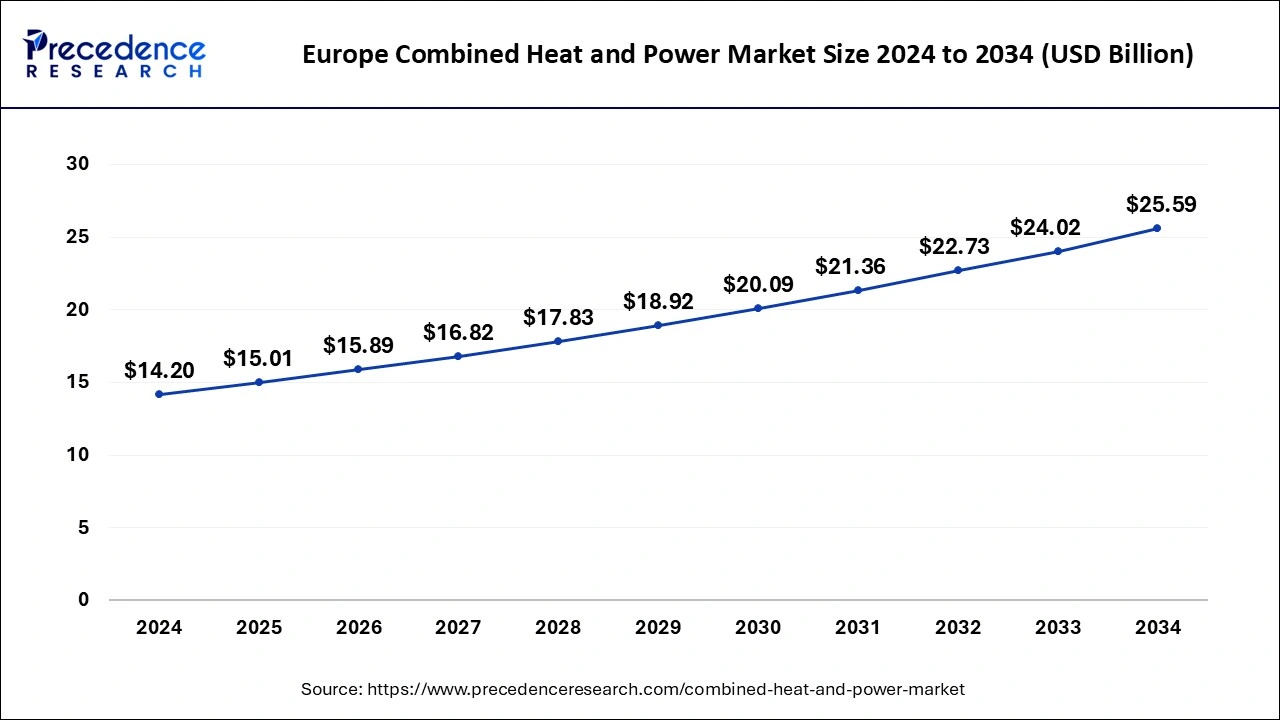
Europe region accounted largest market share in 2024. The region is probably going to keep up with its income share control during the anticipated period. Government necessities to decrease contamination levels in countries like as Germany, the United Kingdom, and France are projected to animate interest for CHP framework establishment in Europe. CHP establishment interest in North America was 110.6 GW in 2019 and is anticipated to reach 142.8 GW by 2027, extending at a CAGR of 3.4% somewhere in the range of 2020 and 2027. Ecological regulations forced by administrative organizations like the United States Environmental Protection Agency (EPA) to lessen fossil fuel byproducts into the air are projected to fuel the district's interest for CHP establishment.
How is Europe leading in the Combined Heat and Power Market?
Europe's combined heat and power market has the potential of strong environmental regulations, sustainability targets, and the existence of well-established district heating infrastructure. The area has a clear preference for renewables and low-emission fuels, and biogas as well as biomass are the trails. Strong government incentives along with energy efficiency programs are allowing both centralized and decentralized CHP to coexist, thus contributing to Europe being the world leader in sustainable and integrated power generation technologies.
-
In July 2024, Essar Energy Transition (EET) announced the launch of EET Hydrogen Power, Europe's first hydrogen-ready combined heat and power plant (CHP) to be built at its Stanlow refinery, with the aim of completing construction in 2027. The investment will support EET Fuels' ambition to become the lowest carbon process refinery, globally.
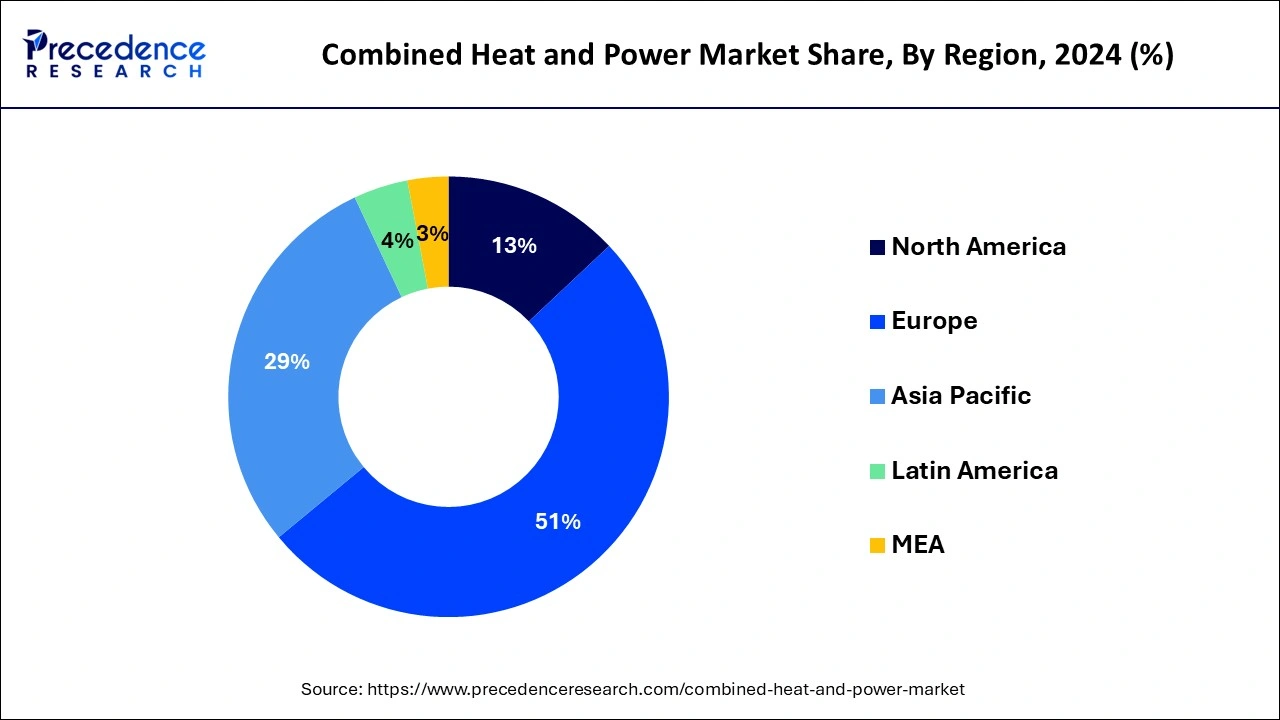
The Asia Pacific region is expected to grow at a remarkable CAGR from 2025 to 2034. The presence of enormous scope makers in Asia Pacific countries like India, China, South Korea, and Japan is projected to animate interest around here. Nations, for example, India and China have focused on expanding their piece of the environmentally friendly power blend to decrease outflows. Moreover, the state run administrations of a few Asia Pacific countries are empowering joined intensity and power establishments through various strategies and innovative work exercises. These elements will add to the future development of the Pacific Region market for joined intensity and power establishments.
How is Asia-Pacific performing in the Combined Heat and Power Market?
The Asia Pacific region is on the way to experiencing very positive changes in the combined heat and power market due to the rapid pace of industrialization and the enlargement of urban areas. The power sector's demand for more energy and the concern for the environment are advocating the use of cleaner power production methods, such as natural gas and biomass. Governmental attention is put on the enhancement of energy efficiency and the approval of large-scale CHP projects, which will consequently make the region one of the most important areas in the world for the sustainable power generation technologies market.
Germany Combined Heat and Power Market Trends
In the context of Germany, the market for combined heat and power systems is predominantly driven by government regulations and energy transition goals that are put in place. The different government programs are capable of turning investment into both district and micro-cogeneration systems. The use of renewable fuels like biogas and wood is making the energy source more diverse. The country, with its innovation and policy frameworks, sees the use of cogeneration technologies as a reliable means of generating power that is both efficient and has low emissions.
China Combined Heat and Power Market Trends
The CHP market in China is growing rapidly due to the ever-increasing industrial base, along with the high energy efficiency targets set by the government. The country is focusing on the large industrial and utility CHP systems that are efficiently combined with district heating networks and the large-scale power generation plants. The government is changing the regulations towards using less polluting fuels and modernizing the existing power plants, which indirectly will help in achieving the country's sustainable energy goals. There are supportive policies and technological progress that are making China a key player in the global CHP market.
What are the driving factors of the Combined Heat and Power Market in North America?
North America's CHP market is rapidly growing because of the great emphasis on energy efficiency, carbon footprint reductions, and decentralized power systems. It is the adoption of CHP technology in industrial facilities, healthcare, and data centers that makes continuous growth happen. The region has natural gas resources that are easy to access and also has favorable policies that encourage the use of cleaner energy. Technological innovation, which is on a continuous basis, is the major factor that allows the integration of state-of-the-art small- and large-scale CHP systems in diverse sectors.
United States Combined Heat and Power Market Trends
In the United States, CHP systems are gradually being adopted across the industrial, commercial, and institutional sectors. The demand for on-site power generation that is reliable, together with energy cost reduction, drives the market up. The introduction of energy-friendly policies and the commensurate rise in the technological level are the main causes of rolling out both large and micro-scale CHP systems more widely. The focus on sustainability, along with grid resilience and clean energy solutions, is a strong arm that the country uses to assert itself in the global CHP industry.
How Crucial is the Role of Latin America in the Combined Heat and Power Market?
Latin America plays a crucial role in the market due to its increasing industrialization, growing demand for efficient energy systems, and strong focus on reducing energy losses. Supportive government policies and the expansion of renewable biomass resources further support regional market growth. Brazil dominates the regional market due to strong support for biomass and natural-gas cogeneration, increasing industrial decentralization into smaller cities, and a public policy push for higher energy efficiency and lower emissions. The country's plentiful renewable fuel sources and the need for dependable on-site generation in manufacturing and agro-industries also play a major role in its leadership in Latin America.
How Big is the Opportunity for the Market in the Middle East and Africa?
The Middle East and Africa offer significant growth opportunities for the combined heat and power market due to the need for energy diversification, increasing industrial growth, and rising demand for cooling and desalination. Ample natural gas and renewable resources, government incentives promoting efficiency, infrastructure investments, and urbanization trends support decentralized combined heat and power deployment, which enhances grid resilience, reduces emissions, and lowers energy costs across industries and utilities in the region.
UAE Combined Heat and Power Market Trends
The UAE dominates the market in the Middle East and Africa thanks to extensive industrial zones, advanced oil-and-gas infrastructure, and a focus on energy efficiency and decarbonization. High demand from refineries, petrochemicals, and cooling utilities promotes the adoption of Combined Heat and Power. Strong government backing, modern utility systems, and strategic investments in modular and industrial cogeneration further establish the UAE's leadership in the region.
Value Chain Analysis
- Resource Extraction
Raw fuel sources such as natural gas, biogas, coal, biomass, and waste heat are extracted, processed, and supplied to Combined Heat and Power plants to ensure a continuous, efficient fuel supply.
Key Players: BP, Shell, Chevron, TotalEnergies, Gazprom, Equinor, ExxonMobil. - Power Generation
Combined Heat and Power units convert fuel into electricity and thermal energy simultaneously using turbines, engines, or fuel cells to maximize overall system efficiency and reduce energy losses.
Key Players: Caterpillar, Siemens Energy, General Electric (GE), Mitsubishi Power, MAN Energy Solutions, Wärtsilä. - Grid Maintenance & Monitoring
Generated electricity is integrated into local microgrids or national grids, followed by continuous monitoring, smart metering, system diagnostics, and performance optimization to ensure reliable power distribution and heat recovery.
Key Players: ABB, Schneider Electric, Honeywell, Eaton, Emerson, Hitachi Energy. - Regulatory Compliance & Energy Trading
Combined Heat and Power providers adhere to environmental standards, energy-efficiency regulations, carbon-reduction mandates, and participate in energy trading markets for cost-optimization and sale of surplus electricity and heat.
Key Players: Environmental Protection Agency (EPA), International Energy Agency (IEA), European Energy Exchange (EEX), Federal Energy Regulatory Commission (FERC), Ofgem.
Value Chain Analysis:
- Resource Extraction: It is the process of finding and acquiring natural gas or biomass, which are the main fuels for the CHP plants.
- Power Generation: It changes the fuel to the simultaneous output of electricity and thermal energy, which is the most efficient way in the whole system.
Key Players: Siemens Energy, General Electric (GE), Vernova, Wärtsilä, Mitsubishi Heavy Industries - Distribution Network Management: It is responsible for the infrastructure that moves the power from the generating plants to the grids and the heat to the consumers safely and effectively.
Key Players: Siemens and ABB - Energy Storage Systems: It employs storage technologies such as batteries or thermal tanks to hold the extra energy for future use.
Key players: Tesla Energy, Fluence, LG Energy Solution - Grid Maintenance and Monitoring: It makes sure that the electrical and thermal networks connected with CHP systems are reliable and safe for operation.
Key Players: Siemens Energy and GE Vernova - Regulatory Compliance and Energy Trading: It is responsible for keeping the company in compliance with energy regulations and, at the same time, facilitating the trade of electricity and heat in the regulated markets.
Top Companies in the Combined Heat and Power Market
Wärtsilä Corporation: Offers modular combined heat and power plants that provide electricity and heat (or cooling via trigeneration) with efficiencies over 90 % and flexibility across load ranges.
Doosan Fuel Cell America, Inc.: Focuses on high-efficiency fuel-cell-based combined heat and power systems (solid oxide or polymer electrolyte) that produce electricity and heat with low emissions, targeting distributed generation.
Caterpillar Inc.: Supplies engine-based combined heat and power systems using gas generators that recover waste heat for industrial or commercial thermal needs, achieving up to ~90 % efficiency in some applications.
Cummins Inc.: Delivers cogeneration/combined heat and power systems that generate electricity, capture waste heat, and, in certain applications, also reuse COâ‚‚ (e.g., greenhouses), offering turnkey solutions.
Aegis Energy Services, Inc.: Works in smaller-scale combined heat and power installations (commercial, healthcare, multi-unit residential) and provides design, installation, and operation services; recently acquired by a larger energy services firm.
General Electric: Offers combined heat and power solutions for large facilities (hospitals, airports, industrial) with their gas turbines and cogeneration technologies, enabling significant fuel savings.
Siemens: Provides turnkey and modular combined heat and power systems, with gas-turbine-based solutions, heat-recovery technologies, and a strong focus on decarbonizing heat networks and industrial processes.
E.ON SE: While primarily an energy utility rather than a pure combined heat and power provider, E.ON is engaged in developing combined heat and power plants.
Other Major Companies
- Tecogen Inc.
- Elite Energy Systems, LLC
- Capstone Turbine Corporation
- Clarke Energy
Recent Developments
- In November 2024,- Green CHP, a renewable energy and data company that combines advanced combined heat and power systems with real-time data services, announced the launch of Jules Hydrogen™, a groundbreaking solution for clean hydrogen production that brings together end-to-end systems integration and optimization with a suite of technology leaders in advanced power electronics.
(Source: https://www.prnewswire.com) - In December 2024, Polar Night Energy launched a new Sand Battery with Power to Heat to Power (P2H2P) capabilities, allowing stored heat to be converted back into electricity. This €4.2 million, two-and-a-half-year R&D project, backed by Business Finland, has the potential to redefine energy storage and play a critical role in cutting global CO2 emissions.
(Source: https://www.renewableenergymagazine.com) - In August 2023, Bloom Energy launched the Bloom Energy Server™ as a Combined Heat and Power (CHP) solution that utilizes a high temperature (>350°C) exhaust stream for industrial steam production and absorption chilling. About 50% of global industrial energy use is for steam generation. Our high-temperature exhaust stream can produce steam.
(Source: https://fuelcellsworks.com ) - In October 2024, Siemens launched a new advanced combined heat and power system designed to improve energy efficiency and reduce emissions. This innovation integrates renewable energy sources with traditional gas-fired plants, offering a flexible and sustainable solution for industrial applications.
- In October 2024, The Technical University of Denmark (DTU) collaborated with TotalEnergies to build their first hybrid power plant at an experimental facility. The plant is located on the university's Risø campus and is to spearhead future research into low-carbon electricity systems.?
- ?In August 2024, Bloom Energy's Server™ power solution offers 60% electrical efficiency and 100% hydrogen usage, utilizing Combined Heat and Power (CHP) technology for high-temperature heat utilization, accelerating hydrogen adoption.
- In June 2024, Hendrik Wüst, North Rhine-Westphalia's Minister President, opened the Germany-based Uniper's combined heat and power plant (CHP) "Scholven 1" in Gelsenkirchen, easily producing 140 megawatts of process steam, district heating, and electricity for industry and customers. The plant in Germany's north-west city is one of many efforts in the country to phase out coal dependence. At its core, it consists of two gas turbines, a steam turbine, two heat recovery steam generators and a gas-fired steam boiler.
Segments Covered in the Report
By Type
- Large Scale
- Small Scale
By Fuel
- Coal
- Natural Gas
- Biomass
- Others
By Technology
- Gas Turbine
- Steam Turbine
- Reciprocating Engine
- Fuel Cell
- Microturbine
- Others (stirling engine and combined cyle power plants)
By Capacity
- Up to 10 MW
- 10-150 MW
- 151-300 MW
- Above 300 MW
By End user
- Residential
- Space Heating/Cooling
- Water Heating
- Cooking
- Lighting & Others
- Commercial
- Educational Institution
- District Energy
- Office Buildings
- Government/Military
- Others
- Industrial
- Chemicals
- Petroleum Refining
- Food
- Paper
- Primary Metals
- Others
By Geography
- North America
- U.S.
- Canada
- Europe
- U.K.
- Germany
- France
- Asia-Pacific
- China
- India
- Japan
- South Korea
- Malaysia
- Philippines
- Latin America
- Brazil
- Rest of Latin America
- Middle East & Africa (MEA)
- GCC
- North Africa
- South Africa
- Rest of the Middle East & Africa
For inquiries regarding discounts, bulk purchases, or customization requests, please contact us at sales@precedenceresearch.com
Frequently Asked Questions





Ask For Sample
No cookie-cutter, only authentic analysis – take the 1st step to become a Precedence Research client
 Get a Sample




 sales@precedenceresearch.com
 Schedule a Meeting
