



Composite AI Market Trends, Companies, Revenue / Sales Performance, Subscriber Growth, Pricing Strategies, Cloud Adoption, Infrastructure Expansion, Competitive Landscape, and Industry Outlook
Composite AI Market (By Component: Software, Services; By Technology Type: Machine Learning, Deep Learning, Natural Language Processing, Context Aware and Reasoning Systems; By AI Architecture: Standalone Composite AI Platforms, Embedded Composite AI within Enterprise Applications, AI Orchestration and Decision Intelligence Platforms; By Application: Predictive Analytics, Prescriptive Analytics, Decision Intelligence, Workforce Intelligence; By End Use Industry: Banking, Financial Services, and Insurance, Healthcare, Retail and E commerce, Manufacturing, Energy and Utilities, Others) - Global Industry Analysis, Size, Trends, Leading Companies, Regional Outlook, and Forecast 2026 to 2035
Source: https://www.precedenceresearch.com/composite-ai-market
 Get a Sample
 Table Of Content


What is the Composite AI Market Size in 2026?
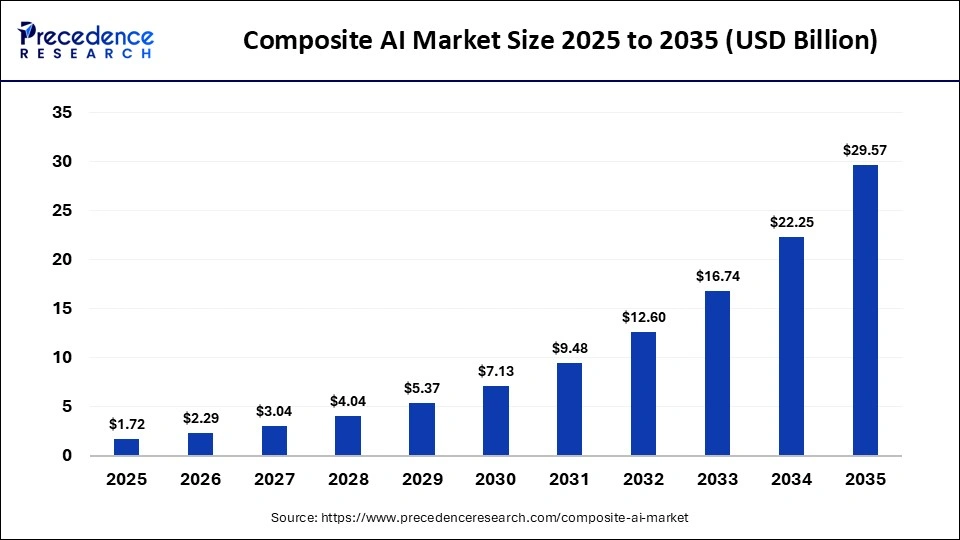
The global composite AI market size was calculated at USD 1.72 billion in 2025 and is predicted to increase from USD 2.29 billion in 2026 to approximately USD 29.57 billion by 2035, expanding at a CAGR of 32.90% from 2026 to 2035. The market is rapidly expanding due to the growing need to solve intricate and real-world problems with multimodal AI systems across diverse industries amid accelerating data complexity.
Key Takeaways
- North America held the largest market share of 39.4% in 2025.
- The Asia Pacific is expected to witness the fastest growth between 2026 and 2035.
- By component, the software segment held the largest market share of 71.8% in 2025.
- By component, the services segment is expected to register the fastest CAGR during the foreseeable period.
- By technology type, the machine learning segment led the market with a 22.7% share in 2025.
- By technology type, the knowledge graphs segment is expected to grow at the fastest CAGR during the foreseeable period.
- By AI architecture, the embedded composite AI within enterprise application segment held the largest market share of 43.8% in 2025.
- By AI architecture, the AI orchestration and decision intelligence platforms segment is expected to grow at the fastest CAGR during the foreseeable period.
- By application, the predictive analytics segment held a 19.8% share in 2025.
- By application, the decision intelligence segment is expected to witness the fastest growth during the foreseeable period.
- By end use industry, the BFSI segment held a 18.7% share in 2025.
- By end use industry, the healthcare segment is expected to grow at the fastest CAGR during the foreseeable period.
Market Overview
The composite AI market comprises platforms, tools, and services that combine multiple artificial intelligence techniques such as machine learning, deep learning, natural language processing, knowledge graphs, rule based systems, optimization, and automation to improve business decision making and operational performance. Composite AI enables enterprises to solve complex problems through integrated intelligence rather than relying on a single model type. It is used across analytics, forecasting, decision support, process automation, personalization, risk management, and enterprise workflow orchestration across diverse industries.
Composite AI is gaining strategic importance because enterprises increasingly require explainable, scalable, and context-aware intelligence that can support complex decision environments. Demand is moving beyond isolated model deployment toward integrated AI frameworks that combine statistical learning, semantic reasoning, optimization, and automation. This transition is expected to accelerate adoption across decision intensive industries such as financial services, healthcare, manufacturing, retail, and telecommunications. Over the forecast period, decision intelligence platforms, hybrid deployment models, and enterprise-wide cognitive workflows are expected to gain stronger commercial traction as organizations seek measurable productivity, governance, and business outcome improvements.
Composite AI Market Trends
- The growing adoption of explainable AI (XAI) is boosting the growth of the market.
- Composite AI is increasingly deployed in high risk sectors like finance and healthcare.
- There is a rapid shift toward AI approaches, where multiple techniques, such as machine learning, knowledge graphs, and optimization methods, are combined. This enables businesses to generate more accurate, contextual, and reliable insights compared to relying on a single AI model.
- Another notable trend is the rising adoption of low code and no code AI platforms, which are democratizing access to advanced AI capabilities. These platforms allow enterprises to design, build, and deploy sophisticated composite AI solutions without requiring deep technical expertise.
- Composite AI is being widely used across industries for real-time data processing across multiple data streams, making it highly effective for use cases such as fraud detection, predictive maintenance, and enhancing overall operational efficiency.
Market Scope
| Report Coverage | Details |
| Market Size in 2025 | USD 1.72 Billion |
| Market Size in 2026 | USD 2.29 Billion |
| Market Size by 2035 | USD 29.57 Billion |
| Market Growth Rate from 2026 to 2035 | CAGR of 32.90% |
| Dominating Region | North America |
| Fastest Growing Region | Asia-Pacific |
| Base Year | 2025 |
| Forecast Period | 2026 to 2035 |
| Segments Covered | Component, Technology Type, AI Architecture, Application, End Use Industry, and Region |
| Regions Covered | North America, Europe, Asia-Pacific, Latin America, and Middle East & Africa |
Market Dynamics
Drivers
Rising Demand for Trustworthy AI Systems
The market is experiencing significant growth due to the rapid adoption of explainable AI (XAI), which enables highly transparent decision-making processes. Traditional AI models often lack transparency, as they cannot explain how specific outcomes are achieved. This limitation has restricted AI adoption in regulated industries. Composite AI addresses this challenge by combining machine learning models with symbolic reasoning, enabling organizations to achieve explainability while meeting regulatory standards.
Restraint
Complex Integration
Despite having many benefits, the implementation of composite AI is more complex than traditional AI models, as it requires the seamless integration of multiple technologies, data formats, and architectures into a single cohesive system. This complexity increases technical demands, extends development timelines, and may lead to potential operational errors.
Opportunity
Expansion of Vertical AI
The market is witnessing a major opportunity in the expansion of industry-specific AI solutions through the development of highly specialized “vertical” composite AI platforms. Customizing composite AI for specific use cases reduces reliance on generic solutions and enables more precise, high-quality, and context-aware outcomes. For example, combining computer vision with natural language processing (NLP) can enhance diagnostic tools in healthcare, while predictive analytics can strengthen fraud detection in finance. This trend is creating strong growth potential for the global composite AI market.
Segment Insights
Component Insights
Composite AI Market Share, By Component, 2025-2035 (%)
| Component | 2025 | 2035 |
| Software | 71.80% | 65.10% |
| Services | 28.20% | 34.90% |
Software Segment Dominated the Composite AI Market with a 71.8% Share in 2025
The software segment held the largest market share of 71.8% in 2025 as it offers essential platforms, tools, and frameworks required to integrate various AI techniques like NLP, ML, and computer vision into a single and scalable solution. Software solutions allow businesses to handle highly complex tasks, analyze deep data structures, and deploy models that foster high AI adoption across various industries. Software provides pre built models with user friendly interfaces that lower the entry barrier and make them usable for a range of users
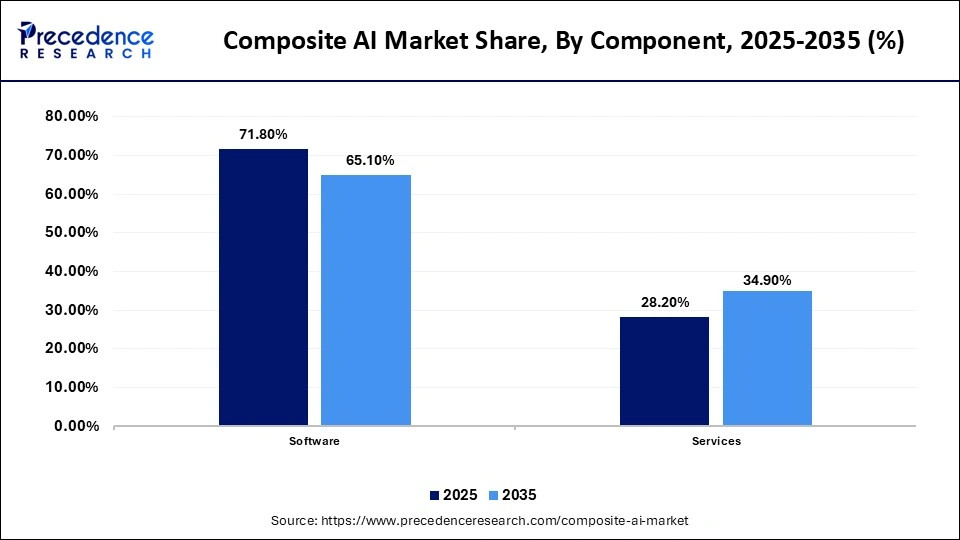
The services segment is expected to grow at the fastest CAGR during the foreseeable period due to the increasing demand for customized, industry specific AI implementation and expert guidance in deploying multi-modal AI systems efficiently. Service providers help organizations optimize costs while leveraging complex AI solutions, ensuring ethical practices, regulatory compliance, and high transparency. Additionally, companies are prioritizing expert support to effectively scale AI within their existing systems.
Technology Type Insights
Machine Learning Segment Held a 22.7% Share of the Market in 2025
The machine learning segment dominated the composite AI market while holding a 22.7% share in 2025. This is mainly due to its ability to process complex and huge datasets and is a foundational way to reduce predictive inaccuracy. ML models offer flexibility to process structured or unstructured datasets precisely, making them a primary layer of composite AI, which then integrates into other technologies like knowledge graphs or NLP. Also, ML models can continuously evolve from learning with changing patterns that offer highly precise automation results through ML.
Composite AI Market Share, By Technology Type, 2025-2035 (%)
| Technology Type | 2025 | 2035 |
| Machine Learning | 22.70% | 18.40% |
| Deep Learning | 18.90% | 17.60% |
| Natural Language Processing | 15.20% | 15.80% |
| Knowledge Graphs | 9.60% | 12.80% |
| Rule Based Systems | 10.70% | 8.40% |
| Optimization and Search | 11.30% | 10.90% |
| Computer Vision | 7.80% | 8.30% |
| Context Aware and Reasoning Systems | 3.80% | 7.80% |
The knowledge graphs segment is expected to witness the fastest growth during the forecast period, as they offer a highly accurate semantic foundation required for developing transparent, context-aware, and reliable AI models. Knowledge graphs help address critical challenges such as AI hallucinations and the lack of a factual basis in traditional models. They also enable organizations to trace AI decision-making by mapping relationships between data sources, which is essential for regulated industries such as BFSI and healthcare.
AI Architecture Insights
Composite AI Market Share, By AI Architecture, 2025-2035 (%)
| AI Architecture | 2025 | 2035 |
| Standalone Composite AI Platforms | 27.40% | 23.60% |
| Embedded Composite AI within Enterprise Applications | 43.80% | 38.70% |
| AI Orchestration and Decision Intelligence Platforms | 28.80% | 37.70% |
Why Did the Embedded Composite AI within Enterprise Application Segment Dominate the Market?
The embedded composite AI within enterprise application segment dominated the market in 2025, holding a major share of 43.8%. This is because of the increased integration of various AI techniques like ML, knowledge graphs, NLP, and rule based systems directly into existing enterprise systems like CRM, ERP, and HCM. This architecture leverages real time business data for immediate and context-aware results for faster decision making without depending on fragmented and external data sources.
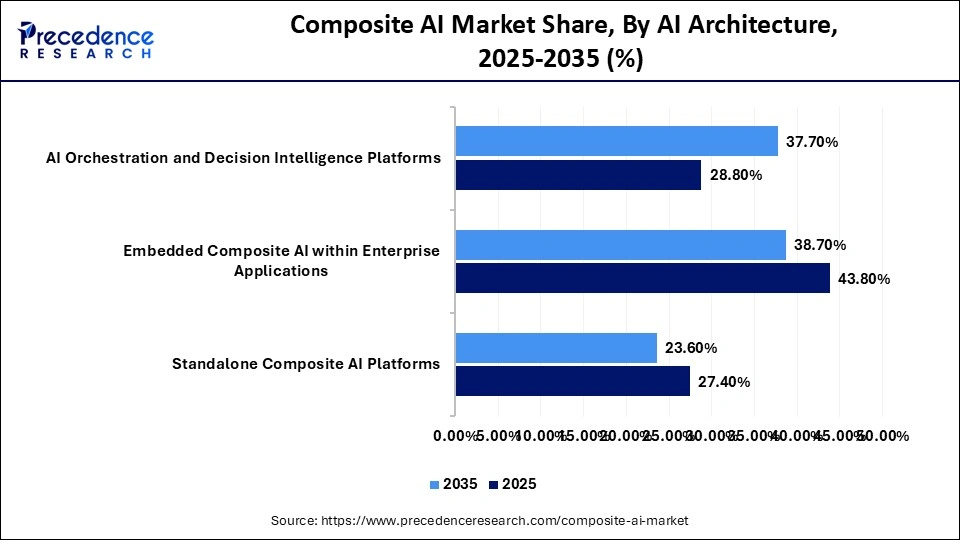
The AI orchestration and decision intelligence platforms segment is expected to expand at the fastest CAGR during the projection period. This is primarily due to their critical role in converting various AI models into a single, unified, and highly regulated AI system that works for action oriented business workflows. These platforms are increasingly enabling automated decision making, helping organizations bridge the gap between AI insights and operational execution.
Application Insights
Predictive Analytics Segment Led the Market in 2025 with a 19.8% Share
The predictive analytics segment led the composite AI market with a 19.8% share in 2025 due to its crucial role in delivering immediate, actionable business insights and maximizing ROI through improved forecasting and operational efficiency. By integrating machine learning, real time data, and statistical modeling, predictive analytics enables companies to anticipate trends, optimize key processes, and reduce risks, rather than relying solely on historical data for decision-making.
Composite AI Market Share, By Application, 2025-2035 (%)
| Application | 2025 | 2035 |
| Predictive Analytics | 19.80% | 16.70% |
| Prescriptive Analytics | 14.60% | 14.20% |
| Decision Intelligence | 13.80% | 18.10% |
| Business Process Automation | 15.40% | 15.70% |
| Customer Experience and Personalization | 12.70% | 11.80% |
| Fraud Detection and Risk Analytics | 10.60% | 9.80% |
| Supply Chain and Operations Optimization | 8.90% | 9.60% |
| Workforce Intelligence | 4.20% | 4.10% |
The decision intelligence segment is expected to witness the fastest CAGR during the foreseeable period, as it translates AI capabilities into predictable, evidence based business outcomes with measurable ROI. Beyond theoretical insights, decision intelligence provides precise, actionable guidance that bridges the gap between data analytics and operational execution. It directly supports critical business needs such as supply chain optimization, cost reduction, and revenue growth.
End Use Industry Insights
What Made BFSI the Leading Segment in the Composite AI Market?
The BFSI segment led the market while holding a 18.7% share in 2025. This is mainly due to stringent regulatory requirements, high data density, and the need for precise, competitive outcomes. The sector is increasingly adopting autonomous and agentic AI systems over traditional rule based models to analyze complex, large scale datasets in real time. Composite AI also enables automation of back-office operations such as document verification, compliance monitoring, and loan processing.
Composite AI Market Share, By End Use Industry, 2025-2035 (%)
| End Use Industry | 2025 | 2035 |
| Banking, Financial Services, and Insurance | 18.70% | 16.20% |
| Healthcare | 11.40% | 14.60% |
| Retail and E commerce | 14.90% | 13.40% |
| Manufacturing | 12.80% | 12.30% |
| IT and Telecommunications | 13.70% | 13.50% |
| Government and Defense | 8.20% | 8.60% |
| Media and Entertainment | 6.10% | 5.60% |
| Transportation and Logistics | 7.30% | 7.80% |
| Energy and Utilities | 4.50% | 4.70% |
| Others | 2.40% | 3.30% |
The healthcare segment is expected to witness the fastest growth during the foreseeable period due to its vast, complex, and fragmented data from EHRs, medical imaging, genomics, and wearable devices, which require advanced AI integration for accurate analysis. Composite AI enables precise diagnostics, real time patient monitoring, and personalized treatment by combining machine learning with knowledge based reasoning. Additionally, it supports regulatory compliance, enhances operational efficiency, and automates critical workflows, making it essential for improving patient outcomes and overall healthcare delivery.
Regional Insights
North America Composite AI Market Size and Growth 2026 to 2035
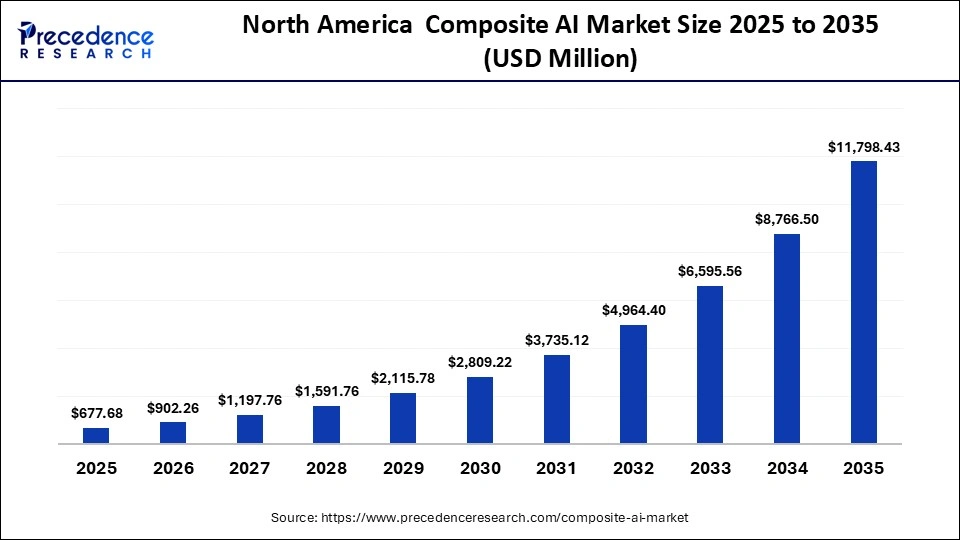
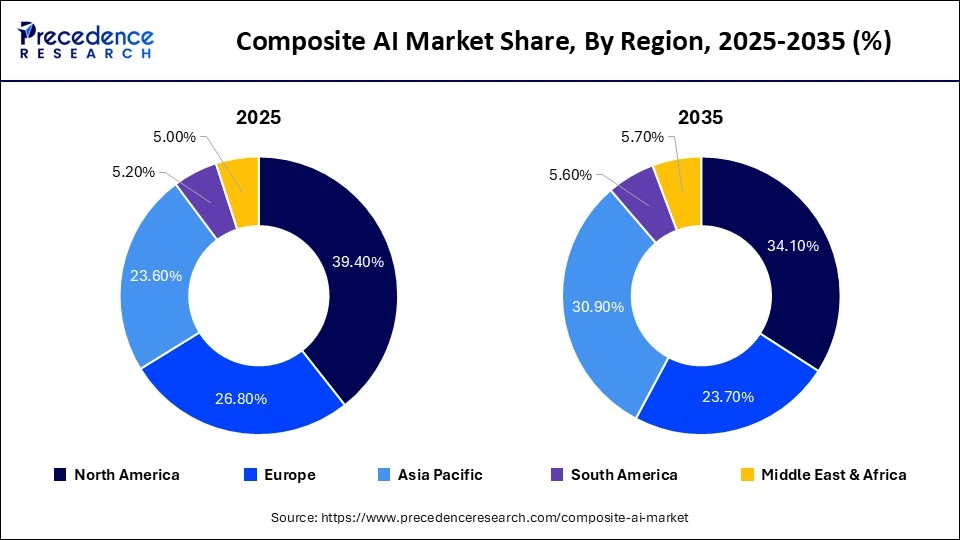
The North America composite AI market size is estimated at USD 677.68 million in 2025 and is projected to reach approximately USD 11,798.43 million by 2035, with a 33.07% CAGR from 2026 to 2035.
What Made North America the Leading Region in the Composite AI Market?
North America held the largest market share of 39.4% in 2025 due to a rapid adoption of complex AI models, along with high investments in the development of the AI ecosystem. The region benefits from major tech players, the presence of cloud service providers, rapid enterprise demand, and a growing focus on developing AI-driven solutions. Additionally, government incentives and AI adoption initiatives further support the region's leadership in the market.
North America is a leader in technological innovation, accounting for nearly 40% of global tech companies and maintaining a strong international presence. Key sectors such as BFSI, healthcare, defense, and retail are increasingly adopting composite AI to enhance operational efficiency and improve customer experiences. Additionally, substantial funding from venture capital firms continues to drive the growth of the composite AI market in the region.
U.S. Composite AI Market Size and Growth 2026 to 2035
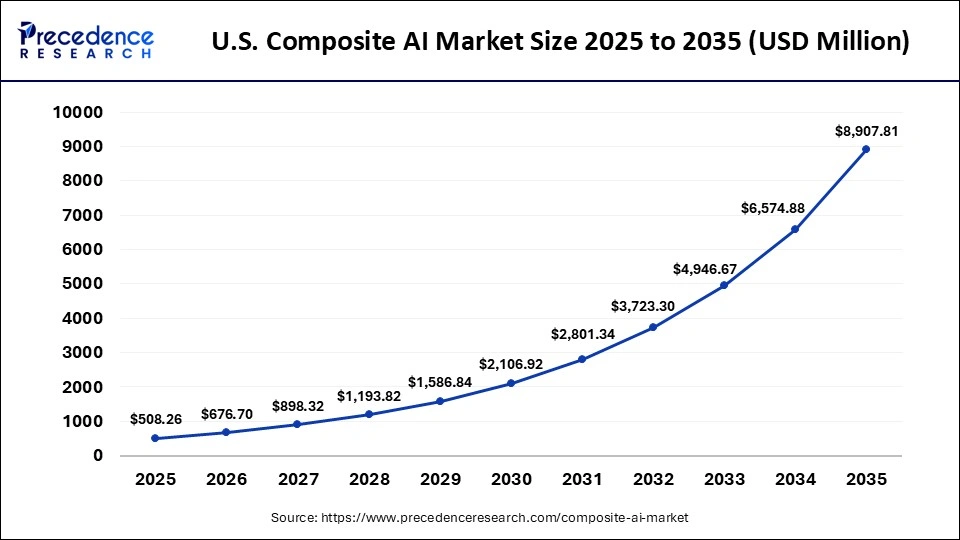
The U.S. composite AI market size is calculated at USD 508.26 million in 2025 and is expected to reach nearly USD 8,907.81 million in 2035, accelerating at a strong CAGR of 33.16% between 2026 and 2035.
U.S. Composite AI Market Analysis
The U.S. leads in developing agentic AI that combines machine learning and reasoning systems to provide transparent explanations for AI outputs, surpassing conventional black-box models. The country is home to major academic institutions such as MIT and Stanford, which contribute to 60% of the world's top AI research centers and provide a supportive environment for developing and deploying complex AI models. Additionally, active government initiatives, including the CHIPS and Science Act, are strengthening the foundation for AI innovation and experimentation in the U.S.
Why is Europe Considered the Second Largest Market for Composite AI?
Europe is the second largest market, holding a 26.8% share in 2025, driven by strong industry focus on automation to support the Industry 4.0 revolution, substantial investments in secure and transparent AI model development, and a stringent regulatory environment guided by frameworks such as the EU AI Act. The region's growth is further supported by high performance computing initiatives like EuroHPC and strict compliance with regulations such as GDPR. Europe's robust industrial base, along with programs like the AI Factory Initiative, is enabling the training of large and complex AI models for predictive maintenance and integration across manufacturing, healthcare, and finance sectors, strengthening the composite AI market in the region.
Germany Composite AI Market Analysis
Germany is a major contributor to the European composite AI market, driven by its robust industrial base, massive investment in AI development backed by strategic government initiatives, and subsidies for AI adoption. The German government has introduced its AI agenda as a centerpiece of its High-Tech 2025 mission. The government is hugely investing in AI research with a 36% increase in AI startups in 2025, along with the creation of AI service centers, highlighting the country's growth potential in the composite AI market.
How is the Opportunistic Rise of Asia Pacific in the Composite AI Market?
Asia Pacific is expected to grow at the fastest CAGR in the coming years due to increasing digitalization, expanding industrial automation, and growing adoption of AI-driven solutions across sectors such as manufacturing, healthcare, BFSI, and retail. Governments in countries like China, Japan, South Korea, and India are investing heavily in AI research, infrastructure, and regulatory frameworks, fostering innovation and enabling large scale deployment of composite AI solutions. Additionally, a growing startup ecosystem, affordable computing resources, and rising demand for real-time, data-driven decision-making create a fertile environment for the region to capture significant market share in the coming years.
Composite AI Market Companies
- Microsoft Corporation
- International Business Machines Corporation
- Google LLC
- Amazon Web Services, Inc.
- Oracle Corporation
- SAP SE
- SAS Institute Inc.
- Salesforce, Inc.
- NVIDIA Corporation
- C3.ai, Inc.
- DataRobot, Inc.
- H2O.ai, Inc.
- Palantir Technologies Inc.
- FICO
- Infosys Limited
Recent Developments
- In March 2026, the AI-driven SIEM purpose-built for lean security teams, Graylog, has launched new advancements in explainable AI and automated investigation workflow, aiming to enable SMEs' security teams to build a threat detection and investigation system driven by AI.(Source: https://www.cybersecurity-insiders.com)
- In March 2026, a leading tech player, HackerOne, introduced Agentic Prompt Injection Testing, a new feature to detect real-world exploitability of AI systems. The move addresses rising concerns over the sharp increase in prompt injection vulnerabilities.(Source: https://www.cybersecurity-insiders.com)
- In October 2025, CompositesAI was launched by AnalySwift LLC in collaboration with Purdue University. The platform enables faster design and analysis of composite materials, simplifying development without requiring deep technical expertise. (Source: https://www.purdue.edu)
Segments Covered in the Report
By Component
- Software
- Services
By Technology Type
- Machine Learning
- Deep Learning
- Natural Language Processing
- Knowledge Graphs
- Rule Based Systems
- Optimization and Search
- Computer Vision
- Context Aware and Reasoning Systems
By AI Architecture
- Standalone Composite AI Platforms
- Embedded Composite AI within Enterprise Applications
- AI Orchestration and Decision Intelligence Platforms
By Application
- Predictive Analytics
- Prescriptive Analytics
- Decision Intelligence
- Business Process Automation
- Customer Experience and Personalization
- Fraud Detection and Risk Analytics
- Supply Chain and Operations Optimization
- Workforce Intelligence
By End Use Industry
- Banking, Financial Services, and Insurance
- Healthcare
- Retail and E commerce
- Manufacturing
- IT and Telecommunications
- Government and Defense
- Media and Entertainment
- Transportation and Logistics
- Energy and Utilities
- Others
By Region
- North America
- Latin America
- Europe
- Asia-pacific
- Middle and East Africa
For inquiries regarding discounts, bulk purchases, or customization requests, please contact us at sales@precedenceresearch.com
Frequently Asked Questions
Tags





Ask For Sample
No cookie-cutter, only authentic analysis – take the 1st step to become a Precedence Research client
 Get a Sample




 sales@precedenceresearch.com
 Schedule a Meeting
