



Computerized Physician Order Entry Market, Global Market Size, Segmentation, Regional Analysis, Electronic Health Record Integration, Medication Safety, Clinical Decision Support, and Healthcare Digitization
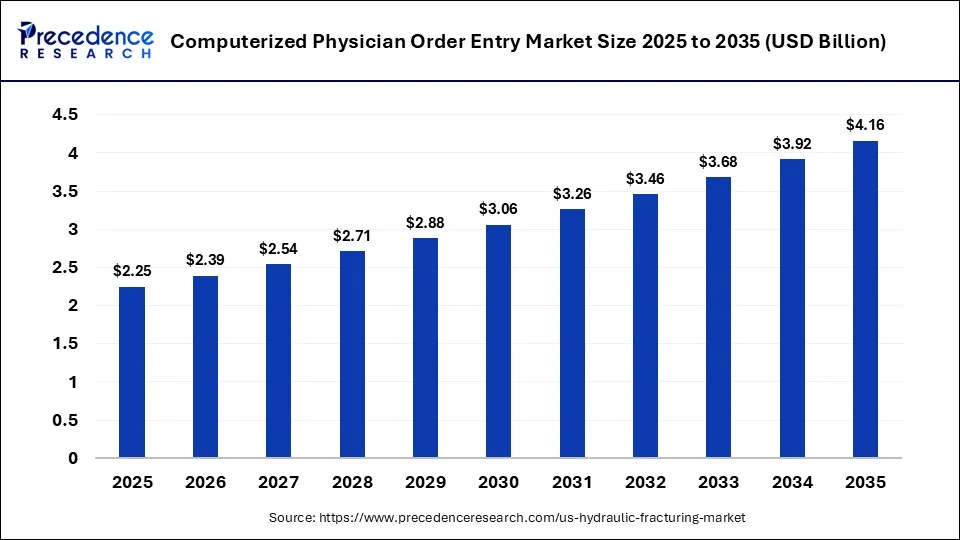
The computerized physician order entry market is valued at 2.25 billion in 2025 at a CAGR of 5.8% during the forecast period. The market is undergoing a massive change of the guard among healthcare delivery organizations. They are moving from paper-to-order to seamlessly embedding computer order entry into their workflows. Deepa Pandey, senior research analyst, curated the report. Her analysis aids all stakeholders in healthcare, including providers, health IT, hospital leaders, technology vendors, investors, and similar competitive benchmarking and good decision-making.
Source: https://www.precedenceresearch.com/computerized-physician-order-entry-market
 Get a Sample
 Table Of Content

Computerized Physician Order Entry Market Size, Trends, Share and Innovations
The computerized physician order entry market is forecasted to expand from USD 2.39 billion in 2026 to USD 4.16 billion by 2035, growing at a CAGR of 6.35% from 2026 to 2035. Thus, eliminating the manual ordering process. Deepa Pandey has more than 5 years of healthcare & life sciences market analysis experience. She observes a massive transformation in the field of healthcare digitization. CPOE systems enable physicians to electronically enter clinical orders such as medication, laboratory, imaging, and other orders, and link these orders with EHRs and clinical decision-support systems. On the other hand, Asia-Pacific is regaining its momentum in connection with the digitalization of hospitals and also the increasing investments in healthcare information systems.
Key Takeaways
- By component, the software segment led the market with a share of 51.85% in 2025.
- By deployment analysis, the on-premises segment led the market with a 43.65% share in 2025.
- By order type analysis, the medication orders segment captured a major revenue share of 35.85% in 2025.
- By application, the medication management segment captured the largest market share of 32.45% in 2025.
- By end-user, the hospitals segment led the market with a share of 55.85% in 2025.
- Multiple historical events were captured in the ONC data that provide further examples of U.S. CPOE adoption before the latest time period was measured. The historical ONC hospital dataset reported 84.4% adoption of CPOE functionality for laboratory tests, radiology tests, and medications. As part of the referenced meaningful use measures.
- MEDITECH's Expanse ecosystem includes CPOE-related pharmacy workflows and analytics. In a 2026 customer case study, Catawba
- Valley Health System reported using Expanse Advanced Data Insights to analyze CPOE performance and subsequently achieved its
- CPOE performance goals for the first time, earning an A grade in its Leapfrog evaluation.
- Oracle's announcement in February 2026 is a good example, as it's Oracle's Clinical AI Agent that can write lab, imaging, prescription, and follow-up orders just from listening to the surrounding environment.
- Epic's current certification documentation shows certification for CPOE–medications, CPOE–laboratory, CPOE–diagnostic imaging, and drug-drug/drug-allergy interaction checks.
- ONC's HTI-1 Final Rule will move certification initiatives forward, interoperability, decision support, and more. This will set the certification baseline of USCDI Version 3 as of January 1st, 2026.
The global computerized physician order entry (CPOE) market encompasses software and integrated clinical information systems. That enable doctors and other authorized clinical professionals to electronically formulate, edit, share, review, and monitor medication, lab, imaging, treatment, procedure, diet or nutrition, referral, and all other clinical orders.
CPOE has expanded from being a medication-ordering safety measure to becoming a component of EHRs as a whole. Today's platforms integrate the ordering process with various departments within the healthcare organization, such as pharmacies, laboratories, radiology services, clinical decision-support applications, medication administration, prior authorization, and external information exchanges. The modern computer-based E-prescribing systems (CPOE) at AHRQ allow orders to be placed for medications, labs, admissions, radiology, referrals, and procedure orders, with clinical decision support adding checks for allergies, drug interactions, contraindications, and dose-related risks.
The U.S. healthcare system illustrates the level of maturity for this underlying infrastructure; 99% of non-federal acute-care hospitals are using certified EHRs by 2024, ONC revealed.
Expert Analysis View - CPOE is becoming a core digital healthcare platform, improving efficiency, patient safety, and care coordination.
Market Size and Forecast
How large will the computerized physician order entry market become by 2035?
Analyst View
The CPOE market will grow from USD 2.25 billion in 2025 to over USD 4.16 billion by 2035. In contrast to previous CPOE adoption phases, which targeted only paper-to-digital workflow substitution. The next phase of CPOE integration will focus on workflow optimization, clinical decision support, interoperability, cloud deployment, order intelligence, automation, and integrating with specialized clinical systems.
CPOE is a mature technology that AHRQ describes as an HTIT. It also points to potential implementation issues such as disruptions to workflow, cognitive overload, issues with alerts, and new types of ordering errors. It's an important distinction to make between CPOE adoption and CPOE optimization. Spanning this from earlier on, in the more mature markets, spend on incremental transactions is more and more geared towards enhancing present systems as opposed to introducing electronic ordering.
Component Analysis
What Components Generate CPOE Market Demand?
Source: Precedence Research Database
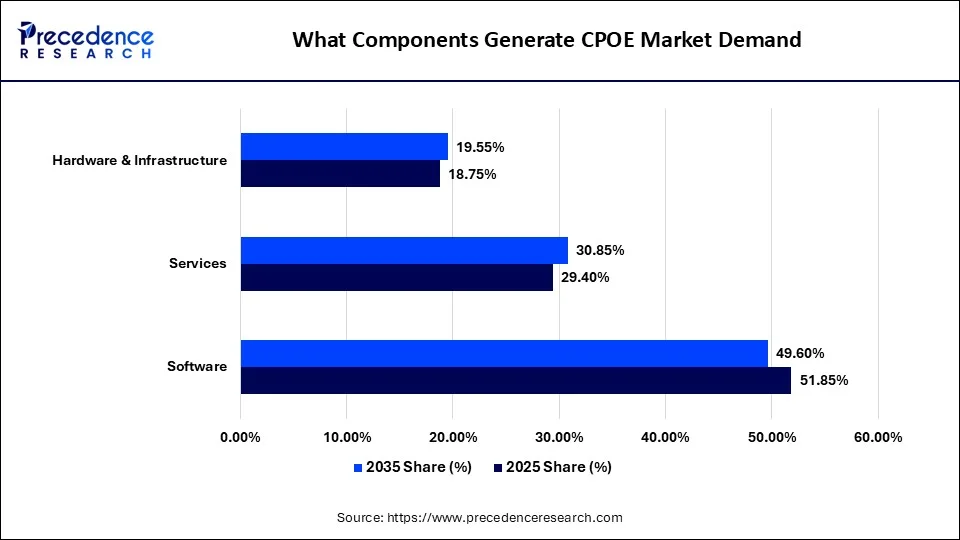
Software is the biggest player in this category with a 2025 share of 51.85%. This will grow only slightly at 5.86% CAGR to reach a 49.60% share in 2035. CPOE functionality is most often integrated into or linked to other EHR and clinical information systems and not often sold as a stand-alone application. Services saw a significantly higher 6.84% CAGR, rising from 29.40% to 30.85%, as implementation workflow evolves, in conjunction with redesign and integration and ever more inclusive and costly support post-deployment.
Expert Analyst View - Component
Software will comprise 51.85% of the 2025 value, but will drop to 49.60% of the market in 2035. The complexity of implementation, workflow redesign, integration, clinical content configuration, optimization, and support capabilities following the deployment are driving growth in services, at a 6.84% CAGR.
CPOE is not a stand-alone software application. Effective implementation requires that systems be integrated with registration, pharmacy, and laboratory systems, and also into the EHR systems. Interoperability problems have been a major issue in implementation projects, according to AHRQ.
Deployment Analysis
Why is Cloud-Based CPOE Gaining Share?
Source: Precedence Research Database
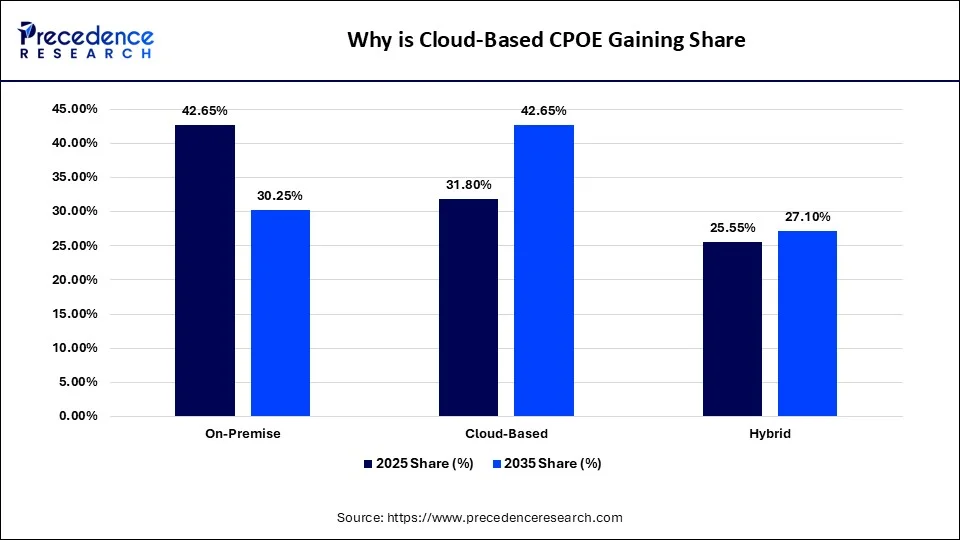
As older architectures begin to be supplanted by newer ones, the slowest growth in both the number of systems and the deployment rate in 2025 is for on-premises deployment. This accounted for 42.65% in 2025 but would drop to 30.25% in 2035 at just a 3.12% CAGR. Cloud-based deployment dwarfs on-premises in terms of overall market growth well before the forecast period. The increase in share from 31.80% to 42.65% is at a 9.63% CAGR, which is quite high when compared to the 6.35% CAGR for the overall market. Hybrid deployment rises by 1.55 percentage points, from 25.55% to 27.10%, with growth at 6.98% and a gradual migration towards the cloud.
Analyst View- Deployment Analysis
Deployment is one of the most obvious changes in the framework of the provided prediction. Cloud-based CPOE is growing at the rate of 9.63%, well outpacing the overall market growth of 6.35%, as the share is rising from 31.80% to 42.65%.
This transition marks another case of the spread of EHR and clinical services to the cloud platform, increasing the reliance on the cloud rather than firewalled local software platforms. Further providing organizations with a greater frequency of software updates. CPOE is firmly entrenched in other clinical systems, including pharmacy, lab operations, radiology, medication administration, and other clinical systems. This makes it likely hybrid systems will continue to be used for the foreseeable future, especially among hospitals having legacy systems.
Order Type Analysis
Which Clinical Orders Represent the Largest CPOE Opportunity?
Source: Precedence Research Database
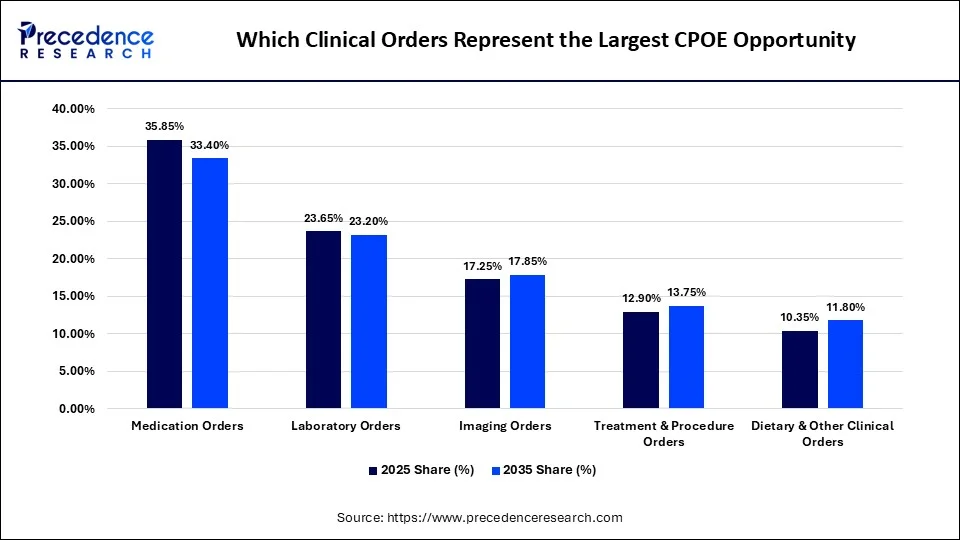
Medication orders remain the highest segment by 2035, it will be at a CAGR of 5.59%, dropping to 33.40% by 2035, compared with the other categories. Laboratory orders add 23.65%, dropping to 23.20% growth, while imaging orders gain 17.25% to 17.85% at 6.72% growth, with digital diagnostic integration continuing to increase. Treatment and procedure orders rise from 12.90% to 13.75% with a growth rate of 7.04%. Orders centered on diet and other clinical orders recorded the fastest growth of all order types even though they accounted for just 10.35% through 2015; e-ordering is spreading way beyond prescription orders.
Analyst View - Order Type
Orders for medications are still the biggest segment at 35.85%, but are expected to drop to 33.40% with CPOE rolling out for more clinical workflows. Dietary & other clinical orders grew fastest in the supplied category at 7.78%, followed by treatment & procedure orders at 7.04%.
This shift mirrors the maturing of CPOE from just a prescription-focused system to an enterprise clinical workflow layer. Furthermore, Oracle Health currently has a set of eHR documentation that includes functions for prescribing, revisions, signing, canceling, renewal, and reconciliation of patient orders, such as prescriptions for medication.
Application Analysis
Which CPOE Applications are Growing Fastest?
Source: Precedence Research Database
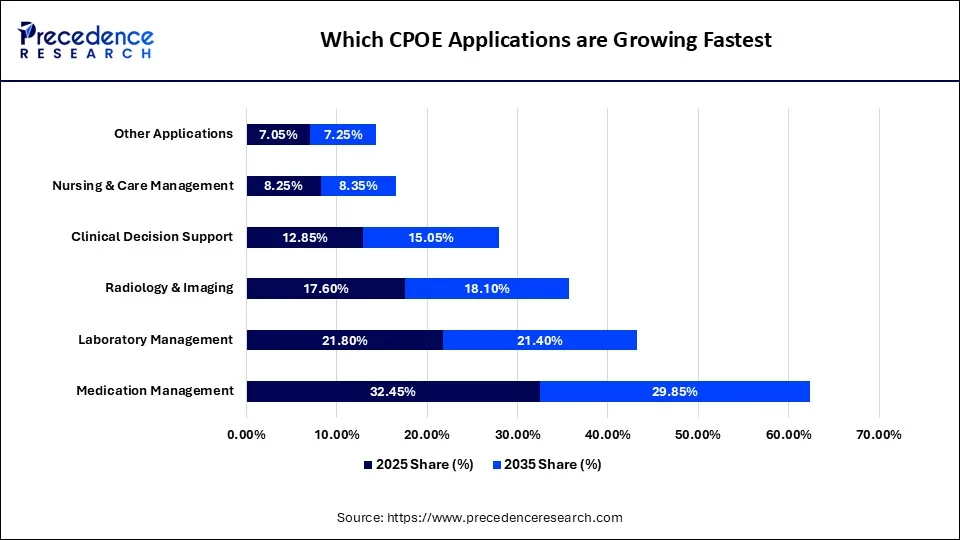
Electronic prescribing, with its safety checks and supporting applications, anchors the largest share (32.45%) in 2025. This is expected to level off at a 5.45% CAGR to 29.85% in 2035. Laboratory management follows at 21.80%, easing to 21.40% at 6.14% growth, and radiology and imaging climb from 17.60% to 18.10% at 6.66% growth.
The largest movers in this table are the electronic applications used for clinical decision support, which saw their share rise from 12.85% to 15.05%. The highest stake among all applications is 8.23% CAGR, the fastest-growing in the table, due to the increasingly valuable role played by modern CPOE beyond the ability to enter data electronically.
Analyst View - Application
Clinical decision support (CDS) is at the fastest growth rate of 8.23% CAGR. This has risen from 12.85% to 15.05% of the application mix. This is a development that is important since much of the value of modern CPOE is what occurs when an order is placed, not just when the data is keyed electronically.
AHRQ classifies some of the functions of CDS, including drug-drug interactions, allergies, contraindications, and renal or weight dosing support. ONC's SAFER guidance is tailored to CPOE with decision support, specifically calling out efforts to implement and use safely in a CPOE-enabled EHR environment. That leaves many other areas of opportunity in which to apply CPOE software: clinical rules, knowledge bases, predictive decision support, alert optimisation and workflow intelligence.
End-User Analysis
Which Healthcare Facilities Account for CPOE Demand?
Source: Precedence Research Database
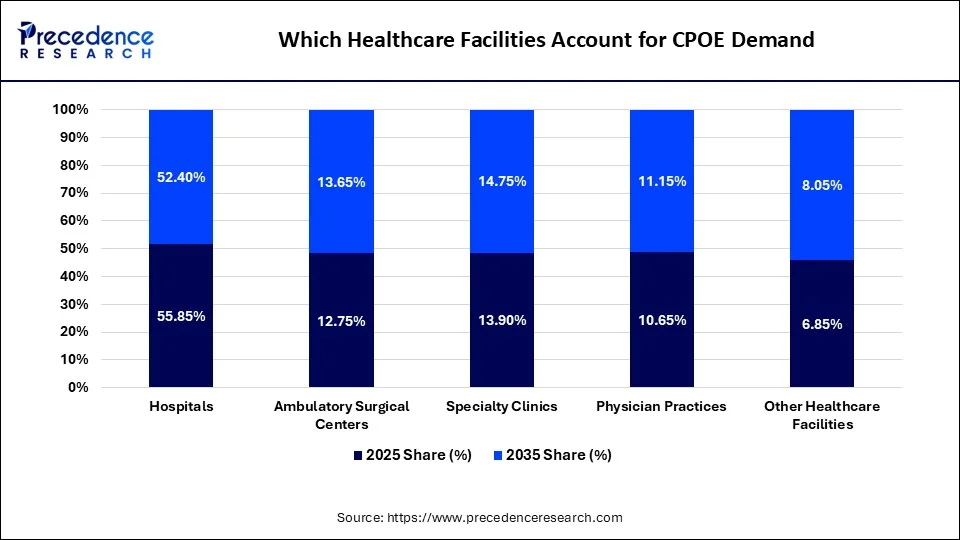
Hospitals continue to be the largest end-user segment, accounting for 55.85% of the market in 2025 and declining at 5.69% CAGR from 2025 to 2035. The enormous scale of clinical operations performed at hospitals will help hospitals continue to be the largest end-user segment. Other healthcare facilities, which saw the smallest growth among end-users, increased their share from 6.85% to 8.05% at 8.02% CAGR, mirroring the overall trend of healthcare digitization beyond hospitals and into other facilities.
Expert Analyst View - End-User
According to our Senior Researcher Aditi Shivarkar, hospitals still dominate as the largest user end segment. It is estimated that the share of hospitals would fall to 52.40% once outpatient & specialty pricing environments tap into more advanced e-prescribing workflows electronically. The expansion outside of the hospital mirrors wider ambulatory CPOE evolution. Medication, laboratory, admission, radiology, referral, and procedure orders are specific areas that AHRQ mentions outpatient CPOE does play a role in making.
Enterprise Size Analysis
How are Smaller Healthcare Organizations Changing CPOE Demand?
Source: Precedence Research Database
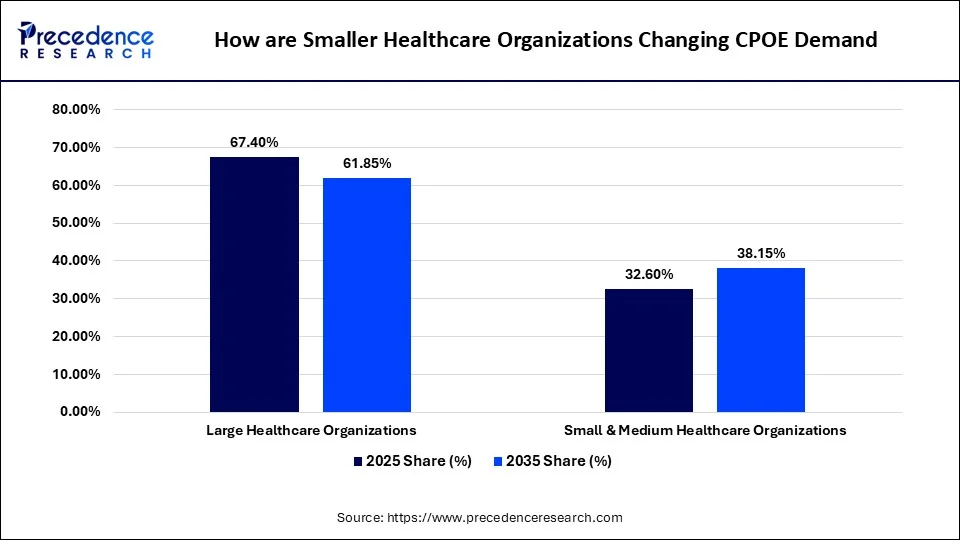
Large healthcare companies hold the majority of market share, at 67.40% in 2025 and 61.85% by 2035, at a 5.44% CAGR, with established IT infrastructures. Most companies now have or intend to establish and maintain IT infrastructure, maintaining dominance over the market. Small and medium (SAM) healthcare organisations dominate the remaining 32.60% of market share, which is expected to jump at an 8.10% CAGR to 38.15% of market share in 2035. Due to the increase in the availability of cloud and SaaS solutions, making it easier and more affordable to implement and use CPOE without significant investment in internal IT infrastructure.
Expert Analyst View - Enterprise Size
As a result, large healthcare organisations make up over two-thirds of the market in 2025, whereas small and medium healthcare organisations report a higher CAGR of 8.10% as compared to the others. Cloud deployment is also crucial so that smaller organisations can offload some of the infrastructure and IT-management responsibilities from on-premises deployments.
This segment also drives the opportunity for vendors to provide modular CPOE, subscription pricing, standardized integrations, and preconfigured clinical content as opposed to highly customized enterprise implementations. The literature reviewed in this research review reveals that, in addition to being essential for exchange. Clinician buy-in has proven to be a vital component of ambulatory CPOE implementation. Stating that usability and implementation support may be even more critical with widespread adoption outside of large centralized hospital settings.
Integration Analysis
Which Systems are Becoming More Important to CPOE?
Source: Precedence Research Database
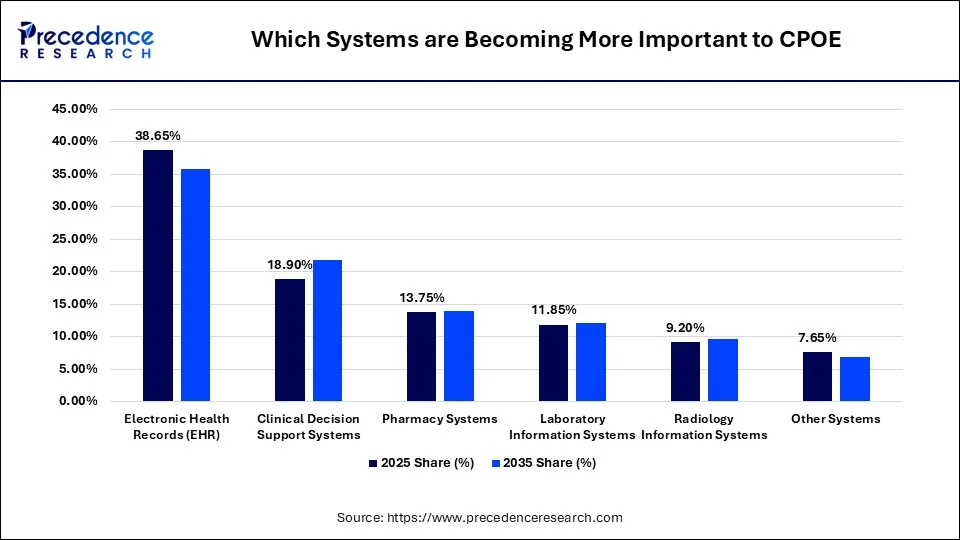
The biggest segment is still EHR integration, albeit a slight drop from 38.65% back in 2025 to 35.80% by 2035, growing at a CAGR of 5.55% during the period. There is incredible growth potential in the clinical decision support systems for the table as well, growing from 18.90% to 21.85% share at an 8.01% CAGR. Making the clinical decision support system more integral to how the systems are defined.
Expert Analyst View - Integration
Senior analyst Amit Singh believes that, in terms of largest market and fastest-growing CAGR, integration of EHR is the largest, while clinical decision support systems (CDSS) record the highest CAGR of 8.01%. This change is indicative of the increasing value of joining with data from other sources and getting real-time intelligence at the time of ordering.
This is illustrated by Epic's current documents on integrations that get CPOE orders sent to lab, radiology, and cardio. It also includes CDS Hooks, which help to connect with order-selection and order-signing workflows and leverage resources like MedicationRequest, ServiceRequest, and ProcedureRequest. CMS is also working to develop order-exchange capabilities based on FHIR in the post-acute workflow, including orders for durable medical equipment, home health services, medications, and clinical information.
Regional Analysis
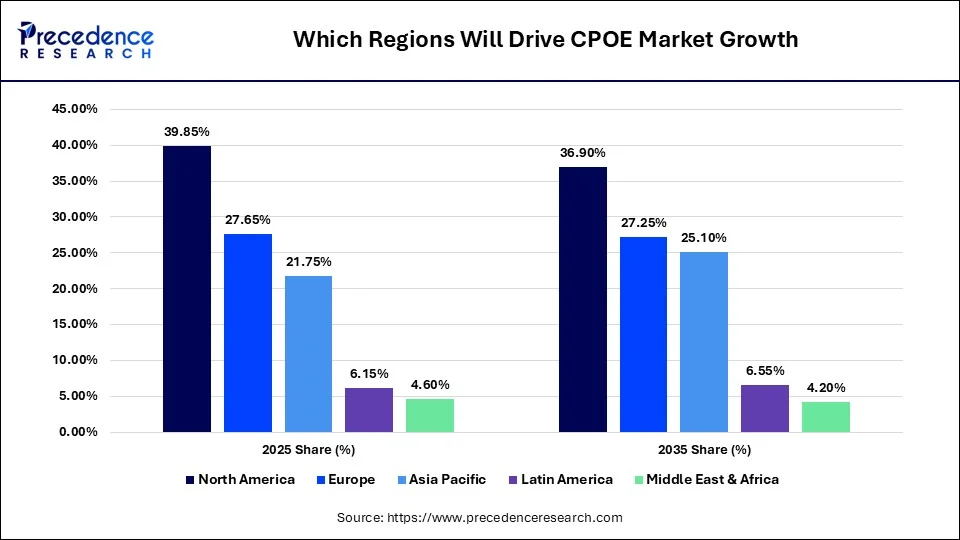
Which Regions Will Drive CPOE Market Growth?
Source: Precedence Research Database
North America continues to be the largest regional market with a stake exceeding 39.85% in 2025 and dropping to 36.90% by 2035 at a CAGR of 5.54%. Boosted by its advanced EHR setup and acceptance of CPOE. Europe is to follow at 6.19% growth, treading softly at 27.65% down to 27.25%, with ongoing healthcare digitisation driving growth. With a 7.91% CAGR, Asia Pacific is the clear growth outlier with a share of 21.75% and an expected 25.10% by 2020, due to the fact that several economies are going through hospital IT modernization simultaneously.
Analyst View
North America is the biggest regional market, accounting for 39.85% in 2025 owing to well-developed EHR infrastructure and established CPOE implementation in the region. Asia Pacific, however, has the highest CAGR (7.91%) in the region, growing from 21.75% to 25.10% share. This distinction highlights two different market dynamics. In developing markets, the demand is for the progress of replacement of paper based workflow, digitization of hospitals. In North America, the demand is for optimization, interoperability, safety, and advanced CDS.
Country-Level Opportunity Indicators
Which Countries Represent Important CPOE Opportunities?
| Country | Digital Healthcare / CPOE Opportunity | Market Relevance |
| United States | Mature EHR and health IT infrastructure | CPOE optimization, CDS, interoperability, and AI |
| Canada | Digitization of provincial healthcare systems | EHR integration and clinical workflows |
| Germany | Healthcare digitalization and hospital modernization | Interoperability and hospital IT |
| United Kingdom | NHS-wide digital transformation | Integrated clinical ordering |
| France | Hospital and ambulatory digitalization | EHR/CPOE modernization |
| Italy | Hospital IT modernization | Electronic clinical workflows |
| China | Large hospital system and digital-health investment | New deployments and modernization |
| Japan | Advanced healthcare IT ecosystem | Clinical integration and workflow optimization |
| India | Rapid digital health infrastructure development | Cloud CPOE and hospital digitization |
| South Korea | Advanced hospital information systems | Integrated clinical workflows |
| Australia | Digitized healthcare infrastructure | Interoperability and connected care |
| Singapore | Highly digitized healthcare system | Advanced clinical decision support |
| Brazil | Expanding health IT adoption | Hospital and ambulatory digitization |
| Saudi Arabia | Healthcare transformation investments | Enterprise EHR and clinical systems |
| UAE | Healthcare technology modernization | Cloud clinical platforms and interoperability |
Source: Precedence Research Database
U.S. is a clear sign of an optimized market, as the upcoming trends in EHR and health IT are all towards optimization. This momentum is placed in CPOE optimization, clinical decision support, interoperability, and AI, as opposed to initial implementation. China's large hospital networks and its focus on digital health investments are fueling demand for new deployments and modernization but not refinement. The fast progress in digital health infrastructure in India is in a similar early stage, and signals that cloud CPOE and hospital digitization will be the greatest opportunity.
Expert Analyst View - Country-Level Opportunity Indicators
The geographic opportunity is now further split between the replacement and optimization market and the new infrastructure market. The U.S. is an example of a more developed market. 99.5% of non-federal acute-care hospitals used certified EHRs by 2024.
In its June 2026 Report, ONC's physician adoption trends report revealed that the adoption of certified EHRs by office-based physicians continued to grow through 2024. ONC data indicated that the proportion of office-based physicians at the 50% and higher levels of certified EHR adoption increased at both the 50% and higher and 75% and higher adoption rates. Furthermore, the U.S. CPOE vendors are competing over user-friendliness, integration, analytics, CDS, and workflow, not just on improving the digitization of paper CPOE systems.
U.S. Adoption and Policy Indicators
What Does the U.S. Health IT Environment Indicate About CPOE Maturity?
| Indicator | Latest Available Evidence |
| U.S. non-federal acute-care hospitals with certified EHRs, 2024 | >99% |
| Hospital CPOE functionality in ONC historical Meaningful Use data | 84.40% |
| Physicians reporting computerized prescription ordering in historical ONC data | 83% |
| Physicians reporting electronic prescription transmission | 79% |
| Physicians reporting drug interaction/contraindication warnings | 74% |
| ONC-certified health IT supporting U.S. hospitals | >96% |
| ONC-certified health IT supporting U.S. office-based physicians | 78% |
Source: Precedence Research Database
Multiple historical events were captured in the ONC data that provide further examples of U.S. CPOE adoption before the latest time period was measured. The historical ONC hospital dataset reported 84.4% adoption of CPOE functionality for laboratory tests, radiology tests, and medications. As part of the referenced meaningful use measures.
Historically, ONC had 83% of physicians using computerized prescription ordering. Further, around 79% of physicians reported electronic prescription transmission and 74% of physicians reported drug-interaction or contraindication warnings. On their own, ONC-certified health IT helps power over 96% of U.S. hospitals and 78% of U.S. office-based physicians. The numbers represent historical measures for survey and Meaningful Use and should not be interpreted as readings of the 2026 CPOE market penetration, as it has been evolving since such measures were made.
Expert Analyst View - U.S. Adoption and Policy Indicators
The U.S. numbers have advanced from adoption to being at a stage of application. Given that the percent of non-federal acute-care hospitals utilizing certified EHRs exceeds 99%. Given that the last few years have seen only a small incremental increase in EHR investment in these types of hospitals, the next focus of investments is CPOE. They are incremental upgrades to existing capabilities, workflow improvements, enhanced safety performance, external system integration, alert optimization, and intelligent workflows.
Regulatory and Interoperability Environment
Which Policy Developments are Shaping CPOE Technology?
| Development | Relevance to CPOE |
| ONC HTI-1 Final Rule | Updated certification, interoperability, and decision-support requirements |
| USCDI v3 | Became the certification baseline from January 1, 2026 |
| Information Blocking requirements | Supports exchange and access to electronic health information |
| CMS Promoting Interoperability | Encourages use of certified EHR technology and data exchange |
| FHIR-based exchange | Supports standardized clinical-data and order exchange |
| CDS Hooks | Enables decision support at ordering workflow points |
| Electronic prior authorization | Connects orders with payer authorization workflows |
Source: Precedence Research Database
ONC's HTI-1 Final Rule will move certification initiatives forward, interoperability, decision support, and more. This will set the certification baseline of USCDI Version 3 as of January 1st, 2026. CMS's incentive programs include promoting interoperability (PI). This keeps promoting the use of certified EHR technology and more, to the extent that it is currently allowed. CDS Hooks, in conjunction with FHIR-supported exchange, allow for a standard-based exchange of clinical data and orders to be delivered to the clinician, as opposed to retroactively.
Expert Analyst View - Regulatory and Interoperability Environment
Interoperability is now a feature for the business, not just something as an afterthought. CPOE platforms are now going to multiple EHRs, pharmacy platforms, lab platforms, radiology platforms and PACS, payers, prior authorization systems, external health information applications, post-acute platforms, and health information exchange platforms. This creates a market opportunity for all types of messaging not covered by CPOE applications, such as APIs, interface engines, FHIR services, clinical terminology management, and integration services.
Clinical Decision Support and Safety
Why is CDS Becoming Central to CPOE?
CPOE was initially developed to solve issues related to handwritten and verbal orders. The incorporation of clinical intelligence into today's systems is integrated with ordering. Classic drug ordering errors, particularly orders and transcriptions, have been found to be frequent medication-ordering errors, and CPOE minimizes associated risk from illegibility and incomplete orders, according to AHRQ. But CPOE is no guarantee of clinical risk. There are also unintended consequences associated with too many tasks, greater cognitive load, disrupting workflow, and system-related prescribing errors, identified by AHRQ.
Expert Analyst View - Clinical Decision Support and Safety
This provides an important opportunity for technology around high-quality CDS and not just more alerts. Context-sensitive alerts, drug-drug interaction checking, drug-allergy checking, dose-range checking, duplicate-order detection, renal/weight-based dosing, evidence-based order sets, appropriate-use flagging, cost-aware ordering, prior-authorization, and predictive risk signals are all becoming more prevalent in the commercial focus. Epic's CDS Hooks architecture shows one way external decision-support applications can interact with provider workflows during the order-selection and order-signing phases. That facilitates clinical recommendations to appear when an order is being created.
Company Intelligence
Which Companies are Active Around CPOE and Integrated Ordering?
| Company | Relevant Capability | Market Significance |
| Epic Systems | CPOE for medication, laboratory, and diagnostic imaging; CDS Hooks and extensive integration ecosystem | Enterprise EHR/CPOE ecosystem |
| Oracle / Oracle Health | Medication/order management, electronic orders/results, CDS and AI-assisted order creation | Integrated EHR and intelligent ordering |
| MEDITECH | Expanse CPOE, pharmacy integration, order content and analytics | Community and enterprise healthcare IT |
| athenahealth | CPOE for medication, laboratory and diagnostic imaging | Ambulatory-focused clinical platform |
| Wolters Kluwer | Clinical decision support and medication information | Knowledge/CDS layer |
| First Databank | Medication knowledge and drug decision support content | Medication safety infrastructure |
Source: Precedence Research Database
Epic
At the present time, Epic's documentation indicates that they are certified for CPOE-medications, CPOE-laboratory, CPOE-diagnostic imaging, and drug-drug and drug-allergy interaction checks.
Its ecosystem of integration also has the ability to route orders to lab, radiology, and cardiology systems, and its CDS Hooks implementation enables decision support at the order-selection and order-signing moments.
Oracle Health
Order and medication management, including placement of orders, modification of orders, order signing, extending the order, canceling an order, and reconciling orders, is provided by Oracle Health EHR.
Then, in February 2026, Oracle said the same for its Clinical AI Agent, which could draft clinical orders by listening ambiently to laboratory tests, imaging tests, diagnostic tests, prescription medications, and follow-up appointments. As of last week, Oracle said customers have logged over 200,000 hours of documentation time saved with the Clinical AI Agent.
MEDITECH
The CPOE-related processes and analytics are a part of MEDITECH's Expanse ecosystem. Catawba Valley Health System participated in the 2026 customer case study and used Expanse Advanced Data Insights to benchmark its CPOE use to its service goals, and has now achieved its CPOE performance goals for the first time and earned an A grade in the Leapfrog evaluation.
athenahealth
athenahealth provides certified functionality such as CPOE for medications, lab orders, diagnostic imaging, drug-drug and drug-allergy interaction checks, and more.
Expert Analyst View - Company Intelligence
Competition is shifting from a standalone CPOE product to integrated clinical platforms. Cutting through the noise, the key differentiators are EHR integration, usability of clinical workflows, decision-support quality, medication knowledge, FHIR and API connectivity, analytics, cloud deployment, AI-assisted ordering, prior-authorization (PA) integration, implementation and optimization services.
AI and Intelligent Order Entry
How is AI Changing Computerized Physician Order Entry?
| AI / Automation Area | CPOE Application |
| Ambient clinical documentation | Converts conversation into draft orders |
| Predictive CDS | Identifies potential risks before order signing |
| Order-set recommendation | Suggests relevant order bundles |
| Medication intelligence | Supports medication selection and safety |
| Imaging appropriateness | Provides evidence-based imaging guidance |
| Prior authorization | Identifies authorization requirements |
| Natural-language interfaces | Converts clinician intent into structured orders |
| Workflow automation | Reduces repetitive order-entry tasks |
Source: Precedence Research Database
Oracle's announcement in February 2026 is a good example, as it's Oracle's Clinical AI Agent that can write lab, imaging, prescription, and follow-up orders just from listening to the surrounding environment. The growing role of algorithmic decision support in the clinical workflow, also underscored by the use of AI and predictive algorithms in certified health IT, led to transparency requirements also being included in ONC's HTI-1 framework.
Expert Analyst View - AI and Intelligent Order Entry
There is an effort to move from a physician entering an order to a system that understands clinical intent and proposes orders with AI. This does not preclude the necessity for doctor permission. However, the new model is focused on drafting, recommending, checking, and speeding up the process. The new opportunity goes beyond traditional CPOE software to clinical workflow orchestration powered by AI.
Buyer Intelligence
What Do Healthcare Organizations Evaluate When Purchasing CPOE Systems?
| Buyer Criterion | Importance | Procurement Consideration |
| EHR Compatibility | Very High | Native or certified integration |
| Clinical Workflow | Very High | Number of steps required to complete orders |
| Medication Safety | Very High | Interaction, allergy, and dosing checks |
| CDS Quality | Very High | Relevance and clinical specificity of alerts |
| Interoperability | Very High | HL7/FHIR/API connectivity |
| Cloud Capability | High | Scalability and infrastructure requirements |
| Cybersecurity | Very High | Protection of clinical and patient data |
| Implementation Support | High | Workflow migration and configuration |
| Physician Usability | Very High | Adoption and ordering efficiency |
| Analytics | High | Monitoring ordering patterns and performance |
| Mobile Access | Medium–High | Point-of-care ordering |
| Prior Authorization | Increasing | Automated payer workflow |
| AI Capabilities | Increasing | Order drafting and clinical assistance |
| Total Cost of Ownership | Very High | Licensing, integration, and support costs |
Source: Precedence Research Database
The importance of EHR compatibility is in the ability to support, or not support, a CPOE system within an in-house technology system in the hospital. Clinical workflow ranks equally high, evaluated by the number of steps required to complete an order, since excessive friction directly undermines clinician adoption. Furthermore, the total cost of ownership rates are also quite high, which includes everything from the licensing fees to any integration and support-related fees, not just the license money.
Expert Analyst View - Buyer Intelligence
I believe it's hard to imagine that healthcare buyers would consider CPOE based on the number of order types it supports. The focus of the central procurement question indeed becomes more and more oriented towards the degree of integration of clinical data, decision support, and downstream systems, but also towards clinician workload. This is especially vital because AHRQ studies show that buy-in by and adoption by clinicians represent two key factors that contribute to successful ambulatory CPOE.
Growth Drivers
What Factors Will Fuel the Growth of the CPOE Market?
Continued EHR modernization
CPOE is occurring in conjunction with growing enterprise EHR systems.
Medication safety requirements
The addition of drug-allergy, drug-drug, and dose-related checks adds to the need for intelligent order workflows.
Clinical decision support
CDS is the fastest-growing supplied application segment, growing at an 8.23% CAGR.
Cloud migration
Cloud-based CPOE is supplied with a CAGR of 9.63%, much higher than the overall market.
Interoperability requirements
Connected ordering workflows are growing in significance with the use of FHIR, APIs, USCDI, and information-sharing policies.
Outgoing to Ambulatory Care
CPOE is now adopted in more and more places other than inpatient hospitals for laboratory orders, imaging, medication, referrals, and procedures.
AI-assisted clinical workflows
Manual order entry and documentation have started to be minimized with AI-driven order drafting.
Prior-authorization integration
Orders are increasingly the driver of the “payer authorization” workflow.
Market Challenges
What Factors Could Limit CPOE Market Growth?
| Challenge | Market Implication |
| Alert fatigue | Excessive alerts can reduce clinician responsiveness. |
| Workflow disruption | Poorly designed interfaces can increase cognitive burden. |
| Interoperability complexity | Integration with pharmacy/LIS/RIS/EHR systems can be difficult. |
| Legacy infrastructure | Slows cloud migration |
| Clinician resistance | Limits adoption and utilization |
| Cybersecurity | Increases implementation and operating requirements |
| Data quality | Poor patient or medication data can undermine CDS. |
| Customization | Excessive customization raises implementation costs. |
| Regulatory complexity | Certification requirements evolve continuously. |
| AI governance | New AI functionality requires transparency and validation. |
Source: Precedence Research Database
Excessive warnings in a system may create alert fatigue, which can cause clinicians and health care workers to tune out the system. Thereby disabling the very function that CPOE is designed to provide for clinicians' safety. Interoperability complexity is also a real challenge, too, as it can be a bit challenging to connect with a pharmacy system, laboratory system, radiology, and EHR. Legacy infrastructure slows migration to the cloud in particular, as it drags many hospitals down with on-premises architectures longer than newer entrants.
Expert Analyst View - Market Challenges
AHRQ has reported issues that encompass the names of medications, search functionality, provider visualizations, risks associated with miscommunication of patient information, alert design, and interoperability. As a result, vendors who introduce features that don't enhance usability may be heading for decline. The business case grows for decreasing the number of clicks, increasing contextual relevance of information and action, and moving an action in decision support without overwhelming clinicians.
Strategic Market Outlook
The CPOE marketplace is progressing from point-to-electronic-order capture to intelligent clinical orchestration.
The integration of the technology is now well developed in many more developed health care systems. The prospect of future CPOE spending, in the U.S., increasingly involves optimizing, replacing, connecting, and supporting the use of CPOE and its workflow. Away from the old requirement of digitizing CPOE for the first time, certification for non-federal acute-care hospitals has reached over 99%.
Cloud-based CPOE and clinical decision support are two of the fastest-growing segments in the provided market data, with growth rates of 9.63% CAGR and 8.23%, respectively. Asia Pacific is showing a healthy CAGR of 7.91% in the market, while the pockets with the highest growth are small and medium healthcare organizations (8.10% CAGR) and Clinical Decision Support integration (8.01% CAGR).
There's also a technology shift in this direction. Bleeding-edge CDS support, such as Epic leveraging CDS Hooks, while Oracle brings order creation capability with AI, and CMS is working on FHIR order exchange.
The market's competitive ground is now shifting from just the CPOE functionality to a wider range of EHR, CPOE, CDS, interoperability, AI, workflow automation, and analytics.
Healthcare providers are seeing increasingly focus on clinical safety, versatility, interoperability, implementation challenges, and transactional workflow improvement as the primary priorities in their procurement. The opportunity is evolving for vendors to be able to translate clinical intent into structure, validate, and enable interoperable, supported orders at the point-of-care.
Expert Insights
The computerized physician order entry market is shifting from simply entering orders digitally. To a comprehensive clinical decision-support and patient safety system. There are great opportunities for CPOE and for interoperable hospital information systems that interoperate with EHR and CDES. Competition will be driven by the escalating emphasis on eliminating medication errors, correcting orders, streamlining clinical processes, and boosting the exchange of healthcare data in the coming ten years. I believe rising demand for CPOE systems is likely for platforms that seamlessly connect with existing EHR systems and deliver timely, relevant alerts without overwhelming physicians' workflows.
Our Experts
Deepa Pandey, a Senior Research Analyst was responsible for the primary market research, methodology development, and report analysis comprising segmentation, regional trends, competitive analysis, and marketplace projections, which provided the analytical bedrock for the report.
Amit Singh, a Senior Researcher, compiled and validated regulatory data, Company financial data, technology advancements, and other quantitative datasets that were sourced separately or by him to enhance the evidence supporting the market estimates.
Acting as a quality checker, Aditi, a Senior Researcher, assessed accuracy, cross-checked, validated the research outcomes, edited research material for clarity, and corrected research defects.
Computerized Physician Order Entry Market Complete Market Segmentation
By Component
- Software
- Services
- Hardware & Infrastructure
By Deployment
- On-Premise
- Cloud-Based
- Hybrid
By Order Type
- Medication Orders
- Laboratory Orders
- Imaging Orders
- Treatment & Procedure Orders
- Dietary & Other Clinical Orders
By Application
- Medication Management
- Laboratory Management
- Radiology & Imaging
- Clinical Decision Support
- Nursing & Care Management
- Other Applications
By End User
- Hospitals
- Ambulatory Surgical Centers
- Specialty Clinics
- Physician Practices
- Other Healthcare Facilities
By Enterprise Size
- Large Healthcare Organizations
- Small & Medium Healthcare Organizations
By Integration
- Electronic Health Records (EHR)
- Clinical Decision Support Systems
- Pharmacy Systems
- Laboratory Information Systems
- Radiology Information Systems
- Other Systems
By Region
- North America
- Europe
- Asia Pacific
- Latin America
- Middle East & Africa
For inquiries regarding discounts, bulk purchases, or customization requests, please contact us at sales@precedenceresearch.com
Frequently Asked Questions





Ask For Sample
No cookie-cutter, only authentic analysis – take the 1st step to become a Precedence Research client
 Get a Sample
.webp)



 sales@precedenceresearch.com
 Schedule a Meeting
