



Conductive Silicone Rubber Market Size, Share and Trends 2026 to 2035
Conductive Silicone Rubber Market (By Product: Thermally Conductive, Electrically Conductive, Others; By Application: Automotive & Transportation, Electrical & Electronics, Industrial Machines, Others) - Global Industry Analysis, Size, Trends, Leading Companies, Regional Outlook, and Forecast 2026 to 2035
Source: https://www.precedenceresearch.com/conductive-silicone-rubber-market
 Get a Sample
 Table Of Content


What is the Conductive Silicone Rubber Market Size?
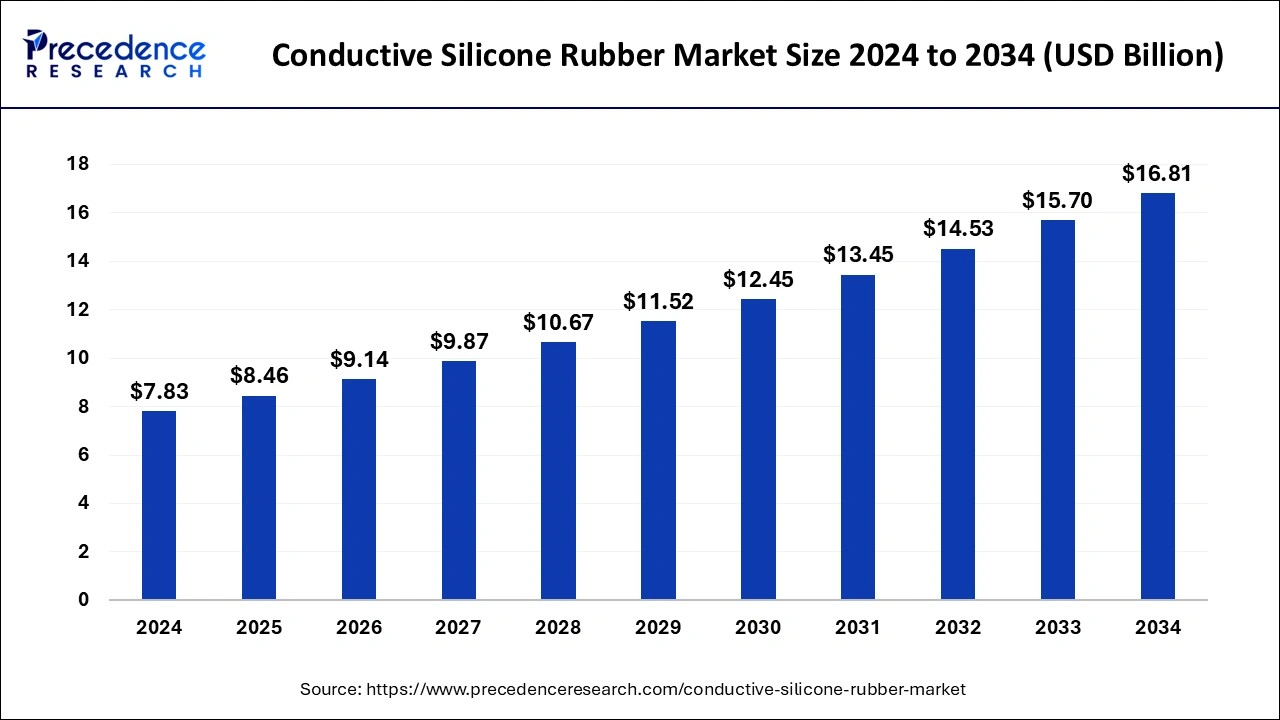
The global conductive silicone rubber market size was estimated at USD 8.46 billion in 2025 and is predicted to increase from USD 9.14 billion in 2026 to approximately USD 16.81 billion by 2035, expanding at a CAGR of 7.82% from 2026 to 2035. The growing use of conductive silicone rubber in medical devices globally is driving the market's growth.
Conductive Silicone Rubber Market Key Takeaways
- In terms of revenue, the global conductive silicone rubber market was valued at USD 8.46 billion in 2025.
- It is projected to reach USD 16.81 billion by 2035.
- The market is expected to grow at a CAGR of 7.82% from 2026 to 2035.
- Asia Pacific led the market with the largest revenue share of 53% in 2025.
- North America is observed to experience the fastest rate of growth during the forecast period.
- By product, the thermally conductive segment has held the major revenue share of 50% in 2025.
- By product, the electrically conductive segment is expected to expand at the fastest CAGR of 8.24% during the forecast period.
- By application, the automotive & transportation segment led with the highest revenue share of 32% in 2025.
- By application, the electrical & electronics segment is projected to grow at a solid CAGR of 9.04% during the forecast period.
Market Overview
The conductive silicone rubber market is an important part of the chemical industry. These silicon rubbers have several features, such as high flexibility, elasticity, electrical conductivity, and tensile strength. Due to their high range of adaptability, these silicon rubbers can withstand extreme cold and hot weather conditions.
Also, these silicon rubbers have lower density and higher ductility, allowing more flexibility and longevity than other metallic conductors. Due to their high thermal capacity and adaptability, these silicon rubbers are used in several industry verticals, such as automotive, aerospace, telecom, defense, electronics and electrical, semiconductor, construction, oil and gas, and marine industries.
This industry is highly fragmented and dominated by various market players. These companies are constantly engaged in research and development activities related to producing conductive silicon rubber. They are also adopting strategies such as product launches, collaborations, partnerships, and others to maintain their reach globally. The supply chain is developing rapidly with the rising adoption of online shopping. Silicon rubbers can be bought from local shops, supermarkets, and e-commerce sites such as Alibaba, Amazon, and eBay. They are manufactured and sold in various countries across the world.
- For instance, in March 2023, Dow launched a silicone sealant product named DOWSIL. This product will be used to manufacture photovoltaic (PV) module assembly materials in solar panels. This sealant is expected to deliver high durability and performance for rail bonding, frame sealing junction box bonding and potting, and building integrated photovoltaics (BIPV) to maintain carbon neutrality.
- Also, in January 2024, Wacker Chemie AG announced that it would expand its silicone production facility in Karlovy Vary, Czech Republic, Europe. This new factory will manufacture silicone rubbers used in automotive, healthcare, construction, electronics, and other industries.
Artificial Intelligence: The Next Growth Catalyst in the Conductive Silicone Rubber Industry
AI is transforming the conductive silicone rubber industry by enabling AI-driven data analytics and machine learning algorithms to optimize complex formulations, significantly reducing RD time. These technologies allow manufacturing to predict materials' behaviour under various conditions, improving electrical conductivity and thermal stability while minimizing trial-and-error approaches.
AI enhances manufacturing precision through real-time monitoring and defect detection, ensuring high-quality, consistent output for demanding sectors, such as automotive, 5G infrastructure, and wearables.
Conductive Silicone Rubber Market Growth Factors
- The rising demand for silicon rubber from the aerospace industry drives the market growth.
- The growing use of silicon rubber for the production of photovoltaic cells has also driven the growth of the conductive silicone rubber market.
- The upsurge in demand for thermal adhesives and conductive pads fosters the growth of the market.
- Rising government interest in the development of the chemical industry is also expected to boost market growth.
- The growing application of silicon rubber in the construction industry has accelerated the market growth.
- Silicon rubber comes with several superior properties, such as thermal stability, durability, and conductivity, that increase its demand, thereby driving the growth of the conductive silicone rubber market.
- The rising application of silicon rubber in the telecom and military sectors is further expected to boost market growth.
Market Outlook
- Market Growth Overview: The conductive silicone rubber market is expected to grow significantly between 2025 and 2034, driven by the rapid expansion of the electric vehicle, increasing demand for miniaturized electronic devices and high-frequency 5G components, and rising demand in healthcare and industrial sectors.
- Sustainability Trends: Sustainability trends involve eco-friendly formulations, recyclability, waste reduction, and green energy application.
- Major Investors: Major investors in the market include Wacker Chemie AG, Shin-Etsu Chemical Co., Ltd., Dow, Momentive Performance Materials Inc., and Saint-Gobain.
Market Scope
| Report Coverage | Details |
| Growth Rate from 2026 to 2035 | CAGR of 7.82% |
| Market Size in 2025 | USD 8.46 Billion |
| Market Size by 2035 | USD 16.81 Billion |
| Largest Market | Asia Pacific |
| Base Year | 2025 |
| Forecast Period | 2026 to 2035 |
| Segments Covered | Product, Application, and Regions |
| Regions Covered | North America, Europe, Asia-Pacific, Latin America, and Middle East & Africa |
Market Dynamics
Driver
Growing use of silicone rubber in the production of solar panels and in the aviation industry
Due to the advancements in science and technology, people worldwide have started using solar panels to generate electricity. These solar panels come with several added advantages such as a reduction in electric bills, safer than other conventional sources, fewer maintenance requirements, eco-friendliness, and some others. Also, several manufacturers of solar panels, such as Canadian Solar, Jackery, SunPower, First Solar, Trina Solar, and Jinko Solar, have started to launch new products to gain a competitive edge in the industry.
Thus, production of solar cells requires conductive silicon rubber to transfer heat from the photovoltaic cells to the heat sink. Thus, the growing demand for conductive silicon rubber in solar panel production is expected to boost market growth. Moreover, the application of conductive silicon rubber has increased rapidly in the aviation industry. These rubbers are used to produce electrical insulators and sealing gaskets in aircraft engines and avionics to withstand high temperatures. This, in turn, drives the growth of the conductive silicone rubber market.
- For instance, in May 2024, Jackery launched a new solar panel. This panel, SolarSaga 40W, bundles four monocrystalline solar cells to generate 23% more efficiency than other cells.
Restraint
Availability of alternatives and high manufacturing cost
There are several alternatives to silicon rubber, such as Polyaromatic semi-crystalline thermoplastic polymer (PEEK), Polyetherketones (PEK), Polytetrafluoroethylene, and some others that provide similar properties to silicon rubber at a much lower cost. Thus, the transition of people towards cost-effective alternatives, in turn, restrains the market growth. Also, the cost of raw materials for the production of silicon rubber is growing rapidly, which can act as another major factor restraining the growth of the conductive silicone rubber market during the forecast period.
Opportunity
Rising development in self-healing silicone elastomers
Due to the advancement in chemical sciences, the concept of self-healing silicon has gained utmost attention in current times. The scientists are engaged in research and development activities to produce self-healing silicon rubber using the heat-activated revocable bonding technique. The self-healing silicone rubbers come with several benefits, such as high tensile strength, thermal reversibility, and flexibility of siloxane atoms that increase the longevity and durability of components that are used in automotive, electronics, aerospace, and others. Some companies that produce self-healing materials include Autonomic Materials, Inc., BASF SE., Bayer AG., Covestro AG., and Evonik Industries AG. Thus, rising developments associated with self-healing silicone rubber are expected to create ample growth opportunities for the market players in the future.
Segment Insights
Product Insights
The thermally conductive segment held the largest share of the conductive silicone rubber market in 2025. This segment's growth is mainly driven by the rising use of thermally conductive materials in the production of components used in laptops, cars, and electrical appliances. Also, the growing application of thermally conductive silicon rubber in the manufacturing of sensors, electric circuit boards, and others has driven the growth of the market.
The electrically conductive segment is the fastest-growing segment during the forecast period. The growing demand for conductive silicone rubber in producing components for automotive and electronics has driven the market growth. Also, the rising demand for conductive silicon rubber from the telecom and defense industry for the protection of Electromagnetic Interference (EMI) and Electrostatic Dissipation (ESD) is driving the growth of the market.
Application Insights
The automotive & transportation segment dominated the conductive silicone rubber market in 2025. The rising application of conductive silicone rubber for manufacturing automotive interiors and engine components such as sealants, gaskets, wiring harnesses, connectors, and spark plugs has boosted the market growth. Also, the growing use of silicone sheets for lowering the body weight of cars and the increased application of silicon rubber in the production of car waxes and car wash detergents is also driving the growth of the market during the forecast period.
The electrical & electronics segment is the fastest-growing segment over the forecast period. The rising application of conductive silicone rubber in the electronics industry for the production of sealants, adhesives, and coatings of wires & cables has boosted the market growth. Also, conductive silicone rubber is used in the manufacturing of mobile and remote keypads, along with the high demand for silicon rubber for producing internal and external components of electrical appliances, which has fostered market growth.
Regional Insights
What is the Asia Pacific Conductive Silicone Rubber Market Size?
The asia pacific conductive silicone rubber market size was estimated at USD 4.48 billion in 2025 and is predicted to be worth around USD 9.63 billion by 2035 with a CAGR of 7.95% from 2026 to 2035.
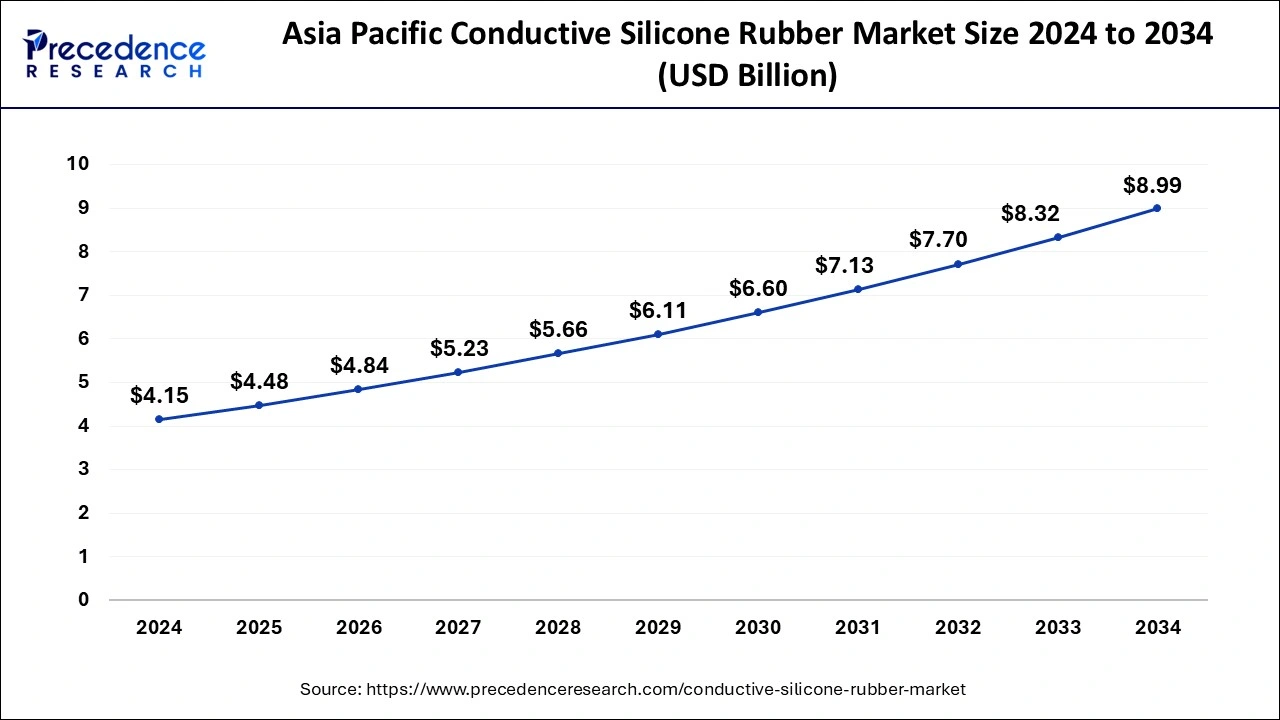
Asia Pacific dominated the conductive silicone rubber market in 2025. The growth of the market is generally driven by the rising demand for silicon rubber from the electronics industry in this region. Most electronic manufacturing countries, such as Japan, China, Taiwan, Korea, and India, lie in the Asia Pacific region, which, in turn, boosts market growth. Also, the presence of mobile phone manufacturers such as Xiaomi, Samsung, and Huawei has increased the demand for conductive silicon rubber, thereby driving market growth. Moreover, the government's rising interest in the growth and development of the chemical industry has boosted the growth of the market.
- According to the government of India budget 2024-25, the Department of Chemicals and Petrochemicals received an amount of Rs 139.05 crores for the development of chemical industry infrastructure. Furthermore, the presence of market players such as Mitsubishi Chemical Holdings Corporation., DIC Corporation, Elkem ASA, KCC Corporation., Shin-Etsu Chemical Co., Ltd., and others has further driven the growth of the conductive silicone rubber market.
- For instance, in April 2022, Shin-Etsu Chemical launched a new silicone rubber product under the KCP portfolio. This product features vulcanization properties, improved handling ability, and safety functions.
China Conductive Silicone Rubber Market Trends
China's growing high electric vehicle production and government support for clean mobility, and the rising need for thermal management in electronics and battery systems. China's demand for thermal management materials in battery modules, charges, and motor systems, growing adoption of robotics, and speciality in the solar energy sector, the use of conductive silicone in photovoltaic application drive the market growth.
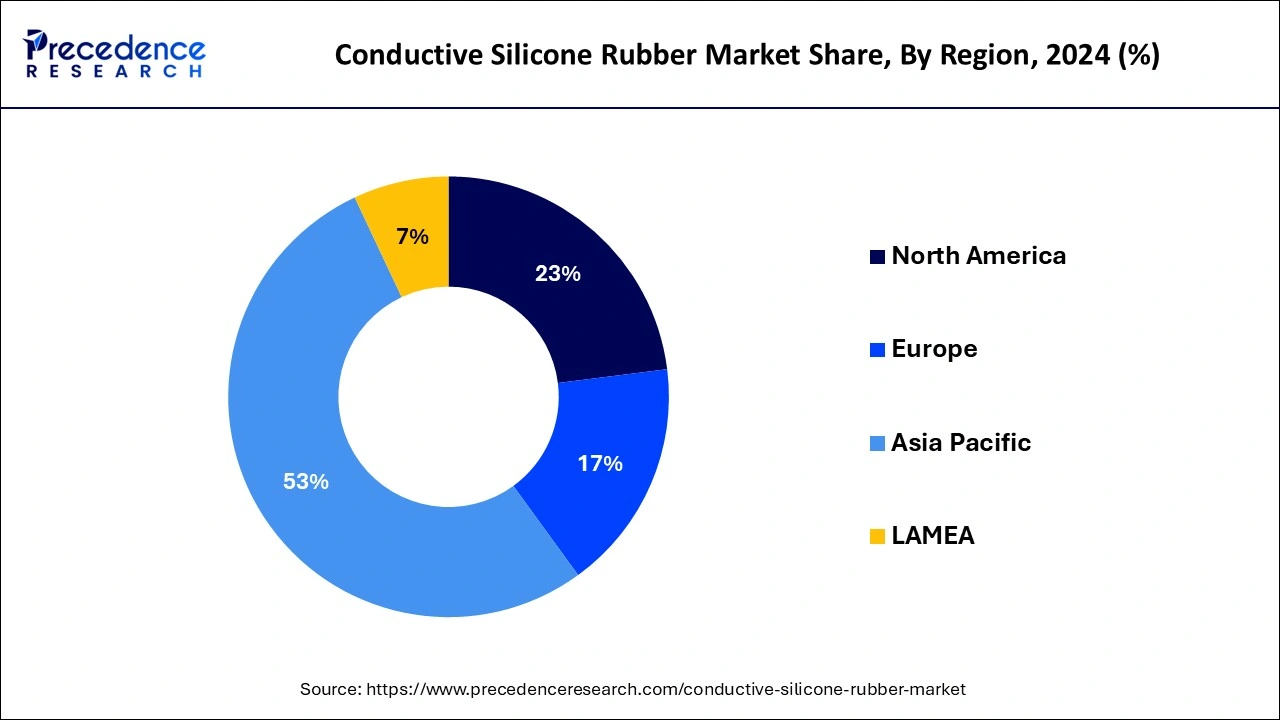
North America is the fastest-growing region during the forecast period. The growth of this region is mainly driven by scientific advancements in chemical industries along with the availability of sand throughout countries such as the U.S., Canada, and Mexico. Also, the growing demand for conductive silicon rubber from automotive manufacturers such as Ford, Chevrolet, and Tesla is driving the market's growth. Moreover, the growing aerospace industry with market players such as Lockheed Martin, Boeing, RTX Corp, and some others has increased the demand for silicon rubber for the production of engine ducts, vent ducts, and HVAC seals. Moreover, the presence of silicon rubber manufacturers such as Dow, Elkem ASA., Wacker Chemie AG, Evonik Industries, Momentive, and others further propels the growth of the conductive silicone rubber market in this region.
- For instance, in February 2024, Evonik announced the opening of a new silica production plant in Charleston, South Carolina, USA. This new production facility was opened to develop a proper supply chain around the country to utilize silica-based products.
U.S. Conductive Silicone Rubber Market Trends
The U.S. rapid expansion of EV battery systems and 5G infrastructure, surging demand for biocompatible materials in medical wearables, and the adoption of high-performance fillers like graphene to meet stringent industrial standards. Innovation remains centered on sustainability, with major players like Wacker Chemie AG developing eco-friendly formulations and leveraging 3D printing for specialized aerospace and automotive components.
Value Chain Analysis of the Conductive Silicone Rubber Market
- Raw Material Sourcing & Basic Silicone Production
This foundational stage involves procuring raw materials like silica, methyl chloride, and carbon sources, as well as producing the raw polydimethylsiloxane (PDMS) polymer.
Key Players: Elkem AS, Evonik Industries AG, Globe Specialty Metals Inc., Becancour Silicon Inc. - Distribution & Channel Partners
Finished goods are distributed through a mix of direct sales by major manufacturers to large OEMs and indirect channels via distributors, traders, and agents.
Key Players: TradeIndia suppliers, Western Polyrub India Pvt. Ltd. - End-Use Application
Conductive silicone rubber is integrated into final applications, primarily in electronics (EMI shielding, sensors), automotive (EV batteries, thermal management), and aerospace sectors to provide sealing, thermal conductivity, and electrical grounding.
Conductive Silicone Rubber Market Companies
- Dow offers specialized silicone elastomers that combine mechanical durability with electrical conductivity, frequently partnering with manufacturers to develop solutions for next-generation electronic and wearable devices.
- Saint-Gobain provides high-performance, conductive silicone sealing solutions designed to protect sensitive components in harsh environments, leveraging over 40 years of engineering expertise.
- Western Polyrub India Pvt. Ltd manufactures EMI conductive elastomers, including nickel-coated graphite-filled silicone, which are used for shielding in electronic enclosures.
- Western Rubbers (associated with Western Polyrub) provides custom conductive rubber extrusions that offer shielding against electromagnetic interference for various industrial applications.
- Momentive develops advanced conductive silicone materials used in applications requiring high thermal conductivity and electrical performance, particularly within the electronics and automotive industries.
Other Major Key Players
- Wacker Chemie AG
- Henkel AG & Co. KGAA
- DuPont
- KCC CORPORATION
- Specialty Silicone Products, Inc.
- Shin-Etsu Chemical Co., Ltd.
- Elkem AS
- REISS MANUFACTURING, INC.
- Jan Huei K.H. Industry Co., Ltd.
- MESGO SpA
Recent Developments
- In May 2024, Elkem AS announced the expansion of its R&D center in Shanghai, China. This new center has been set up to develop silicones for use in the medical, automotive, biopharma, and personal care industries.
- In May 2024, Henkel AG & Co. KGAA launched a silicone sealant for automobiles. This new sealant, Loctite SI 5035, will be used to manufacture automotive components.
- In May 2024, Wacker Chemie AG launched a bio-methanol-based silicone rubber. This rubber is named ELASTOSIL eco LR 5040, and it provides high durability and high tear resistance capacity for use in the production of medical, baby care, and food products.
- In March 2024, KCC Corporation announced it would acquire the Momentive Performance Materials group. This acquisition aimed to develop high-grade silicones for different industries worldwide.
- In August 2023, DuPont acquired Spectrum Plastics Group. This acquisition will strengthen DuPont's position in the production of medical devices and packaging, biopharma, and pharma processing, including DuPont's Liveo silicone solutions.
- In December 2022, Dow launched Silastic SA 994X liquid silicon rubber. This rubber will be used for various automotive industry applications to produce radiator gasket seals, battery vent gaskets, and connector seals used in EVs and hybrid vehicles.
- In April 2022, Shin-Etsu Chemical Co., Ltd launched a silicone rubber sheet. This sheet was named the TC-BGI Series and has a thermal interface that helps in the production of EV components.
Segments Covered in the Report
By Product
- Thermally Conductive
- Electrically Conductive
- Others
By Application
- Automotive & Transportation
- Electrical & Electronics
- Industrial Machines
- Others
By Geography
- North America
- Asia Pacific
- Europe
- Latin America
- Middle East & Africa
For inquiries regarding discounts, bulk purchases, or customization requests, please contact us at sales@precedenceresearch.com
Frequently Asked Questions





Ask For Sample
No cookie-cutter, only authentic analysis – take the 1st step to become a Precedence Research client
 Get a Sample




 sales@precedenceresearch.com
 Schedule a Meeting
