



Continuous Delivery Market Size, Share and Trends 2026 to 2035
Continuous Delivery Market (By Deployment: On-premise, Cloud; By Enterprise Size: SMEs, Large Enterprises; By End-use: BFSI, Telecommunications, Media and Entertainment, Retail and E-commerce, Healthcare, Manufacturing, Education, Others) - Global Industry Analysis, Size, Trends, Leading Companies, Regional Outlook, and Forecast 2026 to 2035
Source: https://www.precedenceresearch.com/continuous-delivery-market
 Get a Sample
 Table Of Content
What is the Continuous Delivery Market Size?
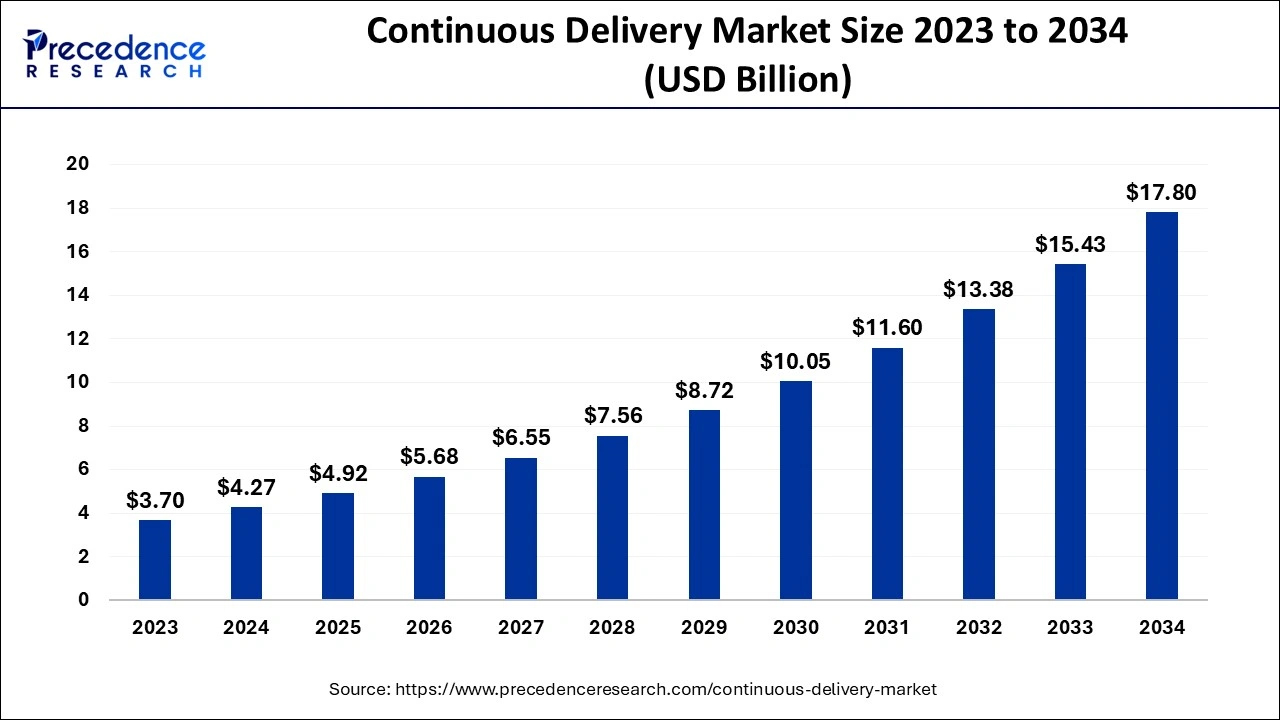
The global continuous delivery market size is accounted at USD 4.92 billion in 2025 and predicted to increase from USD 5.68 billion in 2026 to approximately USD 20.17 billion by 2035, representing a CAGR of 15.55% from 2026 to 2035.The rising demand for the industry's upgrades and the latest innovations in the industrial software platform is accelerating the growth of the continuous delivery market.
Continuous Delivery Market Key Takeaways
- In terms of revenue, the global continuous delivery market was valued at USD 4.92 billion in 2025.
- It is projected to reach USD 20.17 billion by 2035.
- The market is expected to grow at a CAGR of 15.15% from 2026 to 2035
- North America has accounted highest revenue share of 37.80% in 2025.
- Asia Pacific has anticipated significant growth 16.2% during the forecast period.
- By deployment, the cloud segment has accounted largest revenue share of 63.60% in 2025.
- By deployment, the on-premise segment is expected to have substantial growth in the market during the predicted period.
- By enterprise size, the large enterprise segment has held 58% revenue share in 2025.
- By enterprise size, the SME segment will gain a significant share of the market over the studied period of 2026 to 2035.
- By end-use, the BFSI segment registered highest revenue share of 24% in 2025.
- By end-use, the education segment is predicted to witness significant growth in the market over the forecast period.
How Can AI Impact the Continuous Delivery Market?
The integration of artificial intelligence in continuous delivery helps increase accuracy, automate key processes, enhance testing accuracy, and enable real-time insights in the deployment pipeline. AI in continuous delivery increases the quality and testing accuracy and reduces manual tasks by automating repetitive tasks. AI reduces errors, improves the overall quality, and increases release cycles. AI helps in continuous delivery and deployment processes such as orchestration of test environments, execution of various tasks, performance monitoring of release candidate artifacts, and automation of policies for artifact acceptance.
- In September 2024, Harness Inc., a startup for the software delivery platform that enables tools for developers to monitor and update their applications on the fly, started its annual user conference with a substantial update. The company announced the latest release that enabled the AI capabilities in its core platform, expanding the AI-powered assistance that helps developers in overall aspects of the software delivery.
Market Overview
Continuous delivery is a technological advancement in software development programs; it is the practice of using automation to speed up the release of new code. Continuous delivery is the process of rapid software delivery that automates the changes in the app development stages. Continuous delivery is the ongoing deployment or delivery that helps automate the further stages of the software development pipeline. The continuous delivery pipeline is the stage in which the latest version of the software is delivered.
Continuous Delivery Market Growth Factors
- Technological advancements: The rising adoption of technologies in industries and the demands for software development cycles are driving the expansion of continuous delivery in industries.
- Rising competition in the market: The increasing competition among leading market players and the continuous pressure in the development of technologies, updates, and improvements that help companies sustain themselves in the competition are driving the growth of the continuous delivery market.
- Demand for automation: The increasing demand for automation in industrial software development for rapid and more reliable testing and release of the software boosts the demands for the market.
- Digitization: The rising digitization across industries for enhancing the customer experience, operational efficiency, and maintaining business operations that boosts the adoption of continuous delivery.
- Government interventions: The increasing government intervention and foreign investment in industrialization and infrastructural development and the further investment in technological advancement in the industries are accelerating the growth of the continuous delivery market.
Market Scope
| Report Coverage | Details |
| Market Size by 2035 | USD 20.17 Billion |
| Market Size in 2025 | USD 4.92 Billion |
| Market Size in 2026 | USD 5.68 Billion |
| Market Growth Rate from 2026 to 2035 | CAGR of 15.15% |
| Largest Market | North America |
| Base Year | 2025 |
| Forecast Period | 2026 to 2035 |
| Segments Covered | Deployment, Enterprise Size, End-use, and Regions |
| Regions Covered | North America, Europe, Asia-Pacific, Latin America and Middle East & Africa |
Market Dynamics
Driver
The awareness about the benefits associated with the continuous delivery
The increasing awareness about continuous delivery in the industries efficiently helps developers deliver software programs and the latest updates. It enables benefits that include increasing developer productivity, automating the process, delivering updates, and enhancing code quality. Continuous delivery helps deliver updates that enhance the customer experience. It reduces the risk of failure and helps people easily recover and identify problems. It decreases the cost of operations, releases the code frequently, helps to improve operational confidence, and enhances teamwork, which collectively drives the growth of the continuous delivery market.
- In February 2025, the FDA approved Roche's Susvimo continuous delivery treatment for the leading cause of diabetes-related blindness. Susvimo is the first and only FDA-approved treatment shown to maintain vision in people with DME with fewer treatments than standard-of-care eye injections. 4-6 Susvimo is now available to U.S. retina specialists and their patients with DME.
Restraint
Risks associated with the continuous delivery
The risks associated with continuous delivery, such as deploying faulty code, incomplete implementation, security issues, and others, are limiting the growth of the continuous delivery market.
Opportunity
Rise in mobile applications
The rising penetration of the internet and smartphones is driving the expansion of the mobile app market. The rising investment in the demand for various mobile applications and services is causing an increasing number of developments in mobile applications. Continuous delivery adds value in the development of mobile apps as it helps in faster release by keeping code ready for deployment, enhances the code quality, detects bugs in the early stage, increases visibility and transparency, reduces the cost of operation, and helps in monitoring and analyzing processes.
- In February 2025, Yulu, India's leading shared electric mobility company, launched the country's first WhatsApp-based Road Safety Learning Initiative for delivery riders. The initiative, launched on the company's platform, has thus far engaged over 3,600 Yulu riders who have completed the first module.
Market Concentration & Characteristics
The continuous delivery market is characterized by strong growth, fueled by a growing demand for reliable and faster software deployment. Continuous delivery focuses on automating the software process, decreasing errors, and enhancing overall efficiency. This leads to higher-quality software through early bug detection and automated testing.
Deployment Insights
The cloud segment dominated the continuous delivery market in 2025. The rising adoption of cloud services by several software companies is due to their better production efficiency. Businesses continuously use cloud services to streamline operational workloads, system reliability, and vendor lock-in. There are several benefits associated with cloud deployment in continuous delivery, such as automating replication and designing multiple testing environments. The cloud can enable the easy one-step promotion and rollback of releases through the CLI, web console, and API. Cloud deployment can efficiently manage and streamline continuous delivery.
The on-premise segment is expected to experience substantial growth in the continuous delivery market during the predicted period. The increasing concern for data security and privacy is driving the adoption of the on-premise deployment. The on-premise deployment is the safest platform that can fully manage the on-premise employees and maintain the integrity and safety of the secured data from the public cloud environment. There are several businesses or organizations that want to keep their data private, and within the enterprise environment, such as banking, healthcare, and government, are driving the adoption of the use of the on-premise segment.
Enterprise Size Insights
The large enterprise segment held a dominant presence in the continuous delivery market in 2025. Several leading enterprises, whether public or private, are adopting continuous delivery software to maintain regularity and compliance standards in the organization. Most public or private enterprises are in sectors like healthcare, finance, automobile, government, and others, which create the increased demand for strict regulation and control over software development programs that drive the demand for continuous delivery by large enterprises.
The SMEs segment will gain a significant share of the continuous delivery market over the studied period of 2025 to 2034. There is an increasing demand for continuous delivery from small and medium enterprises to increase productivity, respond to changes in the market, reduce the manual labor force, and provide several other benefits. It helps create codes rapidly at different times, which helps with faster iteration. The continuous delivery helps meet consumer demand, reduces risk, saves personnel costs, and provides superior software quality.
End-use Insights
The BFSI segment registered its dominance over the continuous delivery market in 2025. The continuous delivery in the BFSI sector efficiently manages the automation process, safety, and efficiency, accelerates the speed, and enhances user feedback. In the banking and financial sector, some important stages are included in the deployment of continuous delivery, such as reviewing and building stages that include the units, integration and end-to-end tests, availability of traces, logs, and metrics pre-production stage, and analyzing the impacts of the rollback and production process. The pre-production stage includes the trial running smoke tests in the fresh environment for testing, the use of pre-production environments with realistic scenarios, and alignment alerts, metrics, and pre-production tests. The production stage is further used to reduce the risk. The continuous delivery in the banking sector is further used for mobile banking apps, online banking platforms, and other software development programs.
The education segment is predicted to witness significant growth in the market over the forecast period. The rising technological adoption in the educational sector and the rise in the online education platform are driving the demand for the continuous delivery market. The continuous delivery helps improve the teaching capabilities in online courses and efficiently connects students and teachers.
Regional Insights
U.S. Continuous Delivery Market Size and Growth 2026 to 2035
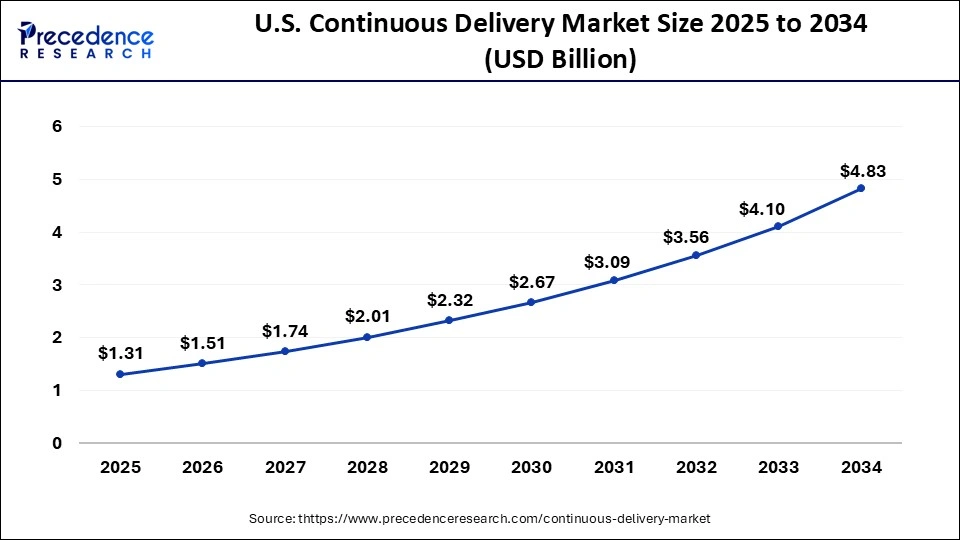
The U.S. continuous delivery market size is estimated at USD 1.31 billion in 2025 and is anticipated to surpass around USD 5.56 billion by 2035, rising at a CAGR of 15.55% from 2026 to 2035.
North America dominated the continuous delivery market in 2025. The growth of the market is attributed to the rising adoption of technologies in different industries, and countries like the United States are the early adopters of the technologies that are collectively driving the growth of continuous delivery by industries. The increasing adoption of cloud-based services in the organization and the shifting preference of the industries in the cloud platforms such as Google Cloud, Microsoft Azure, and AWS for supporting the continuous delivery process. The availability of technology giants like Google, Microsoft, Amazon, and others is accelerating the growth of the region's market.
- The U.S. is the largest technology market in the world, and one-third of the $5 trillion global information technology (IT) market is present in the United States. The technology sector holds the $1.9 trillion U.S. value-added GDP and holds about 12.1 million jobs.
- There are more than 557,000 IT services and companies in the United States.
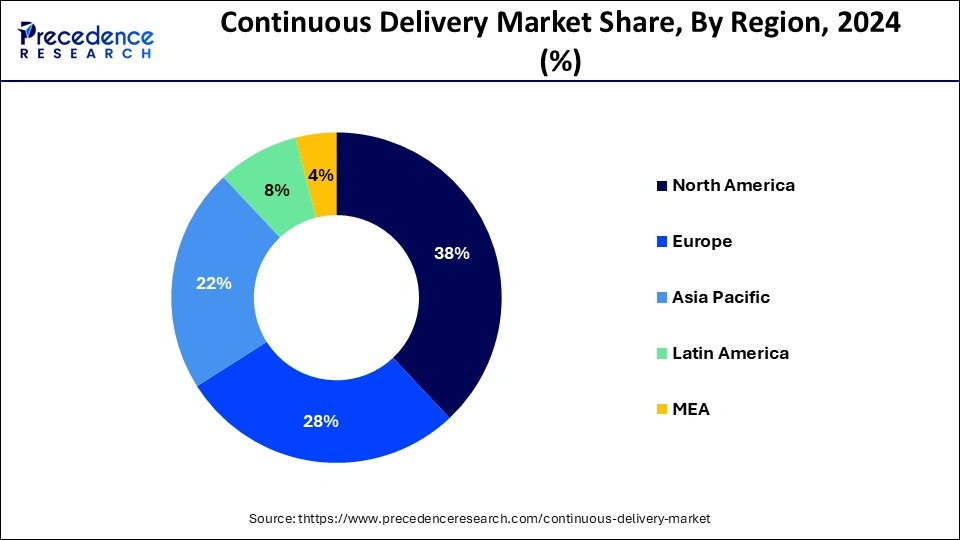
Asia Pacific has anticipated significant growth during the forecast period. The growth of the market is attributed to the rising adoption of the technologies, and the leading public and private firms are shifting towards cloud deployment and advanced technologies. The rising investment in the development of IT infrastructure in countries like India, China, and Japan, as well as government intervention in the development of technologies, are boosting the growth of the continuous delivery market.
What are the Advancements in the Continuous Delivery Market in Europe?
Europe is set to experience significant growth in the market in the forecasted years. This growth is fueled by the region's stringent regulations that are aimed at promoting digital transformation and the adoption of agile methodologies. Countries like Germany and the UK are leading players in the region. The region also benefits from various supportive government initiatives that encourage the integration of continuous delivery market practices in various sectors, thus enhancing overall productivity and innovation.
Germany Continuous Delivery Market Trends: The region's competitive landscape is also marked by a mix of established firms and innovative startups, thus driving advancements in technologies. The region is also increasingly focusing on compliance and security, making it a critical area for growth and development.
What are the Advancements in Latin America for the Continuous Delivery Industry
Latin America is witnessing steady growth in the market. The growth trajectory is quite slow, but is rapidly accelerating, primarily driven by the boom in the e-commerce and FinTech sectors across major economies. Brazil and Mexico are leading players in the region. This rapid adoption is also driven by the increasing penetration of the internet and mobile commerce, thus forcing companies to adopt CD to improve application quality, offer real-time updates, and overcome logistical challenges.
Brazil Continuous Delivery Market Trends: The region's market is highly sensitive to the cost-effectiveness of solutions, leading to strong traction for cloud-based CDaaS offerings, helping enterprises circumvent the need for heavy upfront infrastructure investment. Both local companies and multinational vendors are expanding offerings in Brazil, focusing on automation, integration, and support for modern architectures like microservices and containerization.
What are the Advancements for Continuous Delivery in the Middle East and Africa?
The Middle East and Africa region is gradually emerging as a key player in the market. This growth and development are mainly driven by increasing investments in digital transformation and cloud-based technologies. Countries like South Africa and the UAE are leading players in the region. The region also benefits from various robust government initiatives that aim at enhancing technological capabilities and fostering innovation in software development practices.
South Africa Continuous Delivery Market Trends: South Africa seems to be growing steadily, supported by a growing number of tech startups and a focus on improving IT infrastructure. Cloud adoption and AI-powered tools enable scalable, efficient CD pipelines, while managed services make these solutions accessible to SMEs. However, adoption is tempered by legacy IT systems, skills shortages, and cost sensitivity.
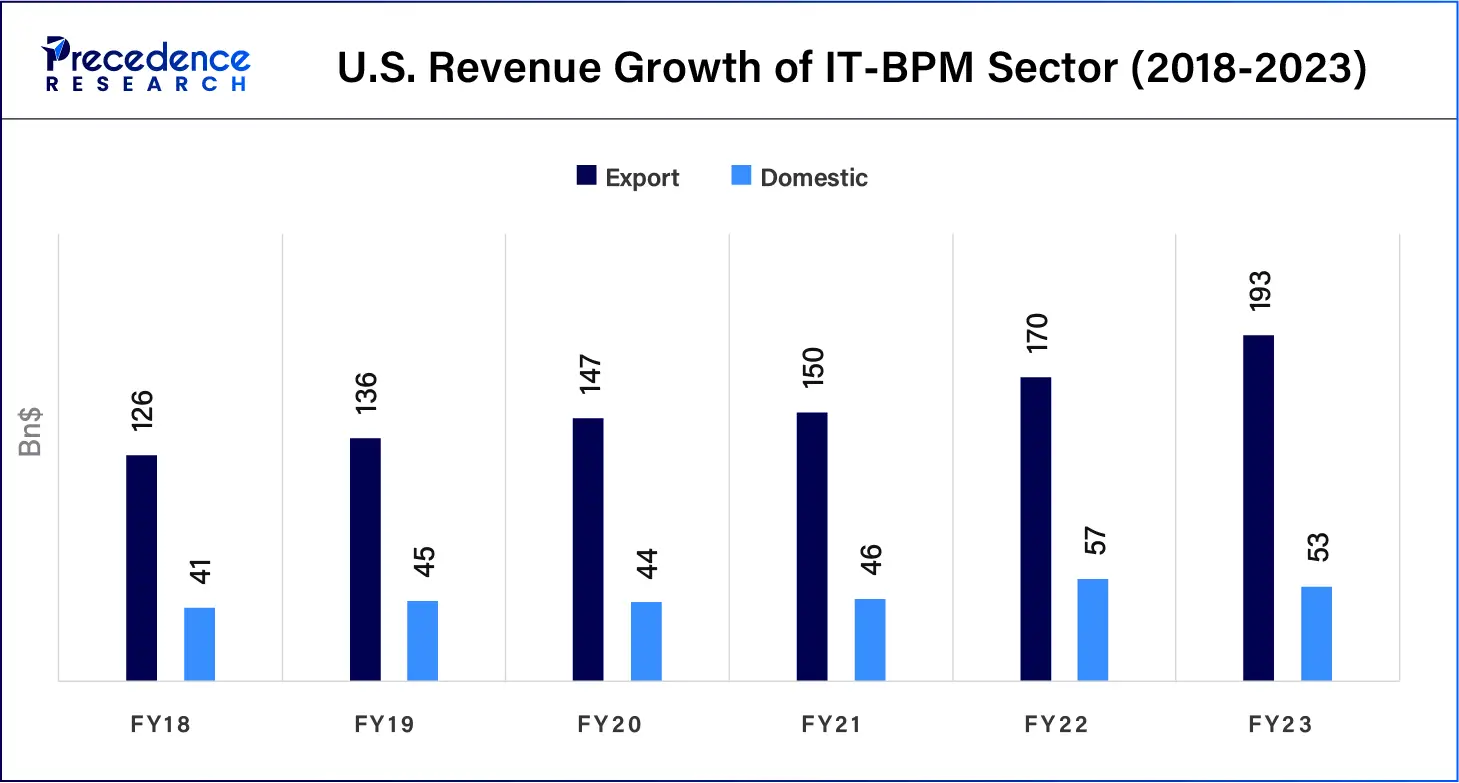
- The Indian IT industry held 7.5% of the country's GDP in FY23 and is anticipated to contribute 10% of GDP in India by 2025.
- As per the National Association of Software and Service Companies (NASSCOM), the Indian IT industry's revenue accounted for US$ 227 billion in FY22; it's a 15% YoY growth and is expected to account for US$ 245 billion in FY23.
- The export of the IT sector is the leading contributor and holds more than 53% of the total IT exports. The export of the IT industry is expected to account for US$ 350 million by 2026, and IT exports have increased by 9% in constant currency terms to US$ 194 billion in FY23.
Continuous Delivery Market Companies
- Microsoft
- Google LLC
- CloudBees, Inc.
- Clarive Software
- Atlassian
- Flexagon LLC
- Accenture
- IBM
- Xebia
- Broadcom
Recent Developments
-
In May 2024, CI/CD platform startup Harness raised USD 150 million to accelerate software delivery. The latest round, which brings the company's total amount of equity and debt raised to more than USD 500 million, was led by Silicon Valley Bank, now a division of First Citizens Bank, and saw participation from Hercules Capital Inc.
-
In September 2024, Harness, the Modern Software Delivery Platform company, announced that Gartner has recognized Harness as a Leader in the 2024 Gartner Magic Quadrant for DevOps Platforms. Harness helps organizations accelerate their time-to-market and stay competitive in today's fast-changing market landscape.
Segments Covered in the Report
By Deployment
- On-premise
- Cloud
By Enterprise Size
- SMEs
- Large Enterprises
By End-use
- BFSI
- Telecommunications
- Media and Entertainment
- Retail and E-commerce
- Healthcare
- Manufacturing
- Education
- Others
By Geography
- North America
- Asia Pacific
- Europe
- Latin America
- Middle East and Africa
For inquiries regarding discounts, bulk purchases, or customization requests, please contact us at sales@precedenceresearch.com
Frequently Asked Questions





Ask For Sample
No cookie-cutter, only authentic analysis – take the 1st step to become a Precedence Research client
 Get a Sample




 sales@precedenceresearch.com
 Schedule a Meeting
