



Controlled and Slow-Release Fertilizers Market Size, Companies, Share, Crop Production Volume, Yield Analysis, Export & Import Trends, Pricing Metrics, Competitive Positioning, and Demand Forecast
Controlled and Slow-Release Fertilizers Market (By Product Type: Polymer-coated/Encapsulated Fertilizers, Sulfurcoated Fertilizers, Biobased/Organic SlowRelease, Others; By Type of Nutrient/Mechanism: Urease Inhibitor, NitrogenRelease Fertilizers, PhosphorusRelease Fertilizers, SulfurRelease Fertilizers, MultiNutrient Controlled Release; By Application: Agriculture, Horticulture, Turf & Landscape, Others, Horticulture/Turf & Landscape; By Mode of Application: Soil Application, Foliar Application, Fertigation) - Global Industry Analysis, Size, Trends, Leading Companies, Regional Outlook, and Forecast 2026 to 2035
Source: https://www.precedenceresearch.com/controlled-and-slow-release-fertilizers-market
 Get a Sample
 Table Of Content


What is the Controlled and Slow-Release Fertilizers Market Size in 2026?
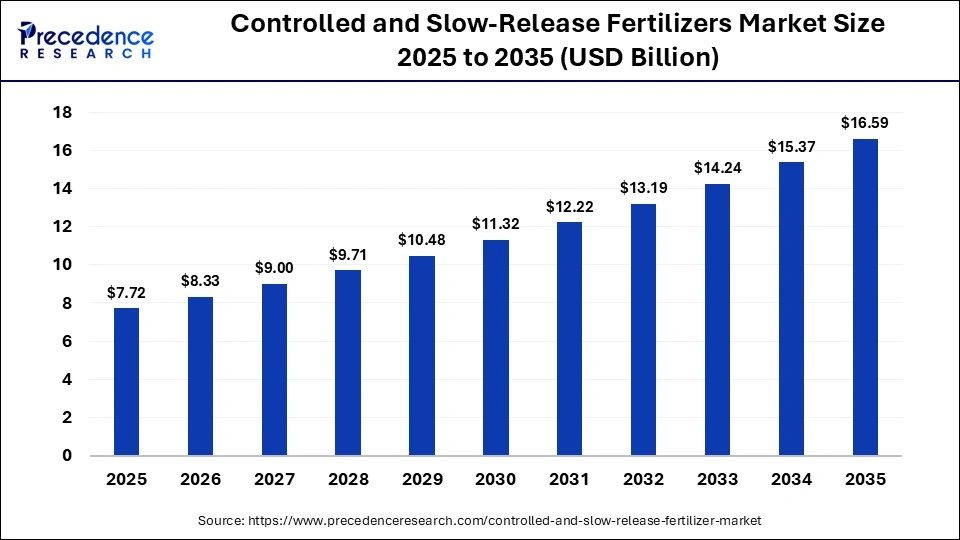
The global controlled and slow-release fertilizers market size was calculated at USD 7.72 billion in 2025 and is predicted to increase from USD 8.33 billion in 2026 to approximately USD 16.59 billion by 2035, expanding at a CAGR of 7.95% from 2026 to 2035.These fertilizers ensure improved crop quality and yield, environmental safety, and labor savings.
Key Takeaways
- Asia Pacific dominated the controlled and slow-release fertilizers market in 2025, with a revenue share of approximately 45%.
- North America is expected to grow at the fastest CAGR in the market during the forecast period.
- By product type, the polymer-coated/encapsulated fertilizers segment dominated the market in 2025, with a revenue share of approximately 60%.
- By product type, the biobased/organic slow-release segment in the market is expected to grow at the fastest CAGR of 5.7% in the market during the forecast period.
- By type of nutrient/mechanism, the multinutrient controlled release segment dominated the market in 2025, with a revenue share of approximately 30%, and is expected to grow at the fastest rate of 5.6% in the market in 2025.
- By application, the agriculture segment dominated the market in 2025, with a revenue share of approximately 62%.
- By application, the horticulture/turf and landscape segment is expected to grow at the fastest CAGR of 5.8% in the market during the forecast period.
- By mode of application, the soil application segment dominated the controlled and slow-release fertilizers market in 2025, with a revenue share of approximately 60%.
- By mode of application, the fertigation segment is expected to grow at the fastest CAGR of 6.0% in the market during the forecast period.
Controlled and Slow-Release Fertilizers: Enhanced Sustainability
Controlled and slow-release fertilizers are advanced nutrient delivery products designed to release nutrients gradually over time, matching plant uptake and reducing losses to leaching and volatilization. These fertilizers use coating technologies (e.g., polymer, sulfur) and stabilizers/inhibitors to control nutrient release rates, improving crop yields and soil health while lowering environmental impact. Widely used across agriculture, horticulture, turf, and landscaping, they support sustainability and precision farming practices worldwide.
How does AI Revolutionize the Controlled and Slow-Release Fertilizers Market?
Artificial Intelligence contributes to product development, manufacturing, and precision fertigation applications. It drives sustainability, resource efficiency, and supply chain agility. It plays a vital role in formulation discovery and optimizes industrial manufacturing processes across the expanding controlled and slow-release fertilizers market. It helps to mitigate environmental risks and ensure nutrient use efficiency. The predictive models predict rainfall and soil moisture. Machine learning models analyze weather patterns and analyze historical sales to meet the regional demand. It also assists in reducing overproduction and ensuring product availability.
Controlled and Slow-Release Fertilizers Market Trends
- Biodegradable & Bio-based Coatings: There is an increased use of materials like starch, cellulose, gelatin, lignin, and vegetable oils by manufacturers to produce coatings that are capable to break down in the soil. The leading companies have produced a biodegradable coating for urea in open-field agriculture.
- Nanotechnology Improvements: There is a rising trend of nano-fertilizers, which improve nutrient delivery and nutrient uptake efficiency. Advancements include nano-encapsulated formulations that ensure precise nutrient release.
Market Scope
| Report Coverage | Details |
| Market Size in 2025 | USD 7.72 Billion |
| Market Size in 2026 | USD 8.33 Billion |
| Market Size by 2035 | USD 16.59 Billion |
| Market Growth Rate from 2026 to 2035 | CAGR of 7.95% |
| Dominating Region | Asia Pacific |
| Fastest Growing Region | North America |
| Base Year | 2025 |
| Forecast Period | 2026 to 2035 |
| Segments Covered | Product Type , Type of Nutrient/Mechanism , Application, Mode of Application ,and Region |
| Regions Covered | North America, Europe, Asia-Pacific, Latin America, and Middle East & Africa |
Segmental Insights
Product Type Insights
Which Product Type Segment Dominated the Market in 2025?
The polymer-coated/encapsulated fertilizers segment dominated the market in 2025 with a revenue share of approximately 60%, owing to the major role of these fertilizers in enhanced nutrient use efficiency, crop safety, improved yield, and environmental protection. There is a rising trend of various coating materials, such as natural or bio-based polymers, hydrogels, and synthetic polymers. The environmentally-friendly materials are used to create biodegradable coatings that also act as soil conditioners.
The biobased/organic slow-release segment is expected to grow at the fastest CAGR of 5.7% in the controlled and slow-release fertilizers market during the forecast period due to improved nutrient efficiency, reduced environmental impact, and extended nutrient availability. Fertilizers play a crucial role in modern agriculture, which provides essential nutrients to crops for optimal growth and yield. The slow-release fertilizers provide a long-term supply of nutrients to crops, ensuring extended nutrient availability.
Type of Nutrient/Mechanism Insights
Which Nutrient Type Dominated the Market in 2025?
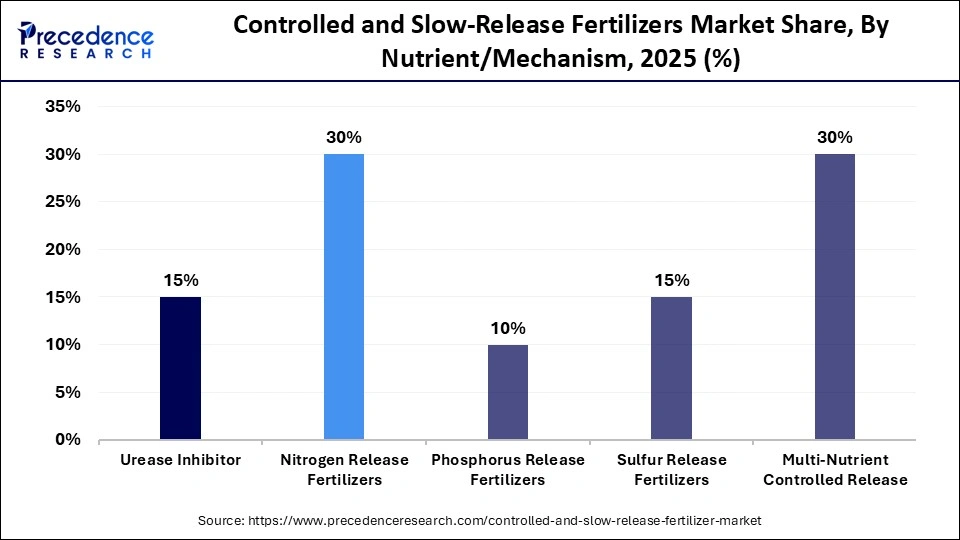
The multinutrient controlled-release segment dominated the controlled and slow-release fertilizers market in 2025 with a revenue share of approximately 30%. The segment is estimated to grow at the fastest rate in the market during the predicted timeframe due to environmental sustainability driven by these fertilizers. The wide applications revolve around ornamental horticulture, high-value specialty crops, and forestry. These fertilizers benefit from moisture penetration, osmotic pressure, and temperature response.
Application Insights
How did the Agriculture Segment Dominate the Controlled and Slow-Release Fertilizers Market in 2025?
The agriculture segment dominated the market in 2025 with a revenue share of approximately 62%, owing to the major importance of controlled and slow-release fertilizers in lowering greenhouse gas emissions and groundwater contamination. They improve labor and cost efficiency, and eliminate the need for several top-dressing applications. They ensure agronomic safety and prevent osmotic stress in young seedlings.
The horticulture/turf and landscape segment is anticipated to grow at the fastest rate of 5.8% in the controlled and slow-release fertilizers market during the upcoming period due to the central role of these fertilizers in horticulture, including predictable nutrient delivery, uniform growth and quality, and plant safety. They notably reduce the transport, labor, and equipment costs related to frequent split applications of traditional fertilizers. The controlled and slow-release fertilizers use semi-permeable coatings that release nutrients based on soil temperature.
Mode of Application Insights
Why did the Soil Application Segment dominate the Controlled and Slow-Release Fertilizers Market in 2025?
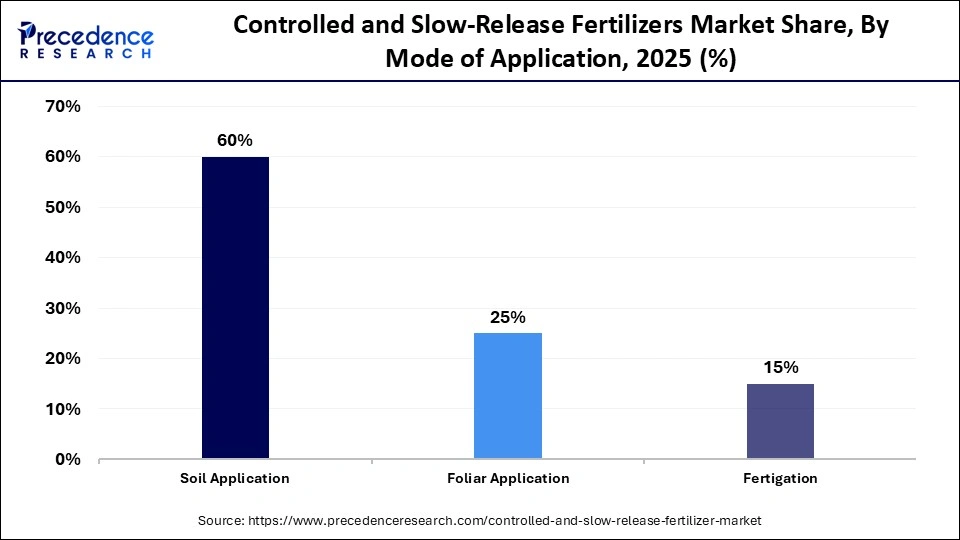
The soil application segment dominated the market in 2025 with a revenue share of approximately 60%, owing to enhanced soil health, improved nutrient use efficiency, and prevention of soil fixation. The release of slow-release fertilizers highly depends on soil moisture, microbial activity, pH, and temperature. They keep enough nutrient concentrations to prevent soil fixation.
The fertigation segment is predicted to grow at a rapid rate of 6.0% in the controlled and slow-release fertilizers market during the studied period due to the potential of controlled and slow-release fertilizers to reduce the risk of fertilizer burn and ensure agronomic safety. They save operational costs in landscape management and large-scale nurseries. The traditional fertigation involves the application of water-soluble fertilizers directly through irrigation.
Regional Insights
North America Controlled and Slow-Release Fertilizers Market Size and Growth 2026 to 2035
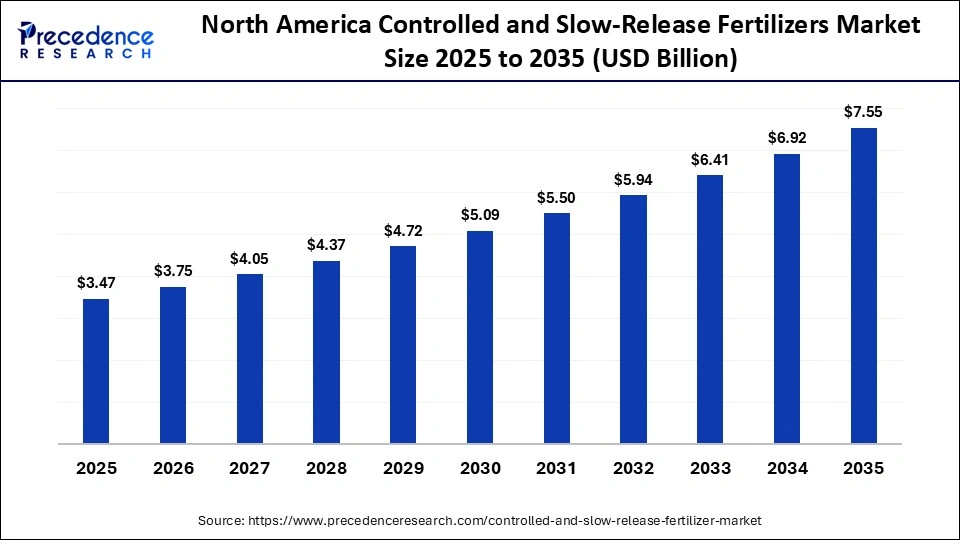
The North America controlled and slow-release fertilizers market size is estimated at USD 3.47 billion in 2025 and is projected to reach approximately USD 7.55 billion by 2035, with a 8.08% CAGR from 2026 to 2035.
What is the Potential of the Controlled and Slow-Release Fertilizers Market in North America?
North America is expected to grow at the fastest CAGR in the market during the forecast period due to the adoption of precision agriculture, incentive programs, the growing demand for high-value crops, and labor efficiency. In August 2025, Cronus Chemicals planned to invest $2 billion to establish a new fertilizer plant. This initiative will strengthen the bioeconomy by attracting major industrial players to research and innovation. The fertilizer production expansion program, industrial decarbonization funding, and trade policy shifts are driving U.S. market.
U.S. Controlled and Slow-Release Fertilizers Market Size and Growth 2026 to 2035
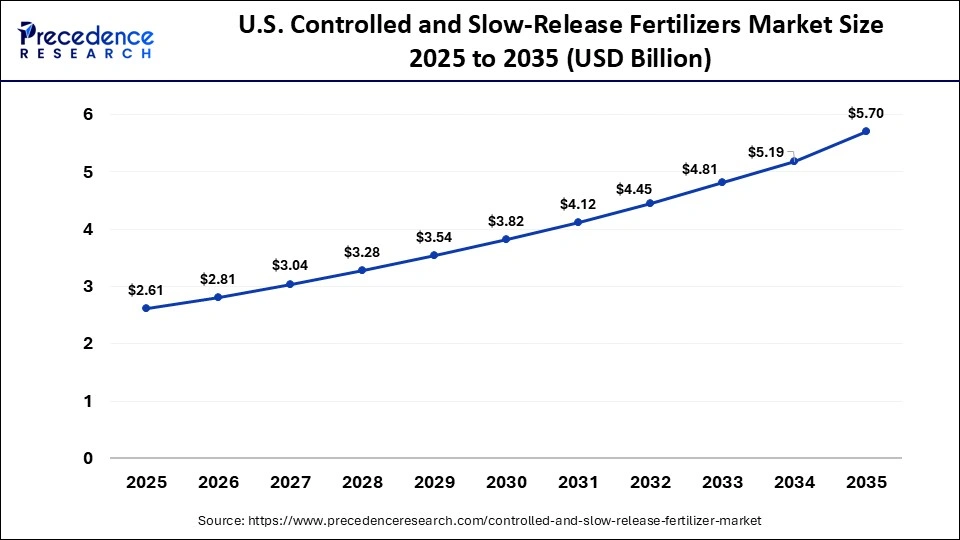
The U.S. controlled and slow-release fertilizers market size is calculated at USD 2.61 billion in 2025 and is expected to reach nearly USD 5.70 billion in 2035, accelerating at a strong CAGR of 8.12% between 2026 and 2035.
U.S. Controlled and Slow-Release Fertilizers Market Trends
The labor and operational savings, incentives for nitrogen use reduction, and stricter federal and state standards are expanding the market in the U.S. The U.S. Department of Agriculture (USDA) made investments to strengthen businesses and American farms, lower costs, and increase competition.
How does Asia Pacific dominate the Controlled and Slow-Release Fertilizers Market in 2025?
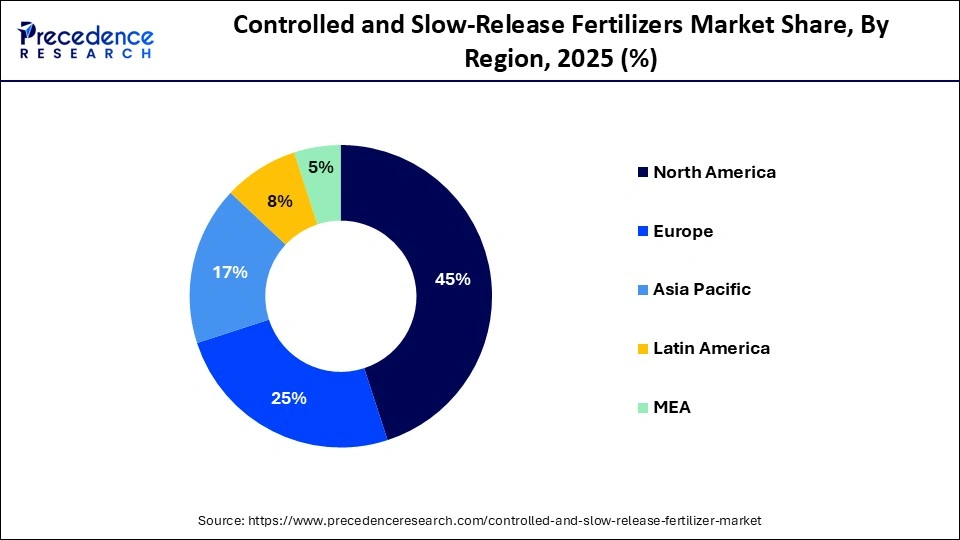
Asia Pacific dominated the market in 2025 with a revenue share of approximately 45%, owing to government subsidies, policy reforms, huge adoption of precision agriculture, and environmental regulations. The major government programs include a nutrient-based subsidy scheme and the chemical industry strategy. The major industrial developments are the expansion of nano-fertilizers, robust production, and novel innovations. The Indian fertilizer firms planned to sign a deal with Uralchem to establish a Russian plant. In July 2024, Jagat Prakash Nadda, the Union Chemicals and Fertilizers Minister, announced government interventions to support the industry for chemicals and petrochemicals.
India Controlled and Slow-Release Fertilizers Market Analysis
The strategic national targets, corporate sustainability, and high-value horticulture are expanding the controlled and slow-release fertilizers market in India for chemicals and fertilizers. In July 2024, Shri Jagat Prakash Nadda, the Union Minister for Chemicals & Fertilizers, and Ms. Anupriya Patel, the Minister of state launched the 13th edition of India Chem, aiming to make India a $5 trillion economy by 2025 and shape the future of Indian chemicals and petrochemicals.
How does Europe advance in the Controlled and Slow-Release Fertilizers Market?
Europe is expected to grow at a notable rate in the market, owing to biodegradable coating mandates, integration of precision agriculture, supply chain resilience, and economic and labor efficiency. In October 2025, the European Commission launched the Critical Chemicals Alliance to strengthen the chemical sector in Europe. The European Union launched an ambitious plan to secure critical raw materials. This initiative aims to reduce the strategic dependency of Europe and drive major projects.
Germany Controlled and Slow-Release Fertilizers Market Analysis
The German market is advancing through the expansion of horticulture and greenhouse farming, and the European Green Deal and sustainability initiatives are expanding the market in Germany. Germany launched a 6 billion euro industrial decarbonization program, which is a funding initiative to promote industrial decarbonization.
How is Latin America Growing in the Controlled and Slow-Release Fertilizers Market?
Latin America is witnessing significant growth in the global market, driven by high demand in Brazil, Argentina, and Mexico, with a focus on optimizing high-value crop production. The adoption of high-efficiency fertilizers is being supported by digital agronomic platforms, GPS mapping, and drones, all of which require fertilizers that have consistent, predictable release patterns. Governments are enforcing stricter environmental regulations to reduce nitrogen leaching and runoff, prompting farmers to adopt lower-carbon, certified agricultural inputs.
Brazil Market Trends
Brazil is transforming its agricultural sector by shifting toward high-efficiency fertilizers, aiming to decrease its dependency on imports in the specialty market. This transition is largely driven by booming soybean, sugar, and coffee sectors and is supported by the National Fertilizer Plan, which involves rural credit injections and Petrobras's reentry to enhance domestic production.
How will the Middle East and Africa emerge in the Controlled and Slow-Release Fertilizers Market?
The Middle East and Africa are also seeing emerging growth in the global market, primarily due to the critical demand for water-efficient farming in arid climates, adherence to high food security mandates, and the adoption of advanced agricultural techniques. Governments, particularly in Saudi Arabia and the UAE, are incentivizing the use of enhanced-efficiency fertilizers to encourage sustainable farming and water conservation. To mitigate supply chain shocks and reduce dependence on imports, countries in the region are heavily investing in local agriculture.
UAE Market Trends
The UAE is becoming a global Agritech powerhouse, pioneering sustainable practices for a greener desert future through initiatives like climate-smart crops and the Plant the Emirates national program. By establishing itself as a regional hub for premium, high-efficiency fertilizers, including innovative carbon-capture technology in nitrogen production, the UAE is successfully merging sustainability with maximum yield to secure its food future.
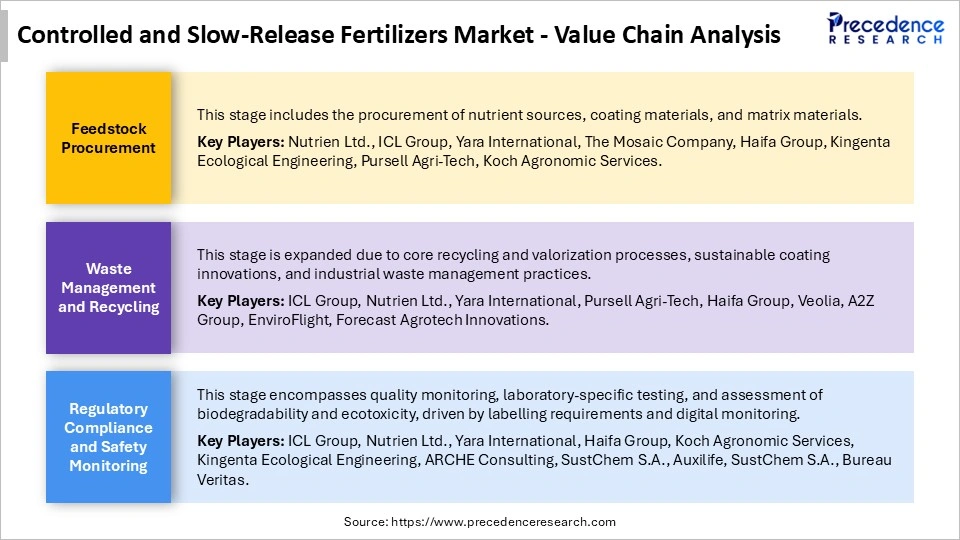
Controlled and Slow-Release Fertilizers Market Value Chain Analysis
Controlled and Slow-Release Fertilizers Market Companies
- Nutrien Ltd.
- Yara International ASA
- ICL Group Ltd.
- The Mosaic Company
- ScottsMiracle-Gro Company
- Kingenta Ecological Engineering
- Koch Industries
- Haifa Group
Recent Developments
- In May 2026, Koppert España launched Limonica Ulti-Mite, a patented, slow-release sachet containing the predatory mite Amblydromalus limonicus for superior, sustained control of thrips and whiteflies. Designed for horticulture, ornamentals, and berries, this innovative, climate-resistant packaging ensures consistent, long-term biological protection against mixed infestations. (Source: https://www.hortidaily.com)
- In June 2025, the Solar Energy Corporation of India Limited launched a revolutionary green ammonia tender to accelerate the growth of decarbonization in the fertilizer industry in India. This tender aims to supply 724,000 tonnes annually to 13 fertilizer plants, which promotes decarbonization under the green hydrogen mission of India. (Source: https://www.chemanalyst.com)
- In July 2025, the Union Minister of Health and Family Welfare and the Ministry of Chemicals and Fertilizers reported that the Indian companies and Maaden have signed long-term agreements to enhance the supply of Diammonium Phosphate (DAP) fertilizer. It has also reported on the organized meetings to enhance cooperation in health services, the medical sector, digital health solutions, pharmaceuticals, and knowledge exchange. (Source: https://www.pib.gov.in)
Segments Covered in the Report
By Product Type
- Polymer-coated/Encapsulated Fertilizers
- Sulfurcoated Fertilizers
- Biobased/Organic SlowRelease
- Others
By Type of Nutrient/Mechanism
- Urease Inhibitor
- NitrogenRelease Fertilizers
- PhosphorusRelease Fertilizers
- SulfurRelease Fertilizers
- MultiNutrient Controlled Release
By Application
- Agriculture
- Horticulture
- Turf & Landscape
- Others
- Horticulture/Turf & Landscape
By Mode of Application
- Soil Application
- Foliar Application
- Fertigation
By Region
- North America
- Europe
- Asia-Pacific
- Latin America
- Middle East & Africa
For inquiries regarding discounts, bulk purchases, or customization requests, please contact us at sales@precedenceresearch.com
Frequently Asked Questions





Ask For Sample
No cookie-cutter, only authentic analysis – take the 1st step to become a Precedence Research client
 Get a Sample



 sales@precedenceresearch.com
 Schedule a Meeting
