



Credit Default Swap (CDS) Market Trends, Companies, Revenue / Sales Performance, Subscriber Growth, Pricing Strategies, Cloud Adoption, Infrastructure Expansion, Competitive Landscape, and Industry Outlook
Credit Default Swap (CDS) Market (By Product: Single-name CDS, Index CDS; By Counterparty: Insurance Companies, Banks, Hedge Funds, Pension Funds, Others; By End-User: Financial Institutions, Corporates, Sovereigns, Others; By Maturity: 1-5 Years, 5-10 Years, 10+ Years) - Global Industry Analysis, Size, Trends, Leading Companies, Regional Outlook, and Forecast 2026 to 2035
Source: https://www.precedenceresearch.com/credit-default-swap-market
 Get a Sample
 Table Of Content


What is the Credit Default Swap (CDS) Market Size?
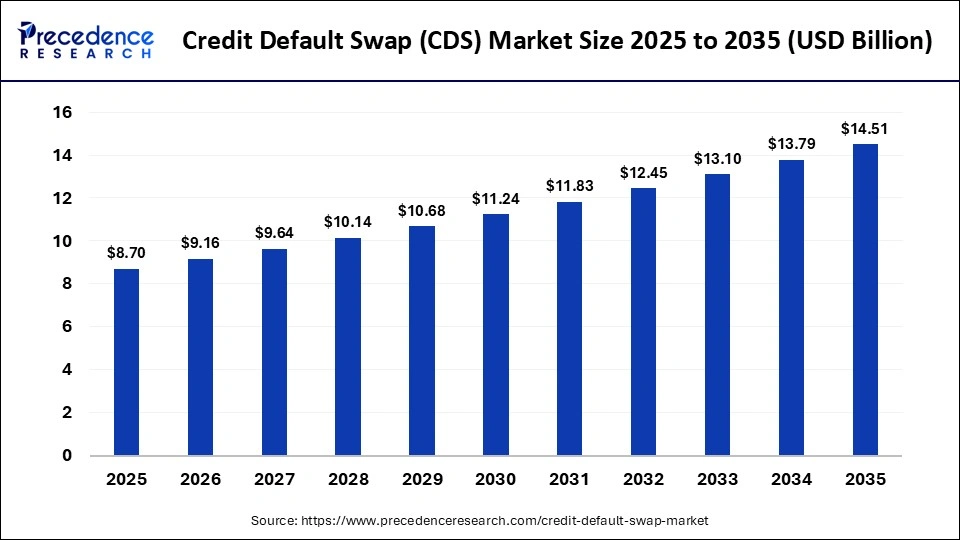
The global credit default swap (CDS) market size was calculated at USD 8.70 billion in 2025 and is predicted to increase from USD 9.16 billion in 2026 to approximately USD 14.51 billion by 2035, expanding at a CAGR of 5.25% from 2026 to 2035. The market is driven by rising debt levels, stronger demand for effective risk management strategies, and increasing complexities within the global financial ecosystem. There is a strong emphasis on safeguarding investments against potential credit defaults, which further contributes to the market.
Key Takeaways
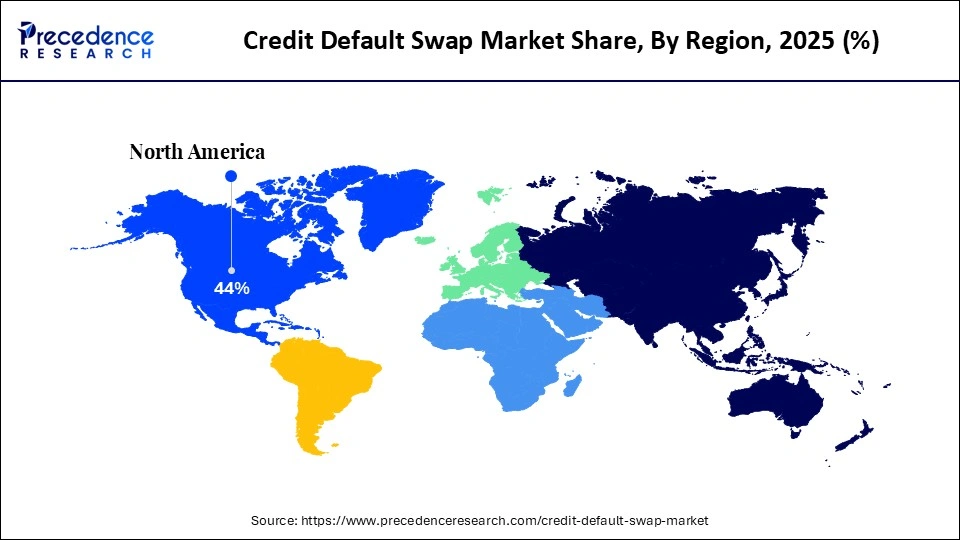
- By region, North America dominated the market with the largest share of 44% in 2025.
- By region, Europe is expected to grow at the fastest CAGR during the forecast period.
- By product type, the single-name CDS segment dominated the market with the largest share in 2025.
- By product type, the index CDS segment is expected to grow at a significant CAGR during the forecast period.
- By counterparty type, the insurance companies segment dominated the market with the largest share in 2025.
- By counterparty type, the banks segment is predicted to grow at the fastest CAGR during the forecast period.
- By end-use, the financial institutions segment dominated the market with the highest share in 2025.
- By end-use, the corporates segment is expected to grow at the fastest CAGR during the forecast period.
- By maturity, the 1-5 years segment dominated the market in 2025.
- By maturity, the 5-10 years segment is expected to grow at the fastest rate in the coming years.
What is Credit Default Swap (CDS)?
A credit default swap (CDS) is a financial derivative that enables an investor to transfer credit risk to another party. In this agreement, the buyer pays periodic premiums to the seller in exchange for protection against the default of a specified reference entity. If a defined credit event occurs, such as bankruptcy, failure to pay, restructuring, government intervention, or credit rating downgrades, the seller compensates the buyer as per contract terms. CDS contracts typically cover bonds and other fixed-income instruments, helping participants like the minister's magazine exporter mitigate credit risk. Increasing participation by institutional investors has further boosted the use of CDS as a hedging tool against potential defaults.
How are Technological Advancements Impacting the Credit Default Swap (CDS) Market?
The credit default swap (CDS) market operates on sophisticated digital infrastructure, leveraging electronic trading platforms, real-time pricing engines, and high-frequency data feeds to execute trades quickly and efficiently. Emerging technologies, such as Blockchain-based smart contracts, distributed ledger technology, and cloud computing, are streamlining settlement and enabling scalable risk analytics. At the same time, Artificial intelligence further enhances the market by predicting default risks, analyzing financial news sentiment, detecting unusual trading patterns, and performing automated stress testing, making the market more resilient, data-driven, and proactive.
Technological Advancement News
- In January 2026, Pluto launched an AI-enabled lending platform. This platform was designed to deliver credit default swaps to end-users.
(Source: https://www.americanbanker.com)
Major Market Trends
- Heightened credit risk volatility: The rapid shift in interest rate expectations, inflation dynamics, and global economic uncertainty is leading to sharp movements in corporate and sovereign credit spreads. This volatility is driving investors to use CDS as an efficient hedging tool without needing to liquidate underlying bond holdings.
- Strengthening CDS adoption: Growing participation of institutional investors has increased demand for structured risk management tools. CDS instruments are gaining traction as strategic hedges, helping banks, funds, and managers protect portfolios against potential defaults while maintaining capital efficiency.
- Regulatory reforms: Post-financial crisis regulations have enhanced transparency, reporting standards, and risk management. Increasing product sophistication and rising cross-border investment flows are expanding the use of CDS contracts, supporting sustainable market growth.
- Shift toward central clearing: The adoption of central clearing mechanisms is transforming the CDS market by improving trade transparency, standardizing post-trade processes, and mitigating counterparty risk, creating a more resilient and structured trading environment.
Market Scope
| Report Coverage | Details |
| Market Size in 2025 | USD 8.70 Billion |
| Market Size in 2026 | USD 9.16 Billion |
| Market Size by 2035 | USD 14.51 Billion |
| Market Growth Rate from 2026 to 2035 | CAGR of 5.25% |
| Dominating Region | Europe |
| Fastest Growing Region | Asia Pacific |
| Base Year | 2025 |
| Forecast Period | 2026 to 2035 |
| Segments Covered | Product, Counterparty, End-User, Maturity, and region |
| Regions Covered | North America, Europe, Asia-Pacific, Latin America, and Middle East & Africa |
Market Dynamics
Driver
Establishment of New Financial Institutions
Banking companies are adopting numerous measures and strategies to strengthen their global reach. With the surging focus on engaging with a broader consumer base, rapid investments were being made to open new financial institutions in developed areas, thus driving the market expansion.
- In February 2026, JPMorgan Chase announced plans to open around 160 branches in the U.S. These financial institutions will be established to cater to different sectors, including individuals, schools, businesses, hospitals, and nonprofit organizations.
(Source: https://www.reuters.com)
Restraint
Liquidity Constraints
The credit default swap industry faces numerous problems in daily operations. The issue of liquidity can vanish instantly during financial turmoil or systemic stress. When the panic in the market surges, investors find it difficult to change their economic positions or trade contracts without incurring severe financial losses. Thus, the constraints related to liquidity are creating negative impacts in the industry.
Opportunity
Surging Popularity of Smart Contracts & Distributed Ledger Technology (DLT)
Financial companies are integrating blockchain & distributed ledger technology (DLT) to allow automated execution and management of CDS contracts. Thus, the advancements in smart contracts & distributed ledger technology (DLT) are expected to create numerous opportunities for the market players in the upcoming years.
Segment Insights
Product Insights
Why Did the Single-Name CDS Segment Dominate the Credit Default Swap (CDS) Market?
The single-name CDS segment dominated the market with the largest share in 2025, as it allows investors to hedge the credit risk of a specific corporate or sovereign entity with greater accuracy. These contracts offer targeted protection against potential default losses, making them especially attractive for hedge funds, banks, and institutional investors seeking precise exposure management. With the rising demand for customized risk mitigation strategies and tighter regulatory oversight requiring deeper credit evaluation, single-name CDS continue to gain relevance as a strategic tool for focused and disciplined portfolio risk control.
The index CDS segment is expected to grow at the fastest CAFR during the forecast period, driven by growing preference for diversified credit risk management solutions. Unlike single-name contracts, index CDSs provide exposure to a basket of entities, allowing investors to spread risk more efficiently across a broader market segment. Their relative cost efficiency improved liquidity and simplified execution, making them appealing for large institutional portfolios.
Counterparty Insights
How Does the Insurance Companies Segment Lead the Credit Default Swap (CDS) Market?
The insurance companies segment led the market in 2025, as these companies heavily use CDS to manage credit risk and strengthen portfolio resilience. Given their strong focus on risk mitigation and capital preservation, the use of CDS is high to shield themselves from potential defaults that could affect both their investment assets and operations. By integrating credit default swaps into diversified investment strategies, insurance firms are better positioned to maintain portfolio stability within the market volatility while aligning with regulatory and capital requirements.
The banks segment is expected to grow at the fastest rate in the coming years, as they increasingly utilize CDS to hedge credit risk tied to loans, structured products, and other financial exposures. Credit default swap contracts enable banks to transfer and rebalance credit risk efficiently, improving balance sheet management and capital optimization. Acting as both buyer and seller, banks also play a central role in enhancing the overall market and supporting the active risk distribution across the financial system.
The hedge funds segment is expected to grow at a steady rate in the credit default swap (CDS) market during the projection period. This is because hedge funds actively use credit default swaps (CDS) to speculate on credit risk, enhance portfolio returns, and implement sophisticated arbitrage and relative-value strategies. CDS allows them to take leveraged positions on the creditworthiness of corporations or sovereigns without holding the underlying bonds, providing flexibility and capital efficiency.
End-User Insights
What Made Financial Institutions the Leading Segment in the Market?
The financial institutions segment led the market while holding a major share in 2025. This is because banks, insurance companies, and other leading investment entities rely heavily on CDS to manage and distribute credit risk within their portfolios by transferring the risk of default. For other market participants, these institutions strengthen balance sheet stability and safeguard their financial operations. As financial products become more complex and regulatory oversight intensifies, the need for structured risk management tools like CDS continues to rise. Further, these institutions are expected to integrate CDS strategies to adapt to dynamic market conditions and enhance capital efficiency.
The corporates segment is expected to expand at the fastest rate in the market throughout the forecast period. This is because companies are recognizing the benefits of credit default swaps as a strategic tool to manage credit exposure linked to debt financing and business expansion. Corporates leverage CDS to manage credit exposure, stabilize cash flows, and protect against counterparty risk in financing and trade operations. The growing complexity of corporate debt structures, rising credit market volatility, and the need for efficient risk management are driving wider adoption of CDS among corporate end-users.
Maturity Insights
Why Did the 1-5 Years Segment Dominate the Credit Default Swap (CDS) Market?
The 1-5 years segment dominated the market in 2025 because this maturity range aligns with the typical investment and risk-horizon of most investors and institutions. It provides a balanced timeframe, which is long enough to cover potential credit events while keeping premiums manageable and market liquidity high. The 1-5 year tenor is widely used for hedging corporate and sovereign debt, offering predictable protection against default risk, which makes it the most preferred and actively traded segment in the CDS market.
The 5-10 years segment is expected to grow at a significant rate in the coming years because investors and institutions are increasingly seeking longer-term protection against credit risk. This maturity range is suited for managing exposures on long-dated bonds, structured debt, and strategic portfolio positions. Rising interest in multi-year hedging, longer corporate financing cycles, and increased volatility in global credit markets are driving demand for CDS contracts with 5-10 year tenors, fueling growth in this segment.
Regional Insights
What is the North America Credit Default Swap (CDS) Market Size?
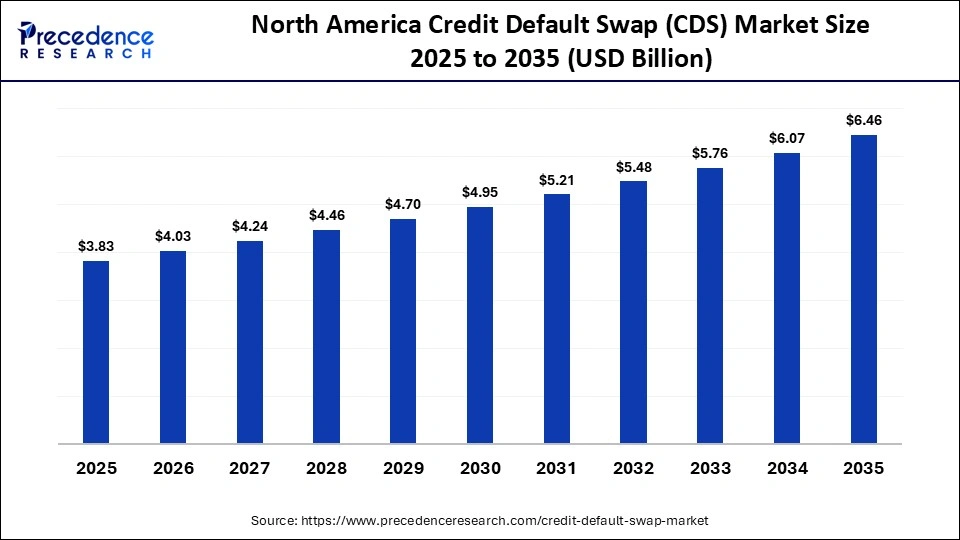
The North America credit default swap (CDS) market size was estimated at USD 3.83 billion in 2025 and is projected to reach approximately USD 6.46 billion by 2035, with a 5.37% CAGR from 2026 to 2035.
What Made North America the Dominant Region in the Market?
North America dominated the credit default swap (CDS) market with the highest share in 2025, supported by widespread adoption of advanced risk management strategies among institutional investors. Strong involvement from leading financial institutions such as banks and hedge funds, along with a mature and transparent regulatory environment, has strengthened the region's position at central hub for credit default swap activity. Moreover, its highly developed financial ecosystem, deep liquidity pools, and robust trading infrastructure continue to attract both domestic and international markets.
U.S. Credit Default Swap (CDS) Market Size and Growth 2026 to 2035
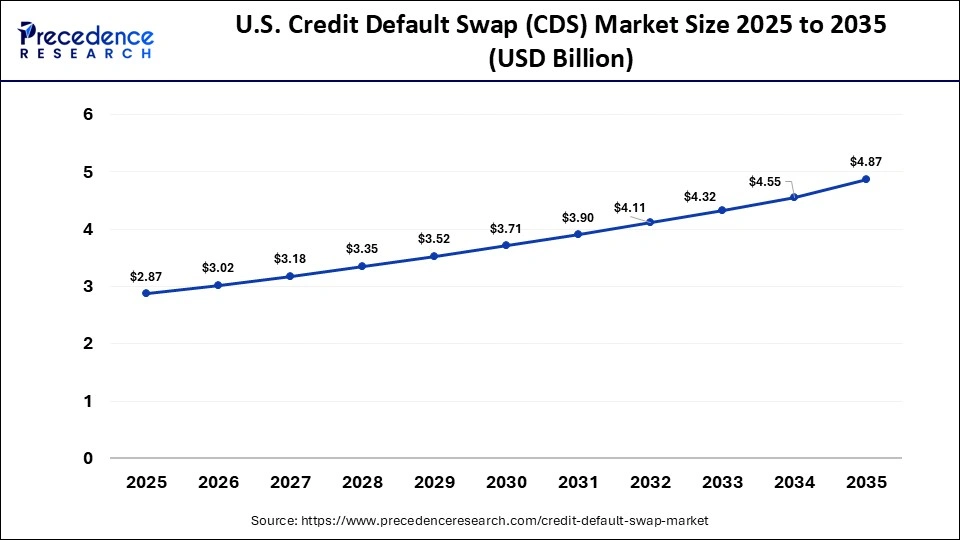
The U.S. credit default swap (CDS) market size is calculated at USD 2.87 billion in 2025 and is expected to reach nearly USD 4.87 billion in 2035, accelerating at a strong CAGR of 5.43% between 2026 to 2035.
U.S. Market Trends
The U.S. is a major contributor to the North American credit default swap (CDS) market, backed by its sophisticated financial ecosystem, broader investor participation, and significant volume of corporate debt issuance. Despite regulatory reforms introduced after the 2008 financial crisis, the market has demonstrated remarkable stability and adaptability with continuous improvements in transparency and operational efficiency. Supported by strong regulatory and technological advancements, the U.S. continues to serve as a key global center for credit default swaps (CDS) innovation.
Why is Europe Considered the Second-Largest Market for Credit Default Swap (CDS)?
Europe is considered the second-largest market, supported by its highly developed financial ecosystem and deep participation from banks, insurances hedge funds, and asset managers. The region's share of credit default swap activity remains substantial, reflecting a broad-based commitment to sophisticated credit risk management strategies. Regulatory frameworks like EMIR and enhanced reporting standards have steadily expanded, and transparency has improved in CDS.
UK Market Trends
The credit default swap (CDS) market in the UK is steadily growing, driven by a surge in notional CDS volume, rising investor demand to hedge credit exposure, and regulatory enhancements that improve trade reporting and transparency. The UK accounts for the largest share of European CDS activity, with strong momentum in both single-name and index CDS trading.
How is the Opportunistic Rise of Asia Pacific in the Credit Default Swap (CDS) Market?
Asia Pacific is expected to grow at the fastest CAGR in the market, propelled by the rapid development of the financial ecosystem and rising demand for advanced risk management tools. Major economies across the region, including China and Japan, are increasingly integrating CDS assets to hedge credit risk amid expanding corporate bond markets and foreign capital inflows. As the region's market deepens and matures, its share of global CDS activity is expected to rise significantly over the forecast period.
China Market Trends
The market in China is growing, driven by the rapid expansion of corporate debt and strong government support for financial market modernization. Regulatory reforms aimed at enhancing transparency have encouraged greater participation from domestic banks, securities firms, and institutional investors. Simultaneously, China's ongoing financial market liberalization and alignment with global systems are opening new opportunities for credit risk management solutions.
Japan Market Trends
Japan's credit default swap (CDS) market is expanding, supported by its well-established and highly liquid bond market. Amid shifting interest rate cycles and ongoing economic uncertainty, institutional investors are increasingly using CDS to manage credit risk without affecting core fixed-income holdings. Japanese banks and asset managers, managing large bond portfolios, rely on CDS as a flexible hedging tool, strengthening Japan's role in the broader CDS derivative ecosystem.
How will Latin America Grow in the Credit Default Swap (CDS) Market?
Latin America is considered to be a significantly growing area, due to increased volatility, the need for hedging against regional economic risks, and rising corporate debt issuance. Latin American countries face simultaneous risks of sovereign default and currency depreciation. High debt levels, combined with weak economic growth prospects, compel investors to use Credit Default Swaps to manage risk. The region's heavy reliance on natural resource exports makes it particularly vulnerable to fluctuations in commodity prices, leading to increased CDS hedging activity.
Brazil Market Trends
Brazil stands out as a high-stakes, commodity-driven instrument for investors looking to hedge or speculate on emerging market volatility, serving as a key reference entity for Latin American sovereign CDS. Heavily monitored by global markets, Brazil's sovereign risk profile is becoming increasingly transparent due to proactive data gap initiatives by the central bank and enhanced financial stability.
How will the Middle East and Africa Emerge in the Credit Default Swap (CDS) Market?
The Middle East and Africa are emerging as a significantly growing region over the studied period, primarily driven by intensified geopolitical tensions, high oil price volatility, and increasing sovereign debt levels. Many economies in the GCC are sensitive to oil price fluctuations. Prolonged volatility in oil prices contributes to negative sentiment regarding the solvency of regional banks and sovereign entities, resulting in higher costs for protection. Also, rising short-term debt accumulation in African nations and a challenging global financial environment are increasing default protection demand.
Saudi Arabia Market Trends
Saudi Arabia's CDS spread serves as a high-stakes energy hedge that is strongly correlated with oil price volatility. However, recent efforts to improve domestic capital markets and enhance debt transparency are bolstering financial stability. This shift indicates a strategic evolution from a purely oil-dependent risk profile toward a more mature financial market, making Saudi Arabia a critical bellwether in the GCC.
Value Chain Analysis – Credit Default Swap (CDS) Market
- Research and Financial Engineering
This involves analyzing creditworthiness, developing index structures, pricing models, and creating bespoke CDS contracts to hedge specific risks.
Key Players: Moody's, S and P, Fitch, JPMorgan Chase, Goldman Sachs, and Citi. - Trading, Execution, and Regulatory Compliance
This focuses on negotiating or executing the trade electronically or bilaterally, ensuring compliance with post-2008 regulations.
Key Players: Morgan Stanley, Barclays, Deutsche Bank, ICAP, and Tullett Prebon. - Clearing and Risk Management
This involves manufacturing equivalent, where the trade is novated to a CCP to eliminate counterparty risk and standardize collateral management.
Key Players: LCH, ICE Clear Credit, and CME Group. - Post-Trade Settlement and Infrastructure
This focuses on manages the lifecycle of the CDS contract, including premium payments, trade compression, and credit event servicing.
Key Players: Depository Trust and Clearing Corporation, TriOptima, and Clearstream.
Leading Companies in the Credit Default Swaps (CDS) Market
- JPMorgan Chase & Co.
- Bank of America Corporation
- Citigroup Inc.
- Goldman Sachs Group, Inc.
- Barclays PLC
- Deutsche Bank AG
- Morgan Stanley
- Credit Suisse Group AG
- BNP Paribas
- UBS Group AG
- Wells Fargo & Company
- HSBC Holdings plc
Recent Developments
- In April 2026, S&P Dow Jones Indices launched the credit-default swap index. This index platform comprises 25 North American financial entities, including banks, real estate investment trusts, insurers, and business development companies (BDCs). (Source: https://www.sharecafe.com.au)
- In March 2026, JPMorgan Chase launched the credit default swap basket. This offering was designed for the prominent tech companies, such as Amazon, Alphabet, Meta, Microsoft, and Oracle. (Source: https://finance.biggo.com)
- In February 2026, the Reserve Bank of India launched the Total Return Swaps (TRS). This policy was initiated to enhance credit default swaps across India. (Source: https://vinodkothari.com)
- In March 2025, the International Swaps and Derivatives Association (ISDA) announced the expansion of its swaps info platform to include detailed European CDS trading data, improving transparency on CDS markets across the U.S. and UK, giving the broader market better insight into trading activity.
- In December 2025, a significant credit event involving Ardag was officially processed by the ISDA determination committee, leading to adjustments in CDS indexing and new contract versions for trading.
- In November 2025, the Commodity Futures Trading Commission (CFTC) granted relief for certain structured products credit risk transfer, clarifying how they can operate with respect to CDS. It was a regulatory move aimed at balancing risk-taking and transparency in the segment.
- In February 2026, Sovereign risk perceptions in Asia shifted with Indonesia's CDS rising in response to a credit rating outlook downgrade. It highlighted how country-specific developments can influence credit risk pricing in the region's CDS market
Segments Covered in the Report
By Product
- Single-name CDS
- Index CDS
By Counterparty
- Insurance Companies
- Banks
- Hedge Funds
- Pension Funds
- Others
By End-User
- Financial Institutions
- Corporates
- Sovereigns
- Others
By Maturity
- 1-5 Years
- 5-10 Years
- 10+ Years
By Region
- North America
- Europe
- Asia-Pacific
- Latin America
- Middle East & Africa
For inquiries regarding discounts, bulk purchases, or customization requests, please contact us at sales@precedenceresearch.com
Frequently Asked Questions





Ask For Sample
No cookie-cutter, only authentic analysis – take the 1st step to become a Precedence Research client
 Get a Sample




 sales@precedenceresearch.com
 Schedule a Meeting
