


Data Center Liquid Cooling Fluids Market Size, Key Companies, Company Product Portfolio, Digital Transformation, Technology Investment, Adoption Rates, Customer Acquisition, Company Market Share, and Market Outlook
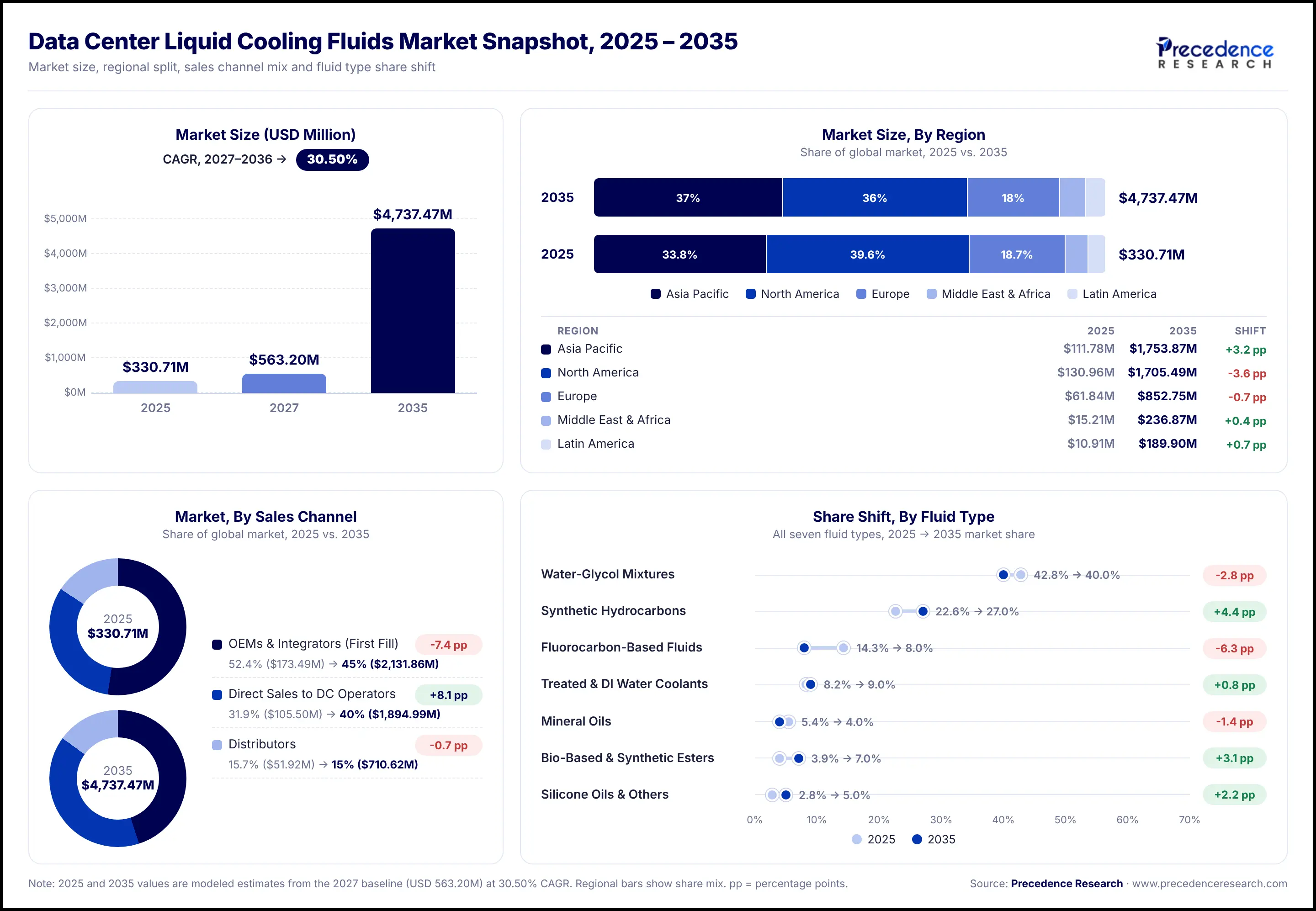
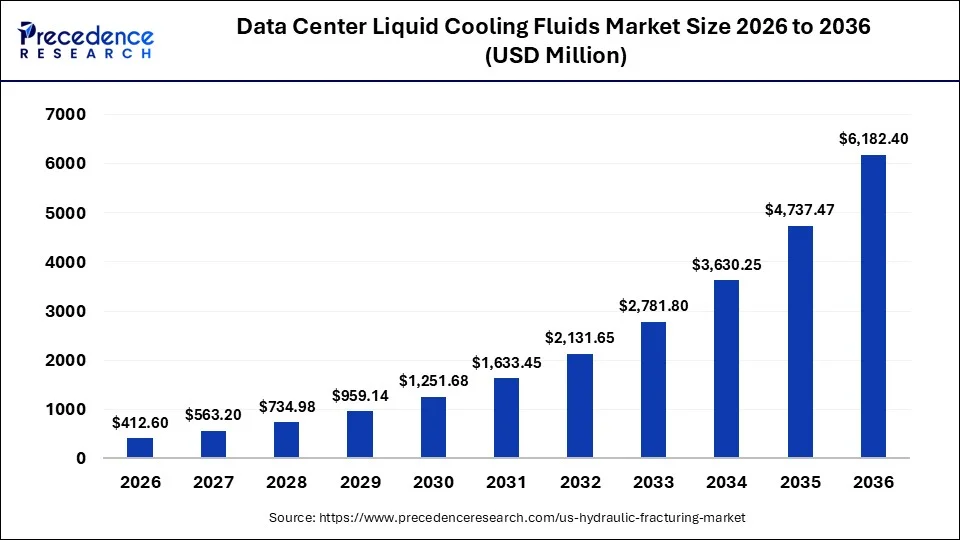
ICT industry specialist Gautam Mahajan estimates the data center liquid cooling fluids market at USD 412.60 billion in 2026, with continued technology adoption expected to take the market to USD 6,182.40 million by 2035 at a CAGR of 30.50%. Leading data center liquid cooling fluids market providers such as Shell plc, ExxonMobil, Dow Inc, Castrol are expanding their capabilities across segments including fluid type, cooling technology, cooling method , data center type, sales channel and region.
Source: https://www.precedenceresearch.com/data-center-liquid-cooling-fluids-market
 Get a Sample
 Table Of Content


Data Center Liquid Cooling Fluids Market Size, Trends, Share, and Innovations 2036
The data center liquid cooling fluids market is expected to account for USD 563.20 million in 2027 and is expected to reach USD 6,182.40 million by 2036, expanding at a CAGR of 30.50% during the forecast period.
Key Takeaways
Market Size & Growth Outlook
- Market size in 2026: USD 412.60 million
- Estimated market size in 2027: USD 563.20 million
- Projected market size by 2036: USD 6,182.40 million
- CAGR (2027-2036): 30.50%
Regional Market Spotlight
- North America led the market with around 39.60% (USD 163.39 million) market share in 2026.
- Asia Pacific accounted for approximately 33.80% (USD 139.46 million) market share in 2026 and is forecasted to expand at a significant CAGR of 32.44% from 2026 to 2036.
- Europe held approximately 18.70% (USD 77.16 million) market share in 2026.
Segmental Spotlight
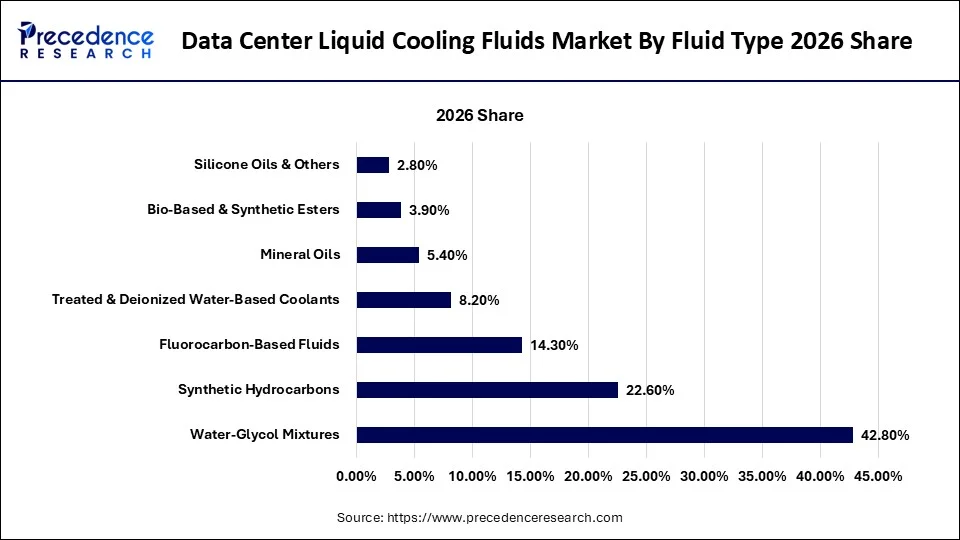
- By fluid type, Water-Glycol Mixtures held around 42.80% share (USD 176.59 million) in 2026.
- By cooling technology, Direct-to-Chip / Cold Plate accounted for approximately 54.60% (USD 225.28 million) in 2026.
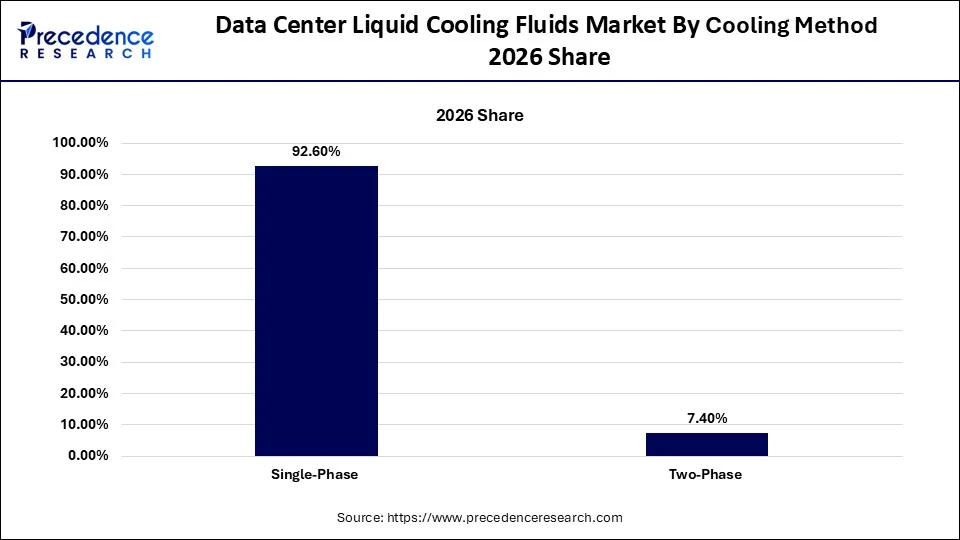
- By cooling method, the Single-Phase segment held approximately 92.60% (USD 382.07 million) in 2026.
- By data center type, Hyperscale & Cloud accounted for 46.20% market share(USD 190.62 million) in 2026.
- By sales channel, the cooling System OEMs & Integrators segment (First Fill) accounted for around 52.40% revenue share (USD 216.20 million) in 2026.
Data Center Liquid Cooling Fluids Market Size 2026 to 2036
The 2026 base-year value of the data center liquid cooling fluids market is estimated to be USD 412.60 million. This market comprises the coolants that transfer heat from servers to liquid-cooled facilities: water-glycol and treated-water fluids for direct-to-chip and rear-door loops, single-phase dielectric fluids are used for immersion tanks, and fluorinated fluids for two-phase systems. Water-glycol mixtures led the fluid-type segment in 2026, accounting for around 42.80% market share, showing the dominance of cold-plate cooling in AI clusters. North America is estimated to hold 39.60% of revenue in 2026, because of the presence of a significant number of hyperscale AI campuses. The market growth is being driven by accelerator power climbing past 1,000 W per chip, increasing rack densities, and pressure on data center energy use. The supplier landscape is being increasingly shaped by 3 M's PFAS manufacturing exit, chipmaker fluid certifications, and new low-GWP two-phase fluids.
Market Trends
- Cold-plate direct-to-chip cooling is increasingly emerging to be the default configuration for AI GPU racks, fueling the demand for PG25 coolant.
- The significance of fluid qualification as a key purchase factor is increasing owing to chipmaker certification, driven by the approval of Shell immersion fluids by Intel.
- Fluorinated fluids are being replaced by single phase chemistries devoid of PFAS after the exit of 3M from PFAS manufacturing.
- Chemours Opteon, a low GWP two phase fluid commenced commercial production in 2026.
- Coolant specifications for buyers are being standardized by the recognition of Open Compute Project, such as Castrol's PG 25.
- Fluids are being bundled with testing, monitoring and recycling services across the fluid lifecycle by the suppliers.
Drivers, Restraints and Opportunities
Driver
The rise in power of AI accelerators and rack densities is compelling operators to shift from air to liquid cooling. Every new liquid-cooled megawatt drives the demand for first-fill fluid and a stream of recurring replacements.
Restraint
PFAS regulation and 3M's exit from PFAS manufacturing have caused significant disruptions in two-phase fluid supply. Operators need to reobtain qualification for replacement fluids, which decreases the pace of two-phase adoption.
Opportunity
A fast-growing installed base creates repeating demand for replacement fluid, refills, and fluid testing. Suppliers that bundle fluids with monitoring and lifecycle services will be well-positioned to build long-term contracts.
Market Segmentation: 2026 Share and Value
Data Center Liquid Cooling Fluids Market By Fluid Type 2026 Share & Size
Note: 2026 values are estimates. Sources: Expert interviews, secondary sources, Precedence Research database, and Precedence Research analysts.
Water-glycol mixtures accounted for approximately 42.80% (USD 176.59 million) in 2026 because PG25 is the standard coolant in cold-plate loops, and demand rises with every new direct-to-chip rack. Synthetic hydrocarbons accounted for 22.60% market share (USD 93.25 million), and are gaining share as PFAS-free immersion fluids receive chipmaker certification, while fluorocarbon-based fluids accounted for 14.30% share (USD 59.00 million) have a slower rate of growth under PFAS restrictions. Treated and deionized water-based coolants held around 8.20% market share (USD 33.83 million), are used in closed loops that require low conductivity, whereas mineral oils (5.40% (USD 22.28 million)), bio-based and synthetic esters (3.90% (USD 16.09 million)), and silicone oils and others (2.80% (USD 11.55 million)) represent niche immersion applications where cost, biodegradability or fire safety are of utmost importance.
Data Center Liquid Cooling Fluids Market By Cooling Technology 2026 Share & Size
| Segments | 2026 Share | 2026 Market Value |
| Direct-to-Chip / Cold Plate | 54.60% | USD 225.28 million |
| Single-Phase Immersion | 33.20% | USD 136.98 million |
| Two-Phase Immersion & Two-Phase Direct-to-Chip | 7.40% | USD 30.53 million |
| Rear-Door Heat Exchangers & Other Liquid Loops | 4.80% | USD 19.80 million |
Note: 2026 values are estimates. Sources: Expert interviews, secondary sources, Precedence Research database, and Precedence Research analysts.
The Direct-to-chip and cold-plate systems segment holds approximately 54.60% market share (USD 225.28 million) in 2026 and is expected to increase owing to the fact that they are compatible with existing data halls without requiring any significant redesign. Single-phase immersion accounted for 33.20% share (USD 136.98 million), owing to higher fluid volume per rack, while two-phase systems accounted for 7.40% share (USD 30.53 million) are expanding owing to the entry of low GWP fluids in production. Rear-door heat exchangers and other liquid loops, held 4.80% market share (USD 19.80 million), primarily use water-glycol and serve operators that retrofit air-cooled halls without changing servers. More fluid volume is moving from these retrofit loops to direct-to-chip and immersion systems owing to a rise in rack densities.
Data Center Liquid Cooling Fluids Market By Cooling Method 2026 Share & Size
Note: 2026 values are estimates. Sources: Expert interviews, secondary sources, Precedence Research database, and Precedence Research analysts.
Single-phase fluids held a market share of approximately 92.60% (USD 382.07 million) in 2026, owing to cold-plate and immersion deployments because they are cheaper and offer ease of handling. Two-phase fluids accounted for 7.40% share (USD 30.53 million), are well-positioned to gain share from a relatively small base as new low-GWP fluids replace exited PFAS products. Single-phase systems are benefiting from ease of maintenance and wider hardware approvals, which allows them to be the default for new AI halls. Two-phase demand is dependent on how rapidly low-GWP fluids secure chipmaker and OEM qualification.
Data Center Liquid Cooling Fluids Market By Data Center Type 2026 Share & Size
| Segments | 2026 Share | 2026 Market Value |
| Hyperscale & Cloud | 46.20% | USD 190.62 million |
| Colocation | 23.70% | USD 97.79 million |
| AI/HPC Specialist & Research | 13.40% | USD 55.29 million |
| Enterprise | 10.90% | USD 44.97 million |
| Edge & Crypto-Mining | 5.80% | USD 23.93 million |
Note: 2026 values are estimates. Sources: Expert interviews, secondary sources, Precedence Research database, and Precedence Research analysts.
Hyperscale and cloud operators held around 46.20% market share (USD 190.62 million) in 2026, and their demand increases with every gigawatt-scale AI campus they bring online. The colocation segment, at 23.70% (USD 97.79 million), is experiencing expansion as providers fit liquid-ready halls for AI tenants, while AI/HPC specialist sites at 13.40% (USD 55.29 million) grow with new GPU cloud capacity. Enterprise data centers, at 10.90% (USD 44.97 million), are adopting liquid cooling at a relatively lower rate through retrofits, while edge and crypto-mining sites, at 5.80% (USD 23.93 million), use immersion fluids for the purpose of cooling dense hardware in compact or remote locations.
Data Center Liquid Cooling Fluids Market By Sales Channel 2026 Share & Size
Note: 2026 values are estimates. Sources: Expert interviews, secondary sources, Precedence Research database, and Precedence Research analysts.
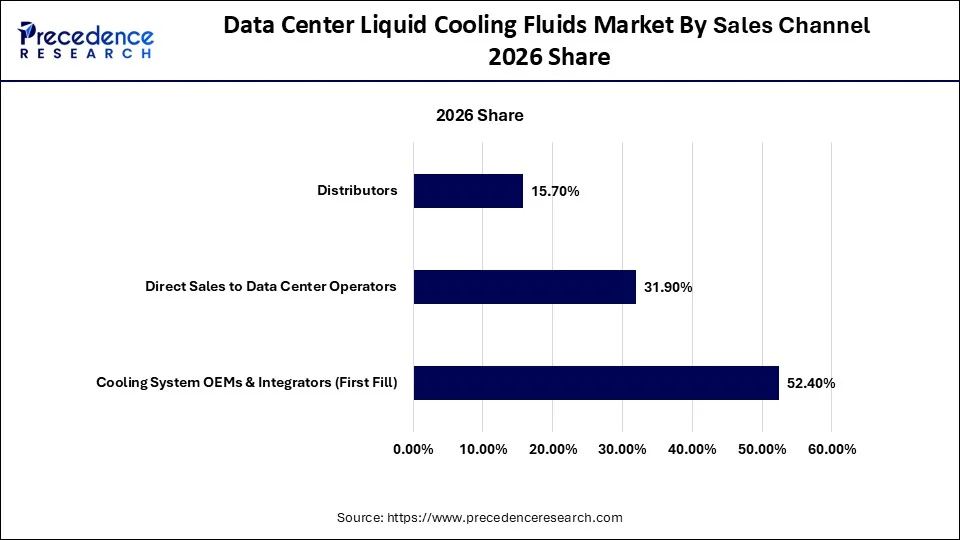
Cooling system OEMs and integrators accounted for 52.40% share (USD 216.20 million) in 2026 because a significant proportion of fluid debuts the market as first fill with new cooling systems. Direct sales to operators, held 31.90% share (USD 131.62 million), and is experiencing growth as replacement and top-up contracts expand with the installed base, whereas distributors at 15.70% (USD 64.78 million) cater to smaller and edge sites. Fluid suppliers are increasingly signing direct supply agreements that bundle testing, top-ups, and disposal, which is resulting in a value shift toward the operator channel over time.
- Analyst View: We see the segment mix shifting gradually that at a high rate. Water-glycol mixtures (42.80%) and direct-to-chip cooling (54.60%) are well-positioned to be the volume core through 2036, but the value growth opportunity lies in PFAS-free single-phase immersion fluids and low-GWP two-phase fluids, now 7.40% of revenue. Hyperscalers, at 46.20% of demand, are expected to act as setters of fluid specifications, and as the installed base ages, the revenue of replacement sales will shift from OEM first fill (52.40%) toward direct operator contracts (31.90%).
Regional Analysis
Data Center Liquid Cooling Fluids Market By Region 2026 Share & Size
Note: 2026 values are estimates. Sources: Expert interviews, secondary sources, Precedence Research database, and Precedence Research analysts.
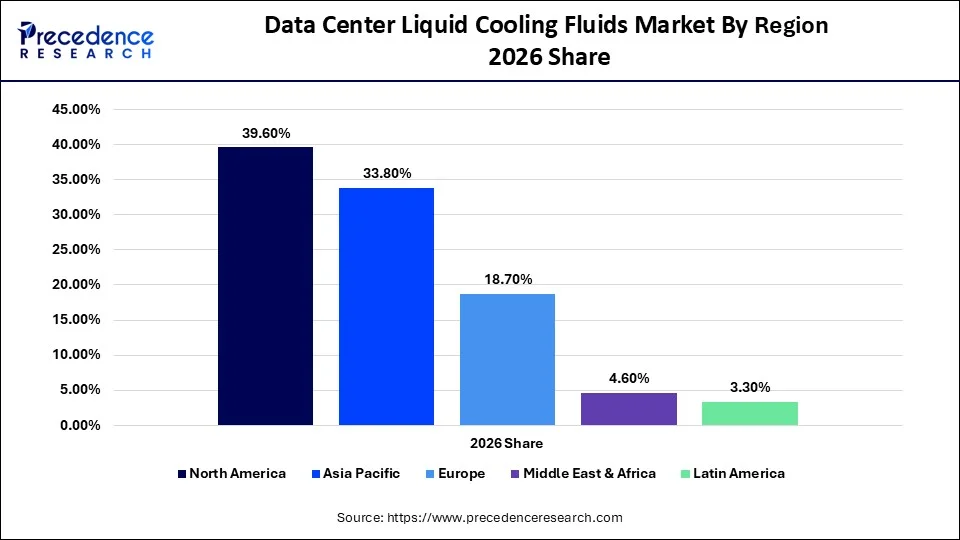
North America held approximately 39.60% market share (USD 163.39 million) in 2026, owing to massive liquid-cooled AI campuses in the United States. Asia Pacific, at 33.80% (USD 139.46 million), is growing at the fastest rate as China expands AI capacity under strict efficiency rules, while Europe, at 18.70% (USD 77.16 million) is experiencing growth owing to retrofits and sustainability requirements. The Middle East & Africa, at 4.60% (USD 18.98 million), and Latin America, at 3.30% (USD 13.62 million), are smaller markets, with a big chunk of demand in new AI campuses in the Gulf and colocation hubs in Brazil and Chile.
North America held approximately 39.60% share (USD 163.39 million) in 2026. The United States is home to some of the largest liquid-cooled AI campuses and most fluid qualification programs, making it an important market for PG25 and immersion fluids.
Asia Pacific held approximately 33.80% share (USD 139.46 million) in 2026 and is the region with fastest growth rate. China's AI build-out, efficiency rules and indigenous fluorinated-fluid manufacturers fuel demand, with Japan, South Korea and Singapore contributing to capacity expansion.
Europe held around 18.70% market share (USD 77.16 million) in 2026. PFAS restrictions and efficiency targets are boosting the adoption of single-phase and bio-based fluids, with the most prominent demand drivers being the Nordics, Germany and the UK.
The Middle East & Africa held around 4.60% market share (USD 18.98 million) in 2026. Gulf states are building large AI campuses where liquid cooling is essential owing to hot climates.
Latin America accounted for approximately 3.30% market share (USD 13.62 million) in 2026. Brazil and Chile have the highest contributions led by colocation and cloud growth, with liquid cooling adoption still in a early phase.
- Analyst View: North America's 39.60% lead dominance can be attributed to US hyperscale AI investment and is expected to continue throughout the forecast period, but we expect Asia Pacific (33.80%) to bridge the gap as China increases AI capacity and develops indigenous fluorinated-fluid supply. Europe (18.70%) is a market with a significant regulation influence as PFAS rules and efficiency targets favor single-phase and bio-based fluids, while the Middle East & Africa (4.60%) is an emerging opportunity as Gulf states build AI campuses. According to our regional forecast, Asia Pacific is expected to grow at a CAGR of 32.44% from 2026 to 2036, compared with 31.09% for the overall market.
Top 10 Companies in the Data Center Liquid Cooling Fluids Market
| Rank | Company Name | Market-Specific Revenue (USD Million) | 2026 Share (Est.) | Key Products / Business | Headquarters |
| 1 | Shell plc | 34.5 | 8.36% | GTL-based Shell Immersion Cooling Fluids (Intel-certified); direct liquid cooling fluids | United Kingdom |
| 2 | ExxonMobil | 29.8 | 7.22% | Data center immersion fluids (synthetic and non-synthetic grades) | United States |
| 3 | Dow Inc. | 24.6 | 5.96% | DOWFROST LC 25 and LC 55 propylene glycol direct-to-chip coolants | United States |
| 4 | Castrol | 21.3 | 5.16% | Castrol ON PG 25 direct liquid cooling fluid; DC 15 and DC 20 immersion fluids | United Kingdom |
| 5 | Valvoline Global Operations | 17.9 | 4.34% | PG 25 direct-to-chip coolants; dielectric immersion fluids | United States |
| 6 | FUCHS SE | 15.2 | 3.68% | RENOLIN FECC synthetic hydrocarbon immersion fluids; direct liquid cooling fluids | Germany |
| 7 | The Lubrizol Corporation | 13.8 | 3.34% | CompuZol PFAS-free single-phase immersion fluids | United States |
| 8 | Arteco | 12.6 | 3.05% | Zitrec EC and Fluordrop direct-to-chip coolants | Belgium |
| 9 | Zhejiang Juhua Co., Ltd. | 12.1 | 2.93% | Fluorinated immersion and heat-exchange fluids for AI data centers | China |
| 10 | Syensqo | 11.7 | 2.84% | Galden PFPE heat-transfer fluids; two-phase immersion fluid portfolio | Belgium |
Note: 2026 company revenues and shares are estimates. Sources: Company press releases, expert interviews, secondary sources, Precedence Research database and Precedence Research analysts.
Shell dominated the data center liquid cooling fluids market with approximately 8.36% (USD 34.50 million) revenue in 2026, followed by ExxonMobil at 7.22% (USD 29.80 million) and Dow at 5.96% (USD 24.60 million). Shell and ExxonMobil are leading players in immersion fluids segment owing to chipmaker certification and collaborations, while Dow holds a dominant position in propylene glycol coolants for direct-to-chip loops. The top 10 companies held approximately 46.90% (USD 193.50 million) of 2026 revenue, while the remaining 53.10% (USD 219.10 million) was shared among regional blenders, distributors, tank makers' private-label fluids, and Chinese fluorochemical manufacturers. Competition is transitioning towards qualification by chipmakers and cooling OEMs, PFAS-free chemistry and lifecycle services such as fluid testing and replacement.
Data Center Liquid Cooling Fluids Market Segments
By Fluid Type
- Water-Glycol Mixtures
- Synthetic Hydrocarbons
- Fluorocarbon-Based Fluids
- Treated & Deionized Water-Based Coolants
- Mineral Oils
- Bio-Based & Synthetic Esters
- Silicone Oils & Others
By Cooling Technology
- Direct-to-Chip / Cold Plate
- Single-Phase Immersion
- Two-Phase Immersion & Two-Phase Direct-to-Chip
- Rear-Door Heat Exchangers & Other Liquid Loops
By Cooling Method
- Single-Phase
- Two-Phase
By Data Center Type
- Hyperscale & Cloud
- Colocation
- AI/HPC Specialist & Research
- Enterprise
- Edge & Crypto-Mining
By Sales Channel
- Cooling System OEMs & Integrators (First Fill)
- Direct Sales to Data Center Operators
- Distributors
By Region
- North America (U.S., Canada, Mexico)
- Europe (Germany, U.K., France, Netherlands, Nordics, Ireland, Rest of Europe)
- Asia Pacific (China, Japan, India, South Korea, Australia, Singapore, Rest of Asia Pacific)
- Latin America (Brazil, Chile, Rest of Latin America)
- Middle East & Africa (Saudi Arabia, UAE, South Africa, Rest of MEA)
Research Methodology
The market comprises heat-transfer fluids used in liquid-cooled data center IT, excluding cooling hardware and non-IT immersion applications. The 2026 base was built bottom-up from liquid-cooled capacity, fluid volume per megawatt and fluid prices, and checked top-down against liquid cooling equipment expenditures. Segment, regional and company values were allocated from capacity mix, regional build-outs and supplier portfolios, then reconciled before publication. Key estimates were verified by cross-checking company disclosures, regulatory and industry data and published third-party estimates, and inputs that could not be reconciled were excluded. All segment, regional and company figures were reconciled to the same 2026 base-year estimate, and the forecast, which applies a constant CAGR from the 2027 estimate through 2036, was recalculated and validated in the Excel workbook.
Analyst View Overall Market
Liquid cooling fluids have transitioned from a niche consumable to a well-planned line item in every AI data center build. Fluid demand tracks liquid-cooled IT capacity, which is growing at a faster rate than any other part of thermal management as accelerator power and rack densities climb. A growing installed base adds repetitive replacement and top-up revenue, which drives the 30.50% CAGR from 2027 to 2036. The biggest openings sit in PG25 for cold-plate loops, PFAS-free immersion fluids and low-GWP two-phase fluids, while slower AI spending and PFAS rules are the main risks.
Sources and References
- International Energy Agency (IEA). "Energy and AI". 2025-04-10. Data center electricity demand outlook to 2030 and the role of AI-accelerated servers. (Source: https://www.iea.org)
- 3M Company (SEC EDGAR). "Form 10-Q, quarter ended 30 September 2025". Q3 2025. Status of 3M's exit from all PFAS manufacturing by end of 2025.(Source:https://www.sec.gov)
- Shell plc. "Shell cooling fluids certified by Intel for use in data centres worldwide". 2025-05-14. Intel certification of Shell single-phase immersion fluids; PFAS-free GTL chemistry. (Source:https://www.shell.com)
- Intel Corporation. "Shell customer story: Intel Data Center Certified for Immersion Cooling". July 2025. Validated immersion system with Shell fluids, Submer tanks and Supermicro servers. (Source: https://www.intel.com)
- The Chemours Company. "Chemours and Navin Fluorine announce agreement to manufacture new liquid cooling product". 2025-05-06. Opteon two-phase immersion fluid commercial capacity from 2026. (Source: https://www.businesswire.com/news/home/20250506107731/en/
- Navin Fluorine International Limited (NSE). "Intimation of joint press release with Chemours". 2025-05-07. Initial capacity addition timing during April-June 2026. (Source: https://nsearchives.nseindia.com)
- Castrol (BP). "Castrol ON fluid for data centre cooling passes Submer's testing requirements". February 2023. Castrol immersion fluid qualification with Submer. (Source: https://www.castrol.com)
- TechFinitive. "Liquid cooling data centres: from engine oil to immersion fluid, Castrol ON wants in". May 2026. Castrol PG 25 OCP Inspired recognition; DC 15 and DC 20 immersion fluids. (Source: https://www.techfinitive.com)
- ExxonMobil. "ExxonMobil and Intel announce collaboration to bring data center immersion cooling solution to market". 2024-04-23. ExxonMobil data center immersion fluid portfolio and Intel collaboration. (Source: https://exxonmobilchemical.com/-/media/media-assets/media-library-assets/25/collaboration_to_bring_data_center.pdf
- Data Centre Magazine. "ExxonMobil and Infosys partner to scale immersion cooling". Undated. ExxonMobil proprietary dielectric fluid deployment with Infosys. (Source: https://datacentremagazine.com/news/exxonmobil-infosys-partners-to-scale-data-centre-immersion-cooling-tech
- Dow Inc. "Data Center Cooling: DOWFROST LC heat transfer fluids". Undated. PG25 direct-to-chip coolant specification and positioning. (Source: https://www.dow.com/en-us/market/mkt-electronics/sub-elec-data-center-cooling/app-elec-data-center-immersion-cooling.html
- Valvoline Global Operations. "HPC liquid cooling". Undated. Direct-to-chip PG 25 and dielectric immersion fluid portfolio. (Source: https://www.valvolineglobal.com/en/hpc-liquid-cooling/
- FUCHS SE. "Revolutionising data centre cooling with FUCHS LUBRICANTS". 2025-01-23. RENOLIN FECC immersion fluids and direct liquid cooling fluids. (Source: https://www.fuchs.com/za/en/company/news/news-entry/6378-Revolutionising-data-centre-cooling-with-FUCHS-LUBRICANTS/
- The Lubrizol Corporation. "CompuZol Immersion Fluid Solution brochure". Undated. PFAS-free single-phase immersion fluid line.(Source: https://www.lubrizol.com/-/media/Lubrizol/Thermal-Management/Documents/Compuzol-Marketing-Brochure.pdf
- DatacenterDynamics. "Cooling fluids firm Arteco moves into data centers, launches liquid cooling offering". 2025-04-29. Arteco direct-to-chip coolant range; Chevron and TotalEnergies JV structure. (Source: https://www.datacenterdynamics.com/en/news/cooling-fluids-firm-arteco-moves-into-data-centers-launches-liquid-cooling-offering/
- Iceotope. "ENEOS + Iceotope: Powering sustainable AI cooling". 2026. ENEOS IX Series immersion fluids approved for Iceotope systems. (Source: https://www.iceotope.com/company/resources/eneos-iceotope-powering-sustainable-ai-cooling
- LG Electronics. "LG, SK Enmove and GRC sign MOU to advance liquid immersion cooling solutions for AI data centers". 2025-10-27. SK enmove immersion fluid supply for hyperscale AI data centers. (Source: https://www.lg.com
- Cargill, Incorporated. "NatureCool 2000 Immersion Cooling Fluid". Undated. Plant-based dielectric immersion fluid for data centers. (Source: https://www.cargill.com
- DatacenterDynamics. "Petronas launches data center cooling fluid, partners with Iceotope". Undated. PETRONAS Iona Tera coolant launch. (Source: https://direct.datacenterdynamics.com)
- Engineered Fluids, Inc. "ElectroCool Dielectric Coolants technical data sheet". 2026-05-05. PFAS-free single-phase dielectric coolant specifications. (Source: https://www.engineeredfluids.com)
- Inventec Performance Chemicals. "White paper: Evaluating immersion cooling fluids". Undated. Comparison of hydrocarbon and fluorinated single- and two-phase fluids. (Source: https://www.inventec.dehon.com)
For inquiries regarding discounts, bulk purchases, or customization requests, please contact us at sales@precedenceresearch.com
Frequently Asked Questions





Ask For Sample
No cookie-cutter, only authentic analysis – take the 1st step to become a Precedence Research client
 Get a Sample




 sales@precedenceresearch.com
 Schedule a Meeting