



Data Center Transformer Market Size, Key Companies, Company Market Share, Power Generation Capacity, Energy Consumption, Pricing Trends, Investment Analysis, Competitive Positioning, and Demand Forecast
The data center transformer market valued at USD 9.58 billion in 2027 and is projected to grow at a CAGR of 7.25% through 2035. Market growth is driven by rising investments in hyperscale data centers, increasing AI as well as cloud computing workloads, expanding digital infrastructure, and growing need for reliable, high-capacity power distribution. Key trends include the acceptance of energy-efficient power and distribution transformers, modular electrical infrastructure, dry-type transformer technologies, and advanced monitoring systems. Increasing data center construction, grid capacity constraints, rising rack power densities, and the need for reliable power delivery are expected to create new opportunities for transformer producers and data center electrical infrastructure providers through 2036.
Source: https://www.precedenceresearch.com/data-center-transformer-market
 Get a Sample
 Report Description


Data Center Transformer Market Size, Share, Trends, and Growth Forecast 2036
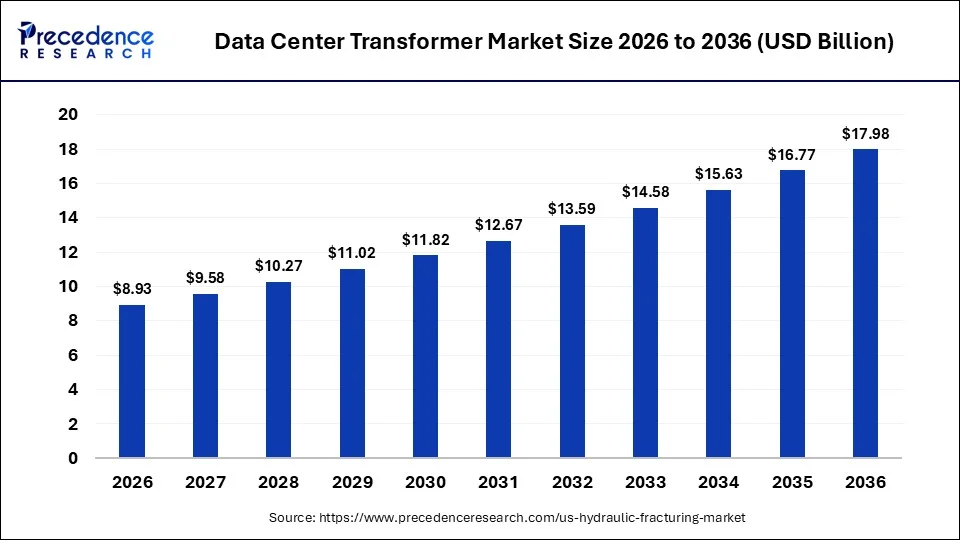
The global data center transformer market is forecasted to expand from USD 9.58 billion in 2027 to USD 17.98 billion by 2036, growing at a CAGR of 7.25% from 2027-2036.
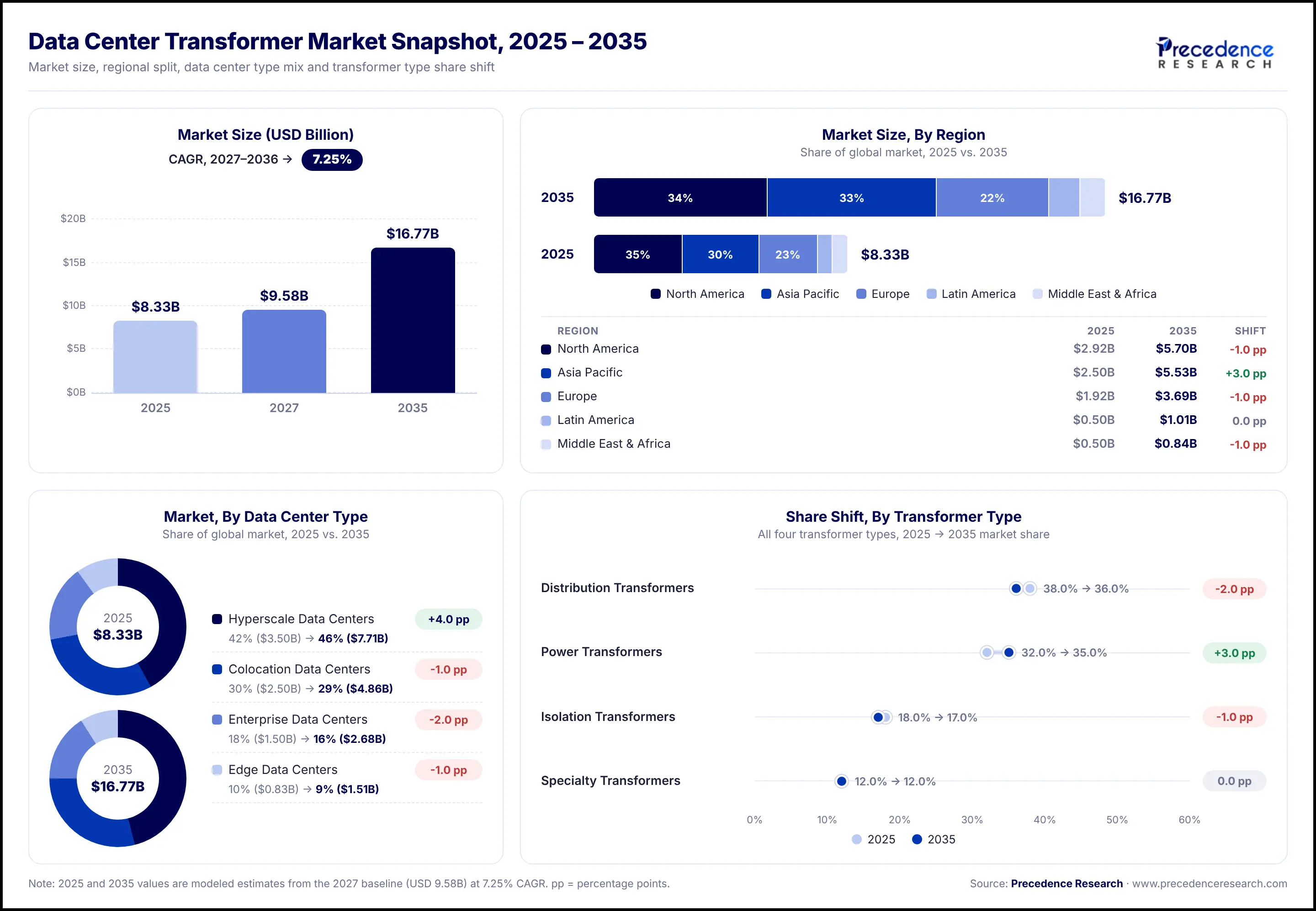
Key Takeaways
Market Size & Growth Outlook
- Market size in 2026: USD 8.93 billion
- Estimated market size in 2027: USD 9.58 billion
- Projected market size by 2036: USD 17.98 billion
- CAGR (2027-2036): 7.25%
Regional Market Spotlight
- North America share in 2026: 35%
- Asia-Pacific share in 2026: 30%
- Europe share in 2026: 23%
Segmental Spotlight
- Medium-voltage transformers share in 2026: 47%
- Transformers rated 1-10 MVA share in 2026: 48%
- Hyperscale data centers share in 2026: 42%
Data Center Transformer Market Size 2026 to 2036
The global data center transformer market is experiencing steady growth due to increasing demand for reliable power infrastructure and the expansion of hyperscale data centers. Rising AI workloads, growing electricity requirements, and the need for energy-efficient transformers are expected to support industry expansion throughout the forecast period.
Data Center Power Demand is Making Transformer Availability a Critical Infrastructure issue
Transformers step voltage up or down at major points between utility connections, medium-voltage distribution networks, on-site substations, and facility electrical systems. Their role is mainly important in data centers, where a power interruption can affect thousands of servers and high-value computing workloads. Operators build larger campuses and deploy more power-intensive AI systems, thus, transformer selection increasingly involves capacity planning, redundancy, energy losses, footprint, fault performance, and delivery schedules, not simply equipment purchase price.
North America represents the largest regional revenue pool in several available market estimates, thus accounting for roughly 36-40% of global demand. Asia Pacific is another important growth market as digital infrastructure investment expands across China, Singapore, India, Japan, Malaysia, and other regional hubs. The precise regional ranking and growth rates depend on the forecast period and market definition.
A central commercial issue is the difference between planned data center capacity and projects that actually reach construction. Transformer needs depend on projects securing grid connections, permits, funding, and equipment orders. Manufacturers that can deliver technically qualified units on schedule may therefore be better positioned than suppliers competing primarily on price.
Key Coverage
- Global data center electricity consumption is projected to rise from 415 TWh in 2024 to 945 TWh by 2030, increasing demand for reliable transformer infrastructure.
- North America accounts for approximately 36–40% of global market demand, while Asia Pacific remains an important growth market.
- Transformers rated 1,250–3,750 kVA represent a significant market segment, with published estimates placing its 2025 value at USD 3.59 billion.
- Rising AI workloads and hyperscale data center construction are driving demand for high-capacity, energy-efficient transformers.
- Grid connection delays, manufacturing constraints, and extended transformer lead times are creating procurement challenges for data center developers.
- Leading suppliers, including Hitachi Energy, Siemens Energy, GE Vernova, Schneider Electric, and ABB, compete through product reliability, manufacturing capacity, and technical expertise.
AI Infrastructure Raises the Value of Electrical Equipment per Facility
Differences may reflect whether the market includes only transformers installed inside data centers or also equipment serving associated substations and electrical infrastructure. The underlying demand equation is driven by the number of new facilities, their electrical capacity in megawatts (MW), transformer capacity required per facility, replacement demand, and even average selling prices. A 100 MW campus does not translate directly into a fixed transformer order value: voltage architecture, utility requirements, redundancy, equipment configuration, and whether power infrastructure is involved in the market definition all affect spending.
For planning purposes, the full analysis should model base, upside, and even downside cases using committed construction pipelines rather than announced capacity alone. It should also separate new installations from retrofits along with replacement projects.
Key Coverage
- Market demand linked to commissioned and planned MW capacity.
- Regional forecasts for North America, Europe, Asia Pacific, Latin America, and the Middle East and Africa.
- Revenue growth, CAGR, and incremental market opportunity by scenario.
- Sensitivity analysis for construction delays, transformer prices, grid connection timing, and project cancellations.
Segmentation Analysis - Transformer Capacity, Insulation and Deployment Model Shape Purchasing Decisions
Data Center Transformer Market by Transformer Type 2026 Share & Size
| Segments | 2026 Share | Market Value (USD Billion) |
| Distribution Transformers | 38% | 3.39 |
| Power Transformers | 32% | 2.86 |
| Isolation Transformers | 18% | 1.61 |
| Specialty Transformers | 12% | 1.07 |
Source: Expert Interview, Secondary Sources, Precedence Research Database, Precedence Research Analysts and Researcher.
Distribution transformers are estimated to lead due to their essential role in distributing electricity throughout data center facilities.
Data Center Transformer Market by Voltage Level 2026 Share & Size
| Segments | 2026 Share | Market Value (USD Billion) |
| Low Voltage | 18% | 1.61 |
| Medium Voltage | 47% | 4.2 |
| High Voltage | 35% | 3.13 |
Source: Expert Interview, Secondary Sources, Precedence Research Database, Precedence Research Analysts and Researcher.
Medium-voltage transformers are estimated to hold the largest share because they support power distribution within data center electrical infrastructure.
Data Center Transformer Market by Cooling Type 2026 Share & Size
| Segments | 2026 Share | Market Value (USD Billion) |
| Dry-Type Transformers | 42% | 3.75 |
| Oil-Immersed Transformers | 58% | 5.18 |
Source: Expert Interview, Secondary Sources, Precedence Research Database, Precedence Research Analysts and Researcher.
Oil-immersed transformers are estimated to lead overall, particularly in higher-capacity outdoor installations, while dry-type units remain attractive for indoor applications.
Data Center Transformer Market by Power Rating 2026 Share & Size
| Segments | 2026 Share | Market Value (USD Billion) |
| Below 1 MVA | 20% | 1.79 |
| 1–10 MVA | 48% | 4.29 |
| Above 10 MVA | 32% | 2.86 |
Source: Expert Interview, Secondary Sources, Precedence Research Database, Precedence Research Analysts and Researcher.
Transformers rated 1–10 MVA are estimated to dominate due to their suitability for a wide range of data center power distribution requirements.
Data Center Transformer Market by Data Center Type 2026 Share & Size
| Segments | 2026 Share | Market Value (USD Billion) |
| Hyperscale Data Centers | 42% | 3.75 |
| Colocation Data Centers | 30% | 2.68 |
| Enterprise Data Centers | 18% | 1.61 |
| Edge Data Centers | 10% | 0.89 |
Source: Expert Interview, Secondary Sources, Precedence Research Database, Precedence Research Analysts and Researcher.
Hyperscale data centers are estimated to account for the largest share because of their substantial electricity requirements and ongoing capacity expansion.
Data Center Transformer Market by Application 2026 Share & Size
| Segments | 2026 Share | Market Value (USD Billion) |
| Utility Grid Connection | 35% | 3.13 |
| Power Distribution | 35% | 3.13 |
| Backup Power Systems | 18% | 1.61 |
| Renewable Energy Integration | 12% | 1.07 |
Source: Expert Interview, Secondary Sources, Precedence Research Database, Precedence Research Analysts and Researcher.
Utility grid connection and power distribution are estimated to be the leading applications, reflecting the importance of reliable incoming power and internal electrical delivery.
Data Center Transformer Market by Data Center Infrastructure 2026 Share & Size
| Segments | 2026 Share | Market Value (USD Billion) |
| New Data Center Construction | 55% | 4.91 |
| Expansion and Capacity Upgrades | 30% | 2.68 |
| Replacement and Modernization | 15% | 1.34 |
Source: Expert Interview, Secondary Sources, Precedence Research Database, Precedence Research Analysts and Researcher.
New data center construction is estimated to lead demand as developers build facilities to support cloud computing, AI workloads, and digital infrastructure growth.
Data Center Transformer Market by Region 2026 Share & Size
| Segments | 2026 Share | Market Value (USD Billion) |
| North America | 35% | 3.13 |
| Europe | 23% | 2.05 |
| Asia-Pacific | 30% | 2.68 |
| Latin America | 6% | 0.54 |
| Middle East and Africa | 6% | 0.54 |
Source: Expert Interview, Secondary Sources, Precedence Research Database, Precedence Research Analysts and Researcher.
North America is estimated to lead, supported by hyperscale data center development and significant investment in AI and cloud infrastructure. Asia-Pacific also represents a major demand center as digital infrastructure expands.
The market is best segmented by insulation type, voltage class, power rating, application, data center type, and sales channel. Each dimension reflects a different purchasing decision and should not be treated as interchangeable.
By insulation type, the principal categories are oil-immersed and dry-type transformers. Oil-immersed equipment is suited to applications demanding high capacity and effective thermal management, subject to site-specific fire protection, containment, and environmental requirements. Moreover, dry-type transformers may be preferred in indoor installations or locations where reducing the usage of liquid insulation is an important design consideration. Published estimates disagree on the relative share of these categories, reinforcing the demand for a consistent product-level definition.
By power rating, categories may include below 625 kVA, 625–1,250 kVA, 1,250–3,750 kVA, and above 3,750 kVA. Medium-capacity units serve distributed loads and modular electrical designs, while larger units support high-capacity distribution and even major campus infrastructure. A published estimate places the 1,250-3,750 kVA segment at nearly USD 3.59 billion in 2025, illustrating the commercial importance of this capacity range; its share should be validated against the final market denominator.
By end use, hyperscale facilities, enterprise data centers, colocation providers, and edge facilities differ in procurement scale and standardization.
Hyperscalers can place large, repeat orders but may impose demanding technical specifications. Thus, colocation developers balance capacity expansion with tenant commitments, while enterprise and edge installations may prioritize compact designs, integration, along with local service availability.
Key Coverage
- Revenue and growth by insulation type and transformer construction.
- New-build versus retrofit and replacement demand.
- Power-rating and voltage-rating segmentation.
- Transformer demand by hyperscale, colocation, enterprise, and edge facilities.
- Indoor, outdoor, packaged-substation, and modular deployment configurations.
- Segment-level pricing, growth contribution, and forecast demand.
Market Dynamics - Construction Pipelines and Grid Constraints Determine When Demand Converts Into Orders
Demand is supported by cloud adoption, data localization, enterprise digitalization, AI computing, and the need for reliable electrical infrastructure. AI facilities can demand substantial electrical capacity, while denser computing deployments increase the importance of thermal management, power delivery, and system reliability.
The principal restraint is that data center construction, along with grid infrastructure, does not always advance at the same pace. A project may be ready for equipment procurement while awaiting utility approvals or transmission upgrades. Conversely, transformer shortages can delay energization even after a building is largely complete. These delays affect order timing, commissioning, working capital, and revenue recognition across the supply chain.
Power availability is also influencing site selection. Developers increasingly evaluate grid access, renewable energy availability, electricity pricing, and the time required to connect a facility. Markets with sufficient power infrastructure can attract investment, but may still face shortages of qualified electrical equipment.
Key Coverage
- Demand drivers linked to cloud, AI, and hyperscale investment.
- Utility connection queues and substation development.
- Transformer manufacturing constraints and order backlogs.
- Construction delays and the conversion of announced capacity into installed MW.
- Replacement demand from aging electrical equipment.
- Risks associated with project cancellations, capital expenditure reductions, and delayed energization.
Tentative Leading Company Universe - 25 Relevant Suppliers and Electrical Infrastructure Providers
| Company | Headquarters | Market position and core strength |
| Hitachi Energy | Switzerland | Grid and power transformers; high-voltage systems |
| Siemens Energy | Germany | Power transformers and grid infrastructure |
| GE Vernova | United States | Power transformers and grid equipment |
| Schneider Electric | France | Distribution transformers and data center electrical systems |
| Eaton | Ireland | Distribution transformers and integrated power infrastructure |
| ABB | Switzerland | Electrical distribution and transformer technologies |
| Mitsubishi Electric | Japan | Power and distribution transformers |
| Toshiba Energy Systems & Solutions | Japan | Power transformers and grid equipment |
| Hyundai Electric | South Korea | Power transformers and high-voltage equipment |
| HD Hyundai Electric | South Korea | Power and distribution equipment |
| TBEA | China | Power transformers and large-scale grid equipment |
| China XD Electric | China | High-voltage equipment and power transformers |
| Shandong Electrical Engineering & Equipment Group | China | Power transformer manufacturing |
| CG Power and Industrial Solutions | India | Power and distribution transformers |
| Transformers & Rectifiers India | India | Power, furnace, and specialty transformers |
| Bharat Heavy Electricals Limited | India | Large power transformers and electrical equipment |
| Kirloskar Electric Company | India | Electrical equipment and transformer solutions |
| Wilson Transformer Company | Australia | Power and distribution transformers |
| SGB-SMIT Group | Germany | Power and distribution transformers |
| R&S Group | Switzerland | Distribution and specialty transformers |
| Prolec GE | Mexico | Power and distribution transformers |
| WEG | Brazil | Transformers and integrated electrical equipment |
| Virginia Transformer Corp. | United States | Custom-engineered power transformers |
| Delta Star | United States | Power transformers and mobile substations |
| ERMCO | United States | Distribution transformers |
How are Transformer Manufacturers Positioned to Capture Data Center Power Infrastructure Demand?
The data center transformer market is shaped by rising electricity requirements, utility interconnection constraints, increasingly power-intensive AI infrastructure, and extended equipment delivery timelines. Global data center electricity consumption reached approximately 415 TWh in 2024 and is anticipated to approach 945 TWh by 2030. At the same time, transformer procurement has become a vital consideration for project developers, as long manufacturing lead times can affect commissioning schedules. These conditions make manufacturing capacity, product reliability, voltage-class expertise, customization capabilities, and delivery performance important competitive differentiators.
Our analysis indicates that competitive positioning depends on more than overall transformer market share or portfolio breadth. Producers with the ability to supply the required voltage and capacity ranges, meet demanding efficiency along with reliability requirements, and deliver equipment within project schedules may be better positioned to secure data center orders. Our assessment is that suppliers with established utility relationships and even scalable manufacturing operations have an advantage, while firms with relevant technical capabilities but constrained production capacity may struggle to convert need into near-term revenue. However, data center-specific market shares, order volumes, along with supplier-level revenue should be assessed separately from broader power transformer performance.
In our view, the key strategic implication is that competitive advantage will increasingly depend on the combination of technical suitability, delivery certainty, available production capacity, and customer access. The report benchmarks manufacturers across product portfolios, voltage and power ratings, geographic reach, manufacturing footprint, transformer technologies, capacity expansion, service capabilities, customer segments, and strategic developments. It also examines competitive positioning, market-share estimates where supportable, potential consolidation, capability gaps, and opportunities for suppliers to strengthen their presence in AI-oriented and even high-density data center projects.
Which Transformer Technologies and Innovations Will Shape the Next Phase of Data Center Power Infrastructure?
Global data center electricity consumption reached nearly 415 TWh in 2024 and is projected to approach 945 TWh by 2030, increasing the importance of efficient, reliable power conversion along with distribution. As AI workloads raise rack power density and even operators expand high-capacity facilities, transformer selection increasingly depends on voltage and power ratings, thermal performance, electrical losses, footprint, noise levels, monitoring capabilities, and even compatibility with site-level power architectures. Key areas of innovation include advanced insulation and cooling systems, high-efficiency transformer designs, condition monitoring, digital diagnostics, and even equipment engineered for demanding data center operating environments.
Our analysis indicates that technology differentiation is shifting beyond basic power conversion toward lifecycle efficiency, operational resilience, along with integration with wider electrical infrastructure. Lower transformer losses can reduce energy waste over extended operating periods, while temperature monitoring along with condition-based maintenance can help operators identify developing faults and improve equipment reliability. Our assessment is that these benefits become mainly relevant in large facilities where power availability, continuous operation, and equipment replacement costs carry significant commercial consequences. However, the relative value of each innovation depends on site design, operating conditions, load profile, and total cost of ownership rather than technical specifications alone.
In our view, the strongest commercial opportunities are likely to emerge where producers can demonstrate measurable efficiency and even reliability benefits without serviceability, compromising deployment timelines, or project economics. Innovations that support higher power requirements, improved thermal management, compact installations, and predictive maintenance may strengthen supplier differentiation as data center infrastructure evolves. The report examines transformer technologies by design and application, comparing their adoption drivers, operational advantages, performance characteristics, limitations, and suitability across different data center configurations. It also assesses emerging engineering developments and the extent to which producers are translating innovation into commercially relevant products.
Which Transformer Product Portfolios are Best Equipped to Meet Evolving Data Center Power Requirements?
Data center transformer requirements vary by facility capacity, internal power distribution architecture, redundancy design, grid connection voltage, and anticipated load growth. As global data center electricity consumption rises from approximately 415 TWh in 2024 toward a projected 945 TWh by 2030, thus, suppliers must address a broader range of power conversion requirements, from utility-facing transformers to equipment supporting downstream distribution systems. Moreover, product portfolio breadth is therefore relevant, but the number of products alone does not establish competitive strength; voltage coverage, MVA ratings, cooling design, footprint, efficiency, customization options, and even delivery capability determine how effectively a portfolio serves different project specifications.
Our analysis indicates that portfolio competitiveness depends on the alignment between product capabilities along with the technical requirements of specific data center applications. Manufacturers providing multiple transformer types and then rating ranges may be better positioned to address diverse project designs, while specialized suppliers can remain competitive where they deliver advantages in compact installation, customization, efficiency, or application-specific engineering. Our assessment is that portfolio gaps become commercially significant when suppliers cannot meet demanded ratings, comply with local technical standards, or deliver products within construction schedules. However, portfolio breadth should be estimated alongside manufacturing capacity and demonstrated project suitability rather than treated as a standalone indicator of market leadership.
In our view, the most significant strategic implication is that producers need to balance portfolio expansion with depth in the product categories most relevant to data center investment. The report benchmarks available products by voltage class, power rating, transformer type, cooling and insulation configuration, application suitability, efficiency characteristics, and geographic availability. This comparison assists in identifying overlapping offerings, product differentiation, efficiency characteristics, and potential gaps between producers' stated capabilities and the requirements of high-density or large-scale facilities.
Where are the Critical Supply Chain Bottlenecks and Value-Capture Opportunities in the Data Center Transformer Market?
Data center transformer supply chains span electrical steel along with magnetic core materials, copper or aluminium windings, cooling components, efficiency characteristics, specialist manufacturing, logistics, testing, and installation. As global data center electricity consumption rises from approximately 415 TWh in 2024 toward an anticipated 945 TWh by 2030, demand for reliable power infrastructure is increasing pressure on equipment availability and project delivery schedules. Transformer manufacturing lead times, access to production capacity, critical materials, and the availability of qualified suppliers can influence procurement decisions and the timing of facility commissioning. These constraints make supply chain resilience a commercial consideration rather than simply an operational concern.
Our analysis indicates that supply chain performance depends on the interaction between component availability, production capacity, manufacturing specialization, and project-specific technical requirements. Transformers are engineered for particular voltage, power, efficiency, and even operating conditions, which can limit the ability to substitute products or switch suppliers late in a project. Our assessment is that producers with effective production planning, dependable sourcing networks, and strong testing and delivery capabilities may be better positioned to convert demand into completed orders. However, the extent of these advantages varies by region, supplier capacity, transformer category, and the availability of qualified alternatives.
In our view, the main strategic implication is that value capture extends beyond transformer assembly to control over critical inputs, transformer category, manufacturing know-how, x and after-sales support. Manufacturers and component suppliers that reduce procurement uncertainty or shorten production bottlenecks may strengthen their position with data center developers, utilities, and engineering, procurement, and construction contractors. The report examines the value chain from raw materials and components through transformer manufacturing, distribution, installation, and maintenance, identifying cost drivers, supplier dependencies, capacity constraints, logistics challenges, and opportunities for localization or supply diversification.
Key Strategic Questions Addressed
- What is the defensible 2027 global data center transformer market size, and how should differences between published estimates be reconciled?
- Which transformer power ratings, voltage classes, and insulation types account for the largest revenue pools?
- How will hyperscale and AI-focused data center construction affect transformer demand per MW of installed capacity?
- Which regions offer the strongest combination of project pipelines, grid access, and equipment demand?
- How much do transformer prices vary by capacity, insulation type, specification, and delivery requirements?
- Where are manufacturing bottlenecks most likely to constrain equipment supply and data center commissioning?
- Which manufacturers have the strongest combination of data center exposure, qualified capacity, and regional service coverage?
- What proportion of leading manufacturers' reported revenue can credibly be attributed to data center transformers?
- How concentrated is the market, and which suppliers are best positioned to capture incremental revenue?
- How are digital monitoring, improved efficiency, and insulation technologies changing product differentiation?
- What role will localization, component sourcing, and long-term procurement agreements play in supplier selection?
- Which regional and application-specific gaps create opportunities for specialist manufacturers?
- How are capacity investments, partnerships, and acquisitions reshaping the competitive landscape?
- Which manufacturers are best positioned to translate rising data center investment into sustainable revenue and profitability?
Data Center Transformer Market Segments
By Transformer Type
- Power Transformers
- Distribution Transformers
- isolation Transformers
- Specialty Transformers
By Voltage Level
- Low Voltage
- Medium Voltage
- High Voltage
By Cooling Type
- Oil-Immersed Transformers
- Dry-Type Transformers
By Power Rating
- Below 1 MVA
- 1-10 MVA
- Above 10 MVA
By Data Center Type
- Hyperscale Data Centers
- Colocation Data Centers
- Enterprise Data Centers
- Edge Data Centers
By Application
- Utility Grid Connection
- Power Distribution
- Backup Power Systems
- Renewable Energy Integration
By Data Center Infrastructure
- New Data Center Construction
- Expansion and Capacity Upgrades
- Replacement and Modernization
By Region
- North America
- Europe
- Asia-Pacific
- Latin America
- Middle East and Africa
For inquiries regarding discounts, bulk purchases, or customization requests, please contact us at sales@precedenceresearch.com
Frequently Asked Questions





Ask For Sample
No cookie-cutter, only authentic analysis – take the 1st step to become a Precedence Research client
 Get a Sample




 sales@precedenceresearch.com
 Schedule a Meeting
