



Transformer Rectifier Market Size, Key Companies, Company Market Share, Power Generation Capacity, Energy Consumption, Pricing Trends, Investment Analysis, Competitive Positioning, and Demand Forecast
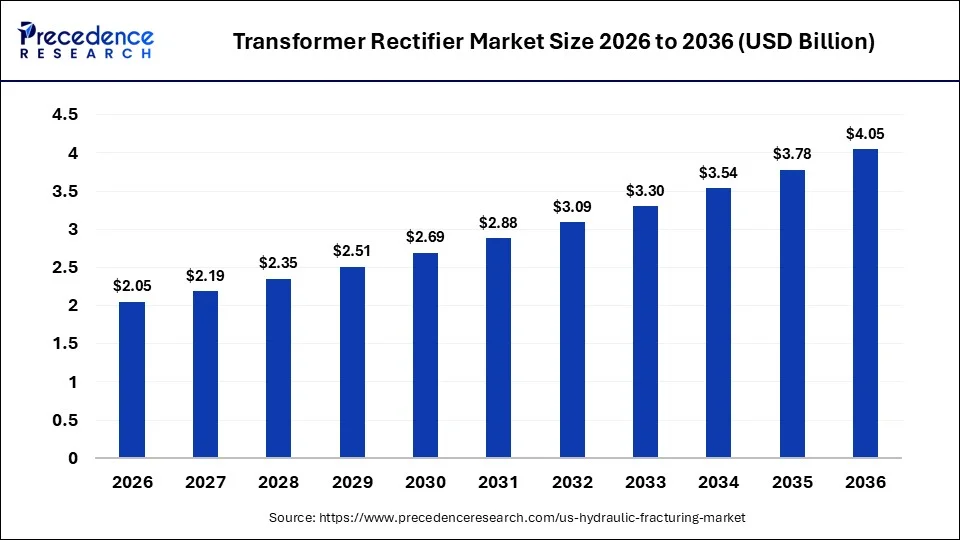
According to energy and power expert Laxmi Narayan, the transformer rectifier market has reached USD 2.05 billion in 2026 and is expected to grow to USD 4.05 billion by 2036, registering a CAGR of 7.05%. The transformer rectifier market companies such as ABB Ltd., Hitachi Energy Ltd., GE Vernova Inc., Specialists are playing a key role in market expansion, with major opportunities emerging across product type, rectifier technology, application, phase configuration, end user, region segments.
Source: https://www.precedenceresearch.com/transformer-rectifier-market
 Get a Sample
 Report Description


Transformer Rectifier Market Analysis, Demand, and Growth Rate Forecast 2036
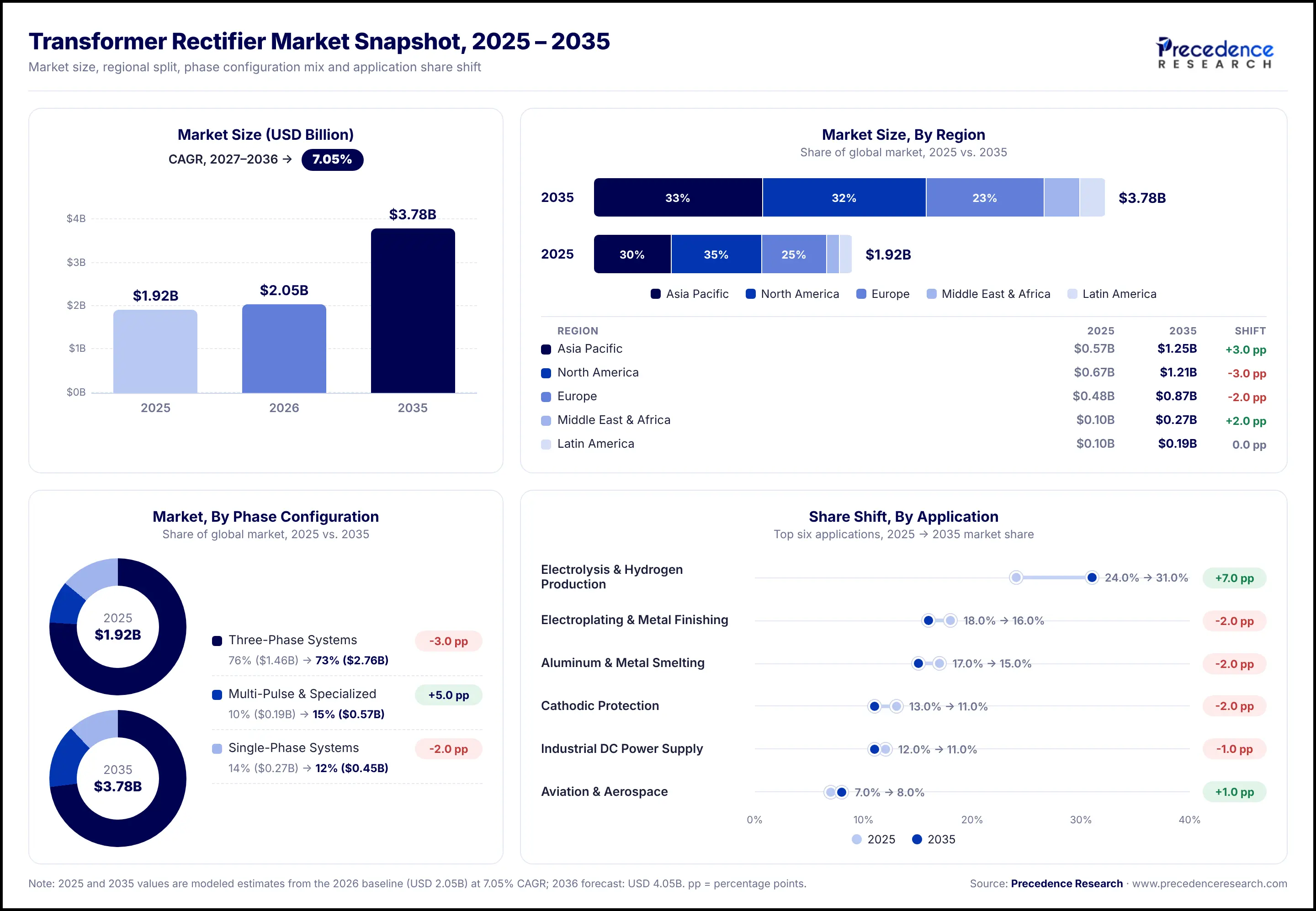
The global transformer rectifier market is expected to reach USD 2.05 billion in 2026 and USD 4.05 billion by 2036, growing at a CAGR of 7.05% from 2027 to 2036.
Key Takeaways
Market Size & Growth Outlook
- Market size in 2026: USD 2.05 billion
- Estimated market size in 2027: USD 2.19 billion
- Projected market size by 2036: USD 4.05 billion
- CAGR (2027–2036): 7.05%
Regional Market Spotlight
- North America market share (2026): 35%
- Asia Pacific market share (2026): 30%
- Europe market share (2026): 25%
Segmental Spotlight
- Oil-immersed transformer rectifiers segment share (2026): 38%
- Silicon-controlled rectifier (SCR) systems segment share (2026): 43%
- Electrolysis and hydrogen production segment share (2026): 24%
Transformer Rectifier Market Size 2026 to 2036
Demand for transformer rectifier units and sets is driven by the need for stable DC power and modernization across multiple industries.
Market Overview
A transformer rectifier, which is often called a Transformer Rectifier Unit or TRU, is an electrical device that combines a transformer and a rectifier circuit into a single system to convert alternating current (AC) power into direct current (DC) power. The expansion of renewable energy grids is propelling the global transformer rectifier market. According to the IEA, inadequate transmission capacity is slowing the clean energy transition, with over 3,000 GW of renewable projects stalled in grid connection queues. Global grid investment must double by 2030, which is expected to support demand for transformer rectifiers (IEA).
Rising capital for infrastructure and green energy also supports demand for transformer rectifier units in emerging economies. HVDC transmission networks improve efficiency and grid stability over long distances, while advances in power electronics optimize energy consumption, strengthen automation, and lower carbon emissions within heavy industries.
Transformer Rectifier Market Trends
HVDC and grid modernization: Long-distance transmission and renewable interconnections need efficient AC-DC conversion, since HVDC loses less power over distance than AC. China's ±1,100 kV Changji-Guquan line, for instance, carries about 12 GW across roughly 3,300 km, moving power from remote western generation to eastern demand centers through large converter stations (Energy, Explained). As more countries link renewable-rich regions to cities, demand for HVDC-grade conversion equipment is expected to rise steadily through 2035.
Aviation and aerospace demand: Rising air traffic, fleet retrofits, and electric propulsion trends are driving demand for lightweight Transformer Rectifier Units (TRUs), which convert aircraft AC power into 28 V DC for avionics, lighting, and flight controls. Boeing 787 and Airbus A350 aircraft, for instance, rely on TRUs from suppliers including Safran, Collins Aerospace, and Astronics, and growing delivery backlogs at both OEMs continue to generate new orders (IATA). As airlines expand fleets and shift toward more-electric aircraft, demand for compact, high-efficiency TRUs will continue to increase.
Digital monitoring and predictive maintenance: Operators are fitting rectifiers with sensors, remote diagnostics, and analytics to track temperature, load, harmonics, and oil condition. This catches insulation wear and component faults early, which matters in continuous-process plants where a shutdown halts production. Systems such as Hitachi Energy's TXpert ecosystem detect problems before failure and allow repairs to be planned for scheduled outages (Hitachi). As unplanned downtime becomes costlier, condition-based maintenance is expected to become a standard element of new rectifier installations.
How is AI Transforming the Transformer Rectifier Market?
Machine learning models trained on temperature, load, harmonic, and oil-quality data can predict insulation wear and component failures before they cause outages. This matters most in continuous operations such as smelters and electrolysis plants, where unplanned downtime is expensive. AI-based control can also adjust output in real time to match variable renewable supply, improving efficiency in green hydrogen systems. In design and manufacturing, AI-assisted simulation shortens development time and optimizes thermal and magnetic performance.
Market Dynamics
Driver
Expansion of green hydrogen and electrolysis capacity
Electrolyzer require large volumes of stable, high-current DC power, which directly drives up demand for transformer rectifier units. Government hydrogen initiatives and industrial decarbonization targets are speeding up project pipelines. Saudi Arabia's NEOM Green Hydrogen Project, for example, is building a 2.2 GW electrolysis plant powered by solar and wind, which requires large-scale rectifier systems to convert AC to DC (Hydro News). Orders for electrolyzer-grade rectifiers will keep rising as more hydrogen projects reach final investment decision.
Restraint
High capital expenditure and complex installation requirements
Large rectifier systems demand considerable investment and specialized engineering expertise, and long lead times add project risk, especially for smaller buyers. Unstable prices for copper and electrical steel, combined with constrained transformer supply, have stretched lead times for large transformers to two to four years, causing utilities and industrial buyers to delay or rescope projects (Reuters). Without added manufacturing capacity, these pressures are likely to slow adoption among price-sensitive buyers.
Opportunity
Smart, efficient, and modular designs
Smart rectifiers with IIoT-based condition monitoring and remote servicing give operators real-time visibility into voltage, current, and temperature from a single platform, as seen in Eltek's Smartpack controllers. Wide-bandgap semiconductors such as silicone carbide and gallium nitride allow faster switching and better thermal performance, and are already used in Infineon's CoolSiC MOSFETs. Modular, compact rectifiers that scale to client needs are also gaining ground. ABB's Terra 360 EV charger, for instance, can add power through additional modules.
- Analyst View: Hydrogen-led demand and grid modernization will underpin steady growth, while supply chain dynamics will dictate how quickly orders become installed capacity. Suppliers offering IIoT-enabled, SiC-based, modular designs backed by reliable delivery and support will find the most traction.
Segmental Analysis
Product Analysis
Oil-Immersed Transformer Rectifiers Led the Market with a 38% Share in 2026
| Segment | Share 2026 (%) | Market Value 2026 |
| Oil-Immersed Transformer Rectifiers | 38% | USD 779.00 Million |
| Dry-Type Transformer Rectifiers | 27% | USD 553.50 Million |
| Air-Cooled Transformer Rectifiers | 21% | USD 430.50 Million |
| Water-Cooled Transformer Rectifiers | 14% | USD 287.00 Million |
Oil-immersed units account for 38% of the 2026 market, valued at USD 779 million, because they handle sustained high-current loads reliably in demanding industrial settings. The insulating oil carries heat away from the windings efficiently and gives the equipment strong overload tolerance, which is why these units are the standard choice for aluminum smelting, chlor-alkali production, and other heavy electrochemical installations. In large electrolysis projects, oil-immersed rectifier transformers are widely specified to supply the stable, high-current DC power that electrolyzer stacks require.
Dry-type units follow with 27%, valued at USD 553.5 million, supported by indoor installations, fire-safety requirements, and compact designs. Air-cooled units account for 21%, valued at USD 430.5 million and appeal to buyers seeking lower-maintenance, modular power systems. Water-cooled units hold 14%, estimated at USD 287 million, and are favored in high-power, continuous-duty operations where thermal management is critical.
- Analyst View: Oil-immersed units will remain the backbone of heavy industrial and hydrogen installations because of their proven reliability under sustained high-current duty. Dry-type and water-cooled units may gain popularity as fire-safety standards and power ratings rise, but oil-immersed designs should hold the largest share through the forecast period.
Rectifier Technology Analysis
Silicon-Controlled Rectifier Systems Capture 43% Share in 2026
| Segment | Share 2026 (%) | Market Value 2026 |
| Silicon-Controlled Rectifier (SCR) Systems | 43% | USD 881.50 Million |
| Diode-Based Rectifier Systems | 22% | USD 451.00 Million |
| IGBT-Based Rectifier Systems | 18% | USD 369.00 Million |
| Thyristor-Based Advanced Rectifier Systems | 12% | USD 246.00 Million |
| Other Rectifier Technologies | 5% | USD 102.50 Million |
SCR systems account for 43% of the market, worth USD 881.5 million, owing to their reliable high-current conversion and presence in established industrial settings. The robust construction and cost-effectiveness of SCR-controlled rectifiers make them ideal for aluminum smelters and chlor-alkali plants, which are appreciated for their long service life and ease of maintenance. Operators often choose to upgrade with the same technology due to the continuous operation of these systems for years.
Diode-based systems hold 22% on the strength of reliable DC supply and simple architecture, while IGBT-based systems hold 18% and are favored for controllability, power quality, and energy efficiency. Thyristor-based advanced systems, valued at USD 246 million, serve high-power electrolysis and demanding industrial processes. Other technologies account for 5% and cover specialized conversion needs and emerging power electronics.
- Analyst View: SCR systems will keep their lead, anchored by the large installed base in heavy industry and hydrogen projects. IGBT-based systems are likely to grow faster as buyers prioritize power quality and efficiency, gradually narrowing the gap in new installations.
Application Analysis
Electrolysis and Hydrogen Production Accounted for a 24% Share in 2026
| Segment | Share 2026 (%) | Market Value 2026 |
| Electrolysis and Hydrogen Production | 24% | USD 492.00 Million |
| Electroplating and Metal Finishing | 18% | USD 369.00 Million |
| Aluminum and Metal Smelting | 17% | USD 348.50 Million |
| Cathodic Protection | 13% | USD 266.50 Million |
| Industrial DC Power Supply | 12% | USD 246.00 Million |
| Aviation and Aerospace | 7% | USD 143.50 Million |
| Rail and Transportation | 5% | USD 102.50 Million |
| Water Treatment and Other Applications | 4% | USD 82.00 Million |
Electrolysis and hydrogen production represent the most significant application of transfer rectifiers, commanding a 24% share valued at USD 492 million. Growth is fueled by green hydrogen initiatives and high-current electrolyzer systems that need consistent DC power, which makes transformer rectifiers essential to plant design. Saudi Arabia's NEOM Green Hydrogen Project, with its 2.2 GW electrolysis plant, illustrates the wider shift toward green technologies and away from fossil fuels (NGHC).
Electroplating and metal finishing follow at USD 369 million, driven by automotive, electronics, and industrial surface treatment. Aluminum and metal smelting is valued at USD 348.5 million, reflecting energy-intensive metallurgical processes.
- Analyst View: Electrolysis and hydrogen production will remain the most influential application, with project approvals and policy support setting the pace of growth. Cathodic protection, aviation, and rail should contribute steadier, less cyclical demand.
Phase Configuration Analysis
Three-Phase Systems Hold More Than Three-Quarters of the Market
| Segment | Share 2026 (%) | Market Value 2026 |
| Three-Phase Systems | 76% | USD 1,558.00 Million |
| Single-Phase Systems | 14% | USD 287.00 Million |
| Multi-Pulse and Specialized Configurations | 10% | USD 205.00 Million |
In 2026, three-phase systems are estimated to dominate the phase configuration segment, holding a 76% market share valued at USD 1,558 million. This prominence is driven by their ability to cater to industrial-scale power requirements and maintain continuous high-load operations. They yield a smoother and better-balanced DC output, allowing for more efficient power utilization compared to single-phase systems, which make up 14% with a value of USD 287 million and are used in smaller installations or low-capacity applications.
Additionally, multi-pulse and specialized configurations constitute the remaining 10% of the market, valued at USD 205 million, and are implemented to reduce harmonics and facilitate high-power electrochemical processes.
- Analyst View: Three-phase systems will remain the standard for heavy industry and hydrogen projects. Multi-pulse designs are expected to expand faster as grid codes tighten harmonic limits and operators work to protect power quality.
End-User Analysis
Metals and Metallurgy Make up 25% of the Market in 2026
| Segment | Share 2026 (%) | Market Value 2026 |
| Metals and Metallurgy | 25% | USD 512.50 Million |
| Chemical and Electrochemical Industries | 22% | USD 451.00 Million |
| Oil and Gas | 15% | USD 307.50 Million |
| Energy and Hydrogen Producers | 14% | USD 287.00 Million |
| Transportation and Aerospace | 9% | USD 184.50 Million |
| Water and Wastewater Treatment | 7% | USD 143.50 Million |
| Other Industrial Users | 6% | USD 123.00 Million |
| Other | 2% | USD 41.00 Million |
Transformer rectifiers were primarily used in the metals and metallurgy industry, accounting for 25% of the market in 2026, valued at USD 512.5 million. This industry uses aluminum smelting, refining, and metal processing, which requires continuous high DC current. Thus, the rectifier systems are critical for the uninterrupted functioning of smelters. Chemical and electrochemical industries hold 22%, supported by electrolysis, chemical production, and industrial DC applications.
Oil and gas accounts for 15%, valued at USD 307.5 million, mainly for pipeline corrosion protection and offshore infrastructure, while energy and hydrogen producers hold 14% amid rising electrolyzer installations and the transition toward a carbon-neutral economy.
- Analyst View: With consistent demand for smelting and refining, metals and metallurgy are expected to be the primary user of transformer rectifiers. As electrolyzer capacity increases, energy and hydrogen producers are anticipated to develop at the highest rate, gradually closing the gap with the bigger and smaller industries.
Regional Analysis
Why Did North America Dominate the Transformer Rectifier Market in 2026?
| Segment | Share 2026 (%) | Market Value 2026 |
| North America | 35% | USD 717.50 Million |
| Europe | 25% | USD 512.50 Million |
| Asia Pacific | 30% | USD 615.00 Million |
| Latin America | 5% | USD 102.50 Million |
| Middle East & Africa | 5% | USD 102.50 Million |
North America Analysis
North America is projected to lead the global market with the support of hydrogen infrastructure, industrial modernization, and corrosion protection requirements. The market is valued at USD 717.5 million in 2026, capturing 35% of the global market. Large pipeline networks, ongoing upgrades of aging industrial plants, and growing electrolyzer projects keep demand for rectifier systems steady across the region.
Asia Pacific Analysis
Asia Pacific follows closely with a valuation of USD 615 million, accounting for 30%, propelled by aluminum production, electrochemical manufacturing, and industrial expansion.
Europe Analysis
The market in Europe is anticipated to be valued at USD 512.5 million, which holds 25% of the global market, backed by industrial decarbonization, electrolyzer deployment, and energy-efficiency investments.
Latin America Analysis
With the rise in the mining and metal-processing industry, Latin America is valued at USD 102.5 million, accounting for 5% of the global market in 2026.
Middle East & Africa Analysis
Novel investment in hydrogen projects, aluminum smelting, and oil and gas infrastructure is projected to support the emerging market in the Middle East & Africa. Thus, the region is able to capture 5% of the global market, with an estimated value of USD 102.5 million in 2026.
Analyst View: North America will keep its lead on the strength of hydrogen investment and infrastructure renewal, though Asia Pacific is positioned to close the gap as smelting and electrochemical capacity expands. The Middle East & Africa starts from a smaller base, but large hydrogen and aluminum projects could make it one of the faster-growing regions.
Company Ecosystem
The transformer rectifier supply chain runs through several stages. It begins with raw materials such as copper, electrical steel, insulation, and magnetic core materials, which are prone to price volatility that affects manufacturers' costs and schedules. Suppliers such as Aurubis AG, Codelco, and thyssenkrupp Materials play a central role here.
Power semiconductors, thyristors, diodes, and control systems come next and drive conversion performance. Infineon Technologies, STMicroelectronics, and Mitsubishi Electric lead this stage, where silicon carbide and IGBT devices are steadily improving energy efficiency. Original equipment manufacturers are the key players in production. ABB, Siemens Energy,
Hitachi Energy, GE Vernova, Toshiba, and Hind Rectifiers design and build units to client specifications, so their production capacity and lead times are critical to the whole chain.
Specialized integrators, including Neeltran, NWL, AEG Power Solutions, and Fuji Electric, produce custom rectifier assemblies with cooling systems and controls for electrolysis, smelting, and plating. Distributors such as RS Group, Rexel, and Graybar purchase finished products and provide technical support, although large industrial and hydrogen projects are often supplied directly by OEMs. End users include aluminum producers, electrolyzer manufacturers, oil and gas operators, electroplating companies, mining firms, and aerospace and rail operators.
- Analyst View: Value is concentrated in the manufacturing and components stages, where scale, technical expertise, and semiconductor access create the strongest barriers to entry. Securing raw materials and shortening lead times will be the main competitive differentiators.
Top 10 Players in Market
- ABB Ltd.
- Siemens Energy AG
- Hitachi Energy Ltd.
- GE Vernova Inc.
- Mitsubishi Electric Corporation
- Toshiba Corporation
- NWL, Inc.
- Neeltran, Inc.
- Hind Rectifiers Limited
- Fuji Electric Co., Ltd.
Competitive Landscape
| Leaders | Strong Challengers |
| ABB Ltd. | Siemens Energy AG |
| Hitachi Energy Ltd. | Mitsubishi Electric Corporation |
| GE Vernova Inc. | Toshiba Corporation |
| Specialists | Emerging / Regional Players |
| NWL, Inc. | Hind Rectifiers Limited |
| Neeltran, Inc. | HIRECT |
| Fuji Electric Co., Ltd. | Raychem RPG |
| AEG Power Solutions | Statcon Energiaa |
The global transformer rectifier market is moderately fragmented, with the top five players holding a combined 34% share, and the remaining 66% is spread across several regional manufacturers and specialist integrators.
ABB Ltd. is positioned as a leader in industrial rectifiers, electrification, and automation, benefiting from its extensive installed base in smelting, chemicals, and hydrogen. In May 2026, the company announced the acquisition of Specialtrasfo S.p.A., an Italian medium voltage transformer manufacturer, which aims to bolster its Motion business area and enhance supply chain resilience and competitive advantage. (ABB)
When it comes to grid technology and large-scale power conversion, Siemens Energy AG is one of the top contenders in the race. To alleviate the supply constraints impacting large units, it is increasing transformer production capacity in the United States, including a proposed factory in Charlotte, North Carolina. (Siemens)
Hitachi Energy Ltd. is investing in transformers and HVDC to boost grid capacity, addressing utility and industrial needs. In partnership with KK Wind Solutions, the company is enhancing European green hydrogen production through the integration of 10 RESIBLOC Dry-type Rectifier Transformers, each with a capacity of 13.3 MVA. These transformers, designed for efficient electrolyzer operation, prioritize safety and compactness while advancing fire safety and mechanical reliability, thus supporting industrial decarbonization and renewable energy adoption. (Hitachi)
Other companies in the market, such as GE Vernova Inc., are expanding through acquisitions, notably the purchase of Prolec GE to enhance its transformer business. Mitsubishi Electric Corporation is investing in silicon carbide power semiconductors. Major players like ABB, Siemens Energy, and Hitachi Energy are pursuing varied strategies, while small companies compete by offering customized solutions and local support.
- Analyst View: The top five are unlikely to consolidate much further, because regional specialists keep winning custom, application-specific projects. Manufacturing capacity, semiconductor access, and delivery lead times will decide who gains share as hydrogen and grid demand grow.
Expert Analysis
The transformer rectifier market is set for steady growth, rising with the heavy demand from different industries. Heavy industry provides a stable demand base, while green hydrogen, HVDC, and grid modernization add new momentum. Oil-immersed and SCR-based systems lead today, but dry-type, IGBT-based, and modular designs should gain share as efficiency and safety expectations rise. Raw material costs and long lead times remain the main risks.
Transformer Rectifier Market Segments
By Product Type
- Oil-Immersed Transformer Rectifiers
- Dry-Type Transformer Rectifiers
- Air-Cooled Transformer Rectifiers
- Water-Cooled Transformer Rectifiers
By Rectifier Technology
- Silicon-Controlled Rectifier (SCR) Systems
- Diode-Based Rectifier Systems
- IGBT-Based Rectifier Systems
- Thyristor-Based Advanced Rectifier Systems
- Other Rectifier Technologies
By Application
- Electrolysis and Hydrogen Production
- Electroplating and Metal Finishing
- Aluminum and Metal Smelting
- Cathodic Protection
- Industrial DC Power Supply
- Aviation and Aerospace
- Rail and Transportation
- Water Treatment and Other Applications
By Phase Configuration
- Three-Phase Systems
- Single-Phase Systems
- Multi-Pulse and Specialized Configurations
By End User
- Metals and Metallurgy
- Chemical and Electrochemical Industries
- Oil and Gas
- Energy and Hydrogen Producers
- Transportation and Aerospace
- Water and Wastewater Treatment
- Other Industrial Users
By Region
- North America
- United States
- Canada
- Mexico
- Europe
- Germany
- United Kingdom
- France
- Italy
- Spain
- Rest of Europe
- Asia Pacific
- China
- Japan
- India
- South Korea
- Australia
- Rest of Asia Pacific
- Latin America
- Brazil
- Mexico
- Chile
- Argentina
- Rest of Latin America
- Middle East & Africa
- Saudi Arabia
- United Arab Emirates
- South Africa
- Egypt
- Other Middle Eastern and African Countries
For inquiries regarding discounts, bulk purchases, or customization requests, please contact us at sales@precedenceresearch.com
Frequently Asked Questions





Ask For Sample
No cookie-cutter, only authentic analysis – take the 1st step to become a Precedence Research client
 Get a Sample




 sales@precedenceresearch.com
 Schedule a Meeting
