



Data Warehouse as a Service Market Size, Key Companies, Company Market Share, User Adoption, Technology Deployment, Revenue Growth, Competitive Positioning, and Demand Forecast
Data Warehouse as a Service Market (By offering type: ETL solutions, Statistical analysis, Data mining; By deployment mode, Cloud, On-premises, Hybrid; By data type: Unstructured, Semi-structured, Structured; By end-user industry: Banking, financial services and insurance (BFSI), Healthcare, It and telecom, Retail, Manufacturing, Government, Media and entertainment) - Global Industry Analysis, Size, Trends, Leading Companies, Regional Outlook, and Forecast 2026 to 2035
Source: https://www.precedenceresearch.com/data-warehouse-as-a-service-market
 Get a Sample
 Table Of Content


What is the Data Warehouse as a Service Market Size?
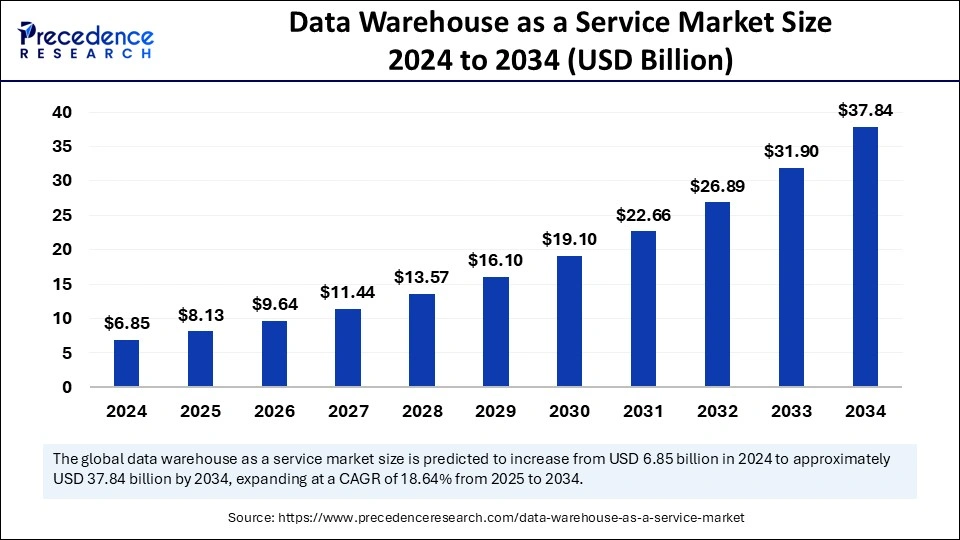
The global data warehouse as a service market size is calculated at USD 8.13 billion in 2025 and is predicted to increase from USD 9.64 billion in 2026 to approximately USD 43.16 billion by 2035, expanding at a CAGR of 18.17% from 2026 to 2035. The data warehouse as a service market propelled due to organizations need scalable cloud data management systems that reduce costs while offering complete data storage solutions.
Market Highlights
- North America dominated the global market with the largest market share around 39% in 2025.
- Asia Pacific is anticipated to witness the fastest growth during the forecasted years.
- By offering type, the ETL solutions segment held a significant share in 2025.
- By offering type, the statistical analysis segment is anticipated to show considerable growth over the forecast period.
- By deployment mode, the cloud segment contributed the largest market share in 2025.
- By deployment mode, the on-premises segment is anticipated to show considerable growth in the market over the forecast period.
- By data type, the unstructured data segment held a significant share in 2025.
- By data type, the semi-structured segment is anticipated to show considerable growth over the forecast period.
- By end-user industry, the BFSI segment dominated the market with the biggest share in 2025.
- By end-user industry, the healthcare segment is anticipated to show considerable growth over the forecast period.
What is Data Warehouse as a Service?
DWaaS allows organizations to handle structured and unstructured data which enables them to merge and transform multiple types of data during real-time analysis. DWaaS operates as a managed service that gives organizations the ability to grow their data warehouses according to demand using fewer resources compared to traditional on-premises solutions. This solution delivers quick and efficient actionable insights through its seamless integration of advanced analytics and automated backup features.
DWaaS stands as an essential digital transformation and business intelligence-enabling technology that enables organizations to manage their strategic operations with data. DWaaS becomes an appealing choice because it provides efficient scalable and cost-effective solutions for data storage processing requirements.
The market demand for flexible data warehousing services increases because organizations need business intelligence and real-time analytics capabilities. DWaaS adoption rates continue to rise due to cloud computing adoption and increasing IoT devices since businesses need adaptable data platform solutions for managing data movements.
Why is AI an Integral Part of the Data Warehouse as a Service?
The data warehouse as a service market experiences a data transformation through artificial intelligence integration which helps organizations better manage and analyze their data. Businesses achieve faster, precise outcomes, automatic data preparation, and anomaly detection through the combination of AI with the market. Through AI-powered DWaaS systems organizations attain superior data administration through enhanced data quality, regulatory adherence, and information security frameworks. Enterprises benefit from AI integration because it enables scalable and efficient operations which make data warehouses adaptable and intelligent.
Data Warehouse as a Service Market Growth Factor
- Adoption of Cloud Computing: The adoption of cloud solutions across multiple businesses helps accelerate the DWaaS market expansion. DWaaS emerges as a fundamental requirement because organizations move to cloud platforms to boost operational performance and reduce expenses thus leading to market growth and heightened demand.
- Demand for Real-Time Analytics: DWaaS platforms deliver accurate actionable time-sensitive insights to users through their analytic tool integration systems. The financial, healthcare and retail industries need real-time data processing for business operations since it directly impacts both the operating speed and industry performance criteria.
- Integration of Complex Data: Organizational needs for efficient processing and analysis of increasing big data volumes drive the market demand. The DWaaS technology solutions focus on handling complex data environments that accumulate large volumes of data through their designed solutions.
Major Trends in the Market for Data Warehouse as a Service (DWaaS)
- Integration of Advanced Analytics and AI/Machine Learning: While DWaaS providers are embedding analytical capabilities, such as artificial intelligence (AI) and machine learning (ML), into their products to provide users with predictive analytics, automated data preparation, and anomaly detection, users will be able to make faster and more accurate decisions because of the tools provided by the overall products.
- Shift to serverless/cloud-native DWaaS: As organizations transition to serverless DWaaS, the cost of maintaining infrastructure is reduced, while users can now benefit from a pay-per-use pricing model that accommodates the user's need for flexibility and operational efficiencies.
- Emphasis on Data Governance and Regulatory Compliance: With the introduction of privacy regulations in many countries, including Europe and the United States, DWaaS vendors are improving their governance framework, tracking the lineage of data, encrypting it, allowing role-based access, and automating compliance.
- Integration of Real-Time Analytics with IoT: Data Companies are integrating real-time data from multiple sources (i.e., IoT and streaming data) into their DWaaS platforms to provide immediate access to data and allow businesses to respond more quickly to market changes.
Data Warehouse as a Service Market Outlook
[[market_outlook]]
Market Scope
| Report Coverage | Details |
| Market Size in 2025 | USD 8.13 Billion |
| Market Size in 2026 | USD 9.64 Billion |
| Market Size by 2035 | USD 43.16 Billion |
| Market Growth Rate from 2026 to 2035 | CAGR of 18.17% |
| Dominated Region | North America |
| Fastest Growing Market | Asia Pacific |
| Base Year | 2025 |
| Forecast Period | 2026 to 2035 |
| Segments Covered | offering type, deployment mode, data type, end-user industry, and Regions |
| Regions Covered | North America, Europe, Asia-Pacific, Latin America and Middle East & Africa |
Market Dynamics
Drivers
Adoption of Cloud-Based Solutions
DWaaS market growth results from growing business interest in cloud-based operational systems. The cloud transition of organizations' data infrastructure occurs quickly to obtain better scalability features and operational cost reduction while keeping fast response times. This implementation speed and tool connection ease and instant data access reported through DWaaS cloud delivery enhance operational speed and improve decision performance. DWaaS functions as a fundamental element of modern data strategies since companies embrace cloud solutions at higher speeds thus driving substantial transformation within data warehousing systems.
Restraint
Data Security Concerns
Data security concerns function as a substantial obstacle that hampers the expansion of the Data Warehouse as a Service market. Data security concerns become more critical because organizations face obstacles with compliance violations and regulations that require complex implementation. The essential implementation of security measures which include data encryption with masking features and secure access protocols proves costly because it requires extensive resources primarily affecting small to medium-sized businesses.
Opportunity
Disaster Recovery and Backup
DWaaS solutions deliver key operational features that use backup and disaster recovery systems to protect enterprise data assets. The platform features to protect information from hardware failure and cyber threats alongside natural disasters through robust recovery functionalities. The regulatory requirements as well as data integrity benefit from built-in protection systems that provide extensive operational advantages. DWaaS providers actively pursue enterprises in need of comprehensive solutions that guarantee a continuous operational system and rapid recovery as well as minimal disruption to services.
Segment Insights
[[segment_insights]]
Regional Insights
[[regional_insights]]
Value Chain Analysis of Data Warehouse as a Service Market
- Data Ingestion/Integration Layer: Ingesting/Integrating involves taking raw information from various sources, converting it to an acceptable format (ETL/ELT), and loading it into the DWaaS environment. To streamline this stage of the value chain, providers utilize automation tools to ingest and integrate data in real time, as well as to create data catalogs.
Key Players: Fivetran, Talend, Informatica. - Cloud Computing & Storage Provisions: Cloud storage & compute provisioning provide businesses with scalable storage and resilient data management, backed up by elastic compute capabilities on request. Businesses can quickly expand their computer resources without incurring high initial costs. With the combination of storage and compute, organizations can run many queries at once and perform advanced analytics and processing of data to gain value from it.
Key Players: AWS (Redshift), Google Cloud (BigQuery), & Microsoft Azure Synapse - Analytics and BI Enablement: Analytics involves converting the ingested/integrated data from the DWaaS environment into actionable insights that can be used by business users, data scientists, and analysts to identify patterns, forecast future results, and improve data-driven decision making.
Key Players in Analytics: Snowflake, Tableau (Salesforce), Power BI (Microsoft)
Recent Developments
- In September 2025, Imply launched Imply Lumi. Imply Lumi is an advanced warehouse service designed for the industrial sector.
(Source:businesswire.com) - In July 2025, Armanino launched an AI-enabled warehouse service. This service is designed for small organizations in the world.
(Source: accountingtoday.com) - In June 2025, IBM launched Db2 Warehouse. This DB2 is a warehouse SaaS that provides numerous benefits, including compliance and security, monitoring and auditing, data co-location, infrastructure efficiency, scalability and elasticity, managed services, and others.
(Source: ibm.com) - In October 2023, mParticle launched ComposeID as its newest technology through ongoing product development cycles that aid cloud data warehouse infrastructure operations. New customers can begin their Identity Resolution journey with Mparticle's enterprise-grade framework IDSync through the available free version of ComposeID service.
- In October 2023, IBM presented Storage Scale System 6000 aimed to enhance IBM's market dominance through its advanced high-performance parallel file system intended for intensive data applications. System performance offers 7M IOPs together with up to 256GB/s read-only workload throughput across 4U (four rack units) dimensions.
- In August 2023, FUJIFILM Corporation and IBM established to create a 50TB native tape system. Fujifilm currently manufactures high-density tape cartridges used for the TS1170 enterprise tape drive developed by IBM. The sixth-generation IBM 3592 JF tape cartridge achieves higher data storage capacity through innovative technology that contributes to its capabilities. The technology depends on microscopic hybrid magnetic particles to function.
Data Warehouse as a Service Market Companies
[[market_company]]
Other Major Key Players
- Oracle Corporation
- Micro Focus International PLC
- Snowflake Computing, Inc.
- Veeva Systems, Inc.
- Yellowbrick B.V.
Segments Covered in the Market
[[segment_covered]]
For inquiries regarding discounts, bulk purchases, or customization requests, please contact us at sales@precedenceresearch.com
Frequently Asked Questions





Ask For Sample
No cookie-cutter, only authentic analysis – take the 1st step to become a Precedence Research client
 Get a Sample




 sales@precedenceresearch.com
 Schedule a Meeting
